Skip to content
The Quadriga on top of the Brandenburg Gate in Berlin at dusk: the goddess in her four-horse chariot, holding the Iron Cross and Prussian eagle

Berlin Experiences/Featured Experiences

Brandenburg Gate: Visit Berlin’s Landmark, from Napoleon to the Wall

Take the former royal route into the heart of Berlin.

The short answer

The Brandenburg Gate (Brandenburger Tor) is Berlin’s 18th-century city gate, built by Carl Gotthard Langhans in 1788–91 and crowned by Johann Gottfried Schadow’s Quadriga. It stands on Pariser Platz at the western end of Unter den Linden in Berlin-Mitte, three minutes’ walk from S+U Brandenburger Tor. It is free and open at all hours, and you can walk through all five passages. Allow 15–30 minutes, more if you look into the Room of Silence in the north gatehouse (daily 11:00–18:00). From 1961 to 1989 it stood in the border zone of the Berlin Wall, closed to everyone.

Where
Pariser Platz, 10117 Berlin-Mitte, at the west end of Unter den Linden
Open
Always: you can walk through at any hour
Admission
Free, including the Room of Silence
Time needed
15–30 minutes
Nearest station
S+U Brandenburger Tor, 3 minutes on foot
Step-free
Yes: level paving through all five passages

The story · by Matt Robinson

There is no more meaningful way of entering Berlin’s historic Mitte district than to walk through the central reservation of the Brandenburg Gate.

This glorious twelve-column neo-classical monument – inspired by the Propylaea entrance to the Acropolis in Athens – was erected by the Prussian Hohenzollern monarchy in 1791 as a dramatic ceremonial entrance – a ‘Peace Gate’ (Friedenstor) – into the capital of the Kingdom of Prussia.

It replaced an earlier structure that had been integrated into Berlin’s customs wall – and is the only entrance remaining of the eighteen that once surrounded Old Berlin (Alt-Berlin). Until the abdication of the last German Emperor, William II, in 1918, the use of this gateway was strictly regulated. With commoners only permitted to use the outer two lanes either side – and the central passage reserved, almost exclusively, for royalty.

Now, more than 200 years after its construction, the Brandenburg Gate is open to all – a recognisable icon of the German capital used by thousands of people daily to cross between the two squares of Platz des 18. März (on the west side) and Pariser Platz (on the east).

The Brandenburg Gate in Berlin from a low angle at dusk, its Doric columns floodlit and the Quadriga on top
Twelve Doric columns, five passages.

The symbolic shift in the use of this iconic entranceway – and the central passage in particular – was made possible only through a series of significant events in Germany’s stormy past. As this monument played silent witness to the development of Berlin; and as a constant station on the country’s treacherous route to parliamentary and federal democracy.

Beginning with its peculiar origin story.

The Peace Gate and Napoleon

The ‘peace’ this gate was said to originally stand for was unquestionably more a matter of coercive pacification. The kind of peace that is granted by a victor. As Prussian King Frederick William II, in alliance with his sister, Wilhelmine of Orange, forcibly brought harmony to the Republic of the United Netherlands – through the use of invading troops.

The kind of peace that is granted by a victor.

This convenient distortion would set the stage for the calamities the Gate would endure through the turbulence of future events – as subsequent rulers and regimes took to integrate this monument, both geographically and as a recognisable icon, into their own narratives. And the Gate languished in the long shadow of its radix malorum – its fons et origo – the troublesome original sin.

With the unwelcome arrival of Napoleon Bonaparte to the city on October 27th 1806, Berlin would lamentably be forcibly pacified by occupying French forces – a mere fifteen years after the completion of this passageway. The French Emperor entered the city without a shot fired – through the ‘Peace Gate’ – following the routing of Prussian forces in the twin battles of Jena & Auerstedt.

His success brought about not only the temporary removal of the four horse-drawn chariot – the pale-verdigris-green Quadriga – atop of the Gate (briefly taken as war booty to Paris before being recovered after Napoleon’s defeat), but a critical reassessment of continental order.

Crown, commoners and the torches of 1933

The enthusiastic early idealism of the French Revolution that had inadvertently led to the installation of the ‘General of the 18th Brumaire’ would be revisited following Napoleon’s defeat.

Starting in France, in 1848, mass public protests swept through Austria and other states before reaching Berlin, in March of that year. As demonstrators formed barricades across the city, the Brandenburg Gate became a symbolic choke point in the battle between commoner and crown.

The tenets of Prussian enlightened absolutism though would continue – with the central passage remaining accessible only to the monarch, plus the remarkable addition of a Prussian General, Ernst von Pfuel (and his family), responsible for returning the Quadriga from French captivity in 1814. The square on the west side of the Gate has been known as Platz des 18. März since June 2000 – after the most significant date of the 1848 protests – although originally it was for a long time simply named Platz vor dem Brandenburger Tor (the square before the Brandenburg Gate).

Street sign for Platz des 18. März in front of the columns of the Brandenburg Gate, Berlin
Platz des 18. März, on the west side of the gate.

The square on the eastern side of the Gate – originally simply called the Square or Platz – has been known as Pariser Platz since Napoleon’s defeat.

Not only had Napoleon’s forces marched through the Gate onto this square in 1806, but following the French Emperor’s defeat a triumphant procession would pass through the arches of the Brandenburg Gate and onto Pariser Platz as the stolen Quadriga was returned. The Prussian victories in the Wars of Unification of the late 1800s brought similar fanfare and later in 1914 soldiers departing westwards – towards the bloodshed and misery of trench warfare in the fields of France and Belgium – would pass through the Gate to attend to their tragic appointments.

It was also here that the National Socialists would celebrate Adolf Hitler’s appointment as German Chancellor with a theatrical torch-lit procession of SS, SA, and men of the ‘Stahlhelm’ veterans’ organisation marching through the Brandenburg Gate – on January 30th 1933.

Divided and reopened

Following the abdication of the German Emperor in 1918 – at the end of the First World War – the central passageway of the Brandenburg Gate was opened for regular city traffic. The partition of Berlin, in 1945 – at the end of the Second World War – meant that the Gate would eventually fall under Soviet control, as the Soviet Union was tasked with administering the central district of Mitte.

View through the passages of the Brandenburg Gate from the west towards Pariser Platz and Unter den Linden, Berlin
Looking east through the gate to Pariser Platz.

It was during this period that the flow of traffic through the central arch was restricted; until it was completely stopped with the construction of the Berlin Wall in 1961. For more than 28 years following the construction of the Wall, the Gate remained inaccessible – stranded in the middle of the notorious East German ‘Death Strip’.

The ‘Fall of the Wall’ in November 1989 finally granted the people of the city full access to the Brandenburg Gate. The result of what in Germany is now often referred to as the ‘Peaceful Revolution’. As not only would the calls for changes in the policies of the government of the German Democratic Republic and the division of the country be expressed using peaceful means – but the East German regime would wither away without resorting to violence in its dying throes. Perhaps the true moment of redemption for the Gate – and the part it played in that peaceful episode of German history.

Through all the changes that have happened around it, the Brandenburg Gate still stands on Pariser Platz – as a symbol of the city’s tumultuous past and an historic landmark for all to visit today.

The monarchy has fallen, the Junkers aristocracy gone. Germany’s imperial ambition contained – and, at no small expense, National Socialism defeated. The frontier is open.

The frontier is open.

With only the horizon to stand as a measure of your exploration here.
The Brandenburg Gate in detail

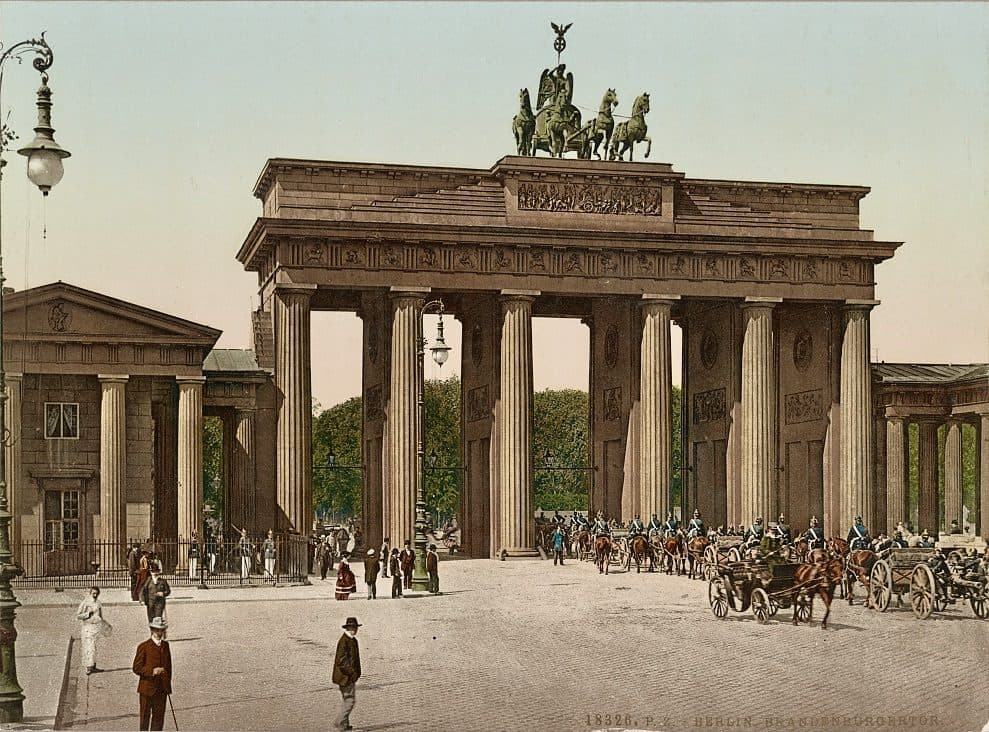
The Brandenburg Gate seen from Pariser Platz around 1900, with horse-drawn carriages, soldiers on horseback and the old gatehouses
The gate from Pariser Platz, around 1900. Photo: Unknown author / Public domain, via Wikimedia Commons

Langhans’s gate and Schadow’s Quadriga

Carl Gotthard Langhans, head of the Prussian royal building office, modelled the gate on the Propylaea, the entrance to the Acropolis in Athens, and built it in sandstone in 1788–91. Two rows of six Doric columns form five passages. The central one, wider than the rest, was kept for the royal family; reliefs on the passage walls show the labours of Hercules, and the low gatehouses at either end housed the guard and the customs collectors.

Schadow’s Quadriga went up in 1793: a goddess driving a four-horse chariot into the city, hammered from copper sheet rather than cast in bronze. When it came back from Paris in 1814, Karl Friedrich Schinkel gave her a new staff carrying an Iron Cross in an oak wreath, topped by the Prussian eagle, turning a symbol of peace into one of victory over Napoleon.

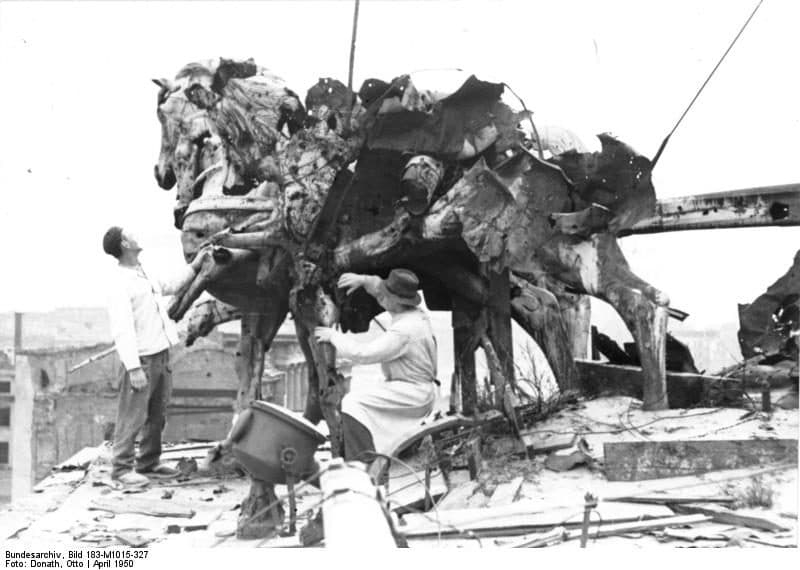
The wrecked Quadriga on the roof of the Brandenburg Gate in Berlin in April 1950, with two people inspecting the shattered horses
What was left of the Quadriga, April 1950. Photo: Bundesarchiv, Bild 183-M1015-327 / Donath, Otto / CC-BY-SA 3.0

Shot to pieces, recast across the border

The gate survived the Second World War standing but scarred, its columns pitted by bullets and shell splinters. The Quadriga was all but destroyed: one horse’s head is all that survives of the original, now in the Märkisches Museum. In 1950 the twisted wreck was still on the roof, on the edge of the Soviet sector, looking out over the British one.

In 1956 the East Berlin authorities decided to restore the gate. The new copper Quadriga was made from plaster casts taken in 1942, at the Hermann Noack foundry in West Berlin’s Friedenau, finished in December 1957 and set on the eastern gate in 1958. On the night of 2–3 August 1958 the East German authorities removed the Iron Cross and the Prussian eagle. Both went back on when the Quadriga was restored after reunification, in 1991.

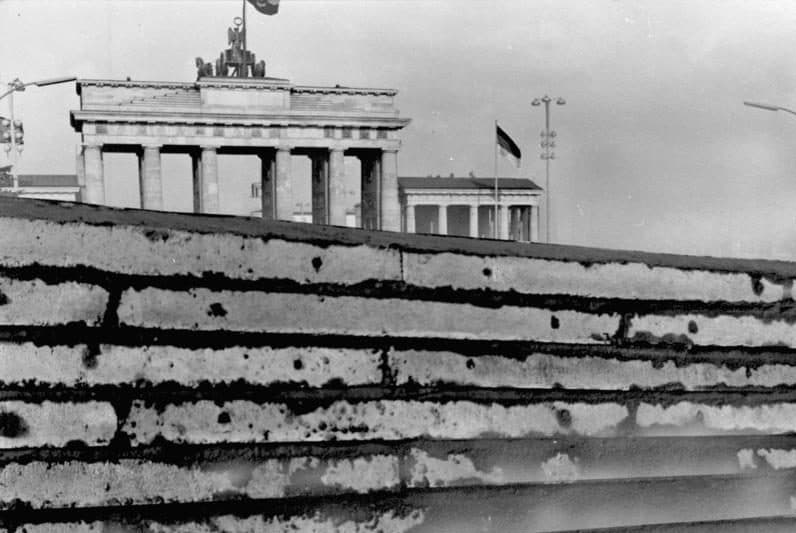
The Berlin Wall in front of the Brandenburg Gate in November 1961, with the East German flag flying over the Quadriga
The Wall in front of the gate, November 1961. Photo: Bundesarchiv, Bild 183-88222-0002 / Sturm, Horst / CC-BY-SA 3.0

In the border zone, 1961–89

When East Germany sealed the border on 13 August 1961, the Brandenburg Gate stayed open as a crossing for one more day; the East Berlin police closed it on the afternoon of 14 August. The Wall did not run through the gate but across the square in front of it, on the western side, so the gate stood just inside East Berlin, in a restricted zone closed to East and West Berliners alike. When John F. Kennedy came to look over the Wall here in June 1963, red banners were hung between the columns to block his view.

On 12 June 1987 Ronald Reagan stood on the western side and called on Mikhail Gorbachev to ‘open this gate’. After the Wall opened on 9 November 1989, crowds climbed the Wall in front of the gate, but the gate itself only opened as a crossing on 22 December 1989, when Chancellor Helmut Kohl walked through to be greeted by East Germany’s prime minister, Hans Modrow.

Plan your visit

Visiting the Brandenburg Gate

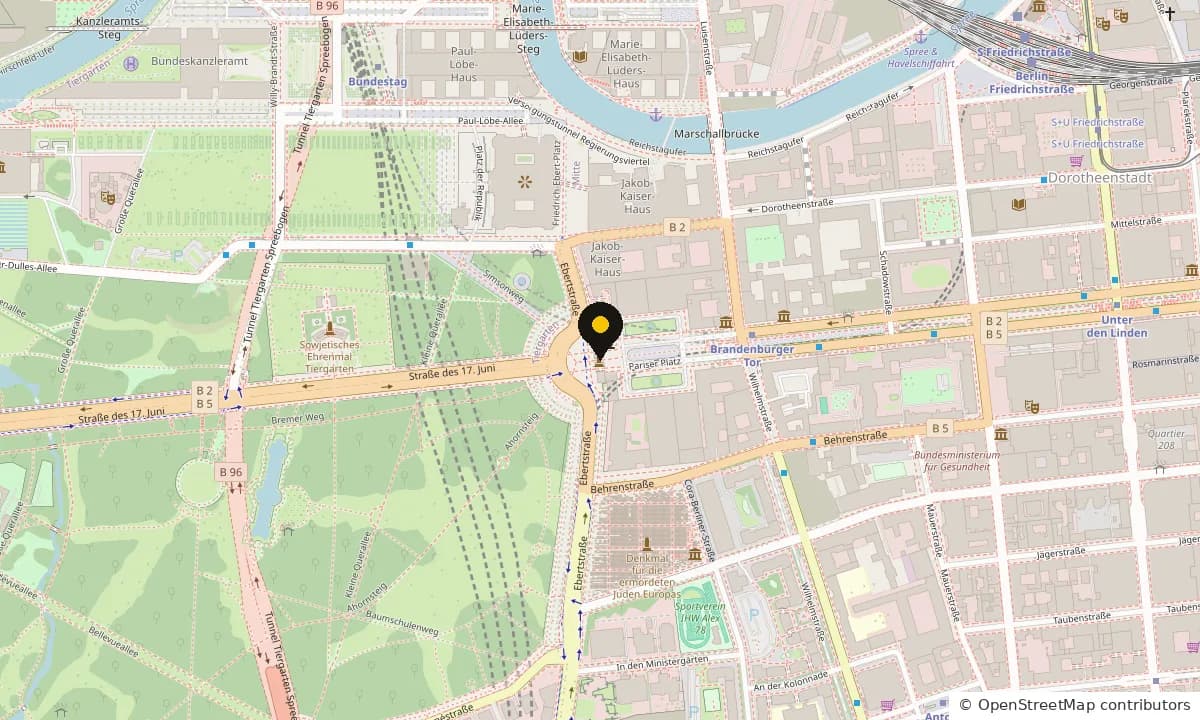
Map of the streets around the Brandenburg Gate, with a pin on the siteOpen in Google Maps

Pariser Platz, 10117 Berlin · Open 24 hours, every day. Room of Silence (north gatehouse): daily 11:00–18:00

Getting there

  • S1S2S25S26U5Brandenburger Tor250 m · 3 min

    Take the exit to Pariser Platz; the gate closes off the western end of the square.

  • S1S2S25S26U2Potsdamer Platz850 m · 11 min

    Walk north up Ebertstraße past the Holocaust Memorial; you reach the west side of the gate first.

  • U5Bundestag800 m · 11 min

    Walk south past the Reichstag: an easy way to combine the two.

What you’ll see

  • The gate itself: twelve Doric columns forming five passages, twenty reliefs of the labours of Hercules inside them, and Schadow’s Quadriga facing east into the city, with the Iron Cross and eagle put back in 1991.
  • The two gatehouses at either end: the Room of Silence in the north wing and a Berlin Tourist Info in the south wing.
  • On the west side, a double row of cobblestones set into the road marks where the Wall ran in front of the gate; on the east side, the rebuilt Pariser Platz with the Hotel Adlon and the French and US embassies.

Tips from a guide

  • Come early in the morning or after dark. Before about 09:00 the square is quiet enough for photos without crowds, and at night the gate is floodlit.
  • Walk through from west to east, starting on Platz des 18. März: that was the old royal route into the city, and it brings you out facing Pariser Platz and Unter den Linden.
  • Around New Year’s Eve, the Berlin Marathon and other big events, the area west of the gate is fenced off for days. Check before you go if your dates are close.

Accessibility

Pariser Platz, Platz des 18. März and all five passages are level and paved; the cobbled strip marking the Wall is the only uneven surface. Check the BVG website for lift status at S+U Brandenburger Tor. The Room of Silence is in the north gatehouse at street level; ask there about step-free access.

Timeline

From royal gate to symbol of unity

  1. 1788–91Carl Gotthard Langhans builds the gate in the customs wall for Frederick William II.
  2. 1793Johann Gottfried Schadow’s Quadriga is set on top.
  3. 27 Oct 1806Napoleon rides through the gate; the Quadriga is taken to Paris as booty.
  4. 1814The Quadriga returns; Schinkel adds the Iron Cross and the Prussian eagle.
  5. 18 Mar 1848Barricades go up across Berlin in the March Revolution.
  6. 30 Jan 1933A torch-lit parade through the gate celebrates Hitler’s appointment.
  7. 1945The gate is left scarred and the Quadriga all but destroyed.
  8. 1958A new Quadriga, cast in West Berlin, goes up; East Berlin removes the cross.
  9. 14 Aug 1961The crossing is closed; the gate stands in the Wall’s border zone.
  10. 12 Jun 1987Ronald Reagan: ‘Mr Gorbachev, open this gate!’
  11. 22 Dec 1989The gate reopens; Helmut Kohl walks through to meet Hans Modrow.
  12. 3 Oct 2002Unveiled after a 22-month restoration; closed to motor traffic in 2002.

See it with a historian

Tours that stop at the Brandenburg Gate

Anyone can walk through the gate; a guide can show you where the Wall ran, where Napoleon and the torchlight parade passed, and what the reliefs and the Quadriga mean.

One hour from the Brandenburg Gate through Berlin’s history, the quickest way to get your bearings.

The Berlin Intro Tour
One Hour1 Hour

The Berlin Intro Tour

Private 1-hour walking tour of Berlin's main historic sites for up to 10 people. Starts at Pariser Platz by the Brandenburg Gate.

€200up to 10
View Tour

The divided city, from the gate in the death strip to the cracks in the Wall.

The Cold War Tour
One Hour1 Hour

The Cold War Berlin Tour

Private 1-hour walking tour of Cold War Berlin's border sites for up to 10 people. Starts by the Berlin Wall segments on Potsdamer Platz.

€200up to 10
View Tour

A full day from Prussian kings to reunification, with the gate as one chapter of many.

The Berlin History Tour
Full Day6 Hours

The Berlin History Tour

Private 6-hour van tour of Berlin's whole history in one day for up to 6 people. Starts at your hotel or anywhere in the city.

€1,000up to 6
View Tour

Questions visitors ask

Frequently asked questions

Is the Brandenburg Gate free to visit?

Yes. The gate stands on a public square and you can walk through it at any hour, every day, without a ticket. The Room of Silence in the north gatehouse is free too.

Can you walk through the Brandenburg Gate?

Yes, through all five passages, including the central one that was once kept for the royal family. The gate has been closed to cars since 2002, so it is a pedestrian space.

Can you go inside or on top of the Brandenburg Gate?

There is no public access to the roof or the Quadriga. You can go into the north gatehouse, which holds the Room of Silence (daily 11:00–18:00), and the south gatehouse, which has a Berlin Tourist Info.

Was the Brandenburg Gate part of the Berlin Wall?

Not quite. The Wall ran across the square in front of the gate on its western side, so the gate stood just inside East Berlin, in the closed border zone. From 14 August 1961 until 22 December 1989 nobody could walk through it.

Was the Brandenburg Gate in East or West Berlin?

East Berlin. It was in the Soviet sector, on the edge of Mitte; the Tiergarten on its western side was in the British sector, which is why the Wall ran just west of the gate.

What is on top of the Brandenburg Gate?

The Quadriga, a goddess driving a chariot pulled by four horses, designed by Johann Gottfried Schadow in 1793. Napoleon took it to Paris in 1806; today’s copper version was made in 1957–58 from casts of the original.

When is the best time to visit the Brandenburg Gate?

Early morning, before about 09:00, when Pariser Platz is quiet, or after dark, when the gate is floodlit. Around New Year’s Eve and big events the western side is fenced off, so check before you go.

How do I get to the Brandenburg Gate?

Take the S-Bahn (S1, S2, S25, S26) or the U5 to Brandenburger Tor station; the gate is a 3-minute walk from the Pariser Platz exit. From Potsdamer Platz it is about 11 minutes’ walk north along Ebertstraße.

Keep exploring

More Featured Experiences.

Every site we write about — 56 landmarks, museums, memorials and lesser-known corners of Berlin. See the full index →

02Explore The State Museums On Museum Island03Visit The Berlin TV Tower – The Fernsehturm04Cross The Cold War Border At Checkpoint Charlie05Visit The Site Of Adolf Hitler’s Führerbunker06Explore The Reconstructed Berlin Palace07Visit The Reichstag Cupola At Night08Explore The Forum Fridericianum09Shop At The Humboldt University Book Sale10Journey Into The Memorial To The Murdered Jews Of Europe11Step Inside The Neue Wache12Explore The Former Jewish Quarter – Spandauer Vorstadt13Visit The Remains Of The Berlin Wall14Walk Across The Bridge Of Spies15Explore The Topography Of Terror16Climb The Prussian Victory Column – The Siegessäule17Enter The Palace Of Tears – The Tränenpalast18Step Inside The Berlin Olympic Stadium19Explore Erich Mielke’s Office At The Stasi Museum20Walk Along Karl Marx Allee21Visit The Oldest Church In Berlin – The Nikolaikirche22Explore The Berliner Dom23Visit The Grave Of Frederick The Great24Walk Through The Ruins Of Anhalter Bahnhof25Stand On The Platz Des Volksaufstandes26Visit The German Resistance Museum27Visit The Soviet War Memorial In The Tiergarten28See The Georg Elser Memorial On Wilhelmstrasse29Step Inside The Kaiser Wilhelm Gedächtnis Kirche30Visit The Gleis 17 Memorial31Visit The Schloss Charlottenburg Mausoleum32Climb The Französischer Dom at Gendarmenmarkt33Explore The Interbau – IBA 5734Explore The Otto Weidt Workshop35Visit Cecilienhof – Site Of The Potsdam Conference36Visit The Stasi Prison In Hohenschönhausen37Spend The Day At Tempelhof Airport38Ride The Fastest Elevator In Europe39Visit The Soviet War Memorial In Treptower Park40Visit The Sachsenhausen Concentration Camp Memorial41Visit The Ravensbrück Concentration Camp Memorial42Visit Karlshorst – The Site Of The German Surrender43Visit The Socialists Cemetery – Zentralfriedhof Friedrichsfelde44Visit The Soviet War Memorial In Pankow45Visit the Seelow Heights Memorial46Visit The Commonwealth War Cemetery47Cross The Bösebrücke At Night48Explore The Allied Museum In Dahlem49Explore The Spandau Citadel50Visit The Brandenburg T4 Euthanasia Memorial51Visit The Wannsee Conference House52Visit The Jewish Museum53Visit The Jewish Cemetery In Weissensee54Walk Along The East Side Gallery55Explore The Volkspark Friedrichshain Flak Tower56Head Up The Teufelsberg