Skip to content
Sign at the Führerbunker: the information board on Gertrud-Kolmar-Straße in Berlin, with the East German flats behind

Berlin Experiences/Featured Experiences

Hitler’s Bunker: Visit the Site of the Führerbunker

The Nazi leader’s subterranean sanctuary and final command centre.

The short answer

Hitler’s Führerbunker was under the garden of the Reich Chancellery, at today’s corner of In den Ministergärten and Gertrud-Kolmar-Straße in Berlin-Mitte, a few minutes’ walk from Potsdamer Platz and the Brandenburg Gate. You cannot go inside: what survived Soviet and East German demolition was destroyed or filled in during building work in 1988–89. Today a car park and apartment blocks stand over it, and the only marker is an information board put up in 2006. It is outdoors, free and open at all hours.

Where
Corner of In den Ministergärten and Gertrud-Kolmar-Straße, 10117 Berlin-Mitte
Open
Always: an outdoor information board on a public street
Admission
Free
Time needed
10–15 minutes
Nearest station
U2 Anton-Wilhelm-Amo-Straße, 4 minutes on foot
Step-free
Yes: the board is at street level
With a guide
The site is a stop on the one-hour Third Reich Tour of the old government district. See the Third Reich Tour →

The story · by Matt Robinson

The final days of Nazi leader Adolf Hitler’s life – and his unceremonious end – still fascinate and confound, perhaps in equal measure.

To any students of history familiar with the events of Germany’s tumultuous past, the idea that one of the most hated despots to have ever lived would die by his own hand – contrary to any glorious end he may have desired or the cold justice he deserved – seems ironic at best, perhaps even darkly comical in its absurdity. His death in the concrete Führerbunker would come to symbolise the end of one of the bloodiest wars in human history – even though the capitulation of Nazi Germany would not take place until eight days later. So great was the personality and myth surrounding this one man.

His role, cast as the central figure responsible for orchestrating the continental downfall of Europe, seems assured. His legacy – while not as resplendent as he may have desired – has meant that his name will go down in history for future generations as a byword for evil.

Hitler’s Führerbunker site in Berlin: the information board beside the car park
The information board, put up in 2006.

But the earthly end of this caricature madman could not have been more human. Flawed, desperate, and petulant. Punctuated by a suicide – and a hastily performed funeral.

One involving a pyre of dirt and kerosene – in the garden of the New Reich Chancellery.

1933: Hitler takes power

The event widely acknowledged as signalling the moment the Nazi party seized power in 1933 came on January 30th – as party leader, Adolf Hitler, was appointed Chancellor by ailing President Paul von Hindenburg. The musical chairs of German politics of the 1920s and 30s had resulted in the fall of countless governments – and Chancellors and cabinets vested with power only to see it snatched from their hands within weeks or days.

Hitler’s appointment as Chancellor on January 30th was far from inevitable – and uncertain up until the minute of his confirmation. It would take less than a month for the Nazi party to confirm that the jitterbug swing of the Weimar era be replaced by a jackbooted march to the sound of a different drum.

…a jackbooted march to the sound of a different drum.

Following a fire in the German parliament, on the night of February 27th 1933, emergency measures were introduced to suspend civil liberties and allow the Nazis – as the leading political element – to crack down on opposition. Imprisoning and torturing politicians, suppressing dissenting voices, and closing down publications deemed a threat to public good. All in a move towards establishing a single party state – one where all roads would lead to one man, Adolf Hitler.

The passing of the Reichstag Fire Decree (or Decree of the Reich President for the Protection of People and State as it was officially known), issued on February 28th 1933, would provide the legal basis for these actions.

When the so-called Enabling Act (officially the “Law to Remedy the Distress of People and Reich”) passed in parliament on March 23rd 1933, plenary powers would be effectively devolved to Adolf Hitler – in his role as Chancellor and head of cabinet. Leaving the Nazi leader now able to issue laws without parliamentary oversight, thus transforming Germany into a legal dictatorship overnight.

The Reich Chancellery

On assuming power, Hitler had inherited an office on the Wilhelmstrasse government street. The Reich Chancellery was actually a former city palace built for the Polish Prussian prince Antoni Radziwiłł who had married the niece of King Frederick the Great.

Designated as the future Führer’s official address, its dimensions and decoration – those ‘fit for a soap company’ – would do little to satisfy the Nazi leader’s desire to impress on visitors the power and grandeur of the kind of German Reich he envisioned. Despite the enlargement of the Chancellery and the addition of an underground Vorbunker air raid shelter in 1936 – it was deemed wholly inadequate to the Führer’s needs.

…its dimensions and decoration – those ‘fit for a soap company’ – would do little to satisfy the Nazi leader…

In 1938, construction began on an enlarged New Reich Chancellery, on the adjacent Vossstrasse, designed by Albert Speer – the ‘first architect of the Third Reich’ and future Minister of Armaments. Both Speer and Hitler would later work on plans to transform Berlin into the world capital, Germania.

Keeping with Hitler’s insistence on monumental design, Speer would oversee the construction of a huge court of honour (Ehrenhof), where visitors would be greeted by two statues from sculptor, Arno Breker, named “Wehrmacht” and “Partei” (“Armed Forces” and “Party”). Passing through double doors measuring 17 feet high, and along a gallery 145 m (480 ft) long – twice that of the Hall of Mirrors in Versailles – diplomats and dignitaries would reach Hitler’s cavernous 400m2 office suitably reassured that they were in the presence of one of the most powerful leaders on the planet.

The Führerbunker

As the Second World War began in 1939, Hitler would increasingly spend less and less time in Berlin – choosing to remain at his military command posts, such as the Wolf’s Lair, or holiday home of the Eagle’s Nest. Anglo-American air raids on the Nazi capital would eventually force the construction of a permanent air raid shelter in the gardens of the Old and New Reich Chancellery – in addition to the Vorbunker completed in 1936.

Site of the Führerbunker in Berlin today: the car park over the bunker, with the flats behind
The site of the Führerbunker today.

When finished in 1944, this new subterranean accommodation – known as the Führerbunker – would be where Hitler would spend his final days, after arriving in Berlin from his western headquarters on January 16th 1945. This complex (both Vorbunker and Führerbunker) consisted of a collection of around 30 rooms, with the Führerbunker 8.5m underground and built with a concrete roof almost 3 metres thick.

Here in the damp and sparsely furnished interior of this concrete hideaway, Hitler would orchestrate the downfall of the capital of the Third Reich, marry his mistress – Eva Braun – on April 29th 1945, and one day later, commit suicide.

What remains today

The remains of both the Vorbunker and Führerbunker were flooded and eventually destroyed by the Soviet and East German authorities. The ruins of the Old and New Reich Chancellery buildings were cleared in the years after 1945, the Soviets failed to blow up the bunker in 1947, and East German builders finally broke up what was left of it in 1988–89.
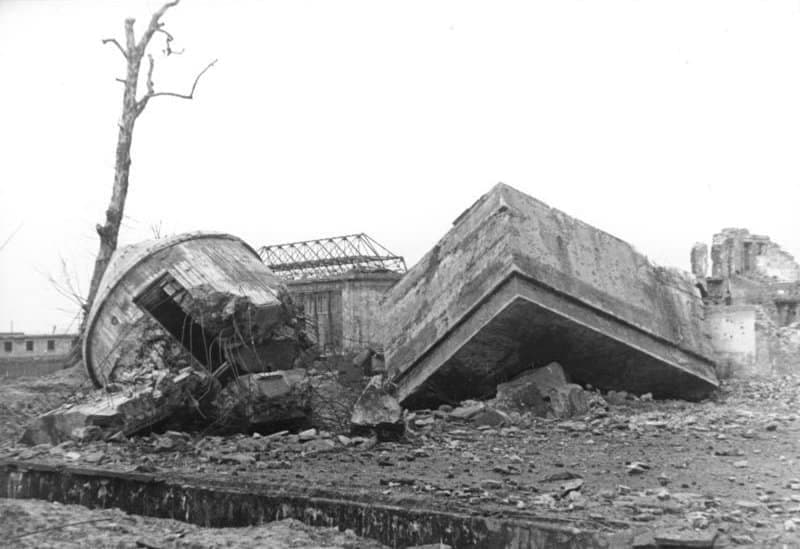
The blown-up remains of the Führerbunker's entrance in the Reich Chancellery garden, 1947
The bunker’s entrance after the Soviet demolition attempt, 1947. Photo: Bundesarchiv, Bild 183-M1204-319 / Donath, Otto / CC-BY-SA 3.0

All that remains at this site today is a sign, added in 2006, and outlining the dimensions of the bunkers – along with a timeline of events. Part of an otherwise innocuous looking parking lot.

Parking lot in Berlin where Hitler’s Führerbunker was, seen from Gertrud-Kolmar-Straße
The parking lot where the bunker was.

Unlike the Memorial to the Murdered Jews of Europe situated nearby, the German government taking care that while remembering the victims of National Socialism it does nothing to celebrate the perpetrators – or chief perpetrator, Adolf Hitler, and his legacy.
The bunker in detail

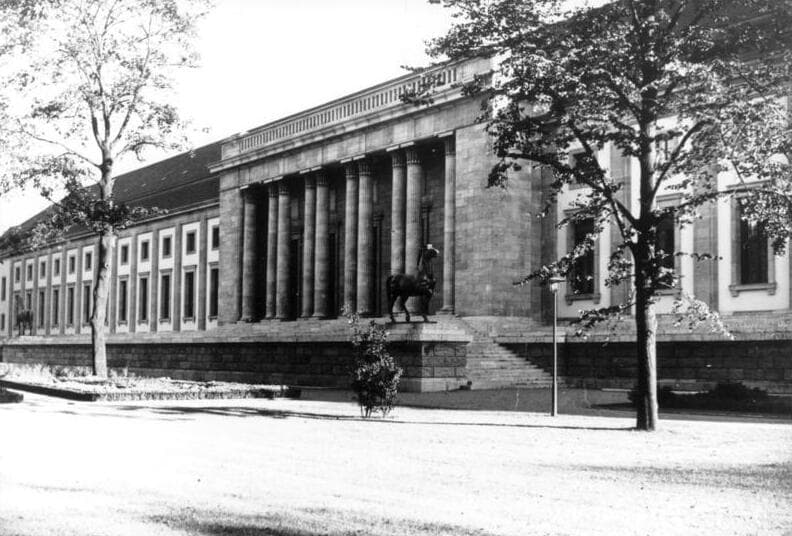
The garden front of the New Reich Chancellery in Berlin, 1941, above the garden where the Führerbunker was built
The New Reich Chancellery’s garden front, 1941. The bunker was built beneath this garden. Photo: Bundesarchiv, Bild 183-1989-0508-502 / Hoffmann, Heinrich / CC-BY-SA 3.0

What was the Führerbunker?

The Führerbunker was the last of Hitler’s headquarters: a reinforced-concrete air-raid shelter beneath the garden of the Reich Chancellery on Wilhelmstraße. It came in two parts. The Vorbunker, finished in 1936, sat 1.5 metres below the cellar of a reception hall. The deeper Führerbunker was begun in 1943 and finished in 1944, about 8.5 metres underground and 2.5 metres lower than the Vorbunker, under a concrete roof almost 3 metres thick.

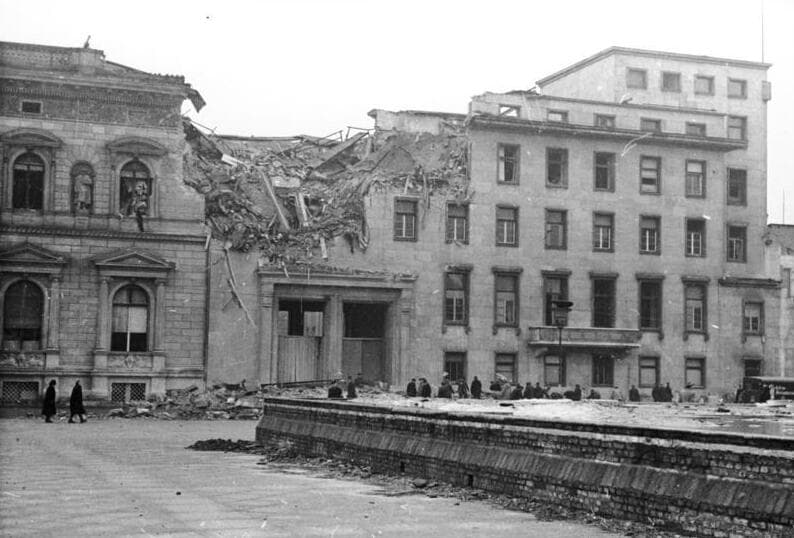
Together they held about 30 small rooms: bedrooms and a study for Hitler, quarters for Eva Braun, the Goebbels family and staff, a conference room, a telephone switchboard, a power plant and the ventilation that never quite kept the damp out. Above them, Albert Speer’s monumental New Reich Chancellery, finished in 1939, filled the whole of Voßstraße.

Bomb damage to the front of the New Reich Chancellery on Wilhelmplatz, Berlin, March 1945
Bomb damage to the Chancellery’s Wilhelmplatz front, March 1945. Photo: Bundesarchiv, Bild 183-J31334 / CC-BY-SA 3.0

Hitler’s last 105 days

Hitler returned to Berlin from his western headquarters on 16 January 1945 and, as the air raids worsened, moved underground for good. From here he ran a war that was already lost, moving armies that existed only on his maps. He came up for the last time in public on his 56th birthday, 20 April, to decorate boys of the Hitler Youth in the Chancellery garden, the day Soviet artillery came within range of the city centre.

On the night of 28–29 April he married Eva Braun in the bunker’s map room. At about 15:30 on 30 April he shot himself in his study while she took cyanide; their bodies were carried up to the garden, doused in petrol and burned near the emergency exit. The next afternoon Magda Goebbels had her six children poisoned before she and Joseph Goebbels killed themselves. That night the rest of the bunker’s occupants tried to break out through the Soviet lines, and on 2 May the Red Army walked in.

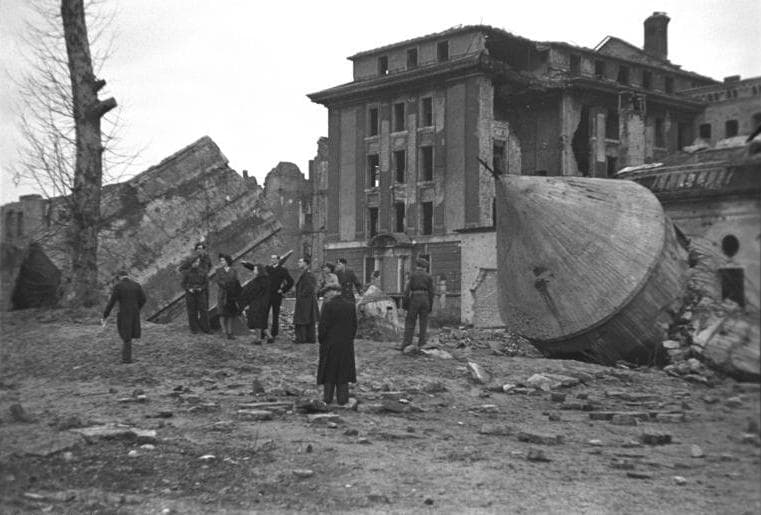
Visitors among the ruins of the Reich Chancellery in 1947, beside a blown-up guard shelter
The ruined Reich Chancellery in 1947, with a blown-up guard shelter on the right. Photo: Bundesarchiv, Bild 183-M1204-318 / Donath, Otto / CC-BY-SA 3.0

What happened to the bunker after 1945?

Between 1945 and 1949 the Soviets cleared the ruins of both Chancellery buildings, and in December 1947 their engineers tried to blow the bunker up. The concrete was too thick: only some inner walls gave way. In 1959 East Germany demolished what was left of the Chancellery, and after the Berlin Wall went up in 1961, a couple of hundred metres to the west, the bunker lay sealed and forgotten in the restricted border area.

It was finally broken up in 1988–89, when East Germany built the prefabricated flats that stand there now. Builders uncovered several sections; most were destroyed, and the rest were filled with rubble and sealed. Nothing of the bunker can be visited, and nothing is meant to be: the authorities did not want a place of pilgrimage. Even the information board took the Berliner Unterwelten association years to get approved. Its chairman, Dietmar Arnold, argued that a plain, factual description would take away the mythic power the site had while it was hidden.

Plan your visit

Visiting the Führerbunker site

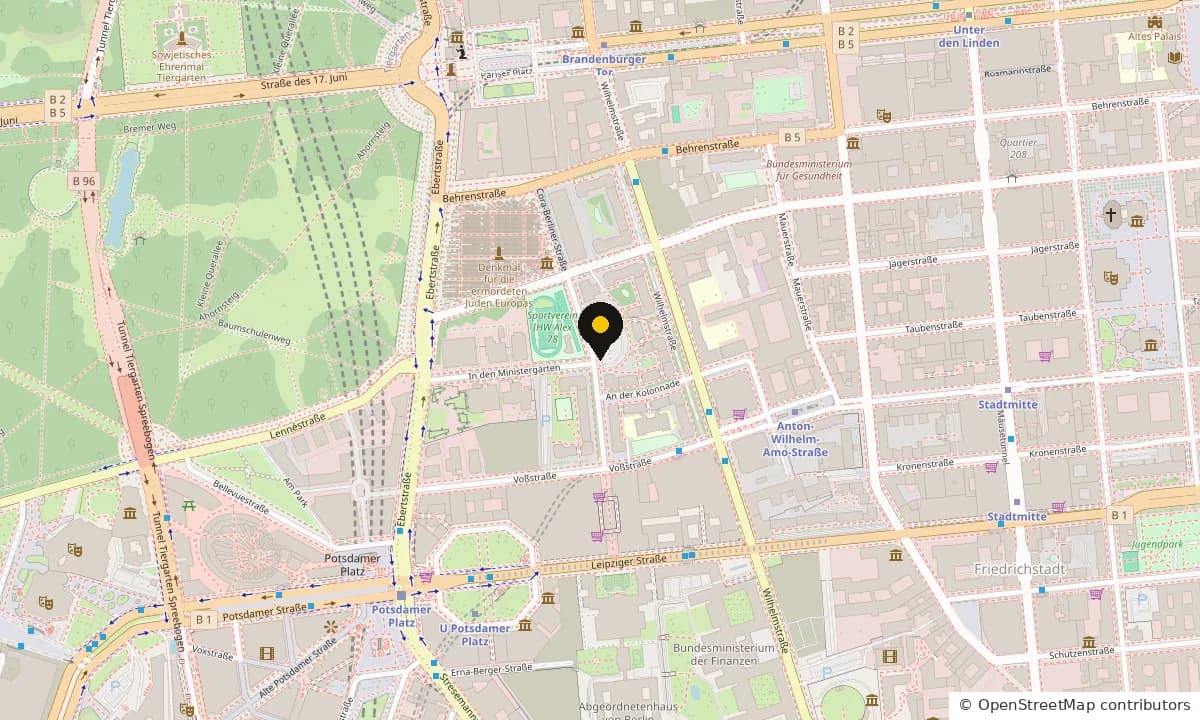
Map of the streets around the Führerbunker site, with a pin on the siteOpen in Google Maps

Gertrud-Kolmar-Straße / In den Ministergärten, 10117 Berlin · Open 24 hours, every day

Getting there

  • U2Anton-Wilhelm-Amo-Straße250 m · 4 min

    Called Mohrenstraße until 2025, so older guides and maps still use that name.

  • S1S2S25S26U5Brandenburger Tor450 m · 7 min

    Walk south down Ebertstraße past the Holocaust Memorial, then left into In den Ministergärten.

  • S1S2S25S26U2Potsdamer Platz450 m · 7 min

    Head north-east along Voßstraße, where the New Reich Chancellery once stood.

What you’ll see

  • A bilingual (German and English) information board with a cutaway plan of the Vorbunker and Führerbunker, photographs and a short history, put up by the Berliner Unterwelten association on 8 June 2006.
  • The car park and lawn that cover the bunker’s footprint, and the prefabricated apartment blocks East Germany built over the Chancellery grounds in the late 1980s.
  • Voßstraße, a block to the south, where Albert Speer’s New Reich Chancellery ran for more than 400 metres. Nothing of it stands above ground.

Tips from a guide

  • There is nothing to see underground, so pair it with the Holocaust Memorial (4 minutes away) and the Topography of Terror (13 minutes).
  • Use the plan on the board to orient yourself: it shows where the Chancellery, its garden and the two bunkers lay beneath the streets around you.
  • People live here: the flats look straight onto the board, so keep voices down and photograph the board, not the residents.

Accessibility

The board stands at street level and the walk from each station is on level pavement. Check the BVG website for lift status at the stations. There are no toilets or seating at the site; the nearest are at Potsdamer Platz.

Timeline

From air-raid shelter to car park

  1. 1936The Vorbunker is finished under the old Reich Chancellery.
  2. 1943–44The deeper Führerbunker is built beneath the Chancellery garden.
  3. 16 Jan 1945Hitler returns to Berlin; he spends his last weeks underground.
  4. 20 Apr 1945His last public appearance, in the garden, on his 56th birthday.
  5. 29 Apr 1945Hitler marries Eva Braun in the bunker’s map room, after midnight.
  6. 30 Apr 1945Hitler and Braun kill themselves; their bodies are burned in the garden.
  7. 1 May 1945The Goebbels children are poisoned; their parents kill themselves.
  8. 2 May 1945Soviet troops take the Chancellery and the bunker.
  9. Dec 1947Soviet engineers try to blow the bunker up; it largely survives.
  10. 1988–89East German flats are built on the site; the bunker is broken up and filled in.
  11. 8 Jun 2006The Berliner Unterwelten association puts up the information board.

See it with a historian

Tours that stop at the Führerbunker site

The board shows a plan; a guide can show you where the Chancellery, its garden and the bunker’s exits stood, and tell you what happened in each.

One hour in the Nazi government district, with the bunker site at its heart.

The Third Reich Tour
One Hour1 Hour

The Third Reich Tour

Private 1-hour walking tour of the Nazi government district for up to 10 people. Starts at Pariser Platz by the Brandenburg Gate.

€200up to 10
View Tour

The rise and fall of the Third Reich, through what remains of Hitler’s Berlin.

The Capital Of Tyranny Tour - Berlin Experiences
Full Day6 Hours

The Capital Of Tyranny

Private 6-hour van tour of Hitler's Berlin and the Third Reich for up to 6 people. Starts at your hotel or anywhere in the city.

€1,000up to 6
View Tour

The race to the Reichstag in April 1945, across what remains of the battlefield.

The Battle Of Berlin Tour - Berlin Experiences
Full Day6 Hours

The Battle Of Berlin Tour

Private 6-hour van tour of the 1945 battlefield, from the outskirts to the Reichstag, for up to 6 people. Starts at your hotel.

€1,000up to 6
View Tour

Questions visitors ask

Frequently asked questions

Where was Hitler’s bunker?

Under the garden of the old Reich Chancellery in Berlin-Mitte. Today the spot is the corner of In den Ministergärten and Gertrud-Kolmar-Straße, between Potsdamer Platz and the Brandenburg Gate, about 200 metres south-east of the Holocaust Memorial.

Is the Führerbunker still there?

Not in any form you can see or enter. The Soviets failed to blow it up in 1947, but East German builders destroyed most of what remained in 1988–89 and filled the rest with rubble. Parts of the floor slab and lower walls are thought to remain deep underground, sealed beneath the car park.

Can you go inside Hitler’s bunker?

No. There is no entrance and no plan to open one. What you can visit is the site itself, marked by an information board, which is free and open at all hours.

Why is there a car park on the site?

Deliberately, nothing marks the spot as special. Neither East nor reunified Germany wanted a place that could become a shrine for neo-Nazis. The information board only went up in 2006, and its factual tone was meant to take away the mystery rather than add to it.

Where exactly did Hitler die?

In his study in the Führerbunker, at about 15:30 on 30 April 1945. His body and Eva Braun’s were burned in the Chancellery garden above, close to the bunker’s emergency exit.

Did anyone survive the Führerbunker?

Yes, many of the staff did, though several were held in Soviet prisons for years. Among them were his secretary Traudl Junge, his valet Heinz Linge and his bodyguard and telephone operator Rochus Misch, who was at the unveiling of the information board in 2006 and died in 2013.

Is the Berlin Story Bunker the same as the Führerbunker?

No. The Berlin Story Bunker is a different wartime air-raid shelter near Anhalter Bahnhof, about 20 minutes’ walk away. It holds a private exhibition about Hitler that includes a model of the Führerbunker.

Are there tours of the Führerbunker site?

Yes. Our Third Reich tour, Capital of Tyranny tour and Battle of Berlin tour all stop at the site, and a private guide can show you where the Chancellery, the garden and the bunker’s exits stood, which the board alone cannot.

Keep exploring

More Featured Experiences.

Every site we write about — 56 landmarks, museums, memorials and lesser-known corners of Berlin. See the full index →

01Walk Through The Brandenburg Gate02Explore The State Museums On Museum Island03Visit The Berlin TV Tower – The Fernsehturm04Cross The Cold War Border At Checkpoint Charlie06Explore The Reconstructed Berlin Palace07Visit The Reichstag Cupola At Night08Explore The Forum Fridericianum09Shop At The Humboldt University Book Sale10Journey Into The Memorial To The Murdered Jews Of Europe11Step Inside The Neue Wache12Explore The Former Jewish Quarter – Spandauer Vorstadt13Visit The Remains Of The Berlin Wall14Walk Across The Bridge Of Spies15Explore The Topography Of Terror16Climb The Prussian Victory Column – The Siegessäule17Enter The Palace Of Tears – The Tränenpalast18Step Inside The Berlin Olympic Stadium19Explore Erich Mielke’s Office At The Stasi Museum20Walk Along Karl Marx Allee21Visit The Oldest Church In Berlin – The Nikolaikirche22Explore The Berliner Dom23Visit The Grave Of Frederick The Great24Walk Through The Ruins Of Anhalter Bahnhof25Stand On The Platz Des Volksaufstandes26Visit The German Resistance Museum27Visit The Soviet War Memorial In The Tiergarten28See The Georg Elser Memorial On Wilhelmstrasse29Step Inside The Kaiser Wilhelm Gedächtnis Kirche30Visit The Gleis 17 Memorial31Visit The Schloss Charlottenburg Mausoleum32Climb The Französischer Dom at Gendarmenmarkt33Explore The Interbau – IBA 5734Explore The Otto Weidt Workshop35Visit Cecilienhof – Site Of The Potsdam Conference36Visit The Stasi Prison In Hohenschönhausen37Spend The Day At Tempelhof Airport38Ride The Fastest Elevator In Europe39Visit The Soviet War Memorial In Treptower Park40Visit The Sachsenhausen Concentration Camp Memorial41Visit The Ravensbrück Concentration Camp Memorial42Visit Karlshorst – The Site Of The German Surrender43Visit The Socialists Cemetery – Zentralfriedhof Friedrichsfelde44Visit The Soviet War Memorial In Pankow45Visit the Seelow Heights Memorial46Visit The Commonwealth War Cemetery47Cross The Bösebrücke At Night48Explore The Allied Museum In Dahlem49Explore The Spandau Citadel50Visit The Brandenburg T4 Euthanasia Memorial51Visit The Wannsee Conference House52Visit The Jewish Museum53Visit The Jewish Cemetery In Weissensee54Walk Along The East Side Gallery55Explore The Volkspark Friedrichshain Flak Tower56Head Up The Teufelsberg