FEATURED EXPERIENCE NO. 32

Climb The Französischer Dom at Gendarmenmarkt

Crowning Glory Of Berlin's French Hugenot Community

Stand in the centre of Gendarmenmarkt, arguably Berlin’s most breathtaking – and certainly overlooked – square, and let your gaze drift upwards.

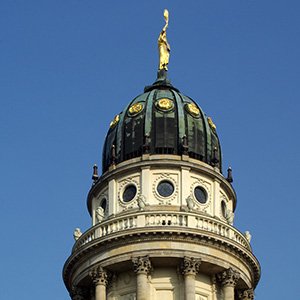
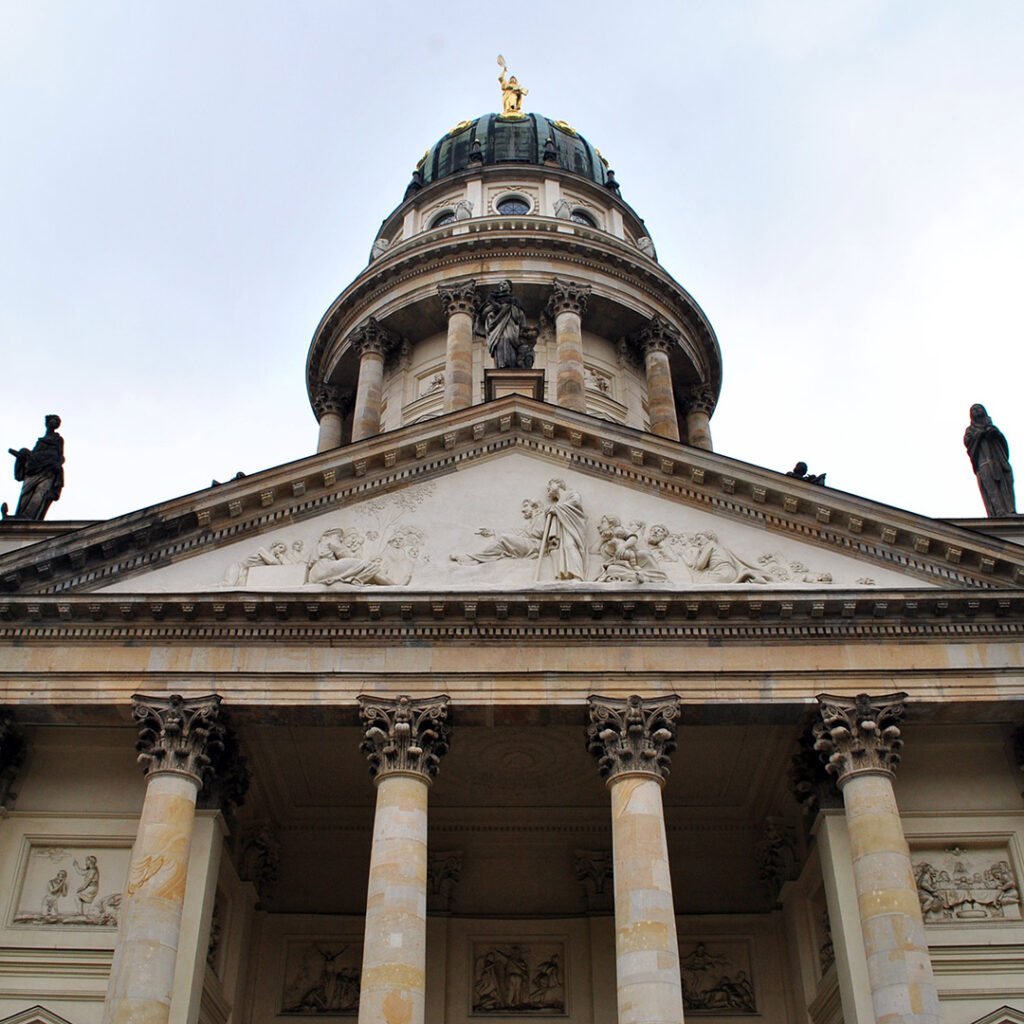
Flanking the elegant Konzerthaus are two magnificent, near-identical domed towers: the Deutscher Dom (German Cathedral) to the south, and its twin, the Französischer Dom (French Cathedral) to the north. But here lies the first fascinating layer of Berlin’s history: neither is technically a cathedral, lacking a bishop’s seat. The Französischer Dom, our focus, isn’t even one building, but two – a simple church nestled beside a grand, ornamental tower added much later. And climbing that tower offers not just a stunning panorama, but a journey into a pivotal moment that shaped Berlin forever: the arrival of the Huguenots.

Our story begins not in Berlin, but in France, amidst the splendour, and intolerance, of King Louis XIV’s reign. In 1685, the ‘Sun King’ revoked the Edict of Nantes, a decree that had granted substantial rights to Calvinist Protestants – the Huguenots – in predominantly Catholic France. Overnight, hundreds of thousands faced persecution, forced conversion, or exile. Their plight resonated across Protestant Europe, particularly in the ambitious, sparsely populated Electorate of Brandenburg-Prussia.

Enter Friedrich Wilhelm I, the ‘Great Elector’. A devout Calvinist himself, married to the Dutch Calvinist princess, Louise Henriette of Orange-Nassau, he saw both a moral obligation and a strategic opportunity.

Just weeks after Louis XIV’s decree, Friedrich Wilhelm issued his own counter-proclamation: the Edict of Potsdam. This remarkable document offered refuge, religious freedom, and significant privileges – tax exemptions, guild memberships, even financial aid – to the persecuted French Huguenots. It was an open invitation, a beacon of tolerance in a divided continent. Thousands answered the call, embarking on perilous journeys to a city that promised safety and respect. They arrived not as destitute refugees, but as skilled artisans, merchants, intellectuals, and professionals, ready to rebuild their lives and, inadvertently, help transform Berlin into a major European capital.

One of the first, most visible symbols of their new home would rise on Gendarmenmarkt: the Französische Friedrichstadtkirche, the French Church, cornerstone laid in 1701. Climbing its adjacent tower today is to ascend through the layers of this incredible story.
The Französischer Dom on Gendarmenmarkt - Marek Mróz
The exterior of the Französischer Dom on Gendarmenmarkt - Frankencharly
The arrival of the Huguenots wasn’t just a footnote in Berlin’s history; it was an important milestone in the city’s development.

Around 20,000 French Protestants sought refuge in Brandenburg-Prussia, with a significant portion, perhaps as many as 6,000 initially, settling in Berlin. At a time when the city’s total population was only around 20,000, this influx represented a staggering demographic shift – suddenly one in four Berliners was French! Beyond the numbers; this was also about injecting a potent blend of skill, capital, and cultural dynamism into the relatively modest electoral capital.

Friedrich Wilhelm’s gamble paid off spectacularly. The Huguenots brought expertise desperately needed. They were master weavers (introducing silk and velvet production), skilled goldsmiths, watchmakers, hatters, tanners, surgeons, lawyers, and military officers. They established workshops, factories, and businesses, revitalising the local economy. Their intellectual contributions were equally profound, enriching the city’s academic and cultural life. They founded the Französisches Gymnasium (French Grammar School) in 1689, which still exists today as one of Berlin’s most prestigious schools, initially teaching entirely in French. For decades, the community maintained its distinct identity, with French spoken in churches, schools, and courts specifically established for them. This level of autonomy, granted by the Edict of Potsdam, was extraordinary.

This embrace of the Huguenots solidified Brandenburg-Prussia’s burgeoning reputation as a land of tolerance, a stark contrast to the religious conflicts raging elsewhere in Europe. This wasn’t purely altruism; it was enlightened self-interest, recognising that diversity and freedom fostered prosperity and strength.

Berlin became a Refugienstadt, a city of refuge, a tradition that would echo through its later history, welcoming Bohemians, Jews, and others seeking sanctuary. The Prussian state, while authoritarian in many ways, understood the pragmatic value of religious tolerance for specific, productive groups long before it became a widespread Enlightenment ideal. The Huguenot community thrived, gradually integrating yet retaining a proud cultural heritage. Their influence permeated Berlin society, evident in surnames still common today (like de Maizière), loanwords absorbed into the Berlin dialect (such as ‘Boulette’ for meatball, from the French), and, most tangibly, in their enduring church on Gendarmenmarkt.
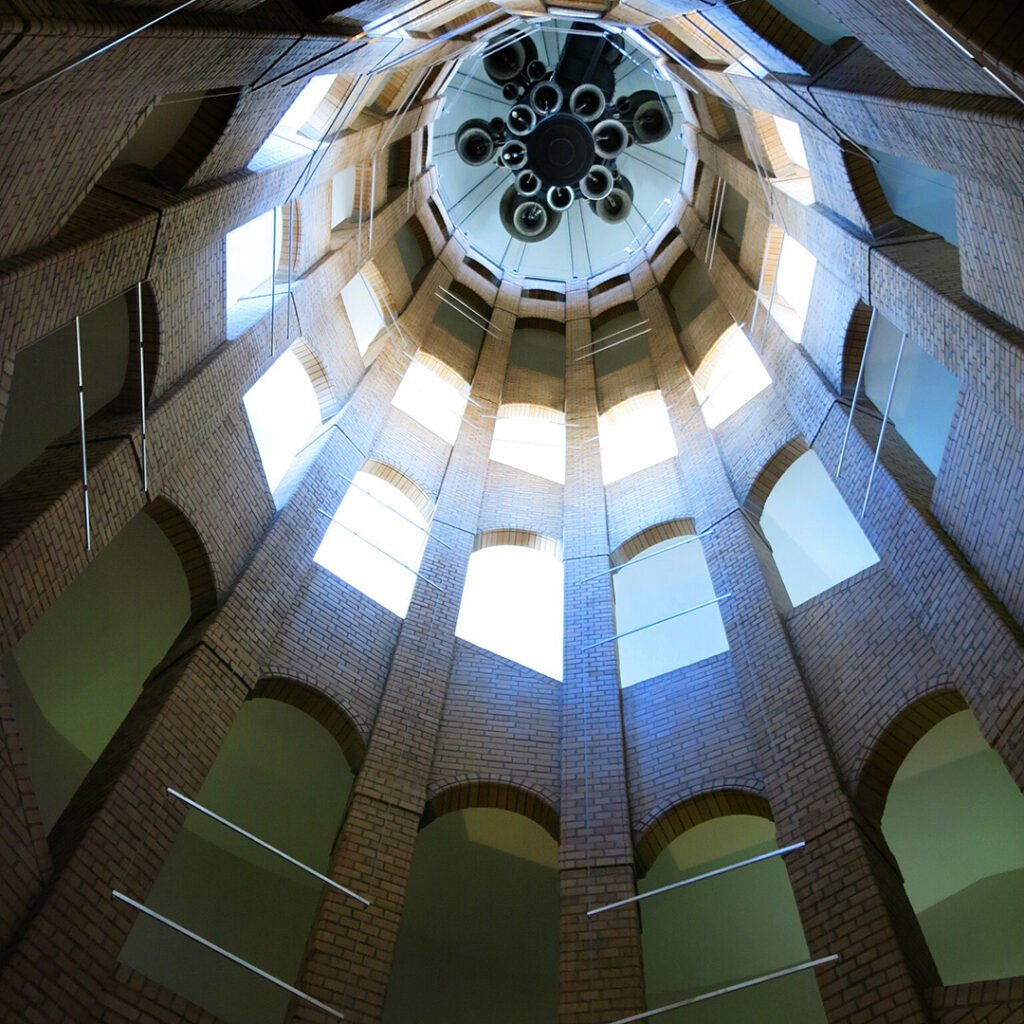
The interior of the bell tower at the Französischer Dom on Gendarmenmarkt - Anna Saini

Did you know...

Deep within the archives, historians rediscovered the original handwritten 'protocol' confirming the Huguenot elders' acceptance of the Edict of Potsdam's terms upon their arrival in Berlin. This fragile document, bearing the actual signatures of the first refugees formally welcomed, provides tangible proof of that foundational moment of trust and refuge which profoundly shaped the city's future.
The heart of this new Huguenot community naturally needed a spiritual home.

Construction began in 1701 on the Französische Friedrichstadtkirche (French Church of Friedrichstadt), which was eventually completed in 1705. Designed by architects Louis Cayart and Abraham Quesnay, working from plans inspired by the destroyed Huguenot temple in Charenton near Paris, it was deliberately modest – a simple, rectangular hall church, reflecting Calvinist principles of unadorned worship. It served the burgeoning French-speaking congregation, a testament to their successful integration and the Elector’s promise of religious freedom. For over eighty years, this humble church stood alone on the northern side of the square then known as Linden-Markt, later Friedrichstädtischer Markt, and finally Gendarmenmarkt (named after the stables, or ‘gens d’armes’, barracks located there).

The dramatic transformation of this square to what can be seen today came much later, under Frederick the Great (Friedrich II), a ruler who valued aesthetics and grand gestures as much as military prowess.

Between 1780 and 1785, Frederick commissioned the renowned architect Carl von Gontard (with Georg Christian Unger) to enhance the square’s architectural harmony. Gontard added the magnificent domed tower, the Französischer Dom, adjacent to the existing church. Crucially, this tower was purely ornamental, designed to mirror an identical structure (the Deutscher Dom) added to the German Lutheran church on the south side. It housed no bells initially and had no ecclesiastical function related to the French Church itself; it was a purely architectural flourish intended to elevate Gendarmenmarkt into one of Europe’s grandest public squares.
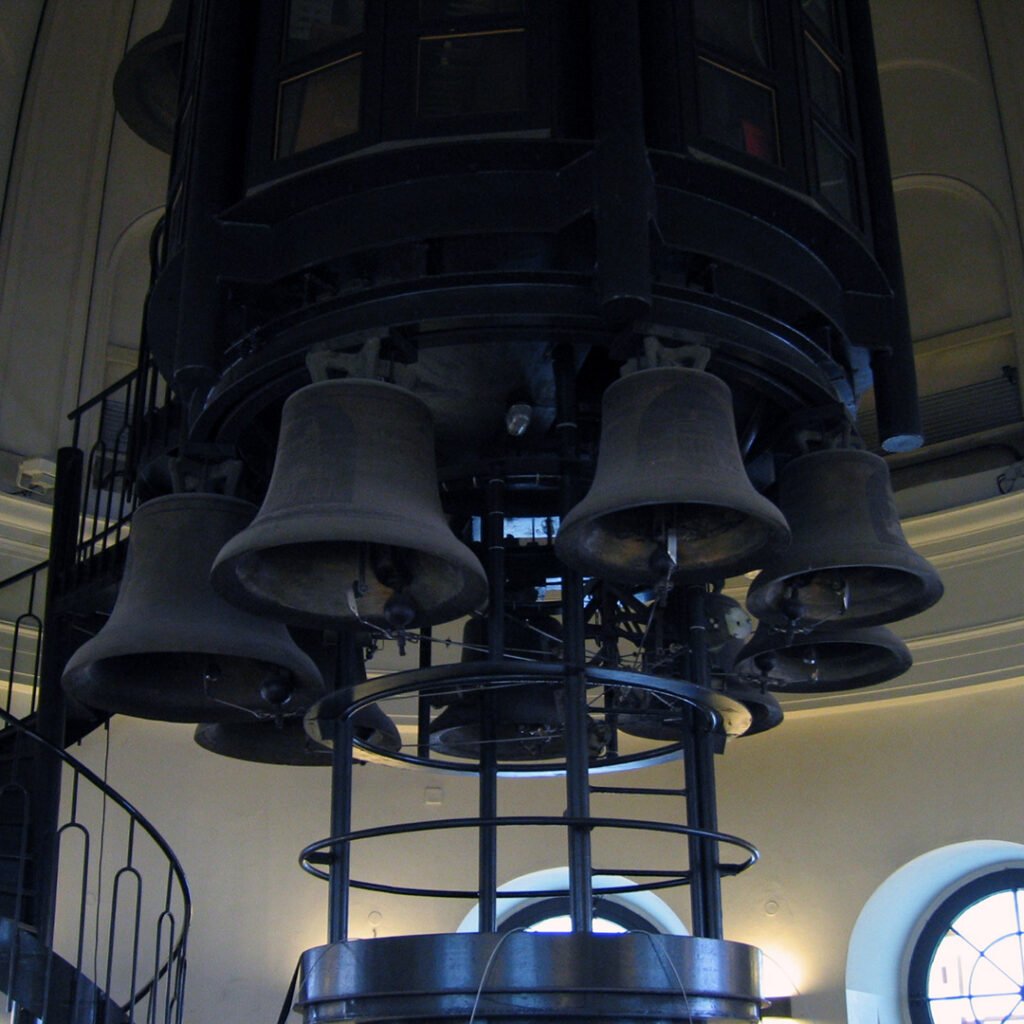
The bells inside the Französisches Dom on Gendarmenmarkt
The Französische Friedrichstadtkirche am Gendarmenmarkt in Berlin - De-okin
The tower we climb today – one of Berlin’s most rewarding viewpoints – is this later addition, a symbol of Prussian royal ambition rather than Huguenot piety, though inextricably linked to the church by proximity and name.

The church and tower ensemble endured centuries, witnessing the rise and fall of empires. It suffered devastating damage during Allied bombing raids in World War II, particularly in 1943 and 1944. The church interior was gutted by fire, and the dome severely damaged.

Then came the division of Berlin. Gendarmenmarkt found itself in East Berlin, under the control of the German Democratic Republic (GDR), a state officially promoting atheism. The reconstruction of churches in the GDR was a complex issue. While the state discouraged religion, it also recognized the historical and cultural significance (and potential tourist appeal) of landmarks like those on Gendarmenmarkt. Reconstruction of the Französischer Dom tower began in 1978, funded partly by the state, and was completed in 1983. The church itself underwent a longer, more complex restoration, completed between 1977 and 1981, with significant support from the Protestant Church in Germany (EKD) and international partners. Highlighting the complex relationship between heritage preservation and ideology in East Germany.

Access to the tower is separate from the church entrance, typically found via a doorway on the side facing the Konzerthaus. After purchasing a modest entry fee, your journey upwards begins: 254 steps winding their way through the historic structure. The climb itself is part of the experience – the stone steps worn smooth by time, the occasional glimpse through narrow windows, the anticipation building as you ascend.
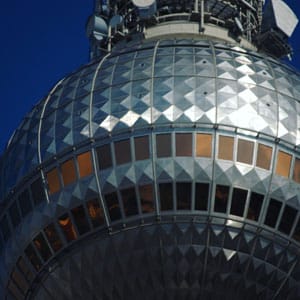
Reaching the viewing platform, 40 metres above the square, you are greeted by a breathtaking 360-degree panorama. Directly below lies the elegant expanse of Gendarmenmarkt – the symmetrical perfection of the square, the majestic Konzerthaus designed by Schinkel, and the identical Deutscher Dom opposite. It’s a unique perspective, allowing you to appreciate the deliberate grandeur envisioned by Frederick the Great and his architects. Look further afield, and the Berlin skyline unfolds: the iconic Fernsehturm (TV Tower) piercing the sky to the east, the dome of the Berlin Cathedral (Berliner Dom), the Reichstag building with its modern glass cupola, the bustling Potsdamer Platz, and the green expanse of the Tiergarten. It’s a visual tapestry of Berlin’s past and present.

The Französischer Dom

Some useful links:

FEATURED EXPERIENCES