FEATURED EXPERIENCE NO. 52

Visit The Haus Der Wannsee Konferenz

Elegant lakeside villa where the Final Solution was planned

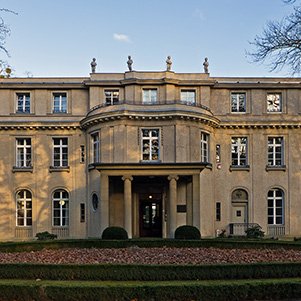
Berlin is a city layered with history, much of it challenging, some of it profoundly disturbing. Yet, few places encapsulate the chilling dissonance between serene beauty and the horrific quite like the Haus der Wannseekonferenz. Located in one of Berlin’s most affluent suburbs, the villa sits gracefully on the shores of the Großer Wannsee lake. On a sunny day, the water sparkles, sailboats glide past, and the surrounding properties offer a picture of peaceful prosperity. It feels a world away from the concrete memorials and scarred landscapes often associated with the city’s darkest chapter. This was, and remains, a desirable address, a place marked for leisure and escape.

Yet, it is precisely this idyllic setting that makes the history that occured within its walls so jarring. This elegant former industrialist’s mansion, commandeered by the Hitler’s notorious SS, became the stage for one of the most infamous meetings of the Third Reich.

On January 20th 1942, fifteen high-ranking Nazi officials – primarily state secretaries from various ministries and senior SS officers – gathered here not in jackboots and combat fatigues, but in suits and uniforms appropriate for a high-level administrative conference. They weren’t plotting battlefield strategy or discussing grand architectural plans for Germania. They were gathered for a brisk, business-like meeting, complete with refreshments, to coordinate the logistics of genocide. The preparation for the “Final Solution to the Jewish Question’’.

The Wannsee Conference, as it became known, was not where the decision to murder the Jews of Europe was made – that horrific decision had evolved earlier through a complex process involving the higher ups of the Nazi Party – Hitler, Himmler, Göring, and others. Instead, this meeting was about how to coordinate mass murder efficiently, drawing together the necessary arms of the German state apparatus.
The view from the Villa Marlier of the Wannsee - JGHowes
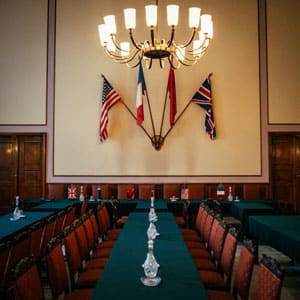
The interior of the Wannsee Conference house - Kjetil Ree
The invitations went out in late November 1941, issued by SS-Obergruppenführer Reinhard Heydrich, the ambitious and ruthless chief of the Reich Security Main Office (RSHA) and recently appointed Reich Protector of Bohemia and Moravia. Citing an earlier authorisation from Hermann Göring tasking him with preparations for a “total solution of the Jewish question,” Heydrich summoned key figures to a meeting followed by breakfast at the SS guest house by the Wannsee lake. The initial date was December 9th, but the Japanese attack on Pearl Harbor and the ensuing German declaration of war on the United States, coupled with the stalling of the offensive against Moscow, forced a postponement. The meeting was rescheduled for 12:00 noon on January 20, 1942.

Fifteen men gathered in the villa’s dining room that winter morning. Heydrich chaired the meeting. Alongside him sat key SS figures like Heinrich Müller (head of the Gestapo) and Adolf Eichmann (head of the RSHA’s Jewish Affairs department, tasked with taking the minutes). Crucially, however, the attendees were not solely SS ideologues. They included State Secretaries and senior officials representing vital government ministries: the Interior Ministry (Dr. Wilhelm Stuckart), the Justice Ministry (Dr. Roland Freisler, though his representative Dr. Erich Neumann attended), the Foreign Office (Martin Luther), the Four Year Plan (Erich Neumann, representing Göring), the Occupied Eastern Territories Ministry (Dr. Alfred Meyer and Dr. Georg Leibbrandt), the General Government of occupied Poland (Dr. Josef Bühler), and the Reich Chancellery (Dr. Wilhelm Kritzinger).

This composition was deliberate. Heydrich’s primary goal was not to debate the morality or desirability of genocide – that was already assumed policy – but to assert his leadership over the “Final Solution,” secure the cooperation of the essential state ministries, and coordinate their efforts to ensure the systematic deportation and murder of Europe’s estimated 11 million Jews proceeded smoothly and efficiently.
The minutes of the meeting that took place at the Wannsee Conference house - Adam Carr,

Did you know...

Remarkably, despite the Nazis' meticulous record-keeping, only one copy of the official minutes of the Wannsee Conference – the Wannsee Protocol – survived the war's destruction and attempts to erase incriminating evidence. This crucial document, designated copy number 16 out of an original 30, was discovered in March 1947 by Robert Kempner, a German-Jewish lawyer working for the American prosecution team at Nuremberg, hidden within the impounded files of the German Foreign Office.

The meeting itself was remarkably brief, lasting only about 90 minutes. Heydrich opened by reviewing anti-Jewish policies to date, outlining the shift from forced emigration to “evacuation to the East” – a euphemism for deportation to ghettos and extermination camps.

He presented staggering figures, country by country, detailing the Jewish populations targeted for this “Final Solution.” Discussion reportedly revolved around practicalities: defining who counted as a Jew (referencing the Nuremberg Laws, with input from Stuckart), the handling of Mischlinge (people of mixed Jewish and Aryan ancestry), the logistical challenges of transport, and the need for various ministries to provide legal and administrative cover. Dr. Bühler from the General Government urged that the “Final Solution” begin in occupied Poland, as transport issues were minimal there and the local population was largely seen as incapable of work. There was no significant dissent recorded against the fundamental goal.

The attendees, representing the bureaucratic heart of the Nazi state, effectively rubber-stamped Heydrich’s plan and pledged their ministries’ cooperation in the machinery of mass murder. The meeting concluded, and Eichmann later recalled that the atmosphere, while business-like during the formal discussion, became more relaxed afterwards, with drinks served and casual conversation taking place.
Despite the brevity, the Wannsee Conference would prove brutally effective in its aims.

The coordination achieved at Wannsee streamlined the process of identifying, rounding up, transporting, and murdering Jews across Nazi-occupied Europe. Deportations to extermination camps like Auschwitz-Birkenau, Treblinka, Sobibor, and Belzec accelerated dramatically in the months following the conference. The bureaucratic machinery, now fully aligned and informed, ground into motion with chilling efficiency, leading directly to the deaths of millions.
Archive images of the Villa Marlier - Public Domain
The Wannsee Konferenz villa next to the Große Wannsee - The Villa Marlier - A.Savin
For decades after the war, the villa at Am Großen Wannsee 56-58 carried its dark secret relatively quietly. It served various purposes, including as a recreational facility and a student hostel, with little public acknowledgement of what transpired here back in the winter of 1942.

The elegant facade and peaceful lakeside setting belied the significance of that fateful meeting. However, the tireless efforts of historians and activists, most notably the Holocaust survivor and historian Joseph Wulf, gradually brought the villa’s history to light and pushed for its transformation into a place of remembrance and learning. Wulf envisioned an international documentation centre on Nazism here as early as the 1960s, but faced significant resistance and lack of funding; tragically, he took his own life in 1974, despairing at the German public’s perceived indifference to confronting the past.

Persistence eventually paid off. Growing historical awareness and political will led to the decision to establish a permanent memorial. On January 20, 1992, the 50th anniversary of the Wannsee Conference, the villa was officially opened as the “Haus der Wannseekonferenz Memorial and Educational Site.”

Visiting the villa now is a profoundly moving and informative experience. The building itself, beautifully restored, retains its pre-war grandeur. Inside, the permanent exhibition, spread across several rooms on the ground floor (including the actual dining room where the meeting took place), meticulously documents the rise of Nazism, the escalating persecution of Jews and other victim groups, the history of the “Final Solution,” and the conference itself. Using documents (including a facsimile of the Wannsee Protocol), photographs, audio-visual displays, and biographical information on both perpetrators and victims, the exhibition lays bare the cold, bureaucratic nature of the planning process.

This is not about witnessing the site of mass murder itself, but what philosopher, Hannah Arendt, fittingly termed ‘the banality of evil’: exploring where the systematic, state-sponsored annihilation of millions was discussed, planned, and bureaucratically streamlined amidst opulent surroundings. How educated men, civil servants, in a beautiful setting, could calmly coordinate mass murder. Wherein lies a vital lesson in the fragility of civilisation and the importance of vigilance against prejudice, hatred, and the abuse of state power.

Haus der Wannseekonferenz

Some useful links:

FEATURED EXPERIENCES