

Britain and France have fought each other often over the centuries and were at war with each other in the early 1800s – this thorny relationship would lead directly to the introduction of the Berlin Decree in 1806 .
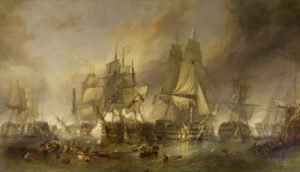
Following the defeat of Napoleon’s navy by the British at the Battle of Trafalgar on 21st October 1805, the French Emperor realised that he had no chance of successfully invading the island nation so sought another approach to bring his enemy to its knees.
From 16th May 1806, the British navy blockaded ports along the coastline of Continental Europe, from Brest to the estuary of the river Elbe, but having defeated the Prussian army at Jena and Auerstädt on 14th October 1806, Napoleon entered the city of Berlin on 27th October 1806 and set about planning the defeat of his arch enemy.
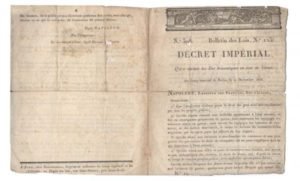
Aware that Great Britain depended heavily on its trading abilities to sustain its position in the world, Napoleon realised that if he could deny his foe opportunities to trade within Europe, he would be able to starve the nation into surrender. So, on 21st November 1806, whilst still in the Prussian capital city, Napoleon announced his Berlin Decree and the adoption of the “Continental System” that brought France and all of its occupied territories and allies under the same rule, introducing a blockade of Britain. This meant that no vessel coming directly from the island or her colonies would be allowed into any port under French control. Correspondence and trade with Great Britain by countries under French rule would also be forbidden.
Britain’s reply to the Berlin Decree was the 24 Orders in Council, issued on 11th November 1807, which confined Europe’s trade to neutral shipping. Britain controlled and taxed neutral trade with Europe by making all vessels proceed via British ports.
Napoleon responded by issuing on 17th December 1807, the Milan Decrees, which ordered that all ships touching British ports before sailing into French territorial waters were to be confiscated. This meant that any country obeying Britain’s Orders in Council was punished by the French. Neutral countries, including America, risked detention by the Royal Navy or confiscation in Napoleon’s ports. America’s response was to place an embargo on trade to both countries.
Like Napoleon, the Berlin Decree and the Continental System eventually failed. There were too many ports that the British could still use. This and the subsequent Peninsular War and defeat by Russia in 1812 led to the spiralling first demise of the French Emperor and his Continental System.
–
The full text of the Berlin Decree
From our Imperial Camp at Berlin, November 21, 1806.
Napoleon, Emperor of the French and King of Italy, considering:
1. That England does not admit the right of nations as universally acknowledged by all civilized people;
2. That she declares as an enemy every individual belonging to an enemy State, and, in consequence, makes prisoners of war, not only of the crews of armed vessels, but also of merchant vessels, and even of the supercargoes of the same;
3. That she extends or applies to merchant vessels, to articles of commerce, and to the property of individuals, the right of conquest, which can only be applied or extended to what belongs to an enemy State;
4. That she extends to ports not fortified. to harbours and mouths of rivers, the right of blockade, which according to reason and the usage of civilized nations, is applicable only to strong or fortified ports;
5. That she declares blockaded, places before which she has not a single vessel of war, although a place ought not be considered blockaded but when it is so invested as that no approach to it can be made without imminent hazard; that she declares even places blockaded which her united forces would be incapable of doing, such as entire coasts, and a whole empire;
6. That this unequalled abuse of the right of blockade has no other object than to interrupt the communications of different nations, and to extend the commerce and industry of England upon the ruin of those of the continent;
7. That this being the evident design of England, whoever deals on the continent in English merchandise favors that design and becomes an accomplice;
8. That this conduct in England (worthy of the first ages of barbarism,) has benefitted her, to the detriment of other nations;
9. That it being right to oppose to an enemy the same arms she makes use of, to combat as she does, when all ideas of justice and every liberal sentiment (the result of civilization among men) are discarded;
We have resolved to enforce against England the usages which she has consecrated in her maritime code.
The present decree shall be considered as the fundamental law of the empire, until England has acknowledged that the rights of war are the same on land as at sea; that it cannot be extended to any private property whatever, nor to persons who are not military, and until the right of blockade be restrained to fortified places, actually invested by competent forces.
–
ARTICLE I. The British islands are declared in a state of blockade.
ARTICLE II. All commerce and correspondence with the British islands are prohibited. In consequence, letters or packets, addressed either to England, to an Englishman, or in the English language, shall not pass through the post-office and shall be seized.
ARTICLE III. Every subject of England, of whatever rank and condition soever, who shall be found in the countries occupied by our troops, or by those of our allies, shall be made a prisoner of war.
ARTICLE IV. All magazines, merchandise, or property whatsoever, belonging to a subject of England, shall be declared lawful prize.
ARTICLE V. The trade in English merchandise is forbidden; all merchandise belonging to England, or coming from its manufactories and colonies, is declared lawful prize.
ARTICLE VI. One half of the proceeds of the confiscation of the merchandise and property; declared good prize by the preceding articles, shall be applied to indemnify the merchants for the losses which they have suffered by the capture of merchant vessels by English cruisers.
ARTICLE VII. No vessel coming directly from England, or from the English colonies, or having been there since the publication of the present decree, shall be received into any port.
ARTICLE VIII. Every vessel contravening the above clause, by means of a false declaration, shall be seized, and the vessel and cargo confiscated, as if they were English property.
ARTICLE IX. Our tribunal of prizes at Paris is charged the definitive adjudication of all the controversies, which by the French army, relative to the execution of the present decree. Our tribunal of prizes at Milan shall be charged with the definitive adjudication of the said controversies, which may arise within the extent of our kingdom of Italy.
ARTICLE X. The present decree shall be communicated by our minister of exterior relations, to the kings of Spain, of Naples, of Holland, and of Etruria, and to our allies, whose subjects, like ours, are the victims of the injustice and the barbarism of the English maritime laws.
ARTICLE XI. Our ministers of foreign affairs, of war, of the navy, of finance, of the police, and our post masters general, are charged each, in what concerns him, with the execution of the present decree.
Source: Napoleon.org
–
To learn more about the history of the Berlin Decree, get in touch to arrange a Berlin Highlights tour – or tailored tour to cover the subjects that interest you during your Berlin visit.


