

The Royal Potsdam Tour
Private 6-hour day trip from Berlin to the palaces and parks of Potsdam for up to 6 people. Starts at your hotel in Berlin.

From Frederick the Great to Otto von Bismarck and beyond - try our Glory of Prussia quiz and see what you really know about the Iron Kingdom.
By Matt Robinson · Updated · 20 questions
Answer all 20 questions — we’ll reveal the correct answer and the story behind it as you go.
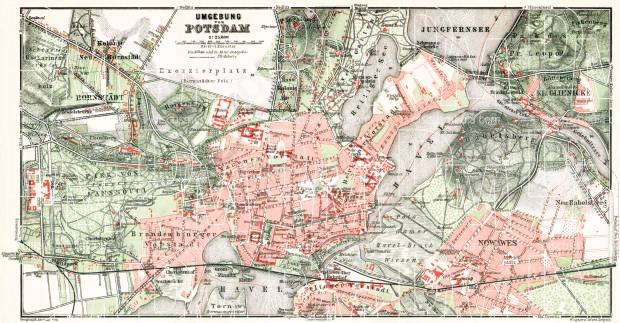
Finished the quiz, or just curious? Open a question to see the answer and the story behind it.
Answer: Beneath the oaks
The name Potsdam originally seems to have been Poztupimi . A common theory is that it derives from an old West Slavonic term meaning " beneath the oaks ", i.e., the corrupted pod dubmi/dubimi ( pod "beneath", dub "oak"). Although this remains disputed.
Answer: 1701
The Kingdom of Prussia was founded when Frederick III crowned himself "King in Prussia" as Frederick I on 18 January 1701 . Legally, no kingdoms could exist in the Holy Roman Empire except for Bohemia. However, Frederick took the line that since Prussia had never been part of the empire and the Hohenzollerns were fully sovereign over it, he could elevate Prussia to a kingdom.
Answer: Königsberg
In 1701, Frederick III crowned himself King In Prussia in the city of Königsberg . From that point, the city would act as the coronation city for the Prussian Kings.
Answer: Without worries
From the original French, Sanssouci, translates into English as " Without Worries ". Frederick the Great spoke French fluently and often prefered to speak it rather than his native German.
Answer: True
TRUE : Potsdam was founded in 993 – when it was first mentioned in a document as Poztupimi , when Emperor Otto III gifted the territory to the Quedlinburg Abbey, then led by his aunt Matilda.
Answer: Babelsberg
Babelsberg palace, near the border between Berlin and Potsdam and the Glienicker Brücke, was used by Wilhelm I before taking the throne.
Answer: A thief
Remembered more often for his patronage of art and for his sizable collections of art and armor, Prince Charles was the brother of future Emperor Wilhelm I and to Prussian King Frederick Wilhelm IV. As a result of his great collection of art treasures, of questionable origin and acquired in questionable manner, it was joked at the time that had Charles not been born a prince, he would have been born a thief .
Answer: The Potsdam Garrison Church
On the morning of August 17th 1786, Frederick died in an armchair in his study at Sanssouci, aged 74. Contrary to his wishes that he be buried in from of Schloss Sanssouci, along with his Italian Greyhounds, Frederick the Great was buried in the Potsdam Garrison Church – on the orders of his nephew and successor, Frederick William II.
Answer: The Miracle of the House of Brandenburg
The inability for the Russian and Austrian forces to follow up on their success at the Battle of Kunersdorf was referred to as the Miracle of the House of Brandenburg by Frederick the Great. A term he would also use to describe the sudden death of Empress Elizabeth of Russia in January 1762 that led to the succession of Peter III, her Germanized pro-Prussian nephew. This led to the collapse of the anti-Prussian coalition in the Seven Years War; as Peter immediately promised to end the Russian occupation of East Prussia and Pomerania, returning them to Frederick.
Answer: Churchill lost an election to Attlee
Due to the late return of ballots from soliders overseas, the result of the 1945 British election was delayed until the middle of the Potsdam Conference – whereupon Winston Churchill was replaced by Clement Attlee after losing the election to the Labour party .
Answer: Italian Greyhounds
Frederick the Great famously kept Italian Greyhounds .
Answer: False
FALSE : the ability to translate Egytian hieroglyphics was not possible until after the construction of this obelisk – following the discovery of the Rossetta Stone in 1799 during the Napoleonic campaign in Egypt.
Answer: A refrigerator
This pyramid structure from the Neuer Garten in Potsdam was used as a refrigerator during the Prussian times – when ice from the nearby Heiligen See would be stored here in the winter, the building maintaing the ice during the summer. The cellar of the structure is 5 meters deep in the ground, with a size of 2 meters square.
Answer: Frederick II
One of Adolf Hitler's prized possession was a painting of Frederick the Great (Frederick II) , painted by Swiss painter Anton Graff and produced in 1781. Contemporaries claimed it was the best and most accurate portrait of Frederick the Great. It is the most famous, most copied and most reproduced portrait of the King of Prussia.
Answer: True
TRUE : Frederick the Great is considered to have popularised the term 'a dog is a man's best friend' – and as mentioned in previous answers, was a great friend of his Italian Greyhounds – seen pictured here.
Answer: Soldiers who had fought against Napoleon
King Frederick William III of Prussia established the Iron Cross as a military decoration on March 17th 1813 during the Napoleonic Wars – to be awarded to soldiers who had fought against Napoleon . The award was backdated to the birthday of his late wife, Queen Louise (March 10th), and Louise would be the first person to receive this decoration. Albeit posthumously.
Answer: False
The title 'King Of Prussia' was first adopted in 1772 by Frederick the Great following his annexation of vital parts of the Polish-Lithuanian Commonwealth. Until this point, the Prussian King would only be known as the 'King In Prussia', due to Prussia's relationship with the Holy Roman Empire.
Answer: Denmark
The Wars of Unification were fought against three states; Denmark , Austria, and France, and led to German Unification in 1871.
Answer: Reich President Paul von Hindenburg
The 'Day of Potsdam' as it is known by historians described the meeting of Adolf Hitler and Reich President Paul von Hindenburg at the Garrison Church in Potsdam. Seen as a reckoning with the old and new of German society and politics, this meeting would take place at the church where Frederick the Great was buried in 1786.
Answer: 1947
The formal abolition of Prussia occurred on February 25th 1947 , with the introduction of Control Council Law No. 46, passed by the Allied occupation authorities. This law starts: "The Prussian State which from early days has been a bearer of militarism and reaction in Germany has de facto ceased to exist."
Liked this piece? Have a look at the Berlin Experiences tours that cover this history.
See the Royal Potsdam TourMore articles →Go deeper
Explore in person
Private 6-hour day trip from Berlin to the palaces and parks of Potsdam for up to 6 people. Starts at your hotel in Berlin.
More reading


