

The Sachsenhausen Camp Tour
Private 5-hour van tour from Berlin to the Sachsenhausen Memorial for up to 6 people. Starts at your hotel in Berlin.

The inhumanity conjured up in the Sachsenhausen Concentration Camp is undeniable - can you pin down the facts in our Invention of Hell quiz?
By Matt Robinson · Updated · 20 questions
Answer all 20 questions — we’ll reveal the correct answer and the story behind it as you go.
Finished the quiz, or just curious? Open a question to see the answer and the story behind it.
Answer: A triangle
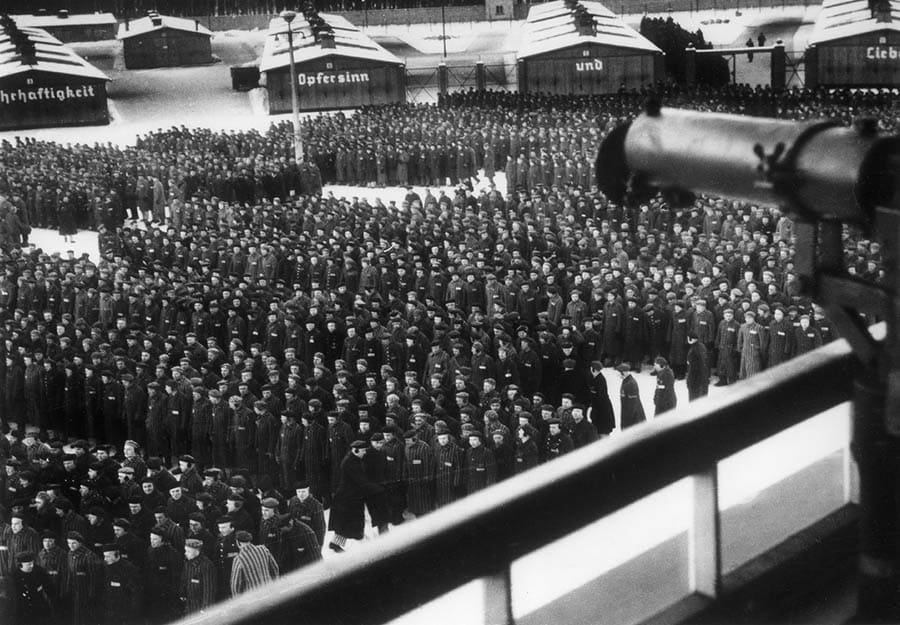
The camp perimeter of the main area of Sachsenhausen is an equilateral triangle with a semi circular roll call area centered on the main entrance gate in the boundary running northeast to southwest. The barracks houses (as seen in the picture above) were connected to this roll call area – with guards in Tower A provided with a clear line of sight to control the prisoners, if necessary, using a Maxim machine gun (also pictured).
Answer: Arbeit Macht Frei
Almost all of the Nazi concentration camps had the words Arbeit Macht Frei (Work Makes Free or Work Sets One Free) on their entrance gates – the exception being Buchenwald, where the text Jedem Das Seine (to each his own) was visible instead.
Answer: A brewery
On 21 March 1933, the Day of Potsdam, on which Germany’s conservative elites bestowed their seal of approval on Hitler, the first state concentration camp in Prussia was set up by the local SA regiment, Standard 208, in a disused brewery in the centre of the town of Oranienburg.
Answer: The Summer Olympics
Originally scheduled for the summer of 1916, the Games of the XI Olympiad – were eventually held in 1936. Known as the 1936 Summer Olympics , they would also be dubbed 'the Nazi Games', and coincide with the construction of the Sachsenhausen camp in August of that year.
Answer: Claus von Stauffenberg
Stalin's son, the man who murdered German diplomat Ernst von Rath in 1938, and the man who almost assassinated Hitler one year later, would all be imprisoned at Sachsenhausen. Claus von Stauffenberg , part of the Walkyrie plot to kill Hitler in 1944 would be shot in the courtyard of the Bendlerblock German Army headquarters on July 21st 1944 – less than 24 hours after his attempt.
Answer: Poland
Troops of the Red Army and the Polish 2nd Infantry Division of Ludowe Wojsko Polskie would be responsible for the liberation of Sachsenhausen on April 22nd 1945.
Answer: A counterfeiting operation
Operation Bernhard was a counterfeiting operation , named after the man in charge of this project – SS Major Bernhard Krüger – to forge British bank notes. One of the largest currency counterfeiting operations ever recorded.
Answer: A boot testing track
The track around the roll call area at Sachsenhausen was a boot testing track , where prisoners had to march over a variety of surfaces, to test military footwear; covering between 25 and 40km each day.
Answer: Purple
The Purple triangle was used in concentration camps to identify Jehovah's Witnesses – who would be referred to officially as 'Bible Researchers'.
Answer: Acting as chief Soviet prosecutor at the Nuremberg trials
Roman Rudenko would serve as the chief Soviet prosecutor at the Nuremburg War trials.
Answer: False
FALSE : Berlin's central Neue Wache, the Memorial for the Victims of War and Tyranny, now includes a statue designed by Käthe Kollwitz. When Sachsenhausen was opened in 1961 by the East German government, an obelisk was added to the centre of the camp as the new main memorial.
Answer: False
FALSE : There is no evidence that Adolf Hitler ever visited any of the Nazi concentration camps. Oversight of the concentration camp industry fell to Heinrich Himmler, Reichführer SS.
Answer: The headquarters of the Concentration Camp Inspectorate
The T building outside of the main Sachsenhausen site was used as the headquarters of the Concentration Camp Inspectorate from August 1938 until the end of the Second World War in 1945. Created by Theodor Eicke – commandant of Dachau – the CCI was the central SS administrative and managerial authority for the concentration camps of the Third Reich.
Answer: Station Z
The killing facility outside the main triangle at Sachsenhausen was known as Station Z . This was the name given by the SS to the building that contained four cremation ovens, a gas chamber, with an adjacent firing squad area. The use of the last letter of the alphabet being a cynical reference to the last station in the life of a prisoner.
Answer: Soviet Prisoners
In September 1941, around 13,000 Soviet Prisoners were murdered at Sachsenhausen – around 10,000 were executed in the camp by being shot in the back of the neck through a hidden hole in a wall.
Answer: True
TRUE : One of the lesser known aspects of concentration camp life is that some brothels (Lagerbordell) were established in 10 Nazi camp to create an incentive for prisoners to collaborate and perform better. The women forced into these brothels came mainly from the Ravensbrück concentration camp, except for Auschwitz, which employed its own prisoners.
Answer: The Saxon Greeting
Punishments at Sachsenhausen could be harsh, with some prisoners required to assume the " Sachsenhausen Greeting " – where a prisoner would squat with his arms outstretched in front for an extended period of time.
Answer: Adidas
AEG, Siemens, and Heinkel all employed slave labour at Sachsenhausen. There is no evidence that ADIDAS was involved at Sachsenhausen.
Answer: True
TRUE : As bizarre as it may sound, East German coupled did regularly visit the Sachsenhausen memorial and lay flowers for the Unknown Concentration Camp inmate at the base of the Obelisk (added by the East German government as a main memorial).
Answer: The Auer-Werke factory
In March 1945, the United States targetted the Auer-Werke in Oranienburg – one of the most important sites in Europe for the Nazi nuclear bomb programme. The military leader for the American 'Manhattan Project', General Leslie R. Groves, wrote in his memoirs: "One target of particular importance to us – the Auer-Gesellschaft works at Oranienburg, north of Berlin – where thorium and uranium metals were being produced on a large scale – was in the future Russian zone. These materials were both to be used for the generation of atomic energy and were therefore probably for the production of an atomic bomb. Since we did not have even the remotest possibility to seize the Auer-Werke, I recommended to General General Marshall to destroy them from the from the air."
Liked this piece? Have a look at the Berlin Experiences tours that cover this history.
See the Sachsenhausen Camp TourMore articles →Explore in person
Private 5-hour van tour from Berlin to the Sachsenhausen Memorial for up to 6 people. Starts at your hotel in Berlin.
More reading


