

The Berlin History Tour
Private 6-hour van tour of Berlin's whole history in one day for up to 6 people. Starts at your hotel or anywhere in the city.

Bist du ein Berliner? Take our 25 question Berlin Quiz and find out how much you know about the German capital and its history.
By Matt Robinson · Updated · 25 questions
Answer all 25 questions — we’ll reveal the correct answer and the story behind it as you go.
Finished the quiz, or just curious? Open a question to see the answer and the story behind it.
Answer: Swamp
Although the origin of the name Berlin is uncertain. It is popularly consider to have its roots in the language of West Slavic inhabitants of the area of today's city, and may be related to the Old Polabian stem berl-/birl- (" swamp ").
Answer: 1871
When Germany was founded in 1871 , following the Wars of Unification against Austria, Denmark, and France, Berlin became the capital of this new state.
Answer: The TV Tower
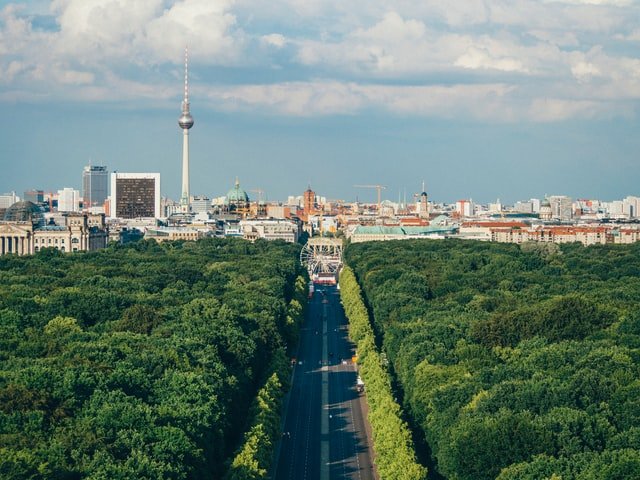
Commonly referred to as the TV Tower , but also known as the Berliner Fernsehturm. At a height of 368m, it is the tallest structure in Germany and the third tallest structure in the European Union.
Answer: True
There are more than 1,700 bridges in Berlin. Which means not only does Berlin have more bridges than Venice . It has more bridges than Venice, Amsterdam, and Stockholm combined.
Answer: 1961
Constructed on August 13th 1961 by the East German government, the Berlin Wall would stand for another 28 years 3 months and 28 days until the 'Fall of the Wall' on November 9th 1989.
Answer: Ronald Reagan
US President Ronald Reagan spoke on the western side of the Brandenburg Gate in June 1987, not only calling for Gorbachev to "Tear down this Wall" but importantly for many Berliners to "Open this Gate" – as the Brandenburg Gate was at that time inaccessible, stranded in the 'Death Strip' of the Berlin Wall.
Answer: Gold
The Berlin flag is red and white, bearing the black bear of Berlin — so red, white and black all feature, but not gold. Not to be confused with the German flag, which is black, red, and gold.
Answer: Spree
Like many cities, Berlin originally grew around a river – the river Spree . In fact it was here that two settlements – one called Berlin and the other called Cölln grew before being merged into one city in 1710 by Prussian King Frederick I.
Answer: Adolf Hitler
Although Adolf Hitler would become a naturalised citizen of Germany in 1932 – following his appointment as a low-ranking official for the city of Braunschweig – the future Führer was born in the Austrian town of Braunau am Inn and remained an Austrian citizen until renouncing his citizenship in 1925 to become a stateless individual for the next seven years.
Answer: Bear
The oldest preserved and known seal of Berlin is from 1253. It depicts the Brandenburg Eagle spreading its wings and was supposedly the seal of Berlin's first mayor Marsilius. However, in 1709, for the first time a bear appeared on the Berlin coat of arms, formerly alongside the eagles of Brandenburg and Prussia. The present day Berlin coat of arms was introduced in West Berlin in 1954, while the East German government used a slightly different version – both making use of the bear, that had by that time become something of a city mascot. Take a trip around the German capital today and you will see the bear everywhere…
Answer: Berlin
Berlin is not only a city but also a state – the capital of the state of Berlin is… Berlin .
Answer: Bonn
Whilst East Berlin would serve as the defacto capital of East Germany from 1949 until 1990; the West German government was based in Bonn – a city of around 300,000 located in the most populous of the current 16 German states: North Rhine-Westphalia. From 1990 to 1999, Bonn also served as the seat of government – but no longer capital – of reunited Germany.
Answer: U-Bahn
The Berlin underground network is known as the U-bahn . Whilst the S-bahn trains are predominantly overground (although with some notable exceptions), there are also some instances where the U-bahn appears overground too (albeit only for a few stations on the line).
Answer: 5
There are 5 museums on Berlin's Museumsinsel : the Altes Museum, the Neues Museum, the Alte National Galerie, the Pergamon Museum, and the Bode Museum. In July 2019, the James Simon Gallery was completed as the sixth building on the island and acts as a visitors centre.
Answer: 3,6 million
According to government statistics, there are 3.669.491 residents in Berlin as of December 31st 2019.
Answer: It was a famous meeting point in East Germany
Completed the same year as the Television Tower (seen in the background of the image), the Urania-Weltzeituhr was a popular meeting place in East Berlin . By walking around the clock it is possible to travel around the world and see the time in different time zones, with the important cities listed above and underneath the central clock section.
Answer: Prussia
From 1701, Berlin served as the capital of the Imperial Kingdom of Prussia – which would grow to become the largest state in Germany following Unification in 1871, with Berlin from that point serving as the capital of the united country. The Kingdom of Prussia continued as a Germany until 1918 when it was abolished in favour of a republic.
Answer: The Hohenzollerns
Elector Frederick III of the House of Hohenzollern established the Kingdom of Prussia by crowned himself "King in Prussia" and taking the title of Frederick I on 18 January 1701.
Answer: The Rathaus Schöneberg
Kennedy spoke to an audience of 120,000 from a platform erected on the steps of Rathaus Schöneberg on June 26th 1963 – at that time the building served as the seat of the state senate of West Berlin and as the seat of the Governing Mayor – future West German Chancellor Willy Brandt.
Answer: Potsdam
Officially known as the Glienicker Brücke , this green bridge connects Berlin with the neighbouring city of Potsdam but also connects the state of Berlin to the state of Brandenburg – which incidentally also has Potsdam as its capital. The Glienicker Brücke served as a Cold War era crossing point between West Berlin on one side and East Germany on the other – and as the only crossing point in the city that fell completely under the control of the Soviet authorities it was used to facilitate a number of spy exchanges. Including the exchange on February 10th 1962 of captured U2-pilot Francis Gary Powers for Soviet Colonel Rudolf Abel.
Answer: Schloss Bellevue
Schloss Bellevue has been the official residence of the President of Germany since 1994. Its name derives from the French – "beautiful view" – to refer to the vantage point it has over the nearby river Spree.
Answer: Tempelhof
Now known as Tempelhofer Feld, this city park was opened in 2008 and is located on the site of the former Tempelhof airport . During the Cold War era this airport was used by US occupation forces and played an important role in the Berlin Airlift.
Answer: ...building a Wall."
At a press conference on June 15th 1961, East German leader Walter Ulbrich was asked by the journalist Annemarie Doherr from the Frankfurter Rundschau whether creating a free city will involve building a state border at the Brandenburg Gate… to which he replied: “ I understand your question in this way: that there are people in West Germany who want us to mobilise the construction workers of the GDR capital to build a wall. Am I right? I am not aware of any such plans. Most of the capital’s construction workers are busy building flats and their manpower is being put to full use in these projects. Nobody has any intention of building a wall. ” Less than two months later, the construction of the Berlin Wall began on August 13th 1961.
Answer: David Hasselhoff
Wearing a piano-keyboard scarf and a leather jacket covered in Christmas lights, David Hasselhoff stood in a bucket crane and performed his song Looking For Freedom to a crowd gathered near the Brandenburg Gate on New Years Eve in 1989. While famous for his roles in Nightrider and Baywatch, Hasselhoff has also had a successful musical career, with his album, also named Looking For Freedom, going triple platinum in Europe in the 1980s. The title track even managed to reach number 1 in the West German charts.
Answer: Napoleon Bonaparte
Following the defeat of the Prussian army in the twin battles of Jena and Auerstedt, Napoleon Bonaparte triumphantly entered Berlin through the Brandenburg Gate on October 14th 1806. His army marched in dress uniform, while Napoleon, in disregard for his personal safety, rode alone, yards in front, in his humble colonel’s attire.
Liked this piece? Have a look at the Berlin Experiences tours that cover this history.
See the Berlin History TourMore articles →Explore in person
Private 6-hour van tour of Berlin's whole history in one day for up to 6 people. Starts at your hotel or anywhere in the city.

Private half-day walking tour of historic Mitte for up to 10 people. Starts at your hotel or anywhere in the centre.
More reading


