Skip to content
Berlin Experiences - Stolpersteine In Berlin

Berlin Experiences/Articles

Stolpersteine: Personalising The Void

By showing how easily people can mindlessly tread on the memorial stones of victims of such an appaling crime, the Stolpersteine highlight how easy it is...

Berlin Experiences · 30/10/25 · 7 min read

When I first travelled to Berlin, I discovered a subtle yet deeply affecting memorial for the victims of the Holocaust – the Stolpersteine. Translated, the word means ‘stumble stones’ – small brass plaques hammered into the city’s pavements that serve to personalise the victims of Germany’s Nazi past.

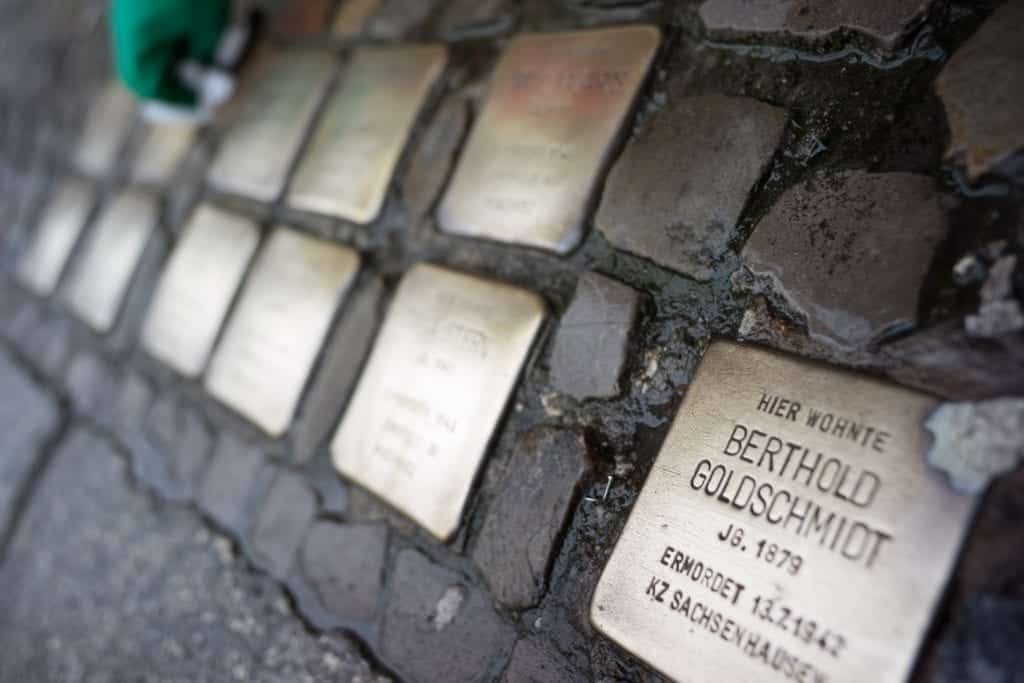
Not long after this I returned to Berlin to live and would stumble across these Stolpersteine with their haunting ‘Hier Wohnte…’ (Here lived…) inscriptions everywhere. Mostly in groups of two or three outside office and apartment buildings. However, it was only when I moved to the ‘Kiez’ (Neighbourhood) of Kreuzberg that they would become a routine part of my everyday life, as an unusual number of them (12 to precise) are situated outside my apartment block.

I now step over, and walking past, these memorials every day as I go about my daily business. 

The way the Stolpersteine interrupt my daily thoughts is truly a testament to the power of these memorials.

They are not only a reminder to pay my respects, but also have helped me grapple with the Holocaust in a way I struggled to before. The stones situated outside my residence made me want to know who the people memorialised were and have personalised what happened in a unique and unforgettable way. With a limited amount of detail – restricted to the names, dates of birth and death and final destinations of those memorialised – impressions of these victims began to form in my mind.

Started in the early 1990s by German artist Gunter Demnig, this extraordinary commemorative project has flourished across Europe with over 60,000 memorials laid – not only for Jewish victims, but also for Sinti, Roma, homosexuals, Jehovah’s Witnesses, the disabled, and others. These histories are typically researched by local individuals, often as part of school projects, and each stone is laid by the artist himself at a small ceremony, sometimes attended by surviving relatives.

Praised, Ignored, Banned, Vandalised and Removed

The reactions and interactions with Stolpersteine tell the story of the aftermath of the Holocaust in Europe and different reactions to remembrance. There have been stark contrasts between the ways different European communities have dealt with their pasts. The stones have been praised, ignored, banned, vandalised and removed – a spectrum that represents how individuals and groups deal with tragedy. 

Cleaning Berlin Stolpersteine

Although the Stolpersteine project has been largely embraced throughout Europe, and even Russia, (Wikipedia lists the Stolpersteine as ‘the world’s largest decentralised memorial’) there are places within Germany that are still resistant to the idea. For example, in 2004 (and again in 2015) the city of Munich voted to prohibit the introduction of the stones on public property, on the grounds that it is disrespectful to have people tread on the memorials. Choosing instead to memorialise these victims with commemorative plaques displayed on the walls of buildings.

Personally, I feel this approach is sadly lacking in the subtlety that makes the Stolpersteine project at its core exceptional. That the constant visibility of the Munich plaques risks normalising memorialisation to the extent of making it redundant and alienating people from the process of commemoration. Perhaps the fundamental beauty of the Stolpersteine project is that these bronze plaques, unlike something similar at eye level, can be easily missed – but can be also be discovered and rediscovered perpetually without violating your vision. Instead of being constantly confronted, there is the opportunity to have your existence unexpectedly interrupted.

I find that the specific allegation that the memorials being laid on the ground leads to people disrespecting them is a misunderstanding of their purpose: they are not graves – they are markers. Reminders designed to punctuate your daily wandering and instigate thought.

Perhaps more poignantly, by also showing how easily people can mindlessly tread on the memorial stones of victims of such a heinous crime, the Stolpersteine highlight how easy it is for humans to be blind to atrocity. And how easy it can be for people to be ignorant of the past.

Truly, the Stolpersteine go beyond memorialisation and reflect the human condition – as powerful art always does.

The Unfathomable Statistic

Commemorative plaques and memorials are rarely laid en-masse for ‘ordinary people’ (non-military casualties), despite the fact that ordinary people made up the overwhelming majority of those who suffered from Nazi persecution. Studying the Holocaust can be paralysing when confronted with the unfathomable number of people who died in its duration. The sheer number of people murdered can make it difficult to think about it in a non-abstract way. As Gaby Melk – an active contributor to the Stolpersteine project – poignantly states: “The Holocaust is too big to imagine, but if you give victims a face and a story, they will be remembered as humans”.

The concept of the ‘unfathomable statistic’ can be uniquely experienced by exploring Berlin’s immense Memorial to the Murdered Jews of Europe. Peter Eisenman, the architect who designed this field of weathered grey stelae, is famous for his elusiveness in any discourse about its meaning and has offered only limited commentary, including “in this monument, there is no goal, no end… the duration of an individual’s experience of it grants not further understanding since understanding is impossible”.

While symbolising the unfathomability of the Holocaust is important – as Eisenman illuminates – this is not where remembrance should end.

The more classical rendering of the Room of Names, presented as the climax of the information centre located beneath the Memorial for the Murdered Jews of Europe, attempts to help people grapple with the Holocaust by presenting the individual biographies of the Jews murdered as an audio-visual installation to “release the victims from their anonymity”.  The project is still collecting names and stories of the victims to be heard and displayed. The current estimate is that the resurrection of these biographies in a relatable form is a process which would take approximately six years, seven months and twenty-seven days. Experienced back-to-back this journey risks relegating a chorus of the millions of voices to white noise – and can only be experienced in manageable chunks, whereby you are left to portion off the amount you can suitably digest before becoming satiated.

Like the Holocaust Memorial, of which the Information Centre is a part, this location has no connection to the actions documented – it was never a perpetrator or victim site. Despite the best of intentions, this format feels to have been reduced to a gimmick. An incomprehensible number expressed in immense detail; in a setting that offers no humanising connection.

Stolpersteine in Berlin on the street

Making The Unfathomable, Fathomable

Making the unfathomable, fathomable is the space that the Stolpersteine inhabit. They are simple yet effective. The project goes beyond naming the victims of the Holocaust and holding them hostage to the distressing minutiae of their fates – it integrates the memory of the Holocaust into everyday life. It powerfully contextualises in a way that the other memorials cannot. While resisting the impulse to sensationalise.

Subsequently, I have found a new interest in the people memorialised outside my apartment block.

There is a little girl about two years of age who often plays in the back garden. She is the same age as Tana Taba Stern, the little girl that lived in the apartment block I now call home until she was sent to her death at Auschwitz in 1943. Sometimes I watch the little girl run around without a care and think about Tana doing the same, completely unaware of what was happening around her. The stones have actually made me think directly about the Holocaust in a way that is relevant to my everyday life – crossing the threshold of distance that exists with a history book or when visiting a memorial.

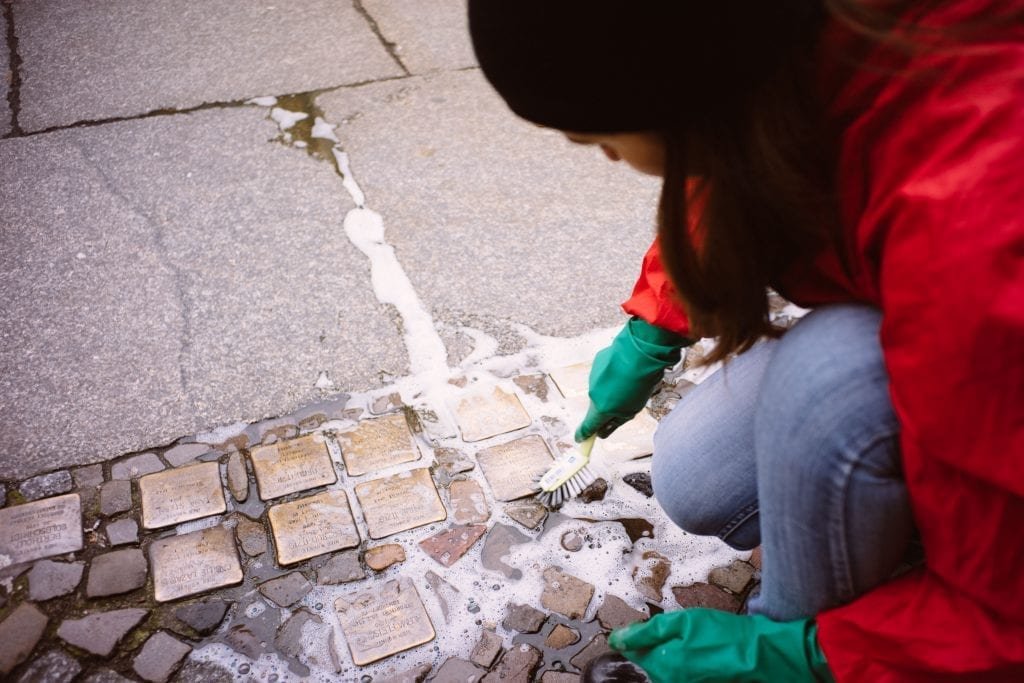
On International Holocaust Remembrance Day, I decided to wash the Stolpersteine outside my apartment to honour the twelve people named. This drew the attention of many passersby; many who remarked they had been ignorant of the fact that the stones were there.

No Holocaust memorial will ever be adequate. However, the Stolpersteine project is an intergenerational memorial and honours the victims of the Holocaust like nothing else. It is a memorial that, as the years roll by and as (hopefully) more stones are laid, will become increasingly visible in public spaces. Thus, the more the collective memory of the Holocaust fades into the past, inversely, the more the Stolpersteine memorials become harder to ignore. 

As the artist responsible for the Stolpersteine project has himself said “Giving names back to the dead is a way of keeping them alive”.

–

The 12 stones in front of my apartment were laid in remembrance of the following people:

1.Norma Fleischer:
born 11.12.1930 in Berlin
deported 26.02.1943 to Auschwitz
murdered in Auschwitz

2.Erich Lustig:
born 22.10.1906 in Berlin-Köpenick
deported 26.02.1943 to Auschwitz
murdered in Auschwitz

3.Ida Lustig (maiden name Eilberg):
born 06.01.1913 in Berlin
deported 26.02.1943 to Auschwitz
murdered in Auschwitz

4.Arthur Itzig:
born 05.06.1894 in Soldau (East Prussia)
deported 26.02.1943 to Auschwitz
murdered in Auschwitz

5.Gertrud Itzig (maiden name Lazarus):
born 05.23.1898 in Neidenburg/Nidzica (East Prussia)
deported 26.02.1943 to Auschwitz
murdered in Auschwitz

6.Amalie Itzig
born 03.10.1921 in Neidenburg/Nidzica (East Prussia)
deported 26.02.1943 to Auschwitz
murdered in Auschwitz

7.Gerd Peter Itzig
born 10.05.1928 in Königsberg/Kaliningrad (East Prussia)
deported 26.02.1943 to Auschwitz
murdered in Auschwitz

8. Berthold Goldschmidt:
06.07.1879 in Gostin (Schlesien)
imprisoned in Sachsenhausen
murdered 13.07.1942 in Sachsenhausen

9. Cäcilie Lazarus:
born 20.04.1900 in Neidenburg/Nidzica (East Prussia)
deported 26.02.1943 to Auschwitz
murdered in Auschwitz

10. Tana Taba Stern:
born 25.12.1941 in Berlin
deported 26.02.1943 to Auschwitz
murdered in Auschwitz

11. Morduch Raichlin:
born 07.01.1879 in Sienicze (Russian Empire)
imprisoned 13.09.1939 in Sachsenhausen
murdered 16.01.1940 in Sachsenhausen

12. Frieda Raichlin (maiden name Schalminis):
born 04.05.1887 in Polangen (Russian Empire)
deported 13.01.1942 to Riga
murdered in Riga

Liked this piece? Have a look at the Berlin Experiences tours that covers this fascinating history.

Book the The Jewish Berlin TourMore articles →

Share this piece

Know someone who still believes it?

Explore in person

Tours that explore this story.

The Jewish Berlin Tour
One Hour1 Hour

The Jewish Berlin Tour

Our Jewish Berlin Tour is a one hour expert-led private guided tour of Berlin's former Jewish Quarter and the history of its Jewish minority.

€200up to 10
View Tour

More reading

Other essays.

31 more — drag, scroll or use the arrow keys.

Inside Berlin's Reichstag - Norman Foster
55 Things You Should Know Before Visiting Berlin
Berlin Experiences - Soviet Tanks In Berlin
Allied Victory Parade 1945: The Forgotten Parade
Brandenburg Gate
Battle Of Berlin Quiz: Test Your Battle Of Berlin Knowledge?
BER Airport - the Fiasco Flughafen
Berlin Brandenburg Airport – Behind The Scenes
Unter den Linden - Berlin's Avenue of Failed Assassinations
Berlin’s Avenue Of Failed Assassinations: Unter Den Linden
Strange clock in West Berlin
Berlin’s Most Unusual Objects – Explore Berlin In Objects
Berlin Experiences - The British Victory Parade In Berlin
British Victory Parade 1945: Desert Rats! May Your Glory Ever Shine!
Hitler Speech 1933
Capital Of Tyranny Quiz: How Much Do You Know About Nazi Germany?
The Day The Wall Fell sculpture in Berlin
Cold War Era Artefacts – Explore Berlin In Objects
Berlin Experiences - The Berlin Wall Escapes
Eight Strangest Berlin Wall Escapes
Berlin's Rotes Rathaus and the Berlin flag
Experience A City In Objects – Explore Berlin In Objects
Potsdam in Prussia - Landscape
Glory Of Prussia Quiz: How Much Do You Know About Potsdam?
Sachsenhausen Tower A
Invention Of Hell Quiz: How Much Do You Know About Sachsenhausen?
Matt Robinson: Private Guide Profile
Günter Litfin - the first victim of the Berlin Wall
On this day: Guenter Litfin is killed trying to escape to West Berlin
Ida Siekmann - the first Berlin Wall victim
On this day: Ida Siekmann becomes the first known victim of the Berlin Wall
Napoleon Arrives In Berlin - 1806
On this day: Napoleon Boneparte announces the Berlin Decree (21st November 1806)
Hegel the Philosopher
On this day: Philosopher G.W.F. Hegel dies (14th November 1831)
On this day: The Berlin Airlift officially ends
1936 Summer Olympics Opening Ceremony
Our Favourite Facts about the 1936 Summer Olympics
Prometheus Statue Berlin
Remnants Of Nazi Berlin – Explore Berlin In Objects
The Berlin Expert Quiz - Palast Der Republik
Republic Of Fear Quiz: Test Your Knowledge Of East Germany
Berlin War Damage in the Mitte district
Scars Of Battle: War Damage In Berlin
Cold War Tour Of Berlin - Bernauer Strasse Berlin Wall Memorial
Ten Great Reasons To Tour The Berlin Wall
The Berlin Expert Quiz - TV Tower
The Berlin Expert Quiz: Are You A Berlin Expert?
The Berlin Quiz - Berlin Skyline
The Berlin Quiz: How Much Do You Know About Berlin?
Ernst Thälmann Island - The Last Piece Of East Germany
The Last Piece Of East Germany – Ernst Thälmann Island
Paul Ogorzow - The S-Bahn Murderer
The S-Bahn Murderer: A Serial Killer In Nazi Berlin
Sachsenhausen Concentration Camp Pamphlet
The Sachsenhausen Concentration Camp In The DDR
Berlin Experiences - Caspar David Friedrich
Top Ten Must-See Berlin Museums
The Kreuzberg in Berlin
Traces Of The Iron Kingdom – Explore Berlin In Objects