“In the very wide and mostly sandy surroundings of Berlin, which are so poor in attractive regions…”
Friedrich Nicolai, writer and bookseller of the Berlin Enlightenment
There is an old saying among Berliners, a piece of dry folk wisdom often delivered with a shrug: “Berlin ist aus dem Sumpf gebaut” – Berlin is built out of a swamp.
Another, more pointed version declares that the city’s true founder was not some great margrave or king, but the humble eel. These are not mere poetic exaggerations.
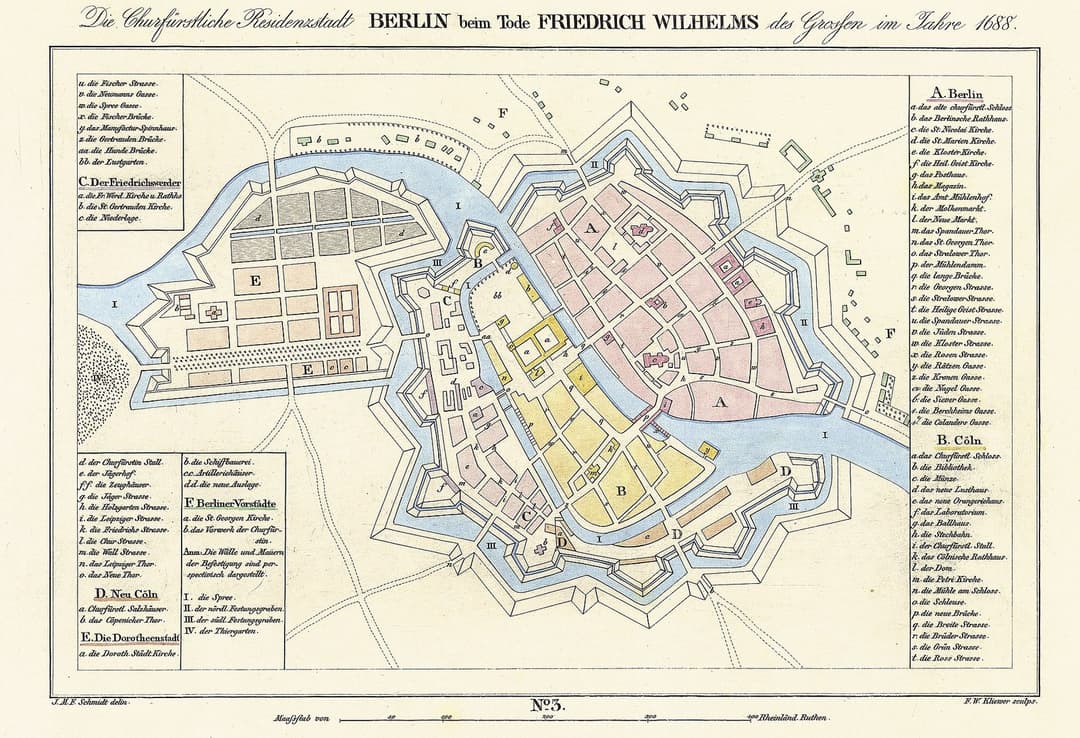
They are the foundational truth of the German capital, a truth that echoes in the city’s very name, which is thought to derive from the old West Slavic word “berl,” meaning swamp or marsh.
For centuries, this was a battle fought largely out of sight.
The city’s founders drove thousands of oak and pine piles deep into the sodden earth to support their first modest stone buildings. The grand architects of Prussia’s golden age devised ingenious foundations to raise their neoclassical monuments on what was essentially a massive sandbar soaked in water.
For generations, the enemy was wet, silent, and subterranean.
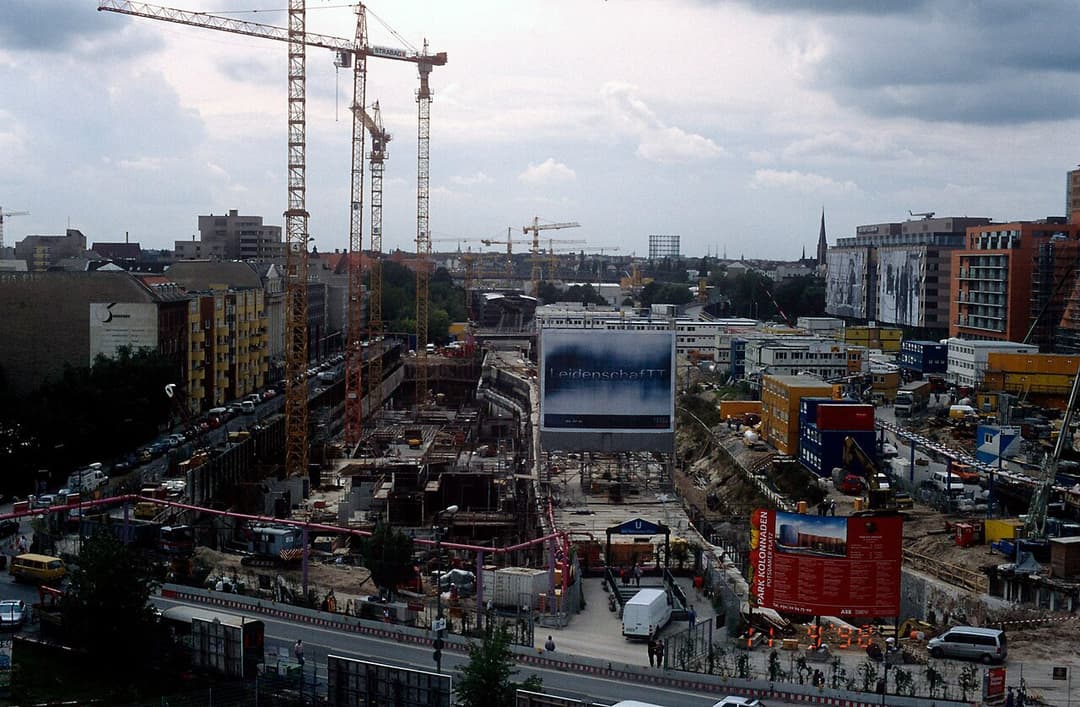
Then, after the Wall fell in 1989, the enemy came into the open. As the reunited city plunged into a fever of reconstruction, digging new U-Bahn lines, new government buildings, and new corporate headquarters, the ancient swamp reasserted its claim. To build down, developers first had to fight down.
And that is when they appeared.
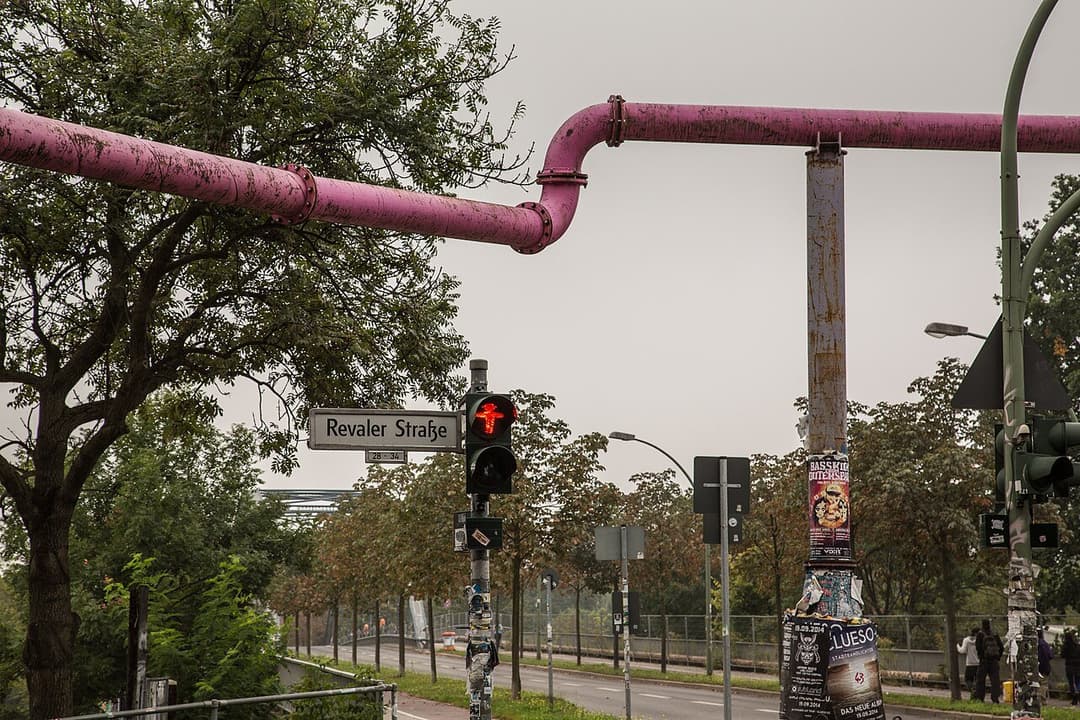
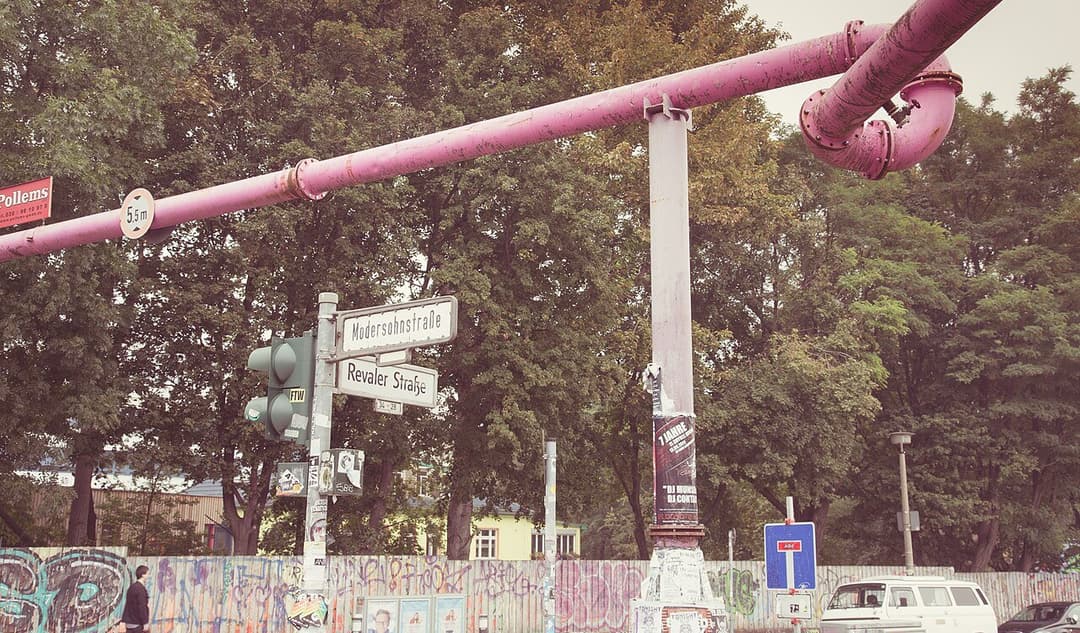
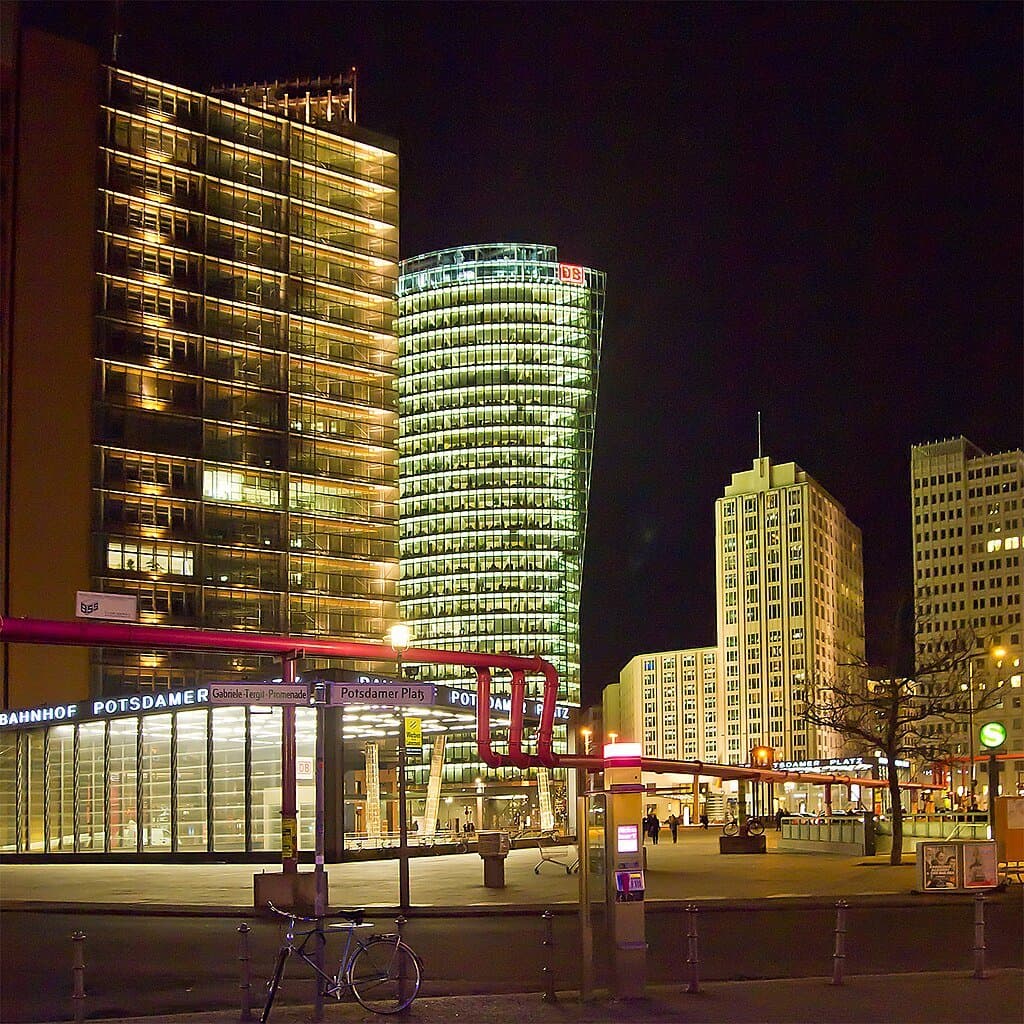
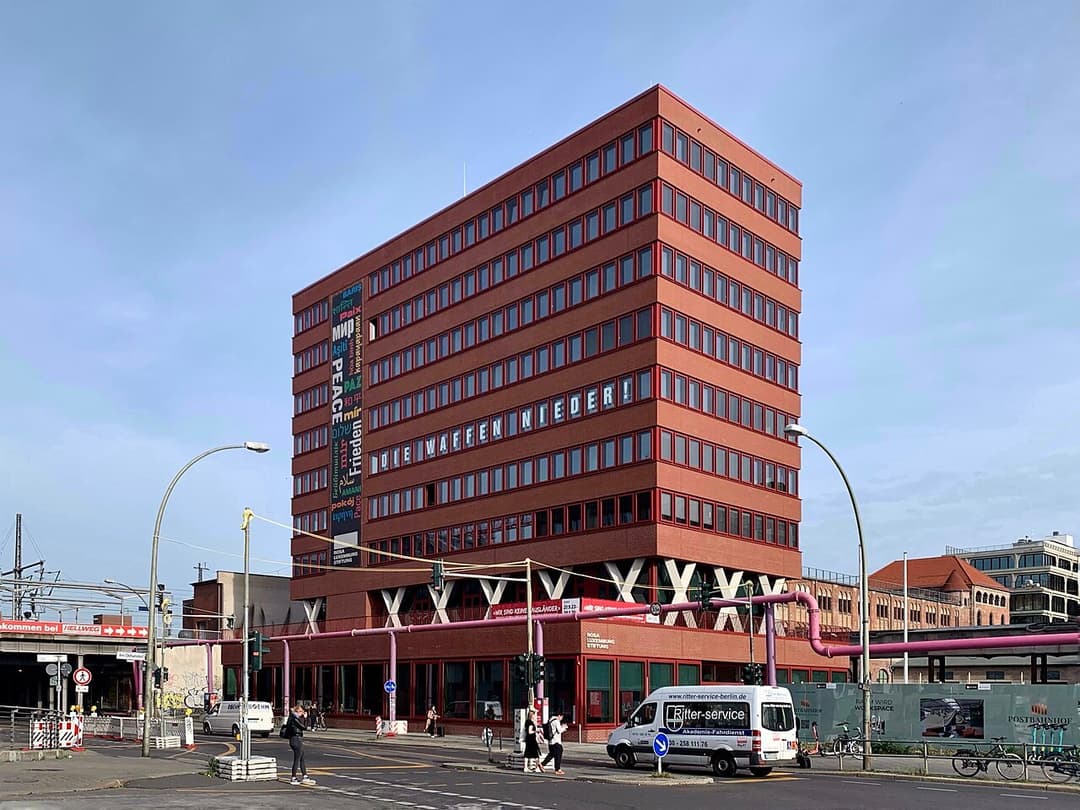
First a few, then dozens, now a seemingly permanent, sprawling network of them: the bright pink pipes. They became the visible, almost cheerful, manifestation of the city’s oldest and most relentless engineering challenge.
They are the city’s second river, an overground, industrial artery doing the work that the Spree river alone cannot.
–
Berlin's Topography: Swamp, High-Water Line, and WWII Bombs
“The ground of Berlin is nothing but sand; not a stone, not a pebble is to be found in it.”
Esteban de Borgoña, Spanish Ambassador, 17th Century
To understand the pipes, one must first understand the ground.
Berlin does not sit on solid bedrock. It rests within the Berlin-Warsaw Urstromtal, a vast glacial valley carved by meltwater at the end of the last Ice Age some 18,000 years ago. As the glaciers retreated, they left behind a landscape that is less a part of Germany and more a part of the great North European Plain—flat, sandy, and marshy.
The Spree River meanders through this valley not like a torrent carving a canyon, but like a lazy stream struggling to find a path through a waterlogged sandbox.
The city’s groundwater is astonishingly high, lurking just two meters (about six feet) below the surface in most central districts. Early settlers in the twin towns of Cölln and Berlin in the 13th century knew this instinctively.
They built their homes on the slightly higher ground of sand dunes and islands, but every well they dug, every foundation pit they excavated, quickly filled with brackish water. The great 19th-century boom, the Gründerzeit, transformed Berlin into a metropolis, but the swamp remained.
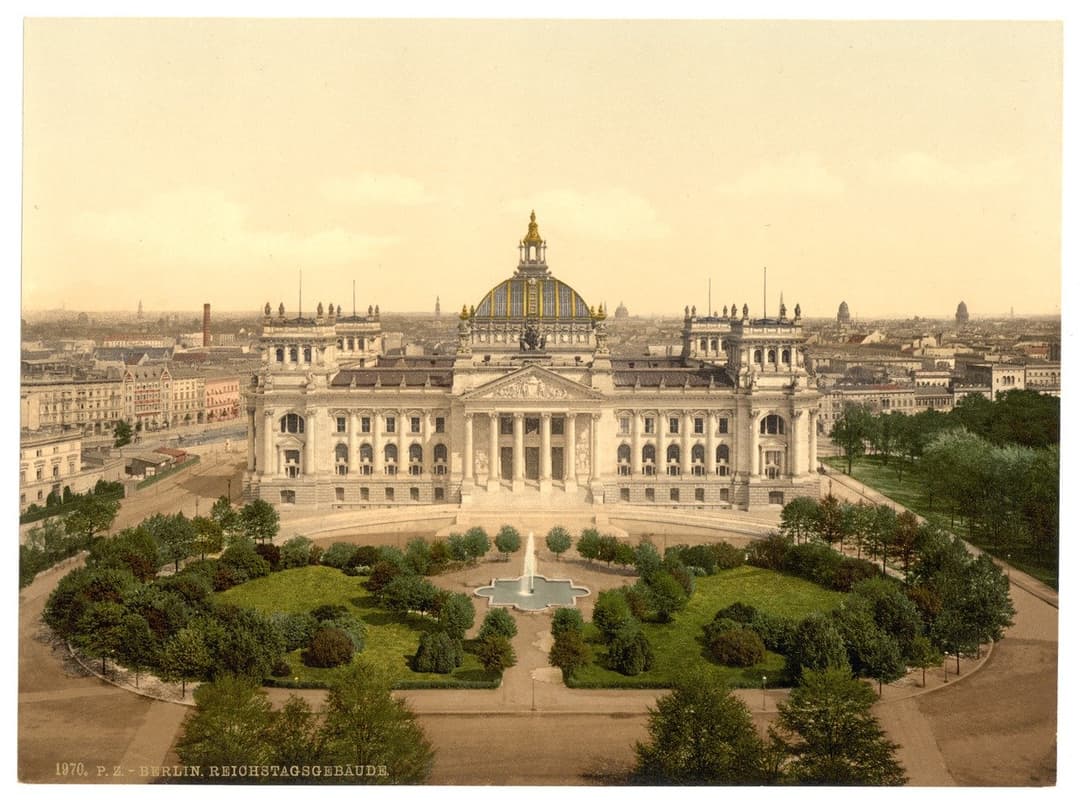
Building the Reichstag in the 1880s was a monumental feat of hydrological defiance.
Its foundations had to be laid on a colossal bed of 1,234 concrete-filled piles driven into the muck. The construction of the U-Bahn system in the early 20th century was a slow, perilous war against constant flooding and soil liquefaction.
This subterranean water is not still. It ebbs and flows, creating a shifting, unpredictable environment for any subterranean structure. For today’s engineers, the problem is acute.
Digging a multi-level basement for a new office block or carving out a new subway station is not simply a matter of excavation; it is an act of temporary dam-building. As soon as the diggers bite into the earth, the ancient swamp begins to seep in, threatening to flood the site and destabilize the surrounding sandy soil.
This problem is compounded by a darker, more violent legacy.
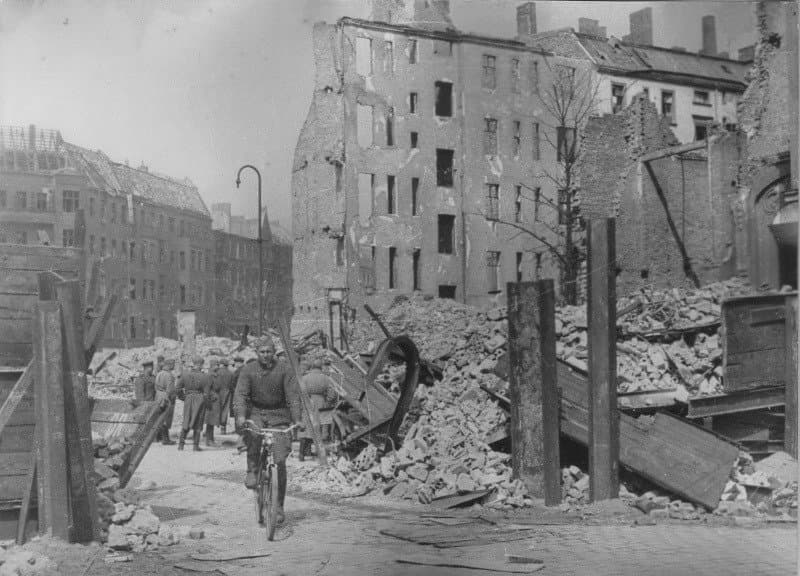
Berlin’s soil is not just full of water; it is contaminated with the iron of the Second World War. Allied bombing and the final, brutal Battle of Berlin left the ground seeded with thousands of unexploded bombs, shells, and other ordnance (UXO). Every major construction project in Berlin is preceded by painstaking work to detect and remove these dormant threats.
This process often requires deep, careful excavation. The pink pipes, therefore, are often the visual heralds of two simultaneous battles: the fight against the high water table, and the search for the ghosts of the war.
To defuse a half-ton British “Blockbuster” bomb, one must first hold back the unseen river that has encased it for eighty years.
The presence of the pipes at a construction site is an almost certain indicator that a search for UXO is either planned or in progress, inextricably linking the city’s geology with its violent history.
–
The Overground Pipes: Pink & Other Colours
“We wanted a color that would bring a smile to people’s faces, especially children’s. Construction is a nuisance, so why not make its most visible aspect something cheerful?”
Bernd Kempf, managing director of Pollems, to the BBC
The solution to the groundwater problem is, in principle, simple: you pump the water out of the construction site as you dig, creating a temporarily dry zone.
This water then needs to go somewhere. It cannot simply be poured into the city’s sewer system, which would be immediately overwhelmed and is, in any case, a costly, metered service. The water must be returned to the city’s natural waterways—the Spree River or the Landwehr Canal.
This is the job of the pipes.
They are a vast, temporary, and mobile network of dewatering channels. Powerful pumps on-site suck up the groundwater and push it through these elevated tubes, which carry it, sometimes for kilometers, until it can be safely discharged.
But this explanation, while technically correct, misses the most captivating part of the story: why pink?
The overwhelming majority of the pink pipes belong to the firm Pollems, a company that has been involved in Berlin’s water management for over a century.
When faced with the task of laying kilometers of unavoidable, visually intrusive piping across the post-reunification cityscape in the 1990s, the company made a brilliantly unorthodox decision.
Instead of choosing a drab, industrial grey or a forgettable black, they opted for vibrancy. Bernd Kempf, the company’s managing director, recounted to the BBC that they consulted a psychologist about what color to use.
Her advice was immediate: pink and purple. These were the colors, she argued, that children overwhelmingly preferred. They were colors associated with playfulness, creativity, and a certain joyful rebellion.
Pollems chose RAL 3015, a shade known as “light pink.”
It was a stroke of genius.
The pipes, which could have been an oppressive symbol of endless construction and disruption, instead became a beloved city quirk. They transformed a purely functional piece of engineering infrastructure into something that felt like public art.
The choice was a nod to Berlin’s burgeoning reputation as a city that was young, creative, and didn’t take itself too seriously. Instead of trying to hide the messy work of rebuilding, the city (and Pollems) flaunted it with a playful wink.
Of course, not all the pipes are pink.
Observant visitors will notice sections of bright blue piping snaking through the city. These belong to a competing company, Brechtel, and serve the exact same function.
While the pink pipes remain the iconic symbol, the flashes of blue serve as a reminder that holding back a swamp is a competitive business.
The pipes also have another peculiar feature: their seemingly random bends and loops. They rarely run in a straight line for long, preferring to curve and undulate like a drowsy serpent. This, too, is a feat of practical engineering, not aesthetics.
The pipes are made of steel, which expands in Berlin’s hot summers and contracts sharply in its frigid winters. A long, straight, rigid pipe would be placed under immense stress by these temperature fluctuations and would be prone to cracking.
The gentle, loopy bends act as expansion joints, allowing the metal to shrink and grow without breaking. It is another example of function dictating a form that feels, to the casual observer, like pure whimsy.
–
Conclusion
“To build the Reichstag, we first had to conquer the Spree.”
Paul Wallot, architect of the Reichstag
The pink pipes of Berlin are the perfect metaphor for the city they serve. They are a practical, ingenious solution to a relentless problem, dressed in a costume of playful absurdity.
They are a constant, visible reminder that this glittering metropolis is, at its heart, a precarious settlement built on sand and water. They are a testament to the city’s endless cycle of destruction and reconstruction, linking the meltwater of the Ice Age to the unexploded bombs of the Second World War and the ceaseless construction of the 21st century.
They debunk the myth of Berlin as an old, established European capital built on solid rock.
The reality is far more interesting. Berlin is a city in a constant state of becoming, a place that has to perpetually fight its own foundations to reinvent itself. The next time you visit and see a bright pink tube snaking its way over a busy avenue, you will know its story. You are not seeing a mere pipe; you are seeing the tip of a hydrological iceberg, the physical manifestation of a city’s centuries-long battle with the swamp it conquered, and a cheerful symbol of the defiant, creative, and perpetually unfinished spirit of Berlin.
Bibliography
Beevor, Antony. The Fall of Berlin 1945. Viking, 2002.
Richie, Alexandra. Faust’s Metropolis: A History of Berlin. Carroll & Graf, 1998.
Large, David Clay. Berlin. Basic Books, 2000.
MacDonogh, Giles. Berlin: A Portrait of Its History, Politics, Architecture, and Society. St. Martin’s Press, 1998.
Ribbe, Wolfgang (ed.). Geschichte Berlins: Erster Band. C.H. Beck, 2002.
Liked this piece? Have a look at the Berlin Experiences tours that cover this history.
See the Berlin Explorer TourMore articles →Explore in person
Tours that address this myth.

The Berlin Explorer Tour
Private half-day walking tour of historic Mitte for up to 10 people. Starts at your hotel or anywhere in the centre.

The Bitesize Berlin Tour
Private 3-hour van tour of Berlin's major sights for up to 6 people. Starts at your hotel or anywhere in the city.
More reading
The other myths, busted.
49 more — drag, scroll or use the arrow keys.


UNIQUE EXPERIENCES FOR MODERN EXPLORERS

