“Berlin is the capital of the 20th century because it is the capital of memory. It remembers what other cities try to forget.”
Neil MacGregor, Historian (Germany: Memories of a Nation)
Berlin is a city that wears its scars openly, yet it is also a master of camouflage. The physical erasure of the Third Reich was so thorough that a visitor walking down Unter den Linden today would be hard-pressed to find a single swastika.
This absence creates a vacuum that is often filled by myth.
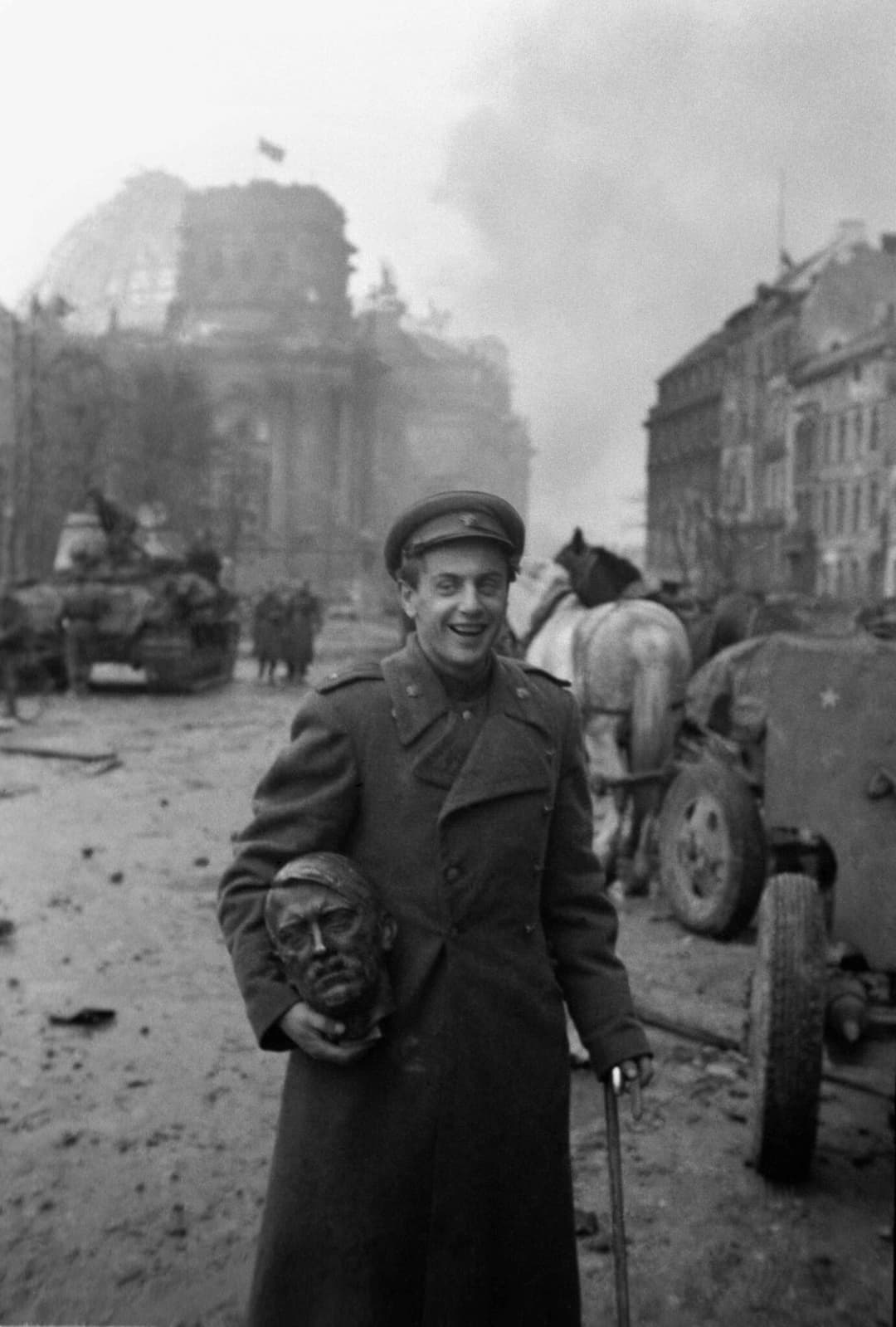
The most common assumption is that Berlin was once cluttered with statues of Adolf Hitler and that these were all toppled in a Lenin-in-Ukraine style purging after May 1945.
The reality is far more interesting.
The absence of Hitler statues is not just a result of Allied destruction; it was, paradoxically, a result of Nazi design.
And while the man himself is missing from the plinths, his heraldic avatar – the Reichsadler – is still perched on facades across the city, if you know where to look.
–
The Prohibition on the Erection of Monuments to the Führer
“The prohibition of statues was a masterstroke of propaganda. By making himself invisible in stone, he made himself ubiquitous in spirit.”
Ian Kershaw, Historian
In the early days of the Third Reich, sycophancy was rampant.
Local mayors and party officials, eager to curry favor with the new Chancellor, began commissioning busts and planning town square monuments in his honor.
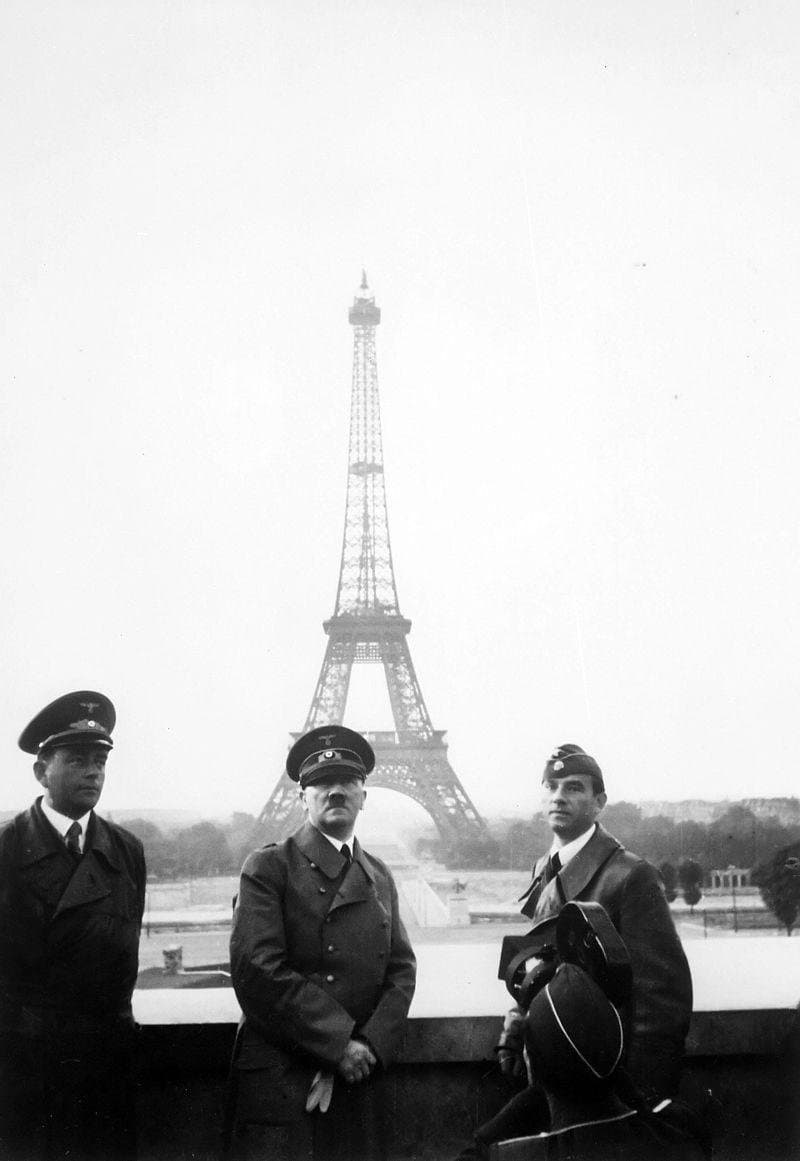
Hitler, however, was a man obsessed with control—specifically, control over his own image.
He viewed these provincial, often artistic failures as an embarrassment.
Consequently, in December 1933, the Reich Minister of the Interior issued a decree that baffled many of the party faithful: “The Führer has again decreed that no Hitler monuments, memorial plaques, or the like may be erected or placed during his lifetime. Insofar as this has already been done, the monuments and plaques are to be removed immediately.”
Why would a narcissist ban monuments to himself?
Hitler’s vanity was not the vanity of a traditional monarch; it was the vanity of a messiah.
He believed that Germany itself was his monument.
He didn’t want to be a statue gathering pigeon droppings in a market square; he wanted to be the architect of the entire state.
Furthermore, he was acutely aware of the transient nature of bad art.
He feared that mediocre sculptors would create caricatures that would undermine his ‘divine’ aura.
The only exceptions were busts for indoor display in official buildings, which were strictly regulated by the Reichskammer der Bildenden Künste (Reich Chamber of Fine Arts).
The Money vs. The Stamp
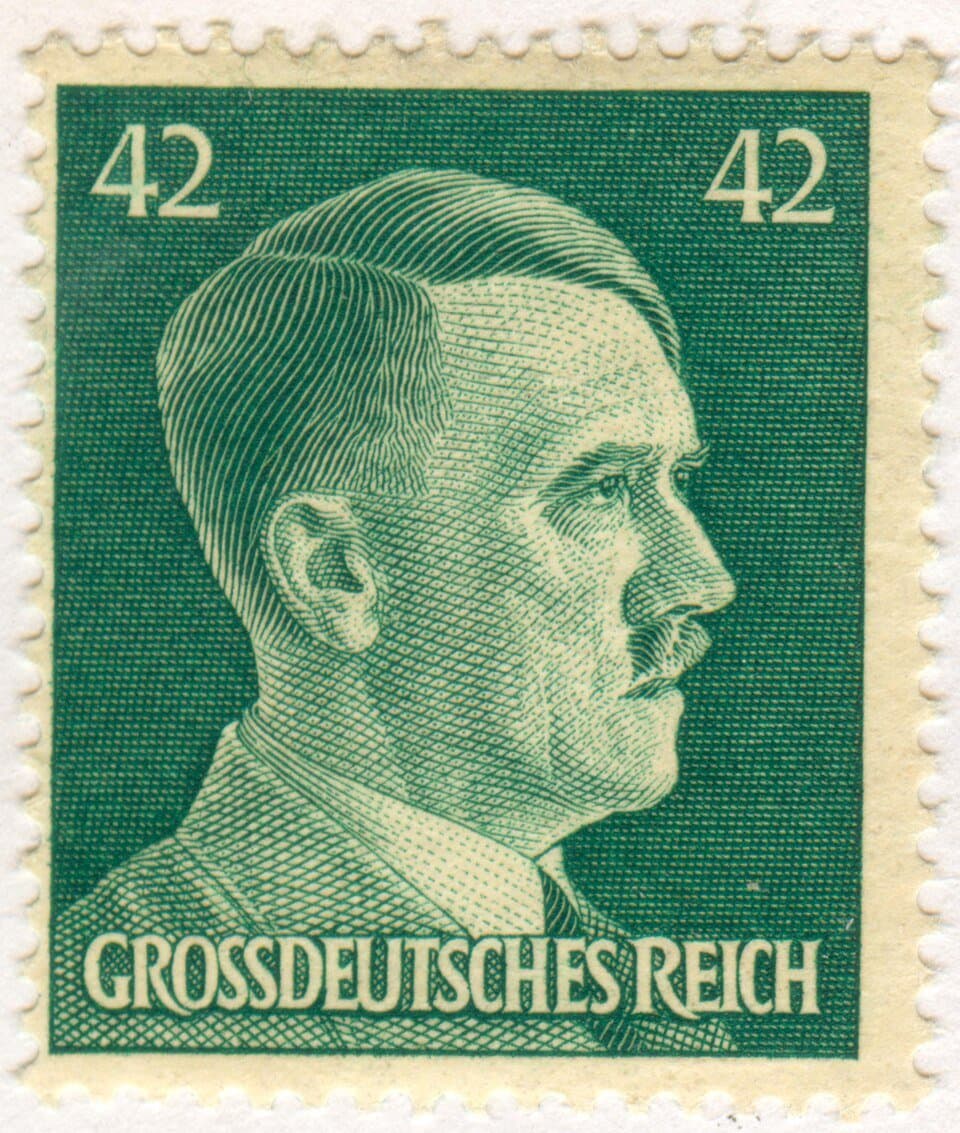
This desire for image control extended to the currency. During the hyperinflation of 1923, money had become worthless trash, swept into gutters. Hitler, scarred by this memory, refused to have his face printed on banknotes or minted on coins, fearing the symbolism of his image being devalued or handled by dirty fingers.
However, his modesty vanished when it came to postage stamps.
Why?
Royalties.
A savvy businessman, Hitler negotiated a deal where he received a percentage of the sale of every stamp featuring his image. Since these stamps were mandatory for daily life, this generated millions of Reichsmarks in personal income—a ‘portrait right’ fee that the Reichsbank (the central bank) refused to pay for coins, but the Reichspost paid willingly.
The Nazi Aesthetic: Reliving Greece and Rome
Since they couldn’t build statues of the Leader, the Nazis pivoted to statues of the Ideal.
The Third Reich’s artistic vision was a rejection of ‘degenerate’ modernism (Expressionism, Dadaism) in favor of a hyper-masculine, monumental Neoclassicism.
They saw themselves as the spiritual successors to the Roman Empire and ancient Greece.
Nazi sculptors like Arno Breker and Josef Thorak were commissioned to create ‘The New Man’—perfectly proportioned, muscular, emotionless figures that projected strength and obedience.
These statues were not meant to be human; they were meant to be racial archetypes.
They adorned the Olympic Stadium and the Chancellery, serving as silent guardians of the ideology.
While the man was missing, the Übermensch was everywhere.
–
The Nazi Eagle
“The eagle is the oldest symbol of German unity, but in the hands of the Nazis, it became a bird of prey.”
Richard J. Evans, Historian
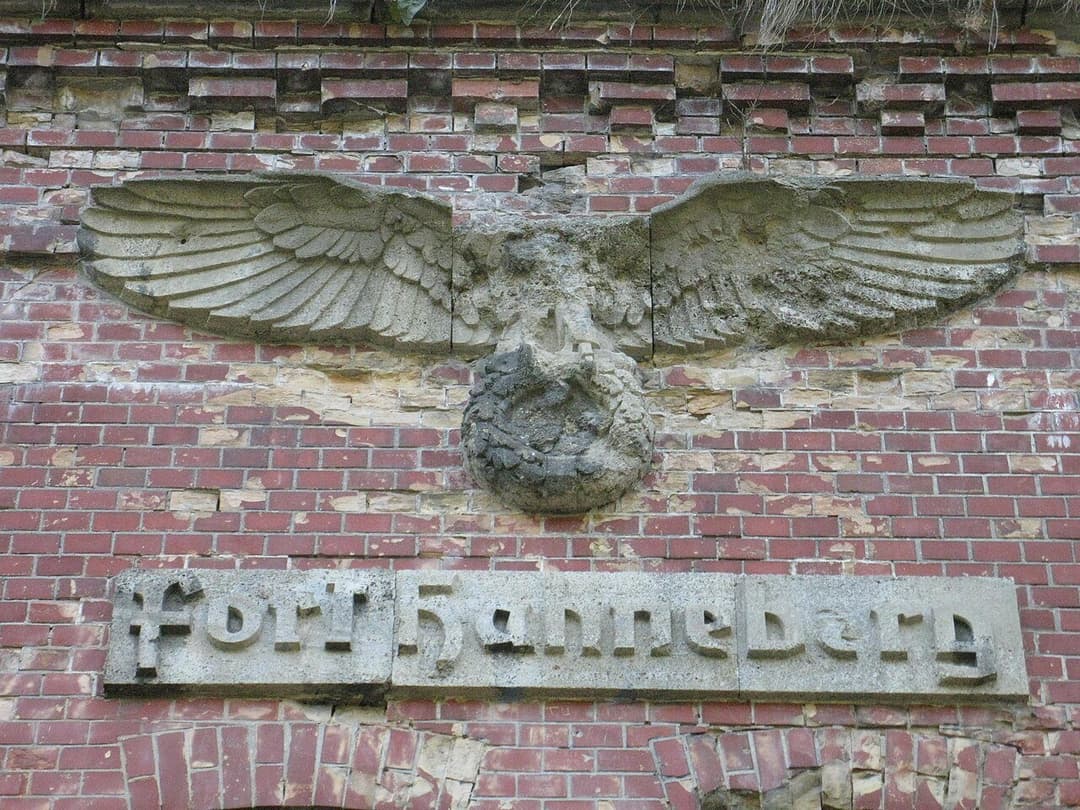
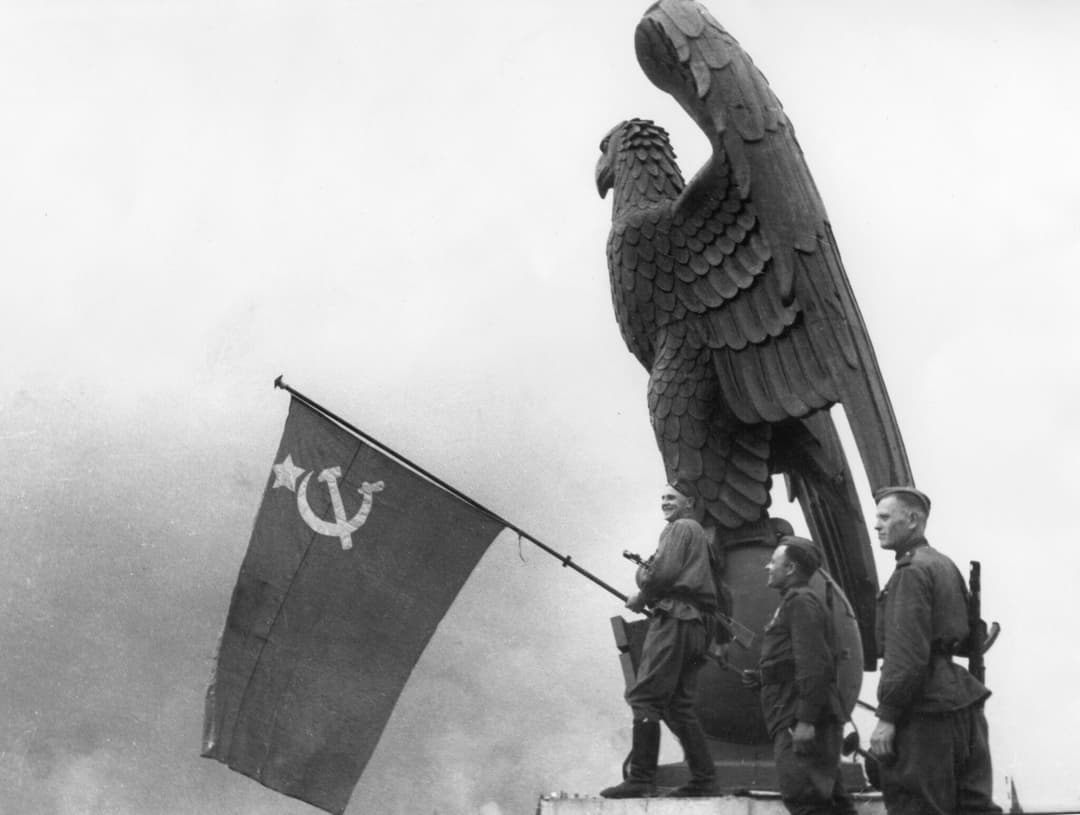
While Hitler’s face is absent, the Eagle (Adler) remains – if you know where to find it.
To understand what you are seeing in Berlin today, you must understand the heraldry.
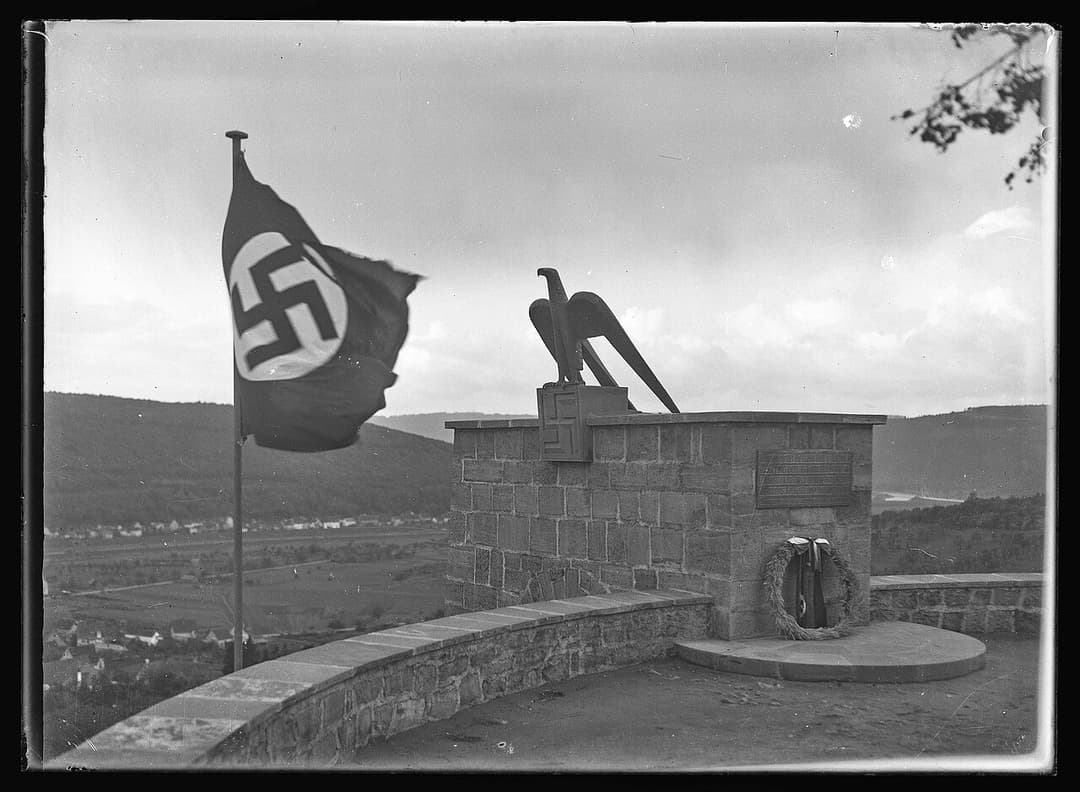
The eagle has been a German symbol since Charlemagne and the Holy Roman Empire (the First Reich).
However, the Nazis codified a specific visual language for it.
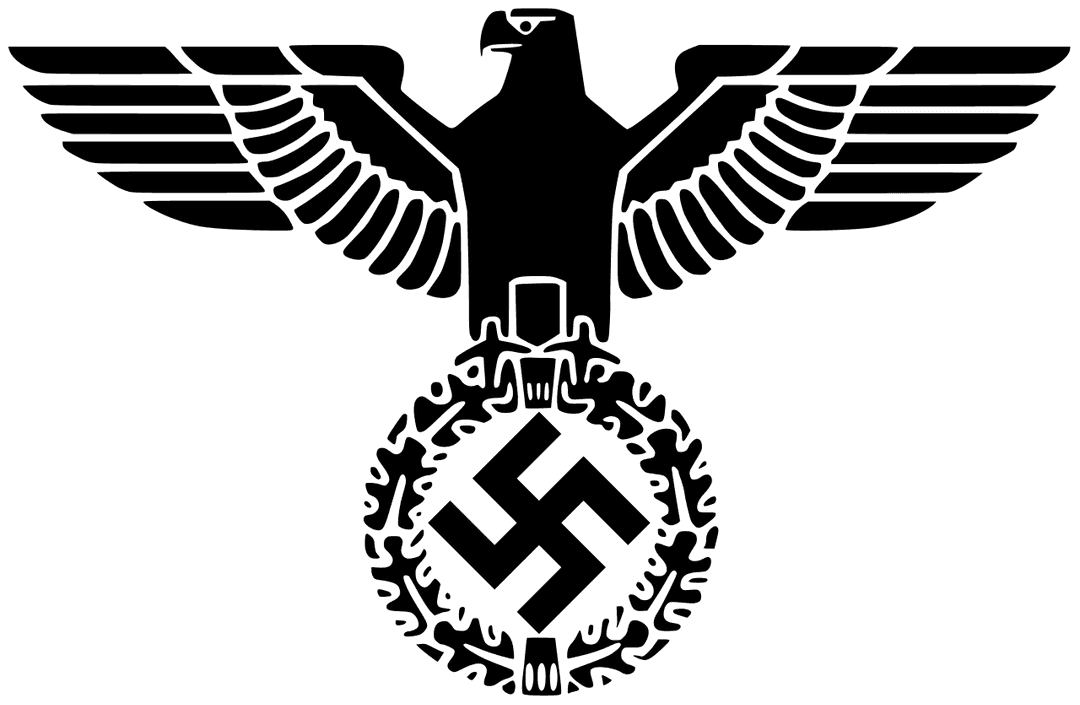
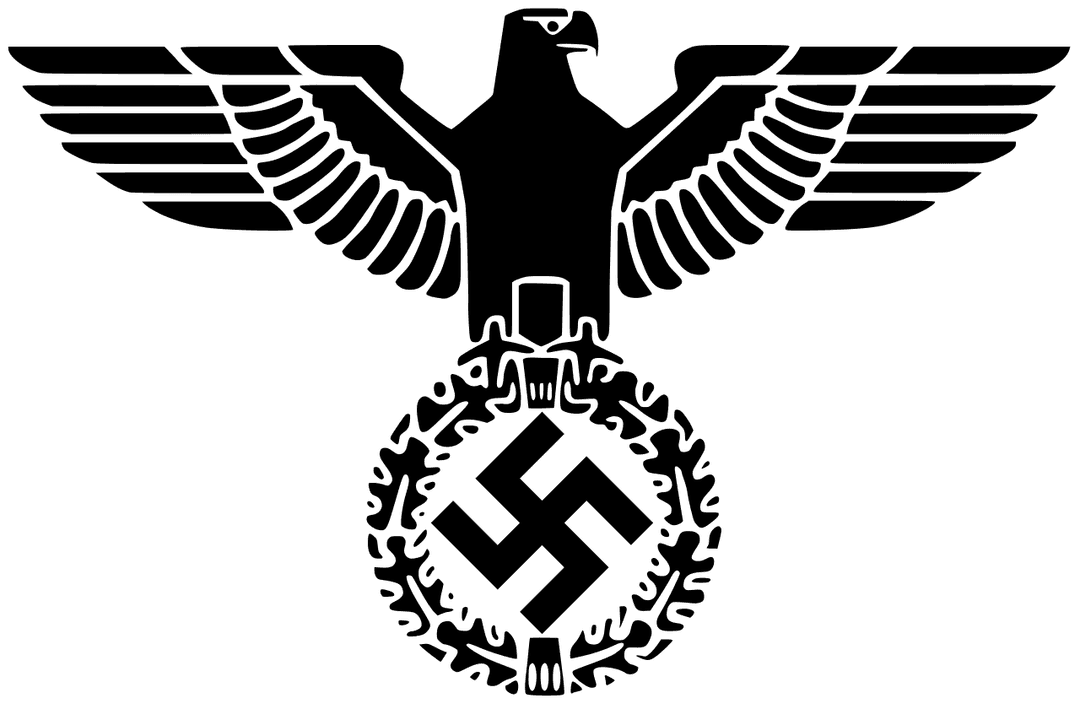
The Reichsadler (Imperial/State Eagle): The eagle looks over its right shoulder (the viewer’s left). This symbolized the State and the Government.
The Parteiadler (Party Eagle): The eagle looks over its left shoulder (the viewer’s right). This symbolized the NSDAP (Nazi Party).
This distinction was crucial.
A ‘Party Eagle’ on a building marked it as a political headquarters, while a ‘State Eagle’ marked a government ministry.
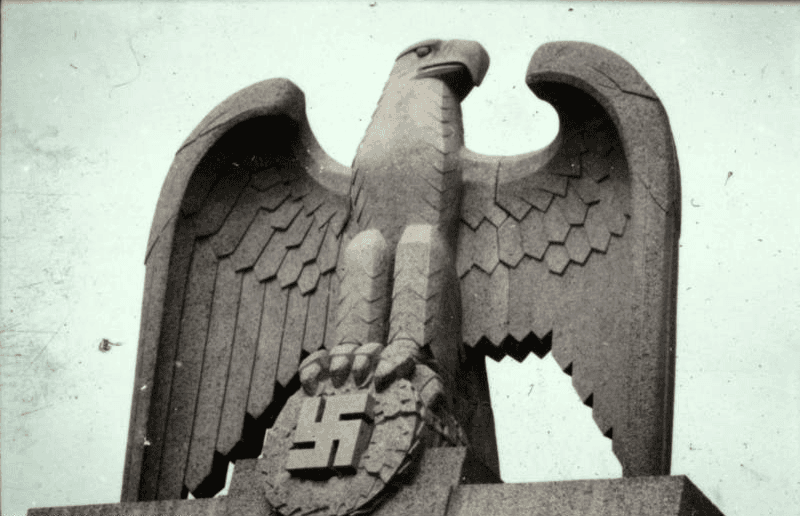
The Nazi design was distinct from the Weimar or Imperial eagles: it was stylised, angular, Art Deco-influenced, and aggressive, typically perched on a wreath of oak leaves containing a swastika.
Remaining Eagles in Berlin
Today, walking through Berlin is a scavenger hunt for these predatory birds. After the war, the Allies issued Order No. 30, requiring the removal of all Nazi memorials. However, chipping a massive stone eagle off a structural façade was expensive and difficult.
The solution?
Denazification by chisel.
The swastika was ground off, but the eagle was left behind.
Here are the most prominent “Ghost Eagles” you can still find:
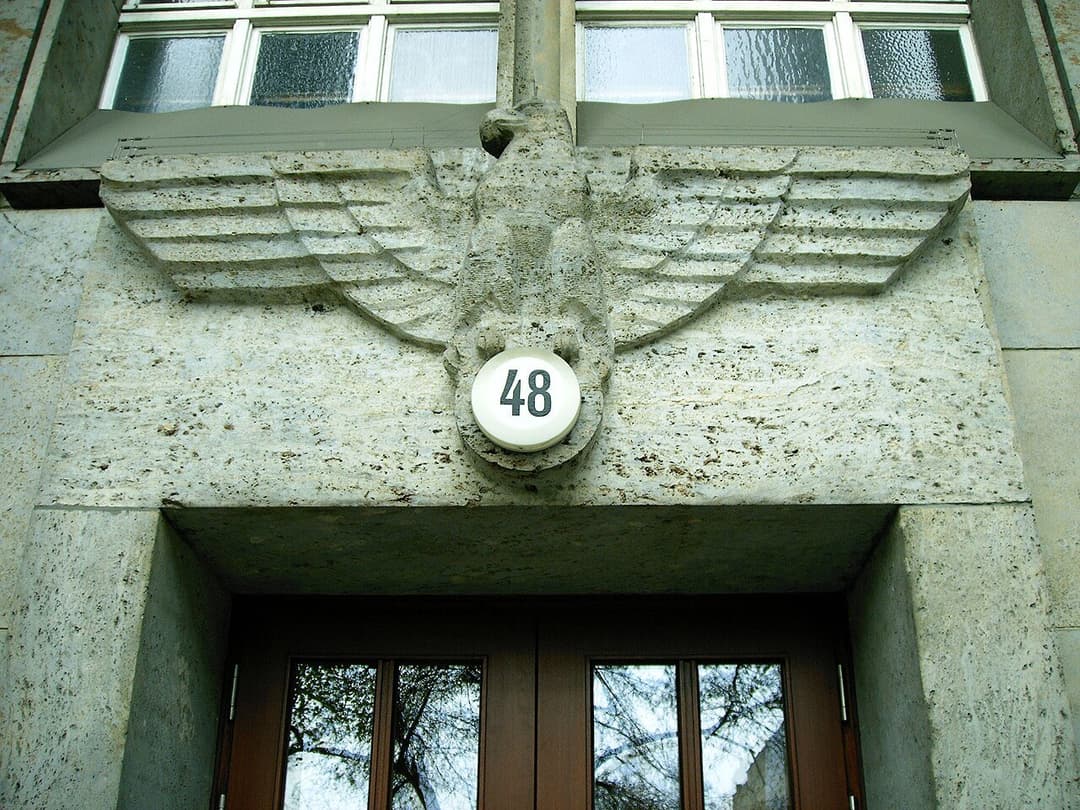
Finanzamt Charlottenburg (Bismarckstraße 48): This is perhaps the most chilling example. Above the entrance to this massive tax office sits a terrifyingly stern Reichsadler. The wreath in its talons is still there, but the swastika has been plastered over. In a stroke of grim irony, the house number ‘48’ now sits exactly where the crooked cross used to be.
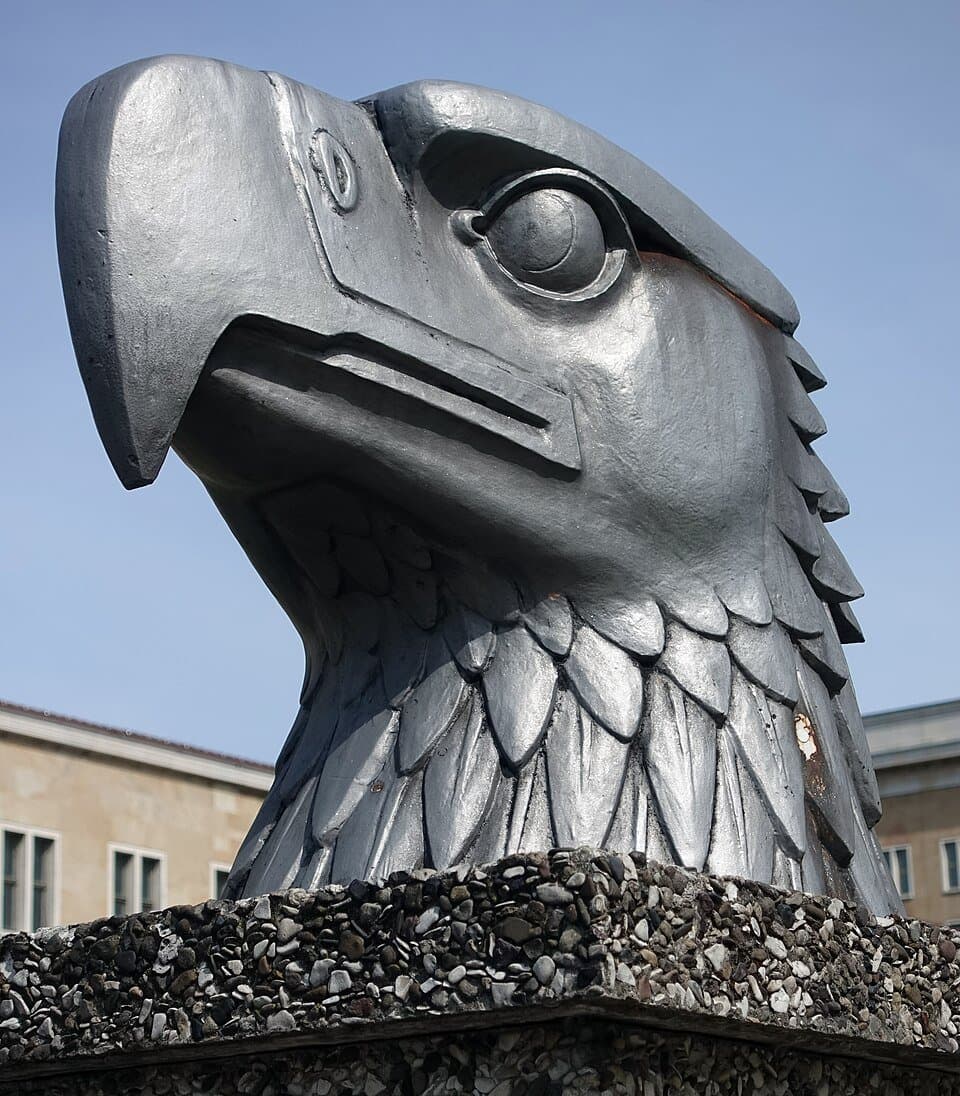
Tempelhof Airport (Platz der Luftbrücke): The massive eagle head monument in the forecourt (discussed below) is the most famous, but look closely at the corners of the airport buildings. There are relief eagles carved into the limestone, their talons now clutching empty wreaths.
Former Reich Ministry of Transport (Voßstraße): In the shadow of the Mall of Berlin, parts of the old government district survive. You can occasionally spot the outline where an eagle once was, a ‘scar’ on the building’s skin.
The Olympic Stadium’s Langemarckhalle: A plaque with a Nazi-era eagle still stands (swastika removed) at the First World War memorial hall.
The Ernst-Moritz-Arndt Church: Built in 1935 in Berlin-Zehlendorf, there is still a Nazi eagle visible here, minus any Nazi emblem.
The Invalidenhof Cemetery: The tomb of General Hans von Seeckt (a First World War hero) has a pair of 1936 eagles on it, since he died that year when Nazis were honoring old Prussian officers.
The Siemensstadt Eagle: Astonishingly, a Nazi-era sculpture stands in a children’s playground in Berlin-Siemensstadt, and remained largely unnoticed for decades. The statue of an eagle family by one of the Nazis’ favorite sculptors, it was put here as a monument to the so-called National Uprising in 1933 when the Nazis seized power. In 1935, the local Nazi administration installed this statue (a parent eagle with eaglets, symbolising the rebirth of the nation). After the war, it wasn’t removed and ended up within a housing estate playground. Only recently have locals debated what to do about this odd relic.
–
The 1936 Summer Olympics - The Nazi Games
“The Olympic Bell called the youth of the world, but it rang with a hollow tone. It was cast in steel, not bronze, fitting for a nation preparing for war.”
Werner March, Architect of the Olympic Stadium
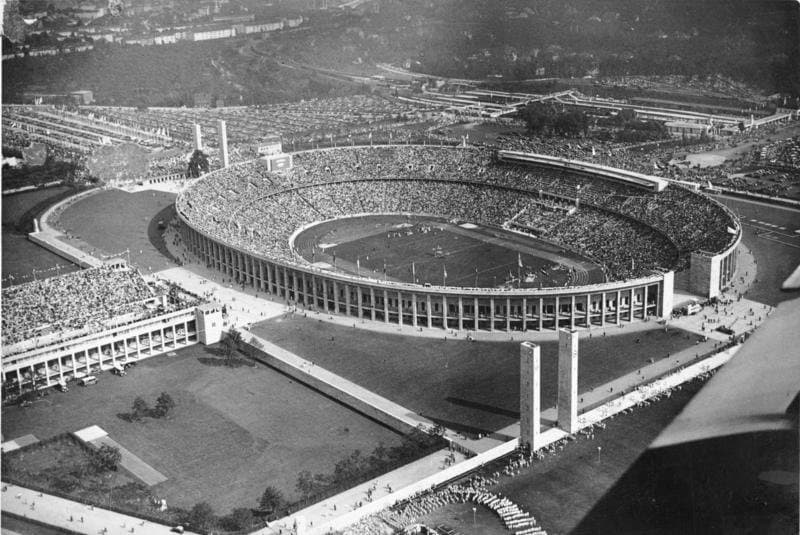
The 1936 Olympics were the debutante ball for the Nazi aesthetic.
The Olympiastadion (Olympic Stadium) was designed by Werner March, but it was the sculptural elements that drove home the ideology. Today, walking around the stadium feels like stepping into a Leni Riefenstahl film.
You are surrounded by giants.
The Horse Tamers and The Discus Throwers
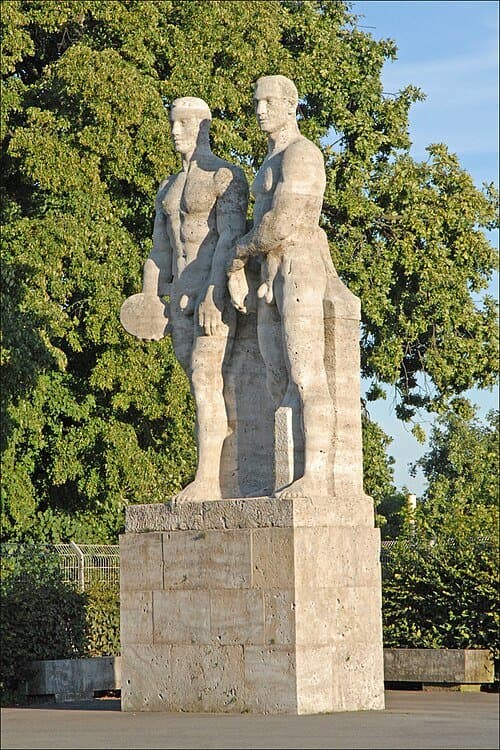
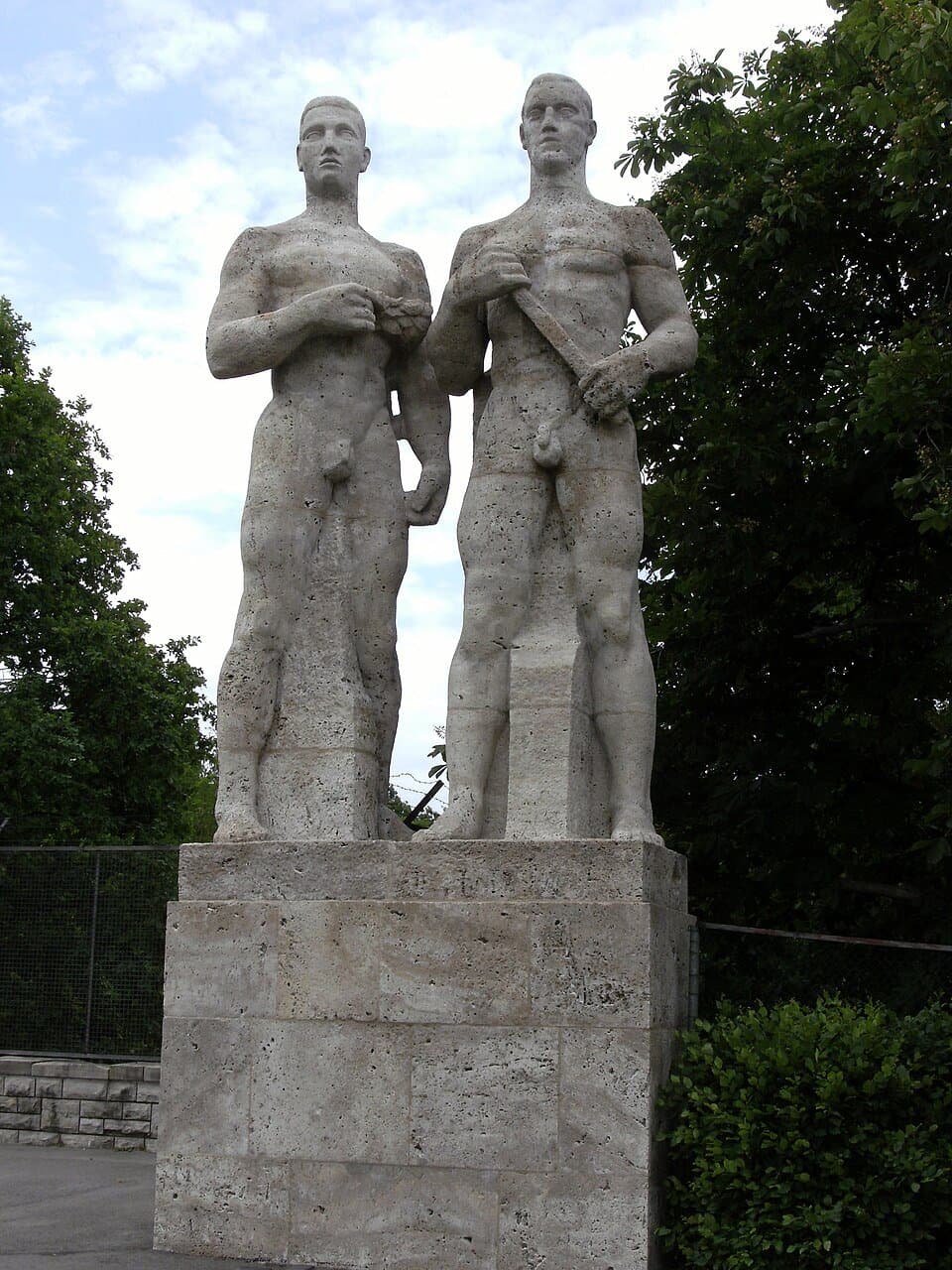
The stadium is still ringed by the statues of the era.
The most prominent survivors are the ‘Horse Tamers’ (Rossebändiger) by Joseph Wackerle, guarding the Marathon Gate. These aren’t just equestrian statues; they are political metaphors. Unlike traditional equestrian statues where the rider sits easily, here, nude muscular men strain to control wild, powerful beasts. It represents the Nazi concept of Bändigung—the forceful taming of chaotic nature (or the populace) by the iron will of the Leader.
Inside the grounds, specifically near the House of German Sports (Haus des Deutschen Sports), you will find the ‘Discus Throwers’ and ‘Relay Runners’ by Karl Albiker and monuments by Arno Breker. Breker, the ‘Michelangelo of the Third Reich’, specialized in hyper-masculine figures with distinct Aryan facial features—chiseled jaws, expressionless gazes, and exaggerated musculature that anatomic experts have noted are biologically impossible (muscles exist on these statues where humans have none).
These Nazi statues were spared destruction because they were deemed ‘classical’ rather than overtly political—a testament to how successfully the Nazis camouflaged their ideology as ‘art’ – dressing their ideology in the toga of antiquity.
The Olympic Bell
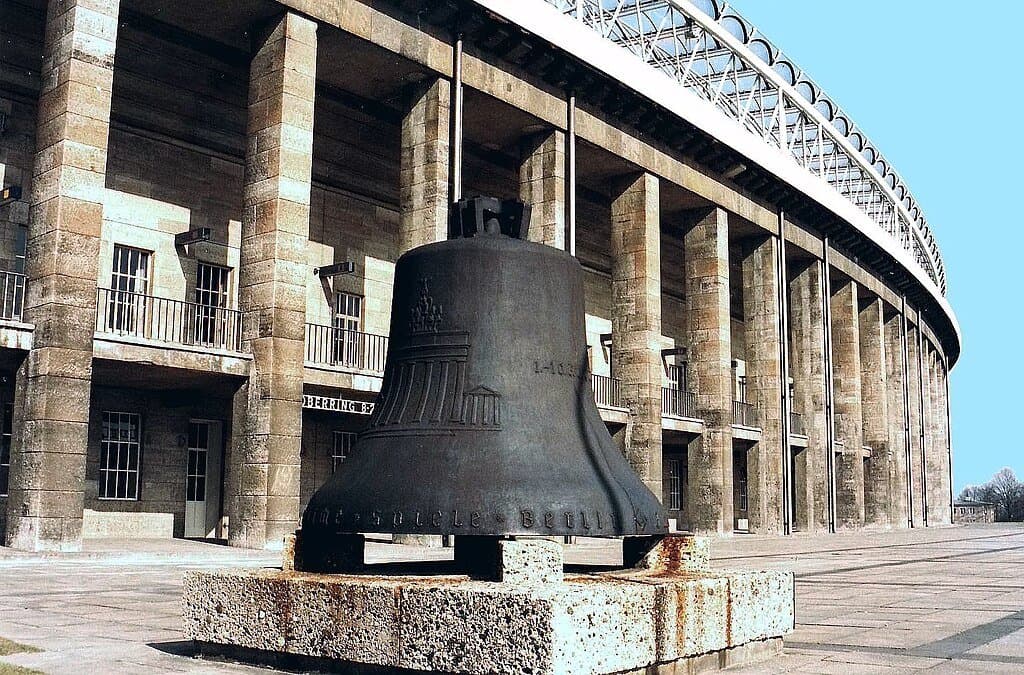
The most haunting relic is the Olympic Bell.
Originally, it hung 77m high in the Glockenturm (Bell Tower). Cast by the Bochumer Verein foundry, it was a monster of engineering, weighing 9.6 tons. Notably, it was cast in steel, not bronze. In 1936, the German war economy was already quietly hoarding copper and bronze for shell casings and cannons. The ‘Peace Bell’ was literally made of the stuff of tanks.
It now sits on the ground outside the stadium.
If you approach the bell today, you can see the localized vandalism of history. On the side of the bell, the Nazi Eagle clutching the swastika was cast in high relief. After the war, someone took an angle grinder or a chisel to it.
The swastika is gone, replaced by a rough, rusted square of abraded metal. Yet, the outline of the eagle remains visible, ghost-like. It is a “negative monument”—the removal of the symbol draws your eye to it more effectively than the symbol itself ever did.
This broken, silenced instrument, which once summoned the world to a deceptive festival of peace, now sits silently in the bushes—a perfect, cracked metaphor for the regime that cast it.
–
Tempelhof Airport & the Ministry of Aviation
“Tempelhof is a strange beast. It is beautiful in its utility, but terrifying in its scale. It was built to impress, not to welcome.”
Colin Philpott, Historian (Relics of the Reich)
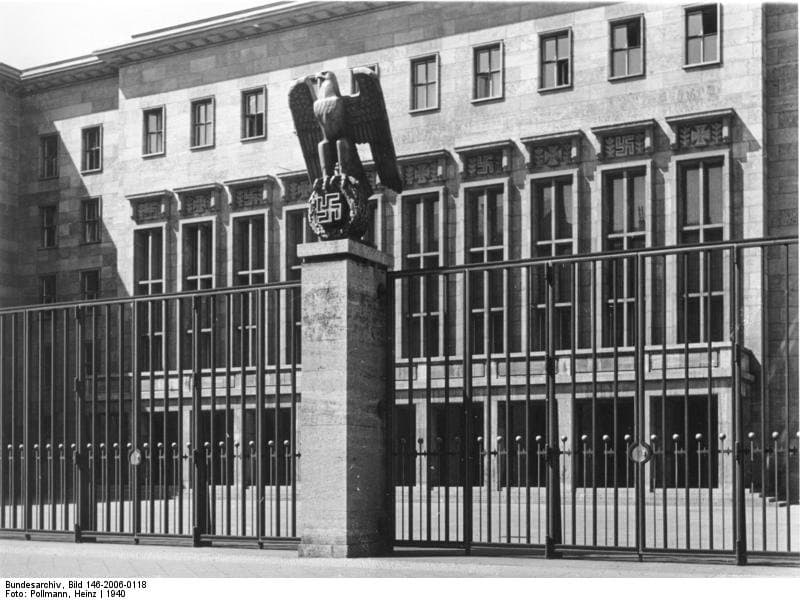
Hermann Göring’s Luftwaffe required headquarters that matched their ego.
The Ministry of Aviation (Detlev-Rohwedder-Haus)
Located on Wilhelmstraße, this was the largest office building in the world when it opened in 1936.
It is one of the few major Nazi buildings to survive the war largely intact. Today, it houses the German Finance Ministry.
The building has been “cleansed”—the eagles and swastikas were removed, and a socialist mural by Max Lingner was added during the GDR era. However, the sheer oppressive scale of the architecture remains a “statue” to the regime in itself.
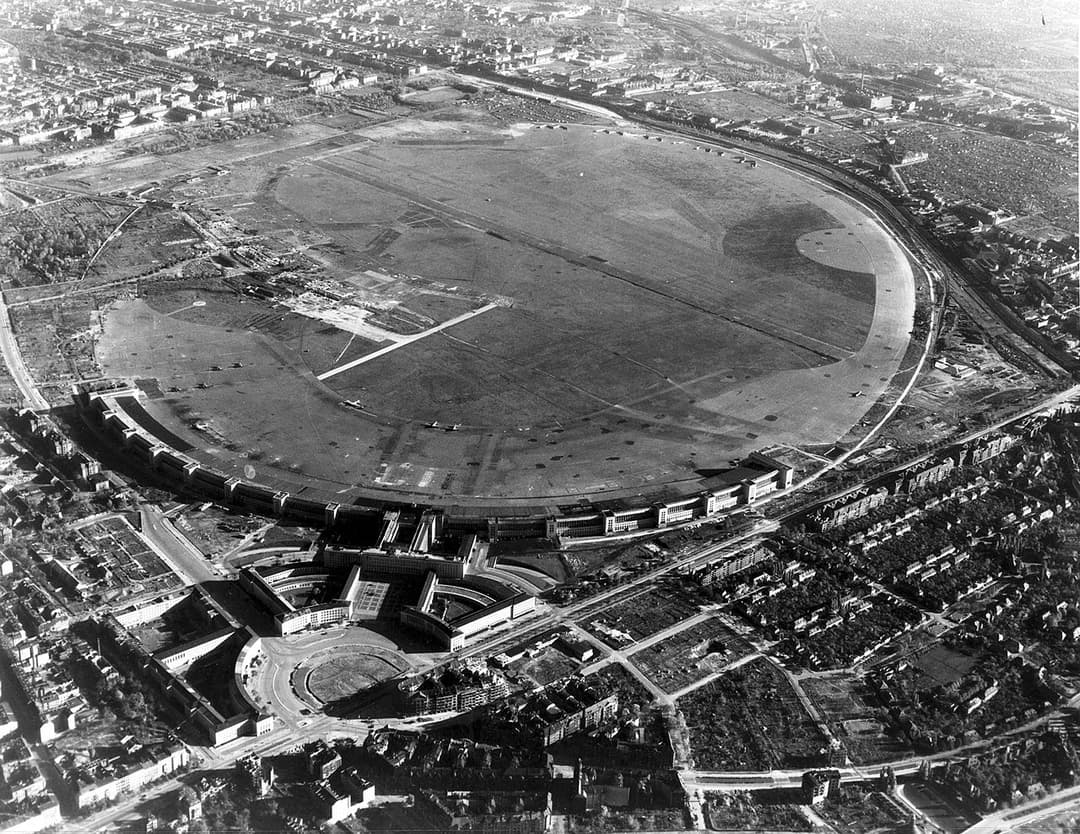
Tempelhof Airport
Sir Norman Foster once described Tempelhof as the “mother of all airports.”
Built between 1936 and 1941, its curved limestone facade stretches for over a kilometer.
The Eagle Myth: There is a persistent myth that the airport was designed to look like an eagle from the air. In reality, the design is a quadrant of a circle (intended to be a full circle eventually). However, the ‘spread wings’ of the hangars give it an avian appearance that fits the legend perfectly.
The Roof Eagle: A massive aluminium eagle once stood on the roof of the main terminal. After the war, it was taken down and the head was sent to the US Military Academy at West Point as a trophy. It was returned to Berlin in 1985 and now sits on a plinth in front of the airport. It is disembodied, staring blindly across the intersection—a literal head of state without a body.
–
Hitler’s Horses & The Nazi Statue Graveyard
“At Spandau, we do not hide the monsters. We put them in a room so we can look them in the eye and see that they are just stone.”
Urte Evert, Curator at Spandau Citadel
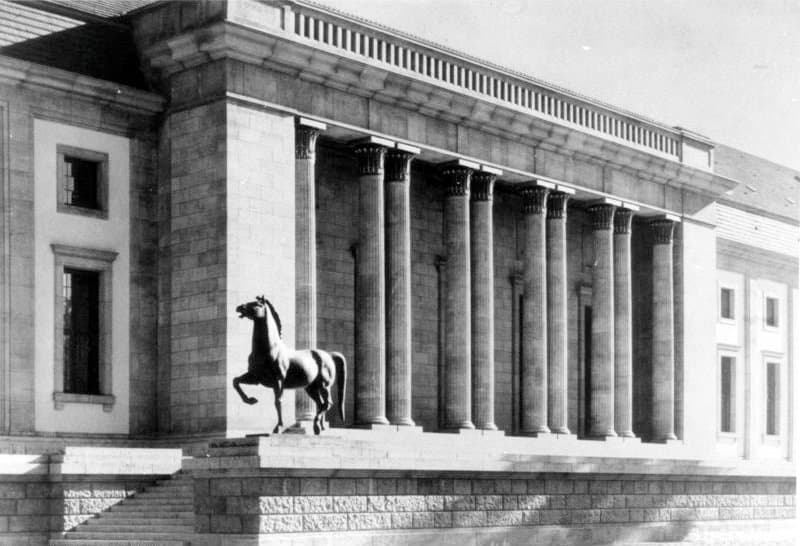
For decades, it was assumed that the bronze statues that guarded the Neue Reichskanzlei (New Chancellery)—Hitler’s seat of power—were destroyed by Soviet artillery.
The Chancellery itself was demolished, its red marble rumored to have been used in the Soviet War Memorial at Treptower Park (another myth, mostly false; the marble came from elsewhere).
But what about the ‘Striding Horses’ by Josef Thorak?
These massive stallions stood in the Chancellery garden, visible in Hitler’s view from his office.
In 2015, a Dutch art detective named Arthur Brand received a tip. The horses weren’t melted down. They were being offered for sale on the black market for €8 million. In a sting operation worthy of a Hollywood thriller, German police raided a warehouse in Bad Dürkheim. There, amidst tires and junk, stood the Führer’s horses, along with statues by Arno Breker.
They had been smuggled out of Berlin during the war, stored in a Soviet barracks for decades (painted gold to hide them!), and then privately acquired.
Spandau Citadel: The Island of Unwanted Monuments
Today, these horses are not hidden.
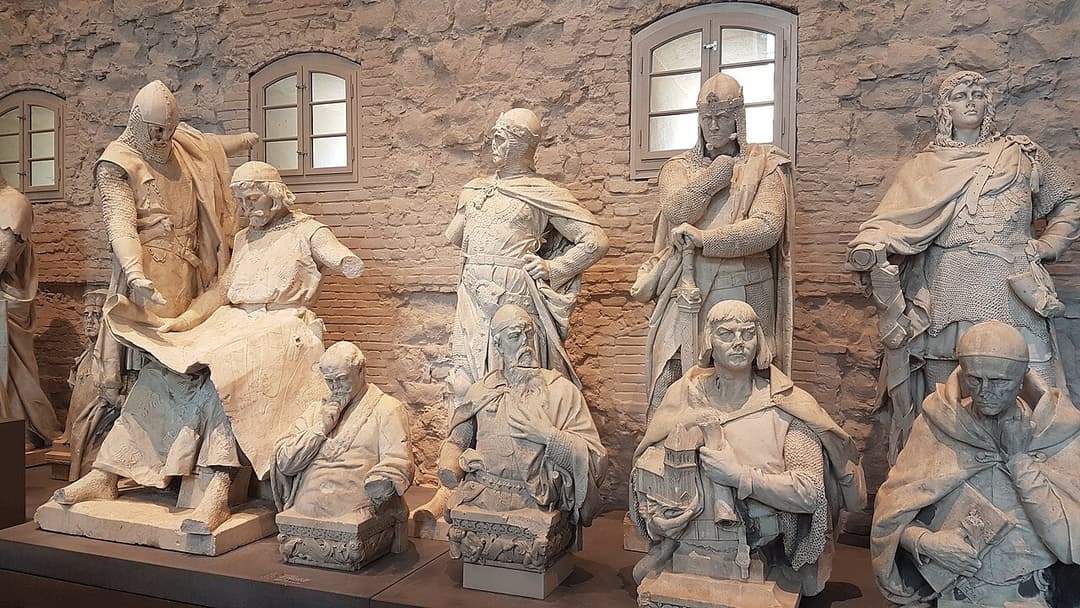
They are on display at the Spandau Citadel in the museum exhibit Unveiled: Berlin and its Monuments. Here, Berlin has finally found a way to deal with its toxic statues.
They are not put on pedestals to be worshipped, nor are they hidden in basements. They are displayed at eye level, stripped of their power, contextualized as historical artifacts rather than idols.
You can walk right up to Hitler’s horses and touch the bronze.
They feel cold, heavy, and surprisingly ordinary.
–
Conclusion
“The body was the ultimate monument in the Third Reich. Stone was just a way to freeze the flesh.”
George L. Mosse, Historian
So, are there any Nazi statues left in Berlin?
If you are looking for a bronze Hitler in a public square, the answer is no—he ensured that himself in 1933, and the Allies finished the job in 1945.
But if you define ‘statues’ as the stone symbols of the regime—the eagles, the bells, the muscular guardians of the stadium, and the architecture itself—then Berlin is still teeming with them.
They remain not as shrines, but as scars.
The denazified eagles on the tax offices and the cracked bell at the stadium serve as a reminder that history cannot be simply deleted.
It must be confronted.
Berlin has chosen not to erase these ghosts entirely, but to force them to live among the living, silent and powerless, reminding us of the fragility of civilisation.
Bibliography
Beevor, Antony (2002), Berlin: The Downfall 1945, Viking Press / Penguin Books, ISBN 978‑0‑14‑103239‑9.
Brand, Arthur (2020), Hitler’s Horses: The Incredible True Story of the Detective Who Infiltrated the Nazi Underworld
Craig, Gordon Alexander (1982), The Germans
Clark, Toby (1997), Art and Propaganda in the Twentieth Century
Evans, Richard J. (2005), The Third Reich in Power
Gerlach, Stefan M. (ed.) (2020), Unveiling Berlin: The City’s Monuments and Memorials
Helmer, Stephen D. (1985), Hitler’s Berlin: The Speer Plans for Reshaping the Central City, UMI Research Press, ISBN 0‑8357‑1682‑1 / 978‑0‑8357‑1682‑6
Kershaw, Ian (1987), The “Hitler Myth”: Image and Reality in the Third Reich
Large, David Clay (2007), Nazi Games: The Olympics of 1936
Ladd, Brian (1997), The Ghosts of Berlin: Confronting German History in the Urban Landscape
Lowe, Keith (2017), The Fear and the Freedom
MacGregor, Neil (2014), Germany: Memories of a Nation
Moorhouse, Roger (2010), Germania: Hitler’s Capital
Petropoulos, Jonathan (2000), The Faustian Bargain: The Art World in Nazi Germany
Philpott, Colin (2016), Relics of the Reich: The Buildings the Nazis Left Behind
Spotlight: Stratigakos, Despina (2024), The Spotless Face: Adolf Hitler in the Public Eye
Speer, Albert (1970), Inside the Third Reich
Spotts, Frederic (2002), Hitler and the Power of Aesthetics
(Exhibition Catalogue) (2016), Unveiled: Berlin and its Monuments (Exhibition Catalogue, Zitadelle Spandau)
Liked this piece? Have a look at the Berlin Experiences tours that cover this history.
See the Capital Of TyrannyMore articles →Explore in person
Tours that address this myth.
The Capital Of Tyranny
Private 6-hour van tour of Hitler's Berlin and the Third Reich for up to 6 people. Starts at your hotel or anywhere in the city.

The Third Reich Tour
Private 1-hour walking tour of the Nazi government district for up to 10 people. Starts at Pariser Platz by the Brandenburg Gate.
More reading
The other myths, busted.
49 more — drag, scroll or use the arrow keys.


UNIQUE EXPERIENCES FOR MODERN EXPLORERS

