Skip to content
Inside the Berlin Olympic Stadium: the stands, the blue running track and the pitch, seen from the upper tier under the roof

Berlin Experiences/Featured Experiences

Berlin Olympic Stadium: Visit the 1936 Olympiastadion

Site of the 1936 ‘Nazi Olympics’.

The short answer

The Olympiastadion is the stadium the Nazi regime built for the 1936 Summer Olympics, in Berlin-Westend, about 25 minutes west of the centre by U-Bahn or S-Bahn. It is still in use, as Hertha BSC’s home ground and a venue for cup finals and concerts, and you can visit it on most days. A self-guided visit costs €11 and takes one to two hours; guided tours into the changing rooms and VIP areas start at €17. The visitor centre is closed on match and event days, so check the stadium’s calendar before you go.

Where
Olympischer Platz 3, 14053 Berlin-Westend (enter by the Olympic Gate)
Open
Daily 10:00–16:00 Nov–Mar, 09:00–19:00 Apr–Oct; closed on event days
Admission
€11 (reduced €8); guided tours from €17
Time needed
1–2 hours; guided tours 1–2 hours
Nearest station
U2 Olympia-Stadion, 7 minutes on foot
Step-free
Mostly: grounds and lower tier yes, upper tier by stairs only

The story · by Matt Robinson

The 1936 Summer Olympics began on an atypical August day. Dark clouds gathered in the sky over Berlin’s Olympic Stadium. Occasional rain harassed the spectators. The doomed Hindenburg airship hovered over the Reichssportfeld, intermittently obscuring the sun and casting a giant shadow across the crowd. For the opening ceremony, three-thousand singers warmed the colossal stone-clad stadium in West Berlin with the sound of the German national anthem, followed by a more sinister rendition of the Horst-Wessel-Song.

Only by chance had the opportunity to hold the Olympic Games fallen into the hands of the Nazi regime, with the decision for the venue made in 1931, two years before Hitler’s seizure of power. Previously scheduled to be held in Germany in 1916, the competition was cancelled due to the outbreak of the First World War.

That year, intended to feature the 6th Olympiad, celebrating the brotherhood of man, would be remembered instead for the names of Verdun, the Somme, Jutland & Fromelles. Twenty years later, in Berlin, the Nazi government would utilise the Olympics as a vehicle for presenting Germany’s recently re-assumed vigour – and the physical prowess of its youth. Not only would this be an exhibition of nations, but of the strength of those nations.

As the regime sought to portray athletic success as a manifestation of political victory – in an imposing arena purposely constructed for this carefully stage-managed spectacle.

Werner March’s stone temple

The present day Olympiastadion was designed by Werner March and his brother Walter. Commissioned to replace the Grunewald Race Track & Deutsches Stadion, designed by their father, Otto, with an immense stone temple to the National Socialist Weltanschauung – lowered deep into the sandy soil of this region.

Reminiscent of the stadiums of antiquity, the neo-classicist form of the venue was intended not only to impress but to intimidate with its monstrous dimensions – to contort the spectators into an awe-struck and subservient mass.

Stone plaque of the 1936 Olympic champions at the Marathon Gate of the Berlin Olympic Stadium, headed ‘XI. Olympische Spiele Berlin, 1.–16. August 1936’
The 1936 champions, carved into the Marathon Gate.

The March brothers’ work would be closely overseen by Nazi court architect, Albert Speer, ensuring the design’s compliance with Hitler’s personal wishes. While Italian master painter Giotto was known to excel at drawing a perfect circle; it has been said that Speer’s talent could be explained in his ability to draw a straight line – or stick to one.

The Deutsches Stadion and the Deutsches Sportforum (German Sport Forum) would become the Reichssportfeld (Imperial Sport Field) – embracing the nomenclature of National Socialism and its adoration of the Imperial.

The arena and the Olympic Gate

Werner March’s original design for the stadium, one of open glass and steel, would be transformed into stone and imposing columns. Lacking in the subtleties and inflections of classical Greek and Roman constructions – opting instead for the brute force of cold, grey, geometric dominance.

A two-tiered arena, with rows of seats on a lower ring – sunk into the ground – and an upper ring towering over the proceedings. Although the stadium is now covered in an immense roof, that seems to float over the spectators concourse of the arena – interrupted only at the western side by the Marathon Gate – in its original form it was open air and fully exposed to the elements.

The stadium is currently accessible from its east side, with the recognisable two towers of the Olympic Gate (bearing the Olympic Rings but missing the original Swastika previously visible on one of the towers), through a reception building and gift shop.

The Olympic Gate at the Berlin Olympic Stadium: two stone towers with the Olympic rings hung between them, the stadium behind
The Olympic Gate, the main entrance.

Next to this entrance is the Podbielski Oak – named after politician Victor von Podbielski, one of the original planners of the fated 1916 Olympic Games. The oak symbolic as it stands as the German equivalent to the traditional Greek olive tree – in fact Olympic victors at the 1936 Games would symbolically be offered an oak wreath and seedlings in congratulations.

The Maifeld and the bell tower

Surrounding the main stadium are numerous figures that remain from the ‘Nazi Olympics’ (the work of well-known artists such as Arno Breker and Waldemar Raemisch) presenting an idealised vision of the human form. To the north side of the stadium is the swimming pool, and grounds that served to accommodate various events (such as field hockey). To the west of the stadium – accessible by either walking around the stadium or exiting through the Marathon Gate – is the Maifeld (Mayfield), constructed to hold more than 300,000 participants and spectators.

Two stone statues of male athletes from 1936 on the grounds of the Berlin Olympic Stadium
Sculpture from 1936 on the stadium grounds.

This area was designed for gymnastics events – polo and dressage during the Olympics – and later used for Nazi party rallies. With some 20-25 events per year held in the stadium until the outbreak of the Second World War.

Buttressing the Maifeld further to the west is the Langemarck-Halle and 77-metre high Glockenturm. If there was ever any doubt of the symbiosis of sport and war proposed by the National Socialist regime in 1936, it can be shed here. The Langemarck-Halle was constructed in remembrance of 2,000 German soldiers – student volunteers – who fell near Langemarck in Belgium, on November 10th 1914, during the First Battle of Ypres. The heroic myth of self-sacrifice surrounding these deaths sees the young volunteers of the German reserves – inspired by the wave of enthusiastic patriotism that swept across the country at the time – charge at the lines of the French Army and British Expeditionary Force while singing the German national anthem, before being ruthlessly slaughtered.

Despite its renovations and the passage of time, the Olympic Stadium and its grounds still stand as testament to the imperial and totalitarian vision of the National Socialist era.

In particular, the crude simplistic classicism of the venue’s design is one of the most complete examples of an integrated and formalised architectural language of dictatorship in the world.
The Olympic Stadium in detail

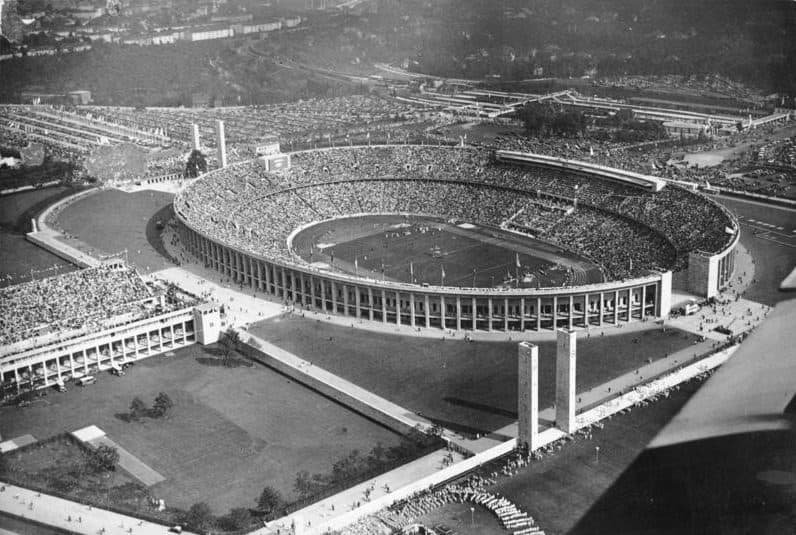
Aerial view of the Berlin Olympic Stadium in 1936, with the Olympic Gate towers and the Maifeld beyond
The new stadium from the air, 1936, with the Olympic Gate in the foreground. Photo: Bundesarchiv, Bild 183-R82532 / Hoffmann / CC-BY-SA 3.0

How the Nazis built the Olympic Stadium

Berlin was awarded the 1936 Games in May 1931, and the organisers at first planned only to modernise the Deutsches Stadion, the sunken arena Otto March had built inside the Grunewald racecourse in 1913, and hired his son Werner to do it. Once in power, Hitler saw what the Games could do for the regime: in October 1933 he ordered a new stadium for 100,000 spectators on the same site and took the project out of the city’s hands. The racecourse was cleared to make room for the Maifeld, the parade ground he wanted beside it.

Visiting the site in October 1934, Hitler approved March’s design and pressed for natural stone on the façades, so the concrete frame was clad in Franconian shell limestone. Albert Speer later claimed a large part in this; his biographer Magnus Brechtken knows of only one meeting with March. Built in 28 months, the stadium opened on 1 August 1936. The budget had grown from 5.5 to 42 million Reichsmarks, and the March brothers won an Olympic gold medal for the design in that year’s art competitions.

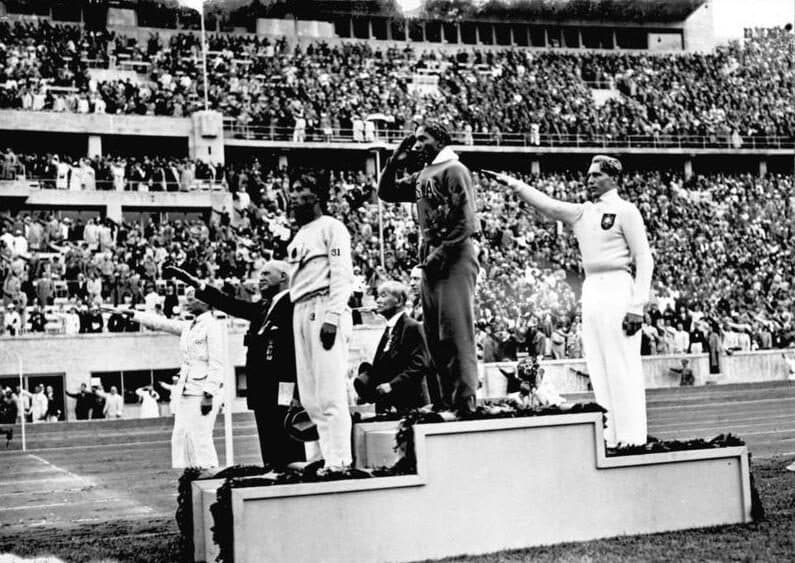
Jesse Owens on the winners’ podium for the long jump at the Berlin Olympic Stadium, 1936, between Naoto Tajima and Luz Long
The long-jump podium, August 1936: Naoto Tajima, Jesse Owens and Luz Long. Photo: Bundesarchiv, Bild 183-G00630 / CC-BY-SA 3.0

Jesse Owens and the 1936 Games

The Games ran from 1 to 16 August 1936, with 3,963 athletes from 49 nations. The star of the athletics was Jesse Owens, a 22-year-old Black American from Ohio State University. He won the 100 metres on 3 August, the long jump on 4 August and the 200 metres on 5 August, and on 9 August he ran the first leg of the 4 × 100 metres relay, won in a world record 39.8 seconds.

The story that Hitler refused to shake Owens’s hand is not quite right. On the first day Hitler congratulated several German and Finnish winners; the IOC president, Henri de Baillet-Latour, then told him to greet every champion or none, and he chose none, a day before Owens’s first final. Owens said that year that it was his own president, Franklin Roosevelt, who snubbed him. His long-jump rival, the German Luz Long, became a friend. Since 1984 the road south of the stadium has been Jesse-Owens-Allee.

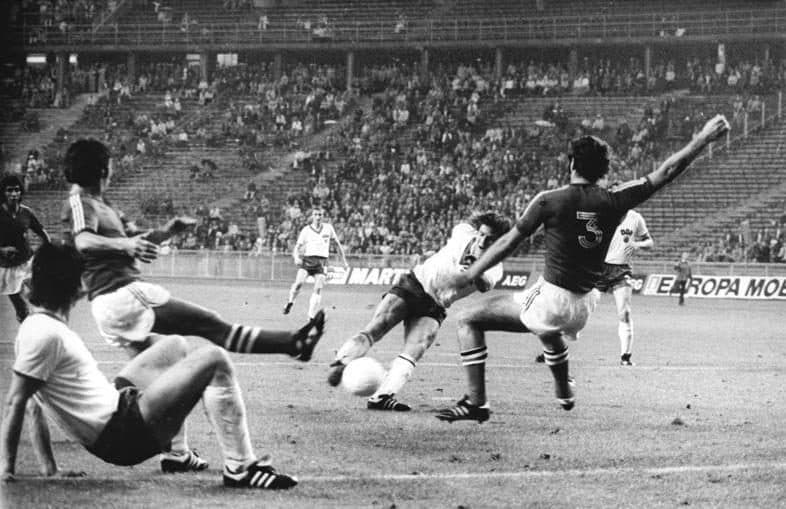
East Germany playing Chile in the Berlin Olympic Stadium at the 1974 World Cup
East Germany against Chile in West Berlin, 18 June 1974. Photo: Bundesarchiv, Bild 183-N0618-0043 / Mittelstädt, Rainer / CC-BY-SA 3.0

After 1945: British headquarters, Hertha and the World Cup

The stadium came through the Battle of Berlin with little more than bullet marks, though the bell tower had burned out; British engineers blew it up in 1947. The Reichssportfeld became the headquarters of the British forces in Berlin, who held the Queen’s Birthday Parade on the Maifeld every year until they left in 1994. Hertha BSC moved in for the first Bundesliga season in 1963, and the stadium was given a partial roof for the 1974 World Cup, when East Germany played Chile here, in West Berlin.

In the late 1990s some Berliners wanted it torn down. Instead, between 2000 and 2004, the architects gmp lowered the pitch, added a roof over every seat and laid the blue track, while keeping about 70 per cent of the historic fabric, the old stone cleaned block by block. The stadium held the 2006 World Cup final, saw Usain Bolt set his 100 and 200 metre world records (9.58 and 19.19 seconds) at the 2009 World Championships, and staged the final of Euro 2024.

Plan your visit

Visiting the Olympic Stadium

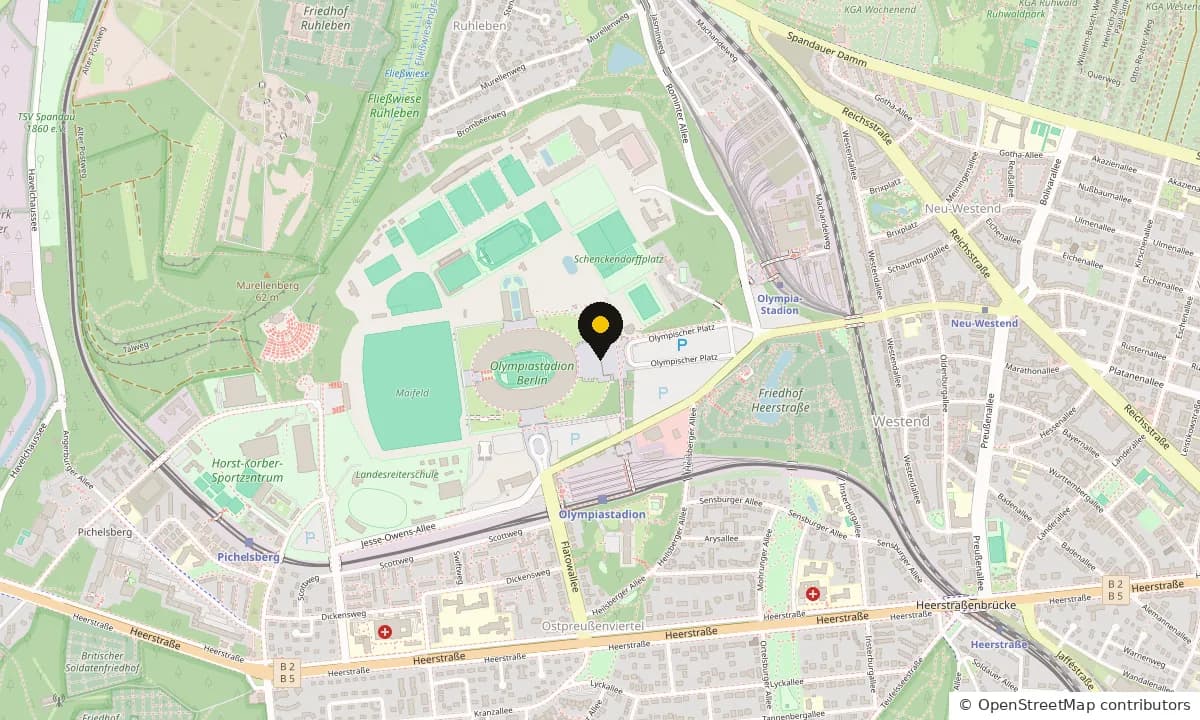
Map of the streets around the Olympic Stadium, with a pin on the siteOpen in Google Maps

Olympischer Platz 3, 14053 Berlin · Daily 10:00–16:00 from November to March and 09:00–19:00 from April to October; last admission 30 minutes before closing. Closed on Hertha BSC home match days and during major events, including the set-up and take-down days around concerts and internationals. Hours change at short notice: check the calendar on olympiastadion.berlin before you go.

Getting there

  • U2Olympia-Stadion500 m · 7 min

    13 minutes from Zoologischer Garten, 25 from Potsdamer Platz. The station has a lift; follow Olympische Straße west to the Olympic Gate.

  • S3S9Olympiastadion250 m · 4 min

    14 minutes from Zoologischer Garten. Use the Trakehner Allee exit for the Olympic Gate; the exit with the lift (Flatowallee) leads to the South Gate, which only opens on event days.

What you’ll see

  • The arena itself, from the East Stand and the lower tier: Werner March’s limestone-clad bowl, sunk deep into the ground, under the roof added in 2000–04, with Hertha BSC’s blue running track.
  • The Marathon Gate, the gap in the west end with the Olympic flame cauldron and the stone plaques of the 1936 champions, Jesse Owens among them, and the view across the Maifeld to the bell tower.
  • Outside the bowl: the twin towers of the Olympic Gate, the 1936 sculptures by Karl Albiker (Discus Throwers, Relay Runners) and Josef Wackerle (Horse Leaders), and the cracked Olympic Bell by the South Gate.

Tips from a guide

  • Check the calendar first: on Hertha home match days, internationals and concert set-up days the stadium shuts completely, sometimes for five days in a row.
  • Take a guided tour if you want the changing rooms, the warm-up hall and the VIP areas, which are off-limits on a self-guided visit. In winter the English Highlights Tour runs at 12:00 on weekdays.
  • Self-guided tickets are sold at the visitor centre by the Olympic Gate, no booking needed; cards are accepted, but not American Express.

Accessibility

The grounds, the East Stand and the lower tier are step-free, with accessible toilets in the lower ring; the upper tier is reached by stairs only, and there are steps on both sides of the Marathon Gate. U2 Olympia-Stadion has a lift. At S Olympiastadion the only lift is at the Flatowallee exit, which leads to the South Gate, open only on event days, so the U-Bahn is the easier step-free route. Wheelchair users joining a guided tour should register in advance so that the lifts can be unlocked. Companions of visitors whose disability card is marked B go free.

Timeline

From racecourse to World Cup final

  1. 1913Otto March’s Deutsches Stadion opens inside the Grunewald racecourse.
  2. 1916The Berlin Olympics are cancelled because of the First World War.
  3. 13 May 1931The IOC awards the 1936 Summer Olympics to Berlin.
  4. Oct 1933Hitler orders a new stadium for 100,000 people on the same site.
  5. 1 Aug 1936Hitler opens the Games; the airship Hindenburg flies over the stadium.
  6. 3–9 Aug 1936Jesse Owens wins four gold medals in the stadium.
  7. 1945–94The Reichssportfeld is the headquarters of the British forces in Berlin.
  8. 1947British engineers blow up the burnt-out bell tower; it is rebuilt in 1960–62.
  9. 1963Hertha BSC make the stadium their home for the first Bundesliga season.
  10. 2000–04Renovation: the pitch is lowered and a roof covers every seat.
  11. 9 Jul 2006Italy beat France on penalties in the World Cup final.
  12. 14 Jul 2024Spain beat England 2–1 in the Euro 2024 final.

See it with a historian

Tours that stop at the Olympic Stadium

On your own you see the stone; a guide explains what it was meant to say, and where the 1936 Games, the Maifeld rallies and the British years fit in.

The rise and fall of the Third Reich, with the stadium as its showpiece of Nazi architecture.

The Capital Of Tyranny Tour - Berlin Experiences
Full Day6 Hours

The Capital Of Tyranny

Private 6-hour van tour of Hitler's Berlin and the Third Reich for up to 6 people. Starts at your hotel or anywhere in the city.

€1,000up to 6
View Tour

A full day by private transport, so the stadium in the far west can be part of it.

The Berlin History Tour
Full Day6 Hours

The Berlin History Tour

Private 6-hour van tour of Berlin's whole history in one day for up to 6 people. Starts at your hotel or anywhere in the city.

€1,000up to 6
View Tour

For runners: the 1936 Olympic marathon started and finished in this stadium.

The Berlin Marathon Tour
Half Day4 Hours

The Berlin Marathon Tour

Private 4-hour van tour along the Berlin Marathon route for up to 6 people. Starts at your hotel or anywhere in the city.

€800up to 6
View Tour

Questions visitors ask

Frequently asked questions

Can you visit the Berlin Olympic Stadium?

Yes, on most days. Buy a ticket at the visitor centre by the Olympic Gate, Olympischer Platz 3, and walk the grounds, the East Stand and the lower tier on your own, or join a guided tour. It is closed on Hertha BSC home match days and around other big events.

How much does it cost to visit the Olympic Stadium in Berlin?

A self-guided visit costs €11 (reduced €8, children 6–14 €6, family ticket €27, under-6s free); the multimedia guide is €4 extra. The one-hour Highlights Tour costs €17 (reduced €14) and the two-hour Premium Tour €19, admission included.

How long do you need at the Olympic Stadium?

The stadium recommends one to two hours for a self-guided visit of the stadium and Olympic Park. The Highlights Tour takes one hour and the Premium Tour two.

Is it the same stadium as the 1936 Olympics?

Yes. It was renovated in 2000–04, when the pitch was lowered and the roof added, but about 70 per cent of the historic fabric was kept. It now holds just under 74,000 spectators, against about 100,000 in 1936.

Did Hitler snub Jesse Owens?

Not in the way the story is usually told. After the first day the IOC told Hitler to congratulate all winners or none, and he stopped congratulating anyone in public before Owens won his first gold. Owens said it was President Roosevelt who snubbed him.

Who plays at the Berlin Olympic Stadium?

Hertha BSC, who have played their home matches here since 1963. The German Cup (DFB-Pokal) final has been held here every year since 1985, and the stadium also hosts internationals, the ISTAF athletics meeting and big concerts.

Can you go up the bell tower at the Olympic Stadium?

Not at present. The Glockenturm and Langemarck Hall are separate from the stadium and its ticket, and they have been closed; a reopening was planned for 2026, so check before you go.

How do I get to the Olympic Stadium in Berlin?

Take the U2 to Olympia-Stadion, 13 minutes from Zoologischer Garten and a 7-minute walk from the Olympic Gate, or the S3 or S9 to Olympiastadion and use the Trakehner Allee exit, 4 minutes from the gate.

Keep exploring

More Featured Experiences.

Every site we write about — 56 landmarks, museums, memorials and lesser-known corners of Berlin. See the full index →

01Walk Through The Brandenburg Gate02Explore The State Museums On Museum Island03Visit The Berlin TV Tower – The Fernsehturm04Cross The Cold War Border At Checkpoint Charlie05Visit The Site Of Adolf Hitler’s Führerbunker06Explore The Reconstructed Berlin Palace07Visit The Reichstag Cupola At Night08Explore The Forum Fridericianum09Shop At The Humboldt University Book Sale10Journey Into The Memorial To The Murdered Jews Of Europe11Step Inside The Neue Wache12Explore The Former Jewish Quarter – Spandauer Vorstadt13Visit The Remains Of The Berlin Wall14Walk Across The Bridge Of Spies15Explore The Topography Of Terror16Climb The Prussian Victory Column – The Siegessäule17Enter The Palace Of Tears – The Tränenpalast19Explore Erich Mielke’s Office At The Stasi Museum20Walk Along Karl Marx Allee21Visit The Oldest Church In Berlin – The Nikolaikirche22Explore The Berliner Dom23Visit The Grave Of Frederick The Great24Walk Through The Ruins Of Anhalter Bahnhof25Stand On The Platz Des Volksaufstandes26Visit The German Resistance Museum27Visit The Soviet War Memorial In The Tiergarten28See The Georg Elser Memorial On Wilhelmstrasse29Step Inside The Kaiser Wilhelm Gedächtnis Kirche30Visit The Gleis 17 Memorial31Visit The Schloss Charlottenburg Mausoleum32Climb The Französischer Dom at Gendarmenmarkt33Explore The Interbau – IBA 5734Explore The Otto Weidt Workshop35Visit Cecilienhof – Site Of The Potsdam Conference36Visit The Stasi Prison In Hohenschönhausen37Spend The Day At Tempelhof Airport38Ride The Fastest Elevator In Europe39Visit The Soviet War Memorial In Treptower Park40Visit The Sachsenhausen Concentration Camp Memorial41Visit The Ravensbrück Concentration Camp Memorial42Visit Karlshorst – The Site Of The German Surrender43Visit The Socialists Cemetery – Zentralfriedhof Friedrichsfelde44Visit The Soviet War Memorial In Pankow45Visit the Seelow Heights Memorial46Visit The Commonwealth War Cemetery47Cross The Bösebrücke At Night48Explore The Allied Museum In Dahlem49Explore The Spandau Citadel50Visit The Brandenburg T4 Euthanasia Memorial51Visit The Wannsee Conference House52Visit The Jewish Museum53Visit The Jewish Cemetery In Weissensee54Walk Along The East Side Gallery55Explore The Volkspark Friedrichshain Flak Tower56Head Up The Teufelsberg