Skip to content
Cobbled path between stone walls winding up the Großer Bunkerberg, the hill over the Friedrichshain flak tower in Berlin

Berlin Experiences/Featured Experiences

Flak Tower Berlin: Visit the Buried Bunkers of Volkspark Friedrichshain

Former Nazi anti-aircraft installation turned rubble mountain.

The short answer

The Friedrichshain flak tower was one of three pairs of huge concrete anti-aircraft bunkers the Nazis built to defend Berlin. Its gun tower and control tower, finished in Volkspark Friedrichshain in 1941, were blown up in 1946 and buried under rubble, and are now two wooded hills, the Großer and Kleiner Bunkerberg. You cannot go inside, but you can climb to the viewing platform on top of the gun tower’s remains, where blown-up concrete still shows through. The park is free and always open; allow 45–60 minutes.

Where
Großer Bunkerberg, Volkspark Friedrichshain, 10249 Berlin-Friedrichshain
Open
Always: a public park
Admission
Free
Time needed
45–60 minutes
Nearest station
Tram M5, M6, M8 Platz der Vereinten Nationen, 9 minutes on foot
Step-free
No: the summit is up steep cobbled paths and steps

The story · by Matt Robinson

On the night of August 25th–26th 1940, 95 bombers from the Royal Air Force set out to attack Berlin, 81 of them dropping their bombs in and around the city, in response to a Luftwaffe attack on London the night before, marking the first offensive against the German capital during World War II.

Another attack would follow on August 28th and from September 6th the Royal Air Force would begin to carry out regular nighttime attacks on Berlin – resulting in air war casualties among the civilian population in the Nazi capital for the first time.

In response to this new threat Nazi leader, Adolf Hitler, demanded the widespread construction of air raid shelters and appointed his chief architect and general building inspector for the Reich capital, Albert Speer, responsible for the implementation of what would become known as the Führer-Sofortprogramm or Luftschutz-Sofortprogramm in Berlin.

Cobbled path climbing the wooded Großer Bunkerberg in Volkspark Friedrichshain, the rubble hill over the flak tower
The path up the Großer Bunkerberg.

Three sets of Flak Towers would be constructed to protect the city. One built near the Berlin Zoo in the west, another in Friedrichshain to the east, and the third in Humboldthain to the north. The triangulation of fire from these three installations would mean that the sky above Berlin’s central Mitte district would become the most dangerous area in the Nazi capital for enemy bombers to fly through.

Flakturm II

Apart from these three Flak Towers, other anti-aircraft defences would be scattered throughout Berlin. Smaller calibre guns installed on factory rooftops and wooden towers constructed in parks and open areas. The Flak Towers, along with other bunkers, would additionally provide shelter for thousands of civilians, housed hospitals, military command posts, and safeguarded valuable art and artefacts within their thick concrete walls.

When in October 1941, Flakturm II, located in Volkspark Friedrichshain, was completed, it featured a dual-turreted design – with the commanding G-Turm, equipped with heavy anti-aircraft guns, and the L-Turm, a guiding tower of lesser stature but equal importance designed as a command centre with the personnel there tasked with detecting incoming enemy aircraft.

Old stone steps between walls on the Großer Bunkerberg, the bunker hill in Volkspark Friedrichshain
Stone steps on the bunker hill.

The massive undertaking of constructing the Flak Towers involved extensive use of forced labourers and prisoners of war. Records indicate that over 1,600 tons of construction material were delivered daily by train, truck, and barge to build the Zoo tower, which was completed in April 1941 as the first of the trio.

Throughout the Second World War, the Allied forces dropped over 68,000 tonnes of bombs on Berlin in more than 360 attacks. By April 1945, the once-great city of Berlin lay in ruins, with over 35,000 civilian casualties.

The battle and the fire

During the Battle of Berlin (April 16th-May 2nd), the towers played a critical role in the city’s defence, with their heavy artillery lending support to the ground forces. At that time the towers were primarily controlled by youths aged 16 to 18, who served as Luftwaffe auxiliaries. They were accompanied by women and prisoners of war, all united in their efforts to protect the Nazi capital.

Fighting around the Volkspark Friedrichshain Flak Tower would take place between April 25th and May 2nd 1945, as the Soviet 7th Rifle Corps found their advance hindered by the defenders, they would invest the structure and bypass it – eventually forcing the inhabitants to surrender.

…the loss of approximately 434 irreplaceable paintings from the Berlin Picture Gallery…

Sadly, just days after the Berlin garrison’s surrender, on May 6th 1945, the L-Turm was set ablaze, resulting in the loss of approximately 434 irreplaceable paintings from the Berlin Picture Gallery that had been stored in the cavernous 700 square metre interior.

Some 59 statues from Berlin’s Bode Museum that had also been housed here eventually resurfaced in Moscow in 2016, discovered in the Pushkin Museum, offering a final glimmer of hope following the devastation inflicted on the city and bunker at the end of the war.

Mont Klamott

In May 1946, the Soviet Red Army attempted to blow up the towers, but only partially succeeded. The damaged bunkers were subsequently filled with rubble and covered with earth – made possible due to an elaborate rail system built in the park and the labour of hundreds of ‘Rubble Women’, who worked here until 1950.

The resulting hills, known as the large and small bunker hills (the 78m high Großer Bunkerberg and the 48m high Kleiner Bunkerberg), now characterise the park landscape as heaps of rubble. The bigger of these hills, dubbed Mont Klamott or ‘rubble mountain’ by locals, would later serve as inspiration for a number of songs by East German musicians, including Wolf Biermann.

A viewing platform was eventually built on the crest of the Großer Bunkerberg, atop the visible remnants of the turret. However, due to the surrounding trees that have grown over time, the view is now largely dependent on the season.

The Berlin TV Tower framed by trees, seen from the Großer Bunkerberg in Volkspark Friedrichshain
The TV Tower through the trees from the hill.

Today the area has been well integrated into the park and on a stroll to the top of the Großer Bunkerberg you are just as likely to encounter dog walkers, children playing and parents relaxing as you are hardcore history aficionados looking to find traces of the darkest aspects of the area’s past. Like many things reappropriated and transformed from Berlin’s Nazi era, it is possible to find yourself standing right on top of a literal treasure chamber and gazing out across the city without realising the significance of the land. Unless you know where to look to find the traces.
The flak tower in detail

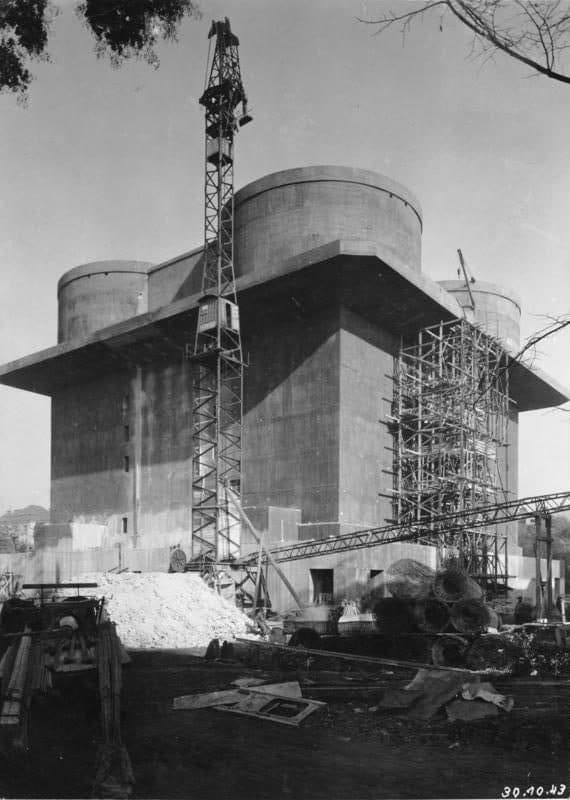
A first-generation Berlin flak tower under construction, with cranes and scaffolding around its corner gun turrets, 1942
A flak tower under construction in 1942. The Friedrichshain pair was finished the year before. Photo: Bundesarchiv, Bild 183-J16840 / Gerlach / CC-BY-SA 3.0

What was the Friedrichshain flak tower?

Flakturm II was a pair of reinforced-concrete towers built between April and October 1941: a gun tower (Gefechtsturm, or G-Turm) and a smaller control tower (Leitturm, or L-Turm), linked by underground passages. Radar and rangefinders on the control tower tracked the incoming bombers and sent firing data to the gun tower, which carried four twin-barrelled 12.8 cm guns, with lighter flak below. The pair took about 120,000 cubic metres of concrete and 10,000 tonnes of steel, with outer walls 2.6 metres thick.

Both towers were also public air-raid shelters. The gun tower was meant to hold 15,000 people; in the last months of the war probably twice that many crowded inside. The concrete held up against bomb hits, but the park around it was wrecked, and many of the gunners on the roof were killed. By the last days of the war 16-year-old schoolboys had taken their place.

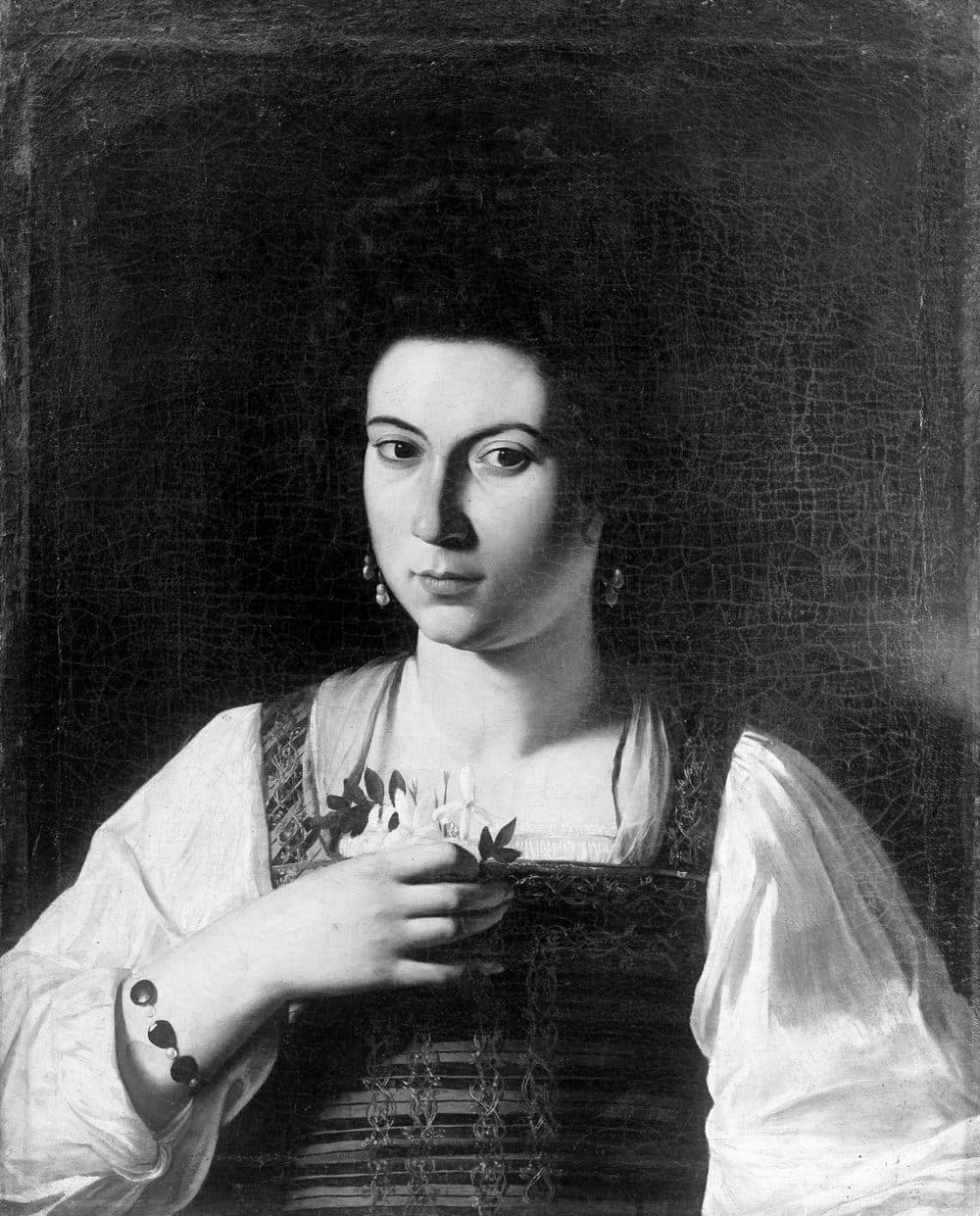
Black-and-white photograph of Caravaggio’s Portrait of a Courtesan, a painting from the Berlin Gemäldegalerie lost in 1945
Caravaggio’s Portrait of a Courtesan, lost in Berlin in 1945 and known today only from photographs like this one. Photo: Caravaggio; photograph: Staatliche Museen zu Berlin / Public domain, via Wikimedia Commons

The art that burned in the bunker

From 1941 Berlin’s Gemäldegalerie moved its most important paintings into the control tower, thought to be one of the safest places in the city. In March 1945, with the front approaching, the most valuable works were taken on to salt mines in Thuringia, where American troops secured them in May. Around 430 paintings, many of them too large to move, stayed behind in Friedrichshain, along with hundreds of sculptures.

After the surrender the bunker was left unguarded. Two fires in May 1945, the first on 6 May and a second about a week later, gutted it, and their cause has never been established. Works by Caravaggio, Rubens, Veronese and van Dyck were lost. Not everything burned, though: paintings believed destroyed have since turned up at auction, and in 2016 59 Renaissance sculptures from the Berlin collections were identified at the Pushkin Museum in Moscow, taken there after the war.

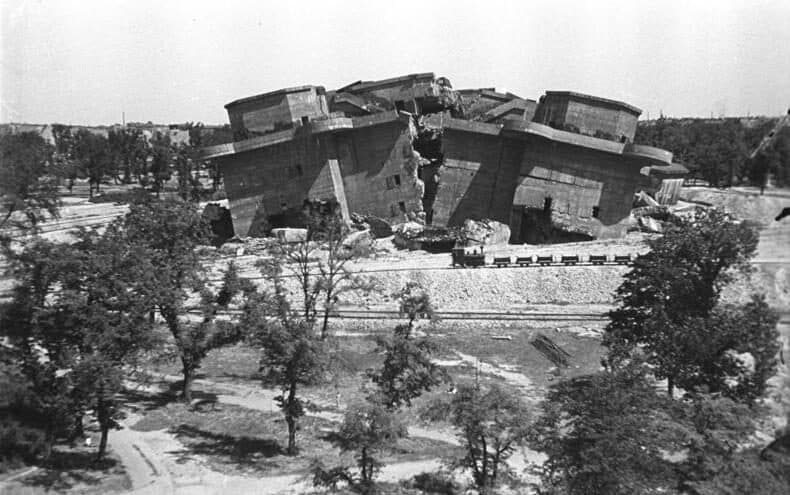
The blown-up gun tower of the Friedrichshain flak tower in August 1949, split in two, with rubble railway tracks in front
The blown-up gun tower in August 1949, with the rubble railway in front. Photo: Bundesarchiv, Bild 183-M1203-316 / Donath, Otto / CC-BY-SA 3.0

How the bunkers became hills

On Allied orders the towers had to go. Soviet sappers set their charges in May and June 1946, but they only managed to break the gun tower in two; the control tower was destroyed. Carting the ruins away was out of the question, so they were buried. The district councillor Alfred Krause, nicknamed ‘Trümmer-Krause’ (Rubble Krause), had narrow-gauge rubble railways bring in 2.1 million cubic metres of debris from the bombed city, and until August 1950 up to 3,000 rubble women worked on the two hills.

The landscape architect Reinhold Lingner drew up the planting while the tipping was still going on, and many of today’s winding paths follow the lines of the old rubble railways. The park reopened in 1951 for the World Festival of Youth and Students. The fast-growing poplars and maples planted then are now being replaced: since 2018 the district has felled unstable trees and is replanting with longer-lived species such as oak and beech.

Plan your visit

Visiting the Friedrichshain flak tower

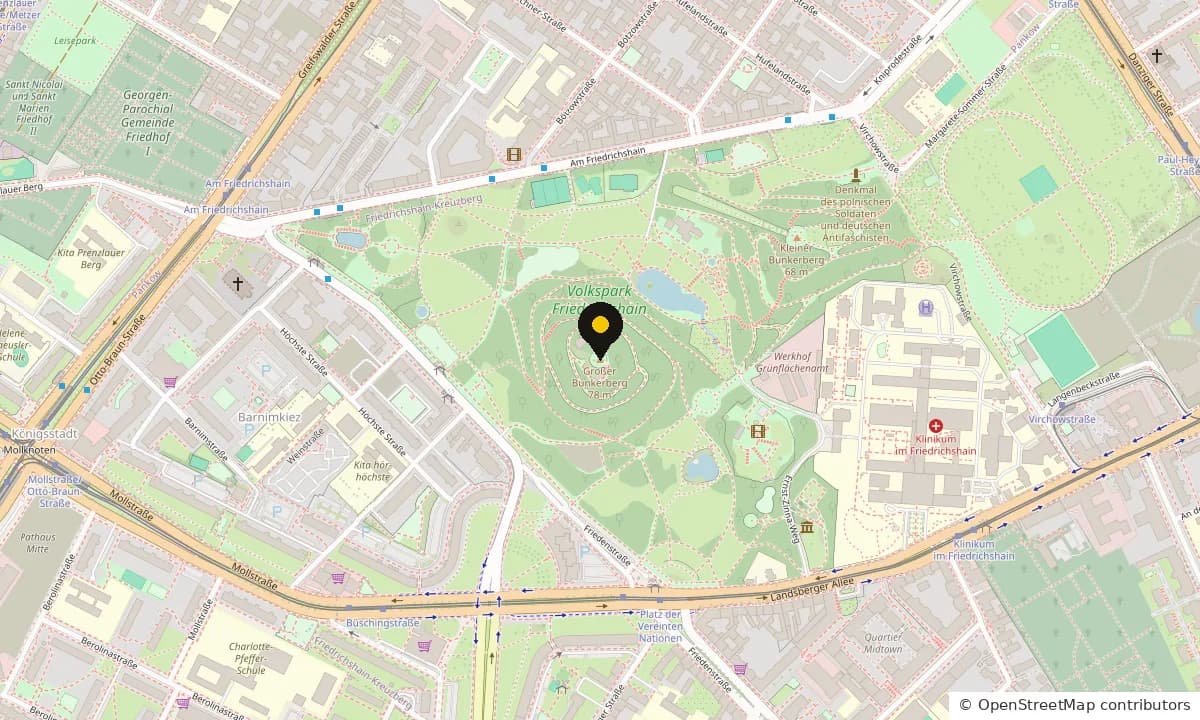
Map of the streets around the Friedrichshain flak tower, with a pin on the siteOpen in Google Maps

Volkspark Friedrichshain (Großer Bunkerberg), 10249 Berlin · Open 24 hours, every day (public park)

Getting there

  • Tram M5Tram M6Tram M8Platz der Vereinten Nationen550 m · 9 min

    A few stops east of Alexanderplatz. Cross into the park on its south side and follow the paths uphill.

  • Bus 200Bötzowstraße500 m · 8 min

    Bus 200 runs from Alexanderplatz along Am Friedrichshain, the park’s northern edge.

  • Tram M4Am Friedrichshain800 m · 12 min

    Next to the Märchenbrunnen, the fairy-tale fountain at the park’s western entrance.

What you’ll see

  • The Großer Bunkerberg, 78 metres above sea level: the rubble hill over the gun tower, with a round viewing platform at the top, built on the tower’s remains.
  • Grey slabs of blown-up concrete breaking through the slopes below the platform: the only parts of the tower still in sight.
  • The smaller Kleiner Bunkerberg over the control tower, where the paintings burned, and the Berliner Unterwelten association’s German and English information panel (2012) by the lake opposite Café Schönbrunn.

Tips from a guide

  • Come between November and April. With the leaves off the trees you get the view the platform was built for and can see the concrete far more clearly.
  • Much of the hillside is fenced off for replanting, so stay on the paths: the fences protect new trees, and the slopes hide broken concrete.
  • Start at the Märchenbrunnen (fairy-tale fountain, 1913) by the western entrance, and leave by the Friedhof der Märzgefallenen, the 1848 revolutionaries’ cemetery in the same park.

Accessibility

The lower park paths are level and mostly paved, but the summit is only reached by steep, cobbled serpentine paths and stone steps, so it is not step-free. There are no toilets or facilities on the hill; there are cafés in the park, including Café Schönbrunn by the lake. The trams on lines M4, M5, M6 and M8 are low-floor; check the BVG website for current details.

Timeline

From flak tower to Mont Klamott

  1. 25–26 Aug 1940The RAF bombs Berlin for the first time.
  2. Sep 1940Hitler orders flak towers to be built to protect the capital.
  3. Apr–Oct 1941The gun tower and control tower go up in Volkspark Friedrichshain.
  4. Mar 1945The most valuable paintings are moved from the tower to salt mines in Thuringia.
  5. 2 May 1945Berlin surrenders and the flak towers stop firing.
  6. May 1945Two fires in the control tower destroy around 430 paintings.
  7. May–Jun 1946Soviet sappers blow up the towers; the gun tower breaks in two.
  8. 1946–502.1 million m³ of rubble is heaped over the ruins, creating two hills.
  9. 1951The park reopens for the World Festival of Youth and Students.
  10. 1983The East German band Silly releases ‘Mont Klamott’.
  11. 31 Aug 2012Berliner Unterwelten unveils an information panel in the park.
  12. 201659 sculptures from the tower are identified in Moscow’s Pushkin Museum.

See it with a historian

Tours that stop at the Friedrichshain flak tower

On its own the hill looks like any other park; a guide can show you where the guns stood, where the paintings burned and where the concrete still breaks the surface.

The Red Army’s advance in 1945, including the surviving Humboldthain flak tower.

The Battle Of Berlin Tour - Berlin Experiences
Full Day6 Hours

The Battle Of Berlin Tour

Private 6-hour van tour of the 1945 battlefield, from the outskirts to the Reichstag, for up to 6 people. Starts at your hotel.

€1,000up to 6
View Tour

The rise and fall of the Third Reich, through what remains of Hitler’s Berlin.

The Capital Of Tyranny Tour - Berlin Experiences
Full Day6 Hours

The Capital Of Tyranny

Private 6-hour van tour of Hitler's Berlin and the Third Reich for up to 6 people. Starts at your hotel or anywhere in the city.

€1,000up to 6
View Tour

Our full-day, all-in-one tour of the city’s history, shaped around what you want to see.

The Berlin History Tour
Full Day6 Hours

The Berlin History Tour

Private 6-hour van tour of Berlin's whole history in one day for up to 6 people. Starts at your hotel or anywhere in the city.

€1,000up to 6
View Tour

Questions visitors ask

Frequently asked questions

Where is the flak tower in Berlin?

Berlin had three pairs of flak towers: at the Zoo, in Volkspark Friedrichshain and in Volkspark Humboldthain. The Friedrichshain towers are buried inside the Großer and Kleiner Bunkerberg hills, a short tram ride east of Alexanderplatz; the Zoo towers were demolished, and part of the Humboldthain gun tower still stands.

Can you go inside the Friedrichshain flak tower?

No. The towers were blown up in 1946, buried under rubble and sealed, and there are currently no tours inside them. To see the inside of a flak tower, book Berliner Unterwelten’s tour of the Humboldthain tower (April–October).

Can you still see the flak tower in Volkspark Friedrichshain?

A little. The viewing platform on the Großer Bunkerberg sits on the remains of the gun tower, and slabs of blown-up concrete show through the slopes just below it, most clearly in winter when the trees are bare.

What was a flak tower?

A huge above-ground concrete bunker carrying anti-aircraft guns (Flak is short for Flugabwehrkanone). Each site had a gun tower and a smaller control tower that tracked the bombers, and both doubled as air-raid shelters for thousands of civilians.

What happened to the art stored in the Friedrichshain flak tower?

Around 430 paintings from the Gemäldegalerie, including works by Caravaggio and Rubens, were destroyed in two fires in the control tower in May 1945, whose cause is still unknown. Some pieces survived: 59 Renaissance sculptures were identified at the Pushkin Museum in Moscow in 2016.

Why is the hill called Mont Klamott?

‘Klamotten’ is Berlin slang for old junk or rags, and the hill is made of 2.1 million cubic metres of wartime rubble. The nickname dates from the 1950s and was made famous by the East German band Silly’s 1983 song ‘Mont Klamott’.

Is Volkspark Friedrichshain free to visit?

Yes. It is a public park, free and open at all hours, and the climb to the viewing platform on the Großer Bunkerberg costs nothing.

Are there tours of the flak towers?

Our Battle of Berlin, Capital of Tyranny and Berlin History tours can include the flak towers, and Berliner Unterwelten runs public tours inside the Humboldthain tower from April to October.

Keep exploring

More Featured Experiences.

Every site we write about — 56 landmarks, museums, memorials and lesser-known corners of Berlin. See the full index →

01Walk Through The Brandenburg Gate02Explore The State Museums On Museum Island03Visit The Berlin TV Tower – The Fernsehturm04Cross The Cold War Border At Checkpoint Charlie05Visit The Site Of Adolf Hitler’s Führerbunker06Explore The Reconstructed Berlin Palace07Visit The Reichstag Cupola At Night08Explore The Forum Fridericianum09Shop At The Humboldt University Book Sale10Journey Into The Memorial To The Murdered Jews Of Europe11Step Inside The Neue Wache12Explore The Former Jewish Quarter – Spandauer Vorstadt13Visit The Remains Of The Berlin Wall14Walk Across The Bridge Of Spies15Explore The Topography Of Terror16Climb The Prussian Victory Column – The Siegessäule17Enter The Palace Of Tears – The Tränenpalast18Step Inside The Berlin Olympic Stadium19Explore Erich Mielke’s Office At The Stasi Museum20Walk Along Karl Marx Allee21Visit The Oldest Church In Berlin – The Nikolaikirche22Explore The Berliner Dom23Visit The Grave Of Frederick The Great24Walk Through The Ruins Of Anhalter Bahnhof25Stand On The Platz Des Volksaufstandes26Visit The German Resistance Museum27Visit The Soviet War Memorial In The Tiergarten28See The Georg Elser Memorial On Wilhelmstrasse29Step Inside The Kaiser Wilhelm Gedächtnis Kirche30Visit The Gleis 17 Memorial31Visit The Schloss Charlottenburg Mausoleum32Climb The Französischer Dom at Gendarmenmarkt33Explore The Interbau – IBA 5734Explore The Otto Weidt Workshop35Visit Cecilienhof – Site Of The Potsdam Conference36Visit The Stasi Prison In Hohenschönhausen37Spend The Day At Tempelhof Airport38Ride The Fastest Elevator In Europe39Visit The Soviet War Memorial In Treptower Park40Visit The Sachsenhausen Concentration Camp Memorial41Visit The Ravensbrück Concentration Camp Memorial42Visit Karlshorst – The Site Of The German Surrender43Visit The Socialists Cemetery – Zentralfriedhof Friedrichsfelde44Visit The Soviet War Memorial In Pankow45Visit the Seelow Heights Memorial46Visit The Commonwealth War Cemetery47Cross The Bösebrücke At Night48Explore The Allied Museum In Dahlem49Explore The Spandau Citadel50Visit The Brandenburg T4 Euthanasia Memorial51Visit The Wannsee Conference House52Visit The Jewish Museum53Visit The Jewish Cemetery In Weissensee54Walk Along The East Side Gallery56Head Up The Teufelsberg