Skip to content
The Georg Elser memorial on Wilhelmstraße in Berlin: a steel silhouette of Elser’s profile on a tall mast against a blue sky

Berlin Experiences/Featured Experiences

Georg Elser: Visit His Memorial on Berlin’s Wilhelmstraße

The monumental tribute to the man who almost assassinated Adolf Hitler.

The short answer

The Georg Elser memorial is a steel outline of Elser’s face, more than 17 metres high, on Wilhelmstraße at the corner of An der Kolonnade in Berlin-Mitte. It honours the Swabian carpenter whose bomb went off in Munich’s Bürgerbräukeller on 8 November 1939, thirteen minutes after Hitler had left. It stands on a public pavement, so it is free and open at all hours, and it is lit at night. Ten to fifteen minutes is enough, and the site of the Führerbunker is two minutes’ walk away.

Where
Wilhelmstraße, corner of An der Kolonnade, 10117 Berlin-Mitte
Open
Always: an outdoor memorial on a public street, lit at night
Admission
Free
Time needed
10–15 minutes
Nearest station
U2 Anton-Wilhelm-Amo-Straße, 2 minutes on foot
Step-free
Yes: the memorial is at street level

The story · by Matt Robinson

Until 1945, Wilhelmstrasse served as the main government street and centre of power in Germany – from the era of Bismarck and German unification to the Battle of Berlin and division of the city into Allied occupation zones following the defeat of Adolf Hitler’s regime.

The construction of palatial villas for Berlin’s aristocratic families here in the 1700s would put Wilhelmstrasse on the map as a north south thoroughfare bordering the city customs wall – that from 1731 would be named Husarenstraße (Street of the Hussars). Following the death of King Frederick William I, the street would be renamed in his honour in 1740 – assuming its identity as Wilhelmstrasse.

By the mid 19th century, the residential neighbourhood for wealthy families and members of the royal Hohenzollern dynasty centred on this street would grow into the main Prussian government street – with the addition of a palace for the Reich President, and the official seat of the German Chancellor.

Information board at the Georg Elser memorial on Wilhelmstraße, Berlin, with a portrait photograph of Elser and his dates
The information board at the memorial, with Elser’s portrait.

Hitler’s government street

Further buildings would either be added or acquired – with the former aristocratic residence soon transformed – such as the Palais Schulenburg, Palais Strousberg, Palais Schwerin (destined to become the residence of the first Reich President) and Palais Borsig (the office of the German Vice Chancellor, and after 1934 home to the Nazi brownshirt SA). Important government institutions would also soon populate the street – the Ministry of Finance, the Ministry of Food, and the Transportation Ministry.

Following the Nazi seizure of power in 1933, further offices would spring up as the street was expanded to the south – with the notable addition of the SS/Gestapo Headquarters and Reich Aviation Ministry.

Portrait of Adolf Hitler, scratched out, on a Wilhelmstraße history board about the Reich Chancellery, near the Georg Elser memorial in Berlin
A history board on the Reich Chancellery, a few steps away. Someone has scratched out Hitler’s face.

Unimpressed with the previous Chancellery, Adolf Hitler also ordered the construction of a New Reich Chancellery – from where he would lead the country from 1939. Destroyed at the end of the Second World War by the Soviets, little indication remains in the area that this colossal building once stood here, although provocatively placed on Wilhelmstrasse next to where Hitler’s offices stood is a memorial for the man who almost assassinated the Nazi leader the same year this building was completed – Johann Georg Elser.

Thirteen minutes

In fact, in November 1939, Elser – a carpenter and cabinet maker by trade – almost succeeded in decapitating the Nazi leadership in one swoop, after planting a homemade bomb in a beer hall in Bavaria – set to go off in the middle of one of Adolf Hitler’s typically long speeches.

This elaborate attempt unfortunately failed when the gathering Hitler was attending – to commemorate the dead of the so-called ‘Beer Hall Putsch’ that had taken place in 1923 – was halted early, leaving Elser’s homemade bomb ticking away in a column next to the stage Hitler had been speaking from. Only to explode thirteen minutes later and cause serious damage to the beer hall when the ceiling collapsed, killing eight people and injuring many more – including Eva Braun’s father. The crowd of nearly 3,000 had already started to dissipate by the time of the explosion; with Hitler on his way back to Berlin to devote his attention to planning the imminent war with France. And the important members of his entourage dispersed.

…leaving Elser’s homemade bomb ticking away in a column next to the stage Hitler had been speaking from.

Elser’s attack had been no last minute affair, in fact he had spent much of the previous two months covertly working inside the Bürgerbräu beer hall – chiselling away at the speaker’s rostrum to hollow out the brickwork for his bomb. The materials used to create his ‘infernal machine’ were stolen from his workplace; as Elser had been employed at an armaments factory and quarry. The timer he constructed himself would be set for 9.20pm on November 8th 1939.

Captured while trying to escape to Switzerland, Elser was interrogated by the Gestapo (Nazi secret police) and forced to make a full written confession – something he was only eager to do. Subsequent torture would induce the young carpenter to concede that he had actually been working with ‘foreign agents’ – contrary to his initial statements – a charge that the Nazi propaganda machine was only too happy to use to its advantage.

One man, acting alone

Despite attempts to paint Elser as part of an international plot, with British backing, there was no evidence that he had in fact colluded with ‘foreign agents’ in his actions. As he repeatedly stated, Elser had acted alone, enraged by the evil of National Socialism and motivated by his desire to prove himself a ‘good man’. He would explain during his interrogation: “I reasoned the situation in Germany could only be modified by a removal of the current leadership, I mean Hitler, Goering and Goebbels …”.

Elser’s words from his 1939 Gestapo interrogation set into the pavement as a lit strip at the Georg Elser memorial, Wilhelmstraße, Berlin
Elser’s words from his interrogation, set into the pavement: “…that conditions in Germany could only be changed by removing the present leadership”.

Elser’s attempt is often cited as the textbook example of how one man, driven by personal conviction, can almost change history. And that, while not being a member of any political party, he was proof that it was possible for an ‘ordinary German’ to channel his outrage into something righteous.

There is evidence, however, that Elser – whose parents were Protestants – increased his church attendance in the run-up to his assassination attempt and that he would claim that recitation of the Lord’s Prayer would calm him whilst he worked.

After being detained at the Gestapo headquarters in Berlin for interrogation, Elser was transferred to the Sachsenhausen concentration camp north of the city and kept in isolation there from 1941 until 1945. The preferential treatment that he received whilst held in the T-block building drew the attention of fellow prisoners, who wondered at why a man so eager to confess his guilt would be left alive for so long.

Shortly before the end of the war, Georg Elser was transferred to Dachau concentration camp, near Munich, and murdered there on April 9th 1945.

Providence and the memorial

Details of Elser’s interrogation and imprisonment remain as absurd as his plan was audacious, as during the investigation he was forced to reconstruct the bomb he had manufactured for the Bürgerbräu attempt – as proof that he was capable of acting as the sole instigator. As tasked, he proved capable of creating this replica and was said to be content to receive praise for his craftsmanship by his interrogators.

During his torture he was not only beaten but also hypnotised, by one of four hypnotists who were brought in to help him confess, and drugged with the stimulant Pervitin.

Several conspiracy theories have even spread suggesting that Elser was somehow working with Nazi agents to carry out the attack – with famed pastor Martin Niemöller, a fellow prisoner at Sachsenhausen, claiming that Elser’s attack had been staged to qualify the claim that Hitler was protected by some divine providence.

Fittingly, this memorial for Georg Elser that now stands on Wilhelmstrasse not only positioned close to where Adolf Hitler’s Chancellery previously stood, but also metres away from where Hitler would take his own life – having survived, by some estimates, up to forty-two known assassination attempts.

…the outline of Elser’s face can be seen staring across the road at the former Nazi Propaganda Ministry.

Whether providence was involved or not, it is certainly remarkable that Hitler would survive for so long before finally perishing by his own hand. This claim to God’s intervention is something that the Nazi propaganda minister, Joseph Goebbels, embraced and propagated through his stranglehold of the German media – perhaps it is now fitting that the outline of Elser’s face can be seen staring across the road at the former Nazi Propaganda Ministry.

Certainly, if Hitler was really part of God’s Plan; what a disgusting and reprehensible plan it was.
Georg Elser in detail

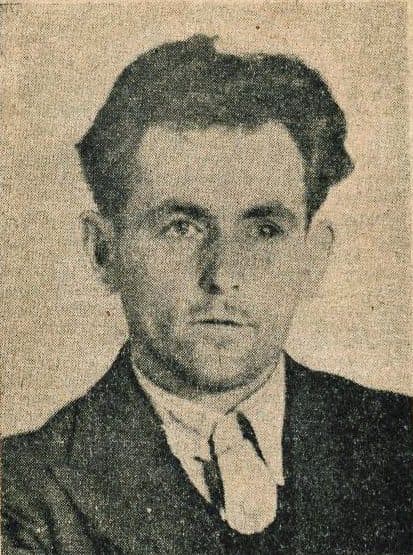
Press photograph of Georg Elser, the carpenter who tried to kill Hitler, taken in November 1939 after his arrest
Georg Elser in a press photograph from November 1939, after his arrest. Photo: Landesarchiv NRW (RW 58 Nr. 65209) / CC0, via Wikimedia Commons

Who was Georg Elser?

Johann Georg Elser was born on 4 January 1903 in Hermaringen in Württemberg and grew up in nearby Königsbronn, on the edge of the Swabian Jura. He trained as a carpenter and cabinetmaker and worked across south-west Germany, including a spell in a clock factory in Konstanz, experience he later put into his bomb’s timer. He voted Communist and joined the Red Front Fighters’ League for a time, but he was never a party man and went to only a handful of its meetings.

What turned him against the regime, he told the Gestapo, was what it did to working people: lower wages, the loss of the right to change jobs, pressure on the churches and, after the Munich crisis of autumn 1938, the near certainty of war. He decided that only removing Hitler, Göring and Goebbels would change that. In 1939 he took explosive and detonators from the quarry in Königsbronn where he worked, after earlier taking powder from the Waldenmaier armaments works in Heidenheim.

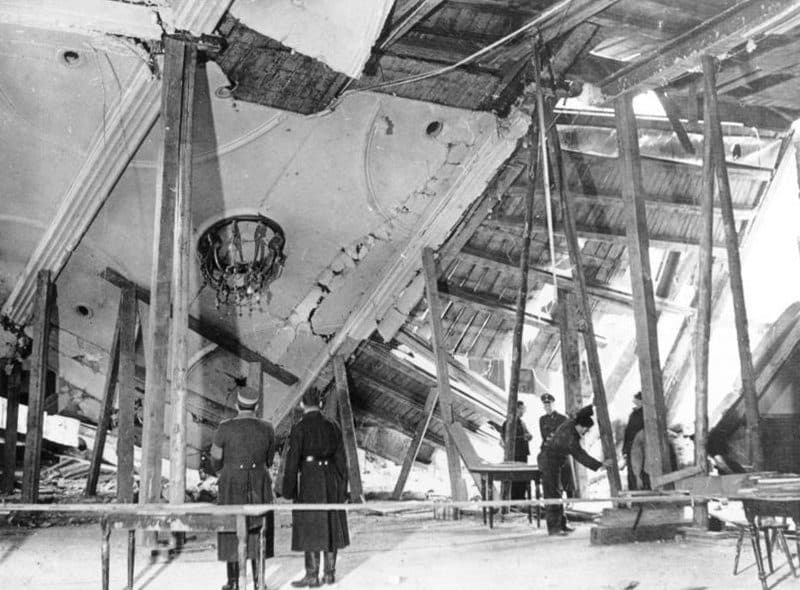
The wrecked hall of the Bürgerbräukeller in Munich the day after Georg Elser’s bomb, 9 November 1939, with the collapsed ceiling propped up by timber
The Bürgerbräukeller the day after the explosion, 9 November 1939. Photo: Bundesarchiv, Bild 183-E12329 / Wagner / CC-BY-SA 3.0

The bomb in the Bürgerbräukeller

Every 8 November Hitler spoke in Munich’s Bürgerbräukeller to the veterans of his failed 1923 putsch. Elser went to look at the hall on 8 November 1938, came back in April 1939 to measure the pillar behind the speaker’s rostrum, and moved to Munich on 5 August. Over some 30 to 35 nights he let himself be locked in after closing and hollowed out the pillar from the gallery. On 1–2 November he installed the explosive and a twin-clock timer, set for 21:20 on 8 November.

That year the event was moved forward to 20:00 and the speech cut from two hours to one, because fog was forecast and Hitler wanted to return to Berlin the same night by train. He left the hall at 21:07. At 21:20 the bomb brought the ceiling down, killing eight people and injuring more than sixty. By then Elser had already been stopped by border guards at 20:45, about 25 metres from the Swiss frontier at Konstanz, carrying wire cutters and a postcard of the hall’s interior.

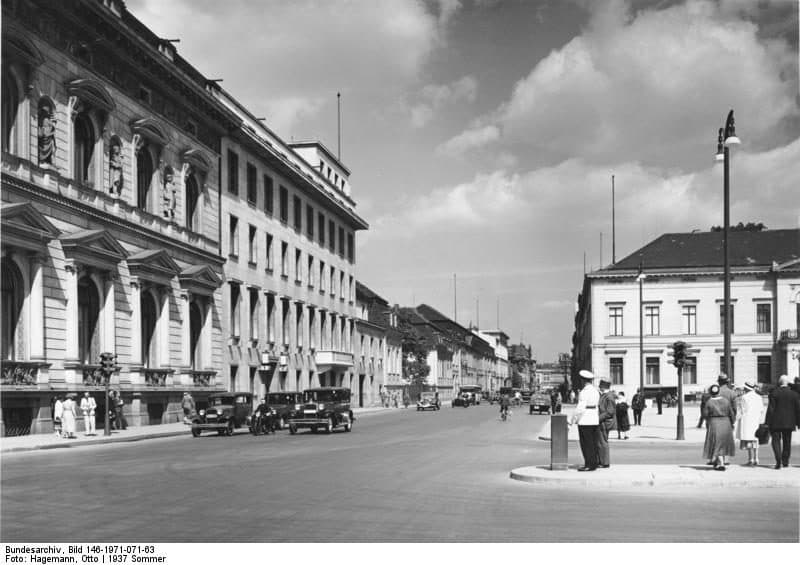
Wilhelmstraße in Berlin in summer 1937, with the Reich Chancellery on the left and the Propaganda Ministry on the right, near where the Georg Elser memorial stands today
Wilhelmstraße in 1937: the Reich Chancellery on the left, the Propaganda Ministry on the right. Photo: Bundesarchiv, Bild 146-1971-071-63 / Hagemann, Otto / CC-BY-SA 3.0

Why Berlin waited 72 years

For decades after the war Elser was remembered as a puzzle. Rumours that he had been an SS stooge in a staged attack, repeated by Martin Niemöller among others, outlived him. His Gestapo interrogation record lay unnoticed in the federal archives in Koblenz until 1964, and only in 1969 did the historian Anton Hoch use it to show that Elser had worked alone. West Germany’s official remembrance largely passed him over until the 1990s; Deutsche Post issued a stamp for his 100th birthday in 2003, and Oliver Hirschbiegel’s film 13 Minutes (Elser) followed in 2015.

The Berlin memorial was the playwright Rolf Hochhuth’s idea. He wanted it on Wilhelmstraße as a counterweight to the Führerbunker site, which he saw becoming a place of pilgrimage. Berlin’s House of Representatives took the project up in 2008, a jury chose Ulrich Klages’s design unanimously on 12 October 2010, and the sculpture was unveiled on 8 November 2011, 72 years to the day after the bomb. It cost €250,000: €200,000 from the State of Berlin and €50,000 from an anonymous donor.

Plan your visit

Visiting the Georg Elser memorial

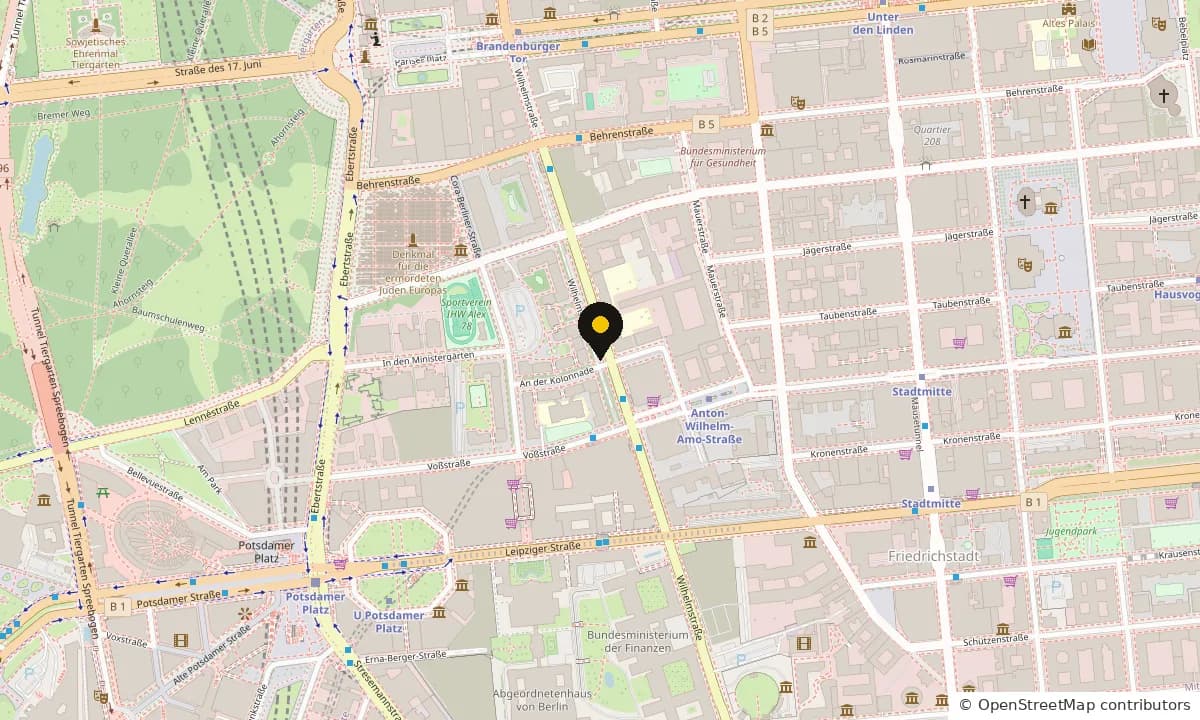
Map of the streets around the Georg Elser memorial, with a pin on the siteOpen in Google Maps

Wilhelmstraße / An der Kolonnade, 10117 Berlin · Open 24 hours, every day

Getting there

  • U2Anton-Wilhelm-Amo-Straße150 m · 2 min

    Called Mohrenstraße until 2025, so older guides and maps still use that name. Walk north up Wilhelmstraße.

  • S1S2S25S26U5Brandenburger Tor600 m · 8 min

    Walk south down Wilhelmstraße, past the British Embassy.

  • S1S2S25S26U2Potsdamer Platz570 m · 8 min

    Head north-east along Voßstraße, where the New Reich Chancellery stood, then left into Wilhelmstraße.

What you’ll see

  • Ulrich Klages’s steel sculpture: a mast that turns into a single line drawing Elser’s profile, more than 17 metres high and visible above the trees. It was unveiled on 8 November 2011 and is lit with LEDs at night.
  • Two of Elser’s sentences set into the pavement as strips of light: that conditions in Germany could only be changed by removing the present leadership, from his 1939 Gestapo interrogation, and “Ich habe den Krieg verhindern wollen” (“I wanted to prevent the war”).
  • An information board on his life, and the old government quarter around it: the former Propaganda Ministry across the road and the site of the Führerbunker a block to the west.

Tips from a guide

  • Come after dark if you can: the lit profile stands out against the sky and is far easier to make out than by day.
  • Look down as well as up: the quotations in the pavement are easy to walk straight over.
  • Pair it with the Führerbunker site, 2 minutes away, where Hitler killed himself in 1945: the board there and Elser’s profile tell the two halves of the story.

Accessibility

The memorial, the board and the pavement quotations are all at street level, and the walk from each station is on level pavement. Check the BVG website for lift status at the stations. There are no toilets or seating at the site; the nearest are at Potsdamer Platz.

Timeline

From the Bürgerbräukeller to Wilhelmstraße

  1. 4 Jan 1903Johann Georg Elser is born in Hermaringen, Württemberg.
  2. Autumn 1938After the Munich crisis, Elser decides to kill Hitler.
  3. 5 Aug 1939He moves to Munich and starts hollowing out the pillar at night.
  4. 8 Nov 1939Arrested at Konstanz at 20:45; his bomb explodes at 21:20, 13 minutes after Hitler left.
  5. Nov 1939Interrogated and tortured by the Gestapo in Munich and Berlin.
  6. Early 1941Held as a special prisoner in Sachsenhausen’s cell block.
  7. Early 1945Moved to the bunker at Dachau concentration camp.
  8. 9 Apr 1945Shot at Dachau on Hitler’s orders, four weeks before the war in Europe ends.
  9. 1969Anton Hoch uses the Gestapo record to show that Elser acted alone.
  10. Jan 2003Deutsche Post issues a stamp for his 100th birthday.
  11. 12 Oct 2010A jury chooses Ulrich Klages’s design for a Berlin memorial.
  12. 8 Nov 2011The memorial is unveiled on Wilhelmstraße, 72 years after the bomb.

See it with a historian

Tours that stop at the Georg Elser memorial

The memorial is easy to walk past; a guide can show you the government quarter Elser tried to decapitate, and where its leaders worked and died.

One hour in the Nazi government district, from the Chancellery site to Elser’s silhouette.

The Third Reich Tour
One Hour1 Hour

The Third Reich Tour

Private 1-hour walking tour of the Nazi government district for up to 10 people. Starts at Pariser Platz by the Brandenburg Gate.

€200up to 10
View Tour

The rise and fall of the Third Reich, through what remains of Hitler’s Berlin.

The Capital Of Tyranny Tour - Berlin Experiences
Full Day6 Hours

The Capital Of Tyranny

Private 6-hour van tour of Hitler's Berlin and the Third Reich for up to 6 people. Starts at your hotel or anywhere in the city.

€1,000up to 6
View Tour

Six hours across Berlin’s history, taking in the old government quarter.

The Berlin History Tour
Full Day6 Hours

The Berlin History Tour

Private 6-hour van tour of Berlin's whole history in one day for up to 6 people. Starts at your hotel or anywhere in the city.

€1,000up to 6
View Tour

Questions visitors ask

Frequently asked questions

Who was Georg Elser?

A carpenter and cabinetmaker from Württemberg, born in 1903, who on 8 November 1939 came within thirteen minutes of killing Hitler with a bomb he had built and hidden himself. He belonged to no resistance group and acted entirely alone.

Where is the Georg Elser memorial in Berlin?

On Wilhelmstraße at the corner of An der Kolonnade in Berlin-Mitte, two minutes’ walk from U2 Anton-Wilhelm-Amo-Straße and from the site of the Führerbunker. It is outdoors, free and open at all hours.

What did Georg Elser do?

Over more than 30 nights he hollowed out a pillar behind the speaker’s rostrum in Munich’s Bürgerbräukeller and hid a time bomb in it, set for 21:20 on 8 November 1939, during Hitler’s annual speech to the veterans of the 1923 putsch.

Why did Elser’s bomb fail to kill Hitler?

Hitler started earlier than usual and cut his speech to an hour so he could take the night train back to Berlin, because fog was forecast. He left at 21:07; the bomb went off on time at 21:20, killing eight people.

How did Georg Elser die?

He was held for over five years, latterly in Sachsenhausen and Dachau, as a special prisoner. On 9 April 1945 he was shot at Dachau on Hitler’s orders, less than a month before the war in Europe ended.

Is it Georg or George Elser?

Georg, the German form; his full name was Johann Georg Elser. ‘George Elser’ is a common English spelling, but you will find him under Georg in German archives and on the memorial.

Is there a film about Georg Elser?

Yes. Oliver Hirschbiegel’s <em>13 Minutes</em> (German title <em>Elser – Er hätte die Welt verändert</em>, 2015) stars Christian Friedel as Elser.

Are there tours that include the Georg Elser memorial?

Yes. Our Third Reich tour, Capital of Tyranny tour and Berlin History tour all pass it, and a guide can place it in the government quarter around it, from the Chancellery to the Führerbunker.

Keep exploring

More Featured Experiences.

Every site we write about — 56 landmarks, museums, memorials and lesser-known corners of Berlin. See the full index →

01Walk Through The Brandenburg Gate02Explore The State Museums On Museum Island03Visit The Berlin TV Tower – The Fernsehturm04Cross The Cold War Border At Checkpoint Charlie05Visit The Site Of Adolf Hitler’s Führerbunker06Explore The Reconstructed Berlin Palace07Visit The Reichstag Cupola At Night08Explore The Forum Fridericianum09Shop At The Humboldt University Book Sale10Journey Into The Memorial To The Murdered Jews Of Europe11Step Inside The Neue Wache12Explore The Former Jewish Quarter – Spandauer Vorstadt13Visit The Remains Of The Berlin Wall14Walk Across The Bridge Of Spies15Explore The Topography Of Terror16Climb The Prussian Victory Column – The Siegessäule17Enter The Palace Of Tears – The Tränenpalast18Step Inside The Berlin Olympic Stadium19Explore Erich Mielke’s Office At The Stasi Museum20Walk Along Karl Marx Allee21Visit The Oldest Church In Berlin – The Nikolaikirche22Explore The Berliner Dom23Visit The Grave Of Frederick The Great24Walk Through The Ruins Of Anhalter Bahnhof25Stand On The Platz Des Volksaufstandes26Visit The German Resistance Museum27Visit The Soviet War Memorial In The Tiergarten29Step Inside The Kaiser Wilhelm Gedächtnis Kirche30Visit The Gleis 17 Memorial31Visit The Schloss Charlottenburg Mausoleum32Climb The Französischer Dom at Gendarmenmarkt33Explore The Interbau – IBA 5734Explore The Otto Weidt Workshop35Visit Cecilienhof – Site Of The Potsdam Conference36Visit The Stasi Prison In Hohenschönhausen37Spend The Day At Tempelhof Airport38Ride The Fastest Elevator In Europe39Visit The Soviet War Memorial In Treptower Park40Visit The Sachsenhausen Concentration Camp Memorial41Visit The Ravensbrück Concentration Camp Memorial42Visit Karlshorst – The Site Of The German Surrender43Visit The Socialists Cemetery – Zentralfriedhof Friedrichsfelde44Visit The Soviet War Memorial In Pankow45Visit the Seelow Heights Memorial46Visit The Commonwealth War Cemetery47Cross The Bösebrücke At Night48Explore The Allied Museum In Dahlem49Explore The Spandau Citadel50Visit The Brandenburg T4 Euthanasia Memorial51Visit The Wannsee Conference House52Visit The Jewish Museum53Visit The Jewish Cemetery In Weissensee54Walk Along The East Side Gallery55Explore The Volkspark Friedrichshain Flak Tower56Head Up The Teufelsberg