Skip to content
Marble effigy of Kaiser Wilhelm I on his sarcophagus in the Mausoleum at Schloss Charlottenburg, Berlin, carved by Erdmann Encke

Berlin Experiences/Featured Experiences

Mausoleum Charlottenburg: Visit Queen Luise’s Tomb in the Palace Garden

The final resting place of the first German Emperor and Prussian Queen Luise.

The short answer

The Mausoleum Charlottenburg is a small temple-like tomb in the north-west of the palace garden of Schloss Charlottenburg in western Berlin, built in 1810 for Queen Luise of Prussia. Inside are the marble tombs of Luise and her husband Frederick William III by Christian Daniel Rauch, and of Kaiser Wilhelm I and Empress Augusta by Erdmann Encke. The garden is free and open all year, but the mausoleum itself only opens from April to October, Tuesday to Sunday, for €3. Allow 20–30 minutes inside, plus about 10 minutes’ walk from the palace.

Where
North-west of the palace garden, Schloss Charlottenburg, Spandauer Damm 10–22, 14059 Berlin
Open
April–October, Tue–Sun 10:00–17:30; closed November–March
Admission
€3, reduced €2 (coins only); garden free
Time needed
20–30 minutes; half a day with the palace
Nearest station
Bus M45/109/309 Schloss Charlottenburg, 12 minutes on foot
Step-free
No: steps up to the entrance

The story · by Matt Robinson

When completed in 1905, the magnificent neorenaissance Berliner Dom, on the eastern edge of the city’s central Museumsinsel, was not only intended to serve as a protestant church – of equal standing to that of St Peter’s in Rome or St Paul’s in London – but also a burial ground for the Hohenzollern royal family.

German Emperor, Wilhelm II, intended that following his death he would be interred inside the crypt of this impressive place of worship, alongside the founder of modern Prussia – Frederick I. Although, in outlining his desire for this monumental building to, in effect, serve as his tombstone – befitting his much addressed inferiority complex – Wilhelm was also highlighting a problem that had plagued the Hohenzollern family since their arrival in this region back in the 1400s – the lack of a dynastic resting place where all members of the family are gathered.

While Friedrich I and his wife Sophie Charlotte are both kept within the confines of the Berliner Dom, Frederick’s son and successor – Friedrich Wilhelm I – is to be found in the Church of Peace in Potsdam. His son, often referred to as Frederick the Great, is buried nearby outside his pleasure palace, Schloss Sanssouci. Contrary to his wishes, Frederick was initially buried next to his father in the Potsdam Garrison Church – before being moved at the end of the Second World War for safe keeping. For much of the Cold War period he resided at the Hohenzollern ancestral home, Burg Hohenzollern, before finally being laid to rest at Sanssouci in 1991.

Even for the most powerful of the German royal families, a final resting place was not always final; and the choice of location would speak volumes about the deceased. Perhaps no more so than in the case of Wilhelm II – who would not be buried in the Berliner Dom. Following his abdication, the disgraced monarch fled to the Netherlands, where he lived and died in exile at his estate in the town of Doorn. His body lies in a maroon-coloured coffin, in a small mausoleum in the gardens of this estate, eagerly awaiting his return to Germany upon the restoration of the Prussian monarchy – according to the terms of his will.

The man whose legacy he spent his entire life overshadowed by – his grandfather, Wilhelm I, the first German Emperor – sought no grand tomb or faux-Italian cathedral to spend eternity in. Instead, he rests silently tucked away in the intimate surroundings of the gardens of the Schloss Charlottenburg in West Berlin, inside a mausoleum originally built for his mother.

A temple for Queen Luise

By the time Queen Luise von Mecklenburg-Strelitz died in 1810 – aged only 34 – her reputation as the ‘soul of national virtue’, something that in her lifetime she had done much to cultivate, was already secure. Venerated for her generosity and fashion sense (popularising the neckerchief as an accessory), she occupied a much more prominent role than her predecessors – frequently advising her husband, Friedrich Wilhelm III, on matters of governance and war. A mother of nine children, her attempts to secure a more advantageous peace with Emperor Napoleon after Berlin was occupied by French troops in 1806, earned her the respect and admiration of future generations and led to the introduction of the Order of Luise (the female equivalent of the Iron Cross) following her death.

Following her arrival in Berlin in 1793, Luise was presented with Schloss Charlottenburg as a residence by her father-in-law, then ruling King Frederick William II. The palace would become a favoured location and, although the princess would spend much of her time at the Paretz Palace near Potsdam, it was here that her husband decided to construct a mausoleum to serve as her final resting place.

Finished by December 1810, and built by architect Heinrich Gentz with master architect Karl Friedrich Schinkel advising, this structure actually utilised leftovers from other royal projects – such as columns from the Oranienburg Palace and steps from Schloss Sanssouci in Potsdam – and was set at the end of a dark avenue of fir trees. Sculptor Christian Daniel Rauch was commissioned to create a marble sarcophagus, that is today considered a masterpiece of 19th century German sculpture.

The veiled marble effigy of Empress Augusta by Erdmann Encke, lying on her sarcophagus in the Charlottenburg Mausoleum
Empress Augusta’s effigy, carved by Erdmann Encke.

Thirty years after the death of his wife, King Frederick William III would join Luise at the mausoleum – which would be structurally altered to make room and introduce a Christian style interior form.

A king’s heart

Of the nine children that Luise brought into the world, three of those would eventually also join her in this building – at least in part. Starting with her eldest son, Friedrich Wilhelm IV, often dubbed ‘the romanticist on the throne’ for the many buildings he constructed in Berlin and Potsdam.

Friedrich Wilhelm IV’s reign until 1861 saw him struggle to deal with the German Revolution of 1848 and turn down the title of Emperor of the Germans, eventually overseeing the conversion of Prussia into a constitutional monarchy. When he died, he was interred in the Church of Peace (Friedenskirche) in Potsdam,  which he had personally designed – inspired by the early Christian Basilica di San Clemente in Rome. His burial here would be incredibly symbolic.

The marble face of King Frederick William III on his tomb by Christian Daniel Rauch in the Mausoleum at Schloss Charlottenburg
Frederick William III, by Christian Daniel Rauch.

As the King of a mainly Protestant kingdom, Friedrich Wilhelm IV was faced with reconciling the Protestant majority with the newly acquired Catholic minority in his Rheinland province. The King’s involvement in the establishment of a civic association to fund and complete the Cologne Cathedral was a reflection of this dedication to improving the relations of his subjects – his insistence that the Church of Peace should reference a pre-Luther era of Christianity was an attempt to provide an image of Christianity that could unite both Protestant and Catholic Prussians.

Despite being interred with his wife in the crypt of the Friedenskirche, Friedrich Wilhelm IV’s heart was removed from his body and buried at the feet of his parents in the Schloss Charlottenburg Mausoleum.

He would be succeeded by his brother in 1861, the most highly regarded of the Prussian Kings since Frederick the Great. By age 12, Wilhelm I was already an officer in the Prussian Army and fought alongside his father against Napoleon in the Wars of Liberation – participating in the defeat of the French Emperor at Waterloo, under Field Marshal von Blücher. As his brother left no heir to the throne, Wilhelm succeeded him in 1861 and – as was tradition – crowned himself in the East Prussian city of Königsberg at the Schlosskirche.

The first German Emperor

Commander-in-chief of the Prussian forces in the Second Schleswig War against Denmark in 1864 and the Austro-Prussian War in 1866, Wilhelm I became the de facto ruler of the northern two-thirds of Germany and in 1867 established the North German Confederation, with himself as the Bundespräsidium – the presidium of the Confederation.

On January 18th 1871, in the Hall of Mirrors in the Palace of Versailles, he was proclaimed Kaiser Wilhelm – German Emperor – following the defeat of Napoleon III at the Battle of Sedan and the surrender of the French forces. His proclamation and the unification of Germany would see Prussia – which at this time held two thirds of the territory that would be gathered into the unified country – transformed from one of the most important European powers to the principal leading part of one of the world’s most important states.

The apse of the Charlottenburg Mausoleum, with Pfannschmidt’s painting of Frederick William III and Queen Luise kneeling before Christ above a crucifix
The apse, painted by Carl Gottfried Pfannschmidt in 1849.

Elevating the Prussian ruling family to the status of German Imperial royal family.

That such an important figure in world history now rests in the tranquil surroundings of the Schloss Charlottenburg park is a reflection of the tumultuous and irregular development of Germany since his reign.

No great shrine or colossal monument marks his final resting place; but a relatively modest family crypt where he remains buried alongside his wife – Augusta – his mother and father, and the heart of the brother he would succeed.
The mausoleum in detail

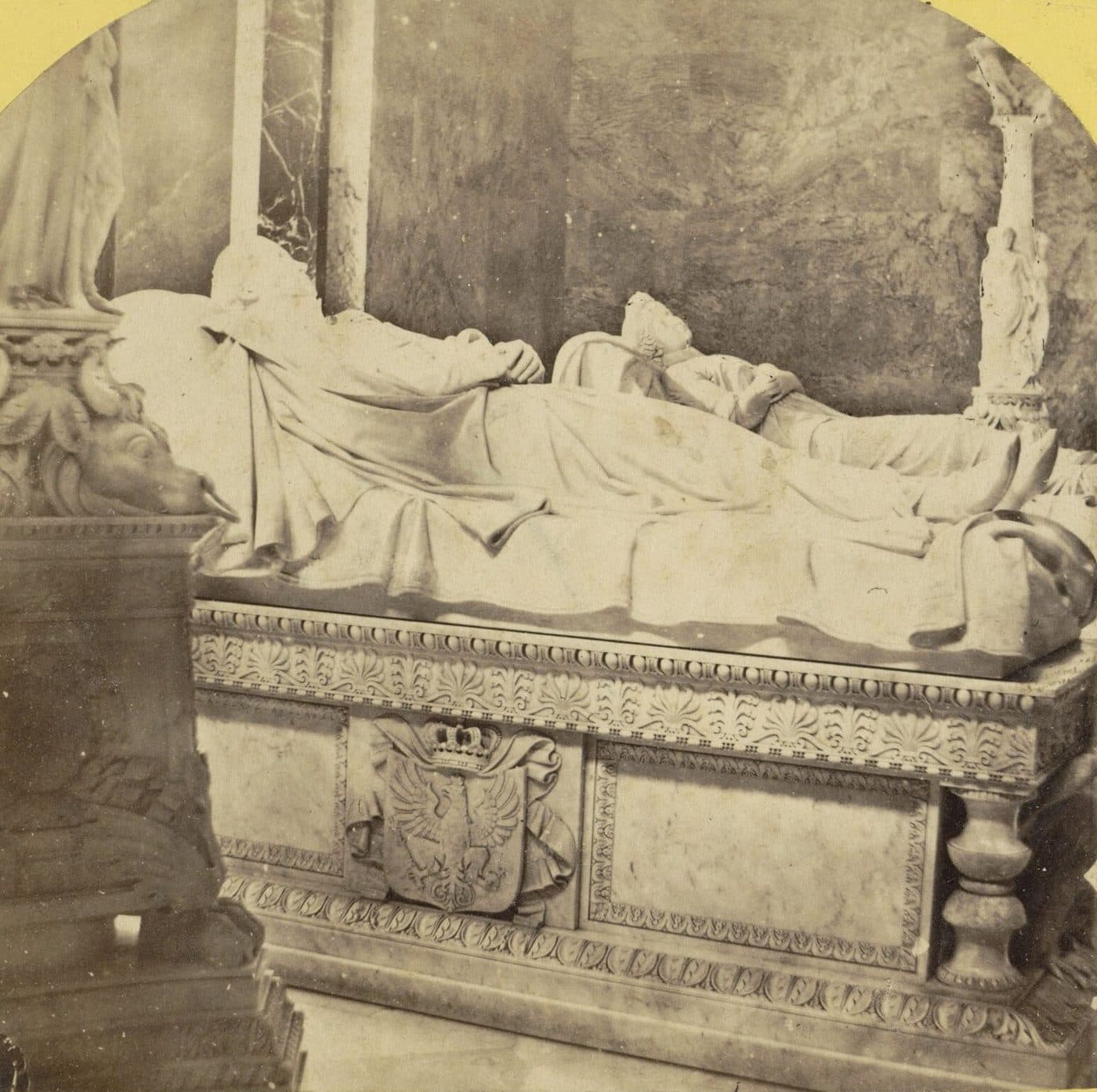
Stereo photograph from around 1861 of the marble tombs of Queen Luise and Frederick William III by Christian Daniel Rauch inside the Charlottenburg Mausoleum
Rauch’s tombs of Luise and Frederick William III, photographed around 1861–62 (one half of a stereo card). Photo: Unknown photographer, Rijksmuseum / CC0, via Wikimedia Commons

Rauch’s tomb for the queen

Frederick William III asked the young sculptor Christian Daniel Rauch for a marble sarcophagus with a figure of Luise lying on it. Rauch made the plaster model in Berlin, with the king watching closely and adding his own ideas, then carved the marble in Rome and Carrara between 1811 and 1814. On its way to Berlin in 1814 the English ship carrying it was captured by an American vessel and taken back by an English one, so it only reached Charlottenburg in spring 1815, half a year late and marked by salt water.

The marble tombs you see are cenotaphs: memorials with no one inside. The coffins lie in metal caskets in a crypt under the hall, which is closed to the public. Down there too are Frederick William IV’s heart, set into the floor at his parents’ feet, Luise’s youngest son Prince Albrecht and Frederick William III’s second wife, Auguste, Princess of Liegnitz, who have no monuments upstairs.

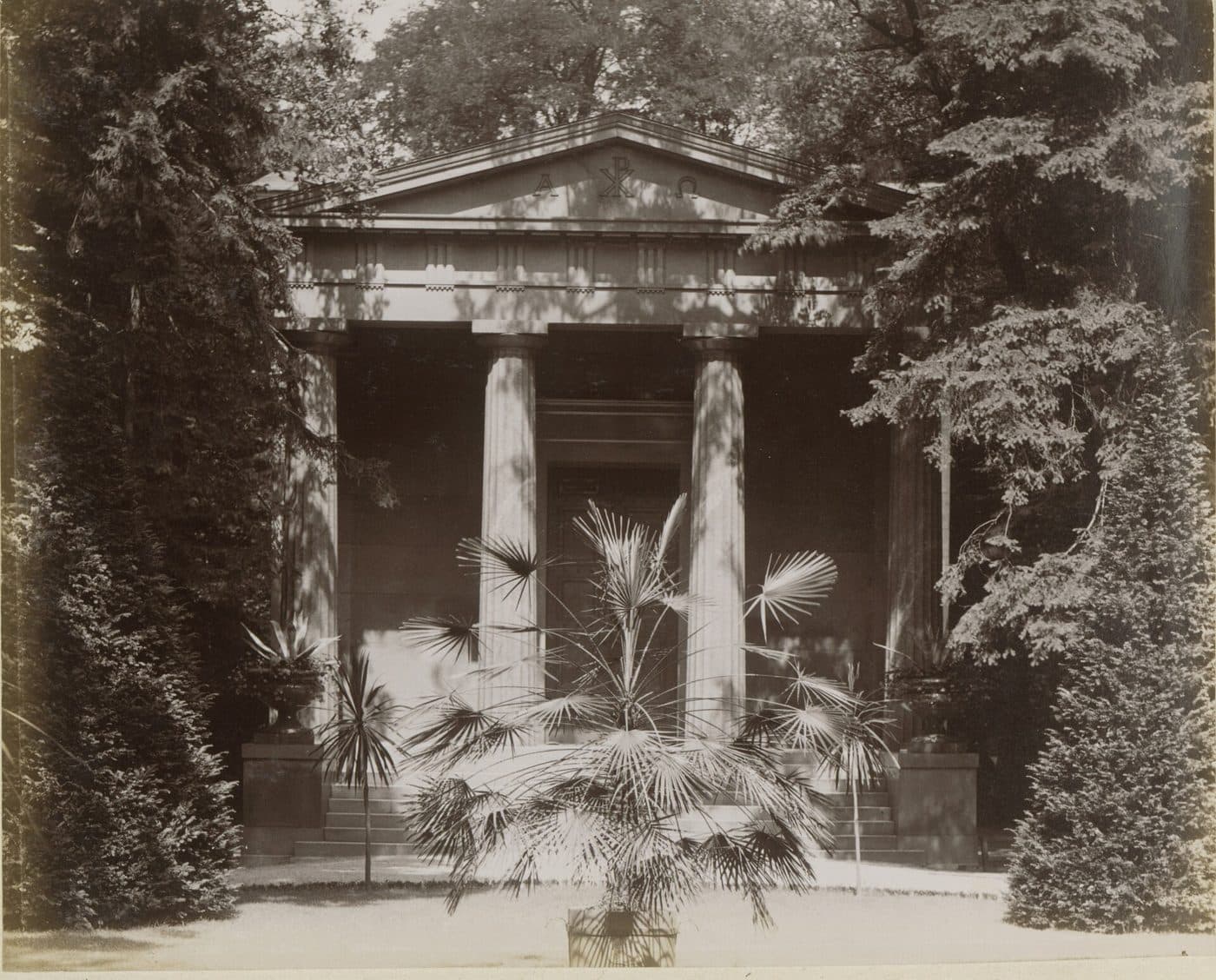
Albumen photograph of the Doric portico of the Mausoleum in the Schlossgarten Charlottenburg, framed by fir trees with a potted palm in front, about 1886–92
The granite portico of 1828, photographed by F. Albert Schwartz around 1886–92. Photo: Friedrich Albert Schwartz / Public domain, via Wikimedia Commons

A temple that grew

The king chose a spot Luise had liked, at the end of a dark avenue of fir trees, and had the mausoleum up within five months by reusing materials from elsewhere. The first portico of four Doric columns was sandstone. In 1828 it was rebuilt in red granite, and the original was taken to Peacock Island, where it still stands as a memorial to Luise.

When Frederick William III died in 1840, Ludwig Ferdinand Hesse added a cross-wing with an apse to a design by Schinkel, so that the couple could lie side by side, and the old room became the entrance hall. The apse painting followed in 1849. After the deaths of Wilhelm I in 1888 and Augusta in 1890, Albert Geyer enlarged the building again, and Erdmann Encke’s tombs of the imperial couple were set up in 1894. SPSG restored the mausoleum and its planting for the 200th anniversary of Luise’s death in 2010.

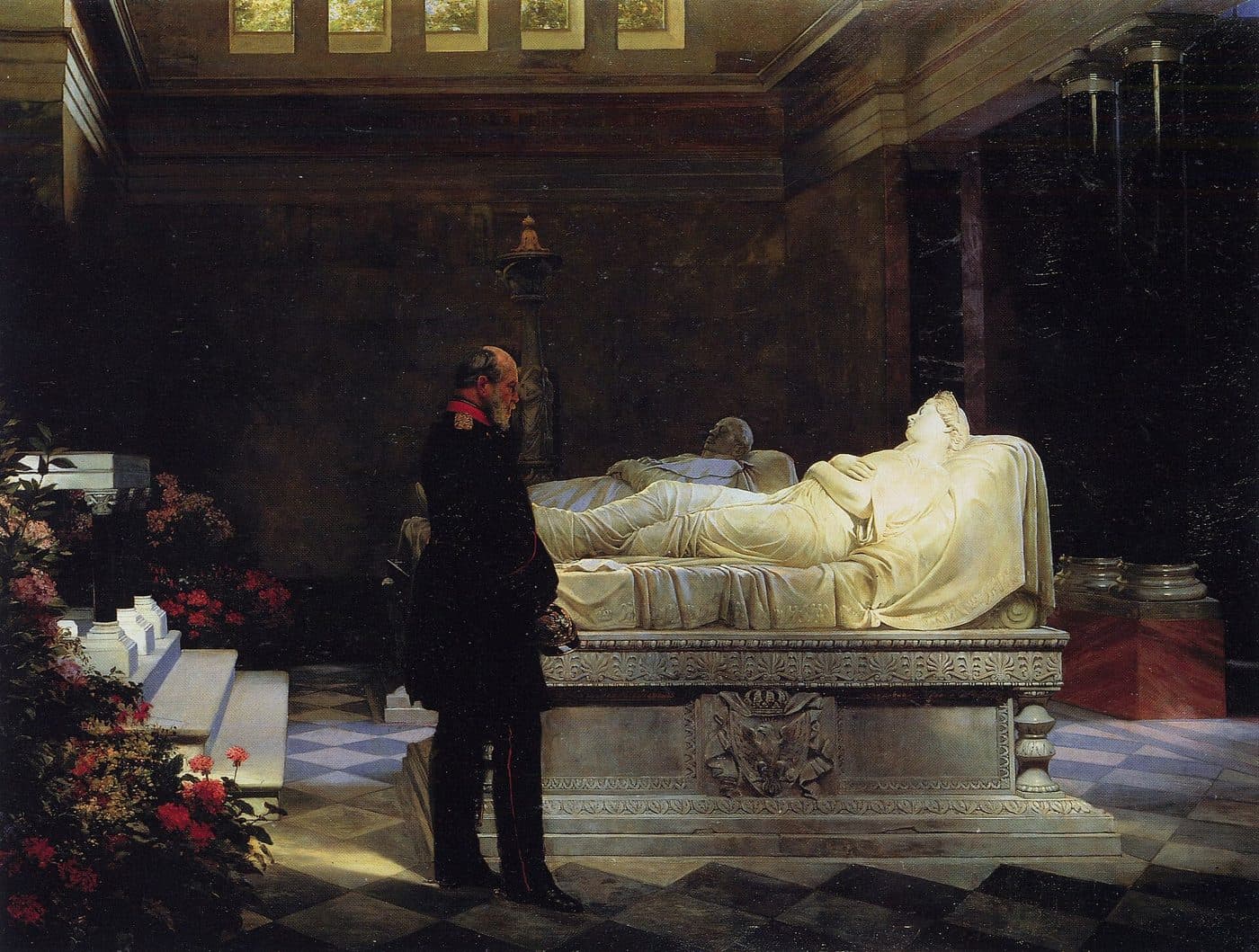
Anton von Werner’s painting of King Wilhelm I standing before the marble tomb of his mother Queen Luise in the Charlottenburg Mausoleum on 19 July 1870
‘19 July 1870’: Wilhelm at his mother’s tomb, painted by Anton von Werner in 1881. Photo: Anton von Werner / Public domain, via Wikimedia Commons

Wilhelm at his mother’s tomb

On 19 July 1870, the 60th anniversary of Luise’s death, France declared war on the North German Confederation. King Wilhelm came straight from the session of the Reichstag in the White Hall of the Berlin Palace to his mother’s tomb at Charlottenburg, with his son Friedrich. Anton von Werner painted the visit in 1881, leaving the son out so that the old king stands alone before Rauch’s figure. Six months later, at Versailles, Wilhelm was proclaimed German Emperor.

He died in Berlin on 9 March 1888, aged 90. Up to 300,000 people are thought to have filed past his coffin in the cathedral, and on 16 March a funeral procession took it out to Charlottenburg, where he was buried near his parents. By the 1900s the mausoleum was one of the sights of Charlottenburg, kept busy by the cult of Queen Luise.

Plan your visit

Visiting the Charlottenburg Mausoleum

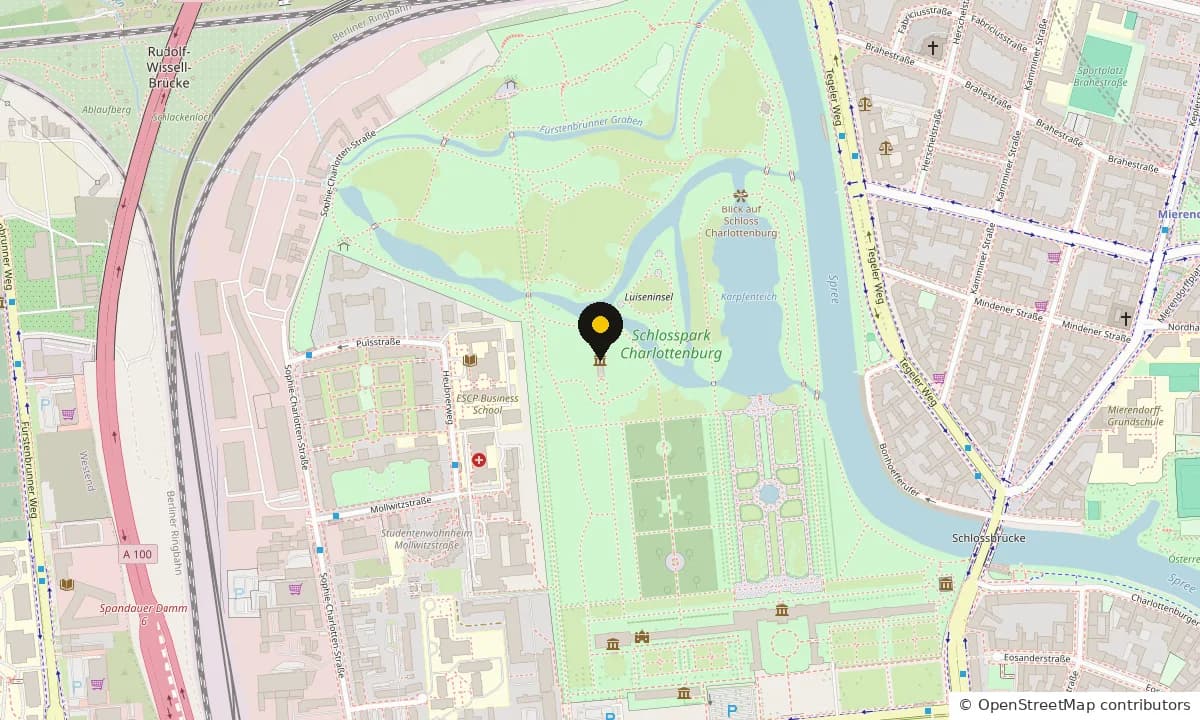
Map of the streets around the Charlottenburg Mausoleum, with a pin on the siteOpen in Google Maps

Spandauer Damm 10–22 (Schlossgarten Charlottenburg), 14059 Berlin · Mausoleum: 1 April–31 October, Tuesday–Sunday 10:00–17:30 (last entry 17:00); closed Mondays and all of November–March. Palace garden: daily from 08:00 until sunset, free.

Getting there

  • Bus M45Bus 109Bus 309Schloss Charlottenburg850 m · 12 min

    M45 and 109 run from Zoologischer Garten, 309 from Wilmersdorfer Straße. Walk west along Spandauer Damm past the Orangery, enter the garden by the side gate and follow the path north to the mausoleum in the trees.

  • S41S42S46Westend1.2 km · 16 min

    Walk east along Spandauer Damm and enter the garden from the west side.

  • U7Richard-Wagner-Platz1.5 km · 20 min

    Walk up Otto-Suhr-Allee to the palace and through the garden. From U2 Sophie-Charlotte-Platz it is about 1.8 km (24 min).

What you’ll see

  • Christian Daniel Rauch’s marble tomb of Queen Luise, lying as if asleep, beside his effigy of her husband Frederick William III.
  • The later tombs of Kaiser Wilhelm I and Empress Augusta by Erdmann Encke, in the hall added after 1888.
  • The apse painting of 1849 by Carl Gottfried Pfannschmidt: Frederick William III and Luise kneeling before Christ, and the Doric portico outside at the end of the fir-tree avenue.

Tips from a guide

  • Bring coins: the ticket machine at the mausoleum takes only coins, gives no change and has no note slot. A charlottenburg+ ticket or an SPSG annual ticket also gets you in.
  • Plan around the season: from November to March the mausoleum is shut, though you can still walk to it in the garden and see the portico.
  • Combine it with the Old Palace or the New Wing; the walk through the garden past the carp pond takes about 10 minutes.

Accessibility

The garden paths to the mausoleum are level gravel. The mausoleum itself has steps up to the portico, and SPSG says its exhibition spaces are not wheelchair accessible. Prams and pushchairs are not allowed inside, and there is nowhere to leave luggage. Assistance dogs are welcome.

Timeline

From Luise’s death to the imperial tombs

  1. 10 Mar 1776Luise is born in Hanover, a duchess of Mecklenburg-Strelitz.
  2. 24 Dec 1793She marries Crown Prince Frederick William of Prussia in Berlin.
  3. 19 Jul 1810Queen Luise dies at Hohenzieritz, aged 34.
  4. 23 Dec 1810She is laid to rest in the new mausoleum by Heinrich Gentz.
  5. 1815Rauch’s marble tomb arrives, half a year late after a sea capture.
  6. 1828The sandstone portico is replaced in red granite and moved to Peacock Island.
  7. 7 Jun 1840Frederick William III dies; Hesse extends the building with an apse.
  8. 1861The heart of Frederick William IV is buried at his parents’ feet.
  9. 19 Jul 1870War with France: Wilhelm visits his mother’s tomb.
  10. 16 Mar 1888Kaiser Wilhelm I is buried in the mausoleum.
  11. 1894Encke’s tombs of Wilhelm I and Empress Augusta are installed.
  12. 2010Restoration finished for the 200th anniversary of Luise’s death.

See it with a historian

Tours that stop at the Charlottenburg Mausoleum

The tombs are easy to find; a guide explains the family lying in them, from the cult of Queen Luise to the founding of the German Empire, and links them with the rest of royal Berlin and Potsdam.

A full day among the Prussian palaces, starting at Charlottenburg before Sanssouci, Cecilienhof and the Bridge of Spies.

The Glory Of Prussia Tour - Berlin Experiences
Full Day6 Hours

The Royal Potsdam Tour

Private 6-hour day trip from Berlin to the palaces and parks of Potsdam for up to 6 people. Starts at your hotel in Berlin.

€1,000up to 6
View Tour

Our full-day, all-in-one tour of the city’s history, shaped around what you want to see.

The Berlin History Tour
Full Day6 Hours

The Berlin History Tour

Private 6-hour van tour of Berlin's whole history in one day for up to 6 people. Starts at your hotel or anywhere in the city.

€1,000up to 6
View Tour

Berlin in one day from your cruise ship, crossing the city from Charlottenburg Palace to the East Side Gallery.

Gendarmenmarkt, Berlin
Full Day12 Hours

The Warnemünde-Berlin Shore Excursion

Private 12-hour shore excursion from Warnemünde to Berlin and back for up to 6 people. Pickup at your ship, timed to its docking.

€2,000up to 6
View Tour

Questions visitors ask

Frequently asked questions

Who is buried in the Charlottenburg Mausoleum?

Queen Luise of Prussia and her husband Frederick William III, their son Kaiser Wilhelm I and his wife Empress Augusta, their youngest son Prince Albrecht and Frederick William III’s second wife, the Princess of Liegnitz. The heart of Frederick William IV is buried there too; his body is in Potsdam’s Church of Peace.

Is the Charlottenburg Mausoleum open in winter?

No. It opens from 1 April to 31 October, Tuesday to Sunday, 10:00–17:30, and is closed from November to March. You can still walk to it in the palace garden, which is open all year.

How much does it cost to visit the mausoleum?

€3, reduced €2, paid in coins at the machine by the door. It is also included in the charlottenburg+ ticket (€19) and free with an SPSG annual ticket. The palace garden itself is free.

Where is the mausoleum in the Schlossgarten Charlottenburg?

In the north-west part of the palace garden, among trees at the end of a fir avenue, about 10 minutes’ walk from the palace. From the bus stop Schloss Charlottenburg it is about 850 m.

Are the bodies inside the marble sarcophagi?

No. The marble tombs are cenotaphs. The coffins lie in a crypt beneath the hall, which is closed to visitors.

Who designed the Charlottenburg Mausoleum?

Heinrich Gentz built it in 1810 to the king’s own sketches, with Karl Friedrich Schinkel advising. Ludwig Ferdinand Hesse extended it in 1841 and Albert Geyer after 1888.

How do I get to Schloss Charlottenburg?

Take Bus M45 or 109 from Zoologischer Garten, or Bus 309, to Schloss Charlottenburg. The nearest U-Bahn stations are Richard-Wagner-Platz (U7) and Sophie-Charlotte-Platz (U2), each about 15–25 minutes’ walk from the mausoleum.

Is the Charlottenburg palace garden free?

Yes. Like all SPSG parks, the Schlossgarten Charlottenburg is free and open daily from 08:00 until sunset. You only pay for the palace buildings and the mausoleum.

Keep exploring

More Featured Experiences.

Every site we write about — 56 landmarks, museums, memorials and lesser-known corners of Berlin. See the full index →

01Walk Through The Brandenburg Gate02Explore The State Museums On Museum Island03Visit The Berlin TV Tower – The Fernsehturm04Cross The Cold War Border At Checkpoint Charlie05Visit The Site Of Adolf Hitler’s Führerbunker06Explore The Reconstructed Berlin Palace07Visit The Reichstag Cupola At Night08Explore The Forum Fridericianum09Shop At The Humboldt University Book Sale10Journey Into The Memorial To The Murdered Jews Of Europe11Step Inside The Neue Wache12Explore The Former Jewish Quarter – Spandauer Vorstadt13Visit The Remains Of The Berlin Wall14Walk Across The Bridge Of Spies15Explore The Topography Of Terror16Climb The Prussian Victory Column – The Siegessäule17Enter The Palace Of Tears – The Tränenpalast18Step Inside The Berlin Olympic Stadium19Explore Erich Mielke’s Office At The Stasi Museum20Walk Along Karl Marx Allee21Visit The Oldest Church In Berlin – The Nikolaikirche22Explore The Berliner Dom23Visit The Grave Of Frederick The Great24Walk Through The Ruins Of Anhalter Bahnhof25Stand On The Platz Des Volksaufstandes26Visit The German Resistance Museum27Visit The Soviet War Memorial In The Tiergarten28See The Georg Elser Memorial On Wilhelmstrasse29Step Inside The Kaiser Wilhelm Gedächtnis Kirche30Visit The Gleis 17 Memorial32Climb The Französischer Dom at Gendarmenmarkt33Explore The Interbau – IBA 5734Explore The Otto Weidt Workshop35Visit Cecilienhof – Site Of The Potsdam Conference36Visit The Stasi Prison In Hohenschönhausen37Spend The Day At Tempelhof Airport38Ride The Fastest Elevator In Europe39Visit The Soviet War Memorial In Treptower Park40Visit The Sachsenhausen Concentration Camp Memorial41Visit The Ravensbrück Concentration Camp Memorial42Visit Karlshorst – The Site Of The German Surrender43Visit The Socialists Cemetery – Zentralfriedhof Friedrichsfelde44Visit The Soviet War Memorial In Pankow45Visit the Seelow Heights Memorial46Visit The Commonwealth War Cemetery47Cross The Bösebrücke At Night48Explore The Allied Museum In Dahlem49Explore The Spandau Citadel50Visit The Brandenburg T4 Euthanasia Memorial51Visit The Wannsee Conference House52Visit The Jewish Museum53Visit The Jewish Cemetery In Weissensee54Walk Along The East Side Gallery55Explore The Volkspark Friedrichshain Flak Tower56Head Up The Teufelsberg