Skip to content
The golden Victoria, nicknamed Goldelse, on top of the Siegessäule (Victory Column) in Berlin, above the railed viewing platform

Berlin Experiences/Featured Experiences

Siegessäule: Climb Berlin’s Victory Column

Germany’s Controversial National Memorial

The short answer

The Siegessäule, or Victory Column, stands in the middle of the Großer Stern roundabout in Berlin’s Tiergarten park, about 2 km west of the Brandenburg Gate. You can climb it: a narrow spiral staircase of 285 steps, with no lift, leads to a viewing platform about 51 metres up, just below the golden Victoria. Entry is €4.50 (€3.50 reduced), cash only, and it is open every day from 09:30 except 24 December. Allow 45 minutes to an hour, and reach it through the pedestrian tunnels, not across the traffic.

Where
Großer Stern, Tiergarten, 10557 Berlin
Open
Daily 09:30–19:00 in summer, 09:30–17:30 in winter; closed 24 December
Admission
€4.50, reduced €3.50, cash only
Time needed
45–60 minutes
Nearest station
Bus 100, 106 or 187 to Großer Stern, 4 minutes on foot
Step-free
No: 285 steps and no lift

The story · by Matt Robinson

Berlin’s colossal Victory Column provides a commanding view across the German capital and the city’s majestic central park for anyone intrepid enough to ascend the 285 steps all the way to the viewing platform on top.

It is the oldest centrally-located viewing point in the city, that since 1939 has graced the centre of the circular Große Stern intersection in Berlin’s Tiergarten park.

The column actually dates back to 1873 and was moved to its current position by virtue of Nazi leader Adolf Hitler’s plans to transform Berlin into the so-called ‘Welthauptstadt’ – to be known as Germania.

It is Berlin’s most significant military monument, akin to Nelson’s Column in London or the Washington Monument, and was originally created to celebrate the Prussian victory over the Danish army in the Second Schleswig War of 1864.

The design – reminiscent of the Colonne de Juillet in Paris, the Friedensengel in Munich, the Monumento a la Independencia in Mexico City, and the Independence Monument in Kyiv – was the work of architect Heinrich Strack. And while each of these columns may resemble each other, they stand alone for their own causes.

Glass mosaic in the colonnade of the Siegessäule in Berlin, after Anton von Werner, showing the founding of the German Empire
The colonnade mosaic: the founding of the German Empire in 1871.

By the time the Siegessäule was erected it would come to represent Prussian military supremacy and success in the wars fought against Denmark, Austria, and France in the late 1800s – as well as the resulting unification of Germany in 1871. Three wars – commonly known as the Wars of Unification – fought by Prussia and its allies and retrospectively cast as the raison d’être for the unification of the separate German states.

Cannons, Victoria and the reliefs

The history of the Siegessäule – and its physical design – is as layered as the city it graces.

Three segments of the Victory Column celebrate the spoils of this ‘Iron and Blood’ strategy. Quite literally, as the gilded cannons used as decoration around the three segments of the sandstone shaft were captured during these three respective wars. The bronze sculpture, 8.3m high and weighing 35 tons, depicts the goddess of victory (Victoria in Roman mythology) with a laurel wreath, a helmet decorated with an eagle and a standard with an Iron Cross. Her eagle helmet is said to make Victoria appear as Borussia, the personification of Prussia.

Initially there were to be the names of the men who had fallen in the Wars of Unification inscribed on the base of the monument, instead reliefs depicting four main scenes from the Wars of Unification were added: ‘Storming of Düppel’, ‘Battle of Königgrätz’, ‘Battle of Sedan’, and ‘Entry of the Troops into Berlin’.

Designed by Johann Heinrich Strack, the column was initially placed in Königsplatz (now Platz der Republik) in front of the Reichstag. Adjacent to the monument now, as was the case at its original location, are three statues of the three elder statesmen of Prussia seen as responsible for those military victories and German unification. General Field Marshal Helmuth von Moltke – head of the Prussian Army, Albrecht von Roon – the Prussian Minister of War, and the man regarded as the George Washington of Germany, Otto von Bismarck – the country’s first Chancellor following unification.

Statue of Field Marshal Helmuth von Moltke beside the Siegessäule on the Großer Stern, Berlin Tiergarten, seen from above
Helmuth von Moltke, one of the three statesmen beside the column.

During the final days of World War II, the Siegessäule was damaged but not destroyed. Efforts were made to demolish the monument after the Second World War, yet it survived this period – and the city governments’ introspective redress of the historical landscape. In 1987, on the occasion of the 750th anniversary of Berlin’s founding, it was restored, ensuring its continued prominence in the city’s landscape and its central place in the Tiergarten.

The Großer Stern and the Tiergarten

The location of the Siegessäule and its surrounding area has long held significance for Berliners, dating back to the 1600s when Elector Frederick III created a hunting star – an element of baroque garden and landscape design used to structure a hunting ground.

Starting in the 16th century, the Electors of Brandenburg began to utilise this area on the west side of Berlin as a hunting ground, leading to the establishment of what is now known as the Grosse Tiergarten – often simply referred to as the Tiergarten despite the fact there is also a Kleine (Small) Tiergarten in the Berlin district of Moabit.

By the late 1600s, the Grosse Stern intersection had begun to take shape with eight avenues leading here and an ensemble of sandstone sculptures of ancient gods and goddesses, dubbed ‘The Dolls’ by locals, added in the mid 1700s. Around this time, the Tiergarten was transformed from a hunting ground to a recreational space – a pleasure garden, thanks to Prussian King, Frederick the Great – a vocal opponent of hunting. One hundred years later, renowned landscape architect Peter Joseph Lenné went to great lengths to transform the area into a landscape park based on the English model. Damp forest areas were drained, and riding, driving and walking paths were created.

In the form that Lenné gave it, the park existed almost unchanged until the middle of the 20th century. Minor changes affected the furnishing of patriotic monuments (since 1849), including the Siegesallee, a magnificent boulevard commissioned and financed by Kaiser Wilhelm II in 1895, which was completed in 1901, and the layout of the Königsplatz (later: Platz der Republik) with the victory column. The park was owned by the royal family until 1881, after which it was incorporated into Berlin.

A monument reinvented

In the century and a half since its construction, the original symbolism of the monument has been further transformed and tailored to suit new purposes and sensibilities. For many years it featured as the final destination for the famous Love Parade techno party, it became an important stop on the route of the Christopher Street Day Parade, and even Berlin’s largest circulation queer magazine Siegessäule was named after the monument. On July 24th, 2008, as part of the presidential election campaign in the United States, then-candidate Barack Obama gave a speech in front of an audience of more than 200,000 here.

Not merely has the Siegessäule survived but become one of Berlin’s most popular tourist attractions. Rebranded as a symbol of tolerance perhaps – or more likely a continued representation of its central theme: that of unity – or unification.

Rebranded as a symbol of tolerance perhaps – or more likely a continued representation of its central theme: that of unity – or unification.

The climb

Embarking on the climb to the top of the Siegessäule is an experience that blends physical exertion with historical immersion. The journey begins at the granite base, where one can explore the colonnaded hall adorned with mosaics that depict key moments in Prussian military history.

Ascending the 285 steps of the claustrophobia-inducing spiral staircase, one is enveloped by the column’s sturdy structure, each step echoing with the footsteps of countless visitors who have made this pilgrimage. The climb, while demanding, is punctuated by glimpses of the outside world through small windows, offering teasing previews of the view that awaits.

View from the Berlin Victory Column through a round window down the Straße des 17. Juni and the autumn Tiergarten at sunset
Through one of the column’s windows: the Straße des 17. Juni cutting through the Tiergarten.

To the east, the unmistakable skyline of Berlin’s central Mitte district rises into view. In the distance, the iconic Fernsehturm (TV Tower) at Alexanderplatz pierces the sky, its gleaming sphere providing a modern counterpoint to the Siegessäule’s classical elegance. This juxtaposition of old and new, of history and modernity, is quintessentially Berlin. As you stand atop the Victory Column, you are not just witnessing the city’s skyline; you are seeing the story of Berlin itself – a story of conflict and triumph, of division and unity, of a city that has constantly reinvented itself while honouring its complex past.
The Victory Column in detail

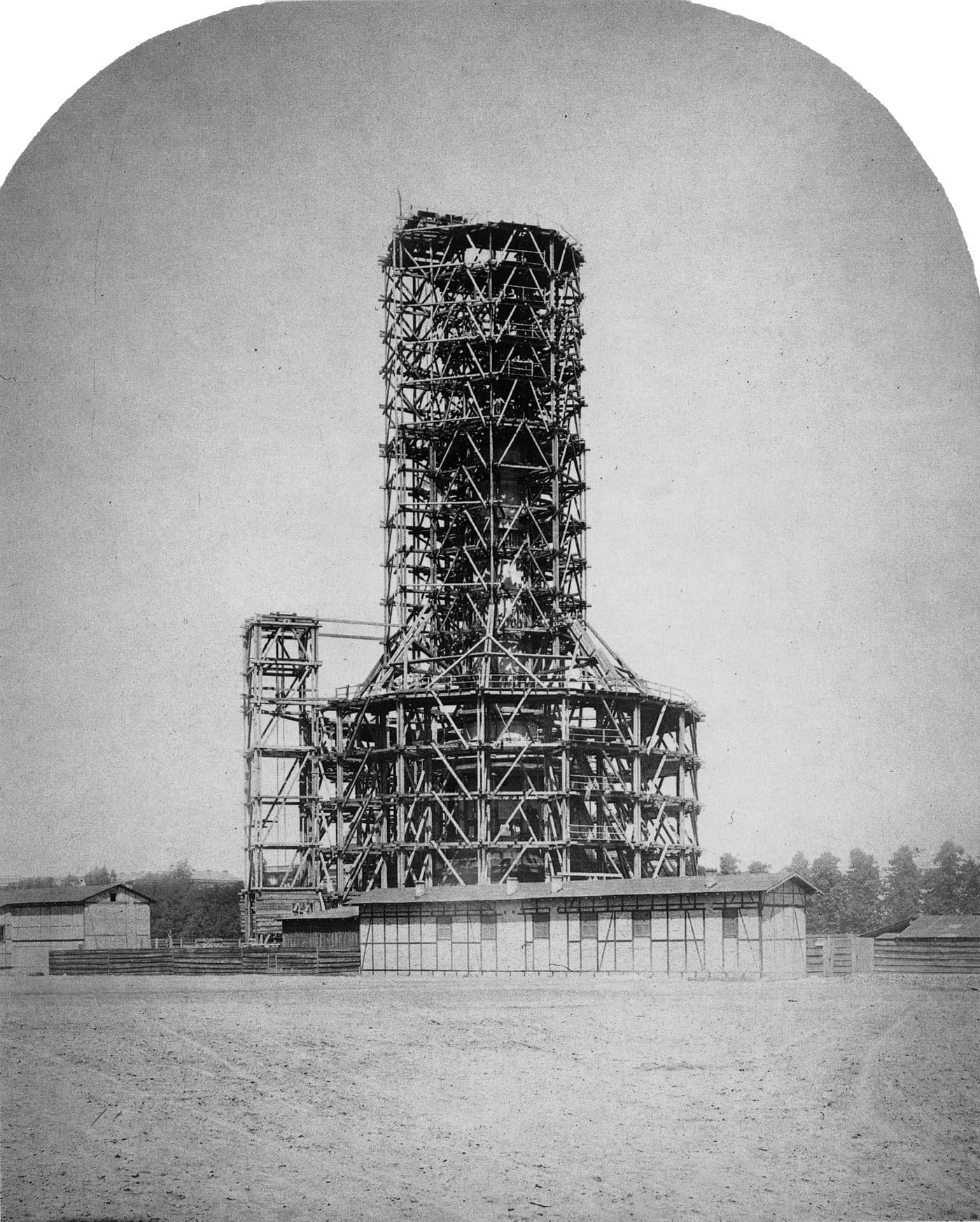
The Siegessäule under construction in scaffolding on Königsplatz in Berlin, 1873, before the Reichstag was built
The column in its scaffolding on Königsplatz, 1873. Photo: Hermann Rückwardt / Public domain, via Wikimedia Commons

Built for one war, finished after three

King Wilhelm I called for victory monuments after the war against Denmark in 1864, and gave the work to his court architect Heinrich Strack. By the time money was approved in 1867, Prussia had beaten Austria too, and by the time the column was finished it had beaten France and Germany had become an empire. Each of the three drums of the original shaft stood for one of those wars, and 60 captured cannon barrels, gilded, were set into the fluting.

Friedrich Drake’s Victoria was cast by the Berlin founder Hermann Gladenbeck: 8.32 metres tall and 35 tonnes of gilded bronze. Berliners soon called her Goldelse, after a popular serial novel by E. Marlitt. The column was unveiled on Königsplatz on 2 September 1873, Sedan Day, the third anniversary of the victory over France. The Reichstag, now its best-known neighbour there, was only built in the 1880s and 1890s.

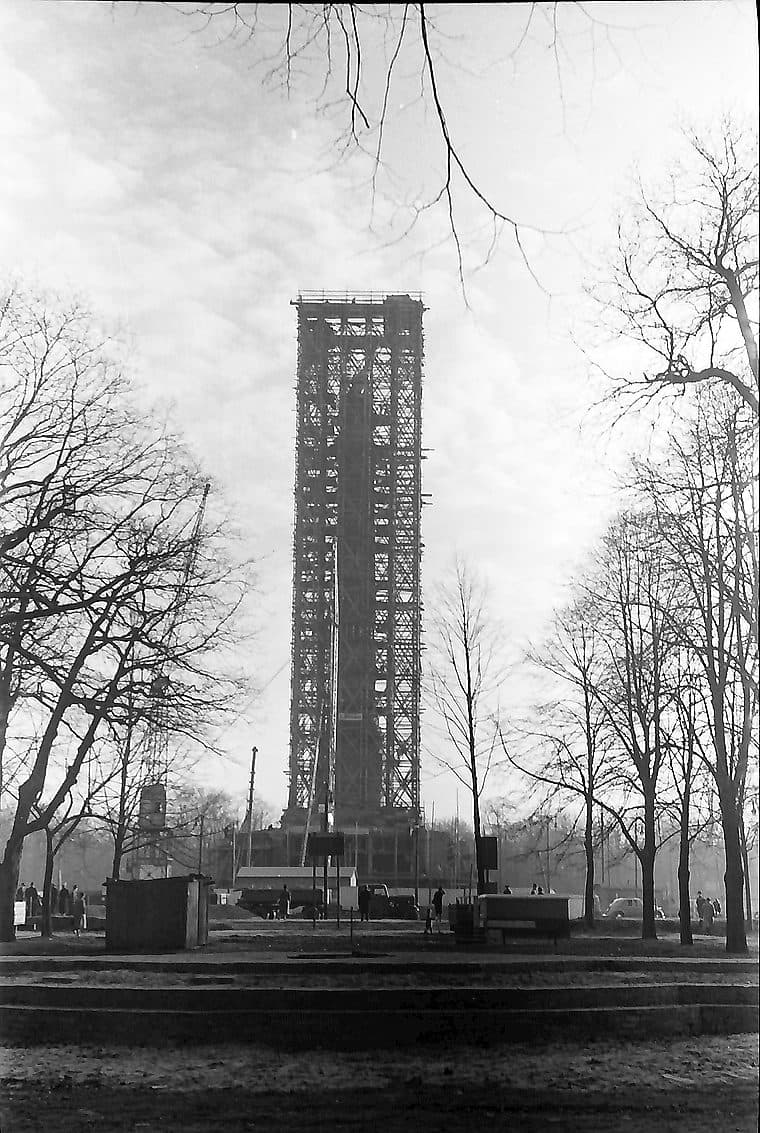
The Victory Column being rebuilt in scaffolding at the Großer Stern in Berlin’s Tiergarten, January 1939
Rebuilding the column at the Großer Stern, January 1939. Photo: Willy Pragher / CC BY 4.0 (Landesarchiv Baden-Württemberg, Staatsarchiv Freiburg W 134 Nr. 015622), via Wikimedia Commons

Moved for Germania, 1938–39

Hitler and Albert Speer planned a monumental East-West Axis through the Tiergarten as part of their Germania scheme, with the Victory Column as its centrepiece. In 1938–39 the construction firm Philipp Holzmann took the column apart and rebuilt it in the middle of the Großer Stern, which was widened from 80 to 200 metres across. To suit the bigger space, a fourth drum was added, raising the shaft by 6.5 metres, and the base was widened; the whole monument went from 60.5 to about 67 metres.

The entrance moved from the north side to the south, and Victoria, who had looked south down the Siegesallee, has faced west ever since. The statues of Bismarck, Roon and Moltke followed to the north edge of the square, and the four neoclassical gatehouses by Johannes Huntemüller were built over the new pedestrian tunnels you still use today.

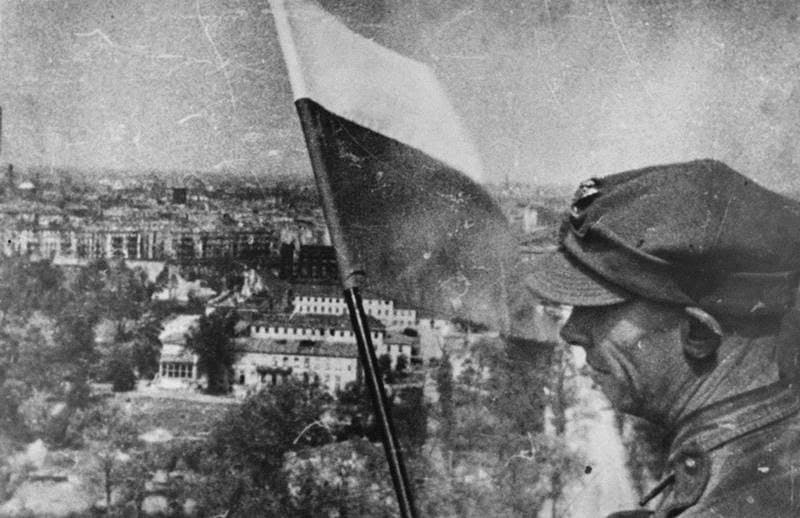
A Polish soldier with the Polish flag on top of the Victory Column in Berlin on 2 May 1945, with Schloss Bellevue below
A Polish soldier on the column, 2 May 1945, with Schloss Bellevue below. Photo: Polish Army / Public domain, via Wikimedia Commons

After 1945: flags, demolition plans and a bomb

The column came through the air raids and the Battle of Berlin largely intact. On 2 May 1945 Polish soldiers fighting alongside the Red Army raised their flag on it. The French had the bronze reliefs taken down that year, and in November 1946 proposed to the Allied Kommandatura that the whole column be demolished. The British and Americans refused, and the Soviets abstained. Three of the reliefs turned up years later in the courtyard of the Musée de l’Armée in Paris; President François Mitterrand returned them for Berlin’s 750th anniversary in 1987.

On 15 January 1991 the far-left Revolutionary Cells set off a bomb on the viewing platform. No one was up there, but the platform stayed shut for ten months. The last full restoration ran from March 2010 to May 2011, when Victoria was regilded with 1.2 kg of gold leaf. Information boards at the gatehouses have told the column’s history since October 2011.

Plan your visit

Visiting the Victory Column

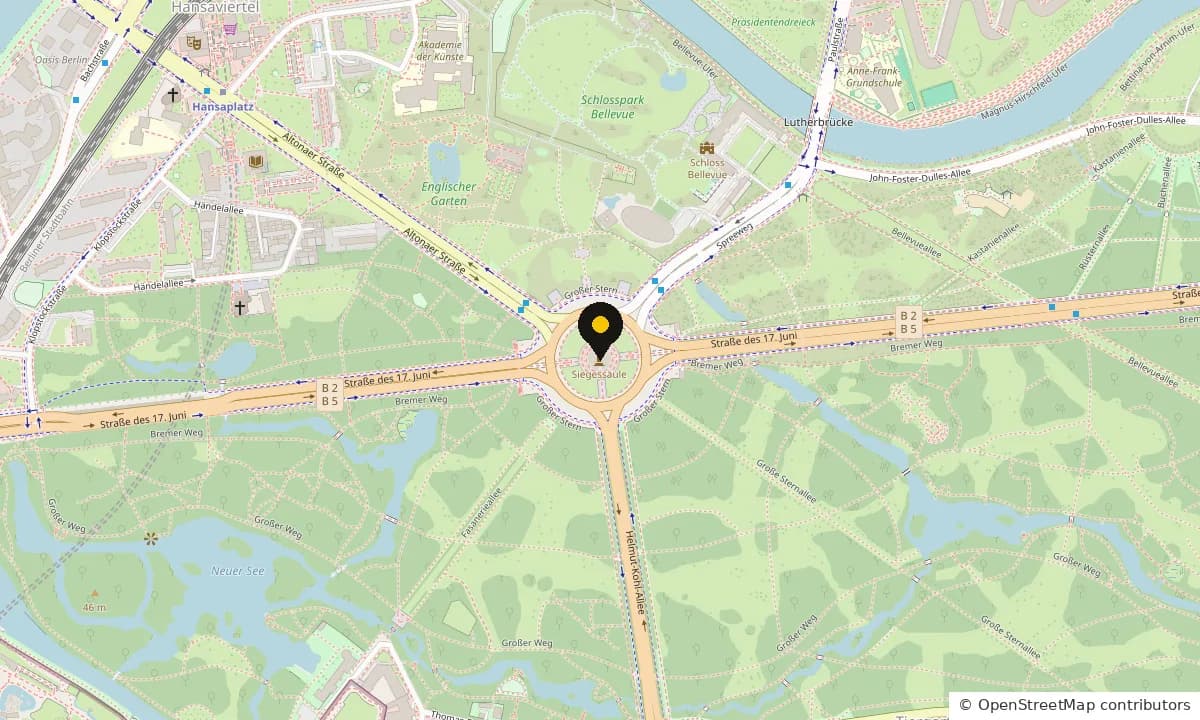
Map of the streets around the Victory Column, with a pin on the siteOpen in Google Maps

Großer Stern 1, 10557 Berlin · Daily, 09:30–19:00 in summer and 09:30–17:30 in winter. Closed 24 December. Check berlin.de before you go: other listings give slightly different weekday hours.

Getting there

  • Bus 100Bus 106Bus 187Großer Stern290 m · 4 min

    There are no crossings on the roundabout: go down through one of the four gatehouses into the tunnels, which come up at the column.

  • S3S5S7S9Bellevue1.1 km · 15 min

    Walk south down Spreeweg past Schloss Bellevue, the Federal President’s residence.

  • U9Hansaplatz830 m · 11 min

    Follow Altonaer Straße south-east through the Hansaviertel to the Großer Stern.

What you’ll see

  • The view from the platform about 51 metres up: east along the Straße des 17. Juni to the Brandenburg Gate, the Reichstag dome and the TV Tower, west towards Charlottenburg, and the Tiergarten all around.
  • The colonnade on the base, with its glass mosaic of the founding of the German Empire, and the four bronze reliefs of the Wars of Unification below it.
  • The 60 gilded cannon barrels captured from Denmark, Austria and France, set into the fluting of the column, and the statues of Bismarck, Moltke and Roon on the north side of the Großer Stern.

Tips from a guide

  • Bring cash: the ticket desk does not take cards.
  • Use the tunnels from the gatehouses. Several busy roads meet at the Großer Stern and there are no pedestrian crossings to the column.
  • The staircase is narrow and gets crowded on summer afternoons; for a quieter climb, come soon after opening.

Accessibility

The column is not accessible for wheelchair users or anyone who cannot manage stairs: the only way up is a narrow spiral staircase of 285 steps, with no lift, and berlin.de advises against the climb for people with limited mobility or health problems. The tunnels to the base are reached by steps from the gatehouses. From street level you can still see the Victoria, the cannon barrels and the statues of Bismarck, Moltke and Roon.

Timeline

From Königsplatz to the Großer Stern

  1. 1864After the war with Denmark, Wilhelm I calls for a victory monument in Berlin.
  2. 1866–71Wins over Austria and France are added; Germany is unified in 1871.
  3. 2 Sep 1873The column is unveiled on Königsplatz on Sedan Day.
  4. 1895–1901Wilhelm II builds the Siegesallee south from the column.
  5. 1938–39Moved to the Großer Stern for Germania and raised by 6.5 metres.
  6. 2 May 1945Polish soldiers raise their flag on the column.
  7. Nov 1946France proposes demolition; Britain and the US refuse.
  8. 1987France returns the reliefs for Berlin’s 750th anniversary.
  9. 15 Jan 1991A Revolutionary Cells bomb damages the platform; it shuts for ten months.
  10. 24 Jul 2008Barack Obama speaks to more than 200,000 people here.
  11. 2010–11Full restoration; Victoria is regilded and reopens on 21 May 2011.

See it with a historian

Tours that stop at the Victory Column

The platform shows you the city; a guide can tell you why the column was moved, what the reliefs show and what happened on the axis below it in 1945.

Berlin’s story in one day, with the Victory Column and the Tiergarten among the stops.

The Berlin History Tour
Full Day6 Hours

The Berlin History Tour

Private 6-hour van tour of Berlin's whole history in one day for up to 6 people. Starts at your hotel or anywhere in the city.

€1,000up to 6
View Tour

Hitler’s Berlin, including the East-West Axis the column was moved to adorn.

The Capital Of Tyranny Tour - Berlin Experiences
Full Day6 Hours

The Capital Of Tyranny

Private 6-hour van tour of Hitler's Berlin and the Third Reich for up to 6 people. Starts at your hotel or anywhere in the city.

€1,000up to 6
View Tour

April and May 1945 in the Tiergarten, where Polish soldiers raised their flag on the column.

The Battle Of Berlin Tour - Berlin Experiences
Full Day6 Hours

The Battle Of Berlin Tour

Private 6-hour van tour of the 1945 battlefield, from the outskirts to the Reichstag, for up to 6 people. Starts at your hotel.

€1,000up to 6
View Tour

Questions visitors ask

Frequently asked questions

How many steps are there to the top of the Victory Column?

285, on a narrow spiral staircase inside the column. They lead to a viewing platform about 51 metres up, just below the statue of Victoria. There is no lift.

How much does it cost to climb the Siegessäule?

€4.50 for adults and €3.50 reduced, according to the city’s official portal, berlin.de. Payment is cash only.

When is the Victory Column open?

Every day except 24 December: 09:30–19:00 in summer and 09:30–17:30 in winter. Hours can change, so check berlin.de before you go.

How do you get to the Victory Column?

Take bus 100, 106 or 187 to Großer Stern, or walk 15 minutes from S-Bahn Bellevue. The column stands in the middle of a busy roundabout with no crossings, so use the pedestrian tunnels from the four gatehouses.

Who is the golden statue on top of the Victory Column?

Victoria, the Roman goddess of victory, by Friedrich Drake. Her eagle helmet also makes her Borussia, the personification of Prussia, and Berliners call her Goldelse.

Why was the Victory Column moved?

It stood on Königsplatz in front of the Reichstag until 1938–39, when Hitler and Albert Speer moved it to the Großer Stern as the centrepiece of their East-West Axis for Germania. It was made 6.5 metres taller at the same time.

How tall is the Victory Column?

About 67 metres including the statue, since it was raised during the move in 1938–39; before that it was about 60.5 metres. The viewing platform is at 50.66 metres.

Is the Victory Column worth climbing?

If you can manage the stairs, yes: it is one of the few viewpoints in the middle of the Tiergarten, with the Brandenburg Gate, the Reichstag and the TV Tower to the east. The staircase is tight and busy in summer, so it is not for anyone uneasy in confined spaces.

Keep exploring

More Featured Experiences.

Every site we write about — 56 landmarks, museums, memorials and lesser-known corners of Berlin. See the full index →

01Walk Through The Brandenburg Gate02Explore The State Museums On Museum Island03Visit The Berlin TV Tower – The Fernsehturm04Cross The Cold War Border At Checkpoint Charlie05Visit The Site Of Adolf Hitler’s Führerbunker06Explore The Reconstructed Berlin Palace07Visit The Reichstag Cupola At Night08Explore The Forum Fridericianum09Shop At The Humboldt University Book Sale10Journey Into The Memorial To The Murdered Jews Of Europe11Step Inside The Neue Wache12Explore The Former Jewish Quarter – Spandauer Vorstadt13Visit The Remains Of The Berlin Wall14Walk Across The Bridge Of Spies15Explore The Topography Of Terror17Enter The Palace Of Tears – The Tränenpalast18Step Inside The Berlin Olympic Stadium19Explore Erich Mielke’s Office At The Stasi Museum20Walk Along Karl Marx Allee21Visit The Oldest Church In Berlin – The Nikolaikirche22Explore The Berliner Dom23Visit The Grave Of Frederick The Great24Walk Through The Ruins Of Anhalter Bahnhof25Stand On The Platz Des Volksaufstandes26Visit The German Resistance Museum27Visit The Soviet War Memorial In The Tiergarten28See The Georg Elser Memorial On Wilhelmstrasse29Step Inside The Kaiser Wilhelm Gedächtnis Kirche30Visit The Gleis 17 Memorial31Visit The Schloss Charlottenburg Mausoleum32Climb The Französischer Dom at Gendarmenmarkt33Explore The Interbau – IBA 5734Explore The Otto Weidt Workshop35Visit Cecilienhof – Site Of The Potsdam Conference36Visit The Stasi Prison In Hohenschönhausen37Spend The Day At Tempelhof Airport38Ride The Fastest Elevator In Europe39Visit The Soviet War Memorial In Treptower Park40Visit The Sachsenhausen Concentration Camp Memorial41Visit The Ravensbrück Concentration Camp Memorial42Visit Karlshorst – The Site Of The German Surrender43Visit The Socialists Cemetery – Zentralfriedhof Friedrichsfelde44Visit The Soviet War Memorial In Pankow45Visit the Seelow Heights Memorial46Visit The Commonwealth War Cemetery47Cross The Bösebrücke At Night48Explore The Allied Museum In Dahlem49Explore The Spandau Citadel50Visit The Brandenburg T4 Euthanasia Memorial51Visit The Wannsee Conference House52Visit The Jewish Museum53Visit The Jewish Cemetery In Weissensee54Walk Along The East Side Gallery55Explore The Volkspark Friedrichshain Flak Tower56Head Up The Teufelsberg