Skip to content
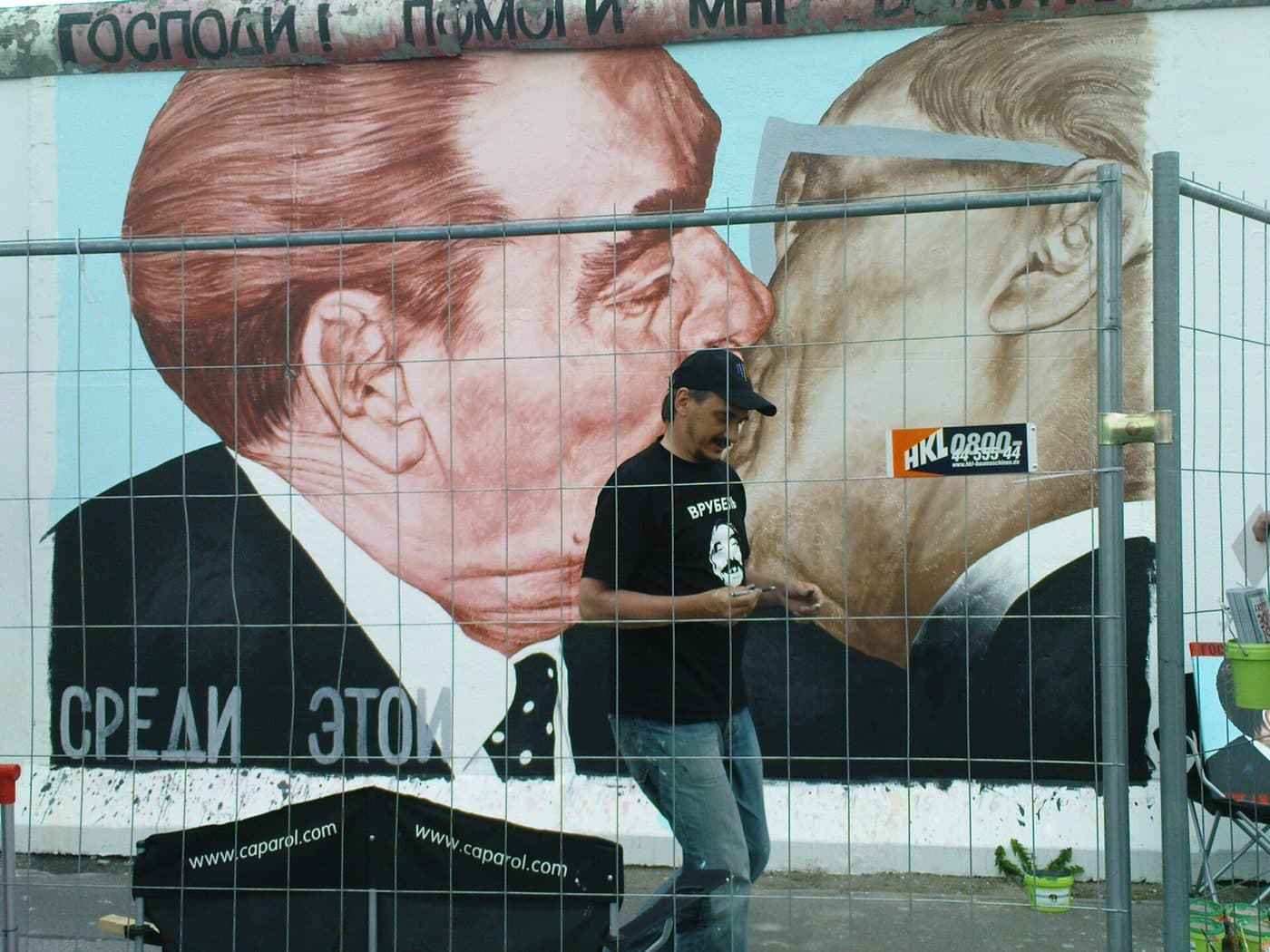
Dmitri Vrubel’s Fraternal Kiss mural of Brezhnev and Honecker on the East Side Gallery in Berlin, with a passer-by

Berlin Experiences/Featured Experiences

East Side Gallery: Walk the Longest Surviving Stretch of the Berlin Wall

The longest remaining piece of the Berlin Wall.

The short answer

The East Side Gallery is the longest surviving stretch of the Berlin Wall: 1.3 km of concrete along Mühlenstraße in Friedrichshain, between Ostbahnhof and the Oberbaum Bridge, painted in 1990 by 118 artists from 21 countries. It is an open-air gallery on a public street, free and open around the clock. Walking its length takes 20–30 minutes, or about an hour if you stop at the murals and walk back along the river side. The nearest stations are S Ostbahnhof at the western end and S+U Warschauer Straße at the eastern end, close to Dmitri Vrubel’s Fraternal Kiss.

Where
Mühlenstraße 47–80, 10243 Berlin-Friedrichshain
Open
Always; info point 10:00–17:00 (closed Fridays from November)
Admission
Free
Time needed
45–60 minutes
Nearest station
S+U Warschauer Straße or S Ostbahnhof
Step-free
Yes, along the whole 1.3 km

The story · by Matt Robinson

For nearly three decades, from the early morning on August 13th, 1961, until the euphoric evening of November 9th, 1989, Berlin served as the representative epicentre of a fractured world. A city cleaved in two. Not just by lines on a map, but by a physical barrier of concrete and barbed wire.

As final as it looked, however, the Berlin Wall was not just a border; it was the starkest, most chilling symbol of the Cold War, an ideological fault line made manifest. Officially termed the ‘Anti-Fascist Protection Rampart’ (Antifaschistischer Schutzwall) by the East German GDR government, its true purpose was tragically clear: to halt the exodus of its own citizens seeking freedom in the West.

The Wall’s construction was swift and shocking. Streets were severed, families divided, and the vibrant metropolis transformed into a schizophrenic entity. West Berlin became an island of democracy deep within communist territory, while East Berlin existed under the watchful eye of one of the largest secret police organisations in the world.

The visual impact was profound. On the Western side, the Wall quickly became a canvas for dissent – vibrant murals, sarcastic graffiti, and desperate messages painted onto the grey concrete, a colourful protest against the monochrome oppression it represented. On the Eastern side, however, approaching the Wall was forbidden, lethal even. It remained a stark, blank, menacing presence, guarded by watchtowers and armed soldiers with shoot-to-kill orders.

1989: the Wall falls

When the Wall finally fell, driven by peaceful protests and political shifts, the world watched in astonishment. Berliners from East and West streamed through the newly opened checkpoints, chipping away at the hated barrier with hammers and chisels – becoming Mauerspechte, or “Wall woodpeckers.”

In the ensuing months and years, most of the 155-kilometre structure was dismantled, its concrete segments ground down, sold off, or simply removed to reconnect the sundered city. Today, surprisingly little of the physical Wall remains.

Black mural spelling ‘Berlin’ with a red sun, a bare tree and the word ‘Tokyo’, on the East Side Gallery in Berlin
One of the murals on Mühlenstraße.

Yet, its shadow looms large over Berlin. The memory of division is woven into the fabric of the city, shaping its identity, its politics, and its unique cultural landscape. And nowhere is the transformation of this symbol of division into a testament to freedom more potent, more vibrant, than along the stretch known as the East Side Gallery. Here, the once-imposing barrier has become a powerful expression of artistic freedom and a poignant memorial to reunification.

Just months after the Wall crumbled, in the heady atmosphere of newfound liberty and reunification, an extraordinary project took shape. An international group of artists was invited to paint directly onto a 1.3-km (just under a mile) section of the Wall standing along Mühlenstraße in the Friedrichshain district, bordering the Spree River.

Completed between February and September 1990, it was officially opened on September 28th, 1990 – less than one year after the Fall of the Wall.

Why the ‘East Side’?

But why the ‘East Side’ Gallery? This often causes confusion.

To understand this, one must grasp the complex structure of the Berlin Wall. It wasn’t a single wall but a fortified system. What most people picture as ‘The Wall’ was technically known as the ‘Grenzmauer 75’, the final, most sophisticated version facing West Berlin – constructed from 1975.

Behind this, on the border of East Berlin/East Germany, lay a series of obstacles: signal fences, anti-vehicle trenches, patrols, beds of nails (‘Stalin’s Lawn’), and corridors of soft sand (to show footprints), floodlights, plus 302 watchtowers.

Graffiti covering the river side of the East Side Gallery in Berlin, seen from the green strip along the Spree
The river side of the Wall, open to anyone’s spray can.

This entire militarised zone was known colloquially as the Todesstreifen – the Death Strip.

Finally, further inland within East Berlin, stood the Hinterlandmauer – the inner wall. This was the barrier East Berliners would encounter first if they attempted to escape. It was generally less imposing than the outer wall, often simpler concrete slabs or even fortified brick buildings incorporated into the line.

The section used for the East Side Gallery is precisely this Hinterlandmauer. During the Cold War, this inner, eastern-facing side was inaccessible, pristine, and stark white or grey concrete – a chillingly blank surface within a heavily guarded area, a stark contrast to the graffiti-covered Western side. By painting here after the Wall fell, artists symbolically reclaimed the forbidden zone, transforming the surface that represented East German oppression into a monument celebrating freedom.

The gallery today

Today, a walk along the East Side Gallery is an essential Berlin experience.

It functions as an open-air art gallery, a historical monument, and a powerful space for reflection. Stretching along Mühlenstraße, easily accessible from Ostbahnhof or Warschauer Straße stations, it draws millions of visitors each year. As you stroll the 1.3-kilometre length, you encounter over 100 murals by artists from across the globe, each offering a unique perspective on the events of 1989/1990, themes of peace, freedom, oppression, and hope. Some paintings are abstract, others deeply political, some joyful, others somber.

A red figure climbing over the top of the East Side Gallery beside a mural of handprints, with a new tower block behind, Berlin
Old Wall, new neighbours: the riverbank is now prime building land.

Inevitably, the Wall’s immense historical weight has led to commercialisation. Souvenir shops abound near the Gallery, selling trinkets, postcards, and, most contentiously, small fragments of concrete purported to be pieces of the Wall, often encased in plastic with certificates of dubious authenticity. This commercial impulse exemplifies how symbols of a complex past can be repurposed and marketed.

Taking pieces from the Gallery itself is strictly forbidden and a criminal offence – essential for preserving this monument.

Yet, despite the surrounding commerce and the inevitable wear-and-tear from weather and vandalism (requiring periodic restoration), the East Side Gallery retains its power. It represents the transformation of an instrument of terror into a canvas for dialogue and free expression – a fundamentally positive act.

The Fraternal Kiss

Perhaps the most famous image is Dmitri Vrubel’s “My God, Help Me to Survive This Deadly Love,” depicting the “socialist fraternal kiss” between Soviet leader Leonid Brezhnev and East German leader Erich Honecker, based on a 1979 photograph. This satirical commentary on the often-hypocritical nature of communist alliances became an instant icon. Its enduring power is evident in its constant reinvention as a meme. The image has been widely parodied, adapted to depict pairings like Boris Johnson and Donald Trump, or Trump and Vladimir Putin, demonstrating how the artwork continues to resonate as a critique of political relationships and power dynamics decades after its creation.

Walking the East Side Gallery isn’t just about seeing art; it’s about engaging with history, witnessing its echoes in the present, and celebrating the enduring human spirit of freedom.
The East Side Gallery in detail

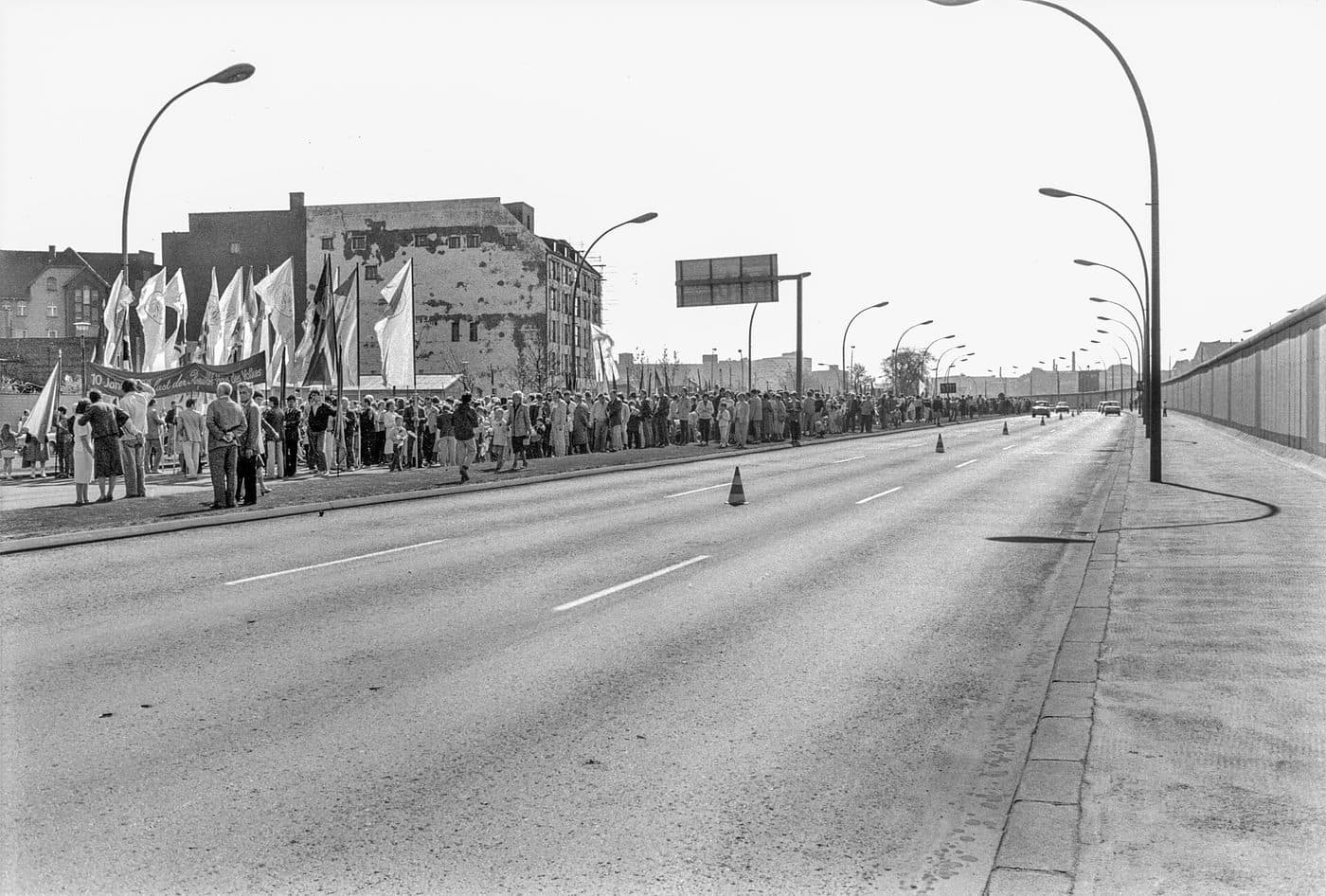
The Socialist Unity Party’s May Day parade on Mühlenstraße near Ostbahnhof, East Berlin, 1987, with the wall of the East Side Gallery on the right
May Day on Mühlenstraße, 1987: the plain wall on the right is today’s East Side Gallery. Photo: Gerd Danigel / CC BY-SA 4.0, via Wikimedia Commons

The Wall on Mühlenstraße, 1961–1989

On 13 August 1961 the Spree between Friedrichshain and Kreuzberg became part of the border. The whole width of the river belonged to East Berlin; West Berlin began at the Kreuzberg bank. So the wall on Mühlenstraße was not the border wall but the inner, hinterland wall that sealed off the death strip along the river. Because Mühlenstraße was a ‘protocol route’ for high-ranking visitors to East Germany, it was built to look like the smooth Border Wall 75 that normally faced the West: segments 3.5 metres high that hid the strip from view.

In 1977 the riverbank behind it was razed to give the guards a clear line of fire. At least five people died trying to cross between the Oberbaum and Schilling bridges, the first of them Udo Düllick in October 1961. Between 1972 and 1975 four Kreuzberg children who fell in from the western bank drowned while rescuers held back for fear of being shot, until the two sides agreed rules for rescues in October 1975.

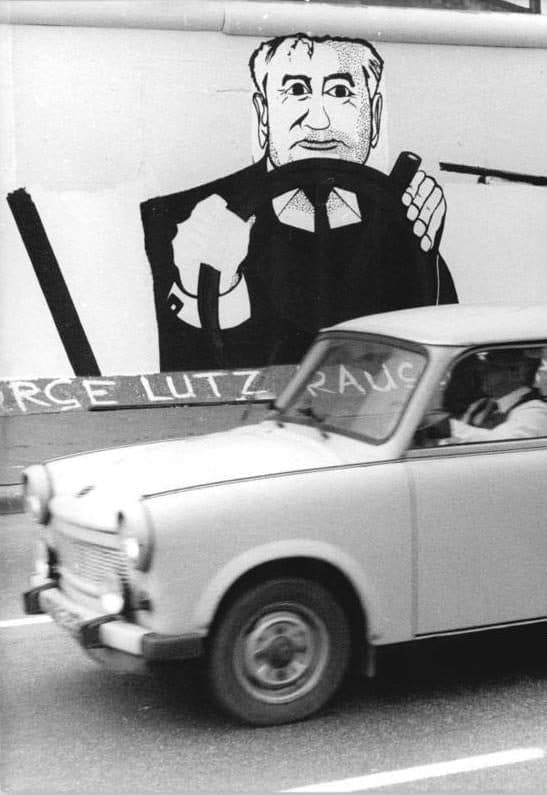
A Trabant drives past a freshly painted mural on the East Side Gallery, Mühlenstraße, East Berlin, March 1990
A Trabant passes one of the new murals, 25 March 1990. Photo: Bundesarchiv, Bild 183-1990-0325-012 / Uhlemann, Thomas / CC-BY-SA 3.0

How the gallery was painted

Within days of 9 November 1989 artists began painting the east side of the Wall, but their first pictures, at Potsdamer Platz, were painted over by East German border guards. Two artists, David Monty from Schöneberg in the West and Heike Stephan from Prenzlauer Berg in the East, proposed turning the Wall into the ‘world’s largest gallery’. After talks with the East German defence ministry, the stretch on Mühlenstraße was agreed, the Council of Ministers approved the project and artists from around the world were invited. Monty’s assistant Christine MacLean coordinated it from March 1990.

The 118 artists from 21 countries painted over a hundred pictures: joy at the fall of the Wall and hopes for peace, alongside worries about an uncertain future. The gallery opened on 28 September 1990, five days before reunification, and in November 1991 it was listed as a protected monument. The paint saved this stretch from the demolition that removed almost all the rest of the Wall.

Dmitri Vrubel repainting his Fraternal Kiss mural behind a construction fence at the East Side Gallery, Berlin, 2009
Dmitri Vrubel repainting the Fraternal Kiss, June 2009. Photo: Don Ludwig / CC BY 2.0, via Wikimedia Commons

Repainting, gaps and the riverbank

Weather, graffiti and souvenir hunters damaged the murals quickly, and some artists were already repainting them in the 1990s. In 2008–09 the concrete itself had to be repaired, which meant destroying the paintings. Most artists came back and painted them again, some as faithful copies, others with changes; Dmitri Vrubel repainted his Fraternal Kiss in the summer of 2009. A small group refused, and their segments have stayed blank ever since.

Meanwhile the riverbank behind the Wall became some of the most valuable land in Berlin. Gaps were cut for access roads to new buildings and a landing stage for the arena, and four painted sections were moved onto the green strip. Plans in 2013 to take out a section for a luxury tower block brought large protests. Since 1 November 2018 the site has been in the care of the Berlin Wall Foundation, which also runs the Berlin Wall Memorial on Bernauer Straße.

Plan your visit

Visiting the East Side Gallery

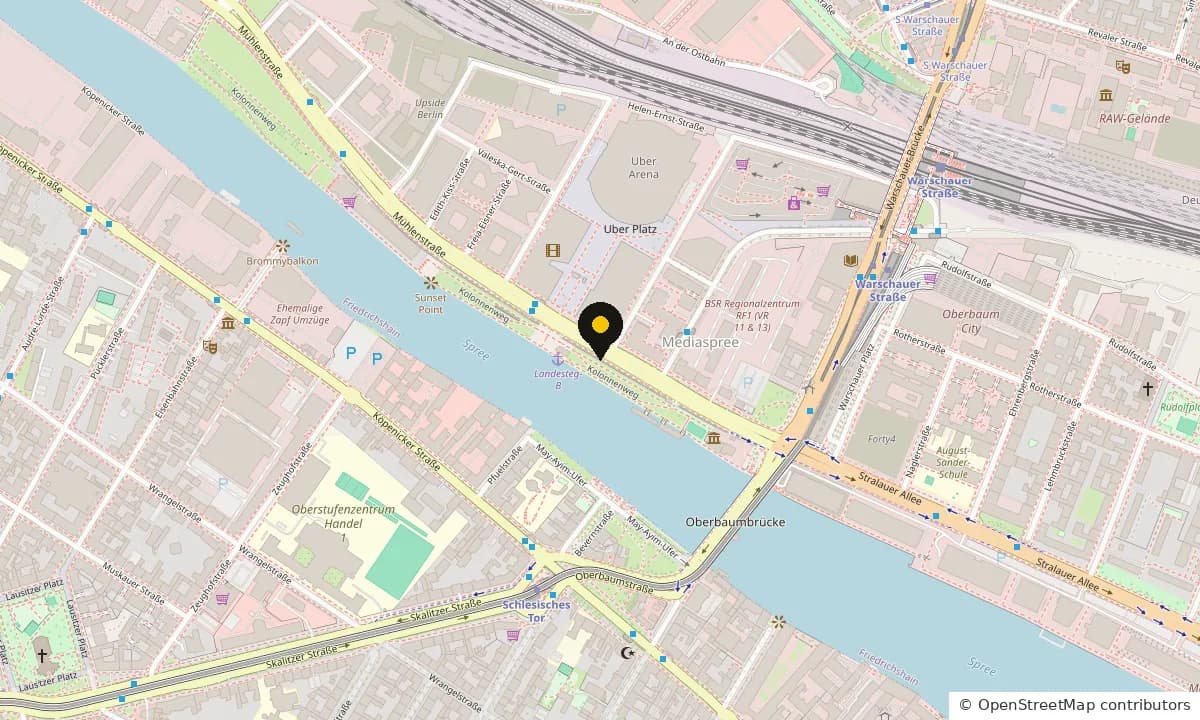
Map of the streets around the East Side Gallery, with a pin on the siteOpen in Google Maps

Mühlenstraße 47–80, 10243 Berlin · The gallery is open 24 hours, every day. Visitor information point (Mühlenstraße 73): daily 10:00–17:00, closed on Fridays from November and from 24 December 2026 to 2 January 2027.

Getting there

  • S3S5S7S9S75U1U3Warschauer Straße700 m · 9 min

    Walk down Warschauer Straße towards the river and turn right into Mühlenstraße: the Fraternal Kiss is near this end.

  • S3S5S7S9Ostbahnhof450 m · 6 min

    Comes out at the western end, by Stralauer Platz, so you can walk the whole gallery east and finish at Warschauer Straße.

  • Bus 300East Side Gallery150 m · 2 min

    Stops on Mühlenstraße, right beside the murals.

What you’ll see

  • More than 100 murals on the side of the Wall facing Mühlenstraße, painted in 1990 and mostly repainted in 2009, among them Dmitri Vrubel’s Fraternal Kiss of Brezhnev and Honecker near the Warschauer Straße end.
  • The river side: the back of the Wall, covered in graffiti, and the Berlin Wall Foundation’s open-air exhibition ‘Borders, Art and the City’, with QR codes linking the murals to interviews with the artists.
  • At the Stralauer Platz entrance near Ostbahnhof, a short stretch of the 1961 inner wall built of cinder blocks, one of the few surviving pieces of the first-generation Wall.

Tips from a guide

  • Start at Ostbahnhof and walk east, so you finish at the Oberbaum Bridge and Warschauer Straße station for onward trains.
  • Walk back along the riverbank: the gallery has two faces, and the open-air exhibition and the view of the Spree are on that side.
  • The info point at Mühlenstraße 73, opposite Tamara-Danz-Straße, has a small toilet and is where the Berlin Wall Foundation’s tours start.

Accessibility

The pavement along the whole 1.3 km is level and wheelchair-accessible, with benches along the way. On the river side only the upper paths of the green strip are step-free, not the bank itself. There is a small toilet at the info point (no baby-changing room), and disabled parking in the nearby Plaza, Arena and East Side Mall car parks. Check the BVG website for lift status at the stations.

Timeline

From border wall to open-air gallery

  1. 13 Aug 1961The Wall goes up; the Spree here becomes part of the border strip.
  2. 5 Oct 1961Udo Düllick drowns under fire, fleeing across the Spree near the Oberbaum Bridge.
  3. 21 Dec 1963The Oberbaum Bridge opens as a crossing for West Berliners on foot.
  4. Oct 1975East and West agree rules for rescuing people from the border river.
  5. 1977The riverbank is razed to give border guards a clear line of fire.
  6. 9 Nov 1989The Wall opens.
  7. Spring 1990118 artists from 21 countries paint the inner wall on Mühlenstraße.
  8. 28 Sep 1990The East Side Gallery opens, five days before reunification.
  9. Nov 1991The gallery is listed as a protected monument.
  10. 2008–09The concrete is repaired and most artists repaint their murals.
  11. Mar 2013Protests over the removal of a section for a luxury tower block.
  12. 1 Nov 2018The Berlin Wall Foundation takes over the site.

See it with a historian

Tours that stop at the East Side Gallery

The murals speak for themselves; a guide can show you where the death strip ran behind them, why the border followed the river and who died trying to cross it.

A full day on life in East Germany, from the Stasi to the Wall.

The Berlin Wall Tour - Berlin Experiences
Full Day6 Hours

The Republic Of Fear

Private 6-hour van tour of East Berlin, the Stasi and life behind the Wall for up to 6 people. Starts at your hotel.

€1,000up to 6
View Tour

Berlin’s whole story in one day, from Prussia to the Cold War.

The Berlin History Tour
Full Day6 Hours

The Berlin History Tour

Private 6-hour van tour of Berlin's whole history in one day for up to 6 people. Starts at your hotel or anywhere in the city.

€1,000up to 6
View Tour

The city’s highlights in half a day, including this stretch of the Wall.

The Bitesize Berlin Tour
Half Day3 Hours

The Bitesize Berlin Tour

Private 3-hour van tour of Berlin's major sights for up to 6 people. Starts at your hotel or anywhere in the city.

€700up to 6
View Tour

Questions visitors ask

Frequently asked questions

Is the East Side Gallery free?

Yes. It is an open-air gallery on a public street, free and open 24 hours a day. Only the Berlin Wall Foundation’s occasional guided tours cost money (from €5).

How long is the East Side Gallery, and how long does it take to walk?

About 1.3 km, between Ostbahnhof and the Oberbaum Bridge. Walking straight through takes 20–30 minutes; allow about an hour to look at the murals and come back along the river side.

Which station is closest to the East Side Gallery?

S Ostbahnhof is at the western end and S+U Warschauer Straße at the eastern end, about 9 minutes’ walk from the Fraternal Kiss. Bus 300 stops on Mühlenstraße beside the murals.

Where is the Fraternal Kiss mural?

Dmitri Vrubel’s painting of Brezhnev and Honecker kissing is towards the eastern, Warschauer Straße end, near the bus stop called East Side Gallery and the visitor information point at Mühlenstraße 73.

Why is it called the East Side Gallery?

Because it was painted on the east side of the Wall. This stretch was the inner wall facing East Berlin, which nobody could approach before 1989; the border itself was the river behind it.

Is the East Side Gallery the original Berlin Wall?

Yes: it is the longest surviving stretch, still where it stood. But it is the inner wall rather than the outer border wall, the concrete was repaired in 2008–09 and most of the murals were repainted then.

Who painted the East Side Gallery?

118 artists from 21 countries, in 1990. Among the best known are Dmitri Vrubel, who painted the Fraternal Kiss, and Birgit Kinder, whose Trabant appears to burst through the Wall.

Can I visit the East Side Gallery at night?

Yes, it is open around the clock. The visitor information point keeps daytime hours, 10:00–17:00, and is closed on Fridays from November.

Keep exploring

More Featured Experiences.

Every site we write about — 56 landmarks, museums, memorials and lesser-known corners of Berlin. See the full index →

01Walk Through The Brandenburg Gate02Explore The State Museums On Museum Island03Visit The Berlin TV Tower – The Fernsehturm04Cross The Cold War Border At Checkpoint Charlie05Visit The Site Of Adolf Hitler’s Führerbunker06Explore The Reconstructed Berlin Palace07Visit The Reichstag Cupola At Night08Explore The Forum Fridericianum09Shop At The Humboldt University Book Sale10Journey Into The Memorial To The Murdered Jews Of Europe11Step Inside The Neue Wache12Explore The Former Jewish Quarter – Spandauer Vorstadt13Visit The Remains Of The Berlin Wall14Walk Across The Bridge Of Spies15Explore The Topography Of Terror16Climb The Prussian Victory Column – The Siegessäule17Enter The Palace Of Tears – The Tränenpalast18Step Inside The Berlin Olympic Stadium19Explore Erich Mielke’s Office At The Stasi Museum20Walk Along Karl Marx Allee21Visit The Oldest Church In Berlin – The Nikolaikirche22Explore The Berliner Dom23Visit The Grave Of Frederick The Great24Walk Through The Ruins Of Anhalter Bahnhof25Stand On The Platz Des Volksaufstandes26Visit The German Resistance Museum27Visit The Soviet War Memorial In The Tiergarten28See The Georg Elser Memorial On Wilhelmstrasse29Step Inside The Kaiser Wilhelm Gedächtnis Kirche30Visit The Gleis 17 Memorial31Visit The Schloss Charlottenburg Mausoleum32Climb The Französischer Dom at Gendarmenmarkt33Explore The Interbau – IBA 5734Explore The Otto Weidt Workshop35Visit Cecilienhof – Site Of The Potsdam Conference36Visit The Stasi Prison In Hohenschönhausen37Spend The Day At Tempelhof Airport38Ride The Fastest Elevator In Europe39Visit The Soviet War Memorial In Treptower Park40Visit The Sachsenhausen Concentration Camp Memorial41Visit The Ravensbrück Concentration Camp Memorial42Visit Karlshorst – The Site Of The German Surrender43Visit The Socialists Cemetery – Zentralfriedhof Friedrichsfelde44Visit The Soviet War Memorial In Pankow45Visit the Seelow Heights Memorial46Visit The Commonwealth War Cemetery47Cross The Bösebrücke At Night48Explore The Allied Museum In Dahlem49Explore The Spandau Citadel50Visit The Brandenburg T4 Euthanasia Memorial51Visit The Wannsee Conference House52Visit The Jewish Museum53Visit The Jewish Cemetery In Weissensee55Explore The Volkspark Friedrichshain Flak Tower56Head Up The Teufelsberg