Skip to content
The zinc-clad Libeskind building of the Jewish Museum Berlin, seen between two concrete pillars of the Garden of Exile

Berlin Experiences/Featured Experiences

Jewish Museum Berlin: Visit the Libeskind Building

Explore the history of the Jews in Berlin from the medieval period to present day

The short answer

The Jewish Museum Berlin (Jüdisches Museum Berlin) tells the story of Jews in Germany from the Middle Ages to today, at Lindenstraße 9–14 in Kreuzberg, a 10-minute walk from Checkpoint Charlie. You enter through the baroque Old Building and go underground into Daniel Libeskind’s zigzag extension, with its three axes, the Garden of Exile, the Holocaust Tower and the Voids. The core exhibition is free; only temporary exhibitions cost €10. It is open Tuesday to Sunday, 10:00–18:00, and closed on Mondays. Allow two to three hours.

Where
Lindenstraße 9–14, 10969 Berlin-Kreuzberg
Open
Tue–Sun 10:00–18:00 (last entry 17:00); closed Mondays
Admission
Core exhibition free; temporary exhibitions €10, reduced €4
Time needed
2–3 hours
Nearest station
U1, U3, U6 Hallesches Tor, 7 minutes on foot
Step-free
Yes, except between the pillars of the Garden of Exile

The story · by Matt Robinson

To attempt to comprehend Berlin without considering its centuries-long, complex, and often tumultuous relationship with its Jewish citizens would be akin to attempting to complete a jigsaw without a significant piece of the puzzle.

Long before the Brandenburg Gate became an icon or the Reichstag housed parliaments, Jewish life was interwoven into the very fabric of this city, a thread sometimes celebrated, often tolerated, and tragically, brutally torn.

While historical records are sparse, evidence suggests that there was a Jewish population in the Berlin-Cölln area as early as the 13th century. However, a more formally recognised community began to flourish in the late 17th century. Following the expulsion of Jews from Vienna in 1670, Frederick William, the ‘Great Elector’ of Brandenburg-Prussia, issued an edict in 1671 permitting fifty expelled Viennese Jewish families to settle in Berlin. More than simple altruism; the Elector recognised the economic benefits these families could bring to a city still recovering from the devastating Thirty Years’ War. This marked the official re-establishment of a Jewish community in Berlin, a community that would grow to become one of the largest and most vibrant in Europe.

Over the ensuing centuries, Berlin’s Jewish population became integral to the city’s transformation into a major European metropolis. They were pioneers in trade, industry, and finance. Thinkers like Moses Mendelssohn, a key figure of the Haskalah (Jewish Enlightenment) in the 18th century, made Berlin a centre of intellectual ferment, bridging Jewish tradition and European philosophy. In the 19th and early 20th centuries, Jewish Berliners were at the forefront of culture, science, and the arts – names like Max Liebermann in painting, Albert Einstein in physics (though his special theory of relativity predated his Berlin professorship, his presence cemented the city’s scientific prestige), Kurt Weill in music, and countless others enriched the city immeasurably.

By the 1920s, Berlin was home to around 170,000 Jews, roughly a third of all Jews in Germany, contributing significantly to the Weimar Republic’s famously liberal and creative atmosphere.

Persecution and return

Yet, this vibrant existence was always shadowed by prejudice, discrimination, and periodic violence. This culminated in the unimaginable horror of the Nazi era and the Holocaust (Shoah). From 1933 onwards, Jewish life was systematically dismantled – rights stripped, businesses aryanized, synagogues burned (most infamously during Kristallnacht in November 1938), and finally, deportation and mass murder. Berlin became a hub for the bureaucratic machinery of genocide. Of the approximately 160,000 Jews living in Berlin when the Nazis seized power, around 55,000 were murdered. Thousands more fled, their absence leaving an unfillable void in the city’s soul.

After 1945, only a few thousand Jews remained in the ruins of Berlin. Yet, against all odds, Jewish life slowly, painstakingly began to re-emerge. The community remained small for decades, split between East and West during the Cold War. A significant turning point came after German reunification, with the influx of tens of thousands of Jews from the former Soviet Union in the 1990s. Today, Berlin once again boasts the largest Jewish community in Germany, estimated at around 40,000-50,000 members affiliated with various community organisations, though the total number of people with Jewish heritage is likely higher. It’s a diverse, dynamic community grappling with its history while forging a new future, with new synagogues, cultural centres, schools, and kosher restaurants adding to the city’s landscape.

The Jewish Museum Berlin stands as a testament to this entire complex narrative – the centuries of contribution, the depths of persecution, and the remarkable resilience of the Jewish spirit in Berlin.

The zinc-clad façade of the Libeskind building at the Jewish Museum Berlin, with its slashed windows, seen from below
The Libeskind building’s titanium-zinc skin.

The museum’s central mission is ambitious: to present two millennia of German-Jewish history and culture. It deliberately avoids being solely a Holocaust museum, though the Shoah inevitably casts a long shadow and is addressed with profound sensitivity. Instead, it seeks to illuminate the richness and diversity of Jewish life in Germany – religious traditions, intellectual achievements, cultural contributions, daily life, periods of coexistence and integration, as well as times of persecution and exclusion. The German state’s commitment to funding and maintaining this institution is a powerful statement about acknowledging historical responsibility and preserving the memory of a community that was nearly destroyed, while also celebrating its enduring presence and future. It stands as a vital space for dialogue and understanding in contemporary Germany.

The story of the Jewish Museum Berlin is itself a reflection of the fractured history it seeks to represent. It’s not the first Jewish Museum the city has known. An earlier institution opened its doors on Oranienburger Straße in 1933, adjacent to the magnificent Neue Synagoge. Housing a significant collection of Jewish art and cultural artefacts, it was a beacon of Jewish heritage precisely when that heritage was coming under vicious attack. Its existence was tragically short-lived; the Nazis forced its closure in 1938 following the Kristallnacht pogrom, its collections confiscated or dispersed. For decades after the war, the physical representation of German-Jewish history in Berlin remained fragmented, overshadowed by the enormity of the Shoah.

Between the Lines

The idea for a new Jewish Museum began to gain traction in the 1970s. Initially, the plan was relatively modest: a Jewish department within the existing Berlin Museum (now part of the Stadtmuseum Berlin). However, as discussions evolved, particularly in the charged atmosphere of West Berlin during the Cold War – a city acutely aware of its historical burdens – the ambition grew. It became clear that the sheer scope and sensitivity of German-Jewish history demanded a dedicated, purpose-built space. This wasn’t just about displaying artefacts; it was about creating a place for reflection, education, and confronting a difficult past. Germany’s post-war generation was grappling with the legacy of the Third Reich, and creating such a museum became an important, if complex, part of that process.

In 1989, a pivotal year marked by the fall of the Berlin Wall, an architectural competition was held for an extension to the Berlin Museum specifically for the Jewish collection. The winning design, submitted by Polish-American architect Daniel Libeskind, was radical, unconventional, and deeply symbolic. It was so powerful, in fact, that it eventually propelled the project towards becoming an independent institution. Libeskind, himself the child of Holocaust survivors, envisioned a building that would embody the complexities, ruptures, and absences within German-Jewish history, particularly the void left by the Holocaust.

…not merely a container for exhibits; it is an exhibit in itself…

The Libeskind section of the museum officially opened its doors to the public in September 2001, though this part of the building had been completed years earlier and already become an architectural landmark, drawing visitors even before exhibits were installed. It comprises two main parts: the Altbau (Old Building), the stately baroque Kollegienhaus, a former Prussian courthouse, which serves as the entrance and houses administrative offices, temporary exhibitions, and event spaces; and the Neubau (New Building), Libeskind’s striking zinc-clad extension accessed via an underground passage from the Altbau.

Libeskind’s design forces visitors to confront the difficult aspects of history through sensory experience – the instability of exile, the chilling emptiness of the Holocaust, the undeniable presence of the void. It’s a challenging, demanding architecture, but one that provides an extraordinarily powerful framework for understanding the exhibits housed within and the history they represent.

Looking up through a bare concrete Void inside the Libeskind building of the Jewish Museum Berlin, with light from above
Looking up into one of the building’s concrete Voids.

Daniel Libeskind’s extension to the Jewish Museum Berlin is not merely a container for exhibits; it is an exhibit in itself, a powerful architectural statement designed to evoke emotion and provoke thought before you even encounter the first display case. It’s an experience meant to be felt as much as seen, translating the often-unfathomable realities of German-Jewish history, particularly the trauma of the Holocaust, into physical space. Libeskind titled his design “Between the Lines,” referencing the complex, often invisible, connections and devastating disconnections within this history.

The three axes

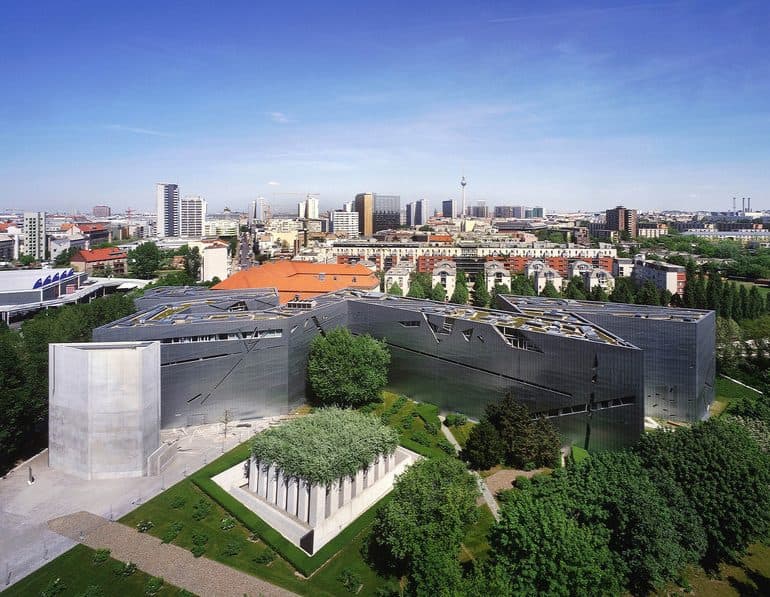
The building’s exterior is immediately arresting: a dramatic, zigzagging form clad in shimmering zinc panels, slashed by seemingly random window openings. This shape, often interpreted as a deconstructed or fractured Star of David, resists easy interpretation and suggests rupture, disorientation, and a path abruptly broken. Unlike the orderly classicism of the adjacent Kollegienhaus, Libeskind’s structure feels dynamic, unsettling, almost scarred. The sharp angles and metallic skin create a sense of tension and vulnerability.

Visitors enter the Libeskind building not directly from the street, but by descending a stark staircase from the baroque Altbau into an underground network. This descent is symbolic, representing a journey into the depths of history. Here, you encounter the building’s conceptual core: three intersecting underground corridors, or “Axes,” each representing a different facet of the German-Jewish experience.

The first is the Axis of Exile. This long, sloping corridor leads out of the building entirely, culminating in the Garden of Exile. This stark outdoor space features 49 tall concrete pillars arranged on a tilted, uneven grid. Growing atop these pillars (48 of them filled with earth from Berlin, representing 1948, the year Israel was founded) are oleaster trees, symbolising hope and life, but their constrained growth speaks to the difficulty of putting down roots in unfamiliar soil. The ground beneath is deliberately slanted, creating a physical sense of instability and disorientation, mirroring the experience of those forced to flee their homeland. The 49th pillar, at the centre, contains earth brought from Jerusalem. Walking through this garden is a profoundly unsettling physical experience.

Inside the Holocaust Tower at the Jewish Museum Berlin: dark concrete walls, an iron ladder out of reach and a slit of daylight
Inside the Holocaust Tower, lit only by a narrow slit.

The second corridor is the Axis of the Holocaust. This path ends abruptly at the Holocaust Tower (or Shoah Void), a towering, empty, unheated concrete silo, almost entirely dark save for a small slit high above letting in a sliver of natural light and muffled city sounds. Entering this space is chilling. The heavy door clangs shut behind you, enveloping you in cold, near-silence, and oppressive darkness. It’s a space of profound absence, designed to convey the suffocation, isolation, and despair experienced by the victims of the Shoah. It’s not an easy place to be, nor is it meant to be. It’s a visceral confrontation with the void left by genocide.

The third and longest corridor is the Axis of Continuity. This path represents the persistence of Jewish life in Germany despite persecution and rupture. It cuts through the museum’s main exhibition spaces and leads to a dramatic, steep staircase that ascends upwards towards the light, symbolising the continuation and endurance of history and culture. Along this axis, intersecting it at various points, are the “Voids” – stark, empty concrete spaces that cut vertically through all levels of the zigzagging building. These Voids are mostly inaccessible to visitors but can often be glimpsed through openings or crossed via bridges. They represent the physical and spiritual emptiness left by the destruction of Jewish life in Berlin and Europe – the absences that cannot be filled, the voices silenced forever.
The Jewish Museum in detail

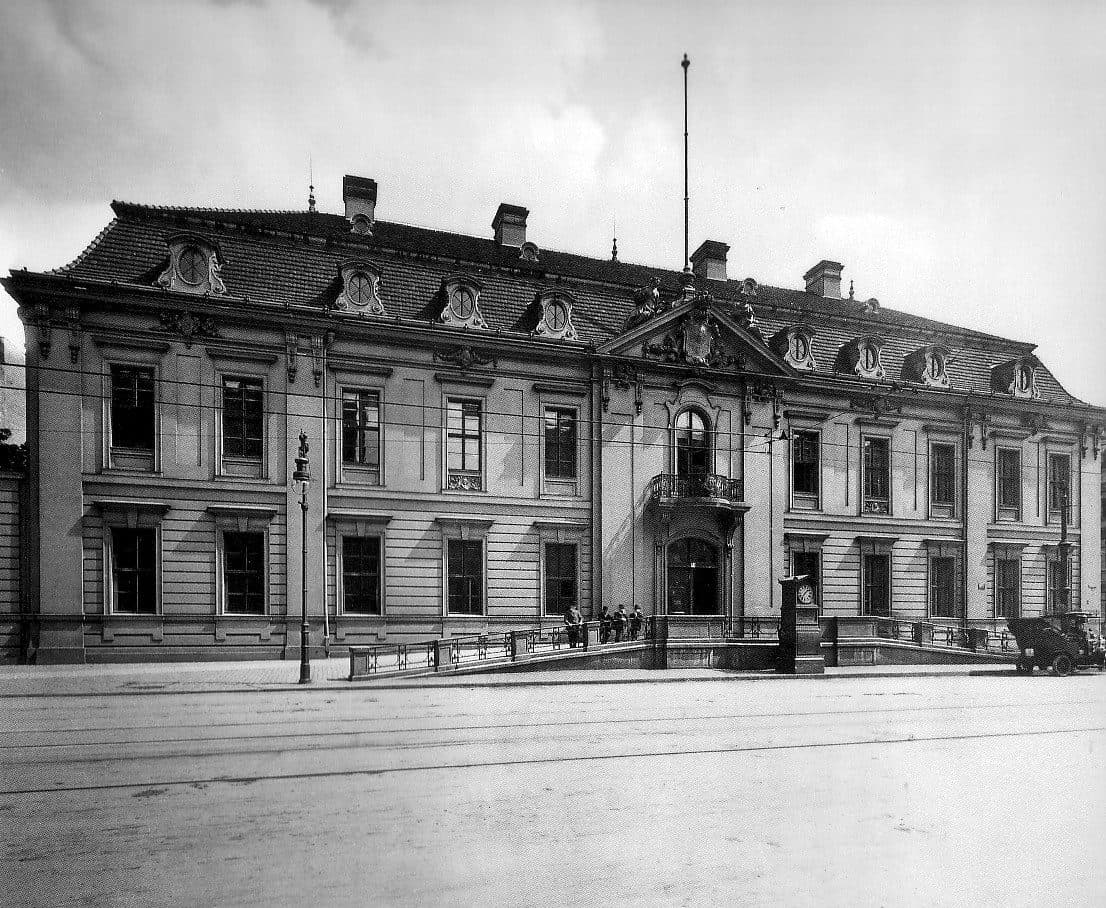
The Kollegienhaus on Lindenstraße in Berlin around 1910, then the old Kammergericht and today the entrance of the Jewish Museum
The Kollegienhaus on Lindenstraße around 1910, three years before the Kammergericht moved out. Photo: Königlich Preußische Messbildanstalt / Public domain, via Wikimedia Commons

The Kollegienhaus: a Prussian courthouse

The museum’s entrance is the oldest surviving building in Kreuzberg. King Frederick William I had the Kollegienhaus built in 1734–35 to plans by Philipp Gerlach, the first large administrative building of his reign, to bring Prussia’s civil, criminal and church courts under one roof. The Kammergericht, Prussia’s highest court, sat here until 1913. Among its judges was the writer E.T.A. Hoffmann, appointed in 1816, who worked here as a judge.

Bombing in the Second World War left only the outer walls standing, and for a while the ruin was meant to make way for a motorway. Instead it was rebuilt in 1963–69 and became the home of West Berlin’s city history museum, the Berlin Museum, whose Jewish department grew into today’s museum. The courtyard has been covered since 2007 by Libeskind’s glass roof, modelled on a sukkah, the hut of the harvest festival of Sukkot.

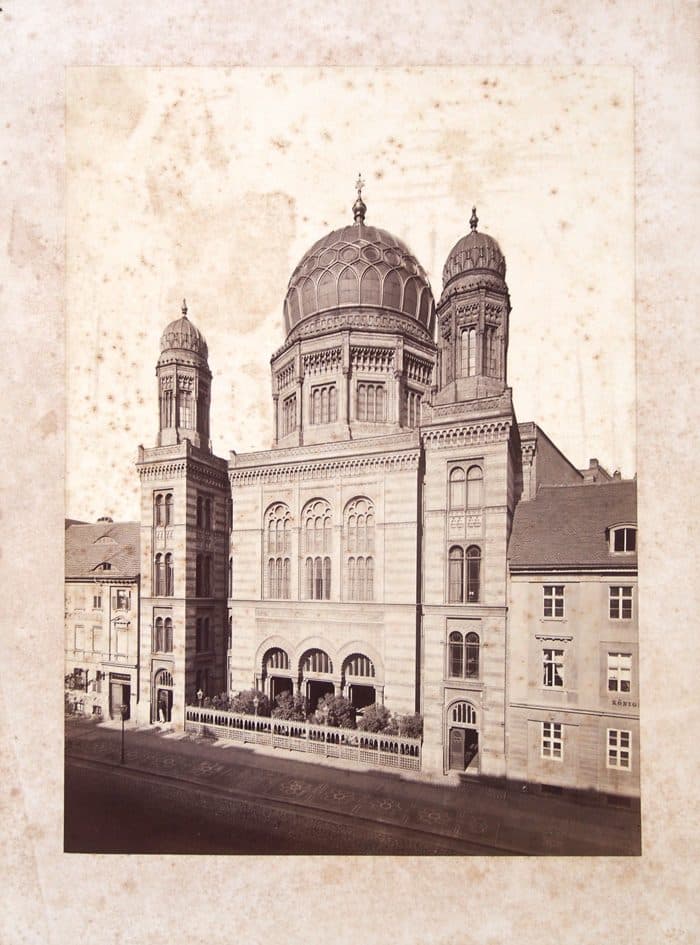
The New Synagogue on Oranienburger Straße in Berlin around 1866, next to which the city’s first Jewish Museum opened in 1933
The New Synagogue on Oranienburger Straße, around 1866. The first Jewish Museum opened next door in 1933. Photo: Unknown photographer / Public domain, via Wikimedia Commons

Berlin’s first Jewish Museum, 1933–1938

Berlin had a Jewish museum once before. It opened on 24 January 1933 at Oranienburger Straße 31, beside the New Synagogue, six days before Hitler became Chancellor. Under its director Karl Schwarz it collected modern Jewish art as well as ceremonial objects and historical documents, and presented that art as part of German art history. One of its last exhibitions was a retrospective of the Impressionist painter Ernst Oppler.

During the November Pogrom, on 10 November 1938, the Gestapo closed the museum and confiscated its collection. Parts of it are now in the Skirball Cultural Center in Los Angeles and the Israel Museum in Jerusalem. The idea of a new museum came back in 1971, with an exhibition for the 300th anniversary of the Jewish community at the Berlin Museum, the same building where today’s museum stands.

Aerial view of the Libeskind building of the Jewish Museum Berlin, with the Holocaust Tower and the planted Garden of Exile in front
The zigzag from above: the Holocaust Tower (left) and the Garden of Exile, its pillars topped with oleaster. Photo: Studio Daniel Libeskind / CC BY 3.0, via Wikimedia Commons

Building “Between the Lines”

Berlin held a competition in 1988 for an extension to the Berlin Museum with a Jewish department, and in 1989 Daniel Libeskind won it. It was the first of his designs ever built. Libeskind based the plan on two lines, the visible zigzag and an invisible straight line, with the Voids where they cross. To draw them he plotted on a map the addresses of Jewish and non-Jewish Berliners such as Rahel Varnhagen, Heinrich von Kleist and Paul Celan, and took ideas from Schoenberg’s unfinished opera Moses und Aron, the Federal Archives’ memorial book of murdered German Jews and Walter Benjamin’s One-Way Street.

The project was briefly cancelled in 1991, then revived; building began in November 1992. The empty museum was finished in 1999, and almost 350,000 people toured it before a single object was installed. After a gala on 9 September 2001, the public opening was put back two days, to 13 September, because of the attacks in the United States.

Plan your visit

Visiting the Jewish Museum

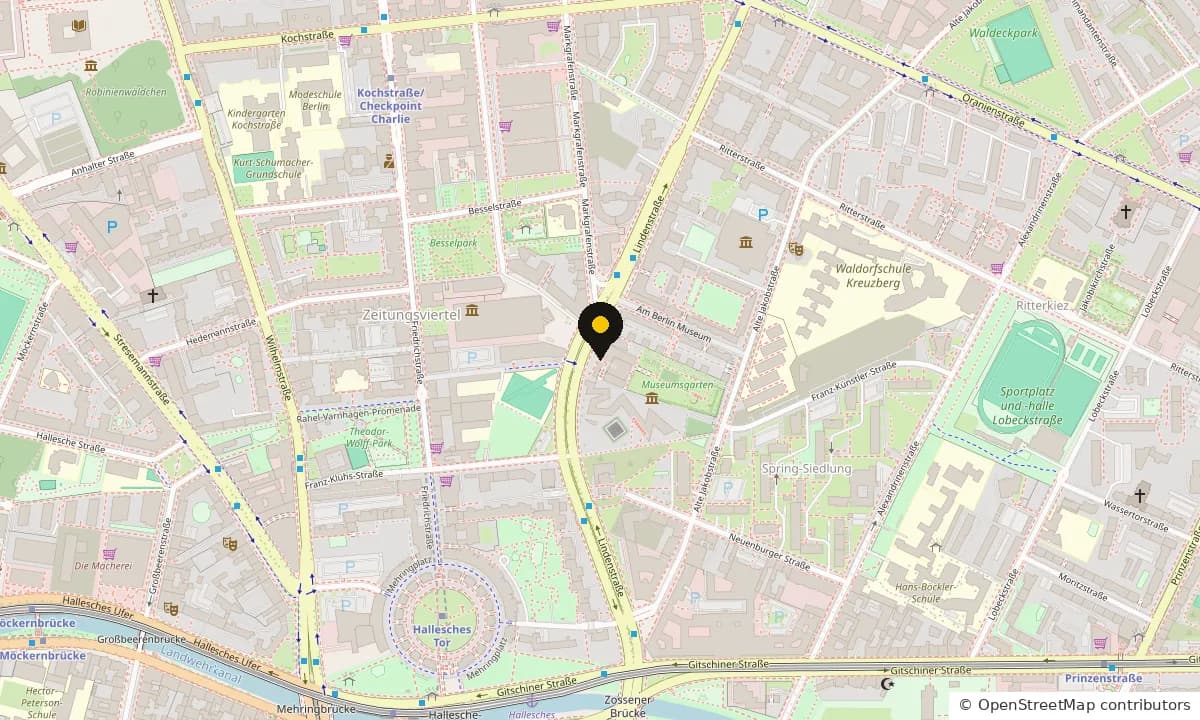
Map of the streets around the Jewish Museum, with a pin on the siteOpen in Google Maps

Lindenstraße 9–14, 10969 Berlin · Tue–Sun 10:00–18:00, last admission 17:00. Closed on Mondays, on 24 December and on Rosh Hashanah and Yom Kippur; also closed on 14 November 2026. ANOHA children’s museum: Tue–Fri 9:00–16:00, Sat, Sun and Berlin public holidays 10:00–17:00.

Getting there

  • U1U3U6Hallesches Tor550 m · 7 min

    Take exit A (north side) and walk up Lindenstraße; lifts at the station.

  • U6Kochstraße/Checkpoint Charlie550 m · 7 min

    Walk south-east through the old newspaper quarter; easy to combine with Checkpoint Charlie.

  • Bus 248Jüdisches MuseumAt the door

    Stops right outside; the stop towards Alexanderplatz has been moved temporarily for building work.

What you’ll see

  • The core exhibition, Jewish Life in Germany: Past and Present, opened in 2020: two floors and some 3,500 m² on 1,700 years of German-Jewish history, with many stations to touch, listen to and try.
  • Daniel Libeskind’s architecture: the three underground axes, the tilted Garden of Exile with its 49 pillars, the cold, dark Holocaust Tower and the 82 steps of the Stairs of Continuity.
  • Shalekhet (Fallen Leaves), Menashe Kadishman’s more than 10,000 iron faces on the floor of the Memory Void, which clang underfoot as you walk across them.

Tips from a guide

  • Book a free time-slot ticket online to skip the queue at busy times; walk-in tickets are also available at the desk. Expect an airport-style security check at the entrance.
  • Start downstairs with the axes, the Garden of Exile and the Holocaust Tower before you climb to the exhibition: the building is the reason many people come. Shalekhet is closed from 23 November to 4 December 2026.
  • The café, shop, Glass Courtyard and garden need no ticket. The core exhibition is large, so pick a few eras rather than trying to read everything.

Accessibility

All exhibition and event spaces are reachable by lift or ramp, the axes slope gently (at most 3.9 per cent), and seating is provided along the exhibition. Wheelchairs can be borrowed in the lobby (reserve in advance). The gaps between the pillars of the Garden of Exile are too narrow for wheelchairs and pushchairs. Accessible toilets are at the rear entrance of the Old Building and on the lower level of the Libeskind building; there are two disabled parking spaces near the entrance. Hallesches Tor has lifts; check the BVG website for lift status.

Timeline

From courthouse to museum

  1. 1671The Great Elector admits 50 Jewish families expelled from Vienna.
  2. 1735The new Kollegienhaus on Lindenstraße becomes the seat of the Kammergericht.
  3. 24 Jan 1933Berlin’s first Jewish Museum opens next to the New Synagogue.
  4. 10 Nov 1938The Gestapo closes the museum and confiscates its collection.
  5. 1963–69The war-ruined Kollegienhaus is rebuilt as the home of the Berlin Museum.
  6. 1989Daniel Libeskind wins the competition for the museum extension.
  7. Nov 1992Construction of the Libeskind building begins.
  8. 1999The empty building is finished; almost 350,000 people tour it before it opens.
  9. 13 Sep 2001The Jewish Museum Berlin opens to the public.
  10. 2012The W. Michael Blumenthal Academy opens in the old flower market hall opposite.
  11. 23 Aug 2020The new core exhibition opens; admission becomes free in 2021.
  12. 27 Jun 2021ANOHA, the children’s museum, opens in the Academy.

See it with a historian

Tours that stop at the Jewish Museum

The museum explains Jewish life in Germany; a guide can take you out to the streets where it happened, from the Scheunenviertel to the government district that planned its destruction.

A full day through Berlin’s whole story, with time to fit in the museum and the Libeskind building.

The Berlin History Tour
Full Day6 Hours

The Berlin History Tour

Private 6-hour van tour of Berlin's whole history in one day for up to 6 people. Starts at your hotel or anywhere in the city.

€1,000up to 6
View Tour

The rise and fall of the Third Reich, and what it did to Berlin’s Jews.

The Capital Of Tyranny Tour - Berlin Experiences
Full Day6 Hours

The Capital Of Tyranny

Private 6-hour van tour of Hitler's Berlin and the Third Reich for up to 6 people. Starts at your hotel or anywhere in the city.

€1,000up to 6
View Tour

The highlights by private van, so Kreuzberg and the museum are easy to add.

The Bitesize Berlin Tour
Half Day3 Hours

The Bitesize Berlin Tour

Private 3-hour van tour of Berlin's major sights for up to 6 people. Starts at your hotel or anywhere in the city.

€700up to 6
View Tour

Questions visitors ask

Frequently asked questions

Is the Jewish Museum Berlin free?

Yes, the core exhibition and the Libeskind building are free for everyone, and have been since 2021. Temporary exhibitions in the Old Building cost €10 (reduced €4; under-18s free).

Do I need to book tickets for the Jewish Museum Berlin?

No, but a free time-slot ticket booked online saves waiting at busy times. Walk-in tickets are available at the desk. ANOHA, the children’s museum, can only be visited with a time-slot ticket.

How long do you need at the Jewish Museum Berlin?

Allow two to three hours: about an hour for the architecture on the lower level and the garden, and the rest for the core exhibition. With a temporary exhibition, plan on half a day.

Is the Jewish Museum Berlin open on Mondays?

No. It is open Tuesday to Sunday, 10:00–18:00, with last admission at 17:00. It also closes on 24 December and on Rosh Hashanah and Yom Kippur.

What is the Holocaust Tower?

An empty, unheated concrete tower at the end of the Axis of the Holocaust, connected to the building only underground. Its only daylight comes through a narrow slit high above, and city sounds are muffled to almost nothing.

Who designed the Jewish Museum Berlin?

The extension is by the American architect Daniel Libeskind, born in Łódź in 1946 to Holocaust survivors. He won the competition in 1989; the building opened as a museum in 2001. The entrance is the baroque Kollegienhaus of 1735.

Is the Jewish Museum Berlin suitable for children?

Yes. The core exhibition has many hands-on stations, and ANOHA across the street is a free play museum built around Noah’s Ark. The Holocaust Tower and some sections may be hard for young children.

Can you take photos in the Jewish Museum Berlin?

Yes, for personal use, but without flash, tripods or selfie sticks.

Keep exploring

More Featured Experiences.

Every site we write about — 56 landmarks, museums, memorials and lesser-known corners of Berlin. See the full index →

01Walk Through The Brandenburg Gate02Explore The State Museums On Museum Island03Visit The Berlin TV Tower – The Fernsehturm04Cross The Cold War Border At Checkpoint Charlie05Visit The Site Of Adolf Hitler’s Führerbunker06Explore The Reconstructed Berlin Palace07Visit The Reichstag Cupola At Night08Explore The Forum Fridericianum09Shop At The Humboldt University Book Sale10Journey Into The Memorial To The Murdered Jews Of Europe11Step Inside The Neue Wache12Explore The Former Jewish Quarter – Spandauer Vorstadt13Visit The Remains Of The Berlin Wall14Walk Across The Bridge Of Spies15Explore The Topography Of Terror16Climb The Prussian Victory Column – The Siegessäule17Enter The Palace Of Tears – The Tränenpalast18Step Inside The Berlin Olympic Stadium19Explore Erich Mielke’s Office At The Stasi Museum20Walk Along Karl Marx Allee21Visit The Oldest Church In Berlin – The Nikolaikirche22Explore The Berliner Dom23Visit The Grave Of Frederick The Great24Walk Through The Ruins Of Anhalter Bahnhof25Stand On The Platz Des Volksaufstandes26Visit The German Resistance Museum27Visit The Soviet War Memorial In The Tiergarten28See The Georg Elser Memorial On Wilhelmstrasse29Step Inside The Kaiser Wilhelm Gedächtnis Kirche30Visit The Gleis 17 Memorial31Visit The Schloss Charlottenburg Mausoleum32Climb The Französischer Dom at Gendarmenmarkt33Explore The Interbau – IBA 5734Explore The Otto Weidt Workshop35Visit Cecilienhof – Site Of The Potsdam Conference36Visit The Stasi Prison In Hohenschönhausen37Spend The Day At Tempelhof Airport38Ride The Fastest Elevator In Europe39Visit The Soviet War Memorial In Treptower Park40Visit The Sachsenhausen Concentration Camp Memorial41Visit The Ravensbrück Concentration Camp Memorial42Visit Karlshorst – The Site Of The German Surrender43Visit The Socialists Cemetery – Zentralfriedhof Friedrichsfelde44Visit The Soviet War Memorial In Pankow45Visit the Seelow Heights Memorial46Visit The Commonwealth War Cemetery47Cross The Bösebrücke At Night48Explore The Allied Museum In Dahlem49Explore The Spandau Citadel50Visit The Brandenburg T4 Euthanasia Memorial51Visit The Wannsee Conference House53Visit The Jewish Cemetery In Weissensee54Walk Along The East Side Gallery55Explore The Volkspark Friedrichshain Flak Tower56Head Up The Teufelsberg