Skip to content
Lev Kerbel’s bronze Soviet soldier on its stone plinth at the Seelow Heights Memorial in Seelow, against a blue sky

Berlin Experiences/Featured Experiences

Seelow Heights: Visit the Battlefield Memorial of April 1945

Before reaching Berlin in 1945, the Soviet Red Army had to advance beyond a formidable and well defended obstacle – the Seelow Heights.

The short answer

The Seelow Heights Memorial (Gedenkstätte Seelower Höhen) stands on the ridge where the Red Army broke through the last German line before Berlin on 16–19 April 1945, in the town of Seelow, about 70 km east of central Berlin. You can visit: the outdoor memorial, with Lev Kerbel’s Soviet soldier, the war graves and the view over the battlefield, is free and open at all times. The small museum costs €5 and opens Tuesday–Sunday, 11:00–16:00. Allow about two hours on site and about two hours each way by regional train from Berlin.

Where
Küstriner Straße 28a, 15306 Seelow, about 70 km east of Berlin
Open
Grounds always; museum Tue–Sun 11:00–16:00
Admission
Grounds free; museum €5 (under-18s free)
Time needed
About 2 hours, plus about 2 hours each way from Berlin
Nearest station
RB60 Seelow (Mark), 5 minutes on foot
Step-free
Yes: from the forecourt to the visitor centre, museum and grounds

The story · by Matt Robinson

In April 1945, after almost four years of bitter conflict and horrifying loss of life, the forces of the Soviet Union finally reached the ‘Gates of Berlin’ – with over six million men and women in uniform bearing down on central Europe and threatening a final confrontation between the Weltanschauung of National Socialism and Stalinist Soviet Communism.

The stage was set for a ferocious battle in the Nazi capital – the largest confrontation between Axis and Allied forces that would take place on German soil. One where vengeance would be weighed in blood.

However, it would be a mistake to think that the Battle of Berlin was decided entirely within the city itself. Despite the ferocity of this engagement, it would be concluded in only 17 days – without the extensive use of siege tactics or an extended period of stalemate.

As the opening days of the battle, particularly for the Seelow Heights some 90km to the east, would seal the fate of the city.

The official Soviet plan for the attack on the Nazi capital – the Berlin Strategic Offensive Operation, as it was known – called for the troops of the Red Army to have conquered the city by April 22nd – the anniversary of Vladimir Lenin’s birth. But in the opening stage of this immense battle the Seelow Heights would prove a formidable obstacle, far more so than Soviet Marshal Georgy Zhukov – or his direct superior, Joseph Stalin – expected.

The Gates of Berlin

In 1945, the “Gates of Berlin” were not so much situated on the fortified outskirts of this city of millions – that had grown dense and rich during its time as the capital of the Imperial Kingdom of Prussia and cold and mean as the heart of Nazi Germany – but further east, along the rivers Oder and Neisse.

Instead of choosing to reinforce the city and brace for a prolonged siege, troops available for the defense of Berlin were sent to hold the Oder-Neisse frontline as part of Army Group Vistula, marshalled to fight a mighty battle to deny the Red Army access to not only the Nazi capital, but the territory of the entire inner German Reich.

To be dealt a blow here, on the city’s eastern approaches, would likely make the fall of Berlin to the Soviet advance a foregone conclusion. For as the saying goes: if the Coliseum falls, Rome falls with it.

Path paved in stripes of grey, yellow and red through the gardens of the Seelow Heights Memorial
A path through the memorial grounds.

Of the Soviet Fronts (Army Groups) that would take part in the Berlin Strategic Offensive Operation, the 1st Belorussian and 1st Ukrainian would spearhead the move on the Nazi capital. With the 1st Belorussian, led by Georgy Zhukov, tasked with pushing over and beyond the Seelow Heights.

Passing through the centre of this elevated terrain was the Reichsstrasse 1 (now the B1 federal highway), which previously ran from the Dutch border near the city of Aachen to the distant Prussian city of Königsberg. Here, and directly opposite the strongest part of the defenses, were the 3rd and 5th Shock Army, the 47th Army, and 8th Guards. The latter having fought as victors at the Battle of Stalingrad – commanded by the man who had defended the city, Colonel General Vasily Chuikov.

First an immense artillery barrage would be unleashed, followed by the main body of troops who were expected to quickly overrun the German positions, then straight to Berlin. The most direct line of attack and the shortest route to the city.

The battle, 16–19 April 1945

In the early hours of April 16th, under cover of darkness, the Berlin offensive started at Seelow Heights, as thousands of artillery pieces and Katyusha rocket launchers bombarded the defensive fortifications. The opening barrage during the Battle of the Seelow Heights would see some 9000 Soviet guns firing 500,000 shells in 30 minutes. Zhukov’s 1st Belorussian Front attacked at 4am Berlin time, across the river Oder and towards the Seelow Heights, but quickly stalled.

The land occupied by the Soviet forces following the Vistula-Oder campaign of early 1945, was saturated by the spring thaw – German engineers had increased this hazard by releasing water from a reservoir upstream, which turned the plain into a swamp. Making the movement of tanks and mechanised units problematic and near impossible in parts. And seriously slowing down the Soviet advance.

Zhukov had hoped to aid the advance of his infantry by using high powered anti-aircraft searchlights operated by female Red Army soldiers to illuminate the heights. This, however, only served to backlight the troops and leave them easier to target as they moved across the swampy floodplain. By the end of April 16th, Zhukov’s gunners had used over 1,250,000 rounds on this first day alone. But his troops had only managed to advance some 8km in parts.

On hearing of the limited movement of his front echelon troops, Zhukov decided to commit his tank armies to the fight just after midday, although they were not scheduled to be brought up until the Seelow Heights had been seized.

On April 18th, Zhukov’s troops did manage to advance north of Army Group Vistula’s main force – the 9th Army – but were hit with serious counterattacks – with some of the heaviest coming from the 11th SS Panzergrenadier Division Nordland and the 23rd SS Panzergrenadier Division Nederland. By nightfall on April 18th, Zhukov’s force had pushed 3-8km in the centre and reached the third and final line of German defenses – but were already 48 hours behind the deadline that Zhukov had set himself to Stalin to break through beyond this final line.

Red granite gravestone at the Seelow Heights Memorial for soldiers of the 1st Belorussian Front who fell taking Seelow on 18 April 1945
The gravestone of soldiers who fell taking Seelow on 18 April 1945, reburied here in 1972.

Stalin’s Red Army would finally move beyond the Seelow Heights on April 19th 1945 – but at a heavy price. Over the course of this mammoth confrontation, the 1st Belorussian Front lost nearly three times as many men as the German defenders. But by the end of the 19th there was a gap in the eastern front about 19 miles wide – from Wriezen to Behlendorf – with the remnants of the once mighty German 9th Army split into three parts. Berlin finally lay open for the taking – and Soviet artillery would start pounding the city’s northern suburbs the next day, just in time for Adolf Hitler’s birthday.

The memorial today

The Seelow Heights site today is maintained as a memorial, with a museum and military cemetery to commemorate the thousands who fell here during the battle for the ‘Gates of Berlin’.

Towering over graves and the military equipment – a katyusha rocket delivery platform and artillery pieces – is a statue designed by artist Lev Kerbel, also responsible for the soldier at the Soviet Memorial in Tiergarten, Berlin and the huge bust of Karl Marx in Chemnitz. Of particular interest is the permanent exhibition inside the museum and the commentary on the relevance of this battle in East German historiography, as this ‘new Germany’ balanced its sense of political and ideological identity against its history.

Soviet Katyusha rocket launcher on a truck on the forecourt of the Seelow Heights Memorial, with the Kerbel statue on the hill behind
A Katyusha rocket launcher on the forecourt.

The immense battle at Seelow Heights although often the focus of any study of the Battle of Berlin, was not the only confrontation on the Eastern Front at that time – as further south the forces of Ivan Konev’s 1st Ukrainian Front managed to break through the Nazi defensive lines before Zhukov and speed towards the Nazi capital.

The race to Berlin was always going to be a propaganda coup for anyone who made it there first – and raised the Soviet flag on top of the Reichstag, considered Objective No. 1 in the battle for Hitler’s capital. But before entering the city, thousands would have to perish whilst the way was cleared.

Still today remnants of this mighty battle – munitions and human remains – are regularly unearthed. Grim reminders of the cost of war – and the price paid to defeat Hitlerism.
The Seelow Heights in detail

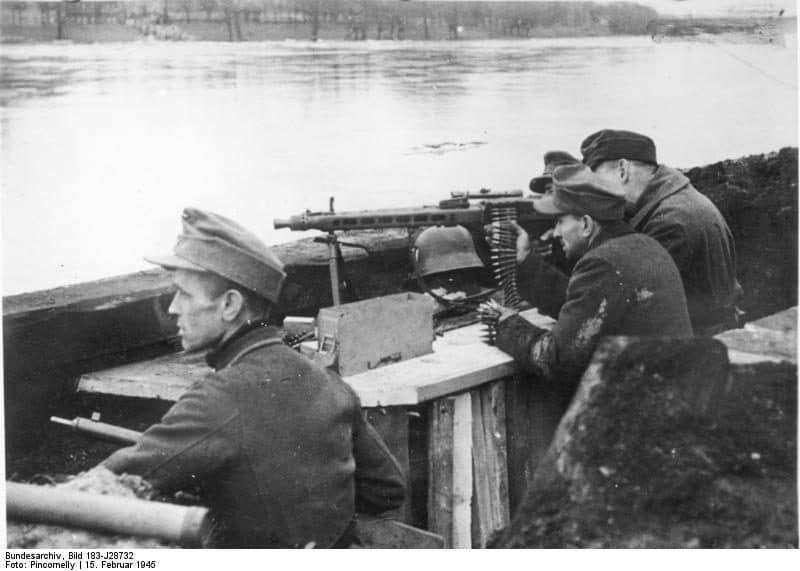
Volkssturm men with a machine gun in a dug-in position on the bank of the Oder, February 1945
Volkssturm men dug in on the Oder, February 1945. Photo: Bundesarchiv, Bild 183-J28732 / Pincornelly / CC-BY-SA 3.0

Why the heights were so hard to take

The Seelow Heights are the steep western edge of the Oderbruch, a flat, marshy river plain up to 20 km wide, and they rise up to 90 metres above it. To reach them, the Red Army first had to cross the Oder: the 5th Shock Army formed the first bridgehead at Kienitz on 31 January 1945, and two months of fighting around Küstrin followed. By the memorial’s figures, the German 9th Army lost about 40,000 men in February and March, and the two Soviet armies in the bridgeheads 15,466 dead and 46,333 wounded.

General Gotthard Heinrici, who took over Army Group Vistula on 20 March, guessed that the main blow would come along Reichsstraße 1 through Seelow, and pulled most of his men back from the front line just before the barrage, so much of it fell on empty trenches. Even so, the memorial puts Zhukov’s strength at 900,000 soldiers, 3,059 tanks and 17,824 guns and rocket launchers, against 90,836 men, 512 tanks and 2,625 guns in the 9th Army.

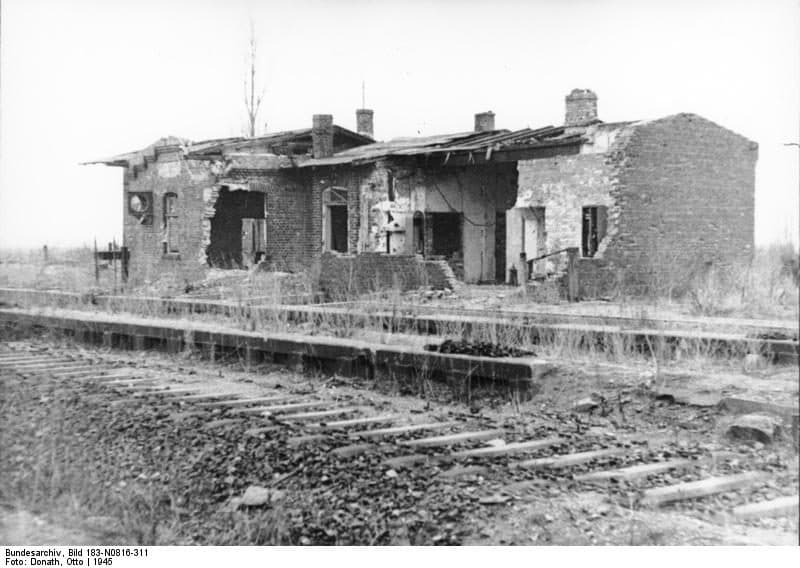
The wrecked railway station at Reitwein in the Oderbruch near the Seelow Heights, photographed in 1945
The ruined station at Reitwein, in the Oderbruch, 1945. Photo: Bundesarchiv, Bild 183-N0816-311 / Donath, Otto / CC-BY-SA 3.0

How many died at the Seelow Heights?

Nobody knows exactly, and the estimates differ several times over. For the four days of 16–19 April, figures for Soviet dead run from 5,000–6,000 killed and missing, out of about 20,000 casualties in the 1st Belorussian Front (the Russian historian Aleksey Isaev, from Soviet archive records), to ‘just over 30,000’ killed (Antony Beevor and Max Hastings). The memorial museums portal of the Topography of Terror Foundation gives more than 35,000. German dead are usually put at about 12,000.

The memorial itself gives no single figure for the four days: it says tens of thousands of soldiers died on both sides, and more than 100,000 soldiers of several nations in the fighting for the Oder bridgeheads and the heights over the winter and spring of 1945. The dying did not stop with the battle. Forty villages in the district were 60–100% destroyed, and by 1986 more than 250 accidents with leftover explosives had killed over 140 people. Soldiers’ remains are still found and reburied today.

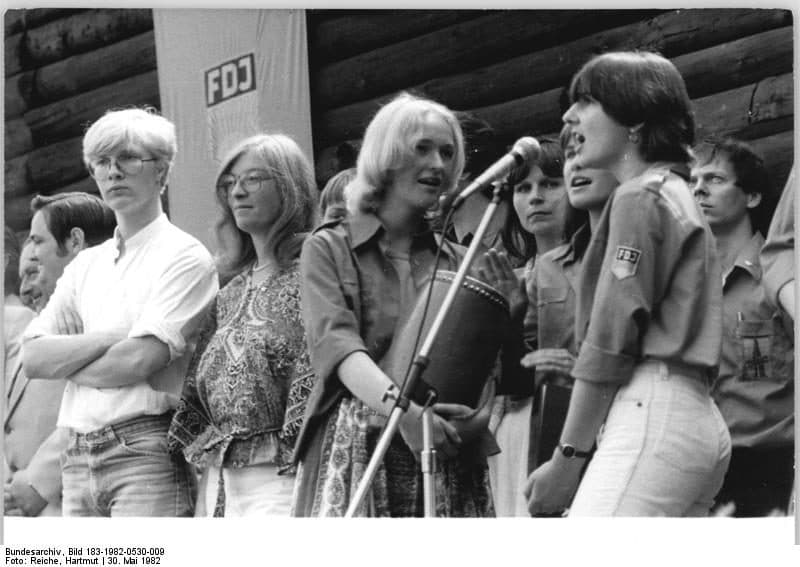
Young people of the East German FDJ singing at a microphone during a Whitsun youth rally at the Seelow Heights Memorial, 1982
An FDJ youth rally at the memorial, Whitsun 1982. Photo: Bundesarchiv, Bild 183-1982-0530-009 / Reiche, Hartmut / CC-BY-SA 3.0

From Soviet monument to museum

In May 1945 Marshal Zhukov commissioned the sculptors Lev Kerbel and Vladimir Tsigal to make monuments in Berlin’s Tiergarten, in Küstrin and in Seelow, marking his front’s road from the Oder to Berlin. The Seelow monument and a cemetery for 66 Red Army soldiers were unveiled on 27 November 1945, among the first memorials the Soviet Union built outside its own territory. In East Germany it became a place for wreath-layings, party admissions, army oath ceremonies and youth rallies, and in 1972 it was enlarged into the ‘Memorial of Liberation on the Seelow Heights’, with more graves and a museum shaped like the command bunker Zhukov used on the Reitwein spur.

The exhibition told the Soviet story alone. Its ideological texts were taken down in 1990, and the 1995 exhibition swung the other way, presenting German soldiers mainly as victims. The current exhibition, opened in December 2012, covers the battle, its aftermath and the memorial’s own changing history.

Plan your visit

Visiting the Seelow Heights Memorial

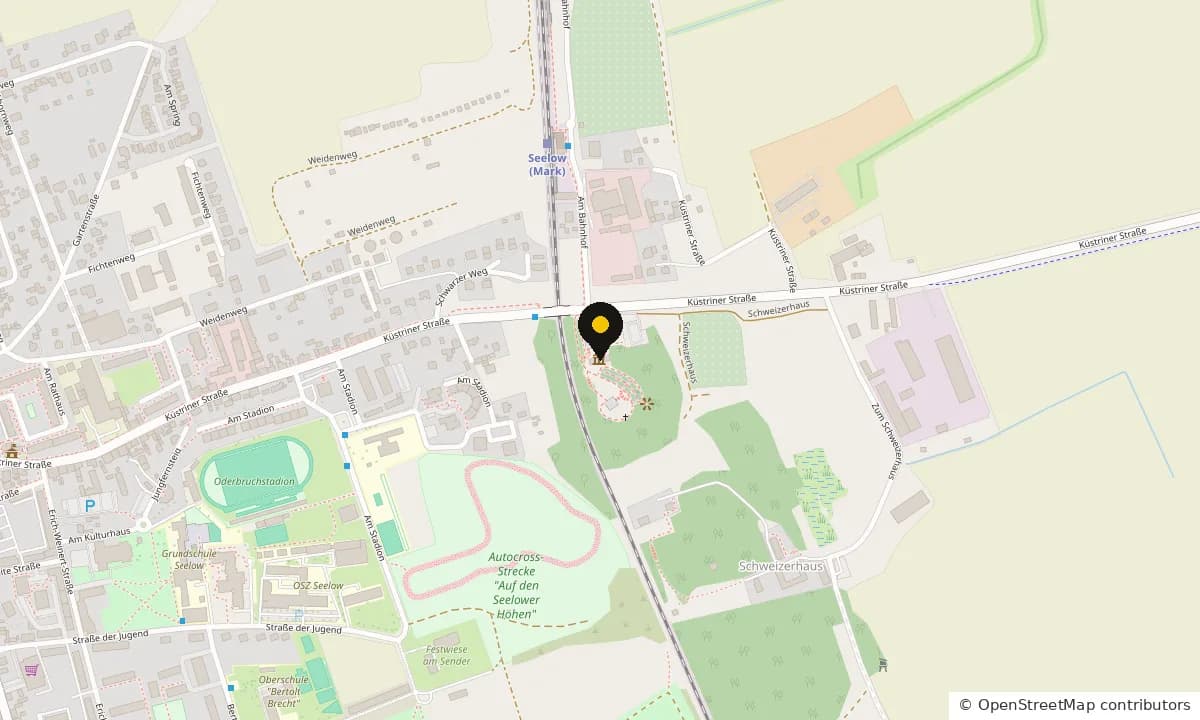
Map of the streets around the Seelow Heights Memorial, with a pin on the siteOpen in Google Maps

Küstriner Straße 28a, 15306 Seelow · Outdoor memorial and grounds: open at all times. Museum: Tuesday–Sunday and public holidays 11:00–16:00, last entry 15:30; closed on Mondays.

Getting there

  • RE1RB60Seelow (Mark)About 2 h from Hauptbahnhof, then 5 min on foot

    Take the RE1 from Hauptbahnhof, Alexanderplatz or Ostkreuz to Frankfurt (Oder) and change to the RB60 towards Eberswalde. Seelow (Mark) station is across Küstriner Straße from the memorial. A Berlin ABC ticket does not reach Seelow: buy a VBB ticket to Seelow or use the Deutschlandticket.

  • RB26Bus 958Seelow-GusowAbout 1 h 25 min from Lichtenberg

    The RB26 from Lichtenberg towards Kostrzyn reaches Seelow-Gusow in under an hour. Bus 958 runs into Seelow (then a 20-minute walk), or change at the Busbahnhof for buses 956 or 969 to the Gedenkstätte stop. Buses are infrequent and some run only on schooldays, so check the VBB planner; the walk from Seelow-Gusow is about 4 km.

  • B1Visitor car park, lower levelAbout 1 h 15 min from central Berlin

    Follow the B1 east from Berlin to Seelow; the memorial is on Küstriner Straße on the way out of town towards Küstrin-Kietz. Drivers with limited mobility can set down on the forecourt; disabled parking is on the lower level.

What you’ll see

  • Lev Kerbel’s 1945 bronze Soviet soldier above the graves of Red Army soldiers, and from the ‘Platz der Ruhe’ the view east across the Oderbruch, the battlefield, towards Küstrin (Kostrzyn).
  • The museum, built in 1972 in the shape of Marshal Zhukov’s command bunker: a 200 m² exhibition in German and English with maps, eyewitness interviews and the film ‘Schlachtfeld vor Berlin’ (‘Battlefield before Berlin’).
  • Soviet tanks, guns and a Katyusha rocket launcher on the forecourt, and eleven information boards in German, Russian and English that explain when each object was put up and why.

Tips from a guide

  • Download the memorial’s free English audio guide from its website before you go: the numbers on the outdoor boards match its chapters. It dates from 2012 and the memorial itself says parts are out of date.
  • Trains and buses are infrequent, so plan your return before you set out, and remember the museum is closed on Mondays and shuts at 16:00 (the grounds stay open).
  • Climb to the top terrace behind the statue for the view: the flat, open ground below is what Zhukov’s troops had to cross on 16 April 1945.

Accessibility

The memorial says there is a step-free route from the forecourt to the visitor centre, the museum and the outdoor grounds. Drivers with limited mobility can set down on the forecourt, and disabled parking is on the lower level. Holders of a German disability card (50% or more) pay the reduced price of €3, and a companion with mark B goes free.

Timeline

From battlefield to memorial

  1. 31 Jan 1945The Soviet 5th Shock Army forms the first bridgehead over the Oder, at Kienitz.
  2. 23 Mar 1945Soviet armies link their bridgeheads either side of Küstrin.
  3. 16 Apr 1945A pre-dawn barrage opens the Berlin offensive; the attack stalls below the heights.
  4. 17 Apr 1945Luftwaffe pilots fly self-sacrifice missions against the Oder bridges.
  5. 18 Apr 1945Seelow falls; Soviet troops reach the third and last German line.
  6. 19 Apr 1945The last line breaks and the German 9th Army is split in three.
  7. 20 Apr 1945Soviet artillery begins shelling Berlin, on Hitler’s 56th birthday.
  8. 27 Nov 1945Kerbel’s monument and a cemetery for 66 Red Army soldiers are unveiled.
  9. 1972East Germany enlarges the site into a ‘Memorial of Liberation’ with a museum.
  10. 1995A new exhibition replaces the East German one.
  11. Dec 2012The current permanent exhibition opens.

See it with a historian

Tours that stop at the Seelow Heights Memorial

The boards explain the memorial; a guide can explain the battle it marks, and follow the Red Army from the Oder to the Reichstag.

The Battle Of Berlin Tour - Berlin Experiences
Full Day6 Hours

The Battle Of Berlin Tour

Private 6-hour van tour of the 1945 battlefield, from the outskirts to the Reichstag, for up to 6 people. Starts at your hotel.

€1,000up to 6
View Tour

Why this tour

Where the breakthrough at Seelow led: the race to the Reichstag through Berlin itself.

See the Battle Of Berlin Tour

Questions visitors ask

Frequently asked questions

Where are the Seelow Heights?

On the western edge of the Oderbruch valley around the town of Seelow in Brandenburg, about 70 km east of central Berlin (some 90 km by road) and 16 km from the Polish border at Kostrzyn. The memorial is on Küstriner Straße, opposite Seelow (Mark) station.

What happened at the Battle of the Seelow Heights?

From 16 to 19 April 1945, Marshal Zhukov’s 1st Belorussian Front, close to a million men, attacked the German 9th Army dug in on the heights, about 90,000–110,000 men. Zhukov planned to break through in two days; it took four, and opened the road to Berlin. The memorial calls it the largest battle of the Second World War on German soil.

How many soldiers died at the Seelow Heights?

Estimates vary widely. Soviet dead are put at anything from 5,000–6,000 killed and missing (Aleksey Isaev, from Soviet archives) to just over 30,000 (Antony Beevor, Max Hastings), with some sources above 35,000; German dead at about 12,000.

Who won the Battle of the Seelow Heights?

The Red Army. It broke the last German line on 19 April 1945, split the 9th Army in three and began shelling Berlin the next day. The cost and the two days lost made it one of the most debated battles of Zhukov’s career.

Is the Seelow Heights Memorial free?

The outdoor memorial, the cemetery and the visitor centre are free. The museum costs €5, or €3 reduced; under-18s go free, and a combined ticket with the Brecht-Weigel-Haus in Buckow costs €8.

How do I get to the Seelow Heights from Berlin?

By regional train: the RE1 to Frankfurt (Oder) and the RB60 to Seelow (Mark), about two hours, or the RB26 from Lichtenberg to Seelow-Gusow and a bus. A Berlin ABC ticket is not enough: buy a VBB ticket to Seelow or use the Deutschlandticket. By car it is about 1 h 15 min along the B1.

Is the exhibition in English?

Yes. The museum’s permanent exhibition is in German and English, the outdoor boards are in German, Russian and English, and an English audio guide can be downloaded free from the memorial’s website. Guided group tours in English cost extra and must be booked ahead.

Where can I follow the battle day by day?

Our Battle of Berlin day-by-day account follows the fighting from the opening barrage at the Seelow Heights on 16 April to the surrender of the city on 2 May 1945, and our sister site battleofberlin.com covers each day in depth.

Sources

Facts checked 3 November 2026. Spotted something out of date? Tell us.

Keep exploring

More Featured Experiences.

Every site we write about — 56 landmarks, museums, memorials and lesser-known corners of Berlin. See the full index →

01Walk Through The Brandenburg Gate02Explore The State Museums On Museum Island03Visit The Berlin TV Tower – The Fernsehturm04Cross The Cold War Border At Checkpoint Charlie05Visit The Site Of Adolf Hitler’s Führerbunker06Explore The Reconstructed Berlin Palace07Visit The Reichstag Cupola At Night08Explore The Forum Fridericianum09Shop At The Humboldt University Book Sale10Journey Into The Memorial To The Murdered Jews Of Europe11Step Inside The Neue Wache12Explore The Former Jewish Quarter – Spandauer Vorstadt13Visit The Remains Of The Berlin Wall14Walk Across The Bridge Of Spies15Explore The Topography Of Terror16Climb The Prussian Victory Column – The Siegessäule17Enter The Palace Of Tears – The Tränenpalast18Step Inside The Berlin Olympic Stadium19Explore Erich Mielke’s Office At The Stasi Museum20Walk Along Karl Marx Allee21Visit The Oldest Church In Berlin – The Nikolaikirche22Explore The Berliner Dom23Visit The Grave Of Frederick The Great24Walk Through The Ruins Of Anhalter Bahnhof25Stand On The Platz Des Volksaufstandes26Visit The German Resistance Museum27Visit The Soviet War Memorial In The Tiergarten28See The Georg Elser Memorial On Wilhelmstrasse29Step Inside The Kaiser Wilhelm Gedächtnis Kirche30Visit The Gleis 17 Memorial31Visit The Schloss Charlottenburg Mausoleum32Climb The Französischer Dom at Gendarmenmarkt33Explore The Interbau – IBA 5734Explore The Otto Weidt Workshop35Visit Cecilienhof – Site Of The Potsdam Conference36Visit The Stasi Prison In Hohenschönhausen37Spend The Day At Tempelhof Airport38Ride The Fastest Elevator In Europe39Visit The Soviet War Memorial In Treptower Park40Visit The Sachsenhausen Concentration Camp Memorial41Visit The Ravensbrück Concentration Camp Memorial42Visit Karlshorst – The Site Of The German Surrender43Visit The Socialists Cemetery – Zentralfriedhof Friedrichsfelde44Visit The Soviet War Memorial In Pankow46Visit The Commonwealth War Cemetery47Cross The Bösebrücke At Night48Explore The Allied Museum In Dahlem49Explore The Spandau Citadel50Visit The Brandenburg T4 Euthanasia Memorial51Visit The Wannsee Conference House52Visit The Jewish Museum53Visit The Jewish Cemetery In Weissensee54Walk Along The East Side Gallery55Explore The Volkspark Friedrichshain Flak Tower56Head Up The Teufelsberg