Skip to content
Karl-Marx-Allee in Berlin under an orange sky, looking east from Strausberger Platz along the boulevard to the domed towers of Frankfurter Tor

Berlin Experiences/Featured Experiences

Karl-Marx-Allee: Walk Berlin’s Former Stalinallee

The former showcase street of East Germany – Stalinallee.

The short answer

Karl-Marx-Allee is East Berlin’s monumental post-war boulevard, built in the 1950s as Stalinallee and renamed in 1961. Its showpiece stretch runs for just under 2 km through Friedrichshain, from Strausberger Platz east to the twin domed towers of Frankfurter Tor, lined with tiled ‘workers’ palaces’. It is a public street, so it is free and open at all hours, and the U5 stops at Strausberger Platz, Weberwiese and Frankfurter Tor. Walking it takes about 25 minutes without stopping, or an hour or so with time to look.

Where
Strausberger Platz to Frankfurter Tor, 10243 Berlin-Friedrichshain
Open
Always: a public street
Admission
Free
Time needed
About 1 hour on foot (just under 2 km)
Nearest station
U5 Strausberger Platz, 4 minutes on foot
Step-free
Yes: wide, level pavements

The story · by Matt Robinson

The Cold War-era ideological conflict between East and West, as played out in the divided German capital, was largely a matter of guns, tanks and missiles. But more subtle forms of confrontation – clandestine espionage operations, symbolic public diplomacy, and various soft power techniques.

The proximity of these conflicting systems – the free-market-capitalist West and state-controlled-socialist East – existing, as they did, cheek-by-jowl in Berlin, presented the opportunity for both to impress upon the world the values and ideas that each side held so dearly. But also supersede each other; through the undertaking of bold flagship projects and use of propaganda to express the supposed superiority of those values.

Nowhere more evident is the extent of this conflict now visible than in the architectural traces of this era still scattered across the city.

At the end of the Second World War, with the German capital in a terrible state of ruin, both East and West would seek to address one of the chief issues of post-war society – that of the lack of housing. And in their own ways, channel their values into the types of accommodation introduced.

In East Berlin, this would mean the construction of a monumental boulevard – named after Soviet leader, Joseph Stalin.

Rebuilding Berlin

On May 19th, 1945, just over two weeks after the surrender of the city and nearly two months before the arrival of the British and American occupation forces, the Soviet Administration in Berlin established a magistrate to oversee the whole area of Greater Berlin. This body would deal with questions of reconstruction and infrastructure; tasked with bringing life back to the ruined city.

In his capacity as head of the building and housing department, architect Hans Scharoun (later responsible for construction of the West Berlin Philharmonic) would present his plans for the collective urban redevelopment of Berlin one year later, in the ruins of the Berlin City Palace. The concept was utopian, with social harmonisation through improved living standards; in opposition to the Industrial Revolution tenements that were to be found throughout Berlin up to this point, and based on continued cooperation between the Allied occupation powers.

Goethe’s lines from Faust, ‘Solch ein Gewimmel möcht ich sehn…’, carved in stone above the windows of a building on Karl-Marx-Allee in Berlin
Goethe’s Faust, carved into a Karl-Marx-Allee façade.

As animosity between East and West increased, Scharoun’s grand plan foundered.

What would follow it, in the East, would be less comprehensive – far from seeking to completely re-order the entire city – but come to be more cost-efficient in its purpose. A specific project that would represent the social, political, and philosophical outlook of the East German state – a wide boulevard leading into the heart of the city, lined with grand structures, and designed in such a way as to impress upon the visitor the magnificence of the people and politics responsible.

Ironically for the East, the focus would not be on increasing the overall living standards of the population – but on symbolic prestige projects to express the ideological direction of the state and society.

Hermann Henselmann and the Weberwiese

Rather than import architects from the Soviet Union, the East German government would however rely on a collection of homegrown names to lead this project and ensure a characteristic Socialist style. Chief amongst them the man who would be appointed head architect for all of East Berlin in 1953 and later provide the plans for the city’s most visible prestige project – the TV Tower – Hermann Henselmann.

Henselmann would contribute the first building in the street’s new style, the Hochhaus an der Weberwiese – not only the first skyscraper constructed in East Berlin but also the first example of Socialist Classicism in the German Democratic Republic.

…“returning to national traditions”…

This building had been proposed earlier, as part of the overall combined reconstruction effort that Hans Scharoun had submitted in 1946, for the district of Friedrichshain. Scharoun’s aim to implement a model of New Objectivity, reminiscent of the design styles of the 1920s and 1930s, would be rejected by the East German state as decadent and elitist – instead Henselmann would be assigned the job of redesigning the structure and “returning to national traditions” by channeling the work of Neo-Classical architect, Karl Friedrich Schinkel, in a distinctly Soviet Socialist style.

This structure would serve as the prototype for the entire aesthetic of East Berlin’s epic boulevard.

Palaces for the workers

Monumental eight-storey structures, designed in what is colloquially known as ‘Wedding Cake style’, line this two kilometre street that stretches from the twin towers at Frankfurter Tor to the square at Strausberger Platz – and beyond to Alexanderplatz. Many of the buildings are covered in ceramic tiles, some feature balconies, others Doric or Ionic columns, ornamental gables with architraves and friezes. The modern amenities available, such as indoor plumbing, central heating, and an intercom system meant that these ‘workers’ palaces’ would prove popular with East German citizens and were intended to represent the strength and engineering skills of the German Democratic Republic as much as its ideological leanings.

Tiled façade of a ‘wedding cake style’ apartment block on Karl-Marx-Allee in Berlin, with ceramic rosettes and yellow balconies
Ceramic tiles and balconies on Karl-Marx-Allee.

When construction began in 1952, government film crews were dispatched to cover the immense popular effort made by Berliners who would help clear rubble from the area in preparation for the project.

From Stalinallee to Karl-Marx-Allee

Originally named Stalinallee in 1949, the street would be renamed in 1961 as part of the de-Stalinization process in the East – instead since called Karl-Marx-Allee.

Following Stalin’s death in 1953, many East Germans had taken to the streets of the country to protest against increased work quotas and attempts by the government to accelerate the path towards ‘true socialism’. The workers on Stalinallee chose to lay down their tools and march on the government headquarters, only to face Soviet tanks a day later on 17th June 1953.

While the image projected here during the Cold War era was one of a prosperous state that sought to provide for its citizens and offered spacious and appealing accommodation, the reality was often much different – for millions of other East Germans who lived in prefabricated Plattenbau or dilapidated pre-war housing. Beyond the cinemas (Kosmos and International), the restaurants (such as Cafe Moscow) that offered regional cuisine of the Socialist sister states, and the sparkling historicist facades of this impressive project. The military parades, the diplomatic routes that would pass along this street, and the sporting events held here, would only serve to further highlight the absurd reality.

The Café Moskau on Karl-Marx-Allee in Berlin, with its Sputnik replica on the roof, the ‘Moskau’ lettering and the mosaic beneath
Café Moskau, with its Sputnik on the roof.

The state and East German society was slowly crumbling, under the weight of its own ideological failings.
Karl-Marx-Allee in detail

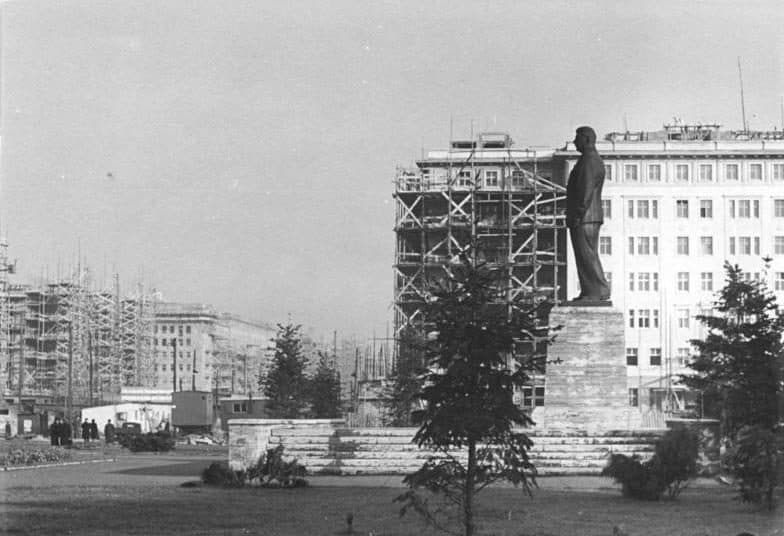
The Stalin monument on Stalinallee in Berlin in autumn 1952, with the scaffolded apartment blocks of the new boulevard behind it
Autumn 1952: the Stalin monument, with Block C-Süd under construction behind it. Photo: Bundesarchiv, Bild 183-16877-0003 / Weiß, Günter / CC-BY-SA 3.0

Building Stalinallee

The first new homes on the street were modern ones: two deck-access blocks (Laubenganghäuser) built in 1949–50 at today’s Nos. 102–104 and 126–128, designed by Ludmilla Herzenstein’s team on the lines of Scharoun’s plan. Within a year they were out of favour. The party now wanted the Soviet-approved ‘national tradition’, Henselmann’s Hochhaus an der Weberwiese (1951–52) set the pattern, and a 1951 competition was won by Egon Hartmann, who drew up the final plan with Richard Paulick, Hanns Hopp, Karl Souradny and Kurt W. Leucht.

Prime Minister Otto Grotewohl laid the foundation stone on 3 February 1952. Tens of thousands of volunteers cleared rubble and put in more than four million unpaid hours in 1952 alone. One incentive was a lottery: 100 three-hour shifts earned a ticket, and the winners got a flat. The first 70 households moved in on 7 January 1953, to a great deal of propaganda.

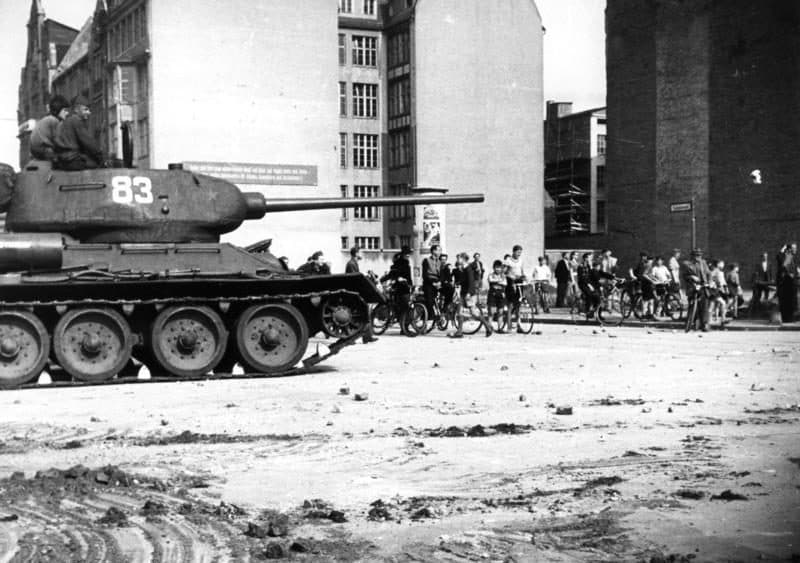
A Soviet T-34 tank on Schützenstraße in East Berlin on 17 June 1953, watched by a crowd of people with bicycles
A Soviet tank on Schützenstraße, East Berlin, 17 June 1953. Photo: Bundesarchiv, B 145 Bild-F005191-0040 / CC-BY-SA 3.0

17 June 1953: the uprising that began here

On 28 May 1953 the East German government raised work norms by at least 10 per cent, in effect a pay cut, and a resolution from the Stalinallee builders asking for it to be withdrawn was ignored. At about 8:30 on 16 June, some 80 builders from Block 40 set off down the street. By 9:30 there were about 2,000. They marched via Strausberger Platz and Alexanderplatz to the House of Ministries on Leipziger Straße, where more than 10,000 people gathered and called for a general strike.

The next day there were strikes and protests in more than 700 places across East Germany. Soviet tanks rolled into East Berlin from late morning, shooting began around midday and the Soviet authorities imposed a state of emergency. At least 55 people were killed across the country, hundreds were badly injured and thousands were sent to prison. East Germany called it a fascist putsch steered from the West; West Berlin renamed the road through the Tiergarten Straße des 17. Juni.

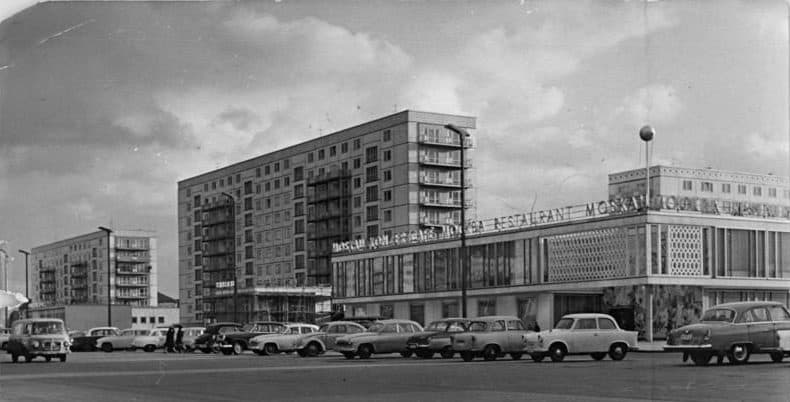
Karl-Marx-Allee in East Berlin in February 1964, with the new Restaurant Moskau and prefabricated slab blocks of the second section
The second section in February 1964, with the new Restaurant Moskau on the right. Photo: Bundesarchiv, Bild 183-C0211-0006-001 / Weiß / CC-BY-SA 3.0

The second section and the street today

By the late 1950s the ornate style had fallen out of favour in Moscow as too slow and too expensive. The second section, west from Strausberger Platz to Alexanderplatz, was built from 1959 in prefabricated concrete panels, with long slab blocks set back from the road and low pavilions in front: the Kino International (1961–63) and Café Moskau (1961–64), both by Josef Kaiser’s team. The Kino Kosmos (1961–62) went up on the eastern stretch. From the 1970s until 1989 the National People’s Army held its parades along the street.

The whole post-war ensemble is now a listed monument. After 1990 most of the blocks were sold to investors and restored; in 1999–2000 the old tiles were replaced with tile-clad panels, and many of those have fallen off since 2007. In 2023 a bid to put Karl-Marx-Allee on Germany’s World Heritage tentative list, together with West Berlin’s Interbau 1957 in the Hansaviertel, was turned down.

Plan your visit

Visiting Karl-Marx-Allee

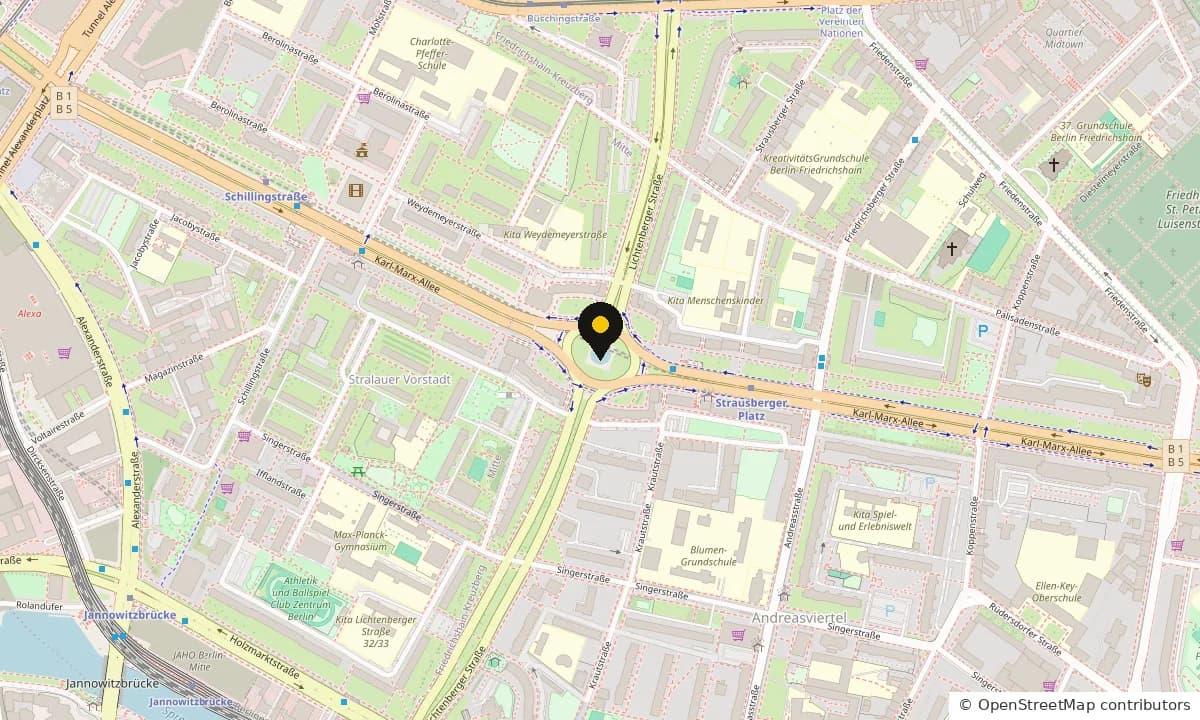
Map of the streets around Karl-Marx-Allee, with a pin on the siteOpen in Google Maps

Karl-Marx-Allee / Strausberger Platz, 10243 Berlin · Open 24 hours, every day

Getting there

  • U5Strausberger Platz250 m · 4 min

    The western end of the Stalin-era section. Start at the fountain and walk east.

  • U5Weberwiese1 km · 14 min

    Halfway along. The Hochhaus an der Weberwiese, the prototype for the whole street, is just south of the station on Marchlewskistraße.

  • U5Tram M10Frankfurter Tor1.8 km · 24 min

    The eastern end, under Henselmann’s domed towers: walk the street the other way, west towards the TV Tower.

What you’ll see

  • Strausberger Platz, with Fritz Kühn’s fountain and Hermann Henselmann’s pair of tower blocks marking the start of the Stalin-era boulevard.
  • Almost 2 km of seven- to nine-storey ‘workers’ palaces’ with tiled façades, balconies, columns and carved friezes, lit by reconstructions of Richard Paulick’s original street lamps.
  • The twin domed towers of Frankfurter Tor at the eastern end, designed by Henselmann and built in 1957–60 as the boulevard’s gateway.

Tips from a guide

  • Walk west to east, from Strausberger Platz to Frankfurter Tor, and take the U5 back: the three stations are spaced along the street.
  • Stop at Café Sibylle (No. 72), which has a free exhibition on the street’s history, including what is left of the Stalin statue.
  • These are people’s homes. Photograph the façades rather than the windows, and use the signal crossings: the road is six lanes wide.

Accessibility

The pavements along Karl-Marx-Allee are wide, level and step-free, and there are benches along the way. Crossing the road means using the signal crossings. BVG lists a lift at U Strausberger Platz; check the BVG website for lift status at Weberwiese and Frankfurter Tor before you go. Café Sibylle has steps at its entrance.

Timeline

From Stalinallee to Karl-Marx-Allee

  1. Aug 1946Hans Scharoun presents his collective plan for rebuilding Berlin.
  2. 21 Dec 1949The street is renamed Stalinallee for Stalin’s 70th birthday.
  3. 1949–50The first new homes, two modern deck-access blocks, are built.
  4. 3 Aug 1951A 4.8-metre bronze statue of Stalin is unveiled on the street.
  5. 1951–52Henselmann’s Hochhaus an der Weberwiese sets the style for the street.
  6. 3 Feb 1952Otto Grotewohl lays the foundation stone of the first section.
  7. 7 Jan 1953The first 70 households move into the new flats.
  8. 16–17 Jun 1953Builders from Block 40 strike; Soviet tanks crush the uprising.
  9. 1959Work begins on the second section, in prefabricated panels.
  10. 13 Nov 1961Renamed Karl-Marx-Allee; the Stalin statue is pulled down that night.
  11. 1989The last National People’s Army parade passes along the street.

See it with a historian

Tours that stop at Karl-Marx-Allee

The street is easy to walk alone; a guide can tell you who lived behind the façades, what happened here in June 1953 and how the showcase compared with the rest of East Germany.

One hour on the showcase street of East Germany, from Alexanderplatz to the Stalin-era blocks.

The Karl Marx Allee Tour
One Hour1 Hour

The Karl Marx Allee Tour

Private 1-hour walking tour of East Berlin's showcase boulevard for up to 10 people. Starts at the World Clock on Alexanderplatz.

€200up to 10
View Tour

A full day on life in East Germany, from the socialist showpieces to the Stasi.

The Berlin Wall Tour - Berlin Experiences
Full Day6 Hours

The Republic Of Fear

Private 6-hour van tour of East Berlin, the Stasi and life behind the Wall for up to 6 people. Starts at your hotel.

€1,000up to 6
View Tour

Berlin’s whole story in one day, with the East Berlin boulevard as one of its stops.

The Berlin History Tour
Full Day6 Hours

The Berlin History Tour

Private 6-hour van tour of Berlin's whole history in one day for up to 6 people. Starts at your hotel or anywhere in the city.

€1,000up to 6
View Tour

Questions visitors ask

Frequently asked questions

Why is Karl-Marx-Allee famous?

It was East Germany’s showcase street: a monumental boulevard of ‘workers’ palaces’ built in the 1950s as Stalinallee, meant to show that socialism could house people better than the West. It is also where the uprising of 17 June 1953 began, when its builders went on strike.

What was Karl-Marx-Allee called before?

Before 1949 it was Große Frankfurter Straße. It was renamed Stalinallee on 21 December 1949, for Stalin’s 70th birthday, and became Karl-Marx-Allee on 13 November 1961, during de-Stalinisation.

How long does it take to walk Karl-Marx-Allee?

The Stalin-era section from Strausberger Platz to Frankfurter Tor is just under 2 km: about 25 minutes without stopping, or an hour or so with time to look. The whole street runs on west to Alexanderplatz, almost 3 km in all.

Where should I start a walk along Karl-Marx-Allee?

At Strausberger Platz (U5), walking east to Frankfurter Tor (U5), so the domed towers are ahead of you all the way. From Alexanderplatz you can add the 1960s second section first.

What happened on Stalinallee on 17 June 1953?

On 16 June builders on the street struck against higher work norms and marched to the government’s House of Ministries. The next day protests spread across East Germany and were crushed by Soviet tanks; at least 55 people were killed.

Is the Stalin statue still on Karl-Marx-Allee?

No. The 4.8-metre bronze statue was pulled down in the night of 13 to 14 November 1961, when the street was renamed. Café Sibylle at No. 72 displays what is shown as its ear and part of the moustache.

Can you go inside the buildings?

The flats are private homes, but the ground floors hold cafés, shops and Café Sibylle, whose exhibition on the street is free. Café Moskau is now an events venue and opens only for events.

Are there tours of Karl-Marx-Allee?

Yes. Our Karl Marx Allee Tour walks the street from Alexanderplatz, and the Republic of Fear and Berlin History tours include it; a guide can explain what you are looking at and what happened here.

Keep exploring

More Featured Experiences.

Every site we write about — 56 landmarks, museums, memorials and lesser-known corners of Berlin. See the full index →

01Walk Through The Brandenburg Gate02Explore The State Museums On Museum Island03Visit The Berlin TV Tower – The Fernsehturm04Cross The Cold War Border At Checkpoint Charlie05Visit The Site Of Adolf Hitler’s Führerbunker06Explore The Reconstructed Berlin Palace07Visit The Reichstag Cupola At Night08Explore The Forum Fridericianum09Shop At The Humboldt University Book Sale10Journey Into The Memorial To The Murdered Jews Of Europe11Step Inside The Neue Wache12Explore The Former Jewish Quarter – Spandauer Vorstadt13Visit The Remains Of The Berlin Wall14Walk Across The Bridge Of Spies15Explore The Topography Of Terror16Climb The Prussian Victory Column – The Siegessäule17Enter The Palace Of Tears – The Tränenpalast18Step Inside The Berlin Olympic Stadium19Explore Erich Mielke’s Office At The Stasi Museum21Visit The Oldest Church In Berlin – The Nikolaikirche22Explore The Berliner Dom23Visit The Grave Of Frederick The Great24Walk Through The Ruins Of Anhalter Bahnhof25Stand On The Platz Des Volksaufstandes26Visit The German Resistance Museum27Visit The Soviet War Memorial In The Tiergarten28See The Georg Elser Memorial On Wilhelmstrasse29Step Inside The Kaiser Wilhelm Gedächtnis Kirche30Visit The Gleis 17 Memorial31Visit The Schloss Charlottenburg Mausoleum32Climb The Französischer Dom at Gendarmenmarkt33Explore The Interbau – IBA 5734Explore The Otto Weidt Workshop35Visit Cecilienhof – Site Of The Potsdam Conference36Visit The Stasi Prison In Hohenschönhausen37Spend The Day At Tempelhof Airport38Ride The Fastest Elevator In Europe39Visit The Soviet War Memorial In Treptower Park40Visit The Sachsenhausen Concentration Camp Memorial41Visit The Ravensbrück Concentration Camp Memorial42Visit Karlshorst – The Site Of The German Surrender43Visit The Socialists Cemetery – Zentralfriedhof Friedrichsfelde44Visit The Soviet War Memorial In Pankow45Visit the Seelow Heights Memorial46Visit The Commonwealth War Cemetery47Cross The Bösebrücke At Night48Explore The Allied Museum In Dahlem49Explore The Spandau Citadel50Visit The Brandenburg T4 Euthanasia Memorial51Visit The Wannsee Conference House52Visit The Jewish Museum53Visit The Jewish Cemetery In Weissensee54Walk Along The East Side Gallery55Explore The Volkspark Friedrichshain Flak Tower56Head Up The Teufelsberg