Skip to content
The nave of the Nikolaikirche in Berlin: white pillars, Gothic vaults and a long lit display case leading to the choir

Berlin Experiences/Featured Experiences

Nikolaikirche: Visit Berlin’s Oldest Church in the Nikolaiviertel

The oldest building in Berlin’s historic Mitte district.

The short answer

The Nikolaikirche (St Nicholas’ Church) is Berlin’s oldest surviving church building, begun around 1230 at the heart of the Nikolaiviertel in Berlin-Mitte, five minutes’ walk from Rotes Rathaus station. It has not been a church since 1938: wrecked in the Second World War and rebuilt by East Germany for the city’s 750th anniversary in 1987, it is now a museum of the Stadtmuseum Berlin about the building and medieval Berlin. Entry is €7 and free for under-18s, and it is open every day, usually 10:00–18:00. Allow 45 minutes to an hour.

Where
Nikolaikirchplatz, 10178 Berlin-Mitte (Nikolaiviertel)
Open
Daily 10:00–18:00; Thursdays 12:00–20:00 until 18 April 2027
Admission
€7; free under 18; €15 combi ticket for three museums
Time needed
45–60 minutes
Nearest station
U5 Rotes Rathaus, 5 minutes on foot
Step-free
Mostly: the nave and choir yes; the coin cabinet, sacristy, organ loft and toilet have steps

The story · by Matt Robinson

The unusually charming Berlin Kiez of the Nikolaiviertel, with its cobbled streets, jaunty Plattenbau, and imposing twin-spired Nikolaikirche, bears the distinction of being one of the oldest areas of the city’s central Mitte district. Dating back to the early 1200s, when the settlement of Alt-Berlin was recognised here – on the northern bank of the meandering river Spree.

The medieval settlement of Cölln, situated on the opposing southern bank of the river would come to be considered the birthplace of the city – dating as it does back to 1237 – seven years older than its sister settlement across the water. The site of the grandiose Stadtschloss occupied by the Hohenzollern royal family, Cölln would unite with the more residential Alt-Berlin in 1710 to form the capital of the Kingdom of Prussia.

While the Nikolaiviertel can boast of a long and colourful history, it is an area that suffered greatly during the bombardment of Berlin by the Anglo-American forces in WWII – situated as it was in the heart of the then Nazi capital. What is visible today is a reconstructed district, an emulation of this medieval quarter courtesy of the East German government – referred to by locals as the “Disneyland of the East”. Rebuilt in 1987 in a distinctly kitsch postmodernist style – with the deconsecrated Nikolaikirche, the oldest church in Berlin, at its centre.

Baroque angels and altar figures around the altar wall inside the Nikolaikirche in Berlin
Baroque figures from the church’s old altar, back in the choir.

From basilica to ruin

Originally a late-Romanesque basilica, the Nikolaikirche – as with all churches in the area – was conceived as a Roman Catholic place of worship. At the time of the construction of the church – before this region was known as Germany, or Prussia – or even the city of Berlin recognised – it would lie in the territory of the Margraviate of Brandenburg. An area simultaneously ruled over by two brothers – John I and Otto III – allied with the powers in Rome. During their joint-reign; John and Otto would increase the power of this region, from a seemingly insignificant sandy backwater settlement, to acquire the indisputable right to vote in the election of the King of the Germans, consolidating their joint role within the Holy Roman Empire.

When this region officially embraced the ideas of the Protestant Reformation in 1539, the Nikolaikirche would be converted for use by a Lutheran congregation. It would serve in this capacity for a further 399 years – when in 1938, five years after the Nazi takeover, it was deconsecrated due to the declining number of parishioners in the area. The industrialisation of Berlin and the commercialisation of the centre of the city had driven many people into the suburban districts, leaving the church largely isolated in the centre of the capital.

Looking down into the side aisle of the Nikolaikirche in Berlin from the organ loft, with brick pillars and exhibition cases
The side aisle and exhibition, seen from the organ loft.

When the Second World War in Europe ended in May 1945, the Nikolaiviertel fell into the hands of the Soviet administration, eventually becoming part of East Berlin – and the German Democratic Republic, in 1949. As a result of the damage inflicted on the area during the war – the Nikolaikirche was reduced to the solitary stump of the tower circled by a few surviving surrounding walls. Until eventually, in 1981, the East German regime began to reconstruct the building based on old plans.

A church turned museum

Stepping inside the Nikolaikirche today, visitors are greeted with an exhibition maintained by the Museum der Stiftung Stadtmuseum Berlin – which has been responsible for the use of the church as an exhibition space since 1995. A permanent display tracing the origin and use of the church over the past 800 years, under the title ‘From City Ground to Double Head’ (in reference to the two church spires), has been in place since 2010, when it was opened by then Berlin mayor, Klaus Wowereit.

Painting of the Raising of Lazarus with German inscriptions, hanging in the Nikolaikirche in Berlin
The Raising of Lazarus, one of the old paintings back in the church.

Beyond serving as an exhibition space, the church has also fulfilled other duties. Following the reunification of Germany, and Berlin, in 1990, the first constituent meeting of the newly elected Berlin House of Representatives took place here on January 11th 1991. Its central hall is also used as an auditorium for musical performances, with space for around 250 people.

…the church’s current appearance is nothing like it would have looked back in 1230.

While the interior of the church maintains its mixed Gothic and Baroque style, the structural changes to the exterior of the church do much more to clarify the story of the many different construction periods of the building. Although, it is considered the oldest church in the city – the church’s current appearance is nothing like it would have looked back in 1230.

Reading the walls

It was only fitting in the 13th century that when constructed the Nikolaikirche would be named after Saint Nicholas of Myra, the patron saint of sailors and merchants – due to its location in the maritime centre of old Berlin. While the use of the area has changed drastically since that time, the church still stands as evidence of the many eras it has endured. With its exterior form capable of being read like the pages of a book.

With its exterior form capable of being read like the pages of a book.

The distinctive two spires that tower over the grey fieldstone base of the building – the oldest part of this structure dating back to the Romanesque period – were not originally included in the first form of the building. Instead there was a single spire, as is typical of most churches, to the right side. The Gothic hall was added behind this section of the building, following a fire, in 1470 – and financed by the sale of a 40-day indulgence to anyone who contributed to its construction – while the Berlin Bakers Guild donated an altar.

When reconstruction work was carried out in the 1980s by the East German government, a collection of graves (around 150) were found beneath the Nikolaikirche – providing important insight into the founding of Berlin. These West-East orientated graves, identifiably Christian, would suggest that rather than being conjured into existence by a single legal decree that Berlin evolved around this site – with the area surrounding the Nikolaikirche as the epicentre of what would grow to be recognised as medieval Berlin.
The Nikolaikirche in detail

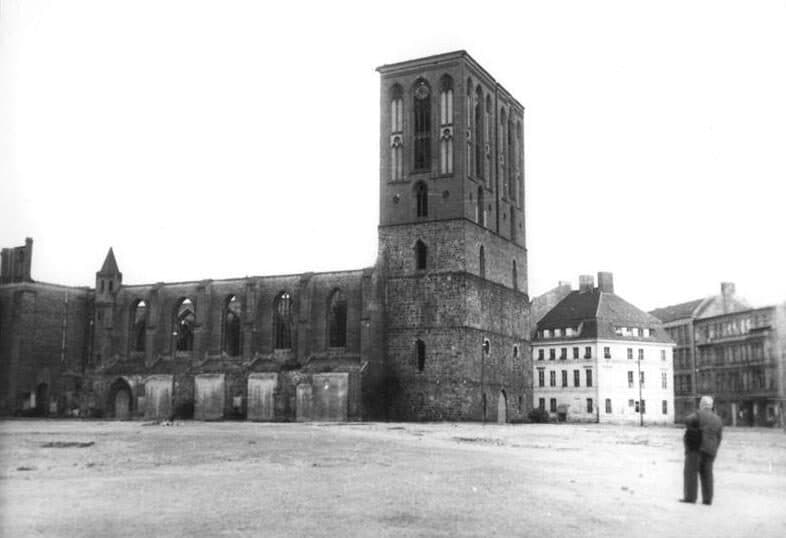
The ruined Nikolaikirche in East Berlin in 1955: the roofless tower and outer walls standing on a cleared site
The ruin in August 1955: the tower stump and outer walls on open ground. Photo: Bundesarchiv, Bild 183-G1122-0600-090 / CC-BY-SA 3.0

From ruin to rebuilt landmark

Air raids in 1944 brought down the twin spires that Hermann Blankenstein had added in 1876–78, along with the roof and part of the vaults. A fire at the end of the war gutted the interior, and because the church was never given a temporary roof, all the remaining vaults and the north row of pillars collapsed in 1949. The East German church could not raise the money to rebuild it, and in 1969 the ruin was handed over to the city.

For years the tower stump and outer walls stood almost alone on a cleared site, and demolition was a real possibility. That ended in 1978, when planning for the new Nikolaiviertel began. The church was rebuilt first, from 1980, using old drawings; archaeologists dug beneath it at the same time. On 20 August 1982 a crane lifted the two new copper spires, each assembled on the ground, onto the tower in 35 minutes apiece.

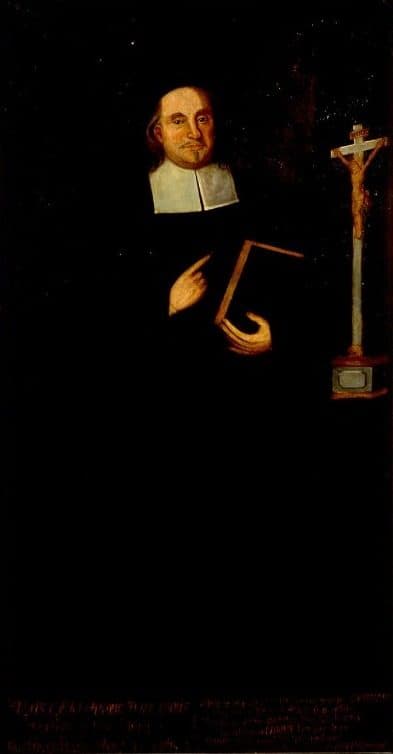
Portrait of the hymn writer Paul Gerhardt in black clerical dress, holding a book, beside a crucifix, painted about 1675
Paul Gerhardt, pastor at the Nikolaikirche from 1657, in a portrait of about 1675. Photo: Unknown artist / Public domain, via Wikimedia Commons

Hymns, councils and a church union

The Nikolaikirche matters to anyone who has sung a German hymn. Johann Crüger, cantor here from 1622 to 1662, wrote the melody of ‘Nun danket alle Gott’ (‘Now Thank We All Our God’) and published the hymns of Paul Gerhardt, who was a pastor here from 1657. Gerhardt, a strict Lutheran, lost his post after refusing to accept the Reformed Elector Frederick William’s edicts on church peace and left in 1667. His hymns, among them ‘O Haupt voll Blut und Wunden’, were later used by Bach.

The church was also a civic stage. On 6 July 1809 Berlin’s first elected city council, created by the Prussian reforms, was sworn in here. On 30 October 1817, the eve of the Reformation’s 300th anniversary, a joint communion of Lutherans and Reformed in the Nikolaikirche sealed the Prussian Union of churches.

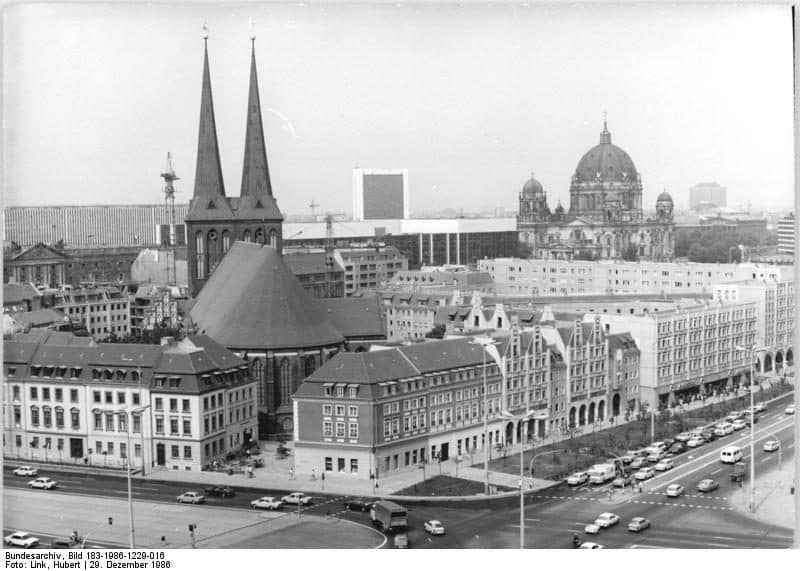
The newly rebuilt Nikolaiviertel in East Berlin in December 1986, with the twin spires of the Nikolaikirche and the Berliner Dom behind
The Nikolaiviertel nearly finished, December 1986, with the Berliner Dom behind. Photo: Bundesarchiv, Bild 183-1986-1229-016 / Link, Hubert / CC-BY-SA 3.0

The Nikolaiviertel: a medieval quarter from 1987

Almost nothing of the old quarter survived the war and the clearances after it. In January 1980 the East German Politburo approved a plan to rebuild it for Berlin’s 750th anniversary, chosen partly because it was cheap and would draw tourists. The architect Günter Stahn won the competition, and his team laid the streets out roughly on the medieval plan, mixing gabled ‘old town’ houses with prefabricated concrete blocks.

Erich Honecker opened the quarter in the Nikolaikirche on 14 May 1987. It had about 800 flats for some 2,000 residents, only sixty of them in traditional brick buildings, plus shops, museums and 22 restaurants and bars. A few buildings are genuine: the Knoblauchhaus survived, the Ephraim-Palais was rebuilt with parts of its original façade a few metres from where it had stood, and the inn Zum Nussbaum is a copy of one that stood on the Fischerinsel.

Plan your visit

Visiting the Nikolaikirche

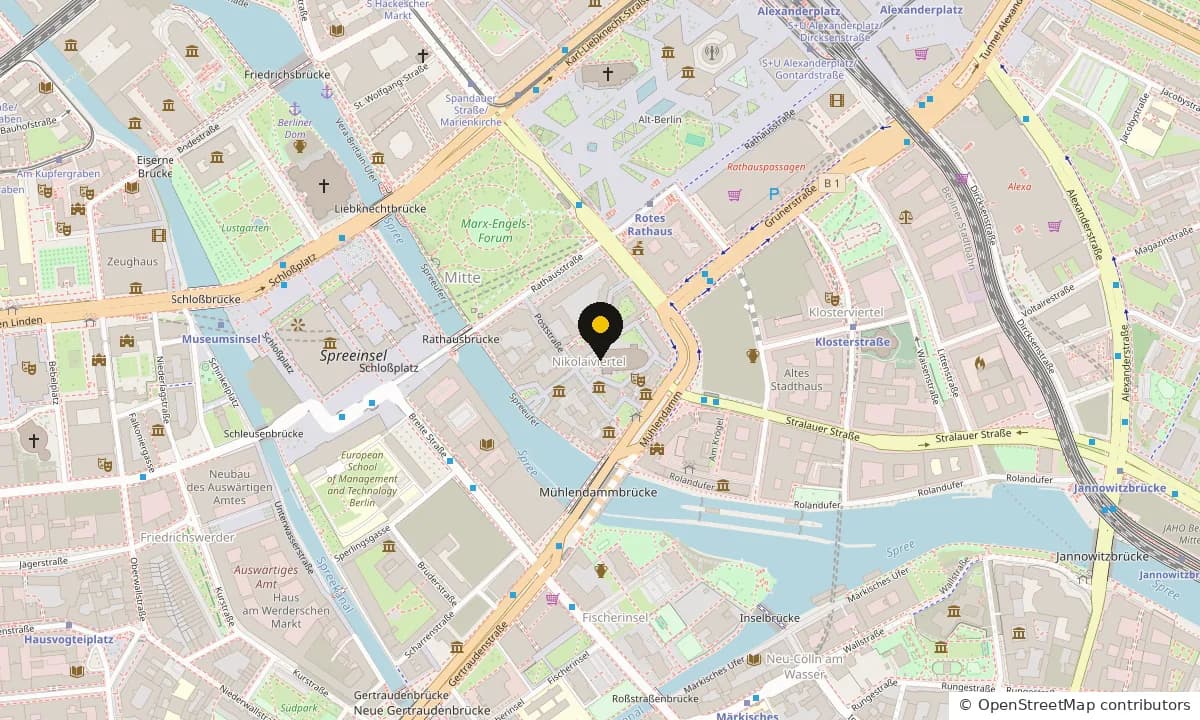
Map of the streets around the Nikolaikirche, with a pin on the siteOpen in Google Maps

Nikolaikirchplatz, 10178 Berlin · Until 18 April 2027: Monday–Wednesday and Friday–Sunday 10:00–18:00, Thursday 12:00–20:00. Otherwise daily 10:00–18:00, public holidays included. Closed on 24 and 31 December.

Getting there

  • U5Rotes Rathaus350 m · 5 min

    Come up by the Red Town Hall, cross Rathausstraße and walk into the Nikolaiviertel along Spandauer Straße.

  • Bus 200U Rotes Rathaus280 m · 4 min

    The stop is by the Red Town Hall; cross Rathausstraße into the Nikolaiviertel.

  • S3S5S7S9U2U5U8Alexanderplatz750 m · 10 min

    Walk past the TV Tower and St Mary’s Church, then across Rathausstraße.

What you’ll see

  • The rebuilt Gothic hall church, with surviving Baroque altar figures, epitaphs and paintings, and the permanent exhibition ‘Berlin’s Middle: 800 Years of History and Culture’, including a large model of the medieval city.
  • An archaeological window onto the walls of the first nave, and the coin hoard from the church tower, sealed into the tower balls between 1514 and 1734.
  • Outside, the grey fieldstone west front of about 1230, the oldest part of the church, under the twin copper spires lifted into place in 1982.

Tips from a guide

  • Until 18 April 2027 the ‘Chorus’ sound installation fills the nave with low organ and trombone notes. For a quiet visit, come on Monday–Wednesday or Friday before 12:00.
  • The €15 combi ticket also covers the Ephraim-Palais and the Knoblauchhaus, both a minute or two away, on two consecutive days.
  • Borrow the free audio guide at the desk (English and five other languages), and check the museum’s programme for organ music, usually on Fridays at 17:00.

Accessibility

The entrance is step-free apart from a 2 cm threshold, but the door is not automatic (staff will help). The nave is level and a ramp leads to the choir; the sacristy (4 steps), coin cabinet (5 steps), organ loft (35 steps) and toilet (3 steps, not accessible) are not step-free. Folding stools are available, and tactile models, a German sign-language video guide and touch tours are offered. The cobbled streets of the Nikolaiviertel can be hard going; there are two disabled parking spaces on Rathausstraße.

Timeline

Eight centuries in one building

  1. c. 1230Work begins on a late-Romanesque fieldstone basilica at the heart of Berlin.
  2. 1380A city fire; the church is rebuilt as a Gothic hall church until about 1470.
  3. 1539The council of Berlin and Cölln goes over to Lutheranism here.
  4. 1657Paul Gerhardt becomes a pastor, working with the cantor Johann Crüger.
  5. 6 Jul 1809Berlin’s first elected city council is sworn in in the church.
  6. 1876–78Hermann Blankenstein replaces the single spire with twin neo-Gothic spires.
  7. 1938The church is taken out of use for services.
  8. 1944Air raids bring down the spires, the roof and part of the vaults.
  9. 20 Aug 1982The new copper spires are lifted onto the rebuilt tower.
  10. 14 May 1987The rebuilt Nikolaiviertel opens for the 750th anniversary; the church is a museum.
  11. 11 Jan 1991The first all-Berlin House of Representatives meets here after reunification.

See it with a historian

Tours that stop at the Nikolaikirche

The audio guide explains the building; a guide shows you where Berlin and Cölln met across the Spree, and which parts of the ‘medieval’ quarter around you date from 1987.

One hour through the Hohenzollerns’ Berlin, with the Nikolaiviertel, where the city began.

The Prussian Berlin Tour
One Hour1 Hour

The Prussian Berlin Tour

Private 1-hour walking tour of Berlin's Prussian royal centre for up to 10 people. Starts at the Rotes Rathaus near Alexanderplatz.

€200up to 10
View Tour

Half a day on foot through historic Mitte, from medieval Berlin to the Cold War.

The Berlin Explorer Tour
Half Day4 Hours

The Berlin Explorer Tour

Private half-day walking tour of historic Mitte for up to 10 people. Starts at your hotel or anywhere in the centre.

€500up to 10
View Tour

A full day through Berlin’s whole story, from its medieval beginnings to reunification.

The Berlin History Tour
Full Day6 Hours

The Berlin History Tour

Private 6-hour van tour of Berlin's whole history in one day for up to 6 people. Starts at your hotel or anywhere in the city.

€1,000up to 6
View Tour

Questions visitors ask

Frequently asked questions

Is the Nikolaikirche the oldest church in Berlin?

It is Berlin’s oldest surviving church building: its fieldstone west front dates from about 1230, though most of what you see was rebuilt in 1980–87. St Mary’s near Alexanderplatz is the oldest church in the centre still used for services, and Marienfelde’s village church, traditionally dated to about 1220, was probably built after 1240. St Nikolai in Spandau is a 14th-century building.

Is the Nikolaikirche still a church?

No. It was taken out of use for services in 1938, and since its reconstruction in 1987 it has been a museum, run today by the Stadtmuseum Berlin. It is still used for concerts.

How much does it cost to visit the Nikolaikirche?

A ticket is €7, and entry is free for under-18s and several other groups. A €15 combi ticket also covers the Ephraim-Palais and the Knoblauchhaus on two consecutive days.

What are the Nikolaikirche’s opening hours?

Usually daily 10:00–18:00, public holidays included. Until 18 April 2027 it opens 12:00–20:00 on Thursdays, and it is closed on 24 and 31 December.

How long do you need for the Nikolaikirche?

45 minutes to an hour for the church and its exhibition. Add an hour or two to walk the Nikolaiviertel and visit the Ephraim-Palais or the Knoblauchhaus.

Is the Nikolaiviertel really medieval?

The street plan roughly is, but the buildings mostly are not. East Germany rebuilt the bombed and cleared quarter in 1980–87 for Berlin’s 750th anniversary, largely with prefabricated concrete; the church, the Knoblauchhaus and a few houses on Poststraße are the old survivors.

Why is it called the Nikolaikirche?

It is dedicated to St Nicholas of Myra, patron saint of merchants and sailors, which suggests it began as the church of a merchants’ settlement on the Spree.

Are there tours of the Nikolaikirche?

The museum runs public tours and lends a free audio guide. Our Prussian Berlin, Berlin Explorer and Berlin History tours all pass the church and the Nikolaiviertel, and a guide can explain how old Berlin and Cölln grew up around it.

Keep exploring

More Featured Experiences.

Every site we write about — 56 landmarks, museums, memorials and lesser-known corners of Berlin. See the full index →

01Walk Through The Brandenburg Gate02Explore The State Museums On Museum Island03Visit The Berlin TV Tower – The Fernsehturm04Cross The Cold War Border At Checkpoint Charlie05Visit The Site Of Adolf Hitler’s Führerbunker06Explore The Reconstructed Berlin Palace07Visit The Reichstag Cupola At Night08Explore The Forum Fridericianum09Shop At The Humboldt University Book Sale10Journey Into The Memorial To The Murdered Jews Of Europe11Step Inside The Neue Wache12Explore The Former Jewish Quarter – Spandauer Vorstadt13Visit The Remains Of The Berlin Wall14Walk Across The Bridge Of Spies15Explore The Topography Of Terror16Climb The Prussian Victory Column – The Siegessäule17Enter The Palace Of Tears – The Tränenpalast18Step Inside The Berlin Olympic Stadium19Explore Erich Mielke’s Office At The Stasi Museum20Walk Along Karl Marx Allee22Explore The Berliner Dom23Visit The Grave Of Frederick The Great24Walk Through The Ruins Of Anhalter Bahnhof25Stand On The Platz Des Volksaufstandes26Visit The German Resistance Museum27Visit The Soviet War Memorial In The Tiergarten28See The Georg Elser Memorial On Wilhelmstrasse29Step Inside The Kaiser Wilhelm Gedächtnis Kirche30Visit The Gleis 17 Memorial31Visit The Schloss Charlottenburg Mausoleum32Climb The Französischer Dom at Gendarmenmarkt33Explore The Interbau – IBA 5734Explore The Otto Weidt Workshop35Visit Cecilienhof – Site Of The Potsdam Conference36Visit The Stasi Prison In Hohenschönhausen37Spend The Day At Tempelhof Airport38Ride The Fastest Elevator In Europe39Visit The Soviet War Memorial In Treptower Park40Visit The Sachsenhausen Concentration Camp Memorial41Visit The Ravensbrück Concentration Camp Memorial42Visit Karlshorst – The Site Of The German Surrender43Visit The Socialists Cemetery – Zentralfriedhof Friedrichsfelde44Visit The Soviet War Memorial In Pankow45Visit the Seelow Heights Memorial46Visit The Commonwealth War Cemetery47Cross The Bösebrücke At Night48Explore The Allied Museum In Dahlem49Explore The Spandau Citadel50Visit The Brandenburg T4 Euthanasia Memorial51Visit The Wannsee Conference House52Visit The Jewish Museum53Visit The Jewish Cemetery In Weissensee54Walk Along The East Side Gallery55Explore The Volkspark Friedrichshain Flak Tower56Head Up The Teufelsberg