Skip to content
Frederick the Great’s grave at Sanssouci in Potsdam: the plain stone slab covered with potatoes and flowers left by visitors

Berlin Experiences/Featured Experiences

Frederick the Great’s Grave: Visit His Tomb at Sanssouci

The modest final resting place of the first ‘King of Prussia’.

The short answer

Frederick the Great is buried on the top terrace of Sanssouci Palace in Potsdam, beside the graves of his greyhounds, under a plain stone that reads only ‘Friedrich der Große’. Visitors leave potatoes on it, in thanks for his promotion of the crop. The grave is in Park Sanssouci, which is free and open daily from 08:00 until dusk; you only need a ticket to go inside the palace. The grave itself takes 15–20 minutes, and it is about an hour from central Berlin by S-Bahn or regional train to Potsdam Hauptbahnhof, then Bus 695.

Where
Top terrace of Sanssouci Palace, Park Sanssouci, Potsdam
Open
Park daily, 08:00 until dusk
Admission
Free (palace tickets extra)
Time needed
15–20 minutes; half a day with the palace
Nearest station
Bus 695 Schloss Sanssouci, 4 minutes on foot
Step-free
Yes from the palace forecourt; gravel paths

The story · by Matt Robinson

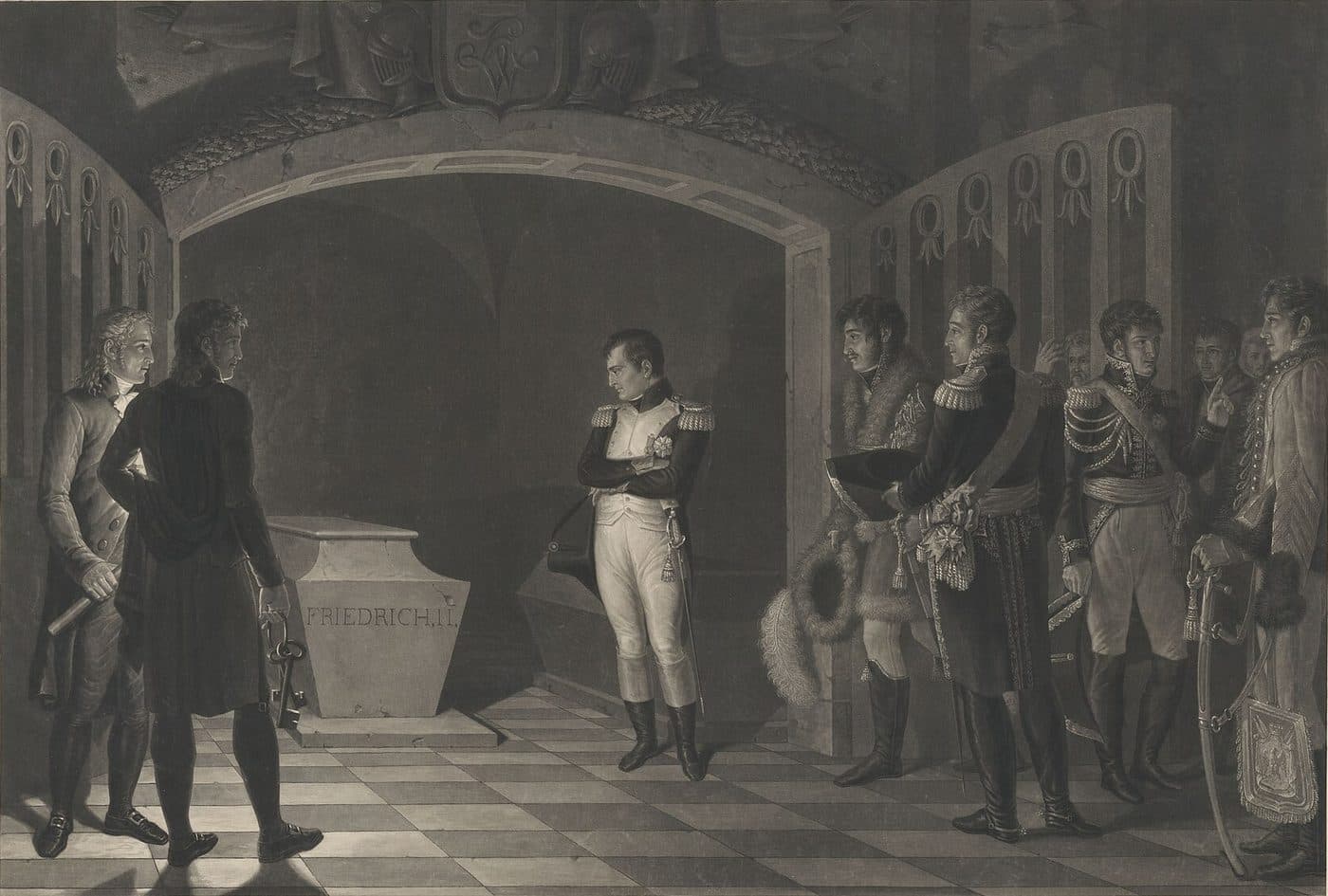
Less than two weeks after near annihilating the Prussian army at the twin battles of Jena and Auerstedt, Napoleon Bonaparte called upon the tomb of Frederick the Great – to meditate on the memory of a man whose legacy stood as colossal as that of Napoleon’s in his time. Remarking on his recent victories, the French Emperor would address his entourage: “Hats off, gentlemen, if he were still alive, we should not be here.”

Frederick remains one of the greatest enigmas of German – and dare say also, world – history. His true identity still leaves much room for speculation. A celebrated military commander who greatly expanded his kingdom’s territory through his military victories. But also a supporter of enlightenment values, dedicated to the arts and sciences, who composed more than 100 flute sonatas – and aspired to be remembered first and foremost as a philosopher.

He would inherit his father’s kingdom in 1740 and with it a formidable army. One that would become the envy of the world over time – and the scourge of Frederick’s European enemies. His first act on assuming the throne was one of belligerence, invading neighbouring Silesia to the east. His greatest military achievement though came twenty three years later, in 1763, when Frederick effectively dispatched the Austrian, French, and the thoroughly negated Russian forces. Succeeding where it mattered most for the kingdom he ruled from 1740 to 1786 – as the longest standing Prussian king – by turning Prussia into a Great Power.

Sanssouci: a life without worries

Despite his skills as a military tactician, Frederick was also an incessant gambler, who often risked everything – his army, his kingdom and his life – on the outcome of a single battle. The son of an abusive father, he grew to become a renowned battlefield commander as much in spite of his father as because of him. As a boy he would be woken every morning with cannon fire, forced to drill his own unit of ‘Potsdam Giants’, and come to witness his close friend (and possible lover) be executed by his father’s soldiers after an attempt at flight to England in his youth. Terrorised by his harsh and demanding father, Frederick dreamed of a life of quiet contemplation and philosophy.

The vineyard terraces of Sanssouci in Potsdam, with the palace on top and a column on the lawn below
The vineyard terraces below Sanssouci.

A life he would create for himself in 1747, at the top of a hill he had been allowed to play on as a boy, when he constructed the Sanssouci Palace – his private residence in Potsdam, south west of the Prussian capital of Berlin. A must-see on any visit to Berlin’s neighbouring city, this 13 room villa, decorated in an intimate Frederician Rococo style, sits at the top of a vineyard and amongst the pleasant surroundings of the Potsdam Sanssouci park.

Bacchic figures holding up the garden front of Sanssouci Palace in Potsdam, carved with grapes and vine leaves
Bacchic figures on the garden front of the palace.

Rather than an expression of the strength and power of Frederick’s kingdom, Sanssouci can be studied as nothing short of an architectural manifestation of the values Frederick would seek to embody as the so-called ‘enlightened monarch’. Held up by Bacchic statues alluding to the pleasures of hedonistic intoxication, with the graduation of decorative leaf and vines embracing the building’s exterior and interior – a romantic reference to the harmony of man and nature. It was here that Frederick would entertain guests, practice his flute in the music room, or retreat to his extensive library.

Only occupied during the summer months – from April to October – this somewhat humble abode (by the standards of a King) would be a celebration of life – to be lived ‘without worries’ (Sans Souci) – but also where Frederick intended to spend eternity. Even before construction started, the Prussian King would designate Sanssouci as his final resting place – in 1744 saying: “Once I am there, I shall be carefree”.

A tomb kept waiting

In the later years of his life, Frederick was frequently concerned with his own death. He would recite his political will and testament before almost every battle, and prepared, down to the finest details, the events that should occur upon his death. “I have lived as a philosopher and wish to be buried as such, without circumstance, without solemn pomp, without splendour,” he would say. “I want to be neither opened nor embalmed.”

“I have lived as a philosopher and wish to be buried as such…”

In 1769, he would state: “Bury me in Sanssouci at the level of the terraces in a tomb which I have had prepared for myself… Should I die in time of war or whilst on a journey, I should be buried in the first convenient place and brought to Sanssouci in the winter.”

Despite his clarity on the matter it was not on the steps of the Sanssouci Palace, and his final resting place constructed following Frederick’s orders in 1744, that Napoleon stood. But in the crypt of the Garnisonkirche in central Potsdam, where Frederick’s remains would reside, against his wishes, for almost 160 years.

The central staircase up the vineyard terraces to Sanssouci Palace in Potsdam, near Frederick the Great’s grave
The steps up to the palace and the top terrace.

Frederick’s nephew and successor – Frederick William II – chose not to obey his uncle’s instructions. Instead, insisting that he should be buried in Potsdam, next to his father – Frederick William I. Two hundred and five years later, a sarcophagus with Frederick’s remains was finally lowered into the ground on the top terrace of the Sanssouci Palace. He would finally be allowed the burial he so desired, on the steps of his favourite residence – surrounded by his dogs.

Potatoes on the grave

Despite belonging to the leader of one of the greatest powers in European history, Frederick’s grave is surprisingly modest. A single stone on a small plot, surrounded by other stones (indicating the presence of his beloved Italian greyhounds). Two things are most remarkable, though, on closer inspection; one that often inspires consternation from uninformed visitors, the other that could easily be missed without explanation.

Most days of the year, visitors to Frederick’s grave will find small mounds of potatoes littered across the stone – a friendly reference to the Prussian king’s substantial contribution to the German kitchen. As it was Frederick who popularised the potato in the 1700s, turning an otherwise suspect vegetable – sometimes referred to as the ‘Devil’s Apples’ at the time – into a widely cultivated and cheap staple of local cuisine.

…what is worth guarding, the Prussian king would conclude, is also worth stealing.

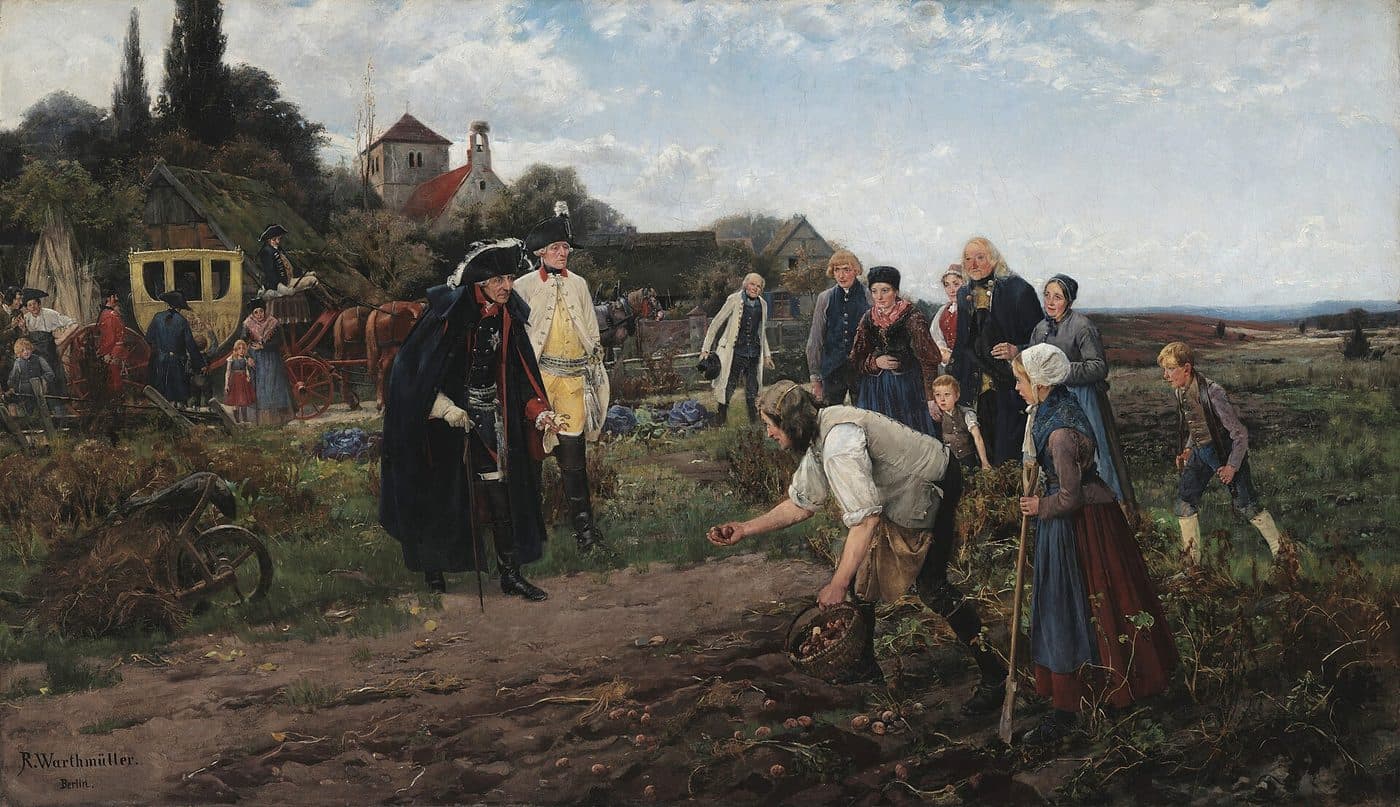
Transforming the humble potato into a royal dish meant serving numerous courses of various preparations in his own household – but also executing an ingenious trick on his own citizens. Frederick ordered his soldiers to plant potatoes in royal fields and lightly guard the crops, allowing the locals to sneak in and pillage the vegetables – as what is worth guarding, the Prussian king would conclude, is also worth stealing. To thank Frederick for his contribution and impressive use of reverse psychology, visitors now lay potatoes at Frederick’s grave.

A grave which bears not his royal title – Frederick II – or his family name (Hohenzollern) but a moniker reportedly given to him by his enemies, fearful of his military prowess – Frederick the Great. Although the first known instance of the use of this term is in a document almost certainly written by Frederick the Great. Despite his intention to be buried in a simple grave; it would not be one completely free from the confines of his ego.
The grave in detail

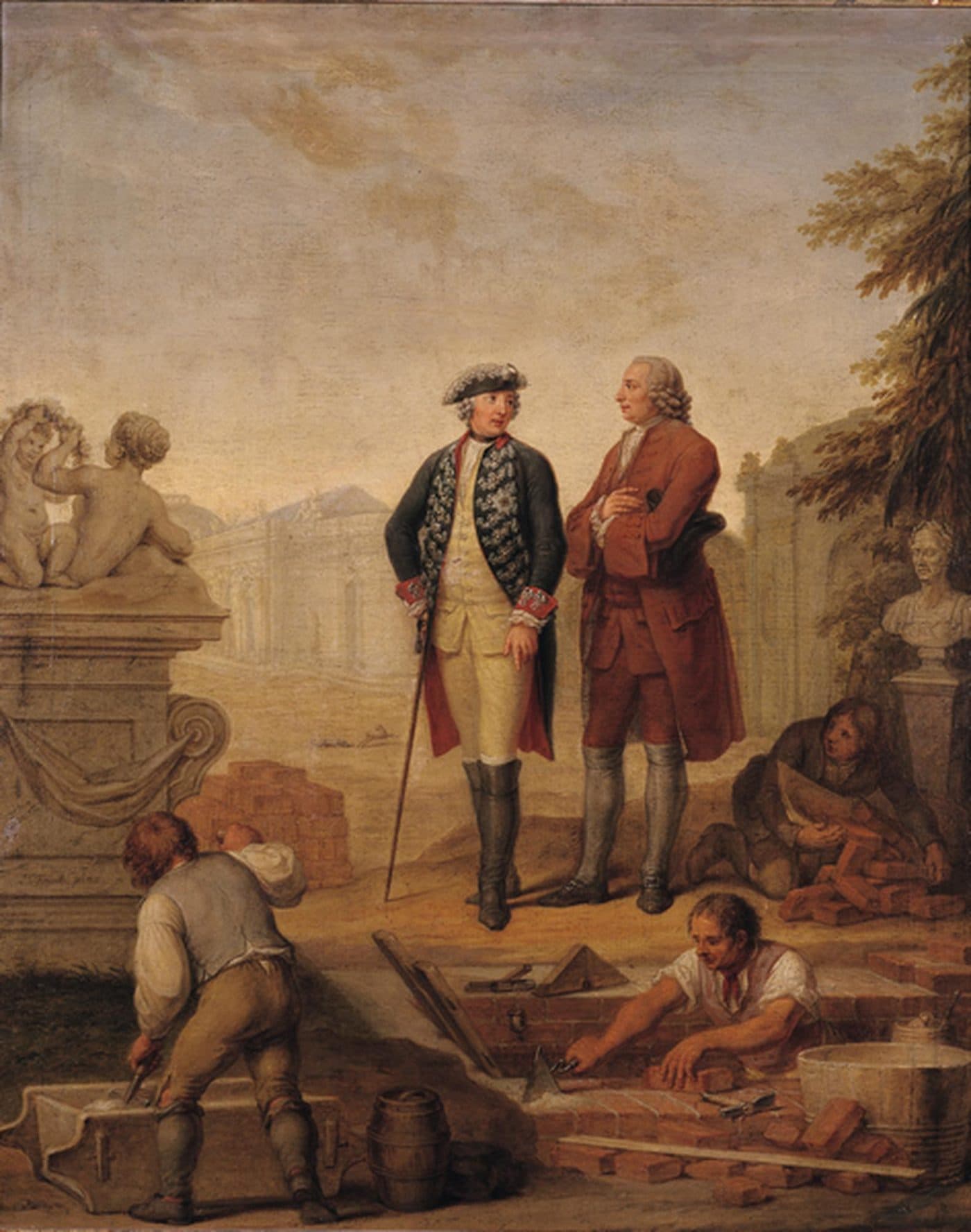
Painting of Frederick the Great and the Marquis d’Argens inspecting the building of his crypt at Sanssouci, by Johann Christoph Frisch
Frederick and the Marquis d’Argens inspect the building of the crypt, painted by Johann Christoph Frisch around 1802. Photo: Johann Christoph Frisch / Public domain, via Wikimedia Commons

The crypt on the terrace

Frederick had his tomb built before his palace. In 1744, while the vineyard terraces were still being laid out, a brick vault covered with marble slabs was dug into the eastern end of the top terrace. According to the Berlin writer Friedrich Nicolai, the king told his friend the Marquis d’Argens as they walked across the building site: “Quand je serai là, je serai sans souci” – once I am there, I shall be without care. The marble group of Flora and Zephyr, carved by François Gaspard Adam in 1749, and a half-circle of busts of Roman emperors still stand around the spot.

His greyhounds were later buried beside the crypt. Frederick William II, who ignored his uncle’s wishes, is said to have shown visitors the empty grave with the words that his predecessor had preferred to lie beside his dogs rather than among his ancestors. When the vault was opened again in 1991 it was found to be largely intact; the brickwork was repaired and a waterproof cover added.

Napoleon standing before Frederick the Great’s coffin in the royal crypt of the Garrison Church in Potsdam, 1806, engraving by Jazet after Ponce-Camus
Napoleon at Frederick’s coffin in the Garrison Church, 1806: an engraving by Jazet after Ponce-Camus. Photo: Jean-Pierre-Marie Jazet after Marie-Nicolas Ponce-Camus / Public domain, via Wikimedia Commons

The long way back to Sanssouci

Frederick died in his armchair at Sanssouci on 17 August 1786 and was buried the next evening in the crypt of Potsdam’s Garrison Church, next to his father. Napoleon visited it on 25 October 1806. In March 1943 the Wehrmacht moved both coffins to a Luftwaffe bunker outside Potsdam, and in March 1945 to a salt mine in Thuringia. The church burned out in an air raid that April. American soldiers found the coffins and took them to Marburg, where they lay in St Elisabeth’s Church from 1946, and in 1952 they went to Hohenzollern Castle near Hechingen.

After reunification Louis Ferdinand, head of the house of Hohenzollern, had them brought back. On 17 August 1991, the 205th anniversary of Frederick’s death, his coffin lay in state in the palace forecourt and was buried at midnight on the terrace, as he had asked, though in front of Chancellor Helmut Kohl and television cameras. His father was buried the same day in the Kaiser Friedrich Mausoleum at the Friedenskirche in the park.

Painting ‘Der König überall’ by Robert Warthmüller, showing Frederick the Great inspecting the potato harvest with farmers in a field
‘The King Everywhere’: Frederick inspects the potato harvest, painted by Robert Warthmüller in 1886. Photo: Robert Warthmüller / Public domain, via Wikimedia Commons

Why the potatoes?

Potatoes had reached Brandenburg about a century before Frederick, but few farmers grew them. On 24 March 1756 he issued what became known as the Kartoffelbefehl, the Potato Order, telling his officials to make the crop ‘comprehensible’ to his subjects and to plant it wherever there was empty ground. Seed potatoes were handed out with instructions, and in the hungry years of the Seven Years’ War and after, the potato turned from a curiosity into a staple. Even the War of the Bavarian Succession of 1778–79, in which Prussian and Austrian armies spent more time foraging than fighting, came to be called the Potato War.

The story of the lightly guarded royal fields is a favourite with guides, but it is not proven: a very similar tale is told about Antoine-Augustin Parmentier in France. Either way, visitors have kept up the habit of leaving potatoes on the stone since the reburial, often alongside flowers.

Plan your visit

Visiting Frederick the Great’s grave

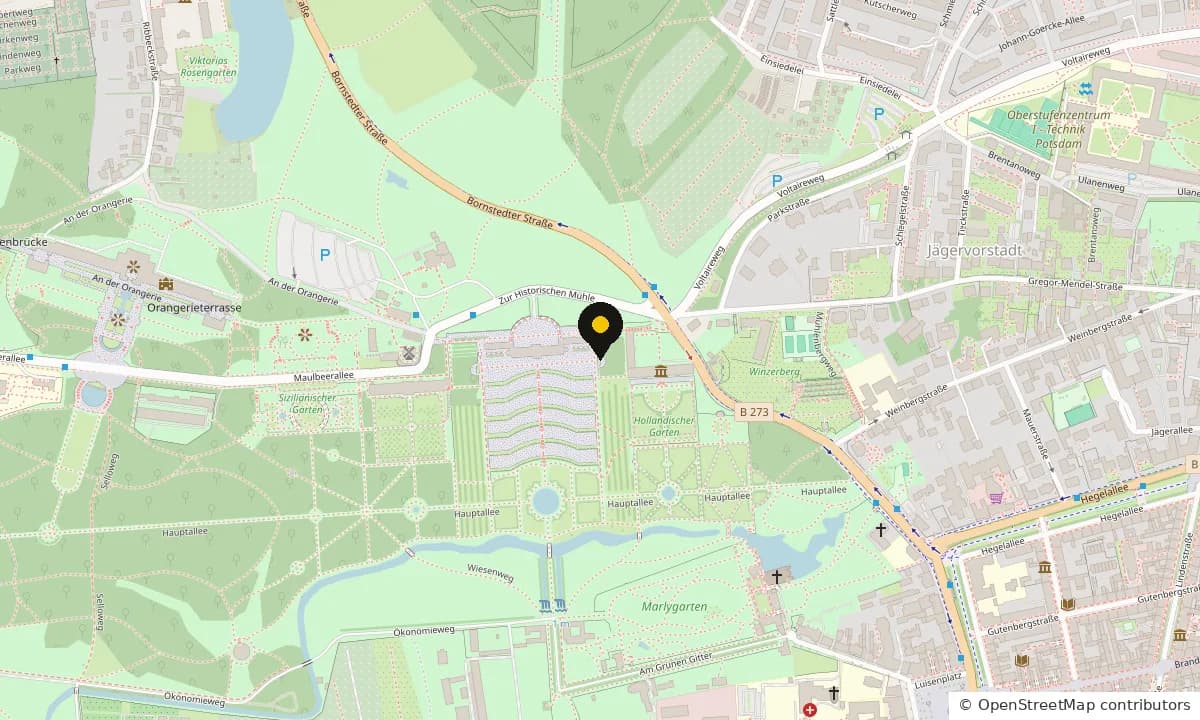
Map of the streets around Frederick the Great’s grave, with a pin on the siteOpen in Google Maps

Park Sanssouci, Maulbeerallee, 14469 Potsdam · Park: daily, 08:00 until dusk. Palace interior: Tuesday–Sunday, 10:00–17:30 (April–October), 10:00–16:30 (November–March)

Getting there

  • Bus 695Schloss Sanssouci290 m · 4 min

    From Potsdam Hauptbahnhof (S7 or RE1 from Berlin) the bus runs about every 20 minutes and takes around 16 minutes. Walk east past the palace forecourt to the end of the top terrace.

  • Tram 91Luisenplatz-Süd/Park Sanssouci1 km · 14 min

    Enter the park through the Grünes Gitter gate, follow the path to the great fountain and climb the vineyard steps; the grave is at the top, on the right.

  • S7RE1Potsdam Hauptbahnhof2.9 km · about 40 min

    To walk all the way, cross the Havel into the old town, follow Brandenburger Straße to Luisenplatz and enter the park there.

What you’ll see

  • The plain gravestone, inscribed only ‘Friedrich der Große’, usually scattered with potatoes and flowers left by visitors.
  • The small stone slabs beside it marking the graves of his greyhounds, and the marble group of Flora and Zephyr with a half-circle of busts of Roman emperors.
  • The view from the top of the six vineyard terraces down to the great fountain and the park, with the palace’s garden front beside you.

Tips from a guide

  • No ticket is needed for the grave or the park. If you want to see inside the palace too, book a timed ticket on spsg.de in advance: numbers are limited and it is closed on Mondays.
  • Come early: the park opens at 08:00 and the top terrace is busiest from late morning, when tour groups arrive.
  • If you want to join in, bring a potato from home and leave it on the stone with the others.

Accessibility

The grave lies on the top terrace, level with the palace, so you can reach it without the vineyard steps by approaching from the north side of the palace (Bus 695 stop Schloss Sanssouci or the Historic Mill car park); the paths are gravel. Wheelchair-accessible toilets are at the Historische Mühle visitor centre. The palace interior is only partly accessible, via a steep provisional ramp.

Timeline

From the Garrison Church to the terrace

  1. 24 Jan 1712Frederick is born in Berlin, son of the ‘Soldier King’ Frederick William I.
  2. 6 Nov 1730His friend Hans Hermann von Katte is executed at Küstrin; Frederick is made to watch.
  3. 31 May 1740Frederick becomes king and invades Silesia that December.
  4. 1744He has his crypt built on the top terrace of the new vineyard.
  5. 1 May 1747Sanssouci Palace is inaugurated.
  6. 24 Mar 1756The Potato Order tells officials to promote potato growing.
  7. 15 Feb 1763The Peace of Hubertusburg ends the Seven Years’ War; Prussia keeps Silesia.
  8. 17 Aug 1786Frederick dies at Sanssouci; he is buried in the Garrison Church the next day.
  9. 25 Oct 1806Napoleon visits the royal crypt in the Garrison Church.
  10. 1943–45The coffin is moved to a bunker, then to the Bernterode salt mine.
  11. 1946–52St Elisabeth’s Church in Marburg, then Hohenzollern Castle near Hechingen.
  12. 17 Aug 1991Reburied at midnight on the terrace at Sanssouci, 205 years after his death.

See it with a historian

Tours that stop at Frederick the Great’s grave

The grave is easy to find; a guide explains the king, the palace and the 205-year journey that ended here, and links it with the rest of royal Potsdam.

The Glory Of Prussia Tour - Berlin Experiences
Full Day6 Hours

The Royal Potsdam Tour

Private 6-hour day trip from Berlin to the palaces and parks of Potsdam for up to 6 people. Starts at your hotel in Berlin.

€1,000up to 6
View Tour

Why this tour

A full day among the Prussian palaces, from Charlottenburg to Sanssouci, Frederick’s grave, Cecilienhof and the Bridge of Spies.

See the Royal Potsdam Tour

Questions visitors ask

Frequently asked questions

Where is Frederick the Great buried?

On the top terrace of the vineyard at Sanssouci Palace in Potsdam, at the east end beside the palace, next to the graves of his greyhounds. He has lain there since 17 August 1991; before that his coffin was in Potsdam’s Garrison Church, then in Marburg and at Hohenzollern Castle.

Why do people leave potatoes on Frederick the Great’s grave?

In thanks for his promotion of the potato. His Potato Order of 1756 told officials to get farmers growing it, and it became a staple across Prussia. The story that he had the fields lightly guarded so people would steal the crop is popular but not proven.

Is it free to visit Frederick the Great’s grave?

Yes. The grave is in Park Sanssouci, which is free and open daily from 08:00 until dusk. You only need a ticket (€14) to go inside Sanssouci Palace.

Why is Frederick the Great buried next to his dogs?

Because he chose the spot himself: he had the crypt built in 1744, before the palace, and wanted to be buried there ‘without pomp’ and at night. His greyhounds were buried beside it, and he was finally laid next to them in 1991.

Why wasn’t Frederick the Great buried at Sanssouci when he died?

His nephew and successor, Frederick William II, ignored his will and buried him beside his father in Potsdam’s Garrison Church in 1786. The coffin only reached the terrace 205 years later, after a wartime journey through a bunker, a salt mine, Marburg and Hohenzollern Castle.

What does Frederick the Great’s gravestone say?

Just ‘Friedrich der Große’ – Frederick the Great. There are no dates, no royal title and no family name.

How do I get to Frederick the Great’s grave from Berlin?

Take the S7 or the RE1 to Potsdam Hauptbahnhof, then Bus 695 to Schloss Sanssouci, four minutes’ walk from the grave. Allow about an hour from Berlin Hauptbahnhof, with a ticket for zones ABC.

Are there guided tours that visit the grave?

Yes. Our Glory of Prussia tour, a private full day that can start at your hotel, takes in Charlottenburg Palace, Sanssouci and Frederick’s grave, the Neues Palais, Cecilienhof and the Bridge of Spies.

Keep exploring

More Featured Experiences.

Every site we write about — 56 landmarks, museums, memorials and lesser-known corners of Berlin. See the full index →

01Walk Through The Brandenburg Gate02Explore The State Museums On Museum Island03Visit The Berlin TV Tower – The Fernsehturm04Cross The Cold War Border At Checkpoint Charlie05Visit The Site Of Adolf Hitler’s Führerbunker06Explore The Reconstructed Berlin Palace07Visit The Reichstag Cupola At Night08Explore The Forum Fridericianum09Shop At The Humboldt University Book Sale10Journey Into The Memorial To The Murdered Jews Of Europe11Step Inside The Neue Wache12Explore The Former Jewish Quarter – Spandauer Vorstadt13Visit The Remains Of The Berlin Wall14Walk Across The Bridge Of Spies15Explore The Topography Of Terror16Climb The Prussian Victory Column – The Siegessäule17Enter The Palace Of Tears – The Tränenpalast18Step Inside The Berlin Olympic Stadium19Explore Erich Mielke’s Office At The Stasi Museum20Walk Along Karl Marx Allee21Visit The Oldest Church In Berlin – The Nikolaikirche22Explore The Berliner Dom24Walk Through The Ruins Of Anhalter Bahnhof25Stand On The Platz Des Volksaufstandes26Visit The German Resistance Museum27Visit The Soviet War Memorial In The Tiergarten28See The Georg Elser Memorial On Wilhelmstrasse29Step Inside The Kaiser Wilhelm Gedächtnis Kirche30Visit The Gleis 17 Memorial31Visit The Schloss Charlottenburg Mausoleum32Climb The Französischer Dom at Gendarmenmarkt33Explore The Interbau – IBA 5734Explore The Otto Weidt Workshop35Visit Cecilienhof – Site Of The Potsdam Conference36Visit The Stasi Prison In Hohenschönhausen37Spend The Day At Tempelhof Airport38Ride The Fastest Elevator In Europe39Visit The Soviet War Memorial In Treptower Park40Visit The Sachsenhausen Concentration Camp Memorial41Visit The Ravensbrück Concentration Camp Memorial42Visit Karlshorst – The Site Of The German Surrender43Visit The Socialists Cemetery – Zentralfriedhof Friedrichsfelde44Visit The Soviet War Memorial In Pankow45Visit the Seelow Heights Memorial46Visit The Commonwealth War Cemetery47Cross The Bösebrücke At Night48Explore The Allied Museum In Dahlem49Explore The Spandau Citadel50Visit The Brandenburg T4 Euthanasia Memorial51Visit The Wannsee Conference House52Visit The Jewish Museum53Visit The Jewish Cemetery In Weissensee54Walk Along The East Side Gallery55Explore The Volkspark Friedrichshain Flak Tower56Head Up The Teufelsberg