Skip to content
Will Lammert’s sculpture group for the Jewish victims of fascism on Große Hamburger Straße, in Berlin’s former Jewish Quarter

Berlin Experiences/Featured Experiences

Berlin’s Jewish Quarter: Walk the Former Spandauer Vorstadt

Poverty-stricken suburb reborn as a vibrant bohemian barrio

The short answer

Berlin’s former Jewish Quarter is the Spandauer Vorstadt and the Scheunenviertel in Berlin-Mitte: the streets north of the Spree around Oranienburger Straße, Große Hamburger Straße and Hackescher Markt. It was never a walled ghetto, but from the 18th century until the Holocaust it was the centre of Jewish life in Berlin. You can walk it at any time and for free: the New Synagogue, the old Jewish cemetery and deportation memorial, the Otto Weidt workshop museum and the Hackesche Höfe are all within ten minutes of each other. Allow 1–2 hours; the New Synagogue’s museum, the Centrum Judaicum, has its own opening hours and charges €7.

Where
Spandauer Vorstadt, around Oranienburger Straße, 10117 Berlin-Mitte
Open
The streets always; the New Synagogue has its own hours (centrumjudaicum.de)
Admission
Free to walk; New Synagogue €7; Otto Weidt museum free
Time needed
A 1–2 hour walk
Nearest station
S Oranienburger Straße, 2 minutes on foot
Step-free
Mostly: level streets, some cobbles; the synagogue museum has a lift
With a guide
Walk the quarter with a historian on the one-hour Jewish Berlin Tour. See the Jewish Berlin Tour →

The story · by Matt Robinson

Back in the early 1700s, the land just north of the River Spree from near present-day Friedrichstraße station to Alexanderplatz, sat outside the city of Berlin – and beyond the Spandauer Tor, a city gate that led to the settlement of Spandau nearby. Like with most of the areas surrounding Berlin’s old boundaries, agriculture would play a large role in the attempts of the people living here to remain self-sufficient – yet the inhabitants of these hamlets outside the city walls would be noticeably poor. When in 1750, King Frederick the Great ordered the expansion of Berlin’s central districts to the north of present-day Torstrasse – beyond the river Spree and Monbijou Palace – this area, by that time known as the Spandauer Vorstadt (the district facing Spandau), would be integrated into the city. With it the Jewish families that had relocated here over the last century.

In 1671, a number of prominent Jewish families had arrived here from Vienna – after being expelled from the Austrian capital by Emperor Leopold I. They would form the core of the city’s Jewish community in this area for the next three centuries. When invited to Berlin, these Viennese Jews were exempt from tolls in travelling, but had to pay a yearly protection tax of eight thalers per family, and one gold florin for every marriage. They were not permitted to have a public synagogue but five years later would be awarded ‘protected Jewish status’ (Schutzjuden) by the ruling Great Elector, Frederick William.

As Berlin had suffered greatly during the Thirty Years War (1618–1648), the Great Elector was eager to see the city’s population grow again and the commercial activity of the city increase. The mercantile participation in the economic redevelopment of what would become the Prussian capital earned some of these Viennese Jews, particularly the Veit and Riess families, prominent roles in the relationship between the state and the members of the city’s most notable minority.

Protection, persecution and the Scheunenviertel

Persecution, expulsion and execution, accusations of host desecration and ritual murder, are sadly common themes within the annals of Berlin’s Jewish history – with the first mention of the Jewish population in the city being a letter from the Berlin local council in 1295, forbidding wool merchants to supply Jews with yarn.

The Abandoned Room memorial on Koppenplatz in Berlin’s former Jewish Quarter: a bronze table and chair, the second chair knocked over
The Abandoned Room on Koppenplatz, a memorial to the neighbourhood’s Jewish residents.

From the re-establishment of the Berlin Jewish community in 1671, some would thrive under these improved conditions as Schutzjuden, garnering wealth and social recognition, others would falter under the draconian restrictions and exclusions from certain trades, ending up either impoverished or destitute from the taxes, or forced to resettle elsewhere.

Although Berlin has never had an official ghetto, the Jewish inhabitants of the city who did not already have a permanent residence would be ordered, in 1737, to settle in the district north-west of Alexanderplatz known as the Scheunenviertel (the Barn Quarter) by King Frederick William I. This area had been specifically established some sixty years earlier to store hay outside the city walls, as it was forbidden to keep flammable materials within the city limits.

Part of this Scheunenviertel to the east, and the Spandauer Vorstadt to the west, would come to be recognised as the Jewish quarter of Berlin from the mid-1700s.

The New Synagogue

The most symbolic landmark in this area was opened in 1866, as the largest synagogue in central Berlin – the Neue Synagoge (New Synagogue). It should be easy to distinguish by the name of this building that there was indeed a predecessor building – the Old Synagogue – which sadly no longer exists, nearby on Heidereutergasse 4. Consecrated in 1714, this would be known as the Grand Synagogue until the construction of the New Synagogue on Oranienburger Strasse.

Designed by non-Jewish architect Eduard Knoblauch in a Moorish Southern Spanish style, this impressive brick and terracotta structure – topped with a series of iconic ribbed domes – was inaugurated in the presence of Count Otto von Bismarck, then Minister President of Prussia. It would play an important role in the development of Conservative Judaism – as one of the largest synagogues in Europe, with space for around 3,000 people inside and religious services reflecting the liberal developments in the Jewish community of the time. Even scientist Albert Einstein would perform a violin concert inside the synagogue in 1930.

Even scientist Albert Einstein would perform a violin concert inside the synagogue in 1930.

Große Hamburger Straße

Around the corner from the New Synagogue is Krausnickstrasse and the former home of the first ever female Rabbi – Regina Jonas – leading to Grosse Hamburger Strasse (or the street of tolerance as it is often referred to by the Berlin tourist office). Home to a Catholic hospital, Protestant church, and a number of sites related to the Jewish community that once lived here – including a former Jewish boys school, the site of the city’s first Jewish retirement home, and the old Jewish cemetery – where Jewish reformer Moses Mendelssohn was buried.

Moses Mendelssohn’s gravestone among the ivy in the old Jewish cemetery on Große Hamburger Straße, Berlin
Moses Mendelssohn’s gravestone in the old Jewish cemetery.

This area of the city is also home to a large number of the brass Stolpersteine (Stumbling Stones), that were first introduced in 1992 (there are now more than 75,000 across Europe). These small plaques commemorate the people who once lived in this area and fell victim to Nazi genocidal plans or, in some instances, managed to escape. The prevalence of them is a clear indication of the number of Jewish Berliners who previously called this neighbourhood home.

After 1945

Following the division of Berlin in 1945, the Spandauer Vorstadt and the Scheunenviertel ended up in the East of the city – as part of the German Democratic Republic. Like many other areas of the country, this district fell into terrible shape, with crumbling buildings and bombed-out, bullet-ridden facades, still visible into the early 1990s.

Entrance to the Otto Weidt Workshop for the Blind museum at Rosenthaler Straße 39 in Berlin-Mitte, beside a street-art portrait of Otto Weidt
The entrance to the Otto Weidt museum, in the courtyard at Rosenthaler Straße 39.

Some trace of this Cold War period is still visible, and the district has managed to retain aspects of what some see as its former derelict charm; although with rent prices and demand for housing rising in Berlin, this part of the central Mitte district has become one of the more desirable areas of the city. Full of art galleries, coffee shops, clothing stores, and restaurants. No longer the city’s Jewish quarter but home to many young creatives and entrepreneurs who are attempting to find their way – both because of the city, and in spite of it.
The Jewish Quarter in detail

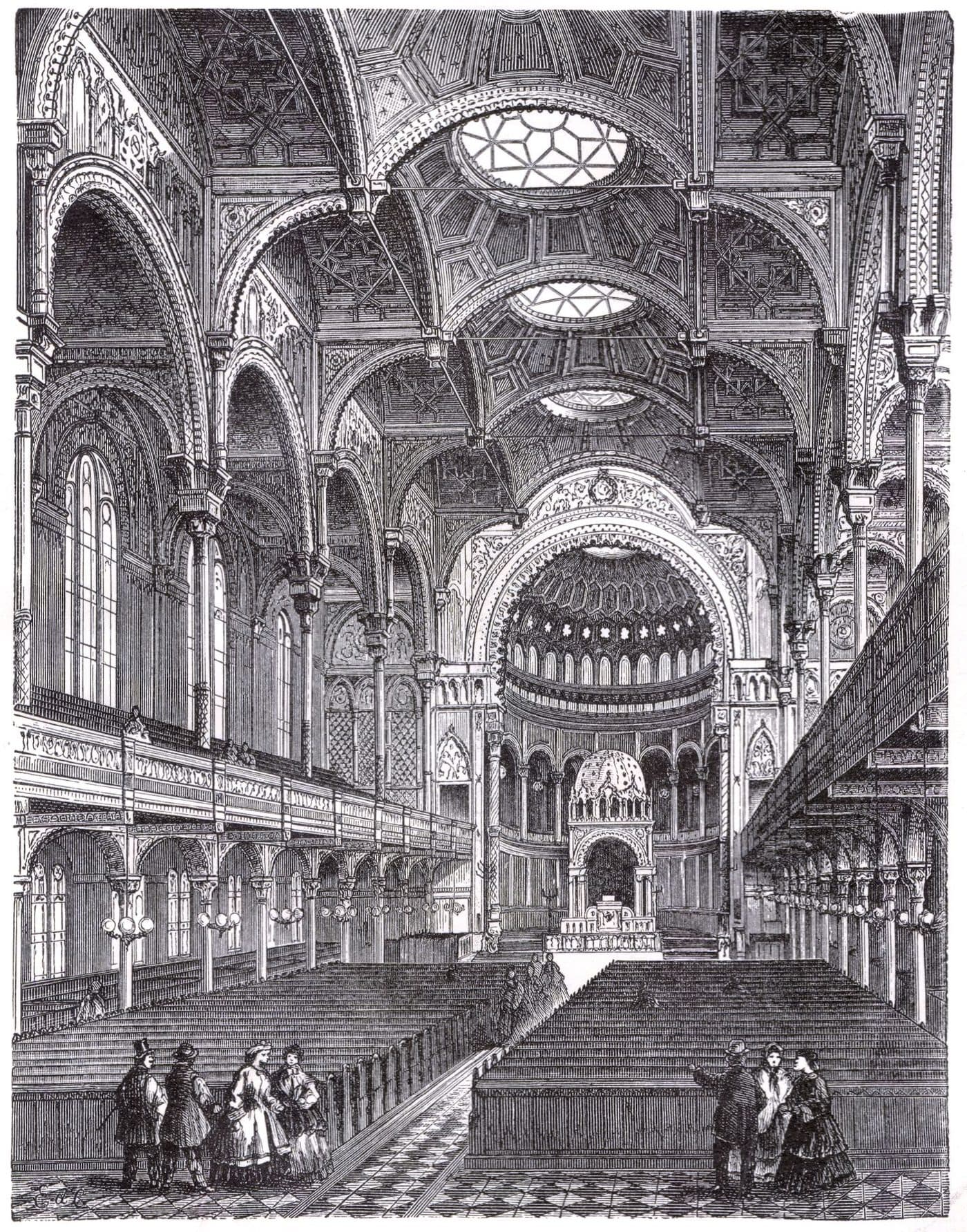
Engraving of the interior of the New Synagogue in Berlin, 1896, showing the main hall that was destroyed in the Second World War
The main hall of the New Synagogue in 1896. It was bombed in 1943 and demolished in 1958. Photo: Berlin und seine Bauten (1896) / Public domain, via Wikimedia Commons

The New Synagogue: what survived

Building began in 1859 to designs by Eduard Knoblauch; after his death in 1865 Friedrich August Stüler finished the work, and the synagogue opened in 1866 as the largest in Germany, with seats for about 3,000. On the night of 9–10 November 1938 the SA broke in and set fires. Otto Bellgardt, a lieutenant from the police station at Hackescher Markt, drew his pistol, told them the building was a protected monument and let the fire brigade in. The plaque on the façade honours his station chief, Wilhelm Krützfeld, who backed him and took the reprimand.

The reprieve was short. Services were banned in 1940 and the Wehrmacht used the main hall as a store, and in November 1943 Allied bombs burned it out. In 1958 the ruined hall was pulled down. Only the street front was rebuilt, from 1988, with its dome, and it opened as the Centrum Judaicum in 1995. A small Masorti congregation worships in the building today.

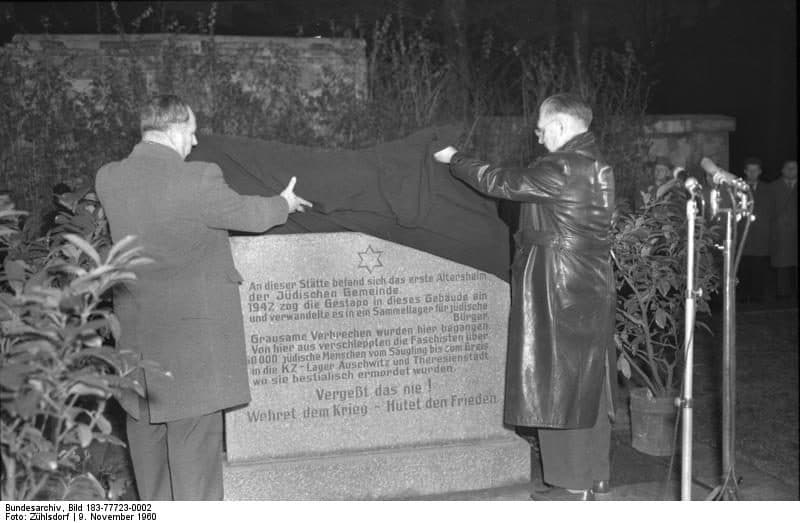
Unveiling of the memorial stone for Jewish victims of fascism at the site of the Jewish old people’s home on Große Hamburger Straße, Berlin, 9 November 1960
The memorial stone at No. 26 is unveiled on 9 November 1960. Photo: Bundesarchiv, Bild 183-77723-0002 / Zühlsdorf / CC-BY-SA 3.0

Große Hamburger Straße: from tolerance to deportation

The community’s first cemetery was laid out here in 1672, and by the early 19th century more than 2,600 people had been buried in it, Moses Mendelssohn among them in 1786. A Prussian ordinance of 1794 stopped burials inside the city’s customs wall. In 1943 the Gestapo had the graves destroyed; Mendelssohn’s stone is a copy put up in 1990. Next door, at No. 27, the Jewish Boys’ School opened in 1862. It was closed in 1942 and has been a Jewish school again since 1992.

No. 26 was the community’s first old people’s home, opened in 1844. In 1942 the Gestapo turned it into a collection camp: its residents were sent to Theresienstadt, and Berlin Jews were held here before deportation to the ghettos and death camps, more than 50,000 of them in all. The building was destroyed in 1943. A memorial stone, unveiled on 9 November 1960, and Will Lammert’s sculpture group of deportees now stand on the site.

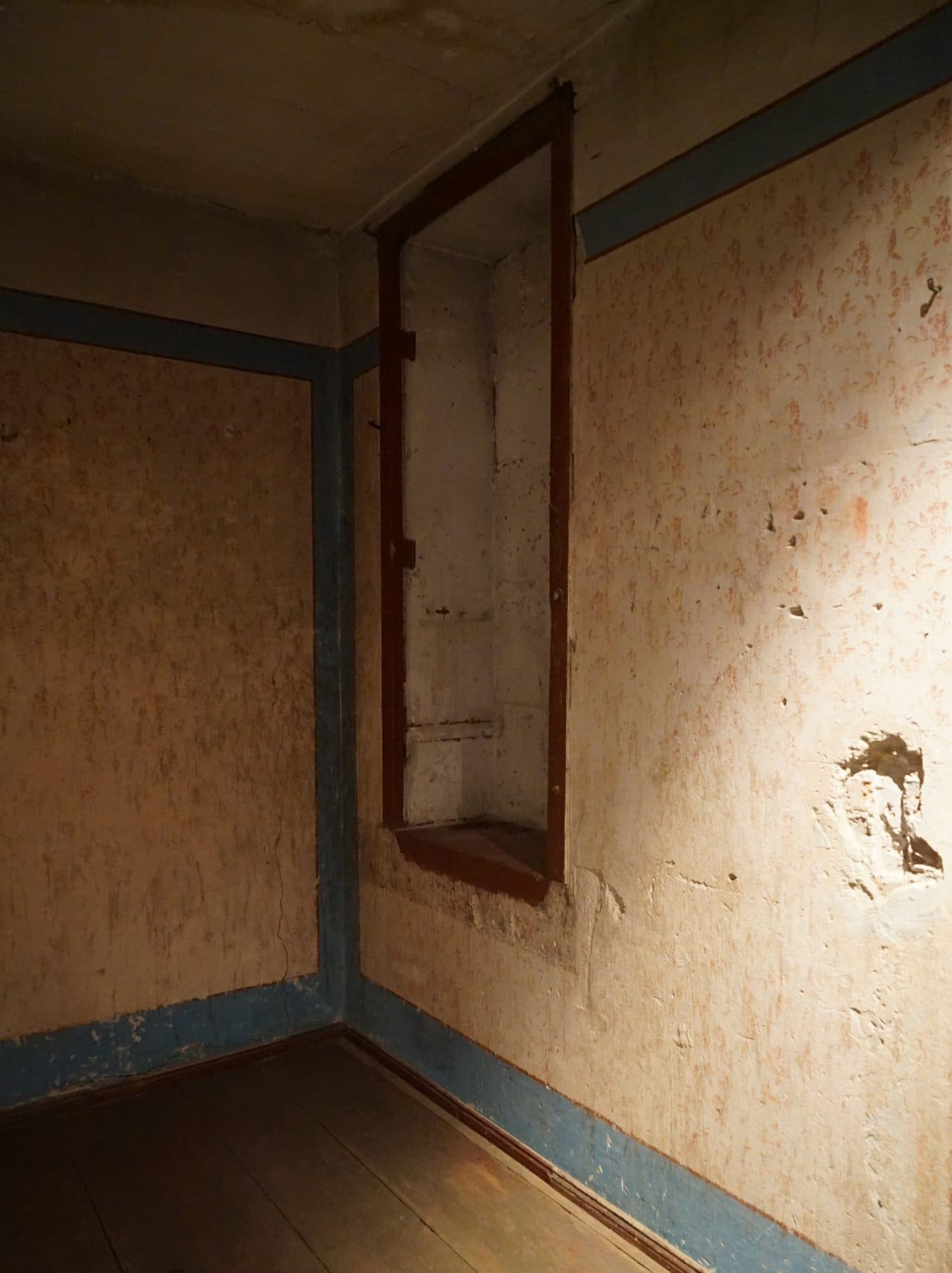
The small back room in the Otto Weidt workshop museum in Berlin where Weidt hid the Horn family
The back room where Weidt hid the Horn family, now part of the museum. Photo: Rudolf H. Boettcher / CC BY-SA 4.0, via Wikimedia Commons

Otto Weidt’s workshop and the Hackesche Höfe

In 1940 Otto Weidt moved his broom and brush workshop into the back courtyard of Rosenthaler Straße 39, and between 1941 and 1943 he employed up to 30 blind and deaf Jews. Because the Wehrmacht bought his brushes, the business counted as vital to the war effort. Weidt used that status, forged papers and bribes to protect his workers, and hid a family in a back room. Many were deported in the end, but Inge Deutschkron, Alice Licht and others survived with his help. Yad Vashem recognised him as Righteous Among the Nations in 1971.

The workshop has been a museum since 1999, run by the German Resistance Memorial Center since 2005, and admission is free. Next door, at Rosenthaler Straße 40, Kurt Berndt built the Hackesche Höfe in 1906–07, eight linked courtyards of flats, workshops and halls, with a glazed-brick first courtyard by August Endell. Nationalised in the GDR, they were returned to the owners’ heirs in 1993 and restored by 1997.

Plan your visit

Visiting the former Jewish Quarter

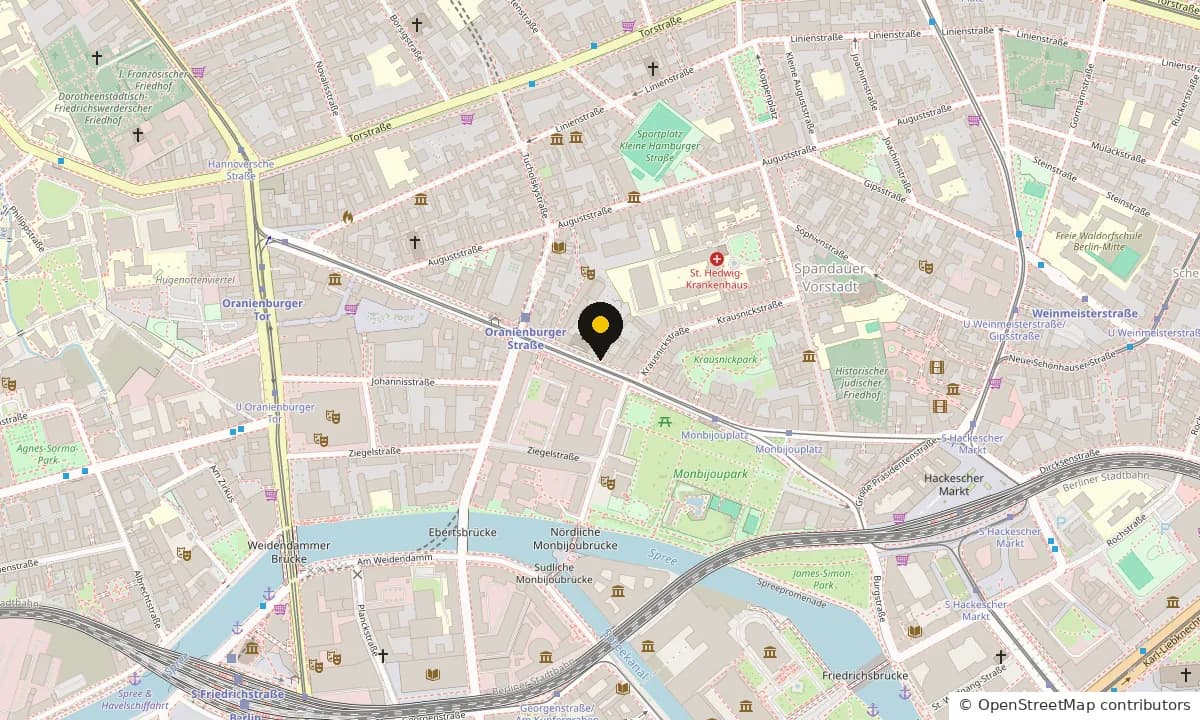
Map of the streets around the former Jewish Quarter, with a pin on the siteOpen in Google Maps

Oranienburger Straße 28–30, 10117 Berlin · The streets and outdoor memorials: always. New Synagogue – Centrum Judaicum: April–September Mon–Fri 10:00–18:00, Sun 10:00–19:00; October–March Sun–Thu 10:00–18:00, Fri 10:00–15:00; closed on Saturdays and Jewish holidays, last entry 30 minutes before closing. Check centrumjudaicum.de before you go.

Getting there

  • S1S2S25S26Oranienburger Straße150 m · 2 min

    The tram M1 also stops here. The synagogue’s gilded dome is in sight as you come up to the street.

  • S3S5S7S9Hackescher Markt750 m · 9 min

    A good place to end the walk: the Hackesche Höfe and the Otto Weidt museum are 3 minutes from the station.

  • U6Oranienburger Tor650 m · 8 min

    Walk east along Oranienburger Straße.

What you’ll see

  • The New Synagogue on Oranienburger Straße: the gilded dome and Moorish street front rebuilt after 1988, with the Centrum Judaicum’s exhibition on the building and its community inside.
  • Große Hamburger Straße: the old Jewish cemetery with Moses Mendelssohn’s gravestone, the memorial and sculpture group where the Jewish old people’s home became a deportation camp, the former Jewish Boys’ School and Christian Boltanski’s The Missing House.
  • The Otto Weidt Workshop for the Blind museum in the courtyard at Rosenthaler Straße 39, the Hackesche Höfe next door, and brass Stolpersteine in the pavements all along the way.

Tips from a guide

  • A good route: from S Oranienburger Straße past the New Synagogue, along Krausnickstraße to Große Hamburger Straße, then Sophienstraße to Rosenthaler Straße, ending at Hackescher Markt station.
  • Visit the synagogue Sunday to Friday: the Centrum Judaicum is closed on Saturdays and Jewish holidays, and there is a metal-detector check at the door; bags larger than 55 × 40 × 23 cm are not allowed in.
  • The old cemetery keeps limited hours, so check before you go; in Jewish cemeteries men are usually expected to cover their heads, so bring a hat.

Accessibility

The walk is on level pavements, with some cobbles and narrow stretches in the side streets. The Centrum Judaicum has ramps, a lift and accessible toilets on every floor (the dome, closed in November 2026, is not accessible). The Otto Weidt museum has a lift from the courtyard and a wheelchair-accessible toilet; its stairs are steep. Check the BVG website for lift status at the stations.

Timeline

Three centuries of Jewish Berlin

  1. 1295First record of Jews in Berlin: wool weavers are forbidden to sell them yarn.
  2. 1671The Great Elector admits 50 Jewish families expelled from Vienna.
  3. 1672The community’s cemetery is laid out on Große Hamburger Straße.
  4. 1714The Old Synagogue on Heidereutergasse is consecrated.
  5. 1737Frederick William I orders Berlin’s Jews to settle in the Scheunenviertel.
  6. 1786Moses Mendelssohn is buried in the cemetery on Große Hamburger Straße.
  7. 1866The New Synagogue opens on Oranienburger Straße, with Bismarck present.
  8. 9–10 Nov 1938Police lieutenant Otto Bellgardt stops the SA burning the New Synagogue.
  9. 1942The Gestapo turns the Jewish old people’s home into a deportation camp.
  10. Nov 1943Allied bombs burn out the New Synagogue’s main hall.
  11. 1995The rebuilt front of the New Synagogue opens as the Centrum Judaicum.

See it with a historian

Tours that stop at the former Jewish Quarter

The streets are free to walk, but a guide can show you the doorways, plaques and gaps that tell you who lived here and what happened to them.

The Jewish Berlin Tour
One Hour1 Hour

The Jewish Berlin Tour

Private 1-hour walking tour of Berlin's old Jewish Quarter for up to 10 people. Starts at the Postfuhramt on Oranienburger Straße.

€200up to 10
View Tour

Why this tour

One hour in the old Jewish Quarter: the New Synagogue, the cemetery and Mendelssohn’s grave.

See the Jewish Berlin Tour

Questions visitors ask

Frequently asked questions

Where is the Jewish quarter in Berlin?

In Berlin-Mitte, north of the Spree: the Spandauer Vorstadt and the Scheunenviertel, around Oranienburger Straße, Große Hamburger Straße and Rosenthaler Straße. The nearest stations are S Oranienburger Straße and S Hackescher Markt.

Did Berlin have a Jewish ghetto?

No, Berlin never had an official walled ghetto. In 1737 Frederick William I ordered Berlin’s Jews to settle in the Scheunenviertel, and from 1939 the Nazis forced Jews into designated ‘Jewish houses’ across the city before deporting them, but there was never a sealed ghetto like those in occupied Poland.

Can you go inside the New Synagogue?

Yes. The rebuilt front houses the Centrum Judaicum, with an exhibition on the synagogue and Berlin’s Jewish community; admission is €7 (reduced €4.50). It is closed on Saturdays and Jewish holidays, hours change between summer and winter, and there is a security check at the entrance.

Is the Jewish quarter free to visit?

Yes. The streets, the memorials on Große Hamburger Straße, the Stolpersteine and the Otto Weidt museum are all free. Only the Centrum Judaicum in the New Synagogue charges admission.

How long do you need for the Jewish quarter?

A walk past the main sites takes 1–2 hours. Add about an hour each if you want to see the Centrum Judaicum and the Otto Weidt museum properly.

What is the Scheunenviertel?

The ‘barn quarter’: in 1672 the Great Elector banned barns inside the city for fear of fire, and new ones were built here, outside the walls. It is the eastern part of the Spandauer Vorstadt, though the name is often used for the whole old Jewish Quarter.

Where is Moses Mendelssohn buried?

In the old Jewish cemetery on Große Hamburger Straße, where he was buried in 1786. The Gestapo destroyed the graves in 1943; the stone there now is a copy put up in 1990.

Are there tours of Berlin’s Jewish quarter?

Yes. Our Jewish Berlin tour starts on Oranienburger Straße and covers the New Synagogue, the cemetery and Mendelssohn’s grave, and our longer walking tours can include the Otto Weidt workshop.

Keep exploring

More Featured Experiences.

Every site we write about — 56 landmarks, museums, memorials and lesser-known corners of Berlin. See the full index →

01Walk Through The Brandenburg Gate02Explore The State Museums On Museum Island03Visit The Berlin TV Tower – The Fernsehturm04Cross The Cold War Border At Checkpoint Charlie05Visit The Site Of Adolf Hitler’s Führerbunker06Explore The Reconstructed Berlin Palace07Visit The Reichstag Cupola At Night08Explore The Forum Fridericianum09Shop At The Humboldt University Book Sale10Journey Into The Memorial To The Murdered Jews Of Europe11Step Inside The Neue Wache13Visit The Remains Of The Berlin Wall14Walk Across The Bridge Of Spies15Explore The Topography Of Terror16Climb The Prussian Victory Column – The Siegessäule17Enter The Palace Of Tears – The Tränenpalast18Step Inside The Berlin Olympic Stadium19Explore Erich Mielke’s Office At The Stasi Museum20Walk Along Karl Marx Allee21Visit The Oldest Church In Berlin – The Nikolaikirche22Explore The Berliner Dom23Visit The Grave Of Frederick The Great24Walk Through The Ruins Of Anhalter Bahnhof25Stand On The Platz Des Volksaufstandes26Visit The German Resistance Museum27Visit The Soviet War Memorial In The Tiergarten28See The Georg Elser Memorial On Wilhelmstrasse29Step Inside The Kaiser Wilhelm Gedächtnis Kirche30Visit The Gleis 17 Memorial31Visit The Schloss Charlottenburg Mausoleum32Climb The Französischer Dom at Gendarmenmarkt33Explore The Interbau – IBA 5734Explore The Otto Weidt Workshop35Visit Cecilienhof – Site Of The Potsdam Conference36Visit The Stasi Prison In Hohenschönhausen37Spend The Day At Tempelhof Airport38Ride The Fastest Elevator In Europe39Visit The Soviet War Memorial In Treptower Park40Visit The Sachsenhausen Concentration Camp Memorial41Visit The Ravensbrück Concentration Camp Memorial42Visit Karlshorst – The Site Of The German Surrender43Visit The Socialists Cemetery – Zentralfriedhof Friedrichsfelde44Visit The Soviet War Memorial In Pankow45Visit the Seelow Heights Memorial46Visit The Commonwealth War Cemetery47Cross The Bösebrücke At Night48Explore The Allied Museum In Dahlem49Explore The Spandau Citadel50Visit The Brandenburg T4 Euthanasia Memorial51Visit The Wannsee Conference House52Visit The Jewish Museum53Visit The Jewish Cemetery In Weissensee54Walk Along The East Side Gallery55Explore The Volkspark Friedrichshain Flak Tower56Head Up The Teufelsberg