Skip to content
The Soviet War Memorial in the Tiergarten, Berlin, seen from Straße des 17. Juni: the curved colonnade with the bronze Red Army soldier on its central pillar

Berlin Experiences/Featured Experiences

Soviet War Memorial Tiergarten: Visit Berlin’s First Soviet Memorial

Berlin’s oldest and most central Soviet war memorial.

The short answer

The Soviet War Memorial in the Tiergarten is a Red Army memorial and war cemetery on Straße des 17. Juni, about 400 metres west of the Brandenburg Gate and a few minutes’ walk from the Reichstag. Unveiled on 11 November 1945, it was the first of Berlin’s Soviet memorials: a curved colonnade topped by Lev Kerbel’s bronze soldier, flanked by two T-34 tanks, over the graves of some 2,000–2,500 soldiers. It stood in the British sector, so throughout the Cold War Soviet troops guarded it in West Berlin. It is outdoors, free and always open; 20–30 minutes is enough for a visit.

Where
Straße des 17. Juni, 10557 Berlin-Tiergarten
Open
Every day: an open-air memorial, no set hours
Admission
Free
Time needed
20–30 minutes
Nearest station
S+U Brandenburger Tor, 9 minutes on foot
Step-free
Partly: level forecourt, steps up to the colonnade

The story · by Matt Robinson

One extremely significant detail separates the Soviet War Memorial in the Tiergarten from other similar Soviet memorials in Berlin – specifically that due to the division of the city at the end of the Second World War, this particular memorial ended up on the other side of the Berlin Wall – in the Cold War West of the city.

To be exact, it is located in the former British sector of West Berlin – a short walk from the Reichstag building and Brandenburg Gate – on a street that was renamed in 1953 by the West Berlin authorities to reference a popular uprising in the east of the city – against the Sovietisation of the East.

Completed to commemorate the war dead of the Red Army who fell in the Battle of Berlin, the memorial was unveiled shortly after hostilities had ceased in the city on November 11th 1945.

Due to its precarious position in West Berlin, the memorial would be guarded by Soviet honour guards sent from the east of the city. Understandably, to protect it from any unwanted attention from any West Berliners eager to voice their objections to the Cold War political climate or actions on the part of East Germany or the Soviet Union.

English inscription on the colonnade of the Soviet War Memorial in the Tiergarten, Berlin, below the bronze Red Army soldier
The English version of the inscription, on the colonnade.

It still serves as a site of pilgrimage for war veterans from the former Soviet states and with wreath laying ceremonies taking place here on the May 9th anniversary of the end of the Second World War in Europe. That said, the memorial is not appreciated by all – and during the Cold War acquired the derogatory nickname ‘the tomb of the unknown rapist’ as a reference to the crimes committed by Soviet troops in Berlin.

1941–45: the dates on the memorial

Not unlike other Soviet memorials across Europe, this particular site also featured an ornate stoa and central column bearing a statue of a Soviet soldier. A large Cyrillic inscription underneath calls for “Eternal glory to heroes who fell in battle with the German fascist invaders for the freedom and independence of the Soviet Union”. Notably there is also the addition of the dates 1941-45, in keeping with the Soviet perspective that the war against Hitler’s regime began following the invasion of the Soviet Union in 1941 – and not with the earlier invasion of Poland.

Naturally this would be problematic to state as Nazi Germany and the Soviet Union both cooperated to divide and occupy Poland following the establishment of a non-aggression treaty in August 1939 – something historians have since referred to as the ‘Midnight of the Century’ – that would also see the Soviet Union invading the Baltic states and fighting a war against Finland.

Gilded emblem and names of fallen soldiers carved on a pillar of the Soviet War Memorial in the Tiergarten, with the bronze soldier above
Names of the fallen on the pillars, below the soldier.

Instead the dates on the memorial reference what in Russia is still referred to as the Great Patriotic War.

This term was first used on June 23rd 1941, in an article printed in the Pravda newspaper, to rally support for the defensive battle against the invading German forces. One year later, an award for heroic deeds – the Order of the Patriotic War – would be introduced with more than one million men awarded this military decoration by the end of the war in 1945.

Tanks, guns and the colonnade

More important than this decoration was the rarer honorary title ‘Hero of the Soviet Union’, applied personally or collectively for heroic feats in service to the Soviet state and society – with 11,635 instances awarded during the Great Patriotic War.

One of the first impressions of visitors to this plot of land, from the south side, is of the two Soviet T-34 tanks flanking the memorial, and the 152mm artillery guns – the tanks somewhat incorrectly often referred to as the first two tanks to arrive in the city in 1945 by numerous guide books. On closer inspection, when walking up the stairs of the memorial towards the central feature, it is possible to make out two sarcophagi and the names of 9 men – each awarded the title of ‘Hero of the Soviet Union’.

A 152 mm Soviet field gun with a T-34 tank behind it at the Soviet War Memorial in the Tiergarten, Berlin
One of the two 152 mm guns, with a T-34 tank behind.

The central feature of the Soviet War Memorial in the Tiergarten is the six column colonnade, with six granite pillars representing the different branches of armed service that took part in the fighting. Each of these pillars is engraved with the names of some 35 soldiers who died, a small selection of the 2,500 soldiers and officers buried here – their final resting place being on the northern side of the memorial.

Three memorials, one battle

This is not the largest Soviet War Memorial in Berlin – that honour alternately belongs to the memorial in Treptower Park (as the largest in terms of area) and the memorial in Pankow (where the largest number of Soviet soldiers who fell in the fight for the Nazi capital are buried).

Of around 80,000 who would be killed in the assault on Berlin – many were repatriated back to their families and loved ones, some buried (at least temporarily) where they fell, many others gathered into mass graves across the former Nazi capital – to be laid to rest eternally on German soil – in this series of three huge cemeteries.

Many of the soldiers buried in the Tiergarten fell during the fight for the Reichstag – designated as the main objective in the city by Soviet commanders. From April 29th 1945 until May 2nd, ferocious fighting took place in and around the building before the Red Army could clearly claim control of the area. As the military forces in Berlin surrendered the same day, the Soviet troops could toast to their new role as occupiers – remaining in the city for more than two months before the British and American forces arrived from the west to take control of their zones.

…a bold statement in reference to that fact – that the Red Army had arrived first…

This Soviet War Memorial in the Tiergarten, built in the western part of the city, is certainly a bold statement in reference to that fact – that the Red Army had arrived first and many of its men had died to liberate the city from fascism.
The memorial in detail

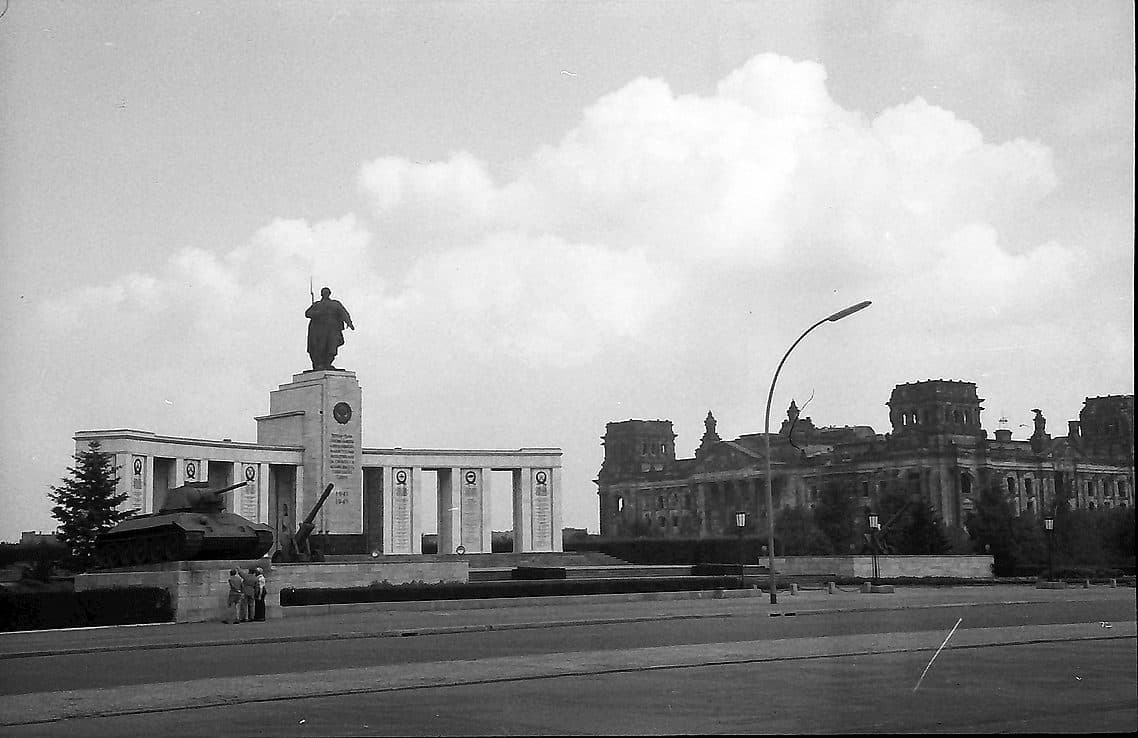
The Soviet War Memorial in the Tiergarten in July 1957, in a treeless park, with the ruined Reichstag building to the right
The memorial in July 1957, with the ruined Reichstag beside it. Photo: Willy Pragher / CC BY 4.0, via Wikimedia Commons (Landesarchiv Baden-Württemberg)

Built on Hitler’s axis

The memorial was ordered by the military council of Marshal Georgy Zhukov’s 1st Belorussian Front and designed by the sculptors Lev Kerbel and Vladimir Tsigal with the architect Nikolai Sergievsky. The site was chosen with care: the crossing of the old Charlottenburger Chaussee and the Siegesallee, 400 metres west of the Brandenburg Gate, where Albert Speer’s north–south axis for Hitler’s ‘Germania’ was to meet the east–west axis. The memorial was set across the line of the Siegesallee, blocking it.

Kerbel’s bronze soldier is 8 metres tall, his rifle slung over his shoulder as a sign that the fighting is over and his left hand held out over the graves; with its pillar the figure rises about 20 metres. Behind the colonnade, two fountains stand for the tears of the Soviet peoples. Whether the stone came from Hitler’s Chancellery has never been settled: the art historian Hans-Ernst Mittig argued that at most limestone from its outer walls could have been reused, as the memorial contains no marble.

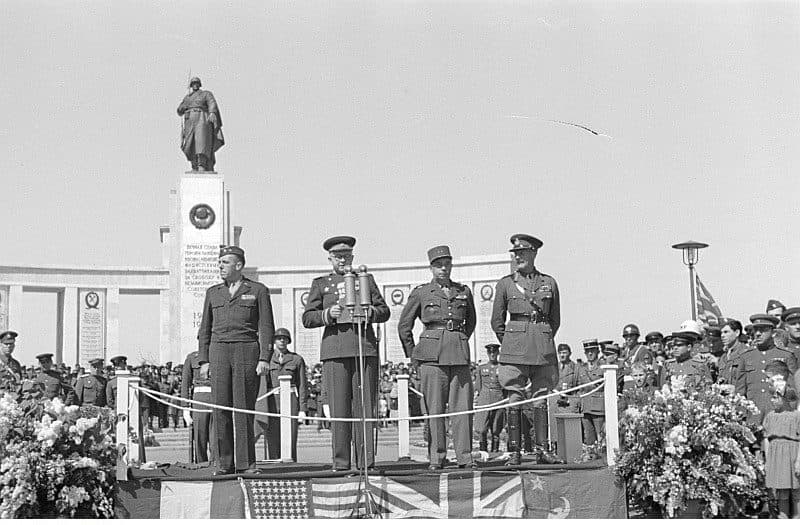
American, Soviet, French and British generals on a tribune in front of the Soviet War Memorial in the Tiergarten, Berlin, 8 May 1946
The four Allied commanders at the memorial on 8 May 1946: Keating (USA), Kotikov (USSR), Lançon (France) and Nares (UK). Photo: Abraham Pisarek / CC BY-SA 3.0 DE, via Wikimedia Commons (SLUB / Deutsche Fotothek)

One memorial, four powers

The memorial was unveiled on 11 November 1945 with a parade of Allied troops, and on 8 May 1946, the first anniversary of the German surrender, the Soviet, American, British and French commanders in Berlin stood together on a tribune in front of it. That unity did not last. The site lay inside the British sector, but under the four-power rules it remained a Soviet enclave, and Soviet honour guards came over from East Berlin to keep watch, changing shifts in front of West Berliners and tourists for 45 years.

It soon became a stage for the Cold War. After Soviet tanks put down the East German uprising of 17 June 1953, the West Berlin Senate renamed the road in front of the memorial Straße des 17. Juni on 22 June 1953. From then on, Soviet soldiers stood guard on a street named after a revolt their own army had crushed, a few hundred metres from the sector boundary at the Brandenburg Gate.

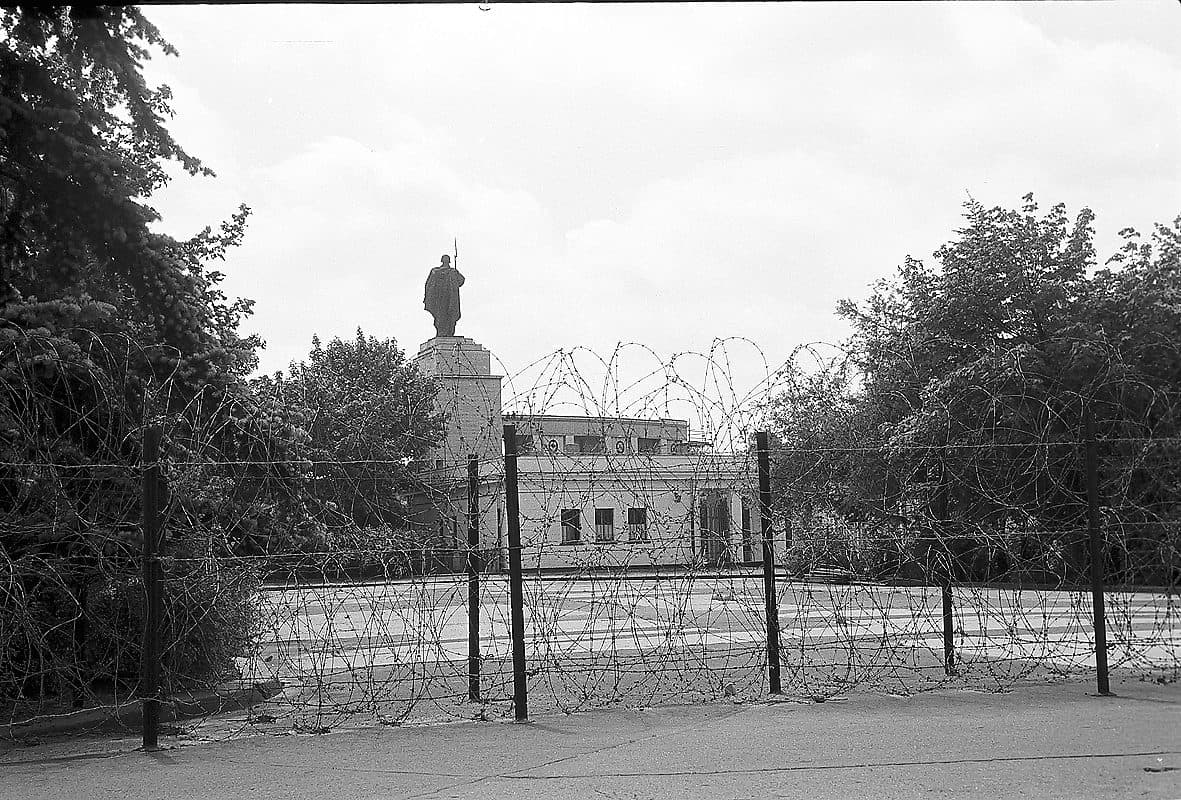
Barbed-wire fence in front of the Soviet War Memorial in the Tiergarten, West Berlin, June 1965, with the bronze soldier behind the trees
Barbed wire around the memorial in West Berlin, June 1965. Photo: Willy Pragher / CC BY 4.0, via Wikimedia Commons (Landesarchiv Baden-Württemberg)

Behind the wire: 1961 to today

After the Berlin Wall went up on 13 August 1961, the British Army sealed the memorial off and guarded the area around it, to protect the Soviet guards from angry West Berliners. The danger was real. On 7 November 1970, the anniversary of the October Revolution, the 21-year-old neo-Nazi Ekkehard Weil shot one of the guards with a small-calibre rifle and gravely wounded him; a British military court sentenced him to six years in prison. The last Soviet honour guard was mounted on 22 December 1990, and the memorial passed to the city of Berlin.

Under a 1992 agreement with Russia, Germany must protect and maintain the Soviet war graves, so the tanks, guns and inscriptions stay. A Bild petition to remove the tanks after Russia annexed Crimea in 2014 was turned down, and calls to remove them after the invasion of Ukraine in 2022 came to nothing; that spring unknown people draped them in Ukrainian flags. The memorial was restored in the mid-1990s and again in 2014, when the soldier was re-anchored and the inscriptions re-gilded.

Plan your visit

Visiting the Soviet War Memorial in the Tiergarten

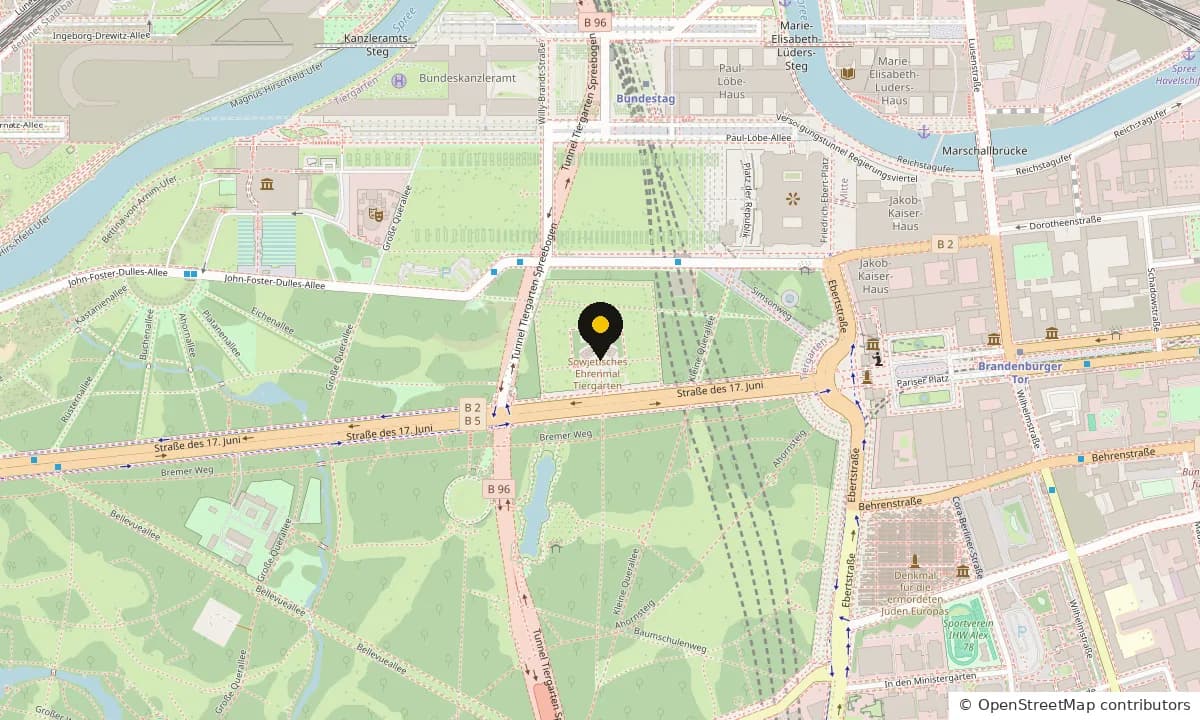
Map of the streets around the Soviet War Memorial in the Tiergarten, with a pin on the siteOpen in Google Maps

Straße des 17. Juni, 10557 Berlin · Open every day; no set hours (open-air memorial)

Getting there

  • S1S2S25S26U5Brandenburger Tor700 m · 9 min

    Walk west through the Brandenburg Gate and along the north side of Straße des 17. Juni; the memorial is on your right.

  • Bus 100Platz der Republik400 m · 5 min

    Bus 100 runs between Alexanderplatz and Zoologischer Garten via Unter den Linden and the Reichstag. From the stop, walk south through the park to Straße des 17. Juni.

  • U5Bundestag750 m · 10 min

    Walk south past the Reichstag lawn (Platz der Republik) to Straße des 17. Juni.

What you’ll see

  • The curved colonnade with Lev Kerbel’s 8-metre bronze Red Army soldier on the central pillar, above a gilded Russian inscription; English and German translations are carved on its outer ends.
  • Two T-34 tanks and two 152 mm ML-20 guns flanking the approach, and two stone sarcophagi carrying the names of officers honoured as Heroes of the Soviet Union.
  • The lawns behind the colonnade, where 2,000–2,500 soldiers lie without individual headstones, and information boards in the former guard buildings about Berlin’s Soviet memorials.

Tips from a guide

  • Visit it between the Brandenburg Gate (5 minutes) and the Reichstag (7 minutes): it lies right on the walk along Straße des 17. Juni.
  • It is a war cemetery: stay on the paths, keep voices down and don’t climb on the tanks or guns.
  • On 8 and 9 May there are commemorations, crowds and police rules on flags and symbols. Come another day for a quiet visit, or then if you want to see the ceremonies.

Accessibility

The forecourt with the tanks is at street level and reached on level paved paths from Straße des 17. Juni, but the colonnade and the statue stand at the top of flights of steps. There are no toilets at the memorial; the nearest are around the Brandenburg Gate. Check the BVG website for lift status at the stations.

Timeline

From battlefield to Cold War outpost

  1. 29 Apr–2 May 1945The Red Army fights for the Reichstag, a few hundred metres away.
  2. 2 May 1945Berlin’s garrison surrenders.
  3. 11 Nov 1945The memorial is unveiled with a parade of Allied troops.
  4. 8 May 1946The four Allied commanders mark the first anniversary of the surrender here.
  5. 22 Jun 1953West Berlin renames the road in front Straße des 17. Juni.
  6. Aug 1961After the Wall goes up, the British seal off and guard the memorial.
  7. 7 Nov 1970A neo-Nazi shoots and gravely wounds a Soviet guard.
  8. 22 Dec 1990The last Soviet honour guard; the memorial passes to Berlin.
  9. 16 Dec 1992A German–Russian agreement commits Germany to preserve the war graves.
  10. 2014Restoration before the 70th anniversary; a petition to remove the tanks fails.
  11. 2022After Russia invades Ukraine, the tanks are draped in Ukrainian flags.

See it with a historian

Tours that stop at the Soviet War Memorial in the Tiergarten

The inscriptions name the dead but not the battle or the Cold War that followed; a guide can tell you who lies here and why Soviet soldiers stood guard in West Berlin.

The race to the Reichstag in April 1945, ending where many of these soldiers fell.

The Battle Of Berlin Tour - Berlin Experiences
Full Day6 Hours

The Battle Of Berlin Tour

Private 6-hour van tour of the 1945 battlefield, from the outskirts to the Reichstag, for up to 6 people. Starts at your hotel.

€1,000up to 6
View Tour

The rise and fall of Hitler’s Berlin, from Germania’s axes to the Red Army’s arrival.

The Capital Of Tyranny Tour - Berlin Experiences
Full Day6 Hours

The Capital Of Tyranny

Private 6-hour van tour of Hitler's Berlin and the Third Reich for up to 6 people. Starts at your hotel or anywhere in the city.

€1,000up to 6
View Tour

One hour from the Brandenburg Gate through the city’s main historic sites.

The Berlin Intro Tour
One Hour1 Hour

The Berlin Intro Tour

Private 1-hour walking tour of Berlin's main historic sites for up to 10 people. Starts at Pariser Platz by the Brandenburg Gate.

€200up to 10
View Tour

Questions visitors ask

Frequently asked questions

Is the Soviet War Memorial in the Tiergarten free?

Yes. There is no ticket and no charge; it is an open-air memorial and war cemetery on Straße des 17. Juni.

When is the Soviet War Memorial open?

Every day. No opening hours are published and it is outdoors, but go in daylight to read the inscriptions.

How many soldiers are buried at the Tiergarten memorial?

Between about 2,000 and 2,500 Red Army soldiers killed in the Battle of Berlin, many in the fighting for the Reichstag. The exact number is not known, and the graves behind the colonnade have no individual headstones.

Why is there a Soviet memorial in West Berlin?

It was built in 1945, before the city split, at a site the Soviets chose on Hitler’s planned axis near the Reichstag. When the sectors were drawn it ended up in the British sector, and Soviet soldiers kept guard there until December 1990.

Are the tanks at the memorial real?

Yes. They are two wartime T-34 tanks, with two 152 mm ML-20 guns behind them. Official texts say they were among the first tanks to reach Berlin in 1945, but that claim is hard to prove.

Who designed the soldier statue?

The sculptor Lev Kerbel, working with Vladimir Tsigal and the architect Nikolai Sergievsky. The bronze soldier is 8 metres tall and stands about 20 metres above the street with its pillar.

Was the memorial built with stone from Hitler’s Chancellery?

That is often said but has never been proven. Historians think at most some limestone from the Chancellery’s outer walls could have been reused; the memorial contains no marble.

Is this the same as the Soviet memorial in Treptower Park?

No. Treptower Park, in south-east Berlin, is a separate and much larger memorial from 1949, with more than 7,000 graves. It is about 45 minutes away by public transport.

Keep exploring

More Featured Experiences.

Every site we write about — 56 landmarks, museums, memorials and lesser-known corners of Berlin. See the full index →

01Walk Through The Brandenburg Gate02Explore The State Museums On Museum Island03Visit The Berlin TV Tower – The Fernsehturm04Cross The Cold War Border At Checkpoint Charlie05Visit The Site Of Adolf Hitler’s Führerbunker06Explore The Reconstructed Berlin Palace07Visit The Reichstag Cupola At Night08Explore The Forum Fridericianum09Shop At The Humboldt University Book Sale10Journey Into The Memorial To The Murdered Jews Of Europe11Step Inside The Neue Wache12Explore The Former Jewish Quarter – Spandauer Vorstadt13Visit The Remains Of The Berlin Wall14Walk Across The Bridge Of Spies15Explore The Topography Of Terror16Climb The Prussian Victory Column – The Siegessäule17Enter The Palace Of Tears – The Tränenpalast18Step Inside The Berlin Olympic Stadium19Explore Erich Mielke’s Office At The Stasi Museum20Walk Along Karl Marx Allee21Visit The Oldest Church In Berlin – The Nikolaikirche22Explore The Berliner Dom23Visit The Grave Of Frederick The Great24Walk Through The Ruins Of Anhalter Bahnhof25Stand On The Platz Des Volksaufstandes26Visit The German Resistance Museum28See The Georg Elser Memorial On Wilhelmstrasse29Step Inside The Kaiser Wilhelm Gedächtnis Kirche30Visit The Gleis 17 Memorial31Visit The Schloss Charlottenburg Mausoleum32Climb The Französischer Dom at Gendarmenmarkt33Explore The Interbau – IBA 5734Explore The Otto Weidt Workshop35Visit Cecilienhof – Site Of The Potsdam Conference36Visit The Stasi Prison In Hohenschönhausen37Spend The Day At Tempelhof Airport38Ride The Fastest Elevator In Europe39Visit The Soviet War Memorial In Treptower Park40Visit The Sachsenhausen Concentration Camp Memorial41Visit The Ravensbrück Concentration Camp Memorial42Visit Karlshorst – The Site Of The German Surrender43Visit The Socialists Cemetery – Zentralfriedhof Friedrichsfelde44Visit The Soviet War Memorial In Pankow45Visit the Seelow Heights Memorial46Visit The Commonwealth War Cemetery47Cross The Bösebrücke At Night48Explore The Allied Museum In Dahlem49Explore The Spandau Citadel50Visit The Brandenburg T4 Euthanasia Memorial51Visit The Wannsee Conference House52Visit The Jewish Museum53Visit The Jewish Cemetery In Weissensee54Walk Along The East Side Gallery55Explore The Volkspark Friedrichshain Flak Tower56Head Up The Teufelsberg