Skip to content
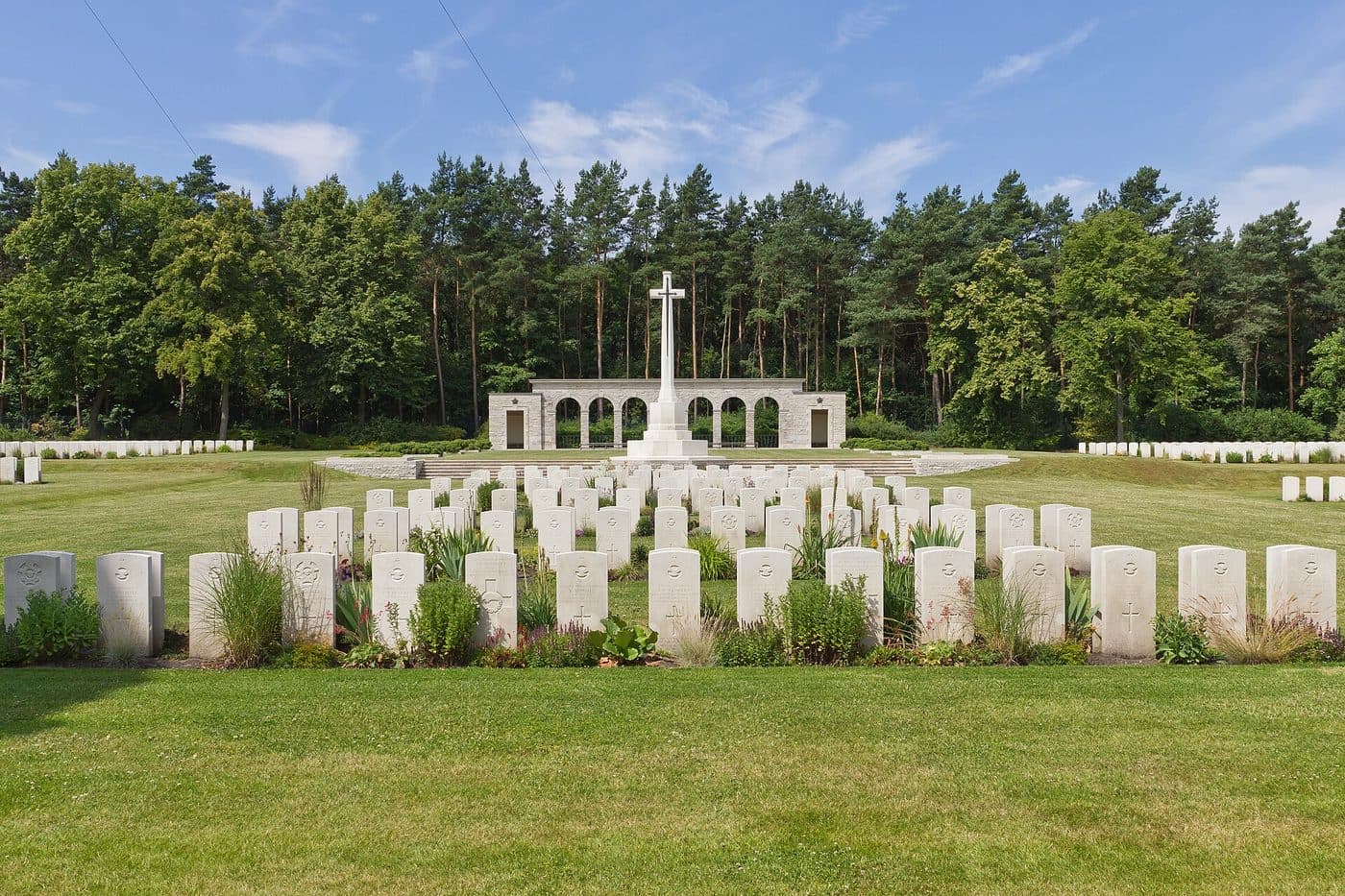
Rows of white headstones at the Berlin 1939–1945 War Cemetery on Heerstraße, with the Cross of Sacrifice and the arcade at the far end

Berlin Experiences/Featured Experiences

Berlin War Cemetery: Visit the Commonwealth War Graves on Heerstraße

Berlin’s main graveyard for British and Commonwealth airmen and POWs.

The short answer

The Berlin 1939–1945 War Cemetery is the Commonwealth War Graves Commission’s cemetery in Berlin, on Heerstraße in Westend (Charlottenburg), about 1.5 km west of the Olympic Stadium. It holds 3,595 Commonwealth graves of the Second World War, around 80% of them airmen shot down over Berlin and eastern Germany, the rest prisoners of war, plus 265 post-war graves. Anyone can visit and it is free. Allow 30 minutes to an hour; the nearest station is Pichelsberg (S3, S9), about 12 minutes’ walk.

Where
Heerstraße 151, 14055 Berlin-Westend (Charlottenburg)
Open
No set hours published: check cwgc.org before you go
Admission
Free
Time needed
30–60 minutes
Nearest station
S3/S9 Pichelsberg, 12 minutes on foot
Step-free
Not at the gate (5 steps); side entrance by arrangement

The story · by Matt Robinson

The encirclement of Berlin by the forces of Stalin’s Red Army, on April 25th 1945, was not the first time that war arrived to the streets of the Nazi capital.

Nor could it be said that the opening volleys of Soviet artillery hitting the city on April 20th were the start of Berlin’s physical ruin. The Battle of Berlin, in many ways, began much earlier. Capable of inflicting a measure of carnage unprecedented before the early 20th century, the air fleets of the British Royal Air Force and United States Army Air Force had been repeatedly pounding the city since 1940. Five years before the arrival of Soviet ground forces. Gradually reducing the blackened heart of the Third Reich to smouldering rubble.

With geography and technology more often than not limiting conflict to the frontiers of any belligerent state – never before in human history had the capital of an enemy power been subjected to so much; and from such a distance. Over the course of these five years, Berliners would endure more than 350 independent air raids.

Some, like those on November 22nd 1943, carried out by the British, and February 3rd 1945, by the US forces – would remain etched into the minds of the city’s residents for their ferocity and randomness long after the final shots of the war had been fired. For as predictable as these raids would become in their regularity, they would remain distinctly inaccurate when measured by their capability of hitting valuable targets. In almost all instances it would be the everyday residents and infrastructure of the city, as much as the munitions factories, government buildings, and military fortifications, that would bear the brunt of the Allied bombardment.

The first raids on Berlin

The first British raid on Berlin took place in August 1940 – almost one year after the German invasion of Poland. Ninety-five aircraft were dispatched to attack Tempelhof Airport and the Siemensstadt area of the city; of which eighty-one made it to Berlin – inflicting minor, but symbolic, damage on the city. A response to a German raid that had accidentally targeted London earlier in the month and would precipitate the ‘Blitz’ attacks at the late stage of the Battle of Britain. Until this point, attacks of cities had been largely restricted to military targets and against infrastructure of direct military importance – such as ports and railways.

Headstones of Flying Officer F. E. Claydon and Pilot Officer A. E. Barnes, RAF, killed 14 January 1944, at the Berlin 1939–1945 War Cemetery
Two airmen of the same crew, killed on 14 January 1944.

At the start of the Second World War, US President Franklin D. Roosevelt had implored the European powers to restrict their air attacks to military targets, to minimise civilian casualties. A warning that the German war machine had repeatedly chosen to ignore – targeting and terrorising civilian populations in cities across the continent. Following the Luftwaffe attack on Rotterdam in May 1940 – the Royal Air Force had gradually begun to adopt a policy of ‘area bombing’ — large-scale bombing of German cities to destroy housing and civilian infrastructure. Increasing raids on Germany in the hope of crippling the country and forcing a German surrender.

Bomber Command’s war

Berlin would be just one of the many German cities targeted from 1940 until 1945, and by the end of the war the men of Royal Air Force Bomber Command had flown some 364,514 operational sorties, with 1,030,500 tons of bombs dropped and 8,325 aircraft lost in action.

The death rate stood at 44.4% – with 55,573 airmen killed out of a total of 125,000 in service.

The cemetery

Around 2,800 of the Royal Air Force airmen shot down over Berlin and the surrounding areas of eastern Germany would end up buried in Berlin’s Commonwealth War Cemetery, now located in the district of Charlottenburg – a short walk from the Olympic Stadium. With airmen accounting for around 80% of the total 3,595 Commonwealth casualties from the Second World War in the cemetery, the remainder being prisoners of war – 397 of these remain unidentified.

RAF and Royal Australian Air Force headstones from January 1944 at the Commonwealth War Cemetery in Berlin, with the Cross of Sacrifice behind
RAF and Australian graves, with the Cross of Sacrifice and the arcade behind.

Walking through the cemetery gates today, the visitor is greeted with a uniform layout typical of Commonwealth cemeteries – plain white grave steles made of English Portland stone, grouped together in a trapezoid shape, serve to commemorate the deceased. Listed as 2,676 British casualties, 527 Canadians, 223 Australians, 56 New Zealanders, 50 Indians, 31 South Africans, 5 Poles and 8 of unknown nationality. The whole area of the cemetery follows a basic pattern established by the British parliament for military cemeteries since 1918, which prescribes two main monuments: a ‘stone of remembrance’ with the inscription “Their name liveth for evermore” and one based on the Celtic cross and with an embedded bronze crusader sword marked “Cross of Sacrifice”.

As the main Commonwealth Cemetery in Berlin, established after the end of the Second World War, this location also serves as the final resting place for 265 men of the British Occupation Forces or their dependants, or of members of the Control Commission.

Although the vast majority remain as casualties of one of the most controversial operations carried out by the Allied forces during the war.

A front in the sky

In first attacking Berlin, Great Britain was undoubtedly sending a strong message in 1940, that as the only major power then fighting Nazi Germany, it was capable of bombing the heart of the Nazi Reich, even though it lay so far behind the front lines. An important accomplishment to acknowledge at the time. However, much debate has been undertaken as to whether it is possible to tally the Allied air raids against the tremendous loss of life that the RAF suffered – and inflicted – over the course of the war.

Despite the mass attacks of the Battle of Berlin in 1943–44 by RAF Bomber Command and the later raids carried out by the USAAF, Berlin was never overwhelmed or broken. RAF Bomber Command chief, Arthur Harris’ famous prediction that the bombing of the Nazi capital would cost Germany the war never materialised. While there were temporary breakdowns in the supply of power and water, the administration in the city acted swiftly to limit lasting damage. And even though nearly every factory in the city was at some point hit, none of the large factories were completely destroyed. Fire fighting and reconstruction of these factories – often utilising the vast swathes of slave labour and concentration camp prisoners that the Nazis lorded over – had the highest priority.

Green Commonwealth War Graves sign reading ‘Berlin 1939–1945 War Cemetery’ at the entrance on Heerstraße, Berlin
The CWGC sign at the entrance on Heerstraße.

In turning Berlin into a frontline city though, the attacks on Berlin did manage to force upon Hitler’s regime another front to deal with – one in the sky.

As every anti-aircraft gun or fighter aircraft kept back in the Nazi capital was one less that might be despatched elsewhere.

The RAF attacks on Berlin have overwhelmingly been deemed a failure in achieving their objective of exclusively forcing a German surrender by historians concerned with the subject. But for the 55,000 airmen who perished on these missions and the majority of those buried in the Commonwealth War Cemetery in Berlin who would not live to see the end of the war, their sacrifices would not prove to have been in vain. The memory of their contribution to the defeat of National Socialism lives on – preserved in this finely manicured cemetery. Prime real estate in what was previously the capital of Nazi Germany.
The Berlin War Cemetery in detail

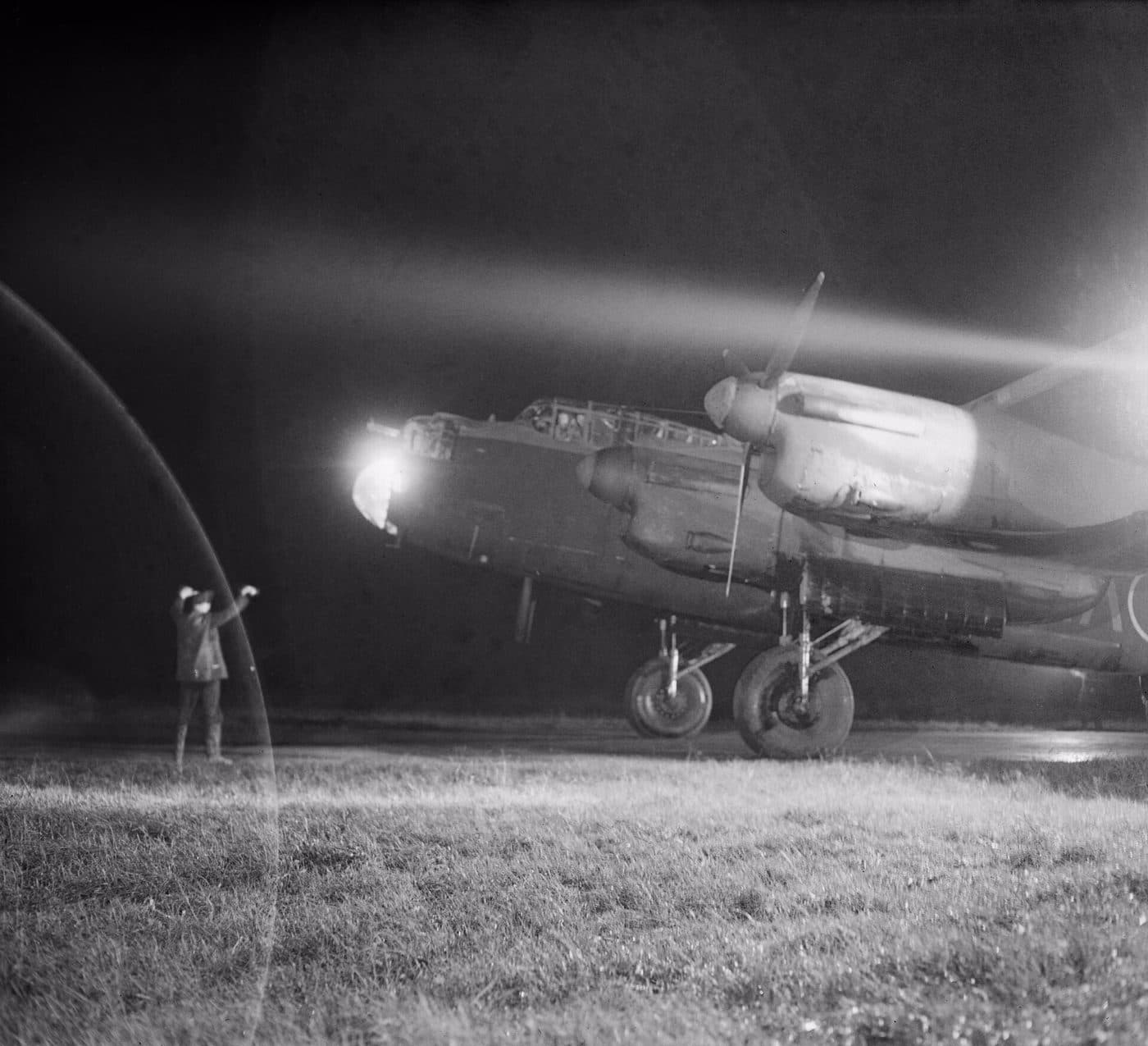
A ground crewman guides Lancaster bomber ‘D for Donald’ of No. 49 Squadron RAF to dispersal at Fiskerton after the Berlin raid of 22 November 1943
A No. 49 Squadron Lancaster back at Fiskerton after the Berlin raid of 22–23 November 1943. Photo: Miller (F/O), Royal Air Force official photographer, IWM CH 11642 / Public domain, via Wikimedia Commons

The Battle of Berlin, 1943–44

Berlin lay about 950 km from London, at the edge of what the early bombers could reach, and for the first years of the war it was hit only by smaller raids. That changed when Arthur Harris, head of Bomber Command from February 1942, had the four-engined Lancaster in numbers. On the night of 18–19 November 1943 he opened what became the Battle of Berlin, promising that it would cost 400 to 500 aircraft and “cost Germany the war”. Between then and March 1944 Bomber Command made 16 massed attacks on the city.

The raid of 22–23 November 1943 was the most destructive: firestorms burned through Tiergarten, Charlottenburg and Schöneberg, about 2,000 Berliners were killed and 175,000 lost their homes. But the 16 raids cost more than 500 aircraft, a loss rate of 5.8%, above what the RAF thought it could sustain. Many of the crews who did not come home that winter now lie at Heerstraße. Britain’s official historians later called the battle not just a failure but a defeat.

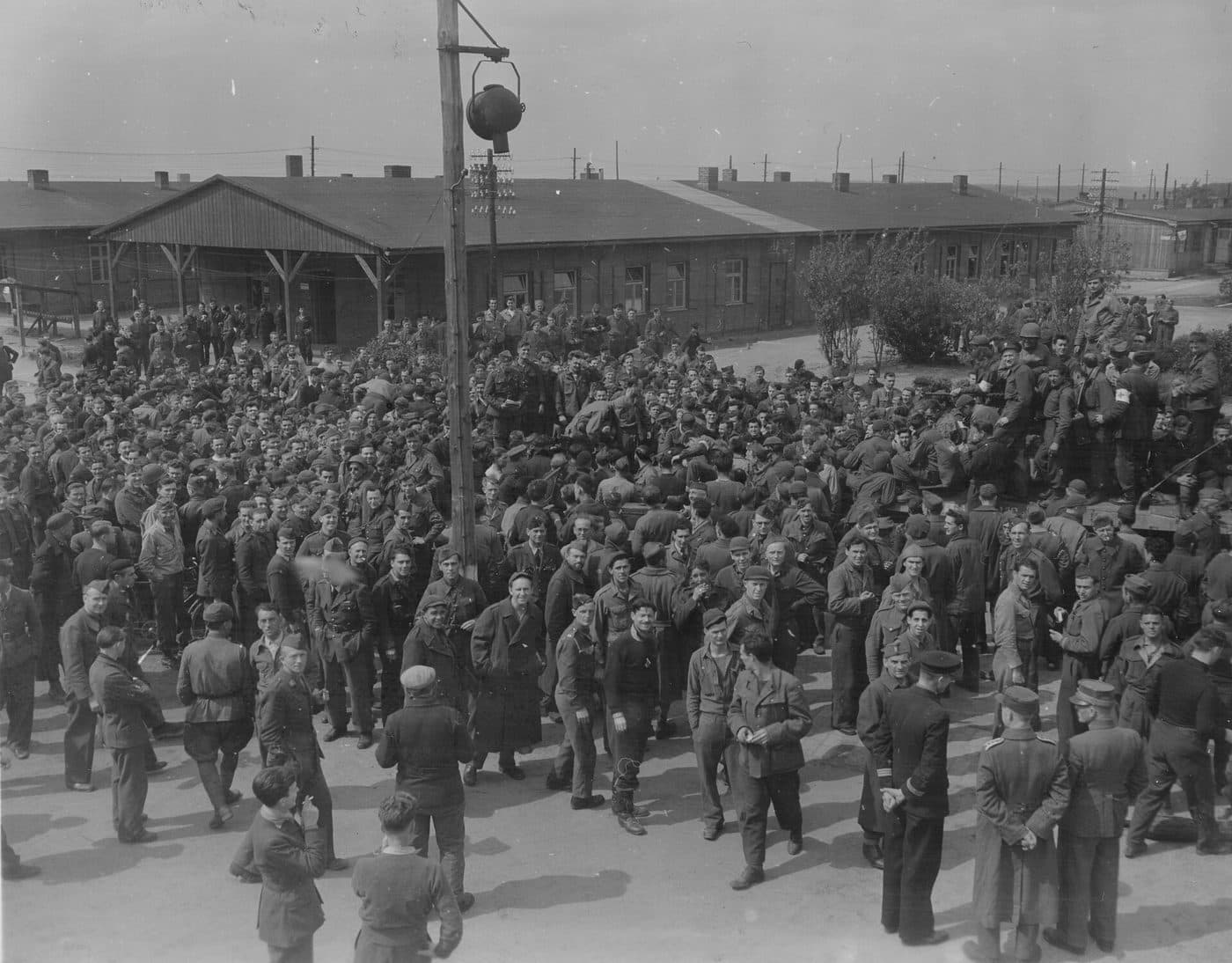
Liberated British and American prisoners of war crowd the camp street at Stalag III-A, Luckenwalde, south of Berlin, May 1945
Liberated British and American prisoners at Stalag III-A, Luckenwalde, south of Berlin, 4 May 1945. Photo: T/4 John E. Freeney, US Army Signal Corps, SC 335544 / Public domain, via Wikimedia Commons

Who lies here

Most of the dead were aircrew shot down over Berlin and the towns of eastern Germany, and they came from all over the Commonwealth: Canadians are the largest group after the British, then Australians and New Zealanders. They were first buried where they fell or in local cemeteries. After the war the Commission brought them in from more than 25 places, among them Leipzig, Dresden, Magdeburg, Rostock and Potsdam, which by then lay in the Soviet zone.

The rest were prisoners of war. Some died in camps, others on the forced marches of early 1945, when the Germans emptied camps in Poland and drove the prisoners west in deep winter ahead of the Red Army. Among the dead are 50 Indian soldiers; the graves of Hindus, Sikhs and Muslims lie in their own rows in the north-west. A post-war plot in the south-west holds 265 men of the British occupation forces and the Control Commission, and their dependants.

The Cross of Sacrifice and the seven-arched arcade at the west end of the Berlin 1939–1945 War Cemetery, with rows of headstones in front
The Cross of Sacrifice and Hepworth’s arcade, 2014. Photo: A.Savin / CC BY-SA 3.0, via Wikimedia Commons

How the cemetery was made

British occupation officials and the Commission chose the site on Heerstraße together in 1945, soon after the fighting ended, on the edge of the Grunewald forest in the British sector. According to Berlin’s monument office, the dead were first buried in a temporary military cemetery between Trakehner Allee and Heilsberger Allee, near the Olympic Stadium, and moved here in 1959 when that site was given up.

The cemetery itself was laid out in 1955–57 by the British architect Philip Dalton Hepworth with the Berlin Senate’s building department. It follows the rules Sir Frederic Kenyon set out in 1918 for every Commonwealth war cemetery: identical headstones whatever a man’s rank, Lutyens’s Stone of Remembrance and Blomfield’s Cross of Sacrifice. A symmetrical main axis runs from the gatehouse in the east to the arcade in the west, crossed by an avenue of chestnut trees, and the plots fan out down the slope towards Heerstraße. It is the only Commonwealth war cemetery in Berlin.

Plan your visit

Visiting the Berlin War Cemetery

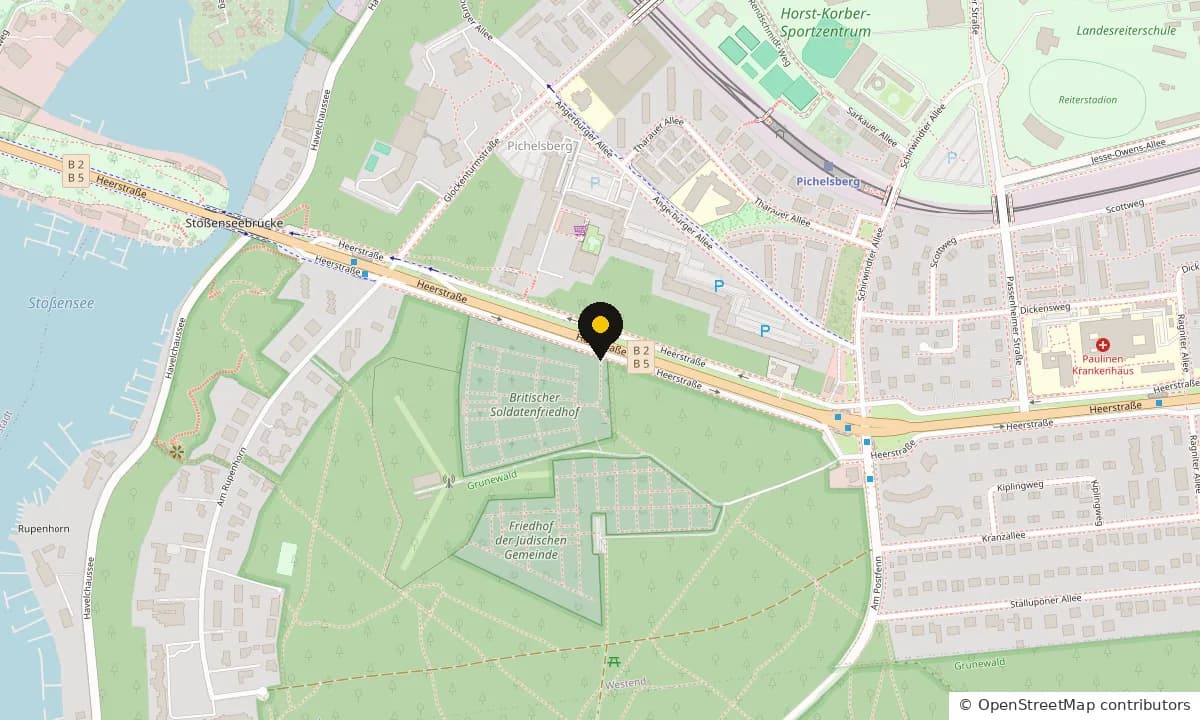
Map of the streets around the Berlin War Cemetery, with a pin on the siteOpen in Google Maps

Heerstraße 151, 14055 Berlin · The CWGC publishes no fixed opening hours for this cemetery. Go in daylight and check the CWGC page before you go.

Getting there

  • S3S9Pichelsberg900 m · 12 min

    15 minutes from Zoologischer Garten, 22 from Hauptbahnhof. Walk south on Schirwindter Allee to Scholzplatz, cross Heerstraße and turn right: the gate is on the small road running parallel to Heerstraße.

  • Bus M49Bus X34Bus 218Scholzplatz400 m · 5 min

    The M49 and X34 run along Heerstraße from Zoologischer Garten. Walk west along the south side of Heerstraße to the CWGC sign.

  • U2Theodor-Heuss-Platz8 min by bus, then 5 min on foot

    Change to the M49 or X34 heading west; Scholzplatz is 6–8 minutes away.

What you’ll see

  • The gatehouse of three shell-limestone arches with wrought-iron gates, and in its southern corner building the cemetery register in a wall cabinet.
  • Rows of Portland stone headstones in 15 plots, the Stone of Remembrance (“Their name liveth for evermore”) at the centre and the Cross of Sacrifice before the seven-arched arcade at the west end.
  • Whole bomber crews buried side by side with the same date of death, the Hindu, Sikh and Muslim graves in the north-west and the post-war plot in the south-west.

Tips from a guide

  • Looking for someone? Search the CWGC’s Find War Dead database before you go: it gives the plot, row and grave number.
  • Read the dates: graves with the same date in one row are usually one aircraft’s crew. The worst nights of the Battle of Berlin, November 1943 to March 1944, fill whole rows.
  • Combine it with the Olympic Stadium, 30 minutes’ walk east, or a walk in the Grunewald: the Teufelsberg is about 30 minutes south through the forest.

Accessibility

There are five steps at the main entrance. A step-free entrance at the back of the cemetery is reached by a private road leading to a TV station; to use it, tell the CWGC in advance (Enquiries, +44 1628 507200) so local staff can let the station know. The paths inside are grass and gravel. There are no toilets or café at the cemetery.

Timeline

From the first raids to Heerstraße

  1. 7 Jun 1940The French naval bomber Jules Verne drops the first Allied bombs on Berlin.
  2. 25 Aug 1940First RAF raid on Berlin: 95 aircraft sent, 81 bomb the city.
  3. Feb 1942Arthur Harris takes over RAF Bomber Command.
  4. 18 Nov 1943Bomber Command opens the Battle of Berlin.
  5. 22 Nov 1943The most destructive RAF raid on Berlin; firestorms in the western districts.
  6. 24 Mar 1944The last big RAF raid of the Battle of Berlin, after 16 massed attacks.
  7. 3 Feb 1945The largest American raid on Berlin hits the city centre by day.
  8. 20 Apr 1945The last of 36 nights of RAF Mosquito raids, as the Red Army closes in.
  9. 1945British officials and the Commission choose the site on Heerstraße.
  10. 1955–57The cemetery is laid out to designs by Philip Dalton Hepworth.
  11. 1959The temporary cemetery off Trakehner Allee closes; its dead are moved here.

See it with a historian

Tours that stop at the Berlin War Cemetery

The cemetery is a long way out of the centre; on a private van tour a guide can take you there and explain the air war, the crews and the prisoners behind the names.

The last weeks of Hitler’s capital in 1945, across what remains of the battlefield.

The Battle Of Berlin Tour - Berlin Experiences
Full Day6 Hours

The Battle Of Berlin Tour

Private 6-hour van tour of the 1945 battlefield, from the outskirts to the Reichstag, for up to 6 people. Starts at your hotel.

€1,000up to 6
View Tour

The rise and fall of the Third Reich, through what remains of Hitler’s Berlin.

The Capital Of Tyranny Tour - Berlin Experiences
Full Day6 Hours

The Capital Of Tyranny

Private 6-hour van tour of Hitler's Berlin and the Third Reich for up to 6 people. Starts at your hotel or anywhere in the city.

€1,000up to 6
View Tour

The all-in-one overview of Berlin’s history, six hours by private van.

The Berlin History Tour
Full Day6 Hours

The Berlin History Tour

Private 6-hour van tour of Berlin's whole history in one day for up to 6 people. Starts at your hotel or anywhere in the city.

€1,000up to 6
View Tour

Questions visitors ask

Frequently asked questions

Where is the Commonwealth War Cemetery in Berlin?

At Heerstraße 151, 14055 Berlin, on the south side of Heerstraße in Westend, between the Olympic Stadium and the Havel. The entrance is on the small road running parallel to Heerstraße, about 400 metres west of Scholzplatz.

Is the Berlin War Cemetery free to visit?

Yes. There is no charge and no booking. The CWGC publishes no fixed opening hours for this cemetery, so go in daylight and check its page before you go.

Who is buried in the Berlin 1939–1945 War Cemetery?

Mostly Commonwealth airmen shot down over Berlin and eastern Germany, around 80% of the wartime burials; the rest are prisoners of war. There are also 265 post-war graves of British occupation personnel and their dependants.

How many graves are there?

The CWGC counts 3,595 Commonwealth burials of the Second World War, 397 of them unidentified, plus 265 post-war graves and 6 foreign national burials.

How do I find a specific grave?

Search the CWGC’s Find War Dead database by name: the record gives the plot, row and grave number. The cemetery register is also kept in a cabinet in the gatehouse.

How do I get to the Berlin War Cemetery by public transport?

Take the S3 or S9 to Pichelsberg (15 minutes from Zoologischer Garten) and walk about 12 minutes, or take the M49 or X34 bus to Scholzplatz, 5 minutes’ walk away.

Is the cemetery wheelchair accessible?

The main entrance has five steps. There is a step-free entrance at the back via a private road, but you need to tell the CWGC in advance so it can be opened.

Is it the same as Friedhof Heerstraße?

No. Friedhof Heerstraße is a separate municipal cemetery on Trakehner Allee by the Olympic Stadium, about 2 km east, known for its many honorary graves.

Keep exploring

More Featured Experiences.

Every site we write about — 56 landmarks, museums, memorials and lesser-known corners of Berlin. See the full index →

01Walk Through The Brandenburg Gate02Explore The State Museums On Museum Island03Visit The Berlin TV Tower – The Fernsehturm04Cross The Cold War Border At Checkpoint Charlie05Visit The Site Of Adolf Hitler’s Führerbunker06Explore The Reconstructed Berlin Palace07Visit The Reichstag Cupola At Night08Explore The Forum Fridericianum09Shop At The Humboldt University Book Sale10Journey Into The Memorial To The Murdered Jews Of Europe11Step Inside The Neue Wache12Explore The Former Jewish Quarter – Spandauer Vorstadt13Visit The Remains Of The Berlin Wall14Walk Across The Bridge Of Spies15Explore The Topography Of Terror16Climb The Prussian Victory Column – The Siegessäule17Enter The Palace Of Tears – The Tränenpalast18Step Inside The Berlin Olympic Stadium19Explore Erich Mielke’s Office At The Stasi Museum20Walk Along Karl Marx Allee21Visit The Oldest Church In Berlin – The Nikolaikirche22Explore The Berliner Dom23Visit The Grave Of Frederick The Great24Walk Through The Ruins Of Anhalter Bahnhof25Stand On The Platz Des Volksaufstandes26Visit The German Resistance Museum27Visit The Soviet War Memorial In The Tiergarten28See The Georg Elser Memorial On Wilhelmstrasse29Step Inside The Kaiser Wilhelm Gedächtnis Kirche30Visit The Gleis 17 Memorial31Visit The Schloss Charlottenburg Mausoleum32Climb The Französischer Dom at Gendarmenmarkt33Explore The Interbau – IBA 5734Explore The Otto Weidt Workshop35Visit Cecilienhof – Site Of The Potsdam Conference36Visit The Stasi Prison In Hohenschönhausen37Spend The Day At Tempelhof Airport38Ride The Fastest Elevator In Europe39Visit The Soviet War Memorial In Treptower Park40Visit The Sachsenhausen Concentration Camp Memorial41Visit The Ravensbrück Concentration Camp Memorial42Visit Karlshorst – The Site Of The German Surrender43Visit The Socialists Cemetery – Zentralfriedhof Friedrichsfelde44Visit The Soviet War Memorial In Pankow45Visit the Seelow Heights Memorial47Cross The Bösebrücke At Night48Explore The Allied Museum In Dahlem49Explore The Spandau Citadel50Visit The Brandenburg T4 Euthanasia Memorial51Visit The Wannsee Conference House52Visit The Jewish Museum53Visit The Jewish Cemetery In Weissensee54Walk Along The East Side Gallery55Explore The Volkspark Friedrichshain Flak Tower56Head Up The Teufelsberg