Skip to content
The green steel Glienicke Bridge, the Bridge of Spies, spanning the River Havel between Berlin-Wannsee and Potsdam, with a canoe on the water

Berlin Experiences/Featured Experiences

Glienicke Bridge: Walk Across the Bridge of Spies

The famous Cold War crossing between East Germany and West Berlin.

The short answer

The Glienicke Bridge (Glienicker Brücke) carries the B1 road across the River Havel between Berlin-Wannsee and Potsdam, about 25 km south-west of central Berlin. During the Cold War the border between West Berlin and East Germany ran across its middle, and the Americans and Soviets exchanged captured agents here three times, in 1962, 1985 and 1986, which earned it the name Bridge of Spies. Today it is an ordinary road bridge with pavements on both sides: free, open at all hours, and a walk across and back takes about 20–30 minutes. Tram 93 and Bus 316 both stop at the Potsdam end.

Where
On the B1 between Königstraße, Berlin-Wannsee, and Berliner Straße, Potsdam
Open
Always: a public road bridge with pavements
Admission
Free
Time needed
20–30 minutes; longer with Glienicke Park
Nearest station
Glienicker Brücke (Tram 93, Bus 316), at the Potsdam end
Step-free
Yes: level pavements on both sides

The story · by Matt Robinson

The two-tone truss Glienicker Brücke stretches across the River Havel, connecting Berlin with neighbouring Potsdam – a larger than life symbol of the Cold War division of Germany and its capital city.

Although originally completed in 1907, this eleven metre wide steel bridge has become most popularly known for its role as a border crossing during the Cold War period and for the tense exchanges in human capital that took place here.

The most famous, that of US spy plane pilot, Gary Powers, who was shot down over the Soviet Union in 1960 and then exchanged here two years later for Soviet intelligence officer Rudolf Abel – earning this structure the moniker, the ‘Bridge of Spies’.

On crossing the bridge today, not only is it possible to move from Berlin to Potsdam, but in the process from the state of Berlin to the state of Brandenburg – and the capital of Brandenburg, which incidentally is also Potsdam.

The road deck and green steel arches of the Glienicke Bridge (Glienicker Brücke), seen from the pavement beside its stone pier
Looking along the bridge from its stone pier.

During the Cold War period the additional significance was that, with the border established here, anyone leaving Berlin – and the Western district of Wannsee in the US sector – would be then entering East Germany and the countryside of Brandenburg surrounding the divided German capital.

The border on the bridge

Heavily damaged at the end of the Battle of Berlin in 1945, the Glienicker Brücke had to be rebuilt – a project completed in 1949, the same year as both East and West Germany were established. A white line was soon introduced in the centre of the bridge, indicating the border between the German Democratic Republic (East Germany) and West Berlin (consisting of the combined US, British, and French occupation sectors).

At around the same time, the bridge was painted different shades of green.

It is still possible to see this difference on the structure today, with the Brandenburg side different from the Berlin side, and a metal strip (instead of a white line) extending across the centre of the bridge. On closer inspection the words “German division until 1989” are now visible in German, on this metal band.

Stone centaur sculpture by Stephan Walter on its pedestal at the Potsdam end of the Glienicke Bridge
One of the four sculptures by Stephan Walter that guard the bridge’s ends.

From 1952 until 1989, it was only possible to cross this bridge with a special permit – with Soviet military checkpoints set up for members of the military missions in Berlin – the US, French, and British troops stationed there.

Despite the worldwide fame that this crossing point would achieve as the ‘Bridge of Spies’ – there were only actually three exchanges that took place here. That of Francis Gary Powers for Rudolf Abel in 1962; a mass exchange of 23 Western operatives for four Eastern Bloc spies in 1985; and four prisoners held by the Eastern Bloc, among them the Soviet dissident Natan Sharansky, swapped for five Eastern Bloc agents held in the West in 1986. With this bridge specifically chosen as it was the only crossing between the East and West that fell completely under Soviet, and not East German control – and the exchanges could be carried out without the interference of the East German authorities.

Before the Cold War

Berlin’s relationship with nearby Potsdam has long since been defined by the investment that the former Hohenzollern royal family made in the area, when choosing to construct their summer residences west of the Prussian capital and in this neighbouring city.

The most famous of these palaces being Sanssouci, constructed in 1747 by King Frederick II (also known as Frederick the Great).

When, seven years later, a permanent mail connection was introduced between Berlin and Potsdam, the carriages responsible for delivery would drive across a small wooden bridge built at this point on the river Havel. Following Frederick the Great’s death, and due to increased traffic, the bridge would be fully absorbed into the Berlin-Potsdamer Chaussee with the introduction of a toll system and the construction of a Chausseehaus (Toll House) next to the bridge here. Which by the end of the 18th century had developed into a wooden drawbridge to allow for increased river traffic.

The colonnade and sculpture at the Potsdam end of the Glienicke Bridge, with the green steel arches behind
The colonnade at the Potsdam end, built with the bridge in 1907.

This route would later be integrated into the Reichsstrasse 1, which from 1934 until 1945 ran 1392 kilometres across Europe – from the Dutch border near Aachen to the Polish corridor in West Prussia via Berlin.

Since the end of the Second World War, the section that remains in German territory has been known as Bundesstrasse 1 (in East Germany, until 1990, its stretch was the F 1, Fernverkehrsstraße 1) – and crosses the Glienicker Brücke as it enters Berlin from Potsdam.

Since 1989

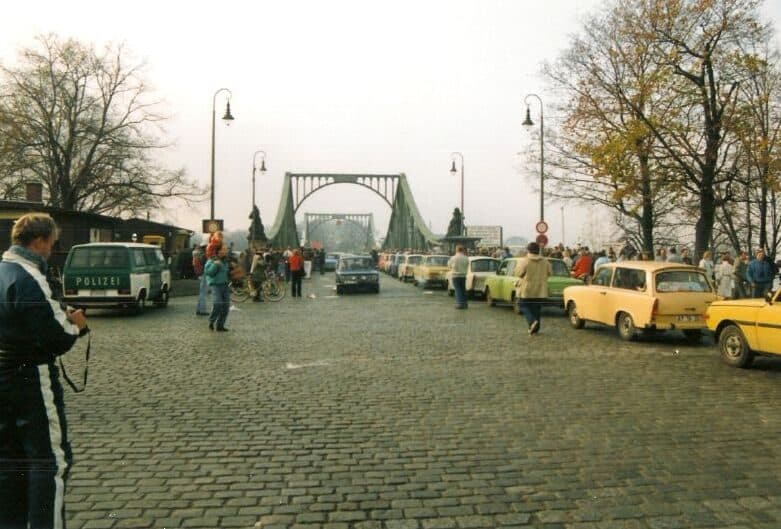
One day after the ‘Fall of the Berlin Wall’ in 1989, the Bridge of Spies was opened to pedestrian traffic and cars – with long lines of East German Trabants queued up to shuttle people back and forth across this now defunct border crossing which for almost three decades had remained symbolically closed to ordinary East Germans. Although, even during the Cold War period, attempted, and successful escapes were not unheard of here.

In 1988, three people from the East even managed to smash through the barriers on the bridge and escape to the West in an industrial truck.

Since 1990, the Glienicker Brücke has been part of the UNESCO World Heritage List of Parks and Palaces in Potsdam and Berlin, as the connecting element between these two cities.

Walking across the bridge today, it is possible to retrace the steps taken by those Cold War spies and released prisoners here, at the height of a conflict that appeared to have no end in sight – and the jubilant crowds of people who gathered here in 1989 to celebrate the unexpected end of this era.

As the river Havel continues to flow slowly under this important symbol, it stands silent witness to all that has occurred here over the last 100 years of its life – and as a conduit to freedom of movement where there previously was so little.
The Glienicke Bridge in detail

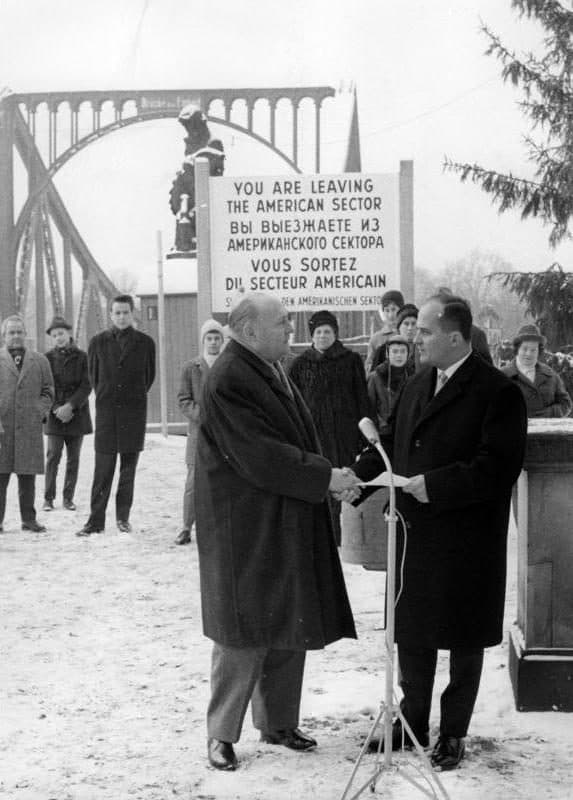
The ‘You are leaving the American sector’ sign at the West Berlin end of the Glienicke Bridge, December 1962, with West German ministers Ernst Lemmer and Rainer Barzel shaking hands
West German ministers Ernst Lemmer and Rainer Barzel at the bridge’s American-sector sign, 29 December 1962. Photo: Bundesarchiv, Bild 175-Z02-00780 / Jung, Joachim G. / CC-BY-SA 3.0

Why the spies were swapped here

After the Glienicke Bridge reopened in 1949 it was mainly used by the Allies, as the link between West Berlin and their military liaison missions in Potsdam. On 27 May 1952 East Germany closed it to West Berliners and West Germans, and after the Berlin Wall went up in August 1961 East Germans could no longer cross either. From then on only Allied military personnel and diplomats were allowed over.

That made it unique. Every other crossing out of West Berlin was run by the East German border troops; the Glienicke Bridge was the only one under full Soviet control. Both superpowers could reach it easily from Berlin, the approaches could be sealed off, and an exchange could happen without East German officials in the way. The KGB watched from the nearby Villa Kampffmeyer. Reporters soon called it the Bridge of Spies.

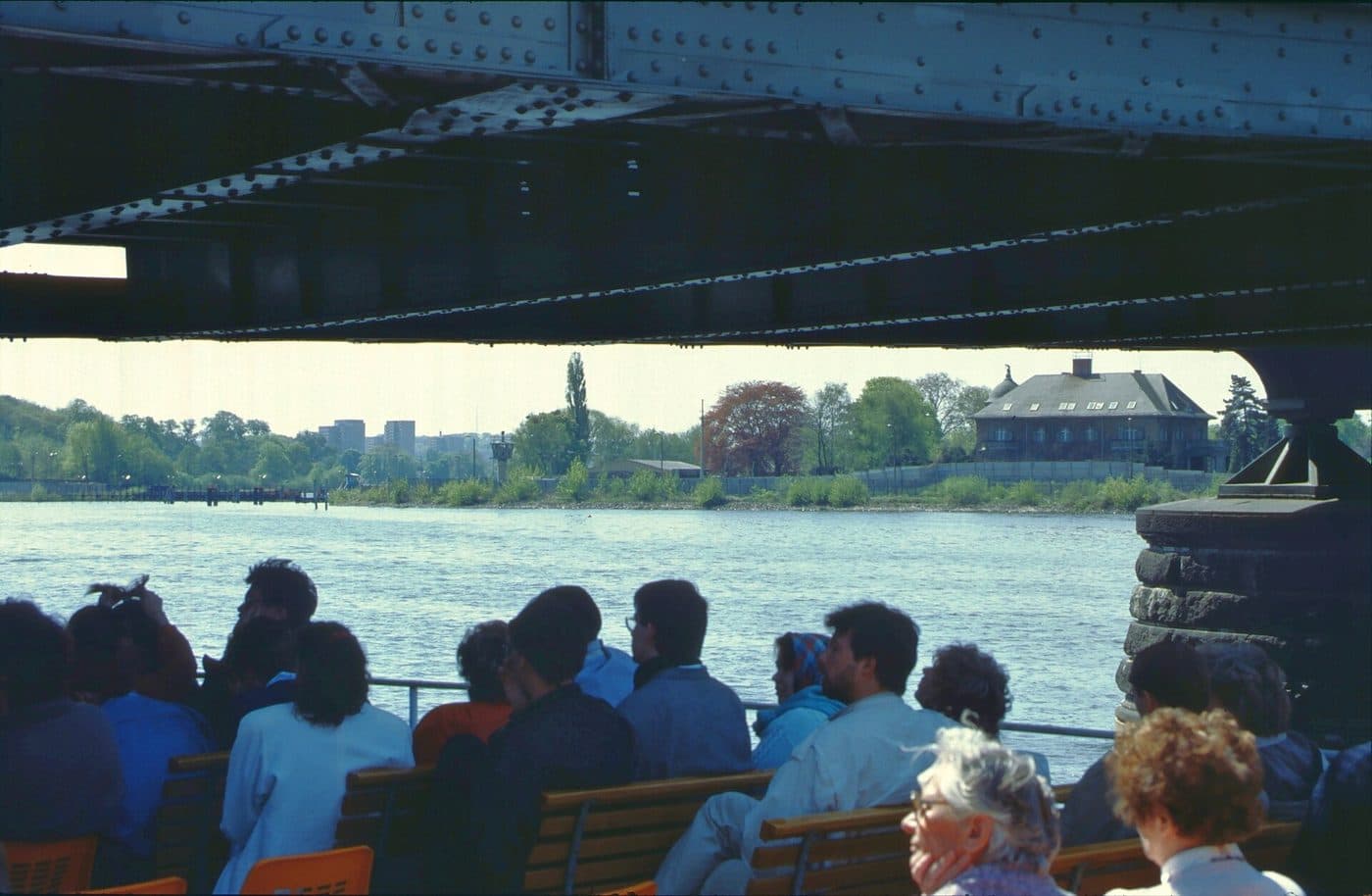
View from a boat under the Glienicke Bridge in May 1989, looking across the Havel to the East German bank at Potsdam
Under the bridge from the West Berlin side, May 1989: the far bank was East Germany. Photo: Lothar Weber / CC BY-SA 4.0, via Wikimedia Commons

The three exchanges

The first came early on 10 February 1962. The Soviet intelligence officer Rudolf Abel, convicted of espionage in the United States in 1957, walked one way; Francis Gary Powers, the U-2 pilot shot down over the Soviet Union in May 1960, walked the other. The American student Frederic Pryor was freed at Checkpoint Charlie the same morning as part of the deal. The story became Steven Spielberg’s film Bridge of Spies (2015), shot partly on the bridge itself.

The second, on 11 June 1985, was the largest: 23 prisoners held in East Germany and Poland, many of them convicted of spying for the West, were traded for four Eastern Bloc agents arrested in the West, among them the Polish officer Marian Zacharski. The last, on 11 February 1986, was the most public: the Soviet dissident Anatoly Shcharansky, sent across first, and three Western agents for five Eastern ones, including the Czechoslovak couple Karl and Hana Koecher. The East Berlin lawyer Wolfgang Vogel brokered both.

Trabant cars and pedestrians crossing the Glienicke Bridge in November 1989, days after the border opened
Trabants on the bridge in November 1989. Photo: Gavin Stewart / CC BY 2.0, via Wikimedia Commons

From border to open bridge

On the evening of 10 November 1989, the day after the Wall opened in central Berlin, the barriers on the Glienicke Bridge were lifted and Potsdamers poured across, many in their Trabants, to be met by crowds from Wannsee. The Unification Treaty of 1990 formally ended all controls, and that winter workers tore down the Soviet guard posts and the rest of the border installations.

Today the bridge carries the B1 as it always did. In the middle, a metal strip in each pavement, laid in 2012, marks the old border line. On 10 November 1999 Wieland Förster’s bronze Nike 89 was unveiled at the bridge to mark the tenth anniversary of the opening, and the landscape around it is part of the UNESCO World Heritage Site of the Palaces and Parks of Potsdam and Berlin.

Plan your visit

Visiting the Glienicke Bridge

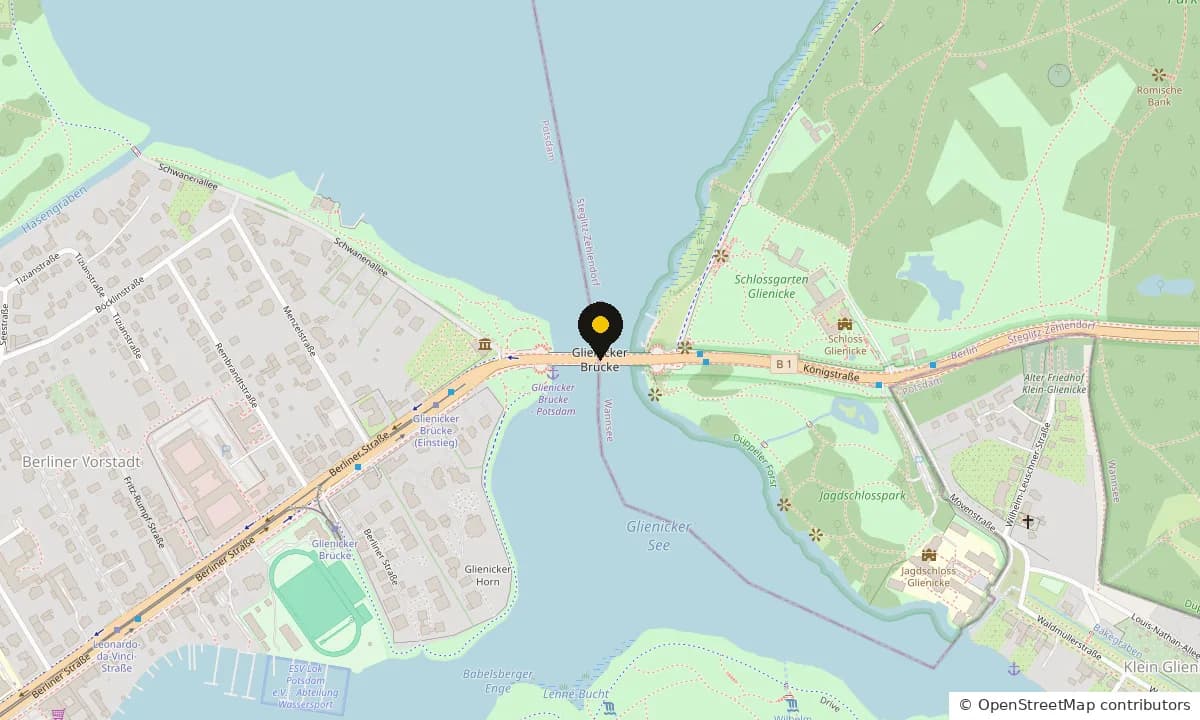
Map of the streets around the Glienicke Bridge, with a pin on the siteOpen in Google Maps

Glienicker Brücke, Königstraße / Berliner Straße, 14109 Berlin · Open 24 hours, every day

Getting there

  • Bus 316Glienicker Brückeabout 15 min from S Wannsee

    Take the S1, S7 or RE1 to Wannsee, then Bus 316, which ends at the Potsdam end of the bridge after passing Schloss Glienicke. It runs every 20–40 minutes, so check the BVG app.

  • Tram 93Glienicker Brückeabout 15 min from Potsdam Hbf

    From Potsdam Hauptbahnhof (S7, RE1) the tram runs through the centre of Potsdam and ends at the bridge.

  • S7Babelsbergabout 40 min on foot

    If you would rather walk: from Babelsberg station head north through Park Babelsberg along the Havel to the bridge.

What you’ll see

  • The bridge’s two shades of green: the Potsdam half is painted a lighter green than the Berlin half, a difference that dates from the division and was kept when the bridge was repaired.
  • The metal strip set into the pavements at the midpoint, where the white border line once ran, and the state boundary between Berlin and Brandenburg still does.
  • The four sculptures by Stephan Walter at the bridge’s ends, the 1907 colonnades on the Potsdam side, and views up the Havel to the Jungfernsee and down to the Glienicker Lake.

Tips from a guide

  • Stand on the metal strip in the middle: one foot is in Berlin, the other in Brandenburg, exactly where the agents were handed over.
  • Combine the bridge with Glienicke Park on the Berlin side, or walk north along Schwanenallee and the Havel to the Neuer Garten and Cecilienhof (about 25 minutes).
  • The bridge carries a busy main road; for photographs of the whole span, go down to the riverbank on the Potsdam side by Villa Schöningen.

Accessibility

The bridge has wide, level pavements on both sides, and the tram and bus stop at the Potsdam end is at street level. Potsdam’s trams on line 93 are usually low-floor. Check the BVG and ViP websites for lift status at Wannsee and Potsdam Hauptbahnhof. Villa Schöningen’s exhibition rooms are not step-free (its café is), and there are no public toilets on the bridge itself.

Timeline

From royal crossing to Bridge of Spies

  1. c. 1660A first wooden bridge is built so the nobility can reach the hunting grounds.
  2. 1754A permanent Berlin–Potsdam mail service crosses; the bridge opens to coaches.
  3. 16 Nov 1907Today’s steel truss bridge opens, officially as the Kaiser-Wilhelm-Brücke.
  4. Apr 1945Soviet tank fire sets off demolition charges and wrecks part of the bridge.
  5. 19 Dec 1949Reopened as the ‘Bridge of Unity’, with a white border line down the middle.
  6. 27 May 1952East Germany closes the bridge to West Berliners and West Germans.
  7. Aug 1961The Berlin Wall goes up; only Allied soldiers and diplomats may cross.
  8. 10 Feb 1962Rudolf Abel is exchanged for the U-2 pilot Francis Gary Powers.
  9. 11 Jun 1985The largest exchange: 23 prisoners from the East for four Eastern Bloc agents.
  10. 11 Feb 1986The last exchange: Anatoly Shcharansky and three others for five agents.
  11. 10 Mar 1988Three East Germans smash through the barriers in a stolen lorry.
  12. 10 Nov 1989The day after the Wall opens, the bridge opens to everyone.

See it with a historian

Tours that stop at the Glienicke Bridge

The bridge itself is easy to reach; a guide brings the exchanges to life on the spot and links it with Potsdam’s palaces and the Cold War borderland around it.

A day in royal Potsdam, from Sanssouci to Cecilienhof, with the Bridge of Spies on the way.

The Glory Of Prussia Tour - Berlin Experiences
Full Day6 Hours

The Royal Potsdam Tour

Private 6-hour day trip from Berlin to the palaces and parks of Potsdam for up to 6 people. Starts at your hotel in Berlin.

€1,000up to 6
View Tour

Life behind the Iron Curtain, and how the divided city kept the superpowers talking.

The Berlin Wall Tour - Berlin Experiences
Full Day6 Hours

The Republic Of Fear

Private 6-hour van tour of East Berlin, the Stasi and life behind the Wall for up to 6 people. Starts at your hotel.

€1,000up to 6
View Tour

The whole story of Berlin in one day; a private tour that can be shaped around the Cold War.

The Berlin History Tour
Full Day6 Hours

The Berlin History Tour

Private 6-hour van tour of Berlin's whole history in one day for up to 6 people. Starts at your hotel or anywhere in the city.

€1,000up to 6
View Tour

Questions visitors ask

Frequently asked questions

Why is the Glienicke Bridge called the Bridge of Spies?

Because the United States and the Soviet Union used it to exchange captured agents during the Cold War, in 1962, 1985 and 1986. It was the only crossing out of West Berlin under full Soviet rather than East German control, which made it ideal for the swaps.

Can you walk across the Bridge of Spies?

Yes. It is a public road bridge with pavements on both sides, free and open at all hours. Walking from one end to the other takes only a few minutes.

Where is the Bridge of Spies?

On the River Havel between Berlin-Wannsee and Potsdam, about 25 km south-west of central Berlin. It carries the B1 road from Königstraße in Berlin to Berliner Straße in Potsdam.

How do I get to the Glienicke Bridge from Berlin?

Take the S-Bahn (S1 or S7) or the RE1 to Wannsee and then Bus 316 to Glienicker Brücke, or go to Potsdam Hauptbahnhof and take Tram 93, which ends at the bridge. Allow about 45–60 minutes from central Berlin.

Was the film Bridge of Spies filmed at the real bridge?

Yes. Steven Spielberg shot the exchange scenes for <em>Bridge of Spies</em> (2015) on the Glienicke Bridge itself at the end of 2014.

Who was exchanged on the Glienicke Bridge?

Rudolf Abel for Francis Gary Powers on 10 February 1962; 23 prisoners from the East for four Eastern Bloc agents on 11 June 1985; and Anatoly Shcharansky with three Western agents for five Eastern agents on 11 February 1986.

Why is the bridge two different colours?

The East German and West Berlin halves were painted in slightly different greens after the 1949 rebuilding, and the difference was kept when West Berlin paid for repairs in 1985. Today the Potsdam half is the lighter one.

Is there anything to see apart from the bridge?

Yes. Glienicke Park and Schloss Glienicke are on the Berlin side, Villa Schöningen with its art exhibitions and café is at the Potsdam end, and the Neuer Garten and Cecilienhof are about 25 minutes’ walk north along the Havel.

Keep exploring

More Featured Experiences.

Every site we write about — 56 landmarks, museums, memorials and lesser-known corners of Berlin. See the full index →

01Walk Through The Brandenburg Gate02Explore The State Museums On Museum Island03Visit The Berlin TV Tower – The Fernsehturm04Cross The Cold War Border At Checkpoint Charlie05Visit The Site Of Adolf Hitler’s Führerbunker06Explore The Reconstructed Berlin Palace07Visit The Reichstag Cupola At Night08Explore The Forum Fridericianum09Shop At The Humboldt University Book Sale10Journey Into The Memorial To The Murdered Jews Of Europe11Step Inside The Neue Wache12Explore The Former Jewish Quarter – Spandauer Vorstadt13Visit The Remains Of The Berlin Wall15Explore The Topography Of Terror16Climb The Prussian Victory Column – The Siegessäule17Enter The Palace Of Tears – The Tränenpalast18Step Inside The Berlin Olympic Stadium19Explore Erich Mielke’s Office At The Stasi Museum20Walk Along Karl Marx Allee21Visit The Oldest Church In Berlin – The Nikolaikirche22Explore The Berliner Dom23Visit The Grave Of Frederick The Great24Walk Through The Ruins Of Anhalter Bahnhof25Stand On The Platz Des Volksaufstandes26Visit The German Resistance Museum27Visit The Soviet War Memorial In The Tiergarten28See The Georg Elser Memorial On Wilhelmstrasse29Step Inside The Kaiser Wilhelm Gedächtnis Kirche30Visit The Gleis 17 Memorial31Visit The Schloss Charlottenburg Mausoleum32Climb The Französischer Dom at Gendarmenmarkt33Explore The Interbau – IBA 5734Explore The Otto Weidt Workshop35Visit Cecilienhof – Site Of The Potsdam Conference36Visit The Stasi Prison In Hohenschönhausen37Spend The Day At Tempelhof Airport38Ride The Fastest Elevator In Europe39Visit The Soviet War Memorial In Treptower Park40Visit The Sachsenhausen Concentration Camp Memorial41Visit The Ravensbrück Concentration Camp Memorial42Visit Karlshorst – The Site Of The German Surrender43Visit The Socialists Cemetery – Zentralfriedhof Friedrichsfelde44Visit The Soviet War Memorial In Pankow45Visit the Seelow Heights Memorial46Visit The Commonwealth War Cemetery47Cross The Bösebrücke At Night48Explore The Allied Museum In Dahlem49Explore The Spandau Citadel50Visit The Brandenburg T4 Euthanasia Memorial51Visit The Wannsee Conference House52Visit The Jewish Museum53Visit The Jewish Cemetery In Weissensee54Walk Along The East Side Gallery55Explore The Volkspark Friedrichshain Flak Tower56Head Up The Teufelsberg