Skip to content
The reconstructed Berlin Palace (Humboldt Forum) on Schloßplatz, its Baroque façade lit by the sun, with the TV Tower and Red Town Hall beyond

Berlin Experiences/Featured Experiences

Berlin Palace: Visit the Reconstructed Schloss and Humboldt Forum

The Humboldt truth behind the fairytale facade

The short answer

The Berlin Palace (Berliner Schloss) is the rebuilt Hohenzollern royal palace on the Spree Island in Berlin-Mitte, opposite the Lustgarten and Museum Island. Blown up by East Germany in 1950, it was rebuilt in 2013–20 with three Baroque façades and a modern interior, and now houses the Humboldt Forum museum. It is open Wednesday to Monday, 10:30–18:30 (closed Tuesdays). The courtyards, the palace cellar, the Sculpture Hall and the Video Panorama are free; the main exhibitions cost €9 each and the roof terrace €3. Allow one to three hours.

Where
Schloßplatz, 10178 Berlin-Mitte, opposite the Lustgarten
Open
Wed–Mon 10:30–18:30; closed Tuesdays
Admission
Courtyards and history displays free; exhibitions €9 each; roof terrace €3
Time needed
1 hour for the building, 3 hours with exhibitions
Nearest station
U5 Museumsinsel, 2 minutes on foot
Step-free
Yes: lifts to every floor and the roof terrace

The story · by Matt Robinson

Not everything is as it seems; don’t believe the hype; expect the unexpected; and perhaps most aptly — thanks to the grisly course of local history — always question authority. Just a few of the viable candidates for the title of Berlin city slogan.

The divisive Klaus Wowereit, the city’s first new mayor of the new millennium, notably coined the phrase “Poor but sexy” when describing the German capital’s struggle to balance its books. As well as the millions of city inhabitants struggling to balance their own.

Sexy? Well, let’s just say beauty is in the eye of the beholder – another Berlin relevant maxim.

Since Wowereit’s tenure as mayor, the city has spent billions on construction (and reconstruction) projects – helping the effete phoenix rise from the ashes of 20th century destruction and division. Each addition controversial in its own way, this drive to push the city into the next century has seen the construction of a new international airport, a new central train station, and perhaps most bizarrely – the reconstruction of a former royal palace, right in the heart of the historic city centre.

This glorified vanity project could be an all-encompassing representation of each and all of the viable candidates for Berlin’s city motto at once – a temple to the absurd, in fact, cast in the demi-mould of a palace.

A palace lost and rebuilt

At one time the largest royal residence in Europe, until it was severely damaged in a bombing raid in 1945 and demolished by the East German authorities five years later, the Berlin Palace was reconstructed and reopened in 2020 – just in time for the arrival of the Corona pandemic. An empty palace for an empty city.

To fully appreciate the significance of the reconstructed palace, it’s essential to understand the history of its predecessor. The original Berlin City Palace was not merely a royal residence; it was the political and cultural heart of Prussia and, later, the German Empire. Built in the mid-15th century and expanded over the centuries, the palace was a magnificent example of Baroque architecture, symbolising the power and prestige of the Hohenzollern dynasty.

Rebuilt Baroque portal of the Berlin Palace (Humboldt Forum), with its balcony carried by stone atlantes and the Prussian eagle above
One of the rebuilt Baroque portals, balcony and all.

Despite being one of the most vaunted heritage projects in Germany, the reconstruction has also been heavily criticised, not least for its cost and political symbolism – coupled with the fact that some of the materials used in the building, such as marble and granite, have been imported from abroad.

Removing things in Berlin has always been easy, but cutting the wheat from the chaff has always had an ideological spin. Whether it be removed in the name of unstoppable progress, obliterated by the ravages of war, or extirpated during the years of post-war realignment.

Rebuilding something as an exact verbatim copy of its extirpated original is always going to be highly controversial. Were that the case here.

Franco Stella’s design

Italian architect Franco Stella’s design, unanimously chosen by jury (there was no second place, but four third places), for the reconstructed city palace was confirmed back in 2009. As a representative of classic modern rationalism, Stella is a self-confessed advocate for the continuation of classical styles, addressed in a modern setting. Rather than completely resurrecting the former palace, Stella promoted a subtle – yet important – amendment to the original design.

Stella’s approach was to recreate the palace’s three original Baroque facades on the exterior, while the interior and the fourth facade facing the Spree River are distinctly modern. This hybrid design is intended to symbolise the dialogue between the past and the present, a physical manifestation of Berlin’s complex history. However, some critics argue that the juxtaposition of old and new creates a jarring effect, detracting from the building’s historical integrity.

The plain modern east façade of the Humboldt Forum on the Spree at night, with the Berliner Dom lit up beyond
Stella’s modern east façade on the Spree, with the Berliner Dom beyond.

It is by no mere coincidence that this blessing of the compass has been made: the historical concept of good things coming from the West and bad from the East – a theme that runs through German history – literally led to the destruction of the original palace. Beyond that, the burden of Prussian, Imperial, and Nazi expansionist policy to the east still weighs heavy on the collective consciousness here. With this preference for West over East, the supporters of this partly privately financed project are indulging in the process of inching back Germany and Berlin to moral respectability.

While in the East German times, when this area of the city fell under control first of the Soviet authorities and then the socialist East German state, the accusation was that there had been a clear line straight from the imperial, militaristic, and expansionist Prussia – and later Germany – that had the royal palace at its heart. Supporters of this readdressing of history – embodied by the reconstruction of the palace – see that Prussia and Imperial Germany was the period before history was blemished with the tyranny of Nazi rule.

Inside the Humboldt Forum

Resurrecting the ghost of this old palace is directly encouraging the impression of a cleaner, purer, and more perfect time. Every fairytale, however, falls apart on close inspection. Whether set deep in the forest, high on a mountain, or inside a palatial residence. Especially in a city where the past is like an exterior wall in a prison yard, chances are we won’t get over it. Pre-Nazi Germany and the Prussian period is not without its controversies. Not least the First World War, the bloody expansion of Prussia, and the horror of German colonialism.

Inside the palace now you will find not the seat of the Hohenzollern dynasty – since the abdication of Kaiser Wilhelm II in 1918 those days are long gone – but a selection of exhibitions from the ethnological collections of the Berlin museums as well as the scientific archives of the Humboldt University and the city museum’s exhibition on Berlin and the world.

View west from the Humboldt Forum roof terrace at dusk: the balustrade, Unter den Linden and the Zeughaus by the Schlossbrücke
Looking west from the roof terrace towards Unter den Linden.

Now known as the Humboldt Forum, after the renowned German scholars Alexander and Wilhelm von Humboldt, it is more than a symbol of nostalgia for a bygone era. It is a place where the arts, sciences, and humanities come together to offer new perspectives on global cultures and histories.

The Forum has dedicated spaces within the palace to exhibitions that critically examine Germany’s colonial past and the impact of colonialism on the world. As visitors walk through the halls of the Humboldt Forum, they are not just stepping into a recreated past but into a space that encourages reflection on the present and the future. The palace, with all its controversies and ambiguities, invites us to question the narratives of history.

A microcosm of the city itself—complex, contradictory, and constantly evolving, the reconstructed Berlin Palace embodies the tensions between tradition and modernity, between nostalgia and progress, and between the desire to remember and the need to move forward.
The Berlin Palace in detail

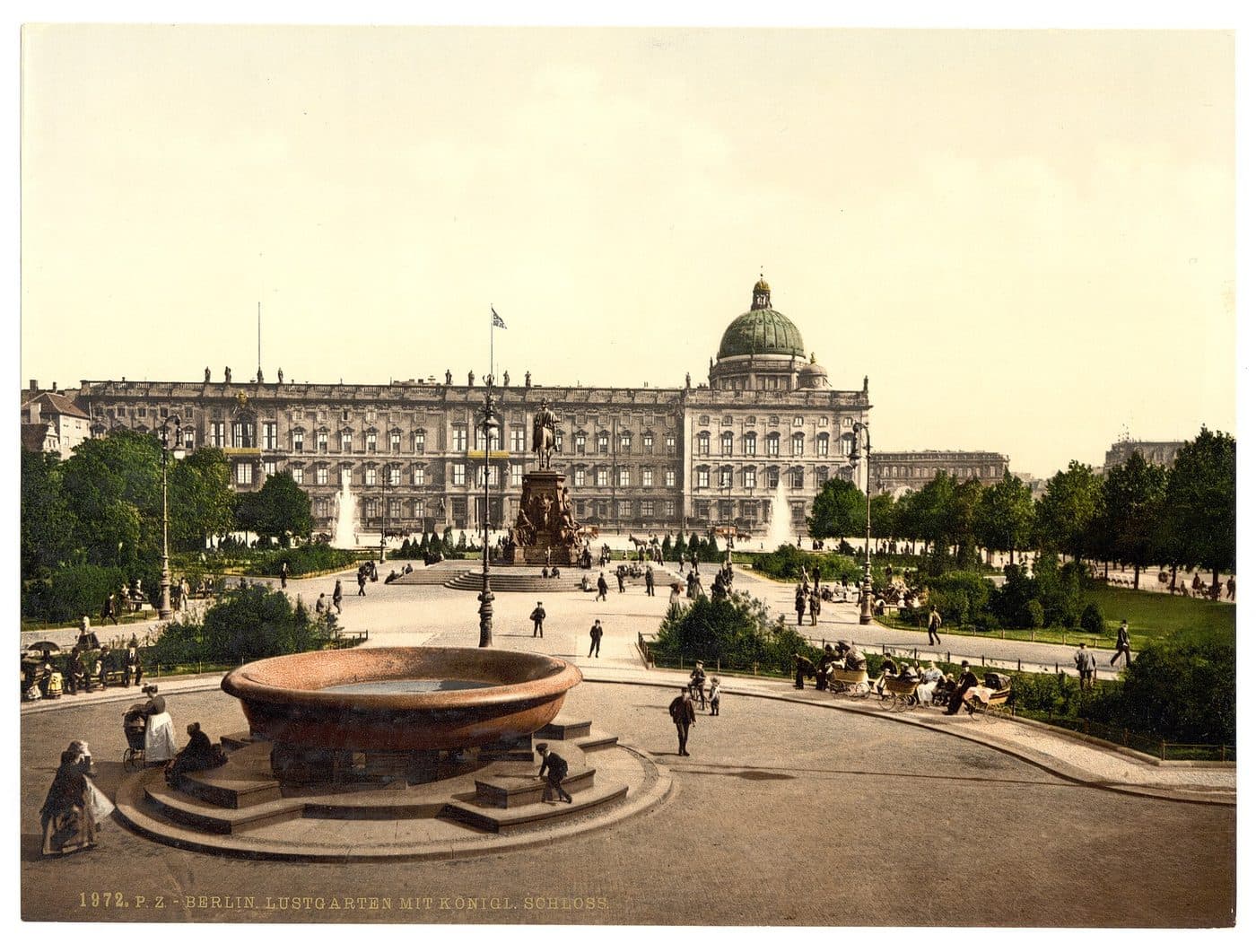
Colour photochrom of the Berlin Royal Palace seen across the Lustgarten around 1900, with the dome, the granite bowl and strolling crowds
The palace from the Lustgarten, about 1900. Photo: Photochrom Print Collection, Library of Congress / Public domain, via Wikimedia Commons

The palace of the Hohenzollerns

Elector Frederick II ‘Irontooth’ began a castle on the Spree Island in 1443 to keep the unruly townspeople of Berlin and Cölln in line. Rebuilt in Renaissance style in the 16th century, it became a Baroque royal palace after 1698, when Elector Frederick III, who crowned himself King Frederick I in Prussia in 1701, had Andreas Schlüter remodel it; his successors, led by Johann Friedrich Eosander, finished it by 1716. Frederick the Great was born here in 1712, and Friedrich Wilhelm IV added the dome over Portal 3 in 1845–54.

For almost five centuries it was the seat of the Hohenzollerns, the stage for court festivities, parades and the opening of the imperial Reichstag. It was also where power met protest: in March 1848 barricades went up in the streets around it. On 31 July 1914 Wilhelm II spoke to the crowd in the Lustgarten from the balcony of Portal V, and the next day from the window above Portal IV. On 9 November 1918 Karl Liebknecht proclaimed a socialist republic from Portal IV’s balcony.

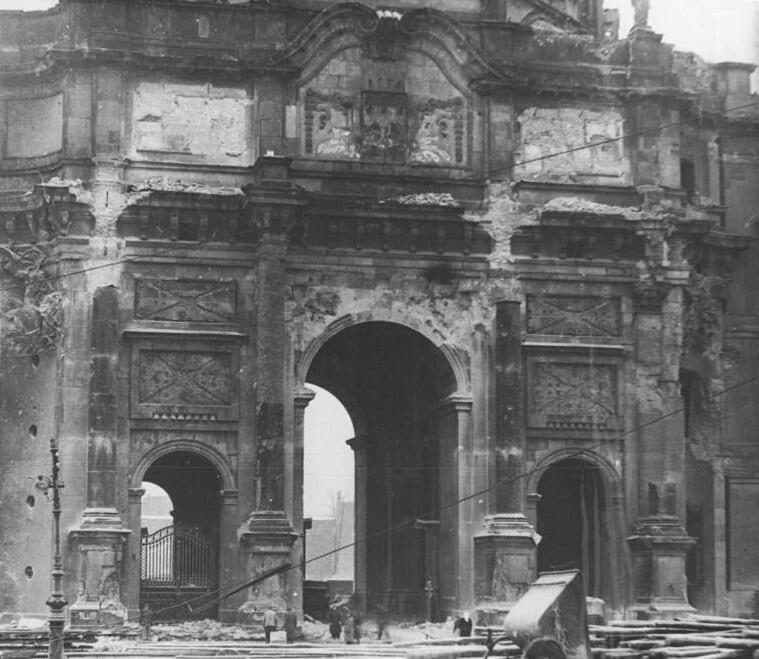
A burnt-out stone portal of the Berlin Palace standing in the rubble during the demolition, January 1951
The ruined palace during demolition, January 1951. Photo: Bundesarchiv, Bild 183-09128-0005 / Kemlein, Eva / CC-BY-SA 3.0

Why East Germany blew it up

Allied bombs hit the palace on 3 and 24 February 1945; it burnt out, but its walls and much of its decoration survived, and parts were used for exhibitions after the war. In July 1950 Walter Ulbricht, the head of the ruling SED, announced its demolition: to the new state it stood for Prussian militarism, and he wanted the space for parades. Despite protests from architects and historians, the demolition began in September 1950 and took four months and about 19 tonnes of explosives.

Only Portal IV was saved, because of Liebknecht’s proclamation. In 1964 it was built into the new State Council Building on the south side of the square, where it still stands. The site became Marx-Engels-Platz, and in 1973–76 East Germany built the Palace of the Republic on most of it: home to the People’s Chamber, but also a concert hall, bowling alley and restaurants, which many East Berliners remember fondly.

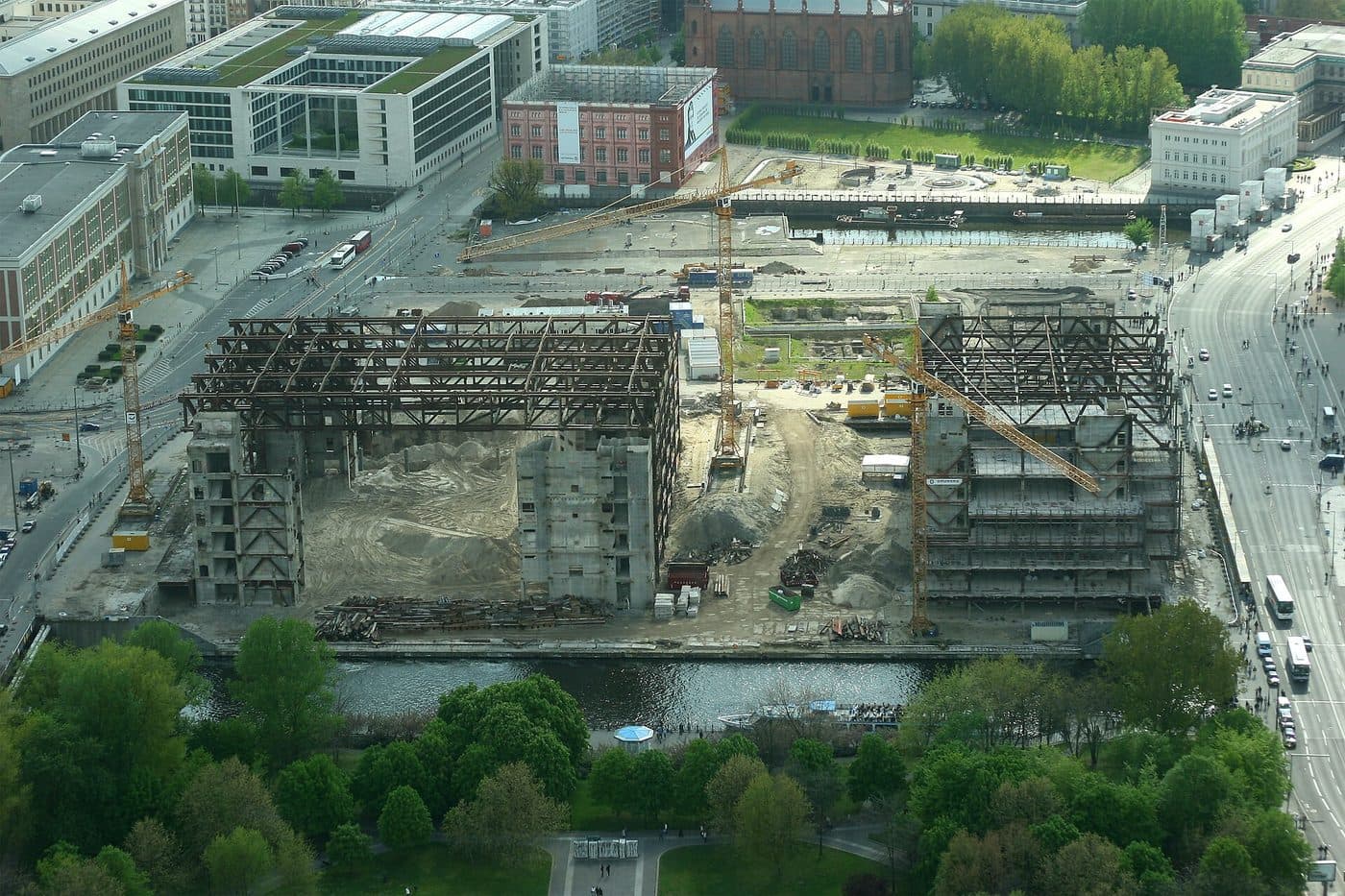
The steel frame of the Palace of the Republic being dismantled beside the Spree in Berlin, seen from above in May 2008
The Palace of the Republic being demolished, May 2008. Photo: Thomas Wolf / CC BY-SA 3.0, via Wikimedia Commons

From the Palace of the Republic to the Humboldt Forum

The Palace of the Republic was closed in September 1990 because of asbestos. After years of debate, the Bundestag voted in 2002 to rebuild the old palace’s exterior, and the Palace of the Republic was demolished in 2006–08. Franco Stella won the 2008 competition, President Joachim Gauck laid the foundation stone on 12 June 2013, and the building was finished in 2020. It opened online in December 2020, because of the pandemic, and to visitors on 20 July 2021; the last museum wing followed in September 2022.

The project cost about €677 million, most of it public money. Around €105 million in donations from some 45,000 people paid for the Baroque façades, carved in a workshop in Spandau from old photographs and surviving fragments. The rebuild is still argued over: for its cost, for the cross and Bible inscription put back on the dome in 2020, and for the colonial-era collections inside, such as the Benin Bronzes.

Plan your visit

Visiting the Berlin Palace

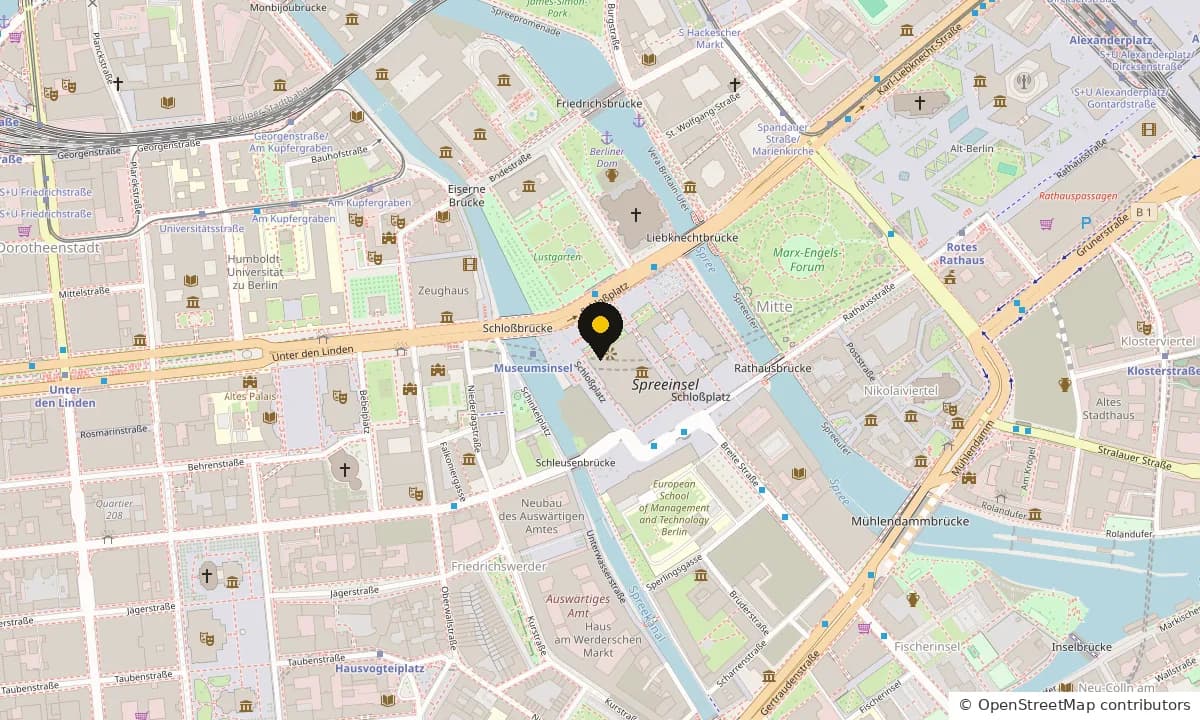
Map of the streets around the Berlin Palace, with a pin on the siteOpen in Google Maps

Schloßplatz, 10178 Berlin · Wednesday to Monday 10:30–18:30; closed Tuesdays. Roof terrace open until 20:00 on Fridays. Holiday hours differ (closed 24 December).

Getting there

  • U5Museumsinsel150 m · 2 min

    Opened in 2021. The palace’s west front, with Portal 3 under the dome, is just across the road.

  • Bus 100Bus 300U Museumsinsel100 m · 2 min

    The double-decker sightseeing routes along Unter den Linden; the stop is on the Lustgarten side and is still called Lustgarten on some maps.

  • S3S5S7S9Hackescher Markt800 m · 10 min

    Walk south down Burgstraße beside the Spree, past the Berliner Dom and across the Lustgarten.

What you’ll see

  • Three rebuilt Baroque façades (north, west and south) after Andreas Schlüter and Johann Friedrich Eosander, with the 70-metre dome over Portal 3 and thousands of hand-carved sandstone figures, plus Franco Stella’s plain modern east front on the Spree.
  • The Schlüterhof courtyard and the Passage, open to everyone, and free displays on the site’s history: the palace cellar with the old foundations, the Sculpture Hall with original fragments, and the Video Panorama.
  • The paid exhibitions: the Ethnological Museum and the Museum of Asian Art on the 2nd and 3rd floors, BERLIN GLOBAL on the 1st, and a temporary show on the ground floor, plus the roof terrace 30 metres up.

Tips from a guide

  • Walk round the outside first: the contrast between the Baroque fronts and the bare east façade on the Spree tells the story of the rebuild better than any panel. Then cross the Schlossplatz to the State Council Building to see Portal IV, the one original portal that survived.
  • Go up to the roof terrace (€3, lift from the stair hall) in the late afternoon for the view over Museum Island, Unter den Linden and the TV Tower. It stays open until 20:00 on Fridays and can close at short notice in snow or ice.
  • Tuesday is the closing day, the reverse of most Berlin museums, which close on Mondays. Under-19s get into most exhibitions free (BERLIN GLOBAL: under-18s).

Accessibility

The building is step-free: automatic doors, lifts to every public floor (the roof terrace can only be reached by lift) and wheelchair-accessible toilets. A tactile floor guidance system starts outside Portal 3 and in the Passage, and the media guide offers audio description and German sign language. There are 22 disabled parking spaces on the south side, temporarily moved to the Gate 2 area during landscaping work. U5 Museumsinsel and S+U Alexanderplatz have lifts; check the BVG website for lift status.

Timeline

From royal palace to Humboldt Forum

  1. 1443Elector Frederick II lays the foundations of a castle on the Spree Island.
  2. 1698–1713Andreas Schlüter rebuilds it as a Baroque royal palace.
  3. 1845–54The dome is added over the west portal under Friedrich Wilhelm IV.
  4. 9 Nov 1918Karl Liebknecht proclaims a socialist republic from Portal IV.
  5. Feb 1945Allied bombs set the palace on fire; it burns out.
  6. Sep–Dec 1950East Germany blows up the palace; only Portal IV is kept.
  7. 1976The Palace of the Republic opens on the site.
  8. 1990The Palace of the Republic closes because of asbestos.
  9. 2002The Bundestag votes to rebuild the old palace’s façades.
  10. 2006–08The Palace of the Republic is demolished.
  11. 12 Jun 2013President Joachim Gauck lays the foundation stone.
  12. 20 Jul 2021The Humboldt Forum opens to visitors.

See it with a historian

Tours that stop at the Berlin Palace

A guide can show you where the old palace’s portals, the Palace of the Republic and the parade ground stood, and what is original and what is copy.

One hour through the Hohenzollerns’ Berlin, from the palace to Unter den Linden.

The Prussian Berlin Tour
One Hour1 Hour

The Prussian Berlin Tour

Private 1-hour walking tour of Berlin's Prussian royal centre for up to 10 people. Starts at the Rotes Rathaus near Alexanderplatz.

€200up to 10
View Tour

Four hours on foot through historic Mitte, with the palace and Museum Island on the way.

The Berlin Explorer Tour
Half Day4 Hours

The Berlin Explorer Tour

Private half-day walking tour of historic Mitte for up to 10 people. Starts at your hotel or anywhere in the centre.

€500up to 10
View Tour

A full day through Berlin’s whole story, from Prussian kings to the fall of the Wall.

The Berlin History Tour
Full Day6 Hours

The Berlin History Tour

Private 6-hour van tour of Berlin's whole history in one day for up to 6 people. Starts at your hotel or anywhere in the city.

€1,000up to 6
View Tour

Questions visitors ask

Frequently asked questions

Is the Humboldt Forum free?

Partly. The building, its courtyards, the palace cellar, the Sculpture Hall, the Video Panorama and the exhibition on the Humboldt brothers are free. The main exhibitions cost €9 each and the roof terrace €3; under-19s get into most exhibitions free.

What day is the Humboldt Forum closed?

Tuesday. It is open Wednesday to Monday, 10:30–18:30, with special hours over Christmas and New Year (closed on 24 December).

Is the Berlin Palace the original?

No. The original was burnt out in 1945 and blown up by East Germany in 1950. What you see is a reconstruction finished in 2020: three Baroque façades and the dome rebuilt in sandstone on a concrete structure, with a modern east front and interior. Only Portal IV, now part of the State Council Building across the square, is original.

Why was the Berlin Palace rebuilt?

Supporters, led by the Förderverein Berliner Schloss, wanted to restore the historic centre the palace had anchored for centuries. After the asbestos-ridden Palace of the Republic closed, the Bundestag voted in 2002 for a reconstruction that would house museums and a forum rather than a royal residence.

What was the Palace of the Republic?

East Germany’s showpiece building, opened in 1976 on the site of the old palace. It held the parliament, the People’s Chamber, along with a concert hall and restaurants. It closed in 1990 because of asbestos and was demolished in 2006–08.

Can you go on the roof of the Humboldt Forum?

Yes. The roof terrace, 30 metres up, is reached by lift from the stair hall and costs €3. It keeps the building’s hours, stays open until 20:00 on Fridays and may close at short notice in snow or ice.

What is inside the Humboldt Forum?

The Ethnological Museum and the Museum of Asian Art, BERLIN GLOBAL (an exhibition about Berlin and the world), the Humboldt Lab of the Humboldt University, a temporary exhibition on the ground floor, displays about the site’s history, restaurants and shops.

How long do you need at the Humboldt Forum?

An hour is enough to walk round the outside, the courtyards and the free history displays, and go up to the roof terrace. Allow two to three hours more if you want to see the museum collections.

Keep exploring

More Featured Experiences.

Every site we write about — 56 landmarks, museums, memorials and lesser-known corners of Berlin. See the full index →

01Walk Through The Brandenburg Gate02Explore The State Museums On Museum Island03Visit The Berlin TV Tower – The Fernsehturm04Cross The Cold War Border At Checkpoint Charlie05Visit The Site Of Adolf Hitler’s Führerbunker07Visit The Reichstag Cupola At Night08Explore The Forum Fridericianum09Shop At The Humboldt University Book Sale10Journey Into The Memorial To The Murdered Jews Of Europe11Step Inside The Neue Wache12Explore The Former Jewish Quarter – Spandauer Vorstadt13Visit The Remains Of The Berlin Wall14Walk Across The Bridge Of Spies15Explore The Topography Of Terror16Climb The Prussian Victory Column – The Siegessäule17Enter The Palace Of Tears – The Tränenpalast18Step Inside The Berlin Olympic Stadium19Explore Erich Mielke’s Office At The Stasi Museum20Walk Along Karl Marx Allee21Visit The Oldest Church In Berlin – The Nikolaikirche22Explore The Berliner Dom23Visit The Grave Of Frederick The Great24Walk Through The Ruins Of Anhalter Bahnhof25Stand On The Platz Des Volksaufstandes26Visit The German Resistance Museum27Visit The Soviet War Memorial In The Tiergarten28See The Georg Elser Memorial On Wilhelmstrasse29Step Inside The Kaiser Wilhelm Gedächtnis Kirche30Visit The Gleis 17 Memorial31Visit The Schloss Charlottenburg Mausoleum32Climb The Französischer Dom at Gendarmenmarkt33Explore The Interbau – IBA 5734Explore The Otto Weidt Workshop35Visit Cecilienhof – Site Of The Potsdam Conference36Visit The Stasi Prison In Hohenschönhausen37Spend The Day At Tempelhof Airport38Ride The Fastest Elevator In Europe39Visit The Soviet War Memorial In Treptower Park40Visit The Sachsenhausen Concentration Camp Memorial41Visit The Ravensbrück Concentration Camp Memorial42Visit Karlshorst – The Site Of The German Surrender43Visit The Socialists Cemetery – Zentralfriedhof Friedrichsfelde44Visit The Soviet War Memorial In Pankow45Visit the Seelow Heights Memorial46Visit The Commonwealth War Cemetery47Cross The Bösebrücke At Night48Explore The Allied Museum In Dahlem49Explore The Spandau Citadel50Visit The Brandenburg T4 Euthanasia Memorial51Visit The Wannsee Conference House52Visit The Jewish Museum53Visit The Jewish Cemetery In Weissensee54Walk Along The East Side Gallery55Explore The Volkspark Friedrichshain Flak Tower56Head Up The Teufelsberg