Skip to content
The Bösebrücke in Berlin at night: tram tracks running across the steel arch bridge on Bornholmer Straße under orange street lamps

Berlin Experiences/Featured Experiences

Bornholmer Bridge: Cross the Bösebrücke, Where the Wall Opened

Follow in the footsteps of the ‘Peaceful Revolution’.

The short answer

The Bösebrücke, often called the Bornholmer Bridge, carries Bornholmer Straße over the railway between Prenzlauer Berg and Wedding in north Berlin. Its east end was the Bornholmer Straße checkpoint, the first crossing in the Berlin Wall to open, at about 23:30 on 9 November 1989. Today you can walk across it at any hour, free, and read the open-air exhibition on the Platz des 9. November 1989 at its eastern end. Allow 20–30 minutes; S-Bahn Bornholmer Straße is directly under the bridge.

Where
Bornholmer Straße, between Prenzlauer Berg and Wedding, 10439 Berlin
Open
Always: a public bridge and open-air exhibition
Admission
Free
Time needed
20–30 minutes
Nearest station
S Bornholmer Straße, 4 minutes on foot
Step-free
Yes: level paths and station lifts; the bridge has a gentle slope

The story · by Matt Robinson

Where previously there was a static border there is now movement.

Although relatively peaceful at night, throughout the day this striking bridge serves as a graft on a major artery for traffic flowing through Berlin.

Rocking gently as the green steel truss embraces the confluence of passing cars, shaking from the weight of the lemon-coloured trams now routed across this iconic structure – as the station beneath temporarily absorbs the local and regional trains calling into its platforms.

It was here, in 1989, that the first crack in the Berlin Wall appeared – at 11:30pm on November 9th – as thousands of jubilant East German citizens poured across the Bösebrücke, bound for West Berlin.

Bornholmer Straße S-Bahn station at night, framed by the riveted steel girders of the Bösebrücke above it
Bornholmer Straße station, closed from 1961 to 1990, under the bridge.

Before the symbolic destruction of the Berlin Wall began, it was the opening of the inner border crossings, such as this bridge on Bornholmer Strasse, that served as the death knell of the East German socialist regime – and later the entire enterprise of the Soviet Union.

From Hindenburg to Böse

Perhaps as a result of its use as an orientation point by British and US bombers, the bridge survived the Second World War with only minor damage – to be dedicated to Communist Anti-Nazi fighter Wilhelm Böse in 1948. Böse had been executed by the National Socialist regime for his resistance work four years earlier.

Constructed in 1916, it was originally named after celebrated First World War Field Marshal – and future Reich President – Paul von Hindenburg. Hindenburg had risen to fame in 1914 as victor in the Battle of Tannenberg, overseeing the almost complete destruction of the Russian Second Army.

Bornholmer Straße climbing onto the Bösebrücke at night, with light trails from passing cars and the steel arches ahead
The approach to the bridge from the east, the way the crowds came in 1989.

The 66-year-old Field Marshal’s triumph in the East led to his appointment as the Chief of the General Staff of the German Army in 1916. Less than two weeks later this nickel steel bridge would be named in his honour. Despite the resulting cult of personality frothing around Hindenburg’s name within Germany, it would be the airship (and disaster) that bore his name that his legacy would come to be generally associated with outside the country.

Had the bridge retained its original name (see: Nomen est omen) it would have been more fitting for what it now largely represents – like the Zeppelin disaster in 1937 – the very graphic end of something fatally flawed by design.

A border on the bridge

Following the partition of Berlin, in 1945, the eastern side of this bridge would lead to the Soviet occupation sector of divided Berlin – while the western side led to the French occupation sector. Border crossings, such as the one at the Bösebrücke, would be integrated into the Berlin Wall frontier – erected by the East German government in 1961.

With the construction of the Wall – a 155 km concrete lariat that ran around West Berlin as the final part of a ‘Death Strip’ zone of obstacles and observation towers – the East German authorities aimed to completely limit the freedom of movement of East German citizens. The existence of this blood-soaked barrier they considered essential to maintain the integrity and survival of the East German state and its Marxist-Leninist ideology.

A tram passing as a trail of light under the steel arch of the Bösebrücke at night, with Bornholmer Straße station behind
Trams have crossed the bridge again since 1995.

In reality this meant that the East German people were, almost without exception, unable to leave the country for the West. Else the brain drain that the country had for the previous 12 years experienced continue; and leave East Germany empty of the people it would make prisoners of in an attempt to prosper. People unable to leave; unable to return; and, in effect, unable to truly make the decision to stay and participate and thus act as true representatives of East German society.

A society watched over by a cadre of secret police enforcers, dedicated to maintaining the status quo – and whose allegiance extended only to the ruling political party and not the people. The borders of this society guarded by uniformed wardens, expected to use all means – including lethal force – to maintain the curtain drawn across society by this deadly frontier.

9 November 1989

On the evening of November 9th 1989, some 20,000 East Germans finally walked, ran, and danced across the Bösebrücke into the promise of the capitalist West. Curious about a system that many had only experienced through pirate Western television and radio broadcasts, propaganda such as Der Schwarze Kanal emanating from the East German state, and the occasional West German relative that may have been granted the opportunity to visit.

…some 20,000 East Germans finally walked, ran, and danced across the Bösebrücke into the promise of the capitalist West.

Faced with an overwhelming number of people, calling on the guards to remove the obstacles to their flight to the West (to the sound of “We only want to see what it is like”), a Stasi officer named Harald Jäger opened the border at 11:30pm.

Crossing at night

Crossing the Bösebrücke now – from East to West – is best experienced in the evening, as the structure and train station connected to it – out of use during the Cold War period – sit in a shroud of soft orange from the sodium vapour lights. As the silence of the night – bar the occasional vehicle or sound of the switching tracks and trains – engulfs you.

The border is no more. No guards. No watchmen.

This is what Berlin has finally become: come as you are; go as you please.
The Bösebrücke in detail

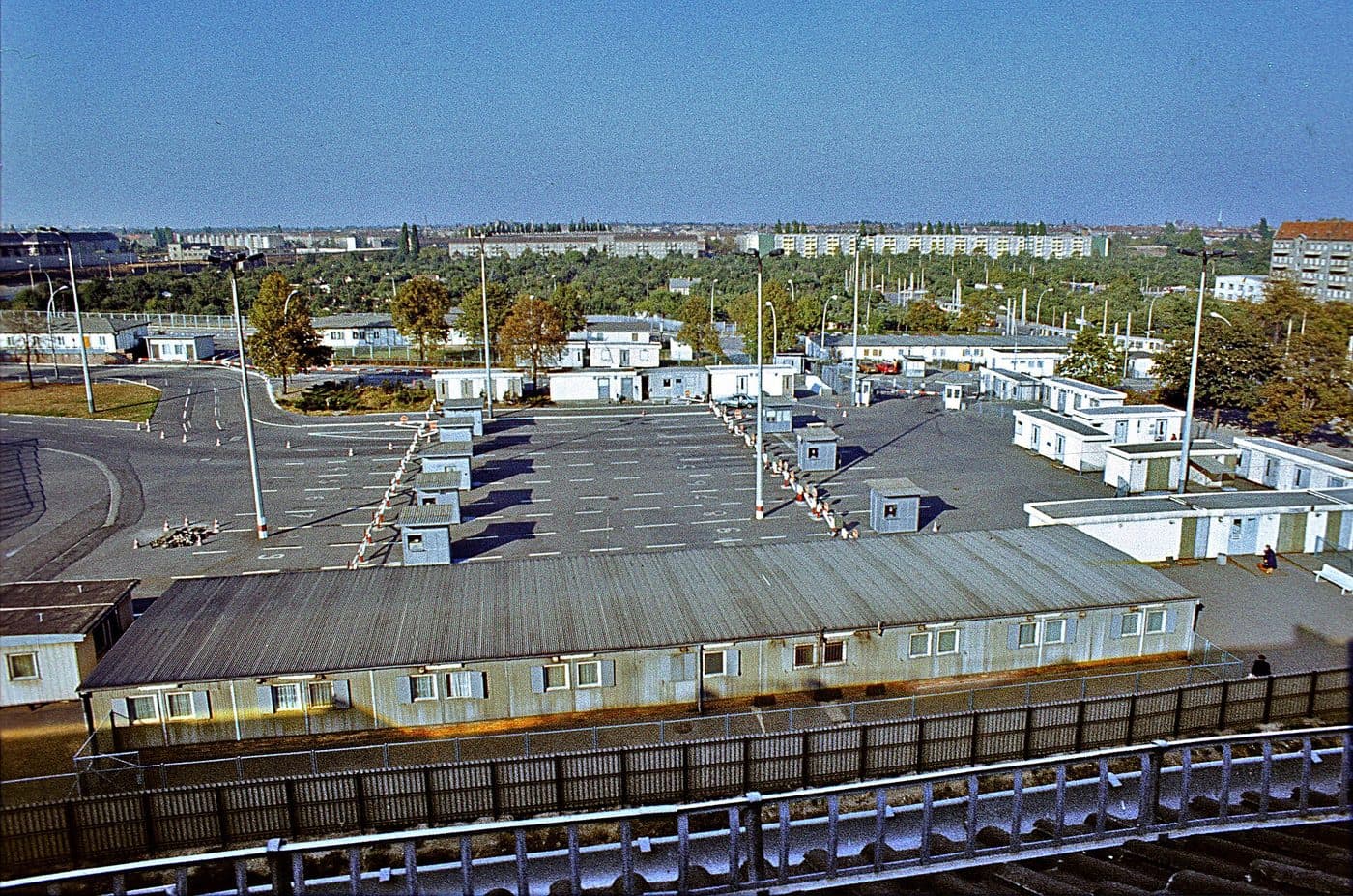
The Bornholmer Straße border crossing in East Berlin in 1984, seen from a rooftop: control booths, barracks and empty car lanes behind a fence
The checkpoint in 1984, from a roof on Finnländische Straße. Photo: Gerd Danigel / CC BY-SA 4.0, via Wikimedia Commons

The checkpoint, 1961–1990

The Bornholmer Straße checkpoint was the northernmost of the seven road crossings through the Wall inside Berlin. It filled the ground east of the bridge as far as Malmöer Straße: control booths, barracks and car lanes, closed off by its own inner wall. East Germany let West German citizens through here on foot and by car, with a lane for diplomats; ordinary East Germans could not cross at all. Below, Bornholmer Straße station was closed on 13 August 1961, and western trains ran through it without stopping.

The checkpoint had its dramas. On 23 August 1962 Hans-Dieter Wesa, a 19-year-old East German border guard, fled across the tracks beneath the bridge and was shot dead by a fellow guard after he had already reached West Berlin. In 1975 Peter Gross, the chef at the Swiss embassy, was arrested here for smuggling his East German girlfriend out in a diplomatic car, a story later filmed as Einmal Ku’damm und zurück.

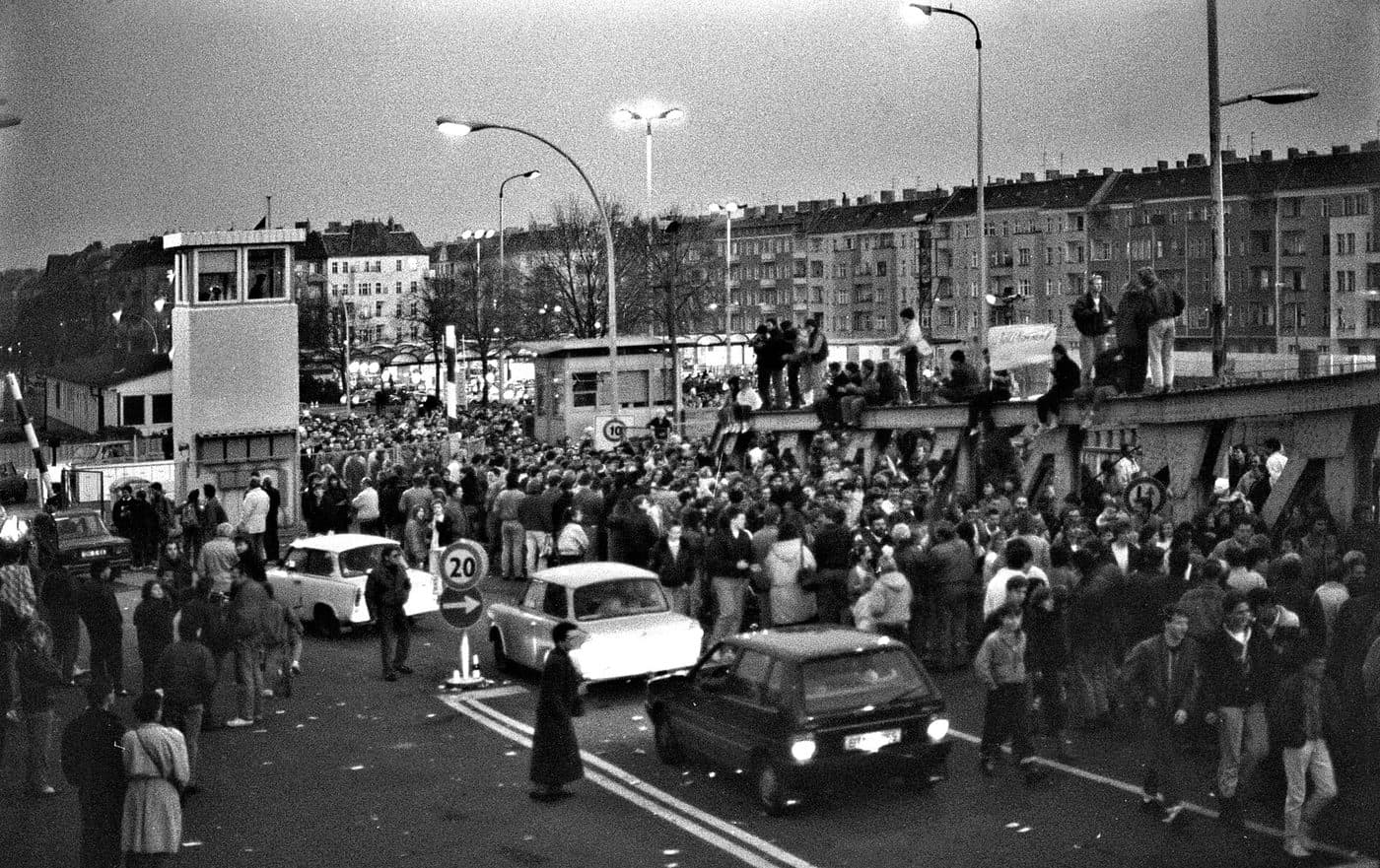
Crowds and Trabant cars at the Bornholmer Straße checkpoint on 10 November 1989, with the watchtower on the left and people standing on the Bösebrücke railing
East Berliners heading home through the checkpoint, 10 November 1989. Photo: Gerd Danigel / CC BY 3.0, via Wikimedia Commons

What happened on 9 November 1989

Shortly before 19:00 on Thursday 9 November, the Politburo member Günter Schabowski told a live press conference that East Germans could travel abroad and, when pressed, that the rule applied ‘immediately’. Within hours crowds were gathering at Bornholmer Straße. The officer in charge that night, Lieutenant Colonel Harald Jäger of the Stasi’s passport control unit, phoned his superiors again and again and got no useful orders. From about 21:20 he was told to let the loudest people out, with a stamp over the photo in their ID cards: without being told, they were being expelled for good.

The crowd only grew, and Jäger feared for the lives of his men and the people at the gate. At about 23:30, against orders, he stopped the checks and opened the barrier. Some 20,000 people crossed in the next hour, and around midnight the other checkpoints followed.

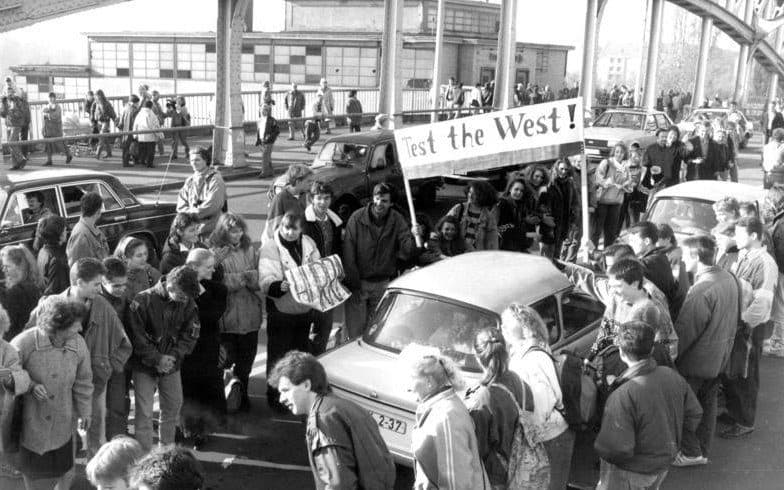
West Berliners welcoming East German visitors on the Bösebrücke on 10 November 1989, with a hand-written banner and East German cars under the steel arch
A welcome on the bridge from Wedding, 10 November 1989. Photo: Bundesarchiv, Bild 183-1989-1118-028 / Lochmann, Hans Peter / CC-BY-SA 3.0

Bridge, station and square since 1989

On 10 November schoolchildren from Wedding lined the bridge to welcome the visitors from the East. The checkpoint buildings were later cleared, and a supermarket has stood on most of the site since 2011. Bornholmer Straße station reopened on 22 December 1990, and on 14 October 1995 trams crossed the bridge again for the first time since 1961. In December 1993 cherry trees, paid for by Japanese donors through the TV Asahi network’s Sakura campaign, were planted along the old border strip below the bridge.

The Platz des 9. November 1989 opened on 9 November 2010, on part of the old checkpoint north of Bornholmer Straße, and was formally named in 2013. A stretch of the checkpoint’s inner wall still stands along it; steel strips set into the ground follow the events of that night, and panels in German and English tell the story. They were renewed for the 35th anniversary in 2024.

Plan your visit

Visiting the Bösebrücke

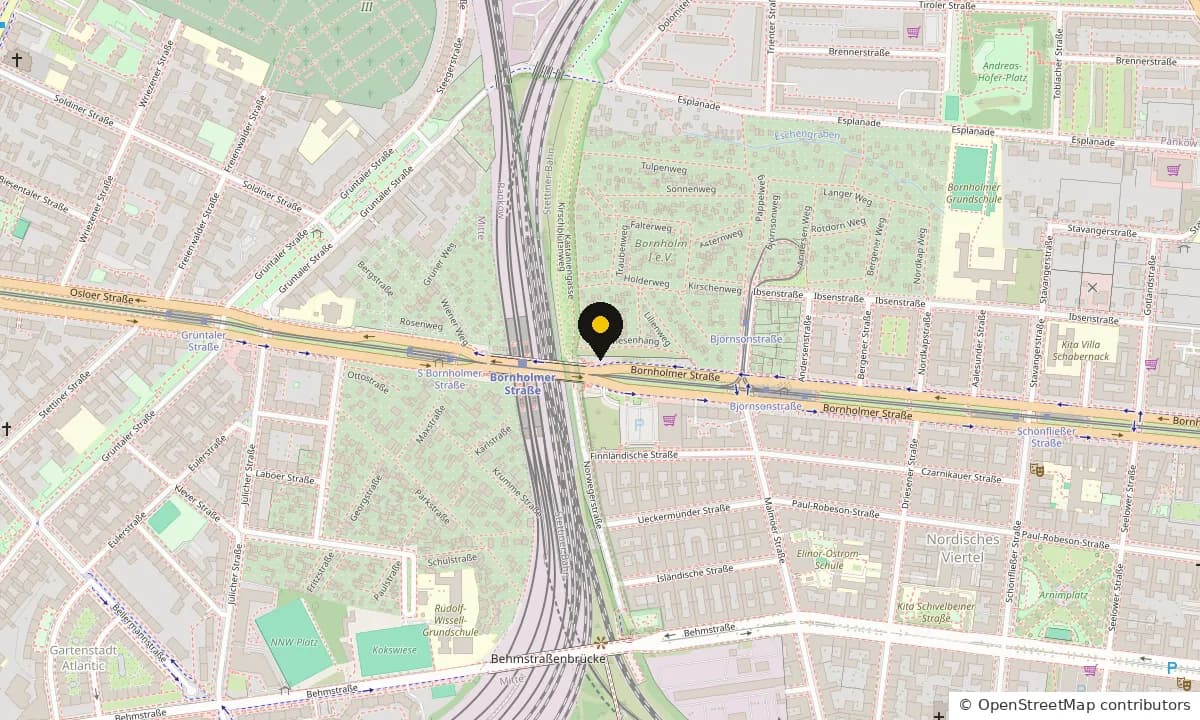
Map of the streets around the Bösebrücke, with a pin on the siteOpen in Google Maps

Bornholmer Straße (Platz des 9. November 1989), 10439 Berlin · Open 24 hours, every day

Getting there

  • S1S2S25S26S8S85Bornholmer Straße300 m · 4 min

    The station lies under the bridge. Go up to street level and walk east, towards Prenzlauer Berg, to the square.

  • Tram M13Tram 50Björnsonstraße280 m · 4 min

    Get off on the Prenzlauer Berg side and walk west over the bridge, the way the crowds went in 1989.

  • U8S1S2S25S26S41S42S85Gesundbrunnen1.5 km · 20 min

    Regional trains stop here too. Walk, or take the S1, S2, S25, S26 or S85 one stop north.

What you’ll see

  • The Bösebrücke itself: a riveted steel arch bridge 138 metres long, opened in 1916 and listed, with Bornholmer Straße station beneath it.
  • The Platz des 9. November 1989 at the eastern end: panels in German and English with photographs of the checkpoint and the night it opened, steel strips in the ground that mark the hours of 9 November, and a surviving stretch of the checkpoint’s inner wall.
  • Below the bridge, the Berlin Wall Trail (Mauerweg) along the old border strip, lined with Japanese cherry trees planted in 1993, plus memorial plaques on the bridge and a memorial stone cut from a Wall segment.

Tips from a guide

  • Come after dark, as Matt suggests, and cross from east to west: start at the square, then walk over the bridge into Wedding.
  • In April the cherry trees along the Mauerweg below the bridge are in blossom; the trail continues south to the Berlin Wall Memorial on Bernauer Straße, about 40 minutes on foot.
  • On 9 November Berliners gather here in the evening, and an ecumenical service is held at 20:30. Expect crowds, and an atmosphere.

Accessibility

The square, the pavements over the bridge and the Mauerweg are level or gently sloped, with no steps. S Bornholmer Straße has lifts to all four platforms; check the S-Bahn or DB website for lift status before you travel. There are no toilets on site; the supermarket beside the square and cafés along Bornholmer Straße are the nearest facilities.

Timeline

From Hindenburg Bridge to open border

  1. 11 Sep 1916The bridge opens as the Hindenburgbrücke, in the middle of the First World War.
  2. 1 Oct 1935Bornholmer Straße S-Bahn station opens beneath the bridge.
  3. 5 Jul 1948Renamed after Wilhelm Böse, a communist resistance fighter executed in 1944.
  4. 13 Aug 1961The Wall goes up; a checkpoint fills the east end and the station closes.
  5. 23 Aug 1962Border guard Hans-Dieter Wesa is shot dead fleeing beneath the bridge.
  6. 9 Nov 1989At about 23:30 Harald Jäger opens the checkpoint; some 20,000 cross.
  7. 22 Dec 1990Bornholmer Straße station reopens.
  8. Dec 1993Japanese cherry trees are planted along the old border strip.
  9. 14 Oct 1995Trams cross the bridge again, for the first time since 1961.
  10. 9 Nov 2010The Platz des 9. November 1989 and its open-air exhibition open.
  11. Nov 2014The Lichtgrenze balloons mark the Wall’s course across the bridge.
  12. 2024The exhibition panels are renewed for the 35th anniversary.

See it with a historian

Tours that stop at the Bösebrücke

The square has the panels; a guide can show you where the checkpoint’s lanes and towers stood, and tell you what Jäger’s men faced that night.

The Berlin Wall Tour - Berlin Experiences
Full Day6 Hours

The Republic Of Fear

Private 6-hour van tour of East Berlin, the Stasi and life behind the Wall for up to 6 people. Starts at your hotel.

€1,000up to 6
View Tour

Why this tour

A full day on life behind the Iron Curtain, the Stasi, the Wall and the night it opened.

See the Republic Of Fear

Questions visitors ask

Frequently asked questions

Where did the Berlin Wall first open?

At the Bornholmer Straße checkpoint on the Bösebrücke, at about 23:30 on 9 November 1989, when the officer in charge, Harald Jäger, stopped the checks and opened the barrier.

Who opened the border at Bornholmer Straße?

Lieutenant Colonel Harald Jäger, deputy head of the checkpoint and officer in charge that night, from the Stasi’s passport control unit. With thousands at the gate and no clear orders from above, he opened it on his own authority.

Why is it called the Bösebrücke?

It opened in 1916 as the Hindenburgbrücke, after Paul von Hindenburg, and was renamed on 5 July 1948 after Wilhelm Böse, a communist resistance fighter executed by the Nazis in 1944. Many people call it the Bornholmer Bridge, after the street it carries.

Can you walk across the Bösebrücke?

Yes. There are pavements on both sides, it is free and open at all hours, and the bridge is 138 metres long, so the crossing takes a couple of minutes.

Is any of the Berlin Wall left at Bornholmer Straße?

A stretch of the checkpoint’s inner wall still stands beside the Platz des 9. November 1989, and a memorial stone there is cut from a Wall segment. The Berlin Wall Trail runs below the bridge along the old border strip.

How do I get to the Bösebrücke?

Take the S-Bahn (S1, S2, S25, S26, S8 or S85) to Bornholmer Straße, which is directly under the bridge, or trams M13 and 50. The square with the exhibition is at the eastern end, about 4 minutes on foot from the station.

Which David Bowie song mentions the Bösebrücke?

‘Where Are We Now?’, released in January 2013, which looks back on his years in Berlin and the night 20,000 people crossed the bridge.

Are there tours that visit the Bösebrücke?

Yes. Our Republic of Fear tour, a full day on life behind the Iron Curtain, includes the bridge, and a private guide can fit it into any Cold War route.

Keep exploring

More Featured Experiences.

Every site we write about — 56 landmarks, museums, memorials and lesser-known corners of Berlin. See the full index →

01Walk Through The Brandenburg Gate02Explore The State Museums On Museum Island03Visit The Berlin TV Tower – The Fernsehturm04Cross The Cold War Border At Checkpoint Charlie05Visit The Site Of Adolf Hitler’s Führerbunker06Explore The Reconstructed Berlin Palace07Visit The Reichstag Cupola At Night08Explore The Forum Fridericianum09Shop At The Humboldt University Book Sale10Journey Into The Memorial To The Murdered Jews Of Europe11Step Inside The Neue Wache12Explore The Former Jewish Quarter – Spandauer Vorstadt13Visit The Remains Of The Berlin Wall14Walk Across The Bridge Of Spies15Explore The Topography Of Terror16Climb The Prussian Victory Column – The Siegessäule17Enter The Palace Of Tears – The Tränenpalast18Step Inside The Berlin Olympic Stadium19Explore Erich Mielke’s Office At The Stasi Museum20Walk Along Karl Marx Allee21Visit The Oldest Church In Berlin – The Nikolaikirche22Explore The Berliner Dom23Visit The Grave Of Frederick The Great24Walk Through The Ruins Of Anhalter Bahnhof25Stand On The Platz Des Volksaufstandes26Visit The German Resistance Museum27Visit The Soviet War Memorial In The Tiergarten28See The Georg Elser Memorial On Wilhelmstrasse29Step Inside The Kaiser Wilhelm Gedächtnis Kirche30Visit The Gleis 17 Memorial31Visit The Schloss Charlottenburg Mausoleum32Climb The Französischer Dom at Gendarmenmarkt33Explore The Interbau – IBA 5734Explore The Otto Weidt Workshop35Visit Cecilienhof – Site Of The Potsdam Conference36Visit The Stasi Prison In Hohenschönhausen37Spend The Day At Tempelhof Airport38Ride The Fastest Elevator In Europe39Visit The Soviet War Memorial In Treptower Park40Visit The Sachsenhausen Concentration Camp Memorial41Visit The Ravensbrück Concentration Camp Memorial42Visit Karlshorst – The Site Of The German Surrender43Visit The Socialists Cemetery – Zentralfriedhof Friedrichsfelde44Visit The Soviet War Memorial In Pankow45Visit the Seelow Heights Memorial46Visit The Commonwealth War Cemetery48Explore The Allied Museum In Dahlem49Explore The Spandau Citadel50Visit The Brandenburg T4 Euthanasia Memorial51Visit The Wannsee Conference House52Visit The Jewish Museum53Visit The Jewish Cemetery In Weissensee54Walk Along The East Side Gallery55Explore The Volkspark Friedrichshain Flak Tower56Head Up The Teufelsberg