Skip to content
A rainbow over Tempelhofer Feld in Berlin, with people gathered on the grass of the former airfield

Berlin Experiences/Featured Experiences

Tempelhof Airport: Spend the Day at Berlin’s Old Airfield

Former international airport now Berlin’s largest park

The short answer

Tempelhof Airport is the former city-centre airport in Berlin-Tempelhof, famous for the 1948–49 Berlin Airlift and closed to flights in 2008. Its runways and meadows are now Tempelhofer Feld, Berlin’s largest park: free and open every day from early morning until between 17:00 and 23:00, depending on the month. You can only see inside the vast Nazi-era terminal on a guided tour (two hours, €17.50, not on Tuesdays), though the THF Tower roof terrace is open Wednesday to Sunday for €5. Allow half a day for a tour and a walk across the field.

Where
Platz der Luftbrücke / Tempelhofer Damm, 12101 Berlin-Tempelhof
Open
Field daily, seasonal hours (November 07:00–18:00); building by tour
Admission
Field free; building tours €17.50; THF Tower €5
Time needed
2–4 hours; half a day with a tour
Nearest station
U6 Platz der Luftbrücke, 6 minutes on foot
Step-free
Field and THF Tower yes; building tours no

The story · by Matt Robinson

Berlin’s recent history is intrinsically linked to the development of modern air transportation and commercial travel. During the Cold War, the city boasted more international airports than anywhere else in the world – albeit at a time when the city was still divided in four sectors. Four airports for the four Cold War powers.

The Berlin Airlift, embarked upon by the Western Allies in 1948 to bypass the Soviet blockade of West Berlin would become the first time in human history that an entire city – well, half at least – was kept alive entirely by air for almost a year.

It was in Berlin that aviation pioneer, Otto Lilienthal, studied and practised his theory of ‘heavier than air’ – establishing the first aeroplane production company in the world. Lilienthal’s research was well known to the Wright brothers, and they credited him as a major inspiration for their decision to pursue manned flight. His flight attempts in the late 19th century are seen as the beginning of human flight.

Berlin was also home to Germany’s first commercial airport at Johannisthal, which opened in 1909, only weeks after the world’s first airfield at Rheims, France.

Lilienthal’s name would eventually be given to the Tegel Airport, built in the French occupation sector of the city in 1948, as a response to the aforementioned Soviet blockade of West Berlin effectively limiting road and rail access to the western sectors of the city.

Arguably the most famous of Berlin’s airports, Tempelhof, would end up in the US Cold War sector – its sprawling cavernous terminal a symbol of the Nazi obsession with all things great and domineering transformed into the most important lifeline to the West of the city during the long months of that blockade.

From parade ground to Nazi airport

Although known by many familiar with 20th century European history for its role in the Berlin Airlift, there is more to Tempelhof airport than that acclaimed operation.

The origins of Tempelhof can be traced back to the early 1920s, a period when aviation was still in its nascent stage. The area was initially used as a parade ground by the Prussian military, but with the burgeoning interest in human flight, it was transformed into a makeshift airfield. In 1923, the first official airport was established, marking the beginning of Tempelhof’s journey in aviation history. This was a time of great experimentation and excitement in the world of flight, and Tempelhof quickly became a hub for air travel in Europe.

The eagle’s head from the roof of Tempelhof Airport, on its plinth outside the building on Platz der Luftbrücke
All that is left of the 4.5-metre eagle that stood on the roof until 1962.

By the 1930s, Tempelhof was recognized as one of the busiest airports in the world. The Nazi regime, under Adolf Hitler, saw the potential of aviation as a means of showcasing Germany’s technological prowess and power. In 1934, a grandiose plan was set in motion to construct a new terminal building, one that would symbolise the might and modernity of the Third Reich. Designed by architect Ernst Sagebiel, the new terminal was an architectural marvel of its time. When completed in 1941, it was one of the largest buildings in the world, featuring vast halls and state-of-the-art facilities.

However, with the outbreak of the Second World War in 1939, the airport was repurposed for military use, serving as a base for the Luftwaffe. The grand halls that once buzzed with civilian activity were now filled with military personnel and equipment. As an understandable target during Allied bombing raids, the airport and airfield suffered extensive damage – even more so with the arrival of Soviet troops in April 1945.

West Berlin’s airport

With Berlin divided in 1945, the airport eventually re-opened for commercial flights, with the American Overseas Airlines, part of American Airlines, given the initial rights to fly into Tempelhof. In 1950 Pan Am would take over, with Air France joining the same year, and British European Airways arriving in 1951. From that point, all of West Berlin’s air services would be concentrated at Berlin’s iconic city centre airport.

Commercial air traffic to and from Tempelhof airport peaked in 1971 at just above 5.5m passengers (out of a total of 6.12m passengers for all West Berlin airports during that year). This represented more than 90% of West Berlin’s commercial air traffic, making Tempelhof Germany’s second-largest airport by passenger numbers. With 3.5m passengers, Pan Am accounted for the bulk of this traffic, while almost all of the remaining 2m passengers were travelling with British European Airways.

Old airport signs inside the Tempelhof Airport building in Berlin, pointing to the U-Bahn, taxis, parking and the general aviation terminal
Airport signs still hang in the terminal.

On September 1st 1975, Pan Am and British Airways moved their entire Berlin operation to the newly built terminal at Tegel Airport. Following Pan Am’s and British Airways’ move to Tegel, commercial operations at Tempelhof ceased, resulting in exclusive use by the US military.

When in 1996, the mayor of reunified Berlin, Eberhard Diepgen, Brandenburg minister-president Manfred Stolpe and the federal transport minister Wissmann established the so-called ‘Consensus resolution’, the future of Tempelhof seemed set. All domestic and international air traffic in Berlin and Brandenburg would be concentrated at one airport outside the city centre: Berlin-Schönefeld International Airport – the former Soviet airport.

A Douglas C-54 ‘raisin bomber’ from the Berlin Airlift under the canopy roof of Tempelhof Airport, Berlin, with the radar towers behind
The Airlift C-54 under the canopy roof. Since 2026 it stands in the hangars, where tours see it.

Eventually on October 30th 2008, Tempelhof was finally closed to commercial flights – with the final arrivals being from Brussels Airlines and Cirrus Airlines. But what to do with this huge piece of historical real estate?

From runway to park

One year later, Berlin city officials announced that the two huge runways and surrounding outfields at Tempelhof would be opened in May 2010 as a city park. An estimated €60 million would be spent between 2010 and 2017 to transform the Tempelhofer Feld into Berlin’s largest public park – and the second largest city park in Germany.

The park is a great place to spend an afternoon, with its wide open spaces (although lacking in shade from trees…), walking and cycling paths, and plenty of places to relax and take in the views. The park is also home to a variety of wildlife, including foxes, hares, and various species of birds. Visitors can also enjoy the many events and activities that take place in the park, such as the annual Berlin Marathon fair, the FIA Formula E Championship raced on the old airport apron, and the Tempelhof Sounds music festival.

Berlin’s notorious shortage of housing led to a proposal from the Senate of Berlin in 2013 to open the outer zones of the Tempelhofer Feld for construction of apartment buildings and a new Berlin Central library. In a citywide referendum held one year later, Berliners overwhelmingly voted to preserve the entire space of the park and prohibit any kind of development by law, thus putting an end to both construction and landscaping plans.

Entrance is free with park hours being from 6/6.30/7/7.30 a.m. until between 5 and 11 p.m., depending on the season.
Tempelhof in detail

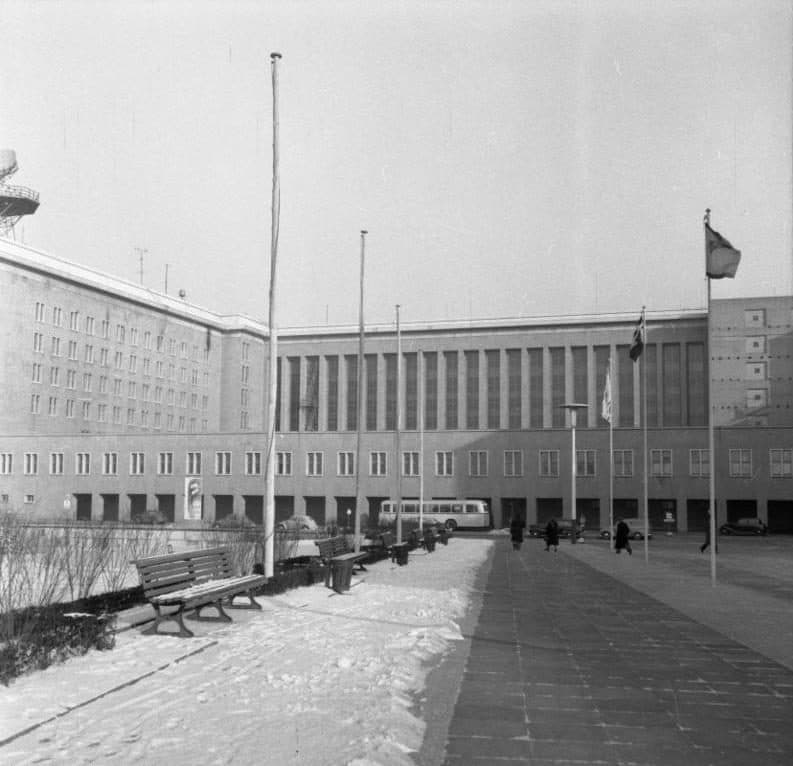
The forecourt and main entrance building of Tempelhof Airport on Platz der Luftbrücke, Berlin, in snow in January 1954
Sagebiel’s forecourt and entrance building, January 1954. Photo: Bundesarchiv, B 145 Bild-F001298-0006 / Brodde / CC-BY-SA 3.0

Sagebiel’s building and its war

In 1934 Ernst Sagebiel, architect of Göring’s Air Ministry, was told to replace the 1920s terminal. His building, put up between 1936 and 1941, curves for about 1.2 kilometres around the edge of the field. With 307,000 m² of floor space it was for two years the largest building in the world, until the Pentagon overtook it. The steel canopy along the apron reaches out more than 40 metres, so aircraft up to almost 12 metres high could taxi in underneath, and the stair towers on the city side were meant to carry 100,000 spectators up to grandstands on the roof for air shows. They were never used.

The new airport never opened in the Nazi era. From 1940 the aircraft maker Weserflug used the unfinished halls to assemble almost 2,000 Ju 87 dive bombers and later Fw 190 fighters, while Lufthansa repaired Luftwaffe aircraft and built radar sets. By 1944 about half of Weserflug’s 4,150 workers there were forced labourers, held in barracks camps on the field.

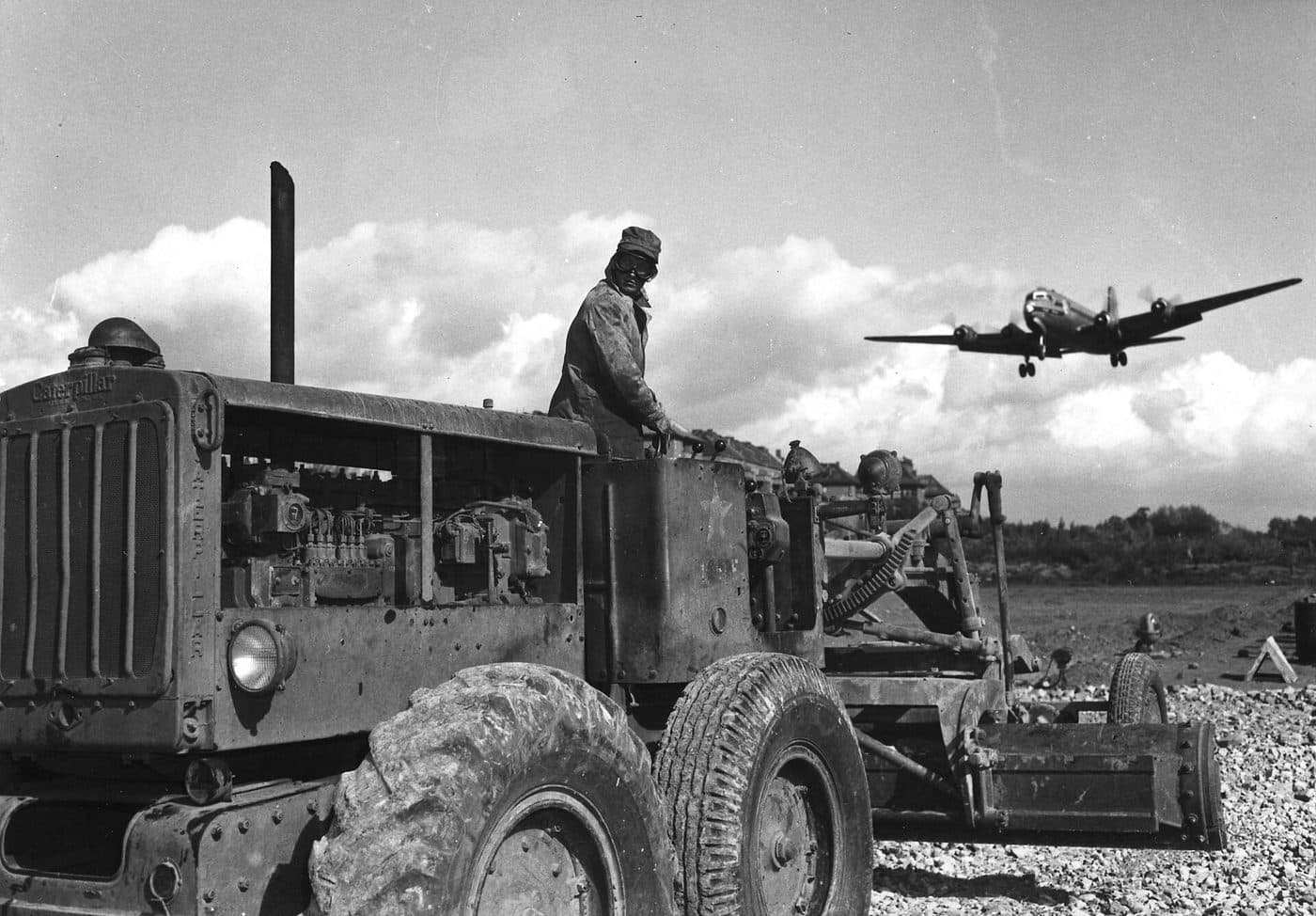
A C-54 Skymaster landing at Tempelhof during the Berlin Airlift in 1948, while a grader levels the second runway
A C-54 lands on the old runway while the second runway is levelled, September 1948. Photo: United States Air Force / Public domain, via Wikimedia Commons

Tempelhof and the airlift

On 26 June 1948, days after the Soviets cut the road, rail and water links to West Berlin, US Air Force C-47s flew the first 80 tonnes of food into Tempelhof. That was a fraction of the 4,500 tonnes of food, coal and supplies the city was thought to need every day, and the larger four-engined C-54 Skymaster soon took over. The old runways could not take the weight, so American engineers built two new ones between July and October 1948; the southern runway still cuts Oderstraße in Neukölln in two. At the height of the operation, aircraft landed at Tempelhof every 90 seconds.

It was on the approach to Tempelhof that the pilot Gail Halvorsen began dropping sweets on handkerchief parachutes to the children waiting by the fence, which gave the aircraft their Berlin name, Rosinenbomber, ‘raisin bombers’. The blockade was lifted on 12 May 1949, but the airlift flew on to build up stocks, and the last transport landed at Tempelhof on 30 September 1949.

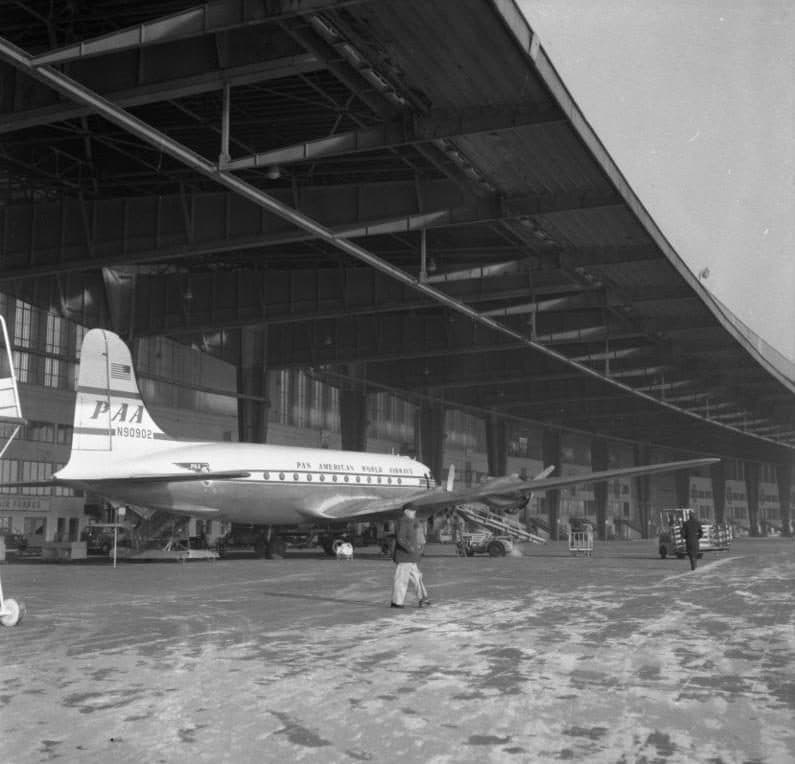
A Pan American World Airways airliner under the canopy roof at Tempelhof Airport, Berlin, in January 1954
A Pan Am airliner under the canopy, January 1954. Photo: Bundesarchiv, B 145 Bild-F001302-0007 / Brodde / CC-BY-SA 3.0

Gateway to the West, and after

For West Berliners, flying was the one way out of the city without East German checks, and many refugees from the East left the same way. Only airlines of the three Western Allies were allowed to use the air corridors, so Tempelhof belonged to Pan Am, British European Airways and, until 1960, Air France. In 1959 the US Air Force handed the main hall over for civilian use; the new check-in area opened in 1962, while the northern wing stayed an American air base until the US Air Force left in 1993.

Closing the airport was never popular. A referendum to keep it open on 27 April 2008 won 60% of the votes cast, but that was only 21.7% of the electorate, short of the 25% needed, and the last flights left on 30 October 2008. From October 2015 to December 2018 the hangars served as an emergency shelter for up to 3,000 refugees. The listed building is now being restored piece by piece; the THF Tower was the first part.

Plan your visit

Visiting Tempelhof

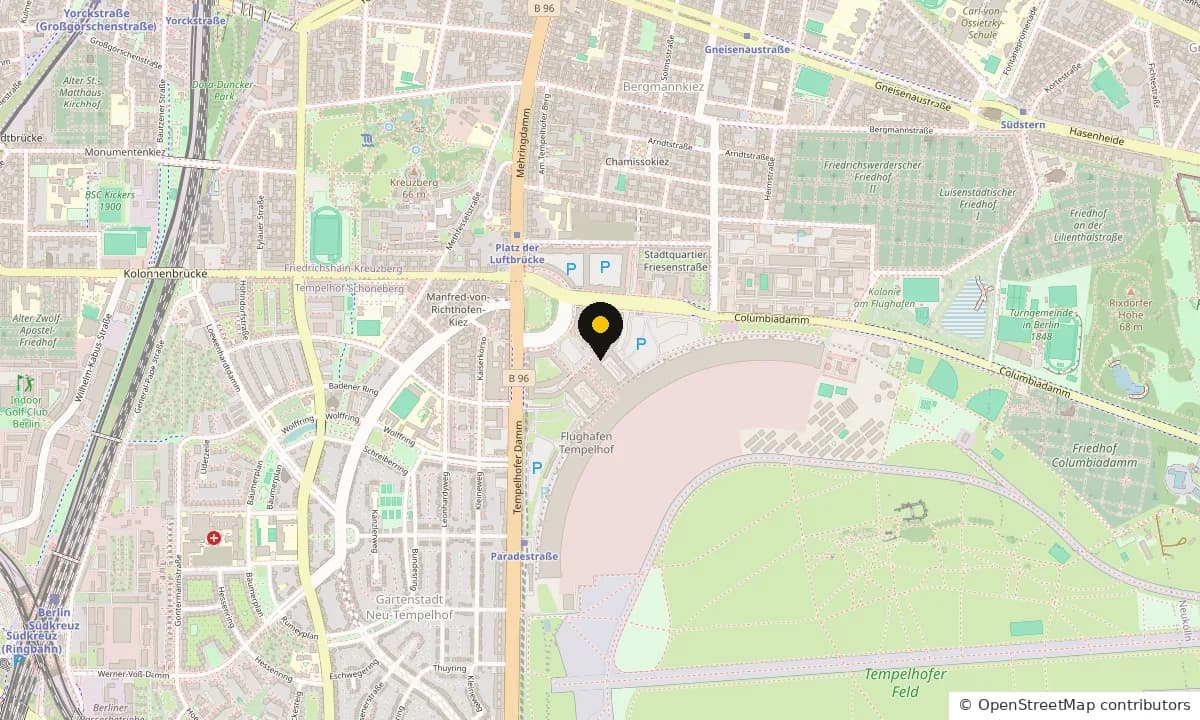
Map of the streets around Tempelhof, with a pin on the siteOpen in Google Maps

Platz der Luftbrücke 5, 12101 Berlin · Field daily, opening 06:00–07:30 and closing 17:00–23:00 by month (November 07:00–18:00). Building tours daily except Tuesday; THF Tower Wednesday–Sunday 10:00–17:00

Getting there

  • U6Platz der Luftbrücke450 m · 6 min

    For the building and tours: the CHECK-IN visitor centre is just left of the main entrance, behind the Airlift Memorial.

  • U6Paradestraße100 m · 2 min

    For the THF Tower, which is almost opposite the station, and the Paradestraße entrance to the field.

  • S41S42U6Tempelhof250 m · 3 min

    For the field’s main entrance on Tempelhofer Damm. From Neukölln, U8 Boddinstraße or Leinestraße lead to the entrances on Oderstraße.

What you’ll see

  • The terminal building on a guided tour: the check-in hall, the areas the US Air Force used, the transit corridor overlooking the field and, on the Hidden Places tour, the air-raid shelters, bunkers and intelligence rooms underneath.
  • The THF Tower: a roof terrace with views over the field and the city, and an exhibition on Lufthansa at Tempelhof from 1926 to 1945, including its use of forced labour.
  • Tempelhofer Feld itself: two runways of about 2 km, the taxiway loop, open meadows with skylarks, community gardens and a history trail, plus the Airlift Memorial and the eagle’s head outside the main entrance.

Tips from a guide

  • Book building tours online in advance: tickets go on sale about four weeks ahead, payment is by card only, there are no refunds, and closed sturdy shoes are compulsory.
  • There is almost no shade on the field and the wind rarely drops, so take water and sun cream in summer and an extra layer in winter. The gates shut at the posted time; after that you can only leave through the turnstiles at the main entrances.
  • Make it a loop: tour from the CHECK-IN on Platz der Luftbrücke, walk south along the building to the THF Tower, then cross the runways east to Neukölln’s Schillerkiez for food.

Accessibility

The four main entrances to the field are step-free and the paths are paved and level; all toilets except the block near the Columbiadamm entrance are wheelchair accessible. The THF Tower roof terrace is fully accessible (email thf-tower@thf-berlin.de before you come). The guided tours are not: they involve long walks and stairs, and wheelchairs, walkers, prams and dogs are not allowed. Check the BVG website for lift status at the stations.

Timeline

From parade ground to park

  1. 1722Frederick William I starts using the field as a parade and drill ground.
  2. Sep 1909Orville Wright makes demonstration flights over Tempelhofer Feld.
  3. 8 Oct 1923Tempelhof is officially designated as an airport.
  4. 1934–36The SS runs the Columbia concentration camp on the field’s northern edge.
  5. 1936–41Ernst Sagebiel’s new terminal is built; it is still unfinished in 1945.
  6. 1940–45Forced labourers assemble Ju 87 and Fw 190 warplanes in the halls.
  7. 26 Jun 1948The first airlift flights land at Tempelhof.
  8. 30 Sep 1949The last airlift transport lands, months after the blockade ends.
  9. 1 Sep 1975Pan Am and British Airways move to Tegel; scheduled flights stop.
  10. 30 Oct 2008The last flights leave and the airport closes.
  11. 8 May 2010The airfield opens to the public as Tempelhofer Feld.
  12. 25 May 201464% vote in a referendum to keep the whole field free of building.

See it with a historian

Tours that stop at Tempelhof

The field explains itself; a guide shows you what the building was built for, what happened in its halls and how the airlift worked.

Follows the battle of April 1945, when the Red Army fought its way into Tempelhof.

The Battle Of Berlin Tour - Berlin Experiences
Full Day6 Hours

The Battle Of Berlin Tour

Private 6-hour van tour of the 1945 battlefield, from the outskirts to the Reichstag, for up to 6 people. Starts at your hotel.

€1,000up to 6
View Tour

A full day across Berlin’s history, which can take in Tempelhof and the airlift.

The Berlin History Tour
Full Day6 Hours

The Berlin History Tour

Private 6-hour van tour of Berlin's whole history in one day for up to 6 people. Starts at your hotel or anywhere in the city.

€1,000up to 6
View Tour

The rise and fall of the Third Reich, with Sagebiel’s airport among its buildings.

The Capital Of Tyranny Tour - Berlin Experiences
Full Day6 Hours

The Capital Of Tyranny

Private 6-hour van tour of Hitler's Berlin and the Third Reich for up to 6 people. Starts at your hotel or anywhere in the city.

€1,000up to 6
View Tour

Questions visitors ask

Frequently asked questions

Can you go inside Tempelhof Airport?

Only on a guided tour: the two-hour Tempelhof Myths tour runs daily except Tuesday and costs €17.50 (€12 reduced), and the Hidden Places tour of the bunkers runs on Saturdays. Without a tour you can visit the CHECK-IN visitor centre and its exhibition, and the THF Tower roof terrace.

Is Tempelhofer Feld free?

Yes. There is no charge to enter the field, and you can walk, cycle or skate on the old runways for as long as the gates are open.

What are the opening hours of Tempelhofer Feld?

They change every month: from 07:30–17:00 in December and January to 06:00–23:00 in June and July (07:00–18:00 in November). After closing time you can still leave through the turnstiles at the main entrances.

Can you walk on the runways?

Yes, and cycle, skate and kite-surf on them too, as long as walkers are given priority. From about late March or April to August the inner meadows between the runways are closed to protect breeding skylarks, and dogs must be on a lead outside the dog areas.

Can you go up the tower at Tempelhof?

Yes. The THF Tower, on Tempelhofer Damm opposite U6 Paradestraße, has a roof terrace and an exhibition, open Wednesday to Sunday 10:00–17:00 for €5 (€3 reduced). The terrace can close at short notice in bad weather.

Why did Tempelhof Airport close?

Berlin and Brandenburg agreed in 1996 to concentrate all flights at one airport at Schönefeld. A 2008 referendum to keep Tempelhof open won most of the votes cast but missed the required quorum, and the last flights left on 30 October 2008.

Will Tempelhofer Feld be built on?

Not for now. In 2014, 64% of voters backed a law keeping the whole field free of building, though the question keeps coming back in Berlin politics.

Can you have a barbecue on Tempelhofer Feld?

Only in the three marked barbecue areas, with a grill standing at least 25 cm off the ground. Disposable grills without legs and gas grills are not allowed.

Keep exploring

More Featured Experiences.

Every site we write about — 56 landmarks, museums, memorials and lesser-known corners of Berlin. See the full index →

01Walk Through The Brandenburg Gate02Explore The State Museums On Museum Island03Visit The Berlin TV Tower – The Fernsehturm04Cross The Cold War Border At Checkpoint Charlie05Visit The Site Of Adolf Hitler’s Führerbunker06Explore The Reconstructed Berlin Palace07Visit The Reichstag Cupola At Night08Explore The Forum Fridericianum09Shop At The Humboldt University Book Sale10Journey Into The Memorial To The Murdered Jews Of Europe11Step Inside The Neue Wache12Explore The Former Jewish Quarter – Spandauer Vorstadt13Visit The Remains Of The Berlin Wall14Walk Across The Bridge Of Spies15Explore The Topography Of Terror16Climb The Prussian Victory Column – The Siegessäule17Enter The Palace Of Tears – The Tränenpalast18Step Inside The Berlin Olympic Stadium19Explore Erich Mielke’s Office At The Stasi Museum20Walk Along Karl Marx Allee21Visit The Oldest Church In Berlin – The Nikolaikirche22Explore The Berliner Dom23Visit The Grave Of Frederick The Great24Walk Through The Ruins Of Anhalter Bahnhof25Stand On The Platz Des Volksaufstandes26Visit The German Resistance Museum27Visit The Soviet War Memorial In The Tiergarten28See The Georg Elser Memorial On Wilhelmstrasse29Step Inside The Kaiser Wilhelm Gedächtnis Kirche30Visit The Gleis 17 Memorial31Visit The Schloss Charlottenburg Mausoleum32Climb The Französischer Dom at Gendarmenmarkt33Explore The Interbau – IBA 5734Explore The Otto Weidt Workshop35Visit Cecilienhof – Site Of The Potsdam Conference36Visit The Stasi Prison In Hohenschönhausen38Ride The Fastest Elevator In Europe39Visit The Soviet War Memorial In Treptower Park40Visit The Sachsenhausen Concentration Camp Memorial41Visit The Ravensbrück Concentration Camp Memorial42Visit Karlshorst – The Site Of The German Surrender43Visit The Socialists Cemetery – Zentralfriedhof Friedrichsfelde44Visit The Soviet War Memorial In Pankow45Visit the Seelow Heights Memorial46Visit The Commonwealth War Cemetery47Cross The Bösebrücke At Night48Explore The Allied Museum In Dahlem49Explore The Spandau Citadel50Visit The Brandenburg T4 Euthanasia Memorial51Visit The Wannsee Conference House52Visit The Jewish Museum53Visit The Jewish Cemetery In Weissensee54Walk Along The East Side Gallery55Explore The Volkspark Friedrichshain Flak Tower56Head Up The Teufelsberg