Skip to content
Teufelsberg in Berlin from above: the former US and British listening station with its radome tower and street-art covered buildings, the Grunewald forest beyond

Berlin Experiences/Featured Experiences

Teufelsberg: Visit Berlin’s Cold War Spy Station

A Cold War listening station turned art colony.

The short answer

Teufelsberg is a 120-metre hill of wartime rubble in the Grunewald forest in west Berlin, piled over an unfinished Nazi military college. On top stand the ruins of Field Station Berlin, the American and British listening station that eavesdropped on the Eastern Bloc from the 1960s until 1992. The hill and the forest are free, but the station is private: it opens daily from 11:00 until around sunset, and adult admission is €12. Allow two to three hours, including the 30-minute walk from S-Bahn Grunewald or Heerstraße.

Where
Teufelsseechaussee 10, 14193 Berlin, in the Grunewald forest
Open
Daily from 11:00 until around sunset (16:30 in Nov–Dec); the hill always
Admission
Hill free; field station €12, reduced €10, under-18s €5
Time needed
2–3 hours, including the walk up
Nearest station
S7 Grunewald or S3/S9 Heerstraße, about 30 minutes on foot
Step-free
Partly: stairs inside; a lift to the viewing platform on request

The story · by Matt Robinson

By virtue of its unique position in the circumstances of the Cold War, Berlin served for much of the 20th century as the undisputed spy capital of the world.

Embassies bristled with antennas, shadowy figures exchanged briefcases on foggy park benches, and tunnels were dug beneath the East/West border for tapping communications or facilitating escapes.

The Glienicke Bridge, connecting West Berlin to Potsdam in the GDR, became known as the ‘Bridge of Spies’, famous for high-profile agent exchanges. The CIA, Britain’s MI6, France’s SDECE, and West Germany’s BND operated cheek-by-jowl, their primary targets being the Soviet KGB and the GDR’s notoriously efficient Ministry for State Security – the Stasi. Information was currency, paranoia was the norm, and the potential for conflict simmered constantly beneath the surface. Everyone was watching everyone.

Against this backdrop of tension and intrigue, the Western Allies needed every advantage they could get. They needed eyes and ears that could penetrate the Iron Curtain, gathering intelligence on Soviet military movements, political intentions, and technological advancements.

A torn radome on the roof of the Teufelsberg listening station in Berlin, its geodesic frame covered in graffiti
A radome on the main building, its fabric shredded.

High above the treetops of the Grunewald forest, in the British Sector of West Berlin, a strange and imposing structure began to take shape in the early 1960s. A cluster of large, white, geodesic domes perched atop an artificial hill, looking like futuristic golf balls dropped onto the landscape.

This was Teufelsberg – the ‘Devil’s Mountain’. Officially a listening post operated jointly by the American National Security Agency (NSA) and the British signals intelligence agency (GCHQ), it would become one of the West’s most crucial intelligence-gathering facilities during the Cold War, a silent sentinel eavesdropping deep into the heart of the Eastern Bloc. Its very existence, built on the detritus of one conflict to fight another, tells a uniquely Berlin story.

A mountain made of rubble

The story of Teufelsberg, the physical hill itself, begins not with spies, but with destruction on an unimaginable scale. The Second World War left Berlin devastated. Allied bombing raids, followed by the brutal street-by-street fighting of the Battle of Berlin in 1945, reduced vast swathes of the city to rubble. Estimates suggest that around 75 million cubic metres of debris choked the streets – mountains of shattered bricks, twisted steel, broken concrete, and the remnants of countless lives. Cleaning this up was a monumental task, essential for the city’s survival and rebirth.

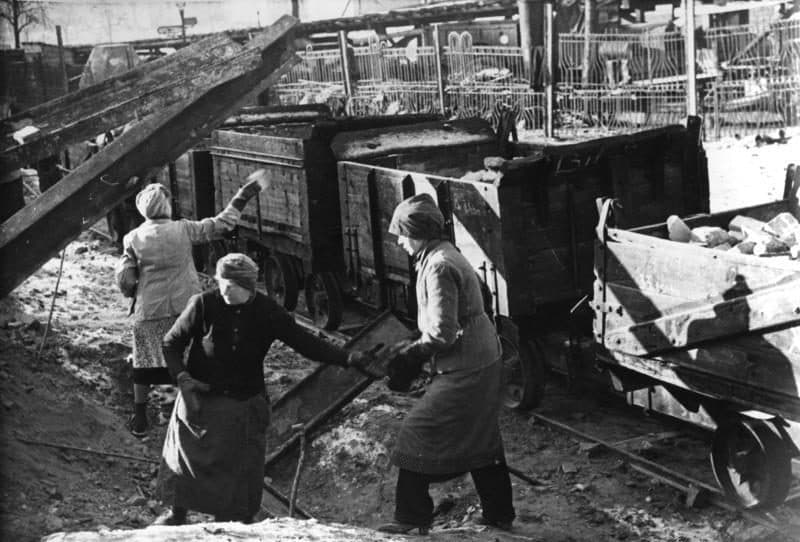
Initially, much of this work fell to the Trümmerfrauen – the ‘rubble women’. With many men dead or still prisoners of war, Berlin’s women, armed with little more than buckets, pickaxes, and sheer determination, began the arduous process of clearing the wreckage. They salvaged usable bricks, sorted materials, and loaded debris onto carts and makeshift narrow-gauge railways (Trümmerbahnen) that snaked through the ruined city. But where could all this debris ultimately go? Berlin is situated on a flat, sandy plain. Landfill sites within the city limits quickly filled up. A more permanent solution was needed.

The authorities designated several locations on the city’s outskirts as official dumping grounds (Schuttberge).

Silhouette of the Teufelsberg spy station tower and radomes above the Grunewald trees at sunset, Berlin
The tower and radomes at dusk, above the Grunewald.

One chosen site was in the Grunewald forest, West Berlin’s vast green lung located in the British Sector. Day after day, year after year, convoys of trucks and trains arrived, disgorging their loads of pulverised history onto this growing mound. Between 1950 and 1972, an estimated 26 million cubic metres of Berlin’s wartime rubble – almost one-third of the city’s total – were deposited here, gradually forming the highest elevation in West Berlin, reaching approximately 120 metres (394 feet) above sea level.

But Teufelsberg hides a deeper, darker secret beneath its layers of wartime debris. Before the bombs fell, this site was earmarked for a project central to Nazi ideology. A colossal Military-Technical College (Wehrtechnische Fakultät) had been designed for this site by the government architect Hans Malwitz, intended as part of Albert Speer’s grandiose Germania plan to reshape Berlin as the capital of the world. Construction had begun, and the shell of the massive faculty building was partially completed when the war intervened. After the war, the Allies found the structure too robust and heavily reinforced to demolish easily with explosives without risking damage to the surrounding areas. The simplest solution? Bury it.

…Hitler’s unfinished monument to Nazi military ambition lies entombed beneath millions of tons of the very destruction his regime unleashed upon the city.

And so, Hitler’s unfinished monument to Nazi military ambition lies entombed beneath millions of tons of the very destruction his regime unleashed upon the city. This artificial mountain, born from the ashes of war, was ironically christened Teufelsberg, ‘Devil’s Mountain’, after the nearby Teufelssee (“Devil’s Lake”). It was this strategically high point, built on the remnants of fascism, that would soon become a critical outpost in the next global confrontation.

The listening station

The unique geography of West Berlin made Teufelsberg an ideal location for signals intelligence (SIGINT). As the highest point in the relatively flat landscape, it offered an unobstructed line-of-sight deep into East Germany and beyond, towards Poland and the Soviet Union. The Western Allies, particularly the Americans and the British, were desperate to monitor Warsaw Pact military communications, track Soviet troop movements, listen in on East German government and diplomatic traffic, and intercept any signals related to missile tests or air defence systems. In the early 1960s, mobile listening units confirmed the site’s potential, and construction of a permanent facility began.

The iconic white radomes, which gave the site its distinctive appearance, were not the listening devices themselves but protective coverings made of fibreglass. They shielded the large, sensitive dish antennas and other sophisticated electronic equipment inside from the harsh Berlin weather – wind, rain, snow, and ice – and also concealed their exact nature and orientation from prying eyes (and potential Soviet satellite reconnaissance).

Inside the operations buildings, hundreds of technicians, linguists, and analysts worked around the clock in shifts, tuning receivers, intercepting radio waves, microwaves, and other electronic emissions radiating from the East. They listened for everything: coded military messages, conversations between tank commanders on manoeuvres, radar signals from air defence installations, communications from East German border guards, even potentially sensitive economic or political information passed over state telephone lines. The raw intercepted data would be recorded, filtered, and potentially decrypted. Highly trained linguists fluent in Russian, German, Polish, and Czech would translate relevant intercepts, which analysts would then piece together to build a picture of Warsaw Pact capabilities and intentions. It was a painstaking, vital part of the West’s intelligence jigsaw puzzle.

…a painstaking, vital part of the West’s intelligence jigsaw puzzle.

The relationship between the different agencies wasn’t always smooth. While the NSA and GCHQ collaborated closely on Teufelsberg, there were underlying currents of competition and differing priorities, mirroring the broader intelligence community dynamics. The CIA, focused more on human intelligence (HUMINT) – recruiting spies and agents – also had a presence and interest in the intelligence gleaned from Teufelsberg. On the other side, the Soviet KGB and the East German Stasi were acutely aware of the listening station’s capabilities. They employed countermeasures, such as frequently changing codes and frequencies, using secure landlines, and attempting electronic jamming. There were constant fears of infiltration – that the Stasi or KGB might have managed to place an agent amongst the thousands of American, British, and German personnel who worked at or serviced the station over its decades of operation. Several spy scandals rocked the Berlin intelligence community during the Cold War, highlighting the ever-present risk.

Teufelsberg represented the technological frontline of the Cold War. As Soviet technology advanced, so too did the West’s interception capabilities, requiring constant upgrades to the equipment housed beneath the domes. This electronic cat-and-mouse game continued relentlessly until the political landscape shifted dramatically. With the fall of the Berlin Wall in November 1989 and the subsequent reunification of Germany in 1990, the primary raison d’être for Teufelsberg vanished. The Warsaw Pact dissolved, the Soviet Union crumbled, and the enemy the station was built to watch ceased to exist in its Cold War form. The listening operations wound down, sensitive equipment was removed or destroyed, classified documents were shredded or shipped out, and by 1992, the Americans and British handed the keys back to the German authorities.

The Devil’s Mountain fell silent.

Teufelsberg today

After the military departed, Teufelsberg entered a strange limbo. The imposing structures remained, empty shells stripped of their secret technology, overlooking a newly unified city.

Ownership reverted to the Berlin Senate, and optimistic plans for redevelopment soon emerged. In the mid-1990s, a Cologne-based investment group bought the site, envisioning luxury apartments, a hotel, a conference centre, and even a spy museum. Foundations were laid, but escalating costs, planning disputes, difficulties with the site’s unique history and location within a protected forest area, and ultimately financial insolvency brought the project crashing down by the early 2000s.

For years, Teufelsberg languished in a state of dereliction. The fences were breached, and the abandoned buildings became a playground for urban explorers, vandals, and partygoers. Nature began reclaiming the site, while graffiti artists discovered the vast, decaying concrete surfaces, transforming the former spy station into one of Europe’s largest and most dynamic street art galleries. The stark, skeletal remains of the radomes and operations buildings became canvases for vibrant murals, tags, and installations, creating a surreal juxtaposition of Cold War history and contemporary urban culture. Even the famous filmmaker David Lynch was briefly interested, proposing to establish a Vedic Peace University on the site, another ambitious plan that never materialised.

Today, Teufelsberg exists in a semi-official state. It is technically private property, but managed by a collective that allows controlled access to the public, usually via paid tours or entry fees. Visiting Teufelsberg now offers a unique, multi-layered experience unlike anything else in Berlin. Firstly, there’s the palpable sense of history. Walking through the echoing, graffiti-covered buildings, climbing the dark stairwells, and standing beneath the skeletal frames of the giant radomes evokes the atmosphere of Cold War espionage in a way no museum exhibit can.

‘Thank God it’s our bomb’ mural of Uncle Sam riding a bomb, street art on a building at Teufelsberg in Berlin
One of the murals in Teufelsberg’s open-air gallery.

Secondly, the site is a living testament to urban art. The sheer scale and quality of the street art are breathtaking, constantly evolving as new pieces are added over older ones. It’s a vibrant, chaotic, and visually stunning environment.

Thirdly, the views from the top are arguably the best in Berlin. On a clear day, you have a panoramic vista stretching across the dense Grunewald forest, over the city skyline with landmarks like the Fernsehturm (TV Tower) clearly visible, and far out towards the Brandenburg plains. This is no polished museum; it’s an atmospheric ruin that tells its story through its very fabric. It’s a journey up a man-made mountain built on ruins, crowned with the ghosts of espionage, and now pulsating with creative energy.
Teufelsberg in detail

Trümmerfrauen, Berlin’s rubble women, loading broken bricks into narrow-gauge rubble wagons in 1946
Rubble women loading a Trümmerbahn wagon in Berlin, 1946. Photo: Bundesarchiv, Bild 183-H30060 / Krueger, Erich O. / CC-BY-SA 3.0

How the rubble mountain was built

Once the city split in 1948, West Berlin could no longer dump its debris in the surrounding countryside, and inner-city tips such as the Insulaner were soon full. In June 1950 the West Berlin Magistrat opened a new dump in the Grunewald, over the half-demolished shell of the Nazi college. For 22 years up to 800 lorries a day tipped their loads here: the ten-millionth cubic metre arrived on 14 November 1957, and by 1972 the total was about 26 million, roughly the remains of 15,000 buildings.

The city landscaped the hill as a place to play. A ski jump opened in 1955 and a bigger one in 1962, with room for 5,000 spectators; jumping stopped in 1969. A ski slope got a tow lift and floodlights in 1964, all removed in 1972 because the Americans said they disturbed their listening. In the 1970s and 1980s a vineyard on the south slope even produced a local wine, the ‘Wilmersdorfer Teufelströpfchen’.

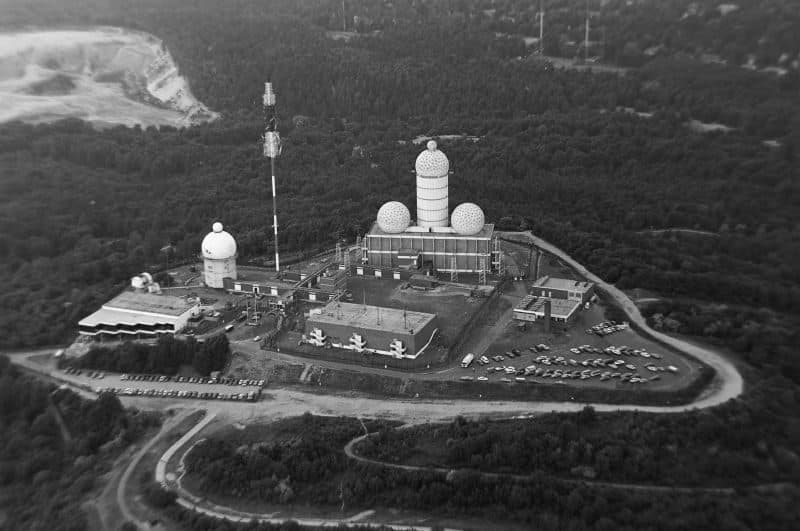
Aerial photograph of Field Station Berlin on Teufelsberg in 1979, with radome tower, antenna mast and car parks in the Grunewald forest
Field Station Berlin from a helicopter, 1979, taken by a soldier who worked there. Photo: Phil Jern / CC BY 2.0, via Wikimedia Commons

Field Station Berlin

The Americans went looking for a new listening post after the Soviets uncovered their spy tunnel under the border at Rudow in April 1956. Mobile Allied units began listening from the growing hill in July 1961 and found reception far better than anywhere else in West Berlin. Work on permanent buildings began in October 1963, and the main complex with its radomes went up in 1969–71. The hill lay in the British sector, but the Americans ran it and the British shared it: the US Army Security Agency (from 1977 INSCOM), the US Air Force’s 6912th Electronic Security Group and the RAF’s No. 26 Signals Unit all worked here.

In the 1970s about 1,500 people staffed Field Station Berlin around the clock, many of them linguists trained in Russian and other Eastern Bloc languages. One story told about the station concerns the Ferris wheel at the German-American Volksfest in Zehlendorf: reception was noticeably better while it stood, so the fair was asked to leave it up for a while after closing.

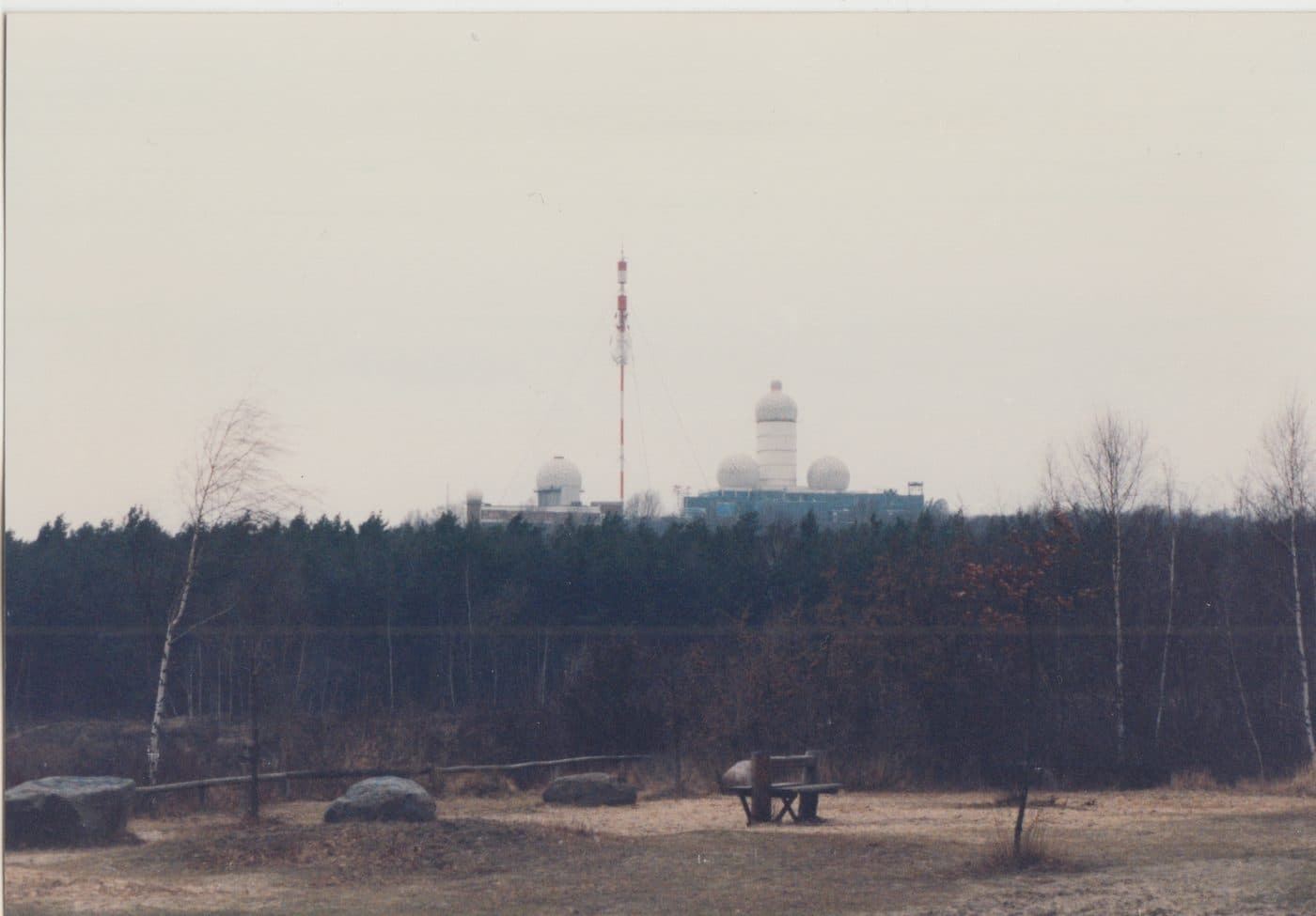
Field Station Berlin on Teufelsberg seen from a clearing in the Grunewald forest in April 1992, with its antenna mast and radomes
The station from the Grunewald in April 1992, as the Allies were leaving. Photo: Ken Mayer / CC BY 2.0, via Wikimedia Commons

After the spies left

The Americans and British pulled out in 1991–92 and stripped out the electronics, but the buildings stayed in use until 1999 as a civilian air-traffic radar station. In 1996 Berlin sold the 4.7-hectare site for DM 5.2 million to a Cologne investor group, which planned a hotel and conference centre, flats, a restaurant and a spy museum. A few foundations, a basement shell and a show flat were built before rising costs, opposition from environmentalists and the investors’ insolvency stopped the work. The building permit lapsed in 2004, and in 2006 the land was designated as forest, where nothing new can be built.

In 2008 the Maharishi movement, with David Lynch’s backing, announced a ‘Vedic peace university’ with a 50-metre tower; Lynch laid a symbolic foundation stone, but the movement withdrew before the year was out. Regular guided tours began in 2011, and on 30 October 2018 Berlin’s monuments office listed the whole hill as a historic monument: the buried Nazi college, the rubble mountain and the listening station on top.

Plan your visit

Visiting Teufelsberg

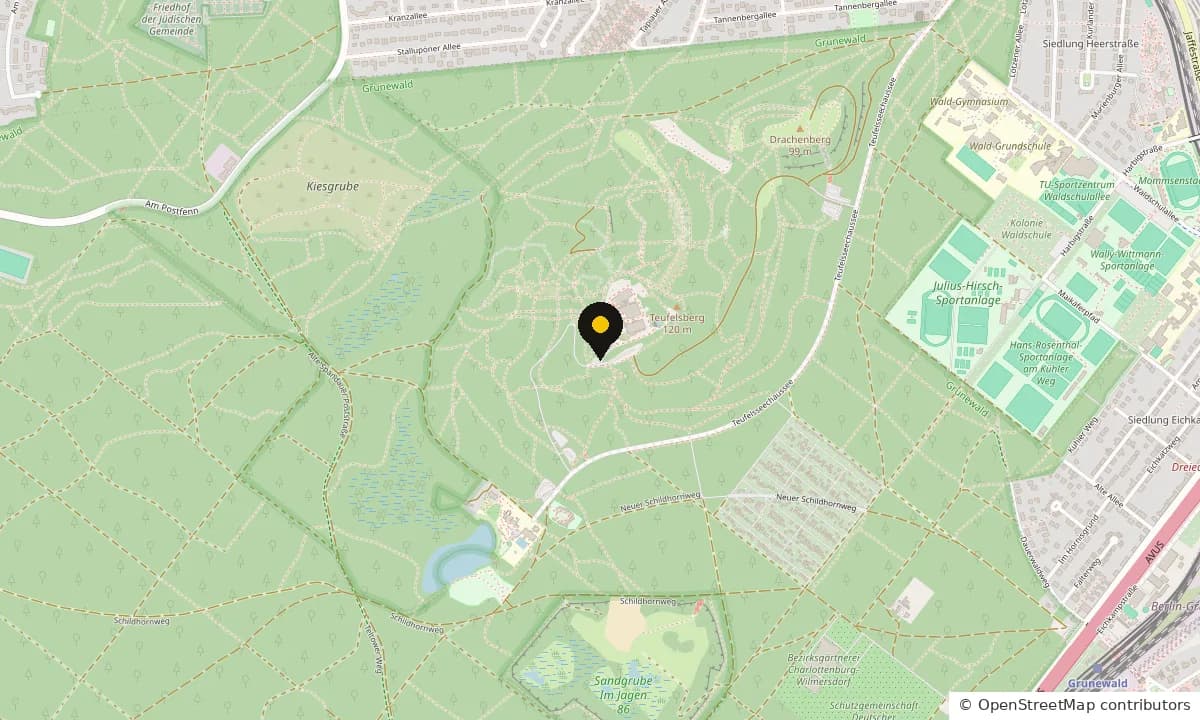
Map of the streets around Teufelsberg, with a pin on the siteOpen in Google Maps

Teufelsseechaussee 10, 14193 Berlin · Field station: daily from 11:00 until around sunset, last entry one hour before closing. In 2026: April and September 11:00–20:00, May and August 11:00–21:00, June and July 11:00–21:30, October 11:00–19:00, November and December 11:00–16:30. Closed 24 and 31 December, and on Mondays and Tuesdays in January and February 2027. It can close at short notice in snow, ice or storms. The hill and forest around it are open at all times.

Getting there

  • S7Grunewald2.1 km · 28 min

    15 minutes from Hauptbahnhof. Walk west through the forest to Teufelsseechaussee, then up the private access road. The forest paths are unlit, so start back before dusk in winter.

  • S3S9Heerstraße2.4 km · 32 min

    Walk south along Teufelsseechaussee through the forest. The X34 express bus also stops here.

  • Bus M49Flatowallee/Olympiastadion1.8 km · 24 min

    The M49 runs along Heerstraße from Zoologischer Garten. From the stop, walk south into the forest past the Drachenberg.

What you’ll see

  • The main tower building, with its torn white radomes and a 360° viewing platform on the roof: views over the Grunewald to the city centre and the Fernsehturm.
  • The former operations buildings, now an open-air street-art gallery the operator bills as the largest in Europe, with murals across walls, stairwells and roofs.
  • Two exhibitions included in the ticket: ‘Declassified’, on the site’s history, and a display by the association Alliierte in Berlin e.V. (Thursday–Sunday 11:00–16:00).

Tips from a guide

  • Wear sturdy shoes and dress for an exposed hilltop: the site is a rough ruin, and the walk up is through forest. In November and December last entry is 15:30, so set off early.
  • You may bring your own food and drink. There is also a bar, a coffee stand and, at weekends, food trucks; cash and cards are accepted at the ticket office.
  • To see the radomes without paying, climb the free Drachenberg next door. To understand what you are looking at, book the operator’s 90-minute MYTHOS Teufelsberg tour on top of your ticket.

Accessibility

The buildings are not step-free and are reached by stairs. Wheelchair users and visitors with limited mobility can reach the 360° viewing platform by an open outdoor lift, operated only by trained staff: email touren@teufelsberg-berlin.de at least one to two days ahead. The two exhibitions are step-free. Guided tours are not accessible, and pushchairs, rollators and wheelchairs cannot be taken on them. The access road up from the car parks is steep. There are toilets in the courtyard.

Timeline

From Nazi college to spy station to art gallery

  1. 27 Nov 1937Hitler lays the foundation stone of the Wehrtechnische Fakultät.
  2. Feb 1940Work stops on all building not vital to the war; the shell is left unfinished.
  3. 1950West Berlin starts dumping wartime rubble over the ruin.
  4. Jul 1961Mobile Allied listening units begin operating from the hill.
  5. Oct 1963Work begins on permanent buildings for Field Station Berlin.
  6. 1969–71The main complex and its radomes are built.
  7. 1972Dumping ends: about 26 million m³ of rubble, 120 m above sea level.
  8. 1991–92The Americans and British leave and strip out the equipment.
  9. 1996Berlin sells the site to investors for DM 5.2 million; the project later fails.
  10. 2004The building permit lapses; the ruins fill with street art.
  11. 2011Regular guided tours begin on the hilltop.
  12. 30 Oct 2018The hill, the buried college and the station are listed as a monument.

See it with a historian

Tours that stop at Teufelsberg

The ruins do not explain themselves: a guide can tell you what the Allies listened to, what lies under the rubble and how the hill fits into Berlin’s Cold War.

Life behind the Iron Curtain, and the Western listening post that eavesdropped on it.

The Berlin Wall Tour - Berlin Experiences
Full Day6 Hours

The Republic Of Fear

Private 6-hour van tour of East Berlin, the Stasi and life behind the Wall for up to 6 people. Starts at your hotel.

€1,000up to 6
View Tour

Hitler’s plans for Berlin, including the military college now buried under the hill.

The Capital Of Tyranny Tour - Berlin Experiences
Full Day6 Hours

The Capital Of Tyranny

Private 6-hour van tour of Hitler's Berlin and the Third Reich for up to 6 people. Starts at your hotel or anywhere in the city.

€1,000up to 6
View Tour

The all-in-one day, with time to add the hill and its views in the west of the city.

The Berlin History Tour
Full Day6 Hours

The Berlin History Tour

Private 6-hour van tour of Berlin's whole history in one day for up to 6 people. Starts at your hotel or anywhere in the city.

€1,000up to 6
View Tour

Questions visitors ask

Frequently asked questions

Is Teufelsberg free to visit?

The hill and the forest around it are free and open at all times. The former listening station on top is private and charges admission: €12 for adults, €10 reduced, €5 for under-18s, €27 for a family ticket and free for children under 7.

What are Teufelsberg’s opening hours?

Daily from 11:00 until around sunset, with last entry one hour before closing: until 16:30 in November and December, and as late as 21:30 in midsummer. In January and February it closes on Mondays and Tuesdays, and it can shut at short notice in bad weather.

How do I get to Teufelsberg?

Take the S7 to Grunewald or the S3 or S9 to Heerstraße, then walk about 30 minutes through the forest. The M49 bus stop Flatowallee/Olympiastadion is a little closer, about 25 minutes on foot. There is no parking at the top; free car parks on Teufelsseechaussee are about 10 minutes’ walk below.

Who ran the Teufelsberg spy station?

The Americans, with the British sharing the site. The US Army Security Agency (later INSCOM), a US Air Force unit and the RAF worked there for the NSA and GCHQ; in the 1970s about 1,500 people listened around the clock to Warsaw Pact military and radio traffic.

What is under Teufelsberg?

About 26 million cubic metres of rubble from bombed Berlin, dumped between 1950 and 1972, and beneath that the shell of the Wehrtechnische Fakultät, a Nazi military-technical college whose foundation stone Hitler laid in 1937. Work stopped in 1940 and it was never finished.

Can you go inside the radomes?

You can climb the main building to the 360° viewing platform on its roof, beside the radomes. The tall radome tower itself is closed for safety, except on the operator’s winter torchlight tour, which goes up into the dome.

Are there guided tours of Teufelsberg?

Yes. The operator’s 90-minute MYTHOS Teufelsberg tour runs daily and is booked on top of admission; it is mainly in German, and the operator says it is also offered in English, so check the booking page. Our Republic of Fear, Capital of Tyranny and Berlin History tours can also include the hill.

Is Teufelsberg worth visiting?

If you like Cold War history, street art and big views, yes: nowhere else in Berlin combines all three. It is a rough, unpolished ruin a long walk from the station, so come in good shoes and allow at least two hours.

Keep exploring

More Featured Experiences.

Every site we write about — 56 landmarks, museums, memorials and lesser-known corners of Berlin. See the full index →

01Walk Through The Brandenburg Gate02Explore The State Museums On Museum Island03Visit The Berlin TV Tower – The Fernsehturm04Cross The Cold War Border At Checkpoint Charlie05Visit The Site Of Adolf Hitler’s Führerbunker06Explore The Reconstructed Berlin Palace07Visit The Reichstag Cupola At Night08Explore The Forum Fridericianum09Shop At The Humboldt University Book Sale10Journey Into The Memorial To The Murdered Jews Of Europe11Step Inside The Neue Wache12Explore The Former Jewish Quarter – Spandauer Vorstadt13Visit The Remains Of The Berlin Wall14Walk Across The Bridge Of Spies15Explore The Topography Of Terror16Climb The Prussian Victory Column – The Siegessäule17Enter The Palace Of Tears – The Tränenpalast18Step Inside The Berlin Olympic Stadium19Explore Erich Mielke’s Office At The Stasi Museum20Walk Along Karl Marx Allee21Visit The Oldest Church In Berlin – The Nikolaikirche22Explore The Berliner Dom23Visit The Grave Of Frederick The Great24Walk Through The Ruins Of Anhalter Bahnhof25Stand On The Platz Des Volksaufstandes26Visit The German Resistance Museum27Visit The Soviet War Memorial In The Tiergarten28See The Georg Elser Memorial On Wilhelmstrasse29Step Inside The Kaiser Wilhelm Gedächtnis Kirche30Visit The Gleis 17 Memorial31Visit The Schloss Charlottenburg Mausoleum32Climb The Französischer Dom at Gendarmenmarkt33Explore The Interbau – IBA 5734Explore The Otto Weidt Workshop35Visit Cecilienhof – Site Of The Potsdam Conference36Visit The Stasi Prison In Hohenschönhausen37Spend The Day At Tempelhof Airport38Ride The Fastest Elevator In Europe39Visit The Soviet War Memorial In Treptower Park40Visit The Sachsenhausen Concentration Camp Memorial41Visit The Ravensbrück Concentration Camp Memorial42Visit Karlshorst – The Site Of The German Surrender43Visit The Socialists Cemetery – Zentralfriedhof Friedrichsfelde44Visit The Soviet War Memorial In Pankow45Visit the Seelow Heights Memorial46Visit The Commonwealth War Cemetery47Cross The Bösebrücke At Night48Explore The Allied Museum In Dahlem49Explore The Spandau Citadel50Visit The Brandenburg T4 Euthanasia Memorial51Visit The Wannsee Conference House52Visit The Jewish Museum53Visit The Jewish Cemetery In Weissensee54Walk Along The East Side Gallery55Explore The Volkspark Friedrichshain Flak Tower