Skip to content
Schloss Cecilienhof in Potsdam: the half-timbered courtyard front, with the Soviet red star of flowers on the lawn

Berlin Experiences/Featured Experiences

Cecilienhof Palace: Visit the Site of the Potsdam Conference

The final meeting of the Big Three victorious allies in 1945.

The short answer

Schloss Cecilienhof is the Tudor-style country house in the Neuer Garten in Potsdam, about 25 km south-west of central Berlin, where Truman, Stalin and Churchill, then Attlee, held the Potsdam Conference from 17 July to 2 August 1945. The house, conference room included, has been closed for restoration since November 2024, and the Prussian Palaces and Gardens Foundation (SPSG) plans to reopen it in 2029. Until then you can see it from outside and walk the Neuer Garten around it, which is free and open daily from 08:00 until dusk. Allow 45–60 minutes, plus about an hour each way from central Berlin.

Where
Im Neuen Garten 11, 14469 Potsdam, at the north end of the Neuer Garten
Open
House closed for restoration until 2029; park daily 08:00–dusk
Admission
Park free; no house tickets until it reopens
Time needed
45–60 minutes for the outside and the park
Nearest station
Bus 603 Schloss Cecilienhof, 4 minutes on foot
Step-free
The park, yes (SPSG); the house is closed
With a guide
The palace park is a stop on the private day trip to Potsdam. See the Royal Potsdam Tour →

The story · by Matt Robinson

As the conflict in Europe reached its much overdue conclusion in 1945, the leaders of the Big Three victorious powers gathered for a final time to decide on the fate of the continent – and shape the future of post-war relations.

Over the space of 17 days in July and August 1945, US President, Harry S. Truman, Soviet Generalissimo, Joseph Stalin, and UK Prime Minister, Winston Churchill, convened in Potsdam – to the south west of Berlin. Having escaped relatively untouched by the ravages of war, the city was chosen as the site for the final of the three major conferences that saw these allies gather – Yalta, Tehran, and Potsdam. Chosen for its proximity to the former Nazi capital of Berlin – one of the reasons this would also initially be called the ‘Berlin Conference’ – Potsdam was historically the second city of the Kingdom of Prussia and site of the summer residences of the Prussian Kings and German Emperors.

The specific location chosen to host the conference was the Tudor-style Schloss Cecilienhof, a 176-room royal residence complete with iconic half-timbered walls and 55 different chimneys, constructed in 1917, and deep within the Soviet zone of occupation from 1945.

Hence, one of the most recognisable aspects of the building now lies in its courtyard – a Soviet red star, which is still freshly planted every spring – a message to the Western Allies in attendance that the conference was taking place firmly on territory that the Red Army had spilled blood to take.

The last Hohenzollern palace

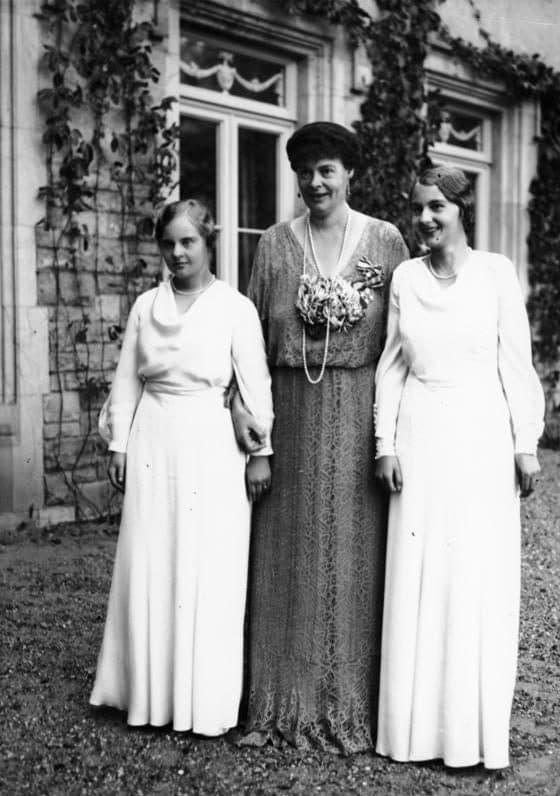
The last palace in Germany constructed by the ruling Hohenzollern Imperial family, Schloss Cecilienhof was initially intended to be the residence of Crown Prince Wilhelm and his wife Cecilie (thus the name of the palace).

The carved oak staircase in the Great Hall of Schloss Cecilienhof in Potsdam, a gift from the city of Danzig
The Danzig staircase in the Great Hall.

The Prussian ruling family had for centuries been on close terms with the British royal family, due largely to the latter’s Hanoverian kingdom that was eventually incorporated into the newly formed German state in 1871. Significantly also dating all the way back to the Treaty of Westminster in 1756, that would establish neutrality between Prussia and Great Britain – while the former was tasked with protecting Hanover from France. The last German Emperor, a grandson of British Queen Victoria in fact, was also a Colonel-In-Chief in the British Army, overseeing the 1st Royal Dragoons.

It should come as no surprise then that the architecture of the Cecilienhof Palace should have a distinctly English touch – even if it was completed during a war (World War One) which saw Germany fighting against its former British ally.

Designed by architect, Paul Schultze-Naumburg, who would later go on to become a Nazi party member and parliamentary representative, Cecilienhof sits in the northern section of the Neuer Garten – near the shore of the Jungfernsee lake. Ideally situated to be defended, in 1945, by Soviet troops looking to secure a location for the Potsdam Conference.

The conference and its agreement

Within the confines of this palace complex is the central assembly room used for the Conference, still maintained as it appeared in 1945 – complete with the table and chairs – and flags – used by the victorious powers. Beyond the possibility to securely maintain a cordon around the palace, due to its extensive parkland, there was a further reason for choosing to host the conference here – the layout of the interior and ability to allow each of the three leaders independent access to the central room – thus showing no preference in who would be deemed more important. The round table, made in Russia exclusively for the conference, would also reflect this equitable dynamic.

The Potsdam Conference room at Cecilienhof: the round table beneath the great window, with the Soviet, US and British flags
The conference room, kept as it was in 1945.

With the military defeat of Nazi Germany complete ten weeks earlier, in May 1945, the Big Three leaders met in Potsdam and issued a statement of aims – known as the Potsdam Agreement – signed on August 1st. Focusing on a series of resolutions – the Four Ds – the conference would charge the Allied Control Council with implementing denazification of Germany, demilitarisation, democratisation, and decentralisation resulting in German federalism.

The powers would also conclude a frontier agreement to shift Germany’s eastern edge to the Oder-Neisse line (its current international border with Poland) – resulting in the loss of 25% of the country’s size and much of the historic eastern part of Prussia. Preparations would be made for the trials of Nazi war criminals, the decartelisation of the economy and a focus on light industry and peacetime production of non-military goods.

Between war and Cold War

At this time it was not apparent that Germany would eventually be divided into two – West Germany and East Germany – following the ensuing Cold War discord between the US, British, and Soviet powers. The so-called Iron Curtain had yet to be recognised in the West as having been drawn across the continent.

These three leaders, their translators, and foreign ministers, would sit at the round table in the conference room of the Cecilienhof Palace as equals. Finalising the division of Germany that had been agreed upon at the earlier Yalta Conference was paramount; preparing the ground for the coming confrontation between East and West once the smoke of the Second World War had conclusively settled was incidental.

Delegates’ chairs and the round conference table in the Great Hall of Cecilienhof Palace, Potsdam
The round table, made in Moscow for the conference.

While war in the Pacific continued to rage, the US and British delegations convened in Potsdam to issue the Potsdam Declaration on July 26th – threatening Japan with “prompt and utter destruction” if it did not surrender. Ten days earlier, in the New Mexico desert, the United States had harnessed a deadly and destructive force. News of the detonation of the world’s first nuclear bomb reached US President Harry S. Truman on July 16th, the day before the Potsdam Conference – where for 13 plenary sessions Truman sat knowing his government possessed a weapon that would change the course of human history forever.
Cecilienhof in detail

Crown Princess Cecilie with her two daughters at Schloss Cecilienhof in Potsdam, on the day of their confirmation in 1934
Crown Princess Cecilie with her daughters at Cecilienhof, 1934. Photo: Bundesarchiv, Bild 183-2003-1014-505 / CC-BY-SA 3.0

A home for the last Crown Prince

Wilhelm II set aside money for a new palace in the Neuer Garten in 1912, and his son, Crown Prince Wilhelm, laid the foundation stone in May 1913. The war held up the work: Crown Princess Cecilie moved into her finished rooms in August 1917, and the building was completed on 1 October that year. Paul Schultze-Naumburg grouped its 176 rooms around five courtyards, which hides how big the house is. Almost all the private rooms were designed by Paul Ludwig Troost, who had made his name fitting out ocean liners, and one was fitted out as a ship’s cabin at Cecilie’s wish.

The monarchy fell a year later, but a 1926 settlement with the Prussian state let the former Crown Prince and his family go on living here. They stayed until 1945: Cecilie left in February as the Red Army approached. That September the Soviet military administration expropriated the family without compensation, and the claims the Hohenzollerns later made on the house were withdrawn in 2023.

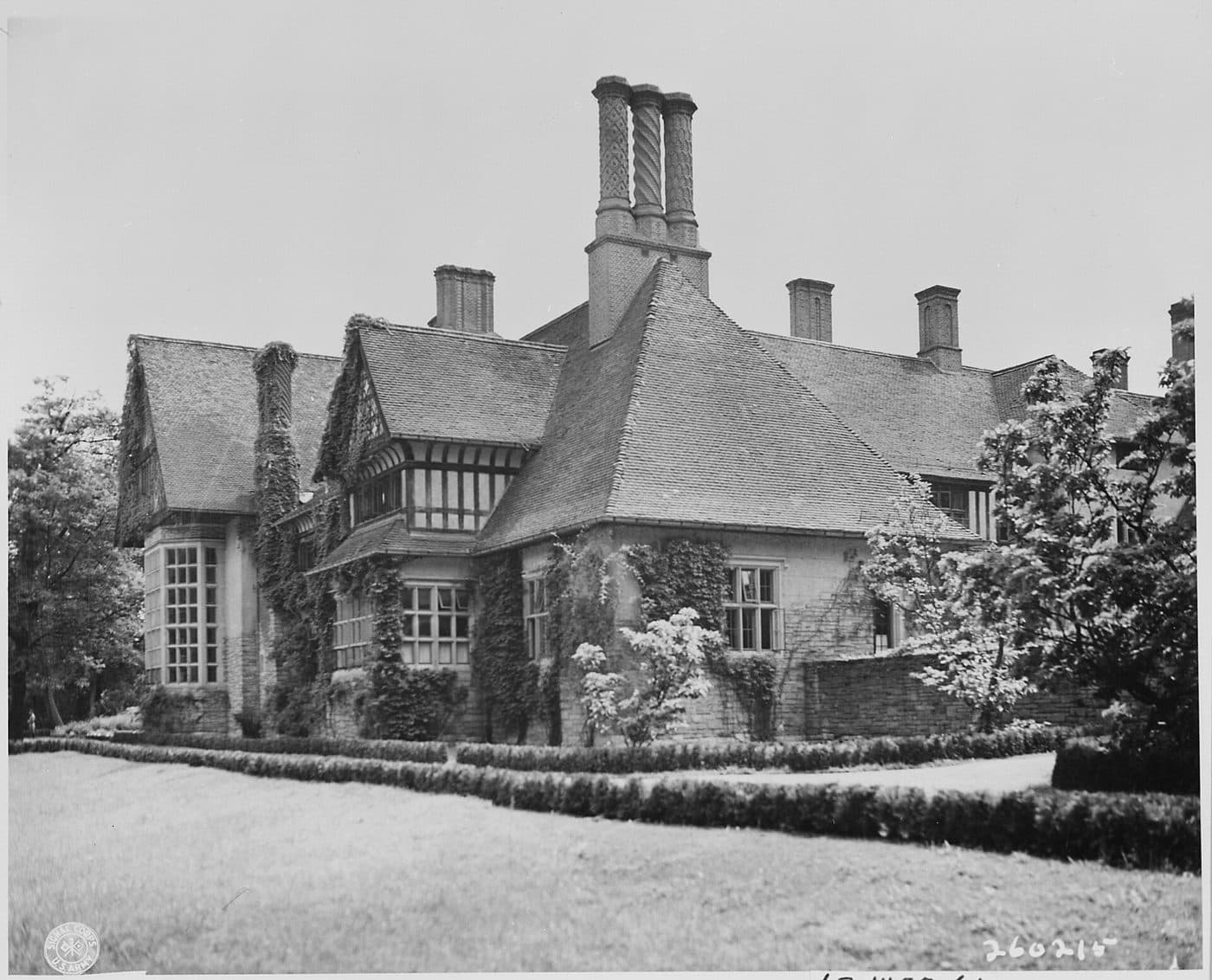
The wing of Cecilienhof Palace in Potsdam set aside for the United States delegation, photographed by the US Army in July 1945
The wing used by the US delegation, July 1945. Photo: US Army Signal Corps / Public domain, via Wikimedia Commons

How the conference used the house

The Red Army took Potsdam in April 1945, and as hosts the Soviets chose and prepared Cecilienhof for the meeting. The family’s furniture was carried out to the Alte Meierei, the old dairy on the shore of the Jungfernsee, where a fire destroyed it on 25 July. Soviet officers furnished the rooms from nearby palaces to suit each delegation: classical pieces from the Marble Palace for Truman’s study, neo-Gothic furniture from Schloss Babelsberg for Churchill’s, and a dark leather sofa and heavy desk for Stalin.

The Great Hall, 26 metres long and two storeys high, became the conference room, with a round table 3.05 metres across made by the Moscow firm Lux. Each delegation had its own wing. The leaders did not sleep here: they stayed in villas in Babelsberg, a few kilometres to the south, and were driven in for the 13 plenary sessions between 17 July and 1 August.

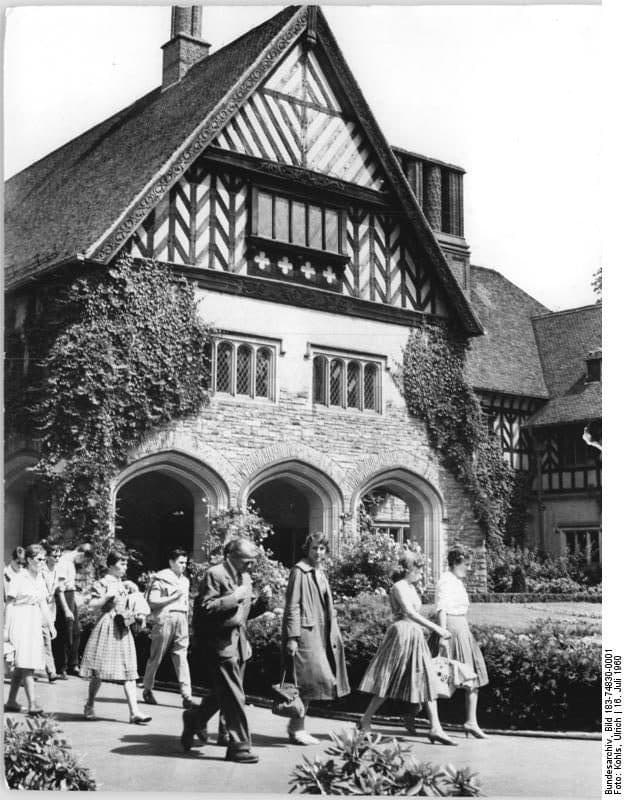
Visitors leaving the courtyard of Schloss Cecilienhof in Potsdam in July 1960, when it was a memorial to the Potsdam Conference
Visitors at the conference memorial, July 1960. Photo: Bundesarchiv, Bild 183-74830-0001 / Kohls, Ulrich / CC-BY-SA 3.0

Memorial, hotel and restoration

After the conference the house and park were opened to the public for the first time. The Democratic Women’s League of Germany used the building as a training centre at first, and the conference rooms became a memorial to the Potsdam Agreement. In 1960 the East German state travel agency opened a 42-room hotel in the west wing, which outlived the GDR and ran until the end of 2013. In 1990 Cecilienhof became part of the UNESCO World Heritage Site of the palaces and parks of Potsdam and Berlin. Queen Elizabeth II visited in November 2004, and the G8 foreign ministers met here in May 2007.

The roof and façades were restored between 2014 and 2018 for nearly €10 million. In November 2024 SPSG closed the house for the next stage: new building services, step-free access, more exhibition space and a new hotel. It expects the work to be finished at the end of 2028 and plans to reopen the palace in 2029.

Plan your visit

Visiting Cecilienhof

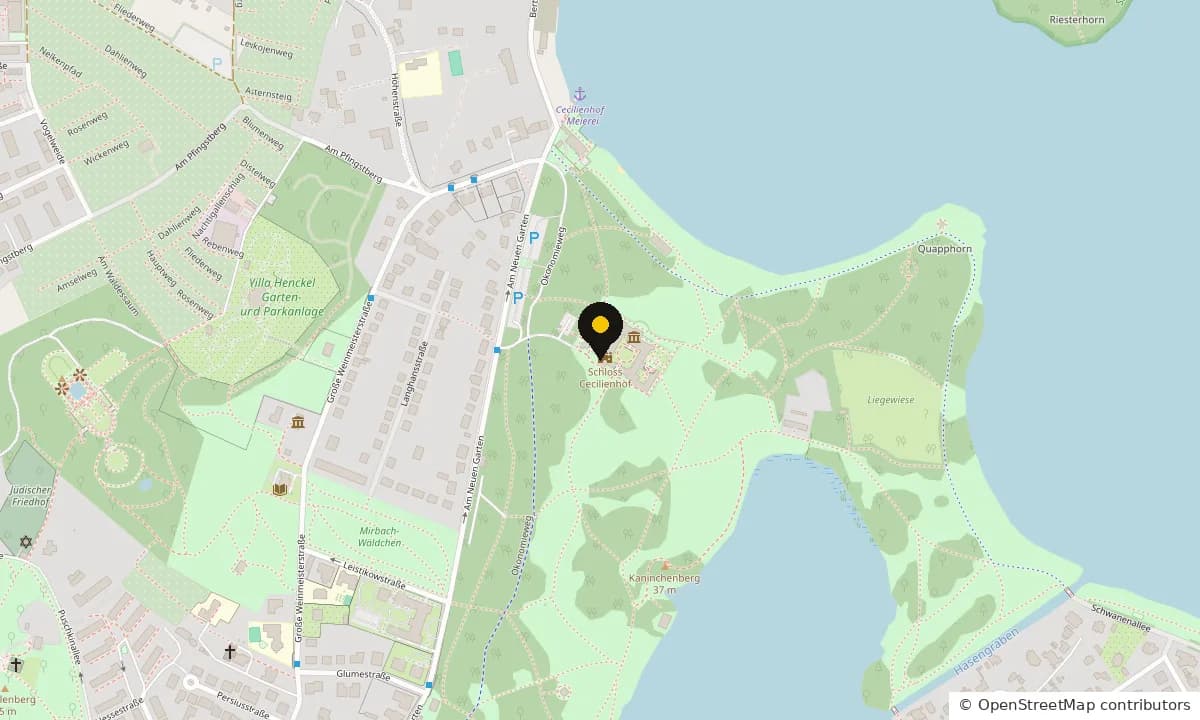
Map of the streets around Cecilienhof, with a pin on the siteOpen in Google Maps

Im Neuen Garten 11, 14469 Potsdam · Palace closed for restoration until 2029; Neuer Garten open daily 08:00 until dusk

Getting there

  • Bus 603Schloss Cecilienhof250 m · 4 min

    The 603 starts at Platz der Einheit/West in the centre of Potsdam, not at the main station: from Potsdam Hauptbahnhof take a tram towards the centre to Platz der Einheit/West (5 minutes), then the bus (10 minutes). It runs every 20–40 minutes.

  • Tram 92Tram 96Puschkinallee1.3 km · 18 min

    About 10 minutes from Potsdam Hauptbahnhof; then walk north-east through the Neuer Garten. Handy if you have just missed the bus.

  • S7RE1Potsdam Hauptbahnhofabout 25 min from Potsdam Hbf

    From Berlin Hauptbahnhof the S7 takes about 35 minutes and the RE1 about 25; then tram and bus as above. Potsdam is in fare zone C, so you need an ABC ticket.

What you’ll see

  • The house from outside: brick, dark-oak half-timbering and tall Tudor chimneys, no two alike, built in the style of an English country house for the Crown Prince and Crown Princess between 1913 and 1917.
  • The Neuer Garten around it: paths along the Jungfernsee and the Heiliger See, the Marble Palace, 10 minutes’ walk to the south, and the Gothic Library at the park’s southern end.
  • Inside, once it reopens in 2029: the conference room with its round table, the delegations’ studies and the Crown Prince couple’s private rooms. Until then SPSG points visitors to free virtual tours on Google Arts & Culture.

Tips from a guide

  • Check spsg.de before you go: building work can fence off parts of the grounds by the house, and the reopening date could move.
  • Buy a Berlin ABC ticket for the day: it covers the S-Bahn or RE1 from Berlin and the trams and buses in Potsdam.
  • Walk on to the Bridge of Spies: it is about 25 minutes from the palace along the Jungfernsee and Schwanenallee, and Tram 93 takes you back to Potsdam Hauptbahnhof from there.

Accessibility

SPSG lists the Neuer Garten as wheelchair accessible. Before the closure the conference rooms were step-free but the Crown Prince couple’s rooms on the first floor were not; the works are meant to add step-free access. During the building work the paid car park near the palace has car spaces only.

Timeline

From royal home to conference room

  1. May 1913Crown Prince Wilhelm lays the foundation stone in the Neuer Garten.
  2. 1 Oct 1917The palace is completed, the last one the Hohenzollerns built.
  3. 1926A settlement with the Prussian state lets the former Crown Prince’s family stay on.
  4. Feb 1945Crown Princess Cecilie flees west as the Red Army approaches.
  5. 17 Jul 1945Truman, Stalin and Churchill open the Potsdam Conference.
  6. 26 Jul 1945The Potsdam Declaration; Attlee replaces Churchill after the UK election.
  7. 2 Aug 1945The protocol, dated 1 August, is signed overnight and the conference ends.
  8. 1960An East German hotel opens in the west wing.
  9. 1990Listed as UNESCO World Heritage with the palaces and parks of Potsdam.
  10. 2014–18The roof and façades are restored.
  11. Nov 2024The palace closes for restoration; SPSG plans to reopen it in 2029.

See it with a historian

Tours that stop at Cecilienhof

With the house closed until 2029, a guide can tell the story of the conference on the spot and fit Cecilienhof into a day with Sanssouci and the Bridge of Spies.

The Glory Of Prussia Tour - Berlin Experiences
Full Day6 Hours

The Royal Potsdam Tour

Private 6-hour day trip from Berlin to the palaces and parks of Potsdam for up to 6 people. Starts at your hotel in Berlin.

€1,000up to 6
View Tour

Why this tour

A day in royal Potsdam, from Sanssouci to the Neuer Garten, with Cecilienhof from outside while it is closed.

See the Royal Potsdam Tour

Questions visitors ask

Frequently asked questions

Is Cecilienhof Palace open?

Not inside. The house, including the conference room, has been closed for restoration since November 2024. The Neuer Garten around it is open daily from 08:00 until dusk and free, so you can still see the outside of the palace.

When will Cecilienhof reopen?

The Prussian Palaces and Gardens Foundation (SPSG) expects the work to finish at the end of 2028 and plans to reopen the palace in 2029. Older sources give autumn 2027, which is out of date; check spsg.de before you plan around it.

Where did the Potsdam Conference take place?

In Schloss Cecilienhof, the Crown Prince’s country house in the Neuer Garten in Potsdam, from 17 July to 2 August 1945. The plenary sessions met in the Great Hall, around a round table made in Moscow for the conference.

Why was Cecilienhof chosen for the Potsdam Conference?

Berlin was in ruins, while Potsdam and Cecilienhof were largely intact and inside the Soviet zone. The park could be sealed off, and the layout let each delegation reach the conference room through its own entrance.

What was decided at the Potsdam Conference?

The Allies agreed how to run occupied Germany: denazification, demilitarisation, democratisation and decentralisation, with reparations and trials of war criminals. They placed the lands east of the Oder–Neisse line under Polish administration, and the US, Britain and China issued the Potsdam Declaration calling on Japan to surrender.

How do I get to Cecilienhof from Berlin?

Take the S7 or RE1 to Potsdam Hauptbahnhof, a tram to Platz der Einheit/West and Bus 603 to Schloss Cecilienhof: about an hour from Berlin Hauptbahnhof on an ABC ticket.

Can you stay at the Cecilienhof hotel?

Not at the moment. The hotel in the west wing, opened in 1960, closed at the end of 2013, and a new hotel is part of the current restoration, which SPSG plans to finish for a reopening in 2029.

Why is there a red star at Cecilienhof?

On Soviet orders, a five-pointed star of red flowers was planted in the courtyard in 1945 to show that the conference was being held on territory the Red Army had taken. It has been kept as part of the site’s history.

Keep exploring

More Featured Experiences.

Every site we write about — 56 landmarks, museums, memorials and lesser-known corners of Berlin. See the full index →

01Walk Through The Brandenburg Gate02Explore The State Museums On Museum Island03Visit The Berlin TV Tower – The Fernsehturm04Cross The Cold War Border At Checkpoint Charlie05Visit The Site Of Adolf Hitler’s Führerbunker06Explore The Reconstructed Berlin Palace07Visit The Reichstag Cupola At Night08Explore The Forum Fridericianum09Shop At The Humboldt University Book Sale10Journey Into The Memorial To The Murdered Jews Of Europe11Step Inside The Neue Wache12Explore The Former Jewish Quarter – Spandauer Vorstadt13Visit The Remains Of The Berlin Wall14Walk Across The Bridge Of Spies15Explore The Topography Of Terror16Climb The Prussian Victory Column – The Siegessäule17Enter The Palace Of Tears – The Tränenpalast18Step Inside The Berlin Olympic Stadium19Explore Erich Mielke’s Office At The Stasi Museum20Walk Along Karl Marx Allee21Visit The Oldest Church In Berlin – The Nikolaikirche22Explore The Berliner Dom23Visit The Grave Of Frederick The Great24Walk Through The Ruins Of Anhalter Bahnhof25Stand On The Platz Des Volksaufstandes26Visit The German Resistance Museum27Visit The Soviet War Memorial In The Tiergarten28See The Georg Elser Memorial On Wilhelmstrasse29Step Inside The Kaiser Wilhelm Gedächtnis Kirche30Visit The Gleis 17 Memorial31Visit The Schloss Charlottenburg Mausoleum32Climb The Französischer Dom at Gendarmenmarkt33Explore The Interbau – IBA 5734Explore The Otto Weidt Workshop36Visit The Stasi Prison In Hohenschönhausen37Spend The Day At Tempelhof Airport38Ride The Fastest Elevator In Europe39Visit The Soviet War Memorial In Treptower Park40Visit The Sachsenhausen Concentration Camp Memorial41Visit The Ravensbrück Concentration Camp Memorial42Visit Karlshorst – The Site Of The German Surrender43Visit The Socialists Cemetery – Zentralfriedhof Friedrichsfelde44Visit The Soviet War Memorial In Pankow45Visit the Seelow Heights Memorial46Visit The Commonwealth War Cemetery47Cross The Bösebrücke At Night48Explore The Allied Museum In Dahlem49Explore The Spandau Citadel50Visit The Brandenburg T4 Euthanasia Memorial51Visit The Wannsee Conference House52Visit The Jewish Museum53Visit The Jewish Cemetery In Weissensee54Walk Along The East Side Gallery55Explore The Volkspark Friedrichshain Flak Tower56Head Up The Teufelsberg