Skip to content
Gleis 17 memorial at Grunewald station in Berlin: the old brick platform with its plaque and pebbles left by visitors, beside the disused track

Berlin Experiences/Featured Experiences

Gleis 17: Visit the Platform 17 Deportation Memorial

One of Berlin’s main deportation stations for Jews during the Holocaust

The short answer

Gleis 17 (Platform 17) is Deutsche Bahn’s memorial to the deportation of Berlin’s Jews, on a disused platform at Grunewald S-Bahn station in the south-west of the city. From October 1941 trains left from here for the ghettos and camps in the East, and 186 steel plates along the track record every deportation train from Berlin, with its date, the number of people on it and its destination. It is outdoors, free and open at all times; take the S7 to Grunewald and follow the signs for ‘Mahnmal Gleis 17’. Allow 20–30 minutes.

Where
Grunewald S-Bahn station, Am Bahnhof Grunewald, 14193 Berlin
Open
Always: an outdoor memorial on a disused platform
Admission
Free
Time needed
20–30 minutes
Nearest station
S7 Grunewald, 2 minutes on foot
Step-free
No: steps or a cobbled ramp, then gravel paths

The story · by Matt Robinson

Since the construction of the Memorial for the Murdered Jews of Europe in Berlin in 2005, visitors to the city have had a central location where they can pay their respects to the victims of the Holocaust and contemplate the crimes of National Socialism. In fact the area surrounding this memorial also features other sites dedicated to the other groups targeted by Nazi racial policy and state violence – a memorial for the Roma and Sinti, a memorial for the persecuted homosexuals, and a memorial for the first group to suffer at the hands of the Nazis on a genocidal level – the mentally handicapped, the depressed, the people who were considered ‘life unworthy of life’ and murdered as part of the T4 euthanasia programme.

What ties almost all these sites together, more than their shared commemoration, is that (with the exception of the T4 memorial) they were all constructed in locations that have nothing to do with the crimes they reference. No extermination camp or deportation point was constructed on the current site of the Memorial for the Murdered Jews of Europe. During the Second World War this site served as the back garden of a Prussian palace, adjacent to the site of Hitler’s Führerbunker, but relatively untouched by the barbarism of the period.

Not the same can be said for the Gleis 17 memorial at the Grunewald train station – which in its current form was unveiled in 1998 – chronologically documenting the 186 deportation trains that left Berlin from 1941 until 1945, transporting more than 50,000 Jewish Berliners to their fates further east. Many sent to their deaths in places such as Theresienstadt and Auschwitz or the ghettos of Łódź or Riga.

The rusted steel plates of the Gleis 17 memorial running along the old track at Grunewald station, one reading ‘1005 Juden / Berlin – Riga’
‘1005 Jews / Berlin – Riga’: one of the transports to Riga.

The first train east

The first deportation train to leave from this station departed on October 18th 1941, with 1,013 Jews – the day the systematic deportation of Berlin’s Jewish population began.

Until this time, persecution of Germany’s Jewish minority had largely taken the form of legal restrictions – designed to create unfavourable circumstances for those who the Nazi state deemed racially impure and encourage emigration, at a high cost to any who chose that route. Violent attacks would occur but largely like ‘summer thunderstorms’, as described by one prominent journalist of the time, loud and cruel but sporadic rather than standardised.

Plate at Gleis 17, Berlin-Grunewald, reading ‘13.7.1944 / 27 Juden / Berlin – Theresienstadt’, beside the overgrown rails
‘13.7.1944 / 27 Jews / Berlin – Theresienstadt’.

Not the same could be said for those Jews unfortunate enough to have found themselves in the territories occupied by Nazi troops following the start of the Second World War in 1939 with the invasion of Poland. By the end of the year, Jews living in occupied Poland would be required to wear the Star of David as identification – a measure that would not be introduced in Germany until two years later, in September 1941.

The establishment of detention camps and ghettos across occupied Europe would see the continent’s Jewish population gradually segregated and corralled into these compounds as part of an organised resettlement strategy. Simultaneously, dedicated Einsatzgruppen (special task forces), coordinated by Heinrich Himmler’s SS (Schutzstaffel), would be entrusted with the job of massacring civilians, members of the intelligentsia, Communists, alleged partisans, and Jews. A long list of people deemed part of groups that needed to be annihilated to pacify the newly acquired territories.

The final role of these Einsatzgruppen would be to also gather those Jews who were not murdered outright into ghettos with good railway connections where they could be held either to be slaughtered at a later date or would die as a result of the poor conditions of their confinement.

How the Holocaust took shape

The debate as to the intention of the increasingly oppressive measures against Germany’s Jewish population has been a hot topic since the end of the Second World War. Whether these were part of a planned direct line towards the attempted extermination of the entire European Jewish population or whether these measures and the techniques used by the Nazi regime evolved organically, around the limitations and possibilities of the time. The intelligent conclusion being that it was simply a measure of both – with more than the fair share of the latter.

From the initial stages of the Nazi takeover, with the proclamations of a new Volksgemeinschaft (People’s Community) and the use of extrajudicial imprisonment to deal with the Gemeinschaftsfremde (“Community Aliens”), a system of coordinated oppression was being forged – to implement official Nazi Party policy.

In the case of the country’s Jewish population, this would mean the exclusion of Jews from civil service, a ban on Jewish doctors, and the Nuremberg laws of 1935 formalising the definition of who exactly would be classified as Jewish – based on the maternal and paternal line. From this point, marriages and extramarital intercourse between Jews and non-Jews would be forbidden. So severe were these restrictions that by 1939, around half of the German Jewish population had left the country – although those who did were often expected to contribute up to 90% of their wealth to the state as a tax upon leaving the country. If they could find a country willing to accept them.

Holocaust historian Raul Hilberg would famously state that the persecution of European Jews would follow a three-part trajectory, where Jews were initially told: “You have no right to live among us as Jews; you have no right to live among us; and finally you have no right to live.”

The rapid conquest of the east by the German Wehrmacht meant that millions more Jews fell under Nazi control from 1939 and following the invasion of the Soviet Union, the implementation of what would be called ‘The Final Solution to the Jewish Question’ would see around six million Jews eradicated by the genocidal fanaticism of Nazi rule. The expansion of existing concentration camp facilities and wholesale utilisation of industrial killing facilities serving to rapidly multiply the number of victims already dispatched through other earlier methods – such as those employed by the Einsatzgruppen.

Along the platform

Walking along the Gleis 17 memorial today, it is possible to discover the dates and destinations of the deportations that took place from Berlin from October 1941 all the way until the final phase of the war.

The Grunewald train station was one of three deportation stations in Berlin used by the Nazis – the other two being Moabit and Anhalter Bahnhof.

Close-up of a Gleis 17 memorial plate in Berlin-Grunewald listing 20 Jews deported to Bergen-Belsen and Sachsenhausen in January 1945
One of the last plates: 20 people sent to Bergen-Belsen and Sachsenhausen in January 1945.

When analysing this memorial it is important to note the destinations, that many of the earlier trains would deliver their human cargo to places like Łódź in Poland and Riga in Latvia, the former a ghetto transformed into a major industrial centre, manufacturing war supplies for the Wehrmacht – and the latter, where many of the arrivals were immediately massacred in the nearby Rumbula forest or imprisoned in a ghetto to be murdered later. Regular transports to Theresienstadt in today’s Czech Republic and Warsaw, Poland also featured prominently in this chronological memorial.

However, the most infamous of the Nazi death camps, Auschwitz, notably does not appear until much later – when you walk along the platform of the track to the second side – with regular deportations starting in November 1942. This being due to the priority the Nazi administration placed on dealing with ‘the Jewish question’ first in Poland and then in other territories such as Germany – following the negotiations at the Wannsee Conference in January 1942.

A perpetrator site

When inaugurated in 1998, this memorial – far removed from the centre of the city – was largely a matter of German train company Deutsche Bahn recognising the role of its predecessor organisation Deutsche Reichsbahn in the Holocaust – providing a place of pilgrimage for people to observe this history and pay their respects to the victims. Unlike the other similar memorials throughout Berlin it is exceptional in that this was previously a ‘perpetrator site’ – the cast-steel plates laid on both sides of track 17 documenting all the journeys from Berlin with the number of deportees and destinations, from exactly where many of these people were deported from.

The track is maintained but no train will ever leave this platform again.

Take note: the distance between the location’s previous use and its present form is as important as the opportunity for contemplation it now offers as a memorial. Unlike the thousands who were mercilessly sent from here to their deaths, visitors to this site can now descend back into the train station and continue to go about their lives. The contrast could not be clearer. The track is maintained but no train will ever leave this platform again.
Gleis 17 in detail

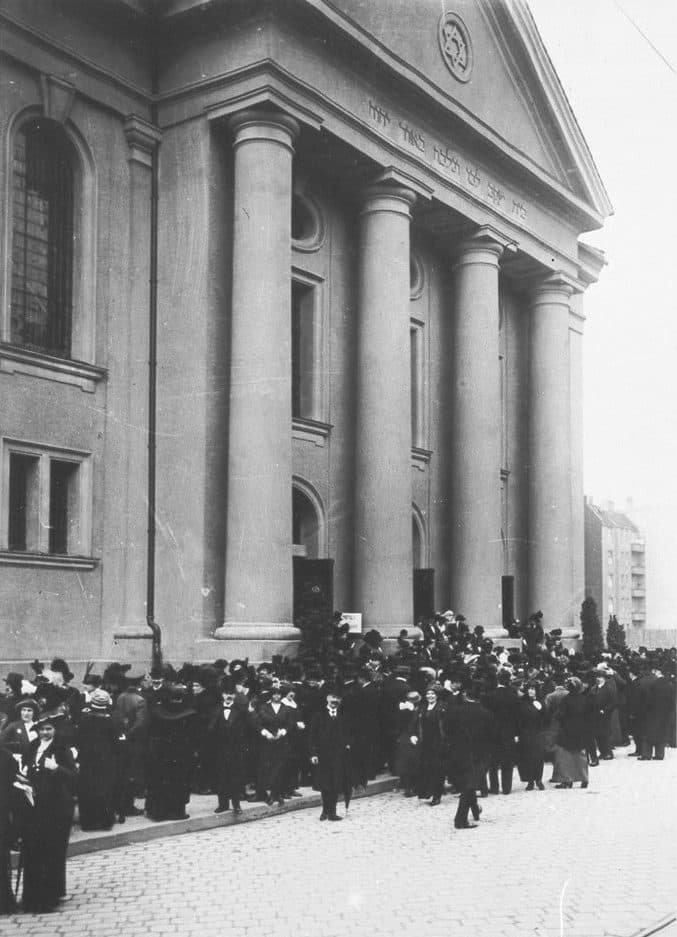
The Levetzowstraße synagogue in Berlin-Moabit on its consecration day in April 1914, later the Gestapo’s assembly camp for deportations
The Levetzowstraße synagogue on its consecration day, 7 April 1914. From October 1941 it was the Gestapo’s main assembly camp. Photo: Landesarchiv Berlin / Public domain, via Wikimedia Commons

From the assembly camps to the ramp

The first trains were filled from the synagogue on Levetzowstraße in Moabit, which the Gestapo turned into an assembly camp in October 1941. People were taken from their flats, made to list everything they owned, which the state then took, and held there for a few days. Files suggest about 20,000 Berlin Jews spent their last nights in the city in that synagogue. From autumn 1942 the former Jewish old people’s home on Große Hamburger Straße in Mitte took its place.

From the assembly camps the deportees were taken across the city to the stations, some on foot through the streets, in full view of their neighbours. At Grunewald they were brought up the cobbled ramp to the freight platform, out of sight of the passenger station. Karol Broniatowski’s concrete wall at the foot of that ramp, unveiled on 18 October 1991, remembers those marches.

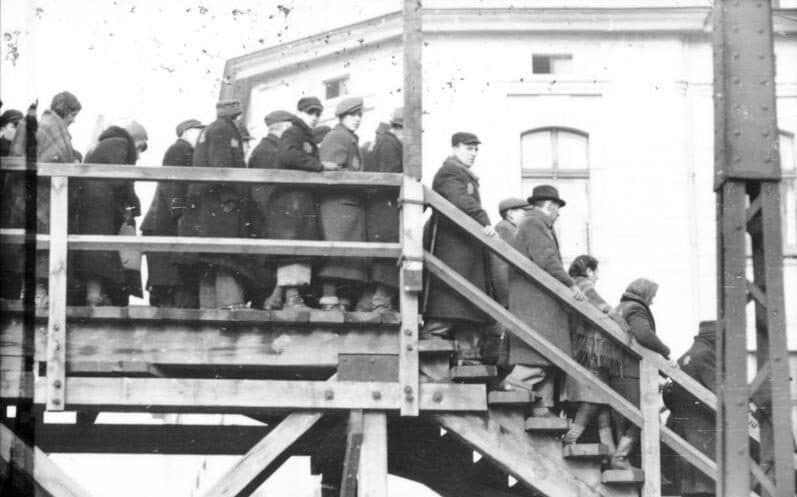
Ghetto inmates crossing the wooden footbridge over Hohensteiner Straße in the Litzmannstadt (Łódź) ghetto, 1941
The footbridge over Hohensteiner Straße in the Łódź ghetto, 1941, where the first trains from Grunewald went. Photo: Bundesarchiv, Bild 101I-133-0703-17 / Zermin / CC-BY-SA 3.0

Where the trains went

The first trains went to ghettos in occupied Eastern Europe: four to Łódź, which the Germans called Litzmannstadt, in October and November 1941, then Minsk, Kaunas and Riga. The people on the Kaunas train of 17 November 1941 were shot at the city’s Ninth Fort on 25 November. Those on the Riga train of 27 November were shot in the Rumbula forest on the morning of 30 November. In spring 1942 trains went to Piaski and Warsaw.

From June 1942 older people were sent to the ghetto at Theresienstadt, most of them from Anhalter Bahnhof. The first train from Berlin straight to Auschwitz left on 11 July 1942, and from 29 November 1942 almost every large transport went there. On 27 February 1943, in the ‘Factory Action’, the Gestapo seized thousands of Jewish forced labourers at their workplaces; within days most of them had been deported to Auschwitz.

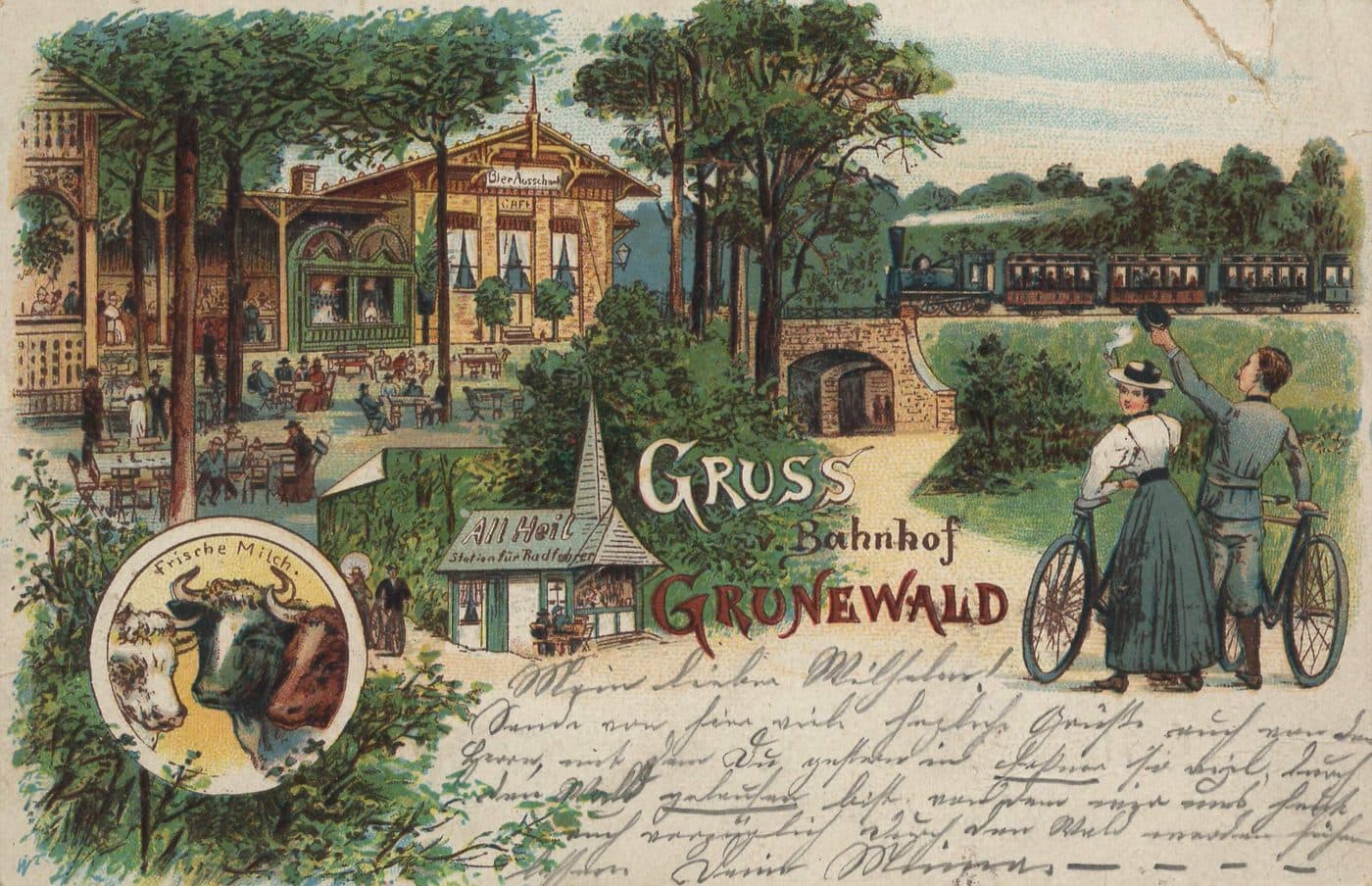
Postcard ‘Gruss vom Bahnhof Grunewald’ from 1898, with a garden café, a steam train on the embankment and cyclists
Greetings from Bahnhof Grunewald: a day-trippers’ station on the edge of the forest, on a postcard of 1898. Photo: Unknown author / Public domain, via Wikimedia Commons

The memorial and the railway

Every deportation train was run by the Deutsche Reichsbahn, the state railway, as a special train. Remembering that took decades. A first plaque at the signal box was unveiled on 8 November 1953 and later disappeared; its successor of 1973 was stolen in 1986. In 1987 a women’s group from the Grunewald parish put up railway sleepers and a plaque on the forecourt, and in 1991 the State of Berlin added Broniatowski’s wall.

Deutsche Bahn, the Reichsbahn’s successor, held a limited competition for a central memorial. The architects Nikolaus Hirsch, Wolfgang Lorch and Andrea Wandel won, and Gleis 17 was unveiled on 27 January 1998, Holocaust Remembrance Day. The crumbling platform walls were secured and the platform, about 160 metres long, rebuilt as a path, with the plates set along both edges. Each year on 18 October, the anniversary of the first train, a ceremony is held here.

Plan your visit

Visiting Gleis 17

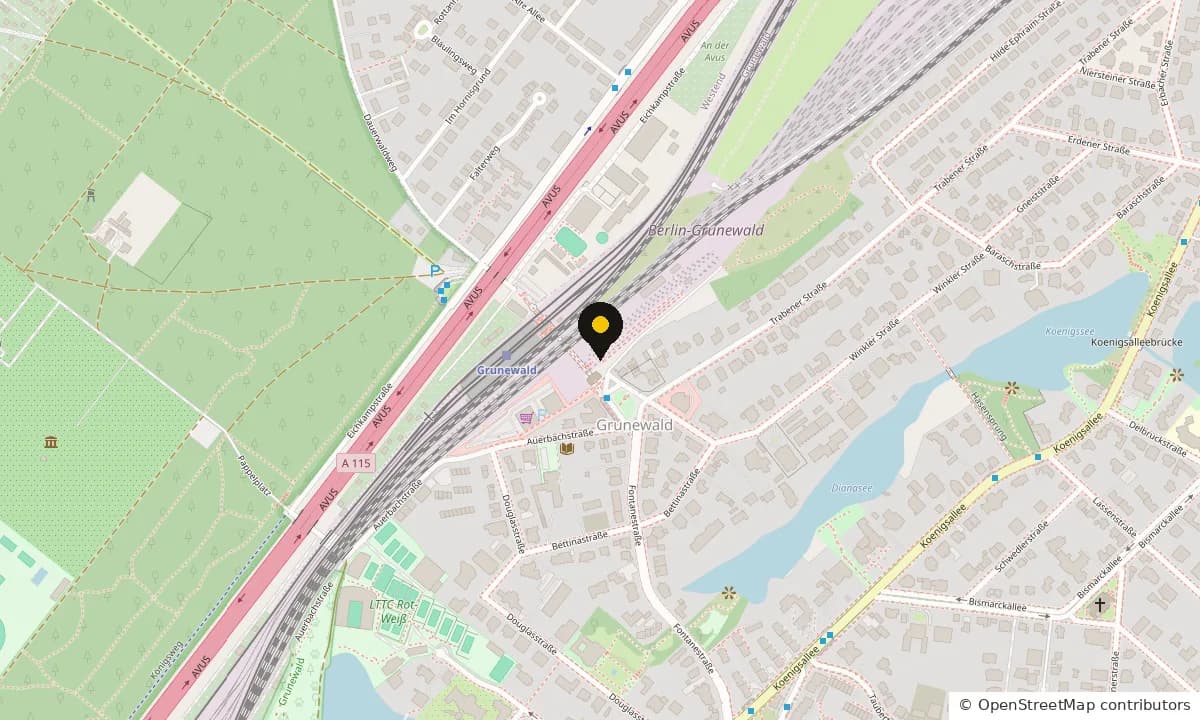
Map of the streets around Gleis 17, with a pin on the siteOpen in Google Maps

Am Bahnhof Grunewald, 14193 Berlin · Open 24 hours, every day

Getting there

  • S7Grunewald150 m · 2 min

    In the underpass below the platforms, follow the signs for ‘Mahnmal Gleis 17’: a flight of steps just before the exit leads straight up to the memorial. About 9 minutes from Zoologischer Garten and 15 minutes from Hauptbahnhof.

  • S7Grunewald250 m · 4 min

    Or leave the station by the main exit onto Am Bahnhof Grunewald and walk up the cobbled ramp to the freight platform, past Karol Broniatowski’s 1991 memorial wall: the way the deportees were made to go.

  • Bus M19Bus 186Bus 349S Grunewald150 m · 2 min

    The stops are on Am Bahnhof Grunewald, at the foot of the ramp.

What you’ll see

  • 186 cast-steel plates set into the ballast along both edges of the old platform, in date order, each giving the date of a transport, the number of Jews on it and its route, from ‘18.10.1941 / 1013 Juden / Berlin – Litzmannstadt’ to the last trains of 1945.
  • The track itself, left to the birch trees and shrubs that grew between the rails after the war: no train will ever leave this platform again.
  • At the foot of the ramp below, Karol Broniatowski’s concrete wall with the hollow outlines of human figures (1991), and on the forecourt a bronze plaque and railway sleepers put up by the Grunewald parish in 1987.

Tips from a guide

  • Walk to the far end of the platform: the dates run in order, and you can watch the numbers fall from about 1,000 a train in 1941–42 to a handful of people by 1944–45.
  • Many visitors leave a small stone on the platform edge, the Jewish custom at a grave. Please don’t step onto the track.
  • Combine it with the House of the Wannsee Conference, 25 minutes away by S7 to Wannsee and Bus 114. Both stand in quiet villa suburbs, and both are best seen in daylight.

Accessibility

The S-Bahn platform at Grunewald has lifts to the underpass, but there is no lift up to Gleis 17: the short way is a flight of about 36 steps, and the alternative is the cobbled ramp from Am Bahnhof Grunewald. On the platform you walk on gravel and on the steel plates. We have not tested the ramp with a wheelchair; it is uneven, so check before you go. There is no seating, shelter or toilet on the memorial; the nearest public toilet is on the station forecourt.

Timeline

From forest station to memorial

  1. 1879The station opens as ‘Hundekehle’; it is renamed Grunewald in 1884.
  2. 18 Oct 1941The first deportation train leaves Grunewald for the Łódź ghetto with 1,013 people.
  3. 27 Nov 1941A train leaves Berlin for Riga; its passengers are shot at Rumbula on 30 November.
  4. 11 Jul 1942The first transport from Berlin straight to Auschwitz.
  5. 29 Nov 1942Regular transports to Auschwitz begin; most later trains go there.
  6. 27 Feb 1943The ‘Factory Action’: thousands of Jewish forced labourers are seized at work.
  7. 5 Jan 1945The last train leaves Grunewald, for Sachsenhausen.
  8. 27 Mar 1945The last deportation from Berlin leaves for Theresienstadt.
  9. 8 Nov 1953A first memorial plaque is unveiled at the station’s signal box.
  10. 18 Oct 1991Karol Broniatowski’s memorial wall is unveiled at the foot of the ramp.
  11. 27 Jan 1998Deutsche Bahn unveils the Gleis 17 memorial.

See it with a historian

Tours that stop at Gleis 17

The plates give dates and numbers; a guide can tell you who was on the trains, how the deportations were organised and what happened at the other end of the line.

The rise and fall of the Third Reich, heading west to the Olympic Stadium and Gleis 17.

The Capital Of Tyranny Tour - Berlin Experiences
Full Day6 Hours

The Capital Of Tyranny

Private 6-hour van tour of Hitler's Berlin and the Third Reich for up to 6 people. Starts at your hotel or anywhere in the city.

€1,000up to 6
View Tour

A private day through Berlin’s history that can be shaped around the Holocaust.

The Berlin History Tour
Full Day6 Hours

The Berlin History Tour

Private 6-hour van tour of Berlin's whole history in one day for up to 6 people. Starts at your hotel or anywhere in the city.

€1,000up to 6
View Tour

Berlin in 1945, as the Red Army closed in on a city still deporting its Jews.

The Battle Of Berlin Tour - Berlin Experiences
Full Day6 Hours

The Battle Of Berlin Tour

Private 6-hour van tour of the 1945 battlefield, from the outskirts to the Reichstag, for up to 6 people. Starts at your hotel.

€1,000up to 6
View Tour

Questions visitors ask

Frequently asked questions

What is Gleis 17?

Gleis 17 (Platform 17) is a disused platform at Grunewald station in Berlin from which Jews were deported from October 1941. Since 1998 it has been Deutsche Bahn’s memorial to the deportations, with 186 steel plates recording every deportation train from Berlin.

How do I get to the Platform 17 memorial?

Take the S7 to Grunewald, about 15 minutes from Hauptbahnhof or 9 from Zoologischer Garten. In the underpass, follow the signs for ‘Mahnmal Gleis 17’: steps lead up to the memorial, or you can walk up the cobbled ramp from the station forecourt.

Is Gleis 17 free, and when is it open?

It is free and open at all hours, every day. It is an outdoor platform with no staff, gate or ticket office.

How many people were deported from Berlin?

More than 50,000 Jews were deported from Berlin between October 1941 and March 1945, on the 186 trains recorded on the plates. They left from Grunewald, the Moabit freight yard and Anhalter Bahnhof; Moabit, not Grunewald, handled the largest number.

When did the first and last trains leave?

The first left Grunewald on 18 October 1941 with 1,013 people for the Łódź ghetto. The last train from Grunewald left on 5 January 1945, and the last deportation from Berlin, to Theresienstadt, on 27 March 1945.

Why is it called Gleis 17?

Gleis is German for track. The memorial is named after track 17 of Grunewald’s old freight station, beside the platform where the deportation trains were loaded.

Is the memorial wheelchair accessible?

Not fully. There is no lift to the platform: you climb about 36 steps or use an uneven cobbled ramp, and the memorial itself is gravel and steel plates.

Are there tours that visit Gleis 17?

Yes. Our Capital of Tyranny tour goes west to Gleis 17, and a private Berlin History Tour can include it, often together with the House of the Wannsee Conference.

Keep exploring

More Featured Experiences.

Every site we write about — 56 landmarks, museums, memorials and lesser-known corners of Berlin. See the full index →

01Walk Through The Brandenburg Gate02Explore The State Museums On Museum Island03Visit The Berlin TV Tower – The Fernsehturm04Cross The Cold War Border At Checkpoint Charlie05Visit The Site Of Adolf Hitler’s Führerbunker06Explore The Reconstructed Berlin Palace07Visit The Reichstag Cupola At Night08Explore The Forum Fridericianum09Shop At The Humboldt University Book Sale10Journey Into The Memorial To The Murdered Jews Of Europe11Step Inside The Neue Wache12Explore The Former Jewish Quarter – Spandauer Vorstadt13Visit The Remains Of The Berlin Wall14Walk Across The Bridge Of Spies15Explore The Topography Of Terror16Climb The Prussian Victory Column – The Siegessäule17Enter The Palace Of Tears – The Tränenpalast18Step Inside The Berlin Olympic Stadium19Explore Erich Mielke’s Office At The Stasi Museum20Walk Along Karl Marx Allee21Visit The Oldest Church In Berlin – The Nikolaikirche22Explore The Berliner Dom23Visit The Grave Of Frederick The Great24Walk Through The Ruins Of Anhalter Bahnhof25Stand On The Platz Des Volksaufstandes26Visit The German Resistance Museum27Visit The Soviet War Memorial In The Tiergarten28See The Georg Elser Memorial On Wilhelmstrasse29Step Inside The Kaiser Wilhelm Gedächtnis Kirche31Visit The Schloss Charlottenburg Mausoleum32Climb The Französischer Dom at Gendarmenmarkt33Explore The Interbau – IBA 5734Explore The Otto Weidt Workshop35Visit Cecilienhof – Site Of The Potsdam Conference36Visit The Stasi Prison In Hohenschönhausen37Spend The Day At Tempelhof Airport38Ride The Fastest Elevator In Europe39Visit The Soviet War Memorial In Treptower Park40Visit The Sachsenhausen Concentration Camp Memorial41Visit The Ravensbrück Concentration Camp Memorial42Visit Karlshorst – The Site Of The German Surrender43Visit The Socialists Cemetery – Zentralfriedhof Friedrichsfelde44Visit The Soviet War Memorial In Pankow45Visit the Seelow Heights Memorial46Visit The Commonwealth War Cemetery47Cross The Bösebrücke At Night48Explore The Allied Museum In Dahlem49Explore The Spandau Citadel50Visit The Brandenburg T4 Euthanasia Memorial51Visit The Wannsee Conference House52Visit The Jewish Museum53Visit The Jewish Cemetery In Weissensee54Walk Along The East Side Gallery55Explore The Volkspark Friedrichshain Flak Tower56Head Up The Teufelsberg