Skip to content
The House of the Wannsee Conference in Berlin: the street front of the Villa Marlier at Am Großen Wannsee 56–58, with its columned porch

Berlin Experiences/Featured Experiences

Wannsee Conference House: Visit the Haus der Wannsee-Konferenz

Elegant lakeside villa where the Final Solution was coordinated.

The short answer

The House of the Wannsee Conference (Haus der Wannsee-Konferenz) is the lakeside villa at Am Großen Wannsee 56–58 in south-west Berlin where, on 20 January 1942, fifteen senior Nazi officials and SS officers met to coordinate the murder of the Jews of Europe. Today it is a memorial and educational site, with a permanent exhibition on the meeting and the Holocaust, and a garden on the lake. It is open every day from 10:00 to 18:00, except on a few holidays, and admission is free. Allow one and a half to two hours there, and about 40 minutes each way from central Berlin by S-Bahn and bus.

Where
Am Großen Wannsee 56–58, 14109 Berlin-Wannsee
Open
Daily 10:00–18:00; closed on some holidays
Admission
Free
Time needed
1½–2 hours
Nearest station
Bus 114 Haus der Wannsee-Konferenz, 7 min from S Wannsee
Step-free
Mostly: ramp, ground-floor exhibition, accessible toilet

The story · by Matt Robinson

Few places in Berlin hold the chilling dissonance between serene beauty and horror quite like the Haus der Wannseekonferenz: the lakeside villa where, on January 20th 1942, senior Nazi officials met to coordinate the murder of the Jews of Europe. Located in one of Berlin’s most affluent suburbs, the villa sits gracefully on the shores of the Großer Wannsee lake. On a sunny day, the water sparkles, sailboats glide past, and the surrounding properties offer a picture of peaceful prosperity. It feels a world away from the concrete memorials and scarred landscapes often associated with the city’s darkest chapter. This was, and remains, a desirable address, a place marked for leisure and escape.

View from the terrace of the Haus der Wannsee-Konferenz across the Großer Wannsee lake in Berlin, with a stone lion and garden urn
The view from the villa’s garden terrace across the Großer Wannsee. Photo: JGHowes / Attribution, via Wikimedia Commons

Yet, it is precisely this idyllic setting that makes the history that occurred within its walls so jarring. This elegant former industrialist’s mansion, bought by Hitler’s notorious SS, became the stage for one of the most infamous meetings of the Third Reich.

On January 20th 1942, fifteen high-ranking Nazi officials – primarily state secretaries from various ministries and senior SS officers – gathered here not in jackboots and combat fatigues, but in suits and uniforms appropriate for a high-level administrative conference. They weren’t plotting battlefield strategy or discussing grand architectural plans for Germania. They were gathered for a brisk, business-like meeting, complete with refreshments, to coordinate the logistics of genocide. The preparation for the “Final Solution to the Jewish Question”.

Heydrich’s invitation

The Wannsee Conference, as it became known, was not where the decision to murder the Jews of Europe was made – that horrific decision had evolved earlier through a complex process involving the higher ups of the Nazi Party – Hitler, Himmler, Göring, and others. Instead, this meeting was about how to coordinate mass murder efficiently, drawing together the necessary arms of the German state apparatus.

Early photographs of the Villa Marlier at Wannsee in its private years: the façade, garden, lake shore and furnished rooms
The villa in its private years, before the SS bought it: early photographs shown at the memorial.

The invitations went out in late November 1941, issued by SS-Obergruppenführer Reinhard Heydrich, the ambitious and ruthless chief of the Reich Security Main Office (RSHA) and recently appointed Deputy Reich Protector of Bohemia and Moravia. Citing an earlier authorisation from Hermann Göring tasking him with preparations for a “total solution of the Jewish question,” Heydrich summoned key figures to a meeting followed by breakfast at the SS guest house by the Wannsee lake. The initial date was December 9th, but the Japanese attack on Pearl Harbor and the ensuing German declaration of war on the United States, coupled with the stalling of the offensive against Moscow, forced a postponement. The meeting was rescheduled for 12:00 noon on January 20, 1942.

Fifteen men gathered in the villa’s dining room that winter morning. Heydrich chaired the meeting. Alongside him sat key SS figures like Heinrich Müller (head of the Gestapo) and Adolf Eichmann (head of the RSHA’s Jewish Affairs department, tasked with taking the minutes). Crucially, however, the attendees were not solely SS ideologues. They included State Secretaries and senior officials representing vital government ministries: the Interior Ministry (Dr. Wilhelm Stuckart), the Justice Ministry (Dr. Roland Freisler), the Foreign Office (Martin Luther), the Four Year Plan (Erich Neumann, representing Göring), the Occupied Eastern Territories Ministry (Dr. Alfred Meyer and Dr. Georg Leibbrandt), the General Government of occupied Poland (Dr. Josef Bühler), and the Reich Chancellery (Dr. Wilhelm Kritzinger).

Ninety minutes

This composition was deliberate. Heydrich’s primary goal was not to debate the morality or desirability of genocide – that was already assumed policy – but to assert his leadership over the “Final Solution,” secure the cooperation of the essential state ministries, and coordinate their efforts to ensure the systematic deportation and murder of Europe’s estimated 11 million Jews proceeded smoothly and efficiently.

The meeting itself was remarkably brief, lasting only about 90 minutes. Heydrich opened by reviewing anti-Jewish policies to date, outlining the shift from forced emigration to “evacuation to the East” – a euphemism for deportation to ghettos and extermination camps.

He presented staggering figures, country by country, detailing the Jewish populations targeted for this “Final Solution.” Discussion reportedly revolved around practicalities: defining who counted as a Jew (referencing the Nuremberg Laws, with input from Stuckart), the handling of Mischlinge (people of mixed Jewish and Aryan ancestry), the logistical challenges of transport, and the need for various ministries to provide legal and administrative cover. Dr. Bühler from the General Government urged that the “Final Solution” begin in occupied Poland, as transport issues were minimal there and the local Jewish population was largely seen as incapable of work. There was no significant dissent recorded against the fundamental goal.

The attendees, representing the bureaucratic heart of the Nazi state, effectively rubber-stamped Heydrich’s plan and pledged their ministries’ cooperation in the machinery of mass murder. The meeting concluded, and Eichmann later recalled that the atmosphere, while business-like during the formal discussion, became more relaxed afterwards, with drinks served and casual conversation taking place.

Despite the brevity, the Wannsee Conference would prove brutally effective in its aims.

The coordination achieved at Wannsee streamlined the process of identifying, rounding up, transporting, and murdering Jews across Nazi-occupied Europe. Deportations to extermination camps like Auschwitz-Birkenau, Treblinka, Sobibor, and Belzec accelerated dramatically in the months following the conference. The bureaucratic machinery, now fully aligned and informed, ground into motion with chilling efficiency, leading directly to the deaths of millions.

After the war

For decades after the war, the villa at Am Großen Wannsee 56–58 carried its dark secret relatively quietly. It served various purposes, including as a recreational facility and a student hostel, with little public acknowledgement of what transpired here back in the winter of 1942.

The elegant facade and peaceful lakeside setting belied the significance of that fateful meeting. However, the tireless efforts of historians and activists, most notably the Holocaust survivor and historian Joseph Wulf, gradually brought the villa’s history to light and pushed for its transformation into a place of remembrance and learning. Wulf envisioned an international documentation centre on Nazism here as early as the 1960s, but faced significant resistance and lack of funding; tragically, he took his own life in 1974, despairing at the German public’s perceived indifference to confronting the past.

Persistence eventually paid off. Growing historical awareness and political will led to the decision to establish a permanent memorial. On January 20, 1992, the 50th anniversary of the Wannsee Conference, the villa was officially opened as the “Haus der Wannseekonferenz Memorial and Educational Site.”

Visiting the villa today

Visiting the villa now is a profoundly moving and informative experience. The building itself, beautifully restored, retains its pre-war grandeur. Inside, the permanent exhibition, spread across several rooms on the ground floor (including the actual dining room where the meeting took place), meticulously documents the rise of Nazism, the escalating persecution of Jews and other victim groups, the history of the “Final Solution,” and the conference itself. Using documents (including a facsimile of the Wannsee Protocol), photographs, audio-visual displays, and biographical information on both perpetrators and victims, the exhibition lays bare the cold, bureaucratic nature of the planning process.

Exhibition room in the House of the Wannsee Conference, Berlin: portraits of the participants, a display case of documents and a photograph of the dining room
An exhibition room in the villa, with portraits of the men who took part, 2017. Photo: Kjetil Ree / CC BY-SA 3.0, via Wikimedia Commons

This is not about witnessing the site of mass murder itself, but what philosopher, Hannah Arendt, fittingly termed ‘the banality of evil’: exploring where the systematic, state-sponsored annihilation of millions was discussed, planned, and bureaucratically streamlined amidst opulent surroundings. How educated men, civil servants, in a beautiful setting, could calmly coordinate mass murder. Wherein lies a vital lesson in the fragility of civilisation and the importance of vigilance against prejudice, hatred, and the abuse of state power.
The Wannsee Conference in detail

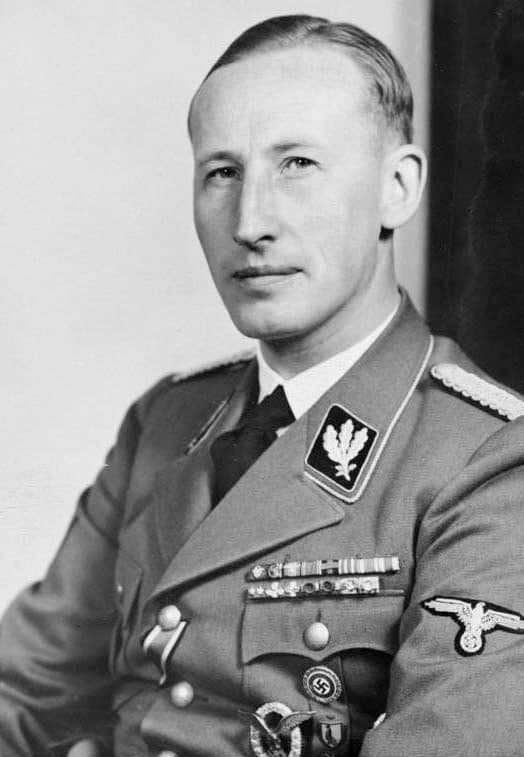
Portrait of Reinhard Heydrich in SS uniform, 1940, the man who called and chaired the Wannsee Conference
Reinhard Heydrich, who called and chaired the meeting, in 1940. Photo: Bundesarchiv, Bild 146-1969-054-16 / Hoffmann, Heinrich / CC-BY-SA 3.0

Why this villa?

Heydrich’s first invitations, sent on 29 November 1941, named a different address: the offices of the International Criminal Police Commission, the forerunner of Interpol, at Am Kleinen Wannsee 16. On 4 December he moved the meeting to the guest house of the Security Police and SD on the Großer Wannsee, where visiting SS officers, commanders of the killing units in the east and friendly foreign intelligence chiefs stayed.

The house had been built in 1914–15 by the architect Paul Baumgarten for the manufacturer Ernst Marlier, who sold it in 1921 to Friedrich Minoux, a director of the Stinnes group. Arrested for fraud in 1940, Minoux sold it from custody for 1.95 million Reichsmarks to the Nordhav foundation, which bought property for the SD. Jewish forced labourers, and later forced labourers from eastern Europe, kept its garden. In 1944 the SD’s domestic intelligence office moved its headquarters here.

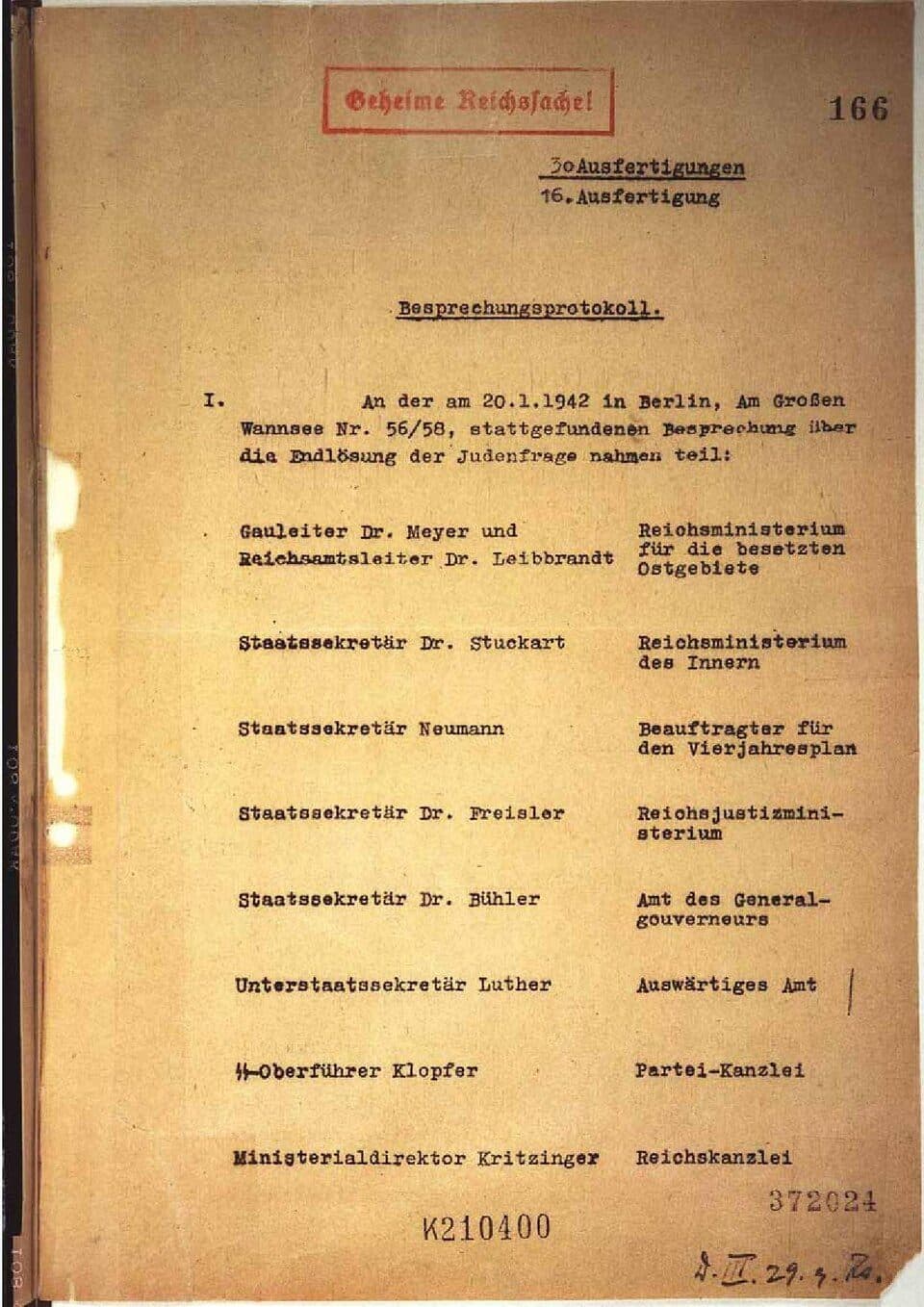
First page of the Wannsee Protocol, copy 16 of 30, stamped Geheime Reichssache, listing the participants of the meeting of 20 January 1942
The first page of copy 16 of the protocol, with the list of participants. Photo: Reich Main Security Office / Public domain, via Wikimedia Commons

What the protocol says

Eichmann drafted the minutes and Heydrich edited them; thirty copies were typed and sent out, marked “Geheime Reichssache” (secret Reich matter). The fifteen pages never use the word murder. Jews are to be “evacuated to the East”, those able to work sent in labour columns to build roads, “in the course of which a large part will undoubtedly fall away through natural reduction”, and any who survive “will have to be treated accordingly”.

The protocol’s table counts eleven million Jews, including those of countries Germany did not control: 330,000 in England, 4,000 in Ireland, and the Jews of neutral Sweden, Switzerland, Spain and Turkey. Much of the meeting was spent on who should count as a Jew and what to do with people of mixed descent and Jews in mixed marriages, questions left for later meetings. Copy 16, sent to Martin Luther at the Foreign Office, is the only one known to survive.

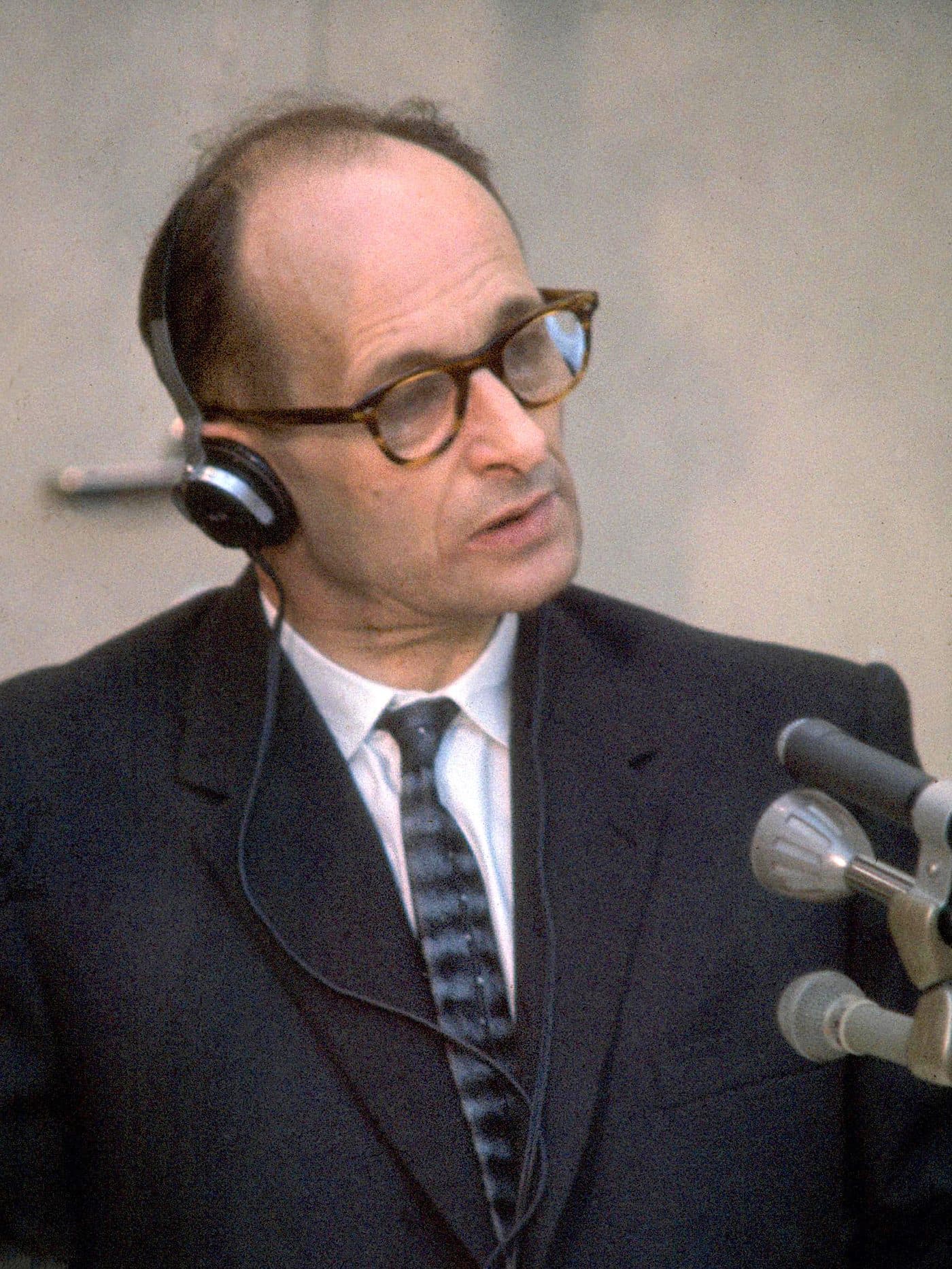
Adolf Eichmann, who took the minutes of the Wannsee Conference, wearing headphones at his trial in Jerusalem, 1961
Adolf Eichmann, who kept the minutes, on trial in Jerusalem in 1961. Photo: Israel Government Press Office / Public domain, via Wikimedia Commons

What became of the men at the table

Few of the fifteen answered for Wannsee. Heydrich died in June 1942 after he was attacked by Czechoslovak parachutists in Prague. Roland Freisler, later president of the People’s Court, was killed in an air raid on Berlin in February 1945; Heinrich Müller disappeared in the last days of the war; Alfred Meyer and Rudolf Lange took their own lives, and Martin Luther died soon after the war. Josef Bühler was tried in Poland and executed in Kraków in 1948. Others, such as Gerhard Klopfer, Georg Leibbrandt and Erich Neumann, escaped punishment almost entirely; Klopfer, the last surviving participant, died in 1987.

Adolf Eichmann fled to Argentina. Israeli agents seized him near Buenos Aires in 1960, and at his trial in Jerusalem in 1961 he described the meeting, the cognac afterwards and the frank talk the minutes left out. He was hanged in 1962. Hannah Arendt’s report on the trial gave the world the phrase “the banality of evil”.

Plan your visit

Visiting the House of the Wannsee Conference

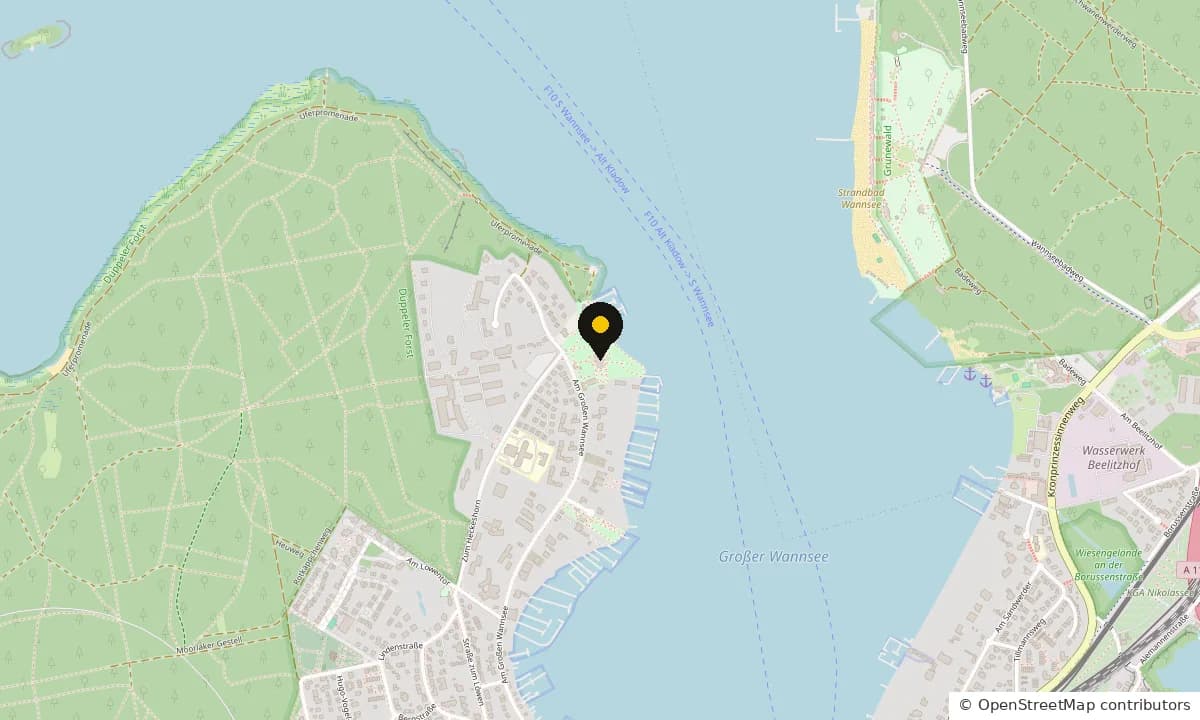
Map of the streets around the House of the Wannsee Conference, with a pin on the siteOpen in Google Maps

Am Großen Wannsee 56–58, 14109 Berlin · Daily 10:00–18:00 (last entry 17:45). Closed 1–4 January, 8 March, Good Friday, 1 May, Ascension Day, 3 October and 24–31 December.

Getting there

  • Bus 114Haus der Wannsee-Konferenz35–40 min from Hauptbahnhof

    Take the S1 or S7 to Wannsee, then Bus 114 towards Heckeshorn from outside the station. The ride takes 7 minutes; buses run about every 10 minutes on weekdays and every 20 minutes on Sundays. The stop is a short walk from the gate.

  • S1S7Wannseeabout 2 km · 25–30 min

    If you would rather walk, follow Am Großen Wannsee north from the station, past the turning for the Liebermann Villa. Regional trains (RE1, RE7) also stop at Wannsee.

  • Bus 316Bus 114Am Kleinen Wannsee (change)about 20 min from Glienicker Brücke

    Coming from Potsdam or the Bridge of Spies: Bus 316 from Glienicker Brücke towards S Wannsee, changing to Bus 114 at Am Kleinen Wannsee.

What you’ll see

  • The permanent exhibition, The Meeting at Wannsee and the Murder of the European Jews (2020), across the ground-floor rooms where the meeting was held: documents, a facsimile of the protocol and biographies of the men at the table and of their victims.
  • The villa itself, built in 1914–15 for the manufacturer Ernst Marlier and restored in the late 1980s, with its classical façade, the statues along its roofline and rooms looking onto the lake.
  • The garden, which runs down to the Großer Wannsee and holds a second, outdoor exhibition on the history of the villa, its neighbours and their owners.

Tips from a guide

  • Combine it with the Liebermann Villa, the painter Max Liebermann’s summer house, about 8 minutes’ walk back along the road (closed on Tuesdays).
  • The memorial’s Joseph Wulf Library is a free public reference library, open Monday to Friday 10:00–18:00, if you want to read further.
  • Groups of more than ten should register in advance, even without a guided tour; tours and seminars are booked through the education department.

Accessibility

There is a ramp at the entrance, and the ground floor of the house, with the permanent exhibition, is wheelchair accessible, as is most of the garden exhibition. There is an accessible toilet and a wheelchair for visitors’ use. The lift to the upper floors and the paths down to the lake are not yet barrier-free. The audio guide is offered in German, English, Hebrew, French, Polish, Arabic, Spanish and Italian, the media guide has a tour in German Sign Language, and the videos have English subtitles. Check the BVG website for lift status at S Wannsee.

Timeline

From private villa to memorial

  1. 1914–15Paul Baumgarten builds the villa for the manufacturer Ernst Marlier.
  2. 1921Marlier sells it to Friedrich Minoux, a director of the Stinnes group.
  3. 1940The SD’s Nordhav foundation buys it as a guest house for SS officers.
  4. 29 Nov 1941Heydrich sends out invitations for a meeting on 9 December.
  5. 20 Jan 1942Fifteen officials meet here to coordinate the murder of Europe’s Jews.
  6. Dec 1946The Berlin SPD rents the villa for an educational and holiday centre.
  7. Mar 1947Robert Kempner finds copy 16 of the protocol in Foreign Office files.
  8. 1952Neukölln district takes it over as a country hostel for school trips.
  9. 1966Joseph Wulf founds an association to turn it into a documentation centre.
  10. 20 Jan 1992The memorial and educational site opens, 50 years after the meeting.
  11. 2020A new permanent exhibition opens in the ground-floor rooms.

See it with a historian

Tours that stop at the House of the Wannsee Conference

The exhibition gives you the documents; a guide connects the villa to the ministries in Berlin whose officials sat at the table, and to the station platforms where the deportations began.

The rise and fall of the Third Reich by vehicle, with the Wannsee villa and Gleis 17 on the route.

The Capital Of Tyranny Tour - Berlin Experiences
Full Day6 Hours

The Capital Of Tyranny

Private 6-hour van tour of Hitler's Berlin and the Third Reich for up to 6 people. Starts at your hotel or anywhere in the city.

€1,000up to 6
View Tour

Our full-day flagship tour, private and flexible, so the villa can be part of the day.

The Berlin History Tour
Full Day6 Hours

The Berlin History Tour

Private 6-hour van tour of Berlin's whole history in one day for up to 6 people. Starts at your hotel or anywhere in the city.

€1,000up to 6
View Tour

The last weeks of Hitler’s Berlin, from the city’s outskirts to the surrender at Karlshorst.

The Battle Of Berlin Tour - Berlin Experiences
Full Day6 Hours

The Battle Of Berlin Tour

Private 6-hour van tour of the 1945 battlefield, from the outskirts to the Reichstag, for up to 6 people. Starts at your hotel.

€1,000up to 6
View Tour

Questions visitors ask

Frequently asked questions

Is the House of the Wannsee Conference free?

Yes. Admission to the house and the garden exhibitions is free. Guided tours and seminars are booked in advance through the memorial’s education department.

What are the opening hours?

Every day from 10:00 to 18:00, with last entry at 17:45. It is closed on 1–4 January, 8 March, Good Friday, 1 May, Ascension Day, 3 October and 24–31 December.

How do I get to the Wannsee Conference House from central Berlin?

Take the S1 or S7 to Wannsee, then Bus 114 to the stop Haus der Wannsee-Konferenz, 7 minutes away. From Hauptbahnhof the trip takes about 35–40 minutes. You can also walk the 2 km from S Wannsee along the lake.

How long should I spend there?

Allow one and a half to two hours for the exhibition and the garden, longer if you add the Liebermann Villa next door.

Can you see the room where the Wannsee Conference took place?

Yes. The permanent exhibition fills the ground-floor rooms, including the former dining room where the fifteen men met. The furniture of 1942 does not survive.

Was the Holocaust decided at the Wannsee Conference?

No. Mass shootings of Jews in the occupied Soviet Union had been going on since the summer of 1941. The meeting coordinated the deportation and murder of the Jews of all Europe and confirmed Heydrich’s control over it.

Who attended the Wannsee Conference?

Fifteen men: Reinhard Heydrich, who chaired it, senior SS and police officers including Heinrich Müller and Adolf Eichmann, who took the minutes, and state secretaries and officials from the ministries, the Nazi Party Chancellery and the General Government in occupied Poland.

Is it suitable for children?

The memorial’s tours and seminars are aimed at teenagers and adults. The exhibition deals plainly with genocide, so it is best suited to visitors of secondary-school age and older.

Keep exploring

More Featured Experiences.

Every site we write about — 56 landmarks, museums, memorials and lesser-known corners of Berlin. See the full index →

01Walk Through The Brandenburg Gate02Explore The State Museums On Museum Island03Visit The Berlin TV Tower – The Fernsehturm04Cross The Cold War Border At Checkpoint Charlie05Visit The Site Of Adolf Hitler’s Führerbunker06Explore The Reconstructed Berlin Palace07Visit The Reichstag Cupola At Night08Explore The Forum Fridericianum09Shop At The Humboldt University Book Sale10Journey Into The Memorial To The Murdered Jews Of Europe11Step Inside The Neue Wache12Explore The Former Jewish Quarter – Spandauer Vorstadt13Visit The Remains Of The Berlin Wall14Walk Across The Bridge Of Spies15Explore The Topography Of Terror16Climb The Prussian Victory Column – The Siegessäule17Enter The Palace Of Tears – The Tränenpalast18Step Inside The Berlin Olympic Stadium19Explore Erich Mielke’s Office At The Stasi Museum20Walk Along Karl Marx Allee21Visit The Oldest Church In Berlin – The Nikolaikirche22Explore The Berliner Dom23Visit The Grave Of Frederick The Great24Walk Through The Ruins Of Anhalter Bahnhof25Stand On The Platz Des Volksaufstandes26Visit The German Resistance Museum27Visit The Soviet War Memorial In The Tiergarten28See The Georg Elser Memorial On Wilhelmstrasse29Step Inside The Kaiser Wilhelm Gedächtnis Kirche30Visit The Gleis 17 Memorial31Visit The Schloss Charlottenburg Mausoleum32Climb The Französischer Dom at Gendarmenmarkt33Explore The Interbau – IBA 5734Explore The Otto Weidt Workshop35Visit Cecilienhof – Site Of The Potsdam Conference36Visit The Stasi Prison In Hohenschönhausen37Spend The Day At Tempelhof Airport38Ride The Fastest Elevator In Europe39Visit The Soviet War Memorial In Treptower Park40Visit The Sachsenhausen Concentration Camp Memorial41Visit The Ravensbrück Concentration Camp Memorial42Visit Karlshorst – The Site Of The German Surrender43Visit The Socialists Cemetery – Zentralfriedhof Friedrichsfelde44Visit The Soviet War Memorial In Pankow45Visit the Seelow Heights Memorial46Visit The Commonwealth War Cemetery47Cross The Bösebrücke At Night48Explore The Allied Museum In Dahlem49Explore The Spandau Citadel50Visit The Brandenburg T4 Euthanasia Memorial52Visit The Jewish Museum53Visit The Jewish Cemetery In Weissensee54Walk Along The East Side Gallery55Explore The Volkspark Friedrichshain Flak Tower56Head Up The Teufelsberg