Skip to content
The Berlin Wall death strip at Bernauer Straße seen from the viewing tower of the Documentation Centre, with the rear wall, patrol road and the TV Tower on the skyline

Berlin Experiences/Featured Experiences

Berlin Wall Memorial: Visit the Death Strip at Bernauer Straße

The Berlin Wall Documentation Centre and preserved ‘Death Strip’.

The short answer

The Berlin Wall Memorial (Gedenkstätte Berliner Mauer) runs for 1.4 km along Bernauer Straße in Berlin-Mitte, from Nordbahnhof towards Mauerpark, on the line where the Wall divided the street. It keeps the only stretch of the Wall’s death strip preserved in its full depth anywhere in the city, with the front wall, patrol road, signal fence, rear wall and a watchtower. Everything is free: the outdoor grounds are open every day 08:00–22:00, and the Visitor Centre and the Documentation Centre, whose viewing tower looks down on the death strip, open Tuesday to Sunday 10:00–18:00. Allow one and a half to two hours.

Where
Bernauer Straße 111 and 119, 13355 Berlin-Mitte
Open
Grounds daily 08:00–22:00; buildings Tue–Sun 10:00–18:00
Admission
Free; public tours €5
Time needed
1½–2 hours
Nearest station
S Nordbahnhof, opposite the Visitor Centre
Step-free
Mostly: lifts in both buildings, grounds partly
With a guide
Walk the memorial with a historian on the one-hour Berlin Wall Tour. See the Berlin Wall Tour →

The story · by Matt Robinson

Despite the extent of the imposing concrete lariat of the Berlin Wall, once stretched over 150km around the districts of West Berlin, there remains little of it to be found in the modern German capital – despite its status as a protected listed landmark. With a few notable exceptions, such as the graffiti-covered East Side Gallery, and a large segment next to the former Nazi SS-Gestapo headquarters. The third longest remaining piece of the Berlin Wall can be found on Bernauer Strasse, with its preserved ‘Death Strip’ – the only section of its kind left in the city – and memorial park of information boards and displays.

Due to its tragic significance, Bernauer Strasse also hosts the official commemoration ceremony for the victims of the Berlin Wall, that takes place every year on November 9th.

The date that in 1989, East Berlin’s borders with the Western districts of the city were finally opened. From that point the Wall would stand as a dwindling monument to the bloody failures of DDR policy. Its reduced physical presence in the city, largely a result of the number of visitors looking for token souvenirs of one of the most iconic symbols of the Cold War conflict – and an official demolition plan carried out in 1990-91.

Entrance to the Berlin Wall Documentation Centre (Dokumentationszentrum Berliner Mauer) on Bernauer Straße, with its red sign
The Documentation Centre, opposite the preserved death strip.

The Berlin Wall documentation centre located here, at the former French-Soviet border, chronicles Bernauer Strasse’s role as witness – and conduit – to many successful escapes, and the personal tragedies that occurred over the 28 years of the Wall’s existence. Including the first victim of the Berlin Wall, 58-year-old Ida Siekmann, who died here in August 1961.

The divided street

By a strange quirk of urban planning, the houses that once lined Bernauer Strasse on its southern side would remain in the Eastern district of Mitte – and under the control of the East German authorities – when the Berlin Wall was first conjured into existence in 1961. However, the pavement and road immediately in front, to the north, would be part of the French sector – and the West Berlin district of Wedding.

Spurred on by this peculiarity, many residents – eager to escape to the West – would jump from their apartment windows – facing north – to the street below, in the weeks immediately following the construction of the Wall. Slowly, as the East German authorities blocked the northern entrances to these dwellings and bricked the windows of the apartments, utilising this escape route would prove harder and harder.

A visitor photographing a surviving stretch of the Berlin Wall on the memorial grounds at Bernauer Straße
A surviving stretch of the Wall on the memorial grounds.

On August 22nd 1961, only one day before her 59th birthday, at around 6.50am, widowed nurse Ida Siekmann – a resident on Bernauer Strasse for more than 30 years – jumped from her 3rd floor apartment into West Berlin, aiming for bedding that she had thrown onto the ground moments earlier. She would not survive the fall.

Becoming the first victim of the Berlin Wall – not murdered by the East German regime but dying as a result of the draconian border measures introduced here by the ‘workers and peasants’ state.

Conrad Schumann’s leap

Earlier that same month, Bernauer Strasse had become the focus of world attention after the audacious escape of a 19-year-old East German border guard, Conrad Schumann. With images of the exact moment when Schumann leapt over the barbed wire fence of the border at the corner of Bernauer Strasse and Ruppiner Straße printed in newspapers for billions around the world to see. That the construction of the Berlin Wall was so vexatious that even a trusted member of the Grenzpolizei (Border Police) would choose to so publicly defect was incredibly embarrassing for the East German government.

Visiting the location of Schumann’s escape now it is possible to see an enlarged photo capturing the moment of his ‘leap to freedom’ – taken by Hamburg photographer, Peter Leibing – on the firewall of a building in the former East. Clearly visible is the border guard’s PPSh-41 submachine gun, which he can be seen throwing away in mid-air, whilst vaulting the wire. No sooner than landing in West Berlin, Schumann was whisked away in a West Berlin police car, parked next to the border to deal with any disturbances.

A hero in the West, the former border guard … would always be perceived as a traitor in the East.

His life in the West would lead to a career with car manufacturer, Audi, with Schumann settling in Germany’s southeastern state of Bavaria – only to end in tragedy in 1998 when, suffering from depression, he took his own life. A hero in the West, the former border guard – responsible for one of the most iconic photos in human history – would always be perceived as a traitor in the East. And painfully distant from the family and friends he had left behind in a split second more than 30 years earlier.

Clay, a chapel and the tunnels

One of the most defining aspects of Bernauer Strasse is its topography – in particular what is invisible to the human eye, lurking beneath the surface. While much of the rest of Berlin suffers from a high water table, leading to problematic and lengthy construction processes, the ground beneath Bernauer Strasse features large amounts of clay.

Now cleverly referenced in the Chapel of Reconciliation – that stands on the site of the Church of Reconciliation, destroyed in 1985 by the East German government. This more modest sized successor is Germany’s only clay-built church, consecrated on the 11th anniversary of the ‘Fall of the Berlin Wall’.

Marcus Haas’s mural ‘If Walls Could Talk…’ on Bernauer Straße, a knife marked ‘Berlin 1961–1989’ cutting through meat, seen through the steel rods that trace the Wall
Marcus Haas’s temporary 2016 mural, seen through the steel rods that trace the Wall.

In more practical terms, the clay in the ground of Bernauer Strasse led to a number of tunnels being constructed during the Cold War period – to facilitate the escape of East Germans to the French sector. In total, 10 tunnels were started – of which 3 would eventually be utilised.

The most famous – Tunnel 57 – enabled the escape of 57 people in October 1964 from the courtyard of a house on Strelitzer Strasse in the East. The path of this tunnel is visible today as a series of metal plates in the ground – halfway up the hill on Bernauer Strasse due north-east and only a short distance from the Chapel of Reconciliation.

Along Bernauer Straße

From the former Geisterbahnhof (Ghost Station) of Nordbahnhof at its most western point, to the Berlin Wall Documentation Centre and beyond to the former border crossing on the corner of Bernauer Strasse and Eberswalder Strasse further east – the stations of Cold War incidents on Bernauer Strasse are plenty. None that leave a more lasting impression on the visitor than the memorial board for the more than 130 victims of one of the most painful chapters in Germany’s past, a short walk from Nordbahnhof – dedicated to the “memory of the city’s division from 13 August 1961 to 9 November 1989 and of the victims of communist tyranny”.
The Berlin Wall Memorial in detail

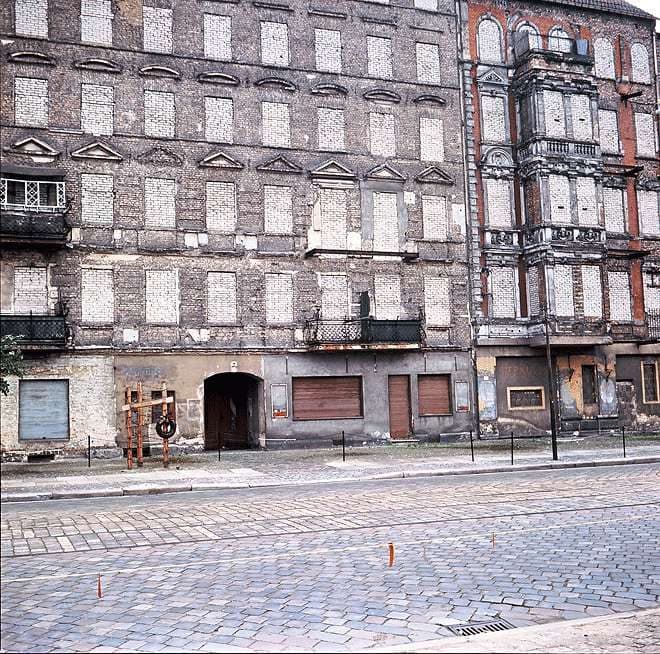
Bricked-up windows and doors of the border houses on Bernauer Straße in 1965, with the memorial cross for Ida Siekmann outside number 48
Bricked-up houses on Bernauer Straße, 1965, with the memorial to Ida Siekmann outside number 48. Photo: Willy Pragher / CC BY 3.0, via Wikimedia Commons

How a street became a death strip

When the border was sealed on 13 August 1961, the front doors of the houses on the south side of Bernauer Straße opened onto West Berlin. East German police bricked up the entrances first, then the windows facing the street, and in September and October 1961 the remaining residents were forcibly moved out. The empty houses became the Wall. In stages from 1963 they were torn down to their ground-floor façades, which stood as part of the border until they too were removed in 1979–80.

Behind them the border troops built the death strip in layers: a rear wall on the eastern side, a signal fence that raised the alarm when touched, a patrol road lit at night, watchtowers, a raked sand strip that showed footprints, and the front wall facing the West. From the late 1970s that front wall was the standard ‘Border Wall 75’ of L-shaped concrete segments, 3.6 metres high. The stretch preserved at the memorial shows the border as it was in 1989.

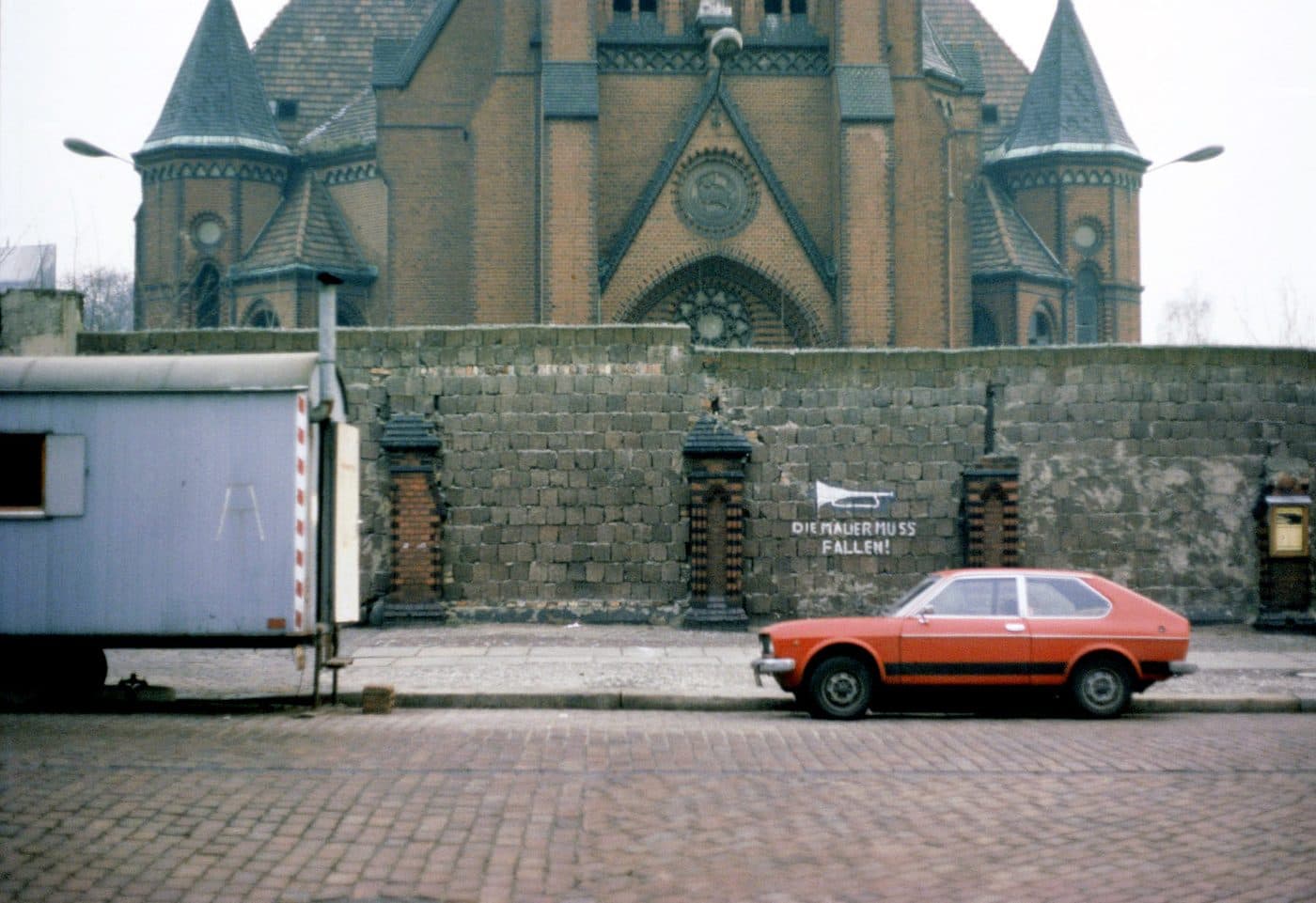
The Church of Reconciliation on Bernauer Straße behind its bricked-up churchyard wall, painted ‘Die Mauer muss fallen’, seen from West Berlin in January 1978
The Church of Reconciliation behind the Wall, seen from West Berlin, January 1978. Photo: Olga Bandelowa / CC BY-SA 2.0 DE, via Wikimedia Commons

The church in the death strip

The neo-Gothic Church of Reconciliation (Versöhnungskirche), paid for by Empress Auguste Viktoria, was consecrated in 1894; its tower rose 75 metres over Bernauer Straße. In 1961 the parish was cut in two: the church, rectory and parish hall stood in the East, while much of the congregation lived across the street in the West. On 21 August 1961 the gate in the churchyard wall was bricked up, and from 23 October 1961 not even East Berliners were allowed in. For more than twenty years the church stood empty in the death strip, and the border troops used its tower as a lookout.

On 22 January 1985 East Germany blew up the nave, and six days later the tower. After reunification the land went back to the parish, which built the Chapel of Reconciliation on the old foundations: an oval of rammed earth by the clay builder Martin Rauch, mixed with crushed rubble from the old church and consecrated on 9 November 2000. The old bells hang in a frame outside, and the damaged altar is inside.

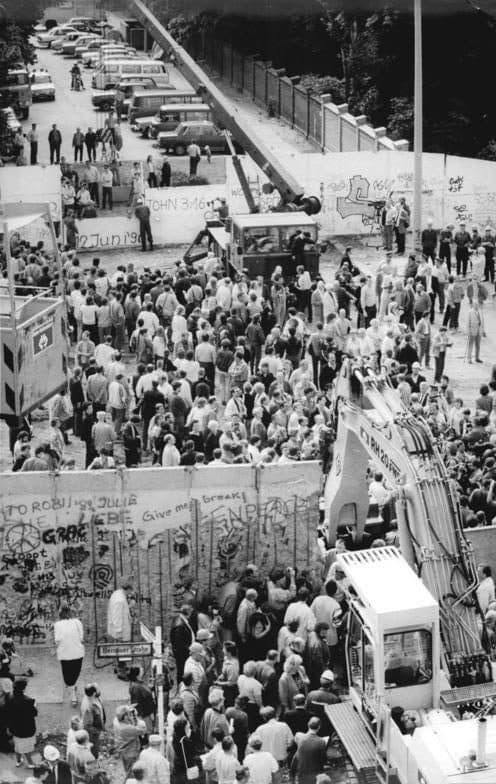
Crowds watch excavators pull down the Berlin Wall at the corner of Bernauer Straße and Ackerstraße on 13 June 1990
The official demolition begins at Bernauer Straße and Ackerstraße, 13 June 1990. Photo: Bundesarchiv, Bild 183-1990-0613-024 / Reiche, Hartmut / CC-BY-SA 3.0

From border strip to memorial

On the night of 10 November 1989 the first segments were knocked out of the Wall between Bernauer Straße and Eberswalder Straße, and a new crossing opened there the next morning. The official demolition of the border fortifications began on 13 June 1990 at the corner of Bernauer Straße and Ackerstraße, the spot where the memorial now stands. On 2 October 1990, the day before reunification, East Berlin’s city government listed the surviving stretch here as a monument; its watchtower had already been taken away.

What to do with it was argued over for years. The architects Kohlhoff & Kohlhoff won the 1994 competition, and their monument, dedicated on 13 August 1998, encloses about 70 metres of border strip between two steel walls. The Documentation Centre opened in the parish hall opposite in 1999, the Visitor Centre in 2009 and the Window of Remembrance in 2010; the outdoor exhibition was finished for the 25th anniversary of the fall of the Wall in 2014. The central commemoration of the building of the Wall is held here every 13 August.

Plan your visit

Visiting the Berlin Wall Memorial

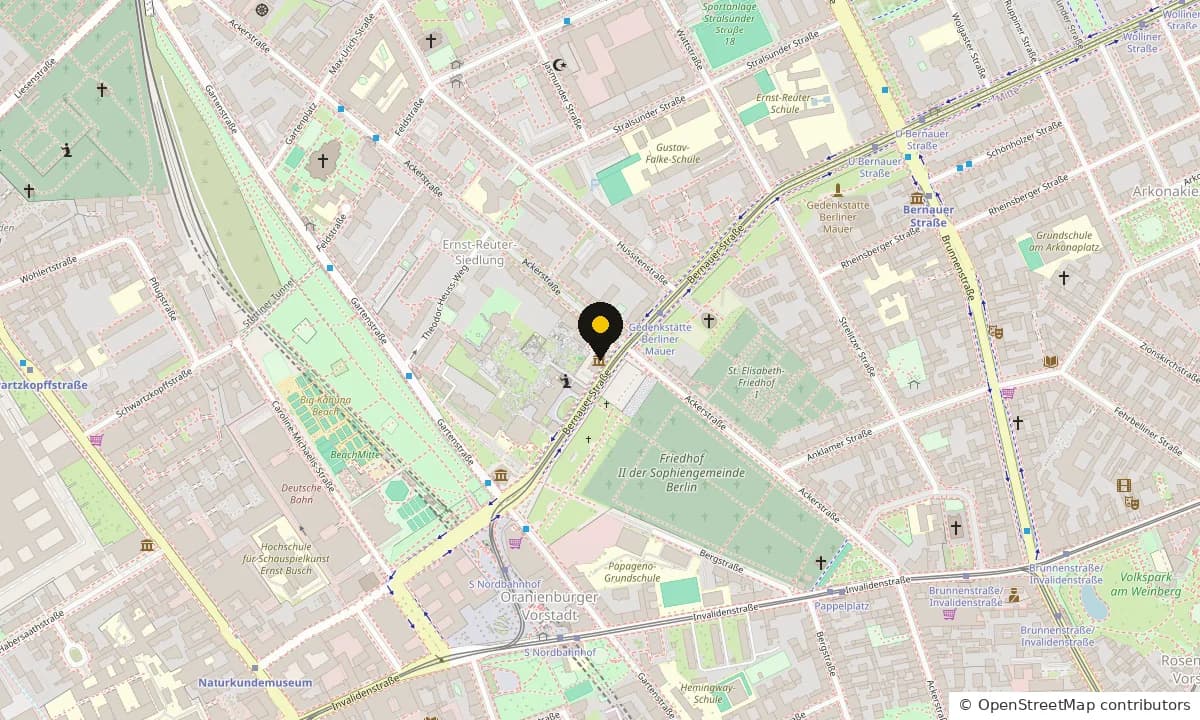
Map of the streets around the Berlin Wall Memorial, with a pin on the siteOpen in Google Maps

Bernauer Straße 111, 13355 Berlin · Outdoor grounds: daily 08:00–22:00. Visitor Centre and Documentation Centre (viewing tower last ascent 17:45): Tuesday–Sunday 10:00–18:00, closed Mondays and on 24, 25 and 31 December.

Getting there

  • S1S2S25S26Nordbahnhof400 m · 5 min

    Take the Gartenstraße/Bernauer Straße exit: the Visitor Centre is across the road. The station itself has a free exhibition on the ‘ghost stations’ of divided Berlin.

  • Tram M10Gedenkstätte Berliner Mauer100 m · 1 min

    Stops right outside the Documentation Centre; the M10 runs between Hauptbahnhof and Warschauer Straße.

  • U8Bernauer Straße650 m · 8 min

    Starts you at the eastern end: walk downhill past the Tunnel 57 markers and the Chapel of Reconciliation.

What you’ll see

  • The preserved death strip opposite the Documentation Centre: front wall, sand strip, lamp-lit patrol road, signal fence, rear wall and a watchtower, closed off at each end by the tall steel walls of the 1998 monument.
  • The outdoor exhibition along 1.4 km of former border strip: rusted steel rods tracing the Wall’s course, the foundations of the demolished houses, markers over the escape tunnels and the Window of Remembrance with portraits of those who died.
  • The Chapel of Reconciliation, built of rammed earth on the foundations of the church East Germany blew up in 1985, and the Documentation Centre’s exhibition ‘1961 | 1989. The Berlin Wall’.

Tips from a guide

  • Climb the Documentation Centre’s viewing tower (last ascent 17:45): the layers of the death strip only make sense from above.
  • Avoid Mondays: the grounds are open, but both buildings, the tower and the films are closed.
  • Start at the Visitor Centre for the short introductory films (in English on the half hour), then walk east, uphill, so you finish at U8 Bernauer Straße or Mauerpark.

Accessibility

The Visitor Centre (Bernauer Straße 119) and the Documentation Centre (Bernauer Straße 111) are step-free with lifts: the Visitor Centre’s lift needs a key from the front desk, the Documentation Centre’s a Euro key, lent against ID. Wheelchairs and folding seats can be borrowed free at the Visitor Centre, and there are accessible toilets in both buildings. The outdoor grounds are only partly step-free; the easiest stretch is the 500 m core between Gartenstraße and Strelitzer Straße, and Bernauer Straße climbs gently towards the east. Ask at the desk about access to the viewing tower.

Timeline

From divided street to memorial

  1. 1894The Church of Reconciliation is consecrated on Bernauer Straße.
  2. 13 Aug 1961The border is sealed; the houses on the south side become the frontier.
  3. 15 Aug 1961Conrad Schumann jumps the barbed wire at the corner of Ruppiner Straße.
  4. 22 Aug 1961Ida Siekmann dies after jumping from her window at Bernauer Straße 48.
  5. Sep 1962Tunnel 29: 29 people escape under the street to West Berlin.
  6. Oct 1964Tunnel 57: 57 people escape; border guard Egon Schultz is killed.
  7. Jan 1985East Germany blows up the Church of Reconciliation.
  8. 11 Nov 1989A new crossing opens where Bernauer Straße meets Eberswalder Straße.
  9. 13 Jun 1990Official demolition of the Wall begins at the corner of Ackerstraße.
  10. 13 Aug 1998The national monument by Kohlhoff & Kohlhoff is dedicated.
  11. 9 Nov 2000The Chapel of Reconciliation is consecrated.
  12. 9 Nov 2014The memorial’s outdoor exhibition is completed.

See it with a historian

Tours that stop at the Berlin Wall Memorial

The boards tell you what happened; a guide can show you where: the window Ida Siekmann jumped from, the corner where Conrad Schumann leapt and the line of Tunnel 57 under your feet.

One hour on Bernauer Straße: the death strip, the ghost station, Tunnel 57 and Schumann’s leap.

The Berlin Wall Tour
One Hour1 Hour

The Berlin Wall Tour

Private 1-hour walking tour of the Berlin Wall on Bernauer Strasse for up to 10 people. Starts at the Berlin Wall Documentation Centre.

€200up to 10
View Tour

The divided city from Potsdamer Platz to Checkpoint Charlie, through what remains of the Wall.

The Cold War Tour
One Hour1 Hour

The Cold War Berlin Tour

Private 1-hour walking tour of Cold War Berlin's border sites for up to 10 people. Starts by the Berlin Wall segments on Potsdamer Platz.

€200up to 10
View Tour

A full day on life in East Germany, from the Stasi headquarters to the Wall.

The Berlin Wall Tour - Berlin Experiences
Full Day6 Hours

The Republic Of Fear

Private 6-hour van tour of East Berlin, the Stasi and life behind the Wall for up to 6 people. Starts at your hotel.

€1,000up to 6
View Tour

Questions visitors ask

Frequently asked questions

Is the Berlin Wall Memorial free?

Yes. The outdoor grounds, the Visitor Centre, the Documentation Centre and its viewing tower are all free. Only the public guided tours cost money: €5, or €3 reduced.

Where can you see the Berlin Wall death strip?

At the Berlin Wall Memorial on Bernauer Straße, opposite the Documentation Centre at number 111. It is the only place in Berlin where a stretch of the death strip survives in its full depth, with both walls, the patrol road, the signal fence and a watchtower; the best view is from the Documentation Centre’s viewing tower.

What was the death strip?

The guarded zone between the Wall’s front wall facing West Berlin and its rear wall on the East German side. It held a patrol road, floodlights, a signal fence, watchtowers and a raked sand strip, so that anyone trying to cross could be seen and stopped.

How long do you need at the Berlin Wall Memorial?

About one and a half to two hours for the core area, the viewing tower and the Documentation Centre. Walking the full 1.4 km of the outdoor exhibition and watching the films in the Visitor Centre takes closer to three.

Is the Berlin Wall Memorial open on Mondays?

The outdoor grounds are open every day from 08:00 to 22:00. The Visitor Centre and the Documentation Centre, with the viewing tower, are closed on Mondays and open Tuesday to Sunday 10:00–18:00.

How do I get to the Berlin Wall Memorial?

Take the S-Bahn (S1, S2, S25 or S26) to Nordbahnhof, opposite the Visitor Centre, Tram M10 to Gedenkstätte Berliner Mauer, or the U8 to Bernauer Straße at the eastern end.

Is the Berlin Wall Memorial or the East Side Gallery better?

They show different things. Bernauer Straße is where you understand how the border worked and who died at it; the East Side Gallery is a long stretch of the rear wall covered in 1990 murals. With time for only one, choose Bernauer Straße for the history.

How many people died at the Berlin Wall?

At least 140 people died at the Berlin Wall between 1961 and 1989, according to research by the Berlin Wall Foundation. Ten of them died in the area around the memorial, five after jumping from the border houses on Bernauer Straße.

Keep exploring

More Featured Experiences.

Every site we write about — 56 landmarks, museums, memorials and lesser-known corners of Berlin. See the full index →

01Walk Through The Brandenburg Gate02Explore The State Museums On Museum Island03Visit The Berlin TV Tower – The Fernsehturm04Cross The Cold War Border At Checkpoint Charlie05Visit The Site Of Adolf Hitler’s Führerbunker06Explore The Reconstructed Berlin Palace07Visit The Reichstag Cupola At Night08Explore The Forum Fridericianum09Shop At The Humboldt University Book Sale10Journey Into The Memorial To The Murdered Jews Of Europe11Step Inside The Neue Wache12Explore The Former Jewish Quarter – Spandauer Vorstadt14Walk Across The Bridge Of Spies15Explore The Topography Of Terror16Climb The Prussian Victory Column – The Siegessäule17Enter The Palace Of Tears – The Tränenpalast18Step Inside The Berlin Olympic Stadium19Explore Erich Mielke’s Office At The Stasi Museum20Walk Along Karl Marx Allee21Visit The Oldest Church In Berlin – The Nikolaikirche22Explore The Berliner Dom23Visit The Grave Of Frederick The Great24Walk Through The Ruins Of Anhalter Bahnhof25Stand On The Platz Des Volksaufstandes26Visit The German Resistance Museum27Visit The Soviet War Memorial In The Tiergarten28See The Georg Elser Memorial On Wilhelmstrasse29Step Inside The Kaiser Wilhelm Gedächtnis Kirche30Visit The Gleis 17 Memorial31Visit The Schloss Charlottenburg Mausoleum32Climb The Französischer Dom at Gendarmenmarkt33Explore The Interbau – IBA 5734Explore The Otto Weidt Workshop35Visit Cecilienhof – Site Of The Potsdam Conference36Visit The Stasi Prison In Hohenschönhausen37Spend The Day At Tempelhof Airport38Ride The Fastest Elevator In Europe39Visit The Soviet War Memorial In Treptower Park40Visit The Sachsenhausen Concentration Camp Memorial41Visit The Ravensbrück Concentration Camp Memorial42Visit Karlshorst – The Site Of The German Surrender43Visit The Socialists Cemetery – Zentralfriedhof Friedrichsfelde44Visit The Soviet War Memorial In Pankow45Visit the Seelow Heights Memorial46Visit The Commonwealth War Cemetery47Cross The Bösebrücke At Night48Explore The Allied Museum In Dahlem49Explore The Spandau Citadel50Visit The Brandenburg T4 Euthanasia Memorial51Visit The Wannsee Conference House52Visit The Jewish Museum53Visit The Jewish Cemetery In Weissensee54Walk Along The East Side Gallery55Explore The Volkspark Friedrichshain Flak Tower56Head Up The Teufelsberg