Skip to content
Entrance to the German Resistance Memorial Center (Gedenkstätte Deutscher Widerstand) in the Bendlerblock, Berlin, with the Silent Heroes sign beside the door

Berlin Experiences/Featured Experiences

German Resistance Museum: Visit Stauffenberg’s Bendlerblock in Berlin

The former Bendlerblock German Army headquarters.

The short answer

The German Resistance Memorial Center (Gedenkstätte Deutscher Widerstand) is Berlin’s museum of the resistance to the Nazis, in the Bendlerblock at Stauffenbergstraße 13–14, a 14-minute walk west of Potsdamer Platz. It fills the former army offices where Claus von Stauffenberg and his fellow officers ran the coup of 20 July 1944; four of them were shot in the courtyard that night. It is open every day, Monday to Friday 09:00–18:00 and at weekends and on holidays 10:00–18:00. Admission, the audio guide and the public tours are all free. Allow one and a half to two hours.

Where
Stauffenbergstraße 13–14, 10785 Berlin-Mitte (Tiergarten)
Open
Mon–Fri 09:00–18:00; Sat, Sun and holidays 10:00–18:00
Admission
Free, audio guide included
Time needed
1½–2 hours
Nearest station
Bus M29 Gedenkstätte Deutscher Widerstand, 3 minutes on foot
Step-free
Yes: ramp, automatic doors and lift (cobbled courtyard)

The story · by Matt Robinson

While regrettably not widespread, resistance against the Nazi state was not as uncommon as many think – even within Germany.

The useful fiction of unanimous support for Hitler certainly served the Nazi regime when it sought to legitimise itself. It could even be said that presenting a monolithic vision of Germany that classified Germans and Nazis as the same thing was useful at the time to the Allied powers fighting Nazi Germany and finding it useful to simplify the enemy.

However this singular narrative of collective responsibility fails to distinguish between perpetrator and victim – of which there were many who were also German. But furthermore those who also fell into a third category: those who resisted, either directly or indirectly.

This phenomenon of German resistance to the Nazi regime is the focus of an entire museum in the German capital – dedicated to the people who risked and often paid with their lives whilst fighting the tyranny of National Socialist rule. From the White Rose movement led by a group of students from the University of Munich – including Hans and Sophie Scholl – to the activities of certain members of the church, Social Democrats, and Communists. But perhaps most significantly, the attempts that were made directly on Adolf Hitler’s life – that by some accounts amounted to more than 40 assassination efforts.

Wall of portrait photographs of men of the 20 July 1944 plot in the permanent exhibition of the German Resistance Memorial Center, Berlin
Portraits of men of the 20 July plot in the exhibition.

The Bendlerblock and 20 July 1944

The most well known of these was coordinated from the Bendlerblock complex and headquarters of the German Army Reserve, when in July 1944 a group of army officers plotted to not only kill Adolf Hitler but also overthrow the entire regime from within. The plot centred around Colonel Claus Schenk Graf von Stauffenberg and Chief of Staff of the 2nd Army, Henning von Tresckow. Popularly referred to as Operation Valkyrie it would see Stauffenberg attempt to blow up Hitler using explosives at his Wolf’s Lair headquarters in present-day Poland, followed by the implementation of an emergency continuity of government operations plan (Valkyrie) allowing the Reserve Army to seize control of the country and neutralise Nazi control.

The failure of this plot would lead to Claus von Stauffenberg’s execution in the courtyard of the Bendlerblock complex, alongside a number of his co-conspirators – now commemorated by a memorial statue and plaque.

Bronze plaque in the Bendlerblock courtyard in Berlin naming Beck, Olbricht, Stauffenberg, Mertz von Quirnheim and von Haeften, with a wreath below
‘Here died for Germany on 20 July 1944’: the plaque in the courtyard.

Fittingly, it is this former German Army building – the Bendlerblock – that now serves as home to the three storey German Resistance Museum.

Georg Elser’s lone attempt

Two major assassination attempts against Hitler take up substantial real estate in the museum; that of the Stauffenberg plot in July 1944 but also that carried out by a carpenter named Johann Georg Elser nearly five years earlier. Elser’s elaborate attempt to dispatch many head Nazis, along with Adolf Hitler, at a beer hall in Bavaria failed when the gathering Hitler was attending was halted early, leaving Elser’s homemade bomb ticking away in a column next to the stage Hitler had been speaking from. Only to explode thirteen minutes later and cause serious damage to the beer hall while killing eight people.

Elser had acted alone, intent on removing the Nazi leadership, stating: “I reasoned the situation in Germany could only be modified by a removal of the current leadership, I mean Hitler, Goering and Goebbels …”

…how one man, driven by personal conviction, can almost change history.

Elser’s attempt to decapitate the Nazi state is often cited as the textbook example of how one man, driven by personal conviction, can almost change history. And that, while not being a devout religious man or member of any political party, he was proof that it was possible for an ‘ordinary German’ to channel his outrage into something righteous.

Stauffenberg’s office

Walking through the section of the museum dedicated to Elser’s story, it is possible to then encounter the room that served as the office of Claus von Stauffenberg during his time at the Reserve Army headquarters – and from where his role in the July 20th plot was coordinated.

This second floor room no longer features the desk and office equipment that would have adorned the interior, but some photographs of the young man who would try – and fail – to take Hitler’s life in 1944. A decorated war veteran who came from one of the oldest and most distinguished aristocratic Catholic families of southern Germany, Stauffenberg served in Poland, France, and the Soviet Union before being transferred to North Africa where he was invalided.

Life-size photograph of Claus von Stauffenberg and a fellow officer in the Stauffenberg room of the German Resistance Memorial Center, Berlin
The room on Stauffenberg and the attempt of 20 July 1944.

Following his rehabilitation, he was assigned to the staff of the Ersatzheer (Reserve Army) based at the Bendlerblock and came into contact with members of a growing officers’ resistance movement, with his superior General Friedrich Olbricht and staff officer Henning von Tresckow introducing Stauffenberg to the Valkyrie plan to sweep the Nazi regime from power in the event of Hitler’s death.

Deciding at the start of July 1944 that he would take personal responsibility for killing Hitler, Stauffenberg was forced to assume two critical roles: assassinate Hitler far from Berlin and trigger the overthrow operation in Berlin during office hours on the very same day.

Although the bomb Stauffenberg intended to use for the plot exploded, the detonation did not prove to be enough to kill Hitler, and when Stauffenberg returned to Berlin he struggled to implement the operational plan – only to be caught and executed less than 24 hours later in the courtyard of this building.

Remembering the resistance

Originally opened in 1968, the German Resistance Museum was part of the attempt by the West Berlin government to reckon with the country’s Nazi past – at a time when student demonstrations and calls for confronting the ‘hidden fascist remnants’ still lurking within the government were high. One year earlier, near the West Berlin Opera, a young man had been executed by a West Berlin police officer during a protest against a visit by the Shah of Iran. Many in the country saw this instance of police brutality as evidence of the unreformed sadism of the post-war state – where denazification was deemed less important than the formation of a strong and economically viable West Germany that could counter the threat of Soviet influence from the East.

The plaque in front of the Stauffenberg statue in the Bendlerblock courtyard has an important message for the generations of visitors to come: “You did not bear the shame. You resisted. You bestowed the eternally vigilant signal to turn back by sacrificing your impassioned lives for freedom, justice and honour.” Although the sad reality is that beyond the many stories detailed in this museum there were many more of people who engaged in the brutal acts unleashed by the Nazi system, or who stood silently by and witnessed – either unmoved by the human suffering that was taking place or finding themselves incapable of interfering.

The evidence presented in this museum shows that resistance – even in the darkest times – is possible. But that is often the exception and should be celebrated for its exceptional nature. That to many it was impossible to imagine a situation where their actions could lead to anything but a voice screaming in the wilderness – and that the absurdity of holding out for the best is a strong factor in many people’s decision making process.

As noted at the entrance to the museum, from the diary of a German resistance member: “It is a strange feeling to wish upon your own country its destruction.”
The Bendlerblock in detail

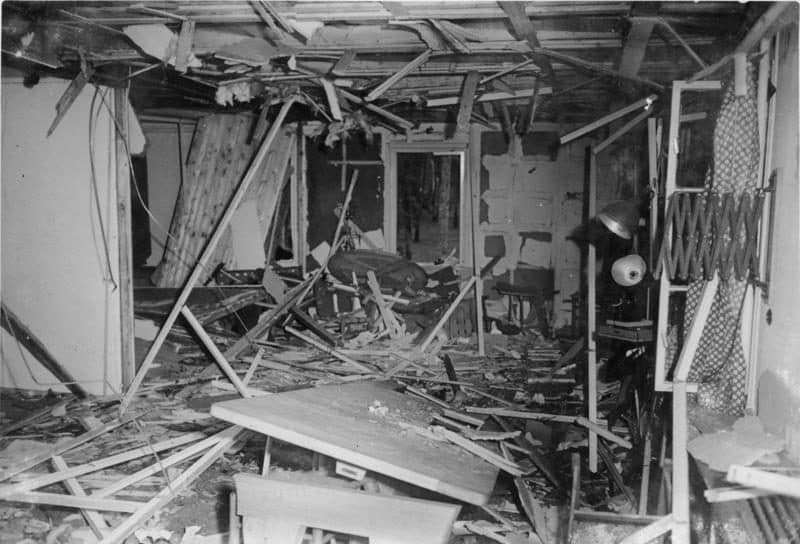
The wrecked briefing hut at the Wolf’s Lair after Stauffenberg’s bomb exploded on 20 July 1944
The wrecked briefing hut at the Wolf’s Lair, July 1944. Photo: Bundesarchiv, Bild 146-1972-025-12 / CC-BY-SA 3.0

Why the bomb failed

On 20 July 1944 the noon briefing at the Wolf’s Lair was held not in a concrete bunker but in a wooden hut, because of the summer heat. In a side room Stauffenberg, who had lost his right hand and two fingers of his left in North Africa, began arming two 1 kg charges of plastic explosive with pliers. A guard knocked to hurry him, and he managed to arm only one. He put the briefcase under the heavy oak table near Hitler, took a pre-arranged telephone call and left.

Colonel Heinz Brandt seems to have pushed the briefcase behind a thick table support. At 12:42 the bomb went off, but the open windows and the flimsy hut let the blast escape, and the table shielded Hitler, who suffered burst eardrums and singed trousers. A stenographer and three officers, Brandt among them, died. Stauffenberg, sure no one could have survived, bluffed his way out and was in the air for Berlin by 13:00.

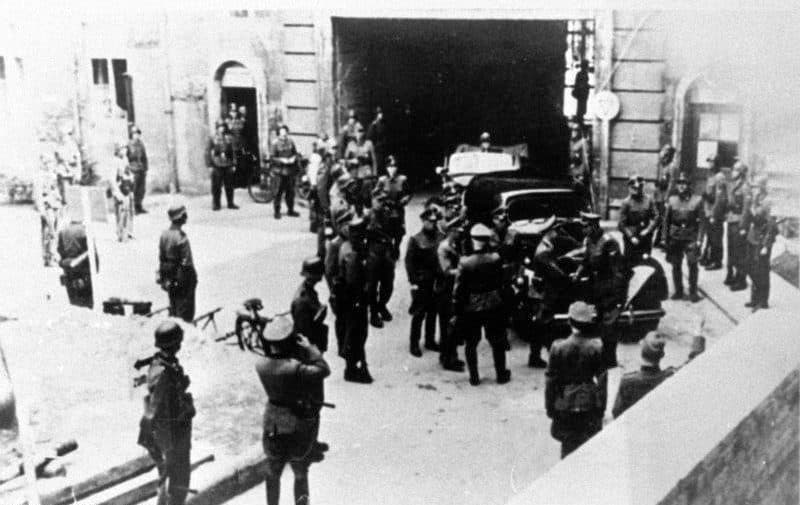
Soldiers and Waffen-SS men at the gateway of the Bendlerblock on Bendlerstraße, Berlin, in July 1944, after the failed coup
Soldiers and Waffen-SS men at the Bendlerblock, July 1944. Photo: Bundesarchiv, Bild 146-1972-109-19A / CC-BY-SA 3.0

The night of 20–21 July in the Bendlerblock

Olbricht did not issue the Valkyrie orders until about 16:00, three hours after the blast, and Stauffenberg reached the Bendlerblock at 16:40. When General Friedrich Fromm, commander of the Reserve Army, refused to join them, the conspirators locked him in his office. But by evening Goebbels had put Major Otto Ernst Remer on the telephone to Hitler, and Remer’s guard battalion sealed off the building. Officers loyal to the regime turned on the plotters, Stauffenberg was wounded in a shoot-out, and by 23:00 the building was lost.

Fromm, perhaps to hide what he had known, held an instant court martial. Ludwig Beck was allowed to shoot himself and, when he failed, was finished off by a soldier. Shortly after midnight Olbricht, Stauffenberg, Mertz von Quirnheim and von Haeften were shot in the courtyard by the headlights of a truck; Haeften is said to have stepped in front of Stauffenberg. The bodies were buried that night in the Alter St.-Matthäus-Kirchhof in Schöneberg; the SS dug them up the next day and burned them.

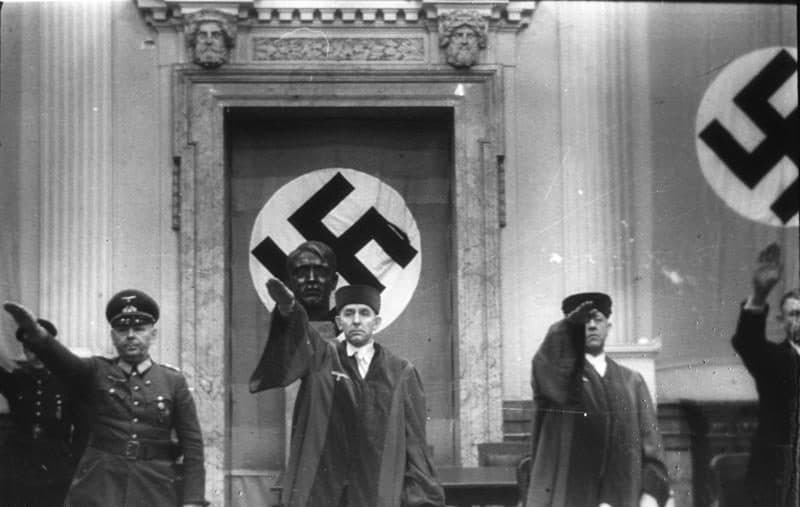
Judge Roland Freisler and fellow judges giving the Nazi salute at the People’s Court in Berlin during a trial after the 20 July 1944 plot
Roland Freisler (centre) at the People’s Court during a 20 July trial, 1944. Photo: Bundesarchiv, Bild 151-39-23 / CC-BY-SA 3.0

The People’s Court and Plötzensee

Hitler set up a special Gestapo commission to hunt down everyone connected with the plot. In the weeks and months that followed more than 7,000 people were arrested; about 200 of those executed were directly linked to 20 July. Under the rule of Sippenhaft, kin liability, families were arrested too: Stauffenberg’s pregnant wife Nina was imprisoned and their children were placed in a home under a different surname.

An army ‘Court of Honour’ expelled the accused officers so that they could be tried as civilians before the People’s Court, where its president Roland Freisler shouted down and humiliated them in front of film cameras. The first trial was held on 7–8 August 1944, and the first eight men were hanged at Plötzensee prison on the day it ended. The trials went on until Freisler was killed in an air raid on 3 February 1945. Fromm himself was shot in March 1945.

Plan your visit

Visiting the German Resistance Memorial Center

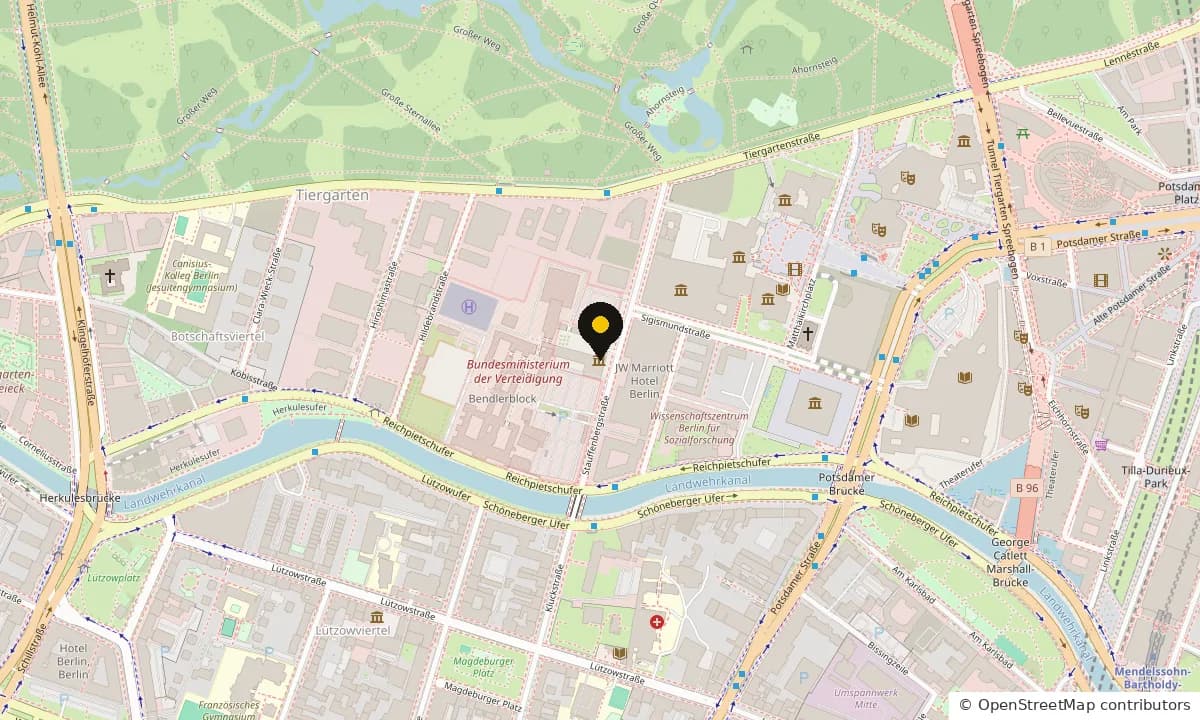
Map of the streets around the German Resistance Memorial Center, with a pin on the siteOpen in Google Maps

Stauffenbergstraße 13–14, 10785 Berlin · Monday–Friday 09:00–18:00; Saturday, Sunday and public holidays 10:00–18:00. Closed 24–26 December, 31 December and 1 January.

Getting there

  • Bus M29Gedenkstätte Deutscher Widerstand250 m · 3 min

    The stop is on Reichpietschufer by the Landwehr Canal. Walk north up Stauffenbergstraße to the courtyard gate.

  • S1S2S25S26U2Potsdamer Platz1 km · 14 min

    Walk west past the Kulturforum and along Sigismundstraße, which meets Stauffenbergstraße opposite the museum.

  • U1U3Kurfürstenstraße1 km · 13 min

    Walk north and cross the Landwehr Canal into Stauffenbergstraße.

What you’ll see

  • The courtyard where Olbricht, Stauffenberg, Mertz von Quirnheim and von Haeften were shot: Richard Scheibe’s 1953 bronze of a young man with bound hands, the plaque naming the five men who died here on 20 July 1944, and the inscription at the gateway.
  • The permanent exhibition ‘Resistance against National Socialism’ on the second floor: 18 topics, from the labour movement, the churches and the White Rose to Georg Elser, the Red Orchestra and the military opposition, in the rooms where the coup was run.
  • Stauffenberg’s former office, part of the exhibition, and in the same building the Silent Heroes Memorial Center, on the Germans who hid and helped Jews, plus special exhibitions on the first floor.

Tips from a guide

  • Borrow the free audio guide (German, English, French, Spanish, Italian, Polish and Turkish) at the exhibition reception on the second floor, or play it on your phone.
  • Free public tours start at 15:00 at that reception and last about 75 minutes: in German and English on the third Sunday of the month, in German only on the first. No booking needed.
  • Start in the courtyard before you go upstairs: it is where the night of 20 July ended. Groups of more than 12 can only visit as part of a free pre-booked programme, so book ahead.

Accessibility

The main entrance in the courtyard has a ramp and automatic doors, and a lift (88 cm wide, 130 cm deep) serves the first and second floors. The courtyard itself is cobbled, which some wheelchair users find difficult. The permanent exhibition is step-free, with roll-under tables and media stations, a barrier-free toilet on the second floor, a video guide in German Sign Language and a topic guide in Easy German. The library on the ground floor is not wheelchair accessible; contact the centre in advance for help. There is no parking of its own, only meters on Stauffenbergstraße and Sigismundstraße.

Timeline

From naval office to memorial

  1. 1911–14The complex is built for the Imperial Navy Office on the Landwehr Canal.
  2. 3 Feb 1933Hitler tells the army chiefs here of his plan to win ‘living space in the east’.
  3. 1 Jul 1944Stauffenberg becomes chief of staff of the Reserve Army in the Bendlerblock.
  4. 20 Jul 1944His bomb explodes at the Wolf’s Lair at 12:42; Hitler survives.
  5. 21 Jul 1944Just after midnight four officers are shot in the courtyard; Beck dies inside.
  6. 8 Aug 1944The first eight conspirators are hanged at Plötzensee after the People’s Court trial.
  7. 2 May 1945The Red Army takes the Bendlerblock, the last command post of Berlin’s defence.
  8. 20 Jul 1953Mayor Ernst Reuter unveils Richard Scheibe’s memorial in the courtyard.
  9. 1955Bendlerstraße is renamed Stauffenbergstraße.
  10. 20 Jul 1968The first exhibition opens in the building.
  11. 20 Jul 1989A permanent exhibition on the whole German resistance opens.
  12. 1993The Ministry of Defence makes the Bendlerblock its second seat.

See it with a historian

Tours that stop at the German Resistance Memorial Center

The exhibition tells the story room by room; a guide can set it in the streets around it, from Hitler’s Chancellery to the courtyard where the coup ended.

The rise and fall of the Third Reich, with the Bendlerblock and the resistance among its stops.

The Capital Of Tyranny Tour - Berlin Experiences
Full Day6 Hours

The Capital Of Tyranny

Private 6-hour van tour of Hitler's Berlin and the Third Reich for up to 6 people. Starts at your hotel or anywhere in the city.

€1,000up to 6
View Tour

April 1945 across the city, including the Bendlerblock, the defenders’ last headquarters.

The Battle Of Berlin Tour - Berlin Experiences
Full Day6 Hours

The Battle Of Berlin Tour

Private 6-hour van tour of the 1945 battlefield, from the outskirts to the Reichstag, for up to 6 people. Starts at your hotel.

€1,000up to 6
View Tour

Six hours across Berlin’s history, from the Prussian kings to the Wall.

The Berlin History Tour
Full Day6 Hours

The Berlin History Tour

Private 6-hour van tour of Berlin's whole history in one day for up to 6 people. Starts at your hotel or anywhere in the city.

€1,000up to 6
View Tour

Questions visitors ask

Frequently asked questions

Is the German Resistance Memorial Center free?

Yes. Admission is free, and so are the audio guide in seven languages and the public tours on the first and third Sunday of the month.

What are the opening hours of the German Resistance Museum?

Monday to Friday 09:00–18:00, and Saturday, Sunday and public holidays 10:00–18:00. It is closed on 24–26 December, 31 December and 1 January.

Is there a Hitler museum in Berlin?

No museum is dedicated to Hitler. The Nazi regime is covered at the free Topography of Terror, on the site of the Gestapo and SS headquarters, and the resistance to it here in the Bendlerblock. The private Berlin Story Bunker near Anhalter Bahnhof has an exhibition called <em>Hitler – how could it happen</em>.

Where was Stauffenberg executed?

In the courtyard of the Bendlerblock, shortly after midnight on 21 July 1944, together with Friedrich Olbricht, Albrecht Mertz von Quirnheim and Werner von Haeften. Ludwig Beck died inside the building just before. A plaque and Richard Scheibe’s statue mark the spot.

Can you see Stauffenberg’s office?

Yes. His former office on the second floor is part of the permanent exhibition. The original furniture has gone; the room now holds photographs and the story of 20 July 1944.

How long do you need at the German Resistance Memorial Center?

Allow one and a half to two hours for the courtyard and the 18 topics of the permanent exhibition, longer if you take the 75-minute public tour.

Was the film Valkyrie shot at the Bendlerblock?

Yes. Bryan Singer filmed scenes for <em>Valkyrie</em>, with Tom Cruise as Stauffenberg, in the courtyard in September and October 2007, and the 2004 German TV film <em>Stauffenberg</em> also restaged the shootings there.

Is the Bendlerblock still a military building?

Yes. Since 1993 most of it has been the Federal Ministry of Defence’s second seat in Berlin. Only the memorial in the east wing and its courtyard are open to visitors.

Keep exploring

More Featured Experiences.

Every site we write about — 56 landmarks, museums, memorials and lesser-known corners of Berlin. See the full index →

01Walk Through The Brandenburg Gate02Explore The State Museums On Museum Island03Visit The Berlin TV Tower – The Fernsehturm04Cross The Cold War Border At Checkpoint Charlie05Visit The Site Of Adolf Hitler’s Führerbunker06Explore The Reconstructed Berlin Palace07Visit The Reichstag Cupola At Night08Explore The Forum Fridericianum09Shop At The Humboldt University Book Sale10Journey Into The Memorial To The Murdered Jews Of Europe11Step Inside The Neue Wache12Explore The Former Jewish Quarter – Spandauer Vorstadt13Visit The Remains Of The Berlin Wall14Walk Across The Bridge Of Spies15Explore The Topography Of Terror16Climb The Prussian Victory Column – The Siegessäule17Enter The Palace Of Tears – The Tränenpalast18Step Inside The Berlin Olympic Stadium19Explore Erich Mielke’s Office At The Stasi Museum20Walk Along Karl Marx Allee21Visit The Oldest Church In Berlin – The Nikolaikirche22Explore The Berliner Dom23Visit The Grave Of Frederick The Great24Walk Through The Ruins Of Anhalter Bahnhof25Stand On The Platz Des Volksaufstandes27Visit The Soviet War Memorial In The Tiergarten28See The Georg Elser Memorial On Wilhelmstrasse29Step Inside The Kaiser Wilhelm Gedächtnis Kirche30Visit The Gleis 17 Memorial31Visit The Schloss Charlottenburg Mausoleum32Climb The Französischer Dom at Gendarmenmarkt33Explore The Interbau – IBA 5734Explore The Otto Weidt Workshop35Visit Cecilienhof – Site Of The Potsdam Conference36Visit The Stasi Prison In Hohenschönhausen37Spend The Day At Tempelhof Airport38Ride The Fastest Elevator In Europe39Visit The Soviet War Memorial In Treptower Park40Visit The Sachsenhausen Concentration Camp Memorial41Visit The Ravensbrück Concentration Camp Memorial42Visit Karlshorst – The Site Of The German Surrender43Visit The Socialists Cemetery – Zentralfriedhof Friedrichsfelde44Visit The Soviet War Memorial In Pankow45Visit the Seelow Heights Memorial46Visit The Commonwealth War Cemetery47Cross The Bösebrücke At Night48Explore The Allied Museum In Dahlem49Explore The Spandau Citadel50Visit The Brandenburg T4 Euthanasia Memorial51Visit The Wannsee Conference House52Visit The Jewish Museum53Visit The Jewish Cemetery In Weissensee54Walk Along The East Side Gallery55Explore The Volkspark Friedrichshain Flak Tower56Head Up The Teufelsberg