Skip to content
Book and print stalls in front of Humboldt University on Unter den Linden, Berlin, below the statue of Wilhelm von Humboldt

Berlin Experiences/Featured Experiences

Humboldt University Book Sale: Browse the Bookstalls on Unter den Linden

Berlin’s labour of literary love.

The short answer

The Humboldt University book sale is a row of second-hand book tables, run by private sellers, along the railings of the university’s main building at Unter den Linden 6 in Berlin-Mitte. It faces Bebelplatz, where Nazi students burned books in May 1933. It is outdoors and free to browse; you pay only for what you buy. The sellers publish no days or hours: they are usually there in the daytime, but check before you go. Allow 15–30 minutes, longer if you like to dig.

Where
In front of Humboldt University, Unter den Linden 6, 10117 Berlin-Mitte
Open
Daytime, weather permitting; no published hours, so check before you go
Admission
Free to browse
Time needed
15–30 minutes
Nearest station
U5/U6 Unter den Linden, 5 minutes on foot
Step-free
Yes: the tables are on the pavement

The story · by Matt Robinson

The term ‘genocide’ – used to refer to the deliberate killing of a large number of people from a particular nation or ethnic group with the aim of destroying that nation or group – has only been part of common parlance since 1944. One year before the end of the Second World War, lawyer Raphael Lemkin coined the term genocide as a hybrid combination of the Ancient Greek word γένος (génos) meaning ‘race or people’ and the Latin caedere, ‘to kill’.

He was at that time describing the murderous Nazi policies in the occupied territories, in his book ‘Axis Rule in Occupied Europe’. The term would later be utilised by the United Nations when defining the crime of genocide under international law in the Genocide Convention, ensuring its adoption by the international community in preference to terms in other languages that predated Lemkin’s neologism – including the German term Völkermord (‘murder of a people’) and the Polish ludobójstwo (‘killing of a people or nation’).

Less known is Lemkin’s use of the term, Cultural Genocide, to refer to the eradication and destruction of cultural artifacts, such as books, artworks, monuments, and structures. Cultural genocide may also involve forced assimilation, as well as the suppression of a language or cultural activities that do not conform to the destroyer’s notion of what is appropriate.

Among the Nazi crimes, for example, against the Polish nation was a campaign of cultural genocide that included the burning of millions of books, resulting in the destruction of an estimated 80% of all school libraries, and three-quarters of all scientific libraries in the country.

The removal of heritage and eradication of identity are at the heart of the concept of Lemkin’s proposed understanding of ‘cultural genocide’. And while this may not involve the physical eradication of a people, it is through the suppression of identity and cultural heritage that the individual and their character is also destroyed.

10 May 1933

In the case of National Socialism, it was a cultural genocide that preceded the very real genocides that would follow. Groundwork laid for the industrial killing processes where exclusion and expulsion developed into extermination.

Here at the current Bebelplatz (formerly Opernplatz/Franz-Josef-Platz) one of the earliest and most visible examples of that movement towards cultural genocide took place in Nazi Germany.

Visitors browsing second-hand books and prints on the tables along the railings of Humboldt University, Berlin
Browsing the tables along the university railings.

On May 10th 1933, around 40,000 people gathered to hear Nazi Propaganda Minister Joseph Goebbels condemn the works of ‘intellectual filth’ and the ‘Jewish asphalt literati’ to the flames of an immense bonfire. “No to decadence and moral corruption!” ran the students’ ‘fire oaths’. “Yes to decency and morality in family and state!”

Erich Kästner, author of the popular children’s story ‘Emil and the Detectives’, was one of the only writers to witness his books being burned in Berlin on May 10th 1933. He would be declared “culturally Bolshevist” by the Nazi Party and denied membership in the new Nazi-controlled national writers’ guild.

One month earlier, this so-called ‘Day of Action Against the Un-Germanic Spirit’ had been announced by the German Student Union (Deutsche Studentenschaft), a great joyous ceremony to include live music, singing, ‘fire oaths’, and incantations – would climax in a literary purge or ‘cleansing’ (“Säuberung”) by fire.

Along with the wholesale demand that universities become centres of German nationalism, the students organised similar book burnings in 34 university towns across the country. While not completely wiping out the works of authors and writers deemed ‘degenerate’, this mass-staging of symbolic acts promoting the restriction of freedom of expression would presage an era of uncompromising state censorship and a campaign of cultural genocide that would eventually extend into the Nazi occupied territories of Europe.

The university

While promoting their distorted vision of the future the National Socialist movement was also careful to cultivate a sense of a shared and pure German past.

The decision to host this book burning in central Berlin sent a message to the populace regarding one of the central tenets of National Socialist control – that of complete submission and respect of a carefully cultivated Party line. The choice of location, on the square in front of the city’s most prestigious university made this event doubly impactful.

Humboldt University (as it is now known) opened in 1810, under the administration of Wilhelm von Humboldt, the Prussian politician and philosopher responsible for the vaunted Humboldtian model of education. Despite never finishing his own university education, Humboldt became one of the most influential voices in German education – encouraging the University of Berlin to operate according to scientific, as opposed to market-driven, principles such as curiosity, freedom of research, and internal objectives.

The university is home to twenty nine Nobel prize winners, including Fritz Haber, Theodor Mommsen, Robert Koch, Max Planck, Albert Einstein, Werner Heisenberg and Erwin Schrödinger. Chemistry, Medicine, Physics and Literature are the speciality subjects of the university.

A paperback of Kurt Tucholsky’s Rheinsberg among second-hand books at the Humboldt University book sale in Berlin
Kurt Tucholsky’s Rheinsberg: his books were burned in 1933.

Other notable alumni and teachers include: Otto von Bismarck, Feuerbach & Fichte, Friedrich Engels, Heinrich Heine, Georg Wilhelm Friedrich Hegel, Karl Marx, Karl Liebknecht, Herbert Marcuse, Arthur Schopenhauer, Felix Mendelssohn Bartholdy, Kurt Tucholsky, Rudolf Virchow (‘the father of modern pathology’) and Robert Havemann.

Arguably though, the most important figures with their names attached to this university would be the two Humboldt brothers from whom the university gets its current name – Wilhelm and his more widely-known sibling, Alexander. Both would promote the development of education as a free and open enterprise to shape society not around the set societal structure – but around the interests and expertises that would develop from the cultivation of the individual.

This great sense of understanding within society would only develop through the unobstructed exposure of individuals to things beyond their horizon. Wilhelm von Humboldt would famously comment that: “it is no more useless for the carpenter to have learned Greek than it is for the scholar to make tables.”

The book sale today

Outside the university now – almost every day of the year, come rain, come shine – is a book sale, run in cooperation with the institution but by private sellers. Its presence stands as a symbolic challenge to the history and Nazi use of the square opposite. To great leaders, and great powers – good or bad – image is everything. As such it must be maintained, by sword or by pen.

Here it is possible to purchase the works of authors persecuted by the Nazis, who would also have their intellectual property condemned to the flames or the nearby cultural bonfire. Although beyond the expected list of degenerate authors’ works one might expect, it is also possible to find other works – contemporary and modern.

French paperbacks by Simone de Beauvoir, Boris Pasternak and François Mauriac at the book stalls outside Humboldt University, Berlin
Not only German titles: French paperbacks on a seller’s table.

Every year, the former Opera Square also plays host to an annual book sale, allowing the many small publishing houses across Germany to step into the spotlight. Regardless of the content of their publications, it is the free flowing dialogue of expression that is promoted here that acts as one of the most important fundamentals of a successful democratic society.

The Basic Law of Germany is currently clear on this subject: “Every person shall have the right freely to express and disseminate his opinions in speech, writing and pictures, and to inform himself without hindrance from generally accessible sources.”

Not only does the individual have the right to freely express themselves but the public has the ability then to judge for themselves the significance of those words and engage in dialogue.

Rather than flames, we have the realm of fiction and non-fiction.
Humboldt University in detail

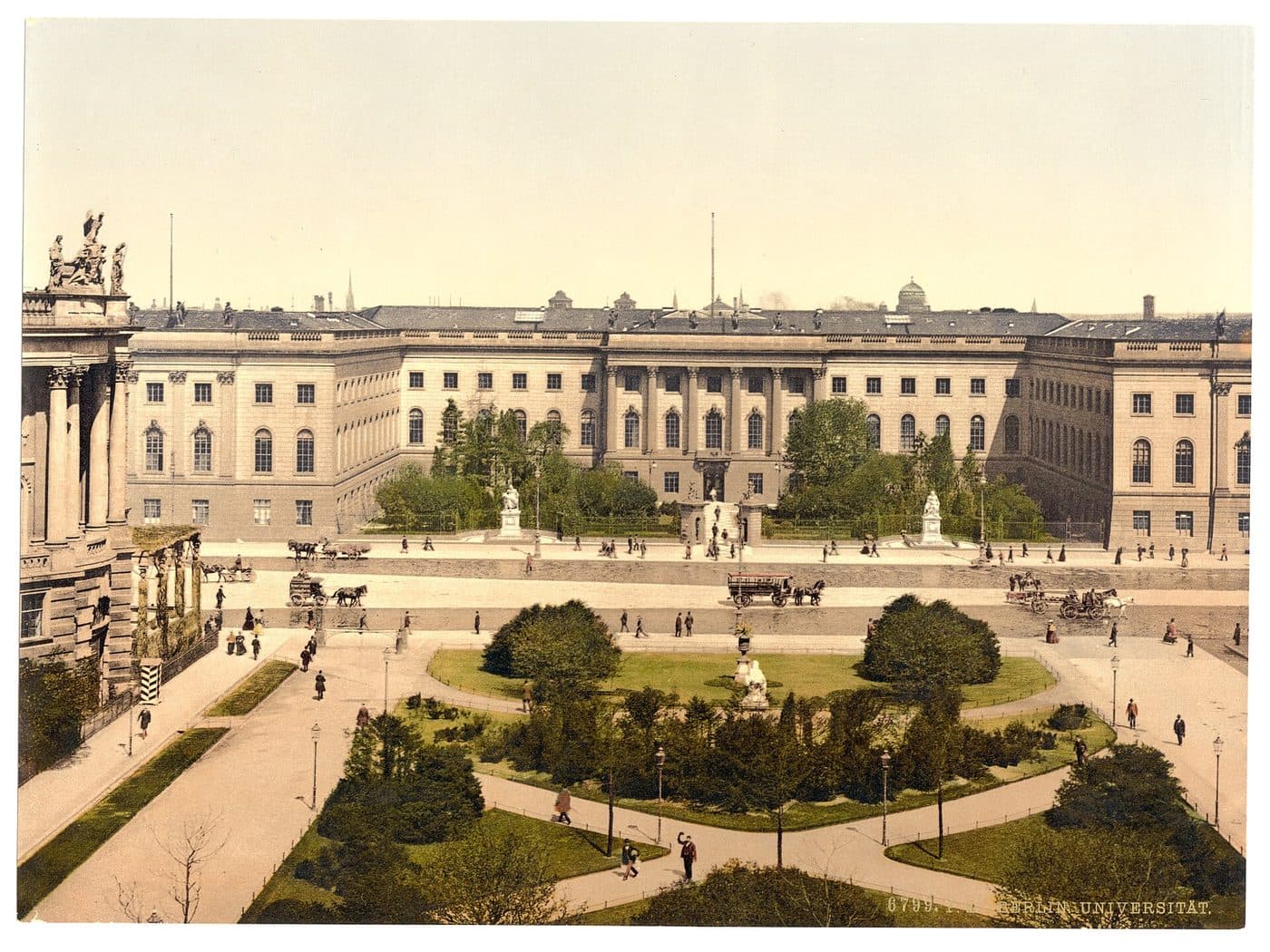
Photochrom print of the University of Berlin on Unter den Linden in the 1890s, the former palace of Prince Heinrich
The university on Unter den Linden in the 1890s. Photo: Photochrom Print Collection, Library of Congress / Public domain, via Wikimedia Commons

From a prince’s palace to a university

The building behind the book tables was never meant for students. Frederick the Great had it built in 1748–53 as a town palace for his younger brother, Prince Heinrich, as part of the Forum Fridericianum, the ensemble of opera house, church and library around today’s Bebelplatz. Johann Boumann was the architect, reportedly working from early designs by Georg Wenzeslaus von Knobelsdorff. Heinrich died in 1802, and in 1809 King Frederick William III gave the empty palace to a new university.

Founded on 16 August 1809 on Wilhelm von Humboldt’s initiative, the University of Berlin began teaching in October 1810 with 256 students and 52 lecturers. In 1828 it took the king’s name, Friedrich-Wilhelms-Universität. On 28 May 1883 the marble statues of Wilhelm and Alexander von Humboldt were unveiled at the railings, where the book tables stand today, and in 1913–20 Ludwig Hoffmann extended the side wings.

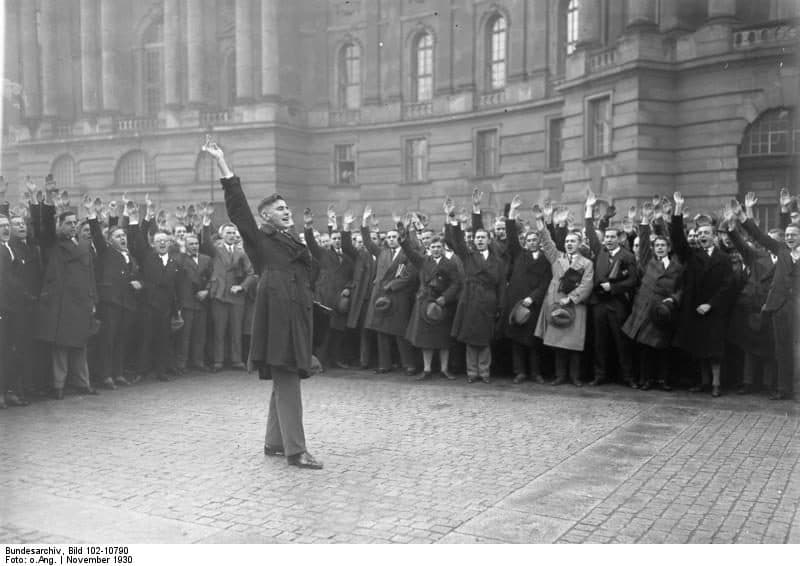
Students raising their hands at a nationalist rally in front of the university in Berlin, November 1930
A nationalist student rally outside the university, November 1930. Photo: Bundesarchiv, Bild 102-10790 / CC-BY-SA 3.0

The university under the Nazis

Many of Berlin’s students did not need to be forced into line. Nationalist student groups were loud at the university well before 1933, as the rally in the photograph shows, and it was the German Student Union that planned the ‘Action against the Un-German Spirit’ and carried books to the bonfire across the road on 10 May 1933.

Inside the building the purge had already begun. Under the Law for the Restoration of the Professional Civil Service of April 1933, some 250 Jewish professors and employees were dismissed in 1933–34, and many doctorates were withdrawn. Jewish students were pushed out too. Since 3 July 2010, twenty Stolpersteine in the pavement in front of the main building have remembered former Jewish students who were murdered or driven to their deaths, among them Walter Brock, deported in December 1942 and murdered in Auschwitz.

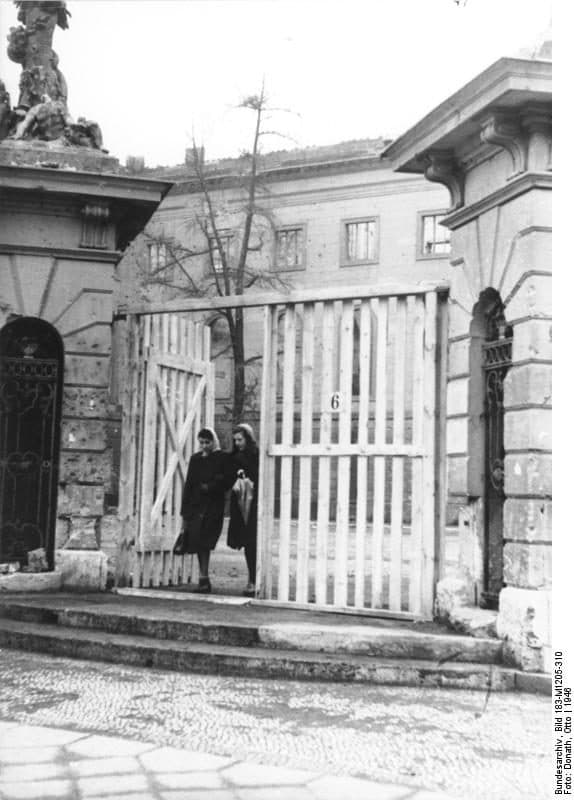
The entrance to the university on Unter den Linden in Berlin in 1946, closed with a makeshift wooden gate
The university entrance in 1946, with a makeshift wooden gate. Photo: Bundesarchiv, Bild 183-M1205-310 / Donath, Otto / CC-BY-SA 3.0

War, division and a new name

Air raids between November 1943 and July 1944 destroyed large parts of the palace. Teaching restarted in 1945 in patched-up rooms in the west wing, and in 1946 the university reopened as the University of Berlin in the Soviet sector; the photograph shows its entrance that year, closed with a makeshift wooden gate. Communist control tightened quickly. After three students were expelled in 1948, students and lecturers founded the Free University in West Berlin, which held its founding ceremony on 4 December 1948.

In 1949 the old university took the name of the Humboldt brothers, whose statues stood at its gate. The street front was rebuilt in two phases, 1947–54 and 1958–62, and in 1953 Karl Marx’s eleventh thesis on Feuerbach went up in gold letters on the main staircase, where it still is. After reunification the university was restructured under commissions led by West German professors.

Plan your visit

Visiting the Humboldt University book sale

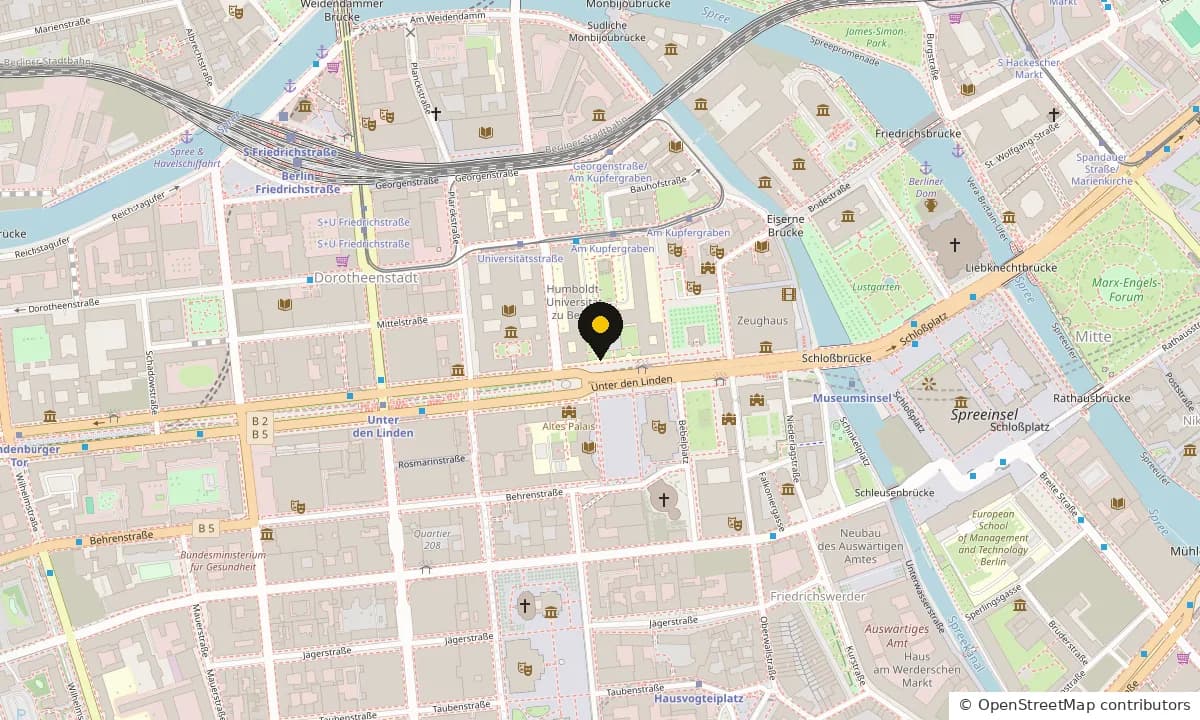
Map of the streets around the Humboldt University book sale, with a pin on the siteOpen in Google Maps

Unter den Linden 6, 10117 Berlin · No published hours. The book tables are run by independent sellers who usually set up in the daytime, but days and times depend on the sellers and the weather, so check before you go. The HumboldtStore inside the main building is open Monday, Tuesday, Thursday and Friday 11:00–18:00 and Wednesday 11:00–16:00.

Getting there

  • Bus 100Bus 300Staatsoper50 m · 1 min

    Both routes run along Unter den Linden between Alexanderplatz and the Tiergarten; the stop is almost outside the university gate.

  • U5U6Unter den Linden320 m · 5 min

    Walk east along the north side of Unter den Linden, past the State Library; the stalls are at the university railings.

  • U5Museumsinsel400 m · 6 min

    Come up by the Schlossbrücke and walk west along Unter den Linden past the Zeughaus and the Neue Wache.

What you’ll see

  • Trestle tables and boxes of second-hand books along the railings in front of the main building: German paperbacks, old hardbacks, foreign-language titles, prints and postcards, depending on the seller and the day.
  • The marble statues of Wilhelm von Humboldt (by Paul Otto, on the left as you face the building) and Alexander von Humboldt (by Reinhold Begas, on the right), unveiled on either side of the main gate in 1883.
  • Twenty Stolpersteine in the pavement for former Jewish students, and across Unter den Linden on Bebelplatz, Micha Ullman’s sunken empty library marking the 1933 book burning.

Tips from a guide

  • Look out for authors whose books were burned across the road in 1933, such as Erich Kästner, Kurt Tucholsky, Heinrich Mann and Heinrich Heine: their paperbacks often turn up on the tables.
  • Cross to Bebelplatz (4 minutes) afterwards and look down into the empty library memorial; it is clearest after dark, when the shelves below are lit.
  • Bring some cash and pick a dry day: these are small outdoor stalls with no published hours, and you cannot count on card payment.

Accessibility

The tables stand on the pavement of Unter den Linden, which is level but partly laid with small stone setts. Books are laid out at table height and in boxes underneath, so some browsing means bending down. There are no toilets or seating at the stalls. Check the BVG website for lift status at Unter den Linden and Museumsinsel stations.

Timeline

From royal palace to book tables

  1. 1748–53A town palace is built on Unter den Linden for Prince Heinrich of Prussia.
  2. 16 Aug 1809The king founds the University of Berlin on Wilhelm von Humboldt’s initiative.
  3. Oct 1810Teaching begins in the former palace with 256 students and 52 lecturers.
  4. 1828The university is named Friedrich-Wilhelms-Universität.
  5. 28 May 1883The statues of Wilhelm and Alexander von Humboldt are unveiled at the railings.
  6. 10 May 1933Students burn books on the Opernplatz, opposite the university.
  7. 1933–34Some 250 Jewish professors and employees are dismissed.
  8. 1943–44Air raids destroy large parts of the main building.
  9. 1946The university reopens in the Soviet sector as the University of Berlin.
  10. 4 Dec 1948The Free University is founded in West Berlin.
  11. 1949The university is renamed after the Humboldt brothers.
  12. 3 Jul 2010Twenty Stolpersteine are laid outside for former Jewish students.

See it with a historian

Tours that stop at the Humboldt University book sale

On your own you see a row of book tables; a guide connects them to the bonfire across the road, the Humboldts at the gate and the names in the pavement.

Half a day on foot through historic Mitte, with time to browse on Unter den Linden.

The Berlin Explorer Tour
Half Day4 Hours

The Berlin Explorer Tour

Private half-day walking tour of historic Mitte for up to 10 people. Starts at your hotel or anywhere in the centre.

€500up to 10
View Tour

The Third Reich in Berlin, from the seizure of power to the book burning opposite.

The Capital Of Tyranny Tour - Berlin Experiences
Full Day6 Hours

The Capital Of Tyranny

Private 6-hour van tour of Hitler's Berlin and the Third Reich for up to 6 people. Starts at your hotel or anywhere in the city.

€1,000up to 6
View Tour

A full day across Berlin’s history, from Prussian Berlin to the fall of the Wall.

The Berlin History Tour
Full Day6 Hours

The Berlin History Tour

Private 6-hour van tour of Berlin's whole history in one day for up to 6 people. Starts at your hotel or anywhere in the city.

€1,000up to 6
View Tour

Questions visitors ask

Frequently asked questions

Where is the book sale at Humboldt University?

On the pavement in front of the university’s main building at Unter den Linden 6, in Berlin-Mitte, along the railings either side of the main gate and its two Humboldt statues. Bebelplatz, where the Nazis burned books in 1933, is directly opposite.

When are the book stalls outside Humboldt University open?

There are no published days or hours. The tables are run by independent sellers who usually set up in the daytime, but it depends on the sellers and the weather, so check before you go.

Is the book sale run by the university?

No. The tables belong to private sellers, not to the university, though they trade at its railings. The university’s own shop, the HumboldtStore, is in the foyer of the main building.

What kind of books can you buy there?

Mostly second-hand books: German paperbacks and older hardbacks, plenty of history, some English and other foreign-language titles, and prints and postcards. Works by authors the Nazis banned, such as Erich Kästner and Kurt Tucholsky, often turn up.

What happened opposite Humboldt University in 1933?

On 10 May 1933 students organised by the German Student Union burned some 20,000 books on the Opernplatz, today’s Bebelplatz, in front of about 40,000 people, and Propaganda Minister Joseph Goebbels spoke to the crowd. Micha Ullman’s underground empty library marks the spot.

Who are the statues in front of Humboldt University?

The university’s namesakes: Wilhelm von Humboldt, the scholar and statesman who founded it, by Paul Otto, and his brother Alexander, the naturalist and explorer, by Reinhold Begas. Both were unveiled in 1883.

What are the brass stones in the pavement outside the university?

Stolpersteine, or ‘stumbling stones’. Twenty were laid in front of the main building in July 2010 for former Jewish students who were murdered or driven to their deaths under the Nazis.

Can you go inside Humboldt University?

You can walk through the gate and forecourt into the foyer, where the HumboldtStore is and where Marx’s line ‘Philosophers have only interpreted the world in various ways; the point is to change it’ runs up the staircase. Lecture halls are for students.

Sources

Facts checked 4 November 2026. Spotted something out of date? Tell us.

Keep exploring

More Featured Experiences.

Every site we write about — 56 landmarks, museums, memorials and lesser-known corners of Berlin. See the full index →

01Walk Through The Brandenburg Gate02Explore The State Museums On Museum Island03Visit The Berlin TV Tower – The Fernsehturm04Cross The Cold War Border At Checkpoint Charlie05Visit The Site Of Adolf Hitler’s Führerbunker06Explore The Reconstructed Berlin Palace07Visit The Reichstag Cupola At Night08Explore The Forum Fridericianum10Journey Into The Memorial To The Murdered Jews Of Europe11Step Inside The Neue Wache12Explore The Former Jewish Quarter – Spandauer Vorstadt13Visit The Remains Of The Berlin Wall14Walk Across The Bridge Of Spies15Explore The Topography Of Terror16Climb The Prussian Victory Column – The Siegessäule17Enter The Palace Of Tears – The Tränenpalast18Step Inside The Berlin Olympic Stadium19Explore Erich Mielke’s Office At The Stasi Museum20Walk Along Karl Marx Allee21Visit The Oldest Church In Berlin – The Nikolaikirche22Explore The Berliner Dom23Visit The Grave Of Frederick The Great24Walk Through The Ruins Of Anhalter Bahnhof25Stand On The Platz Des Volksaufstandes26Visit The German Resistance Museum27Visit The Soviet War Memorial In The Tiergarten28See The Georg Elser Memorial On Wilhelmstrasse29Step Inside The Kaiser Wilhelm Gedächtnis Kirche30Visit The Gleis 17 Memorial31Visit The Schloss Charlottenburg Mausoleum32Climb The Französischer Dom at Gendarmenmarkt33Explore The Interbau – IBA 5734Explore The Otto Weidt Workshop35Visit Cecilienhof – Site Of The Potsdam Conference36Visit The Stasi Prison In Hohenschönhausen37Spend The Day At Tempelhof Airport38Ride The Fastest Elevator In Europe39Visit The Soviet War Memorial In Treptower Park40Visit The Sachsenhausen Concentration Camp Memorial41Visit The Ravensbrück Concentration Camp Memorial42Visit Karlshorst – The Site Of The German Surrender43Visit The Socialists Cemetery – Zentralfriedhof Friedrichsfelde44Visit The Soviet War Memorial In Pankow45Visit the Seelow Heights Memorial46Visit The Commonwealth War Cemetery47Cross The Bösebrücke At Night48Explore The Allied Museum In Dahlem49Explore The Spandau Citadel50Visit The Brandenburg T4 Euthanasia Memorial51Visit The Wannsee Conference House52Visit The Jewish Museum53Visit The Jewish Cemetery In Weissensee54Walk Along The East Side Gallery55Explore The Volkspark Friedrichshain Flak Tower56Head Up The Teufelsberg