Skip to content
Entrance to the Museum Blindenwerkstatt Otto Weidt in the Haus Schwarzenberg courtyard, Berlin, beside a mural of Otto Weidt

Berlin Experiences/Featured Experiences

Otto Weidt Museum: Visit His Workshop for the Blind in Berlin

The workshop where Otto Weidt shielded his blind and deaf Jewish workers from the Nazis

The short answer

The Museum Blindenwerkstatt Otto Weidt is the workshop where the brush maker Otto Weidt employed and protected blind and deaf Jewish workers during the Second World War. It is at Rosenthaler Straße 39 in Berlin-Mitte, in the Haus Schwarzenberg courtyard next to the Hackesche Höfe, three minutes from S Hackescher Markt. Entry is free and it is open daily: 09:00–18:00 on weekdays, 10:00–18:00 at weekends and on public holidays. Allow 45 minutes to an hour for the rooms, the hiding place and the life stories.

Where
Rosenthaler Straße 39, first courtyard, left entrance, 10178 Berlin-Mitte
Open
Mon–Fri 09:00–18:00; Sat, Sun and holidays 10:00–18:00
Admission
Free
Time needed
45–60 minutes
Nearest station
S Hackescher Markt, 4 minutes on foot
Step-free
Yes: lift from the courtyard and an accessible WC

The story · by Matt Robinson

Behind a modest doorway beside the bustling Hackesche Höfe lies one of Berlin’s most moving memorials: the Museum Blindenwerkstatt Otto Weidt, the Workshop for the Blind. Here, at Rosenthaler Straße 39, a small-time brush and broom manufacturer sheltered his predominantly Jewish, blind and deaf workers from the Nazi deportations – with bribes, forged documents and sheer audacity.

Berlin’s history often speaks most clearly from hidden corners like this one, tucked away in unassuming courtyards, revealing intimate tales of individual lives caught in the maelstrom. These are stories not of grand political manoeuvres or vast military campaigns, but of quiet defiance, moral courage, and extraordinary humanity flourishing against the darkest odds.

This isn’t a museum in the conventional sense, filled with curated artefacts removed from their context. This is the context. You step into the actual rooms where Otto Weidt, a small-time brush and broom manufacturer, risked everything to save the lives of his predominantly Jewish, blind, and deaf employees during the horrors of the Third Reich.

It’s a place where the air still seems thick with the tension of its past, offering a perspective on the Holocaust often overlooked – the reality of rescue, resistance, and the unwavering moral compass of an ordinary man who refused to be a bystander. Prepare to discover a side of wartime Berlin you likely never knew existed, a story that will stay with you long after you leave.

An unlikely hero

To understand the significance of the workshop museum, one must first understand Otto Weidt. He was, by many accounts, an unlikely hero. Born in 1883 into modest circumstances, Weidt was a small business owner, not a political figure or a man of significant influence. He held pacifist and somewhat anarchist beliefs early in life, cultivating a worldview that valued individual dignity and opposed authoritarianism.

Crucially, Weidt himself was visually impaired, suffering from a condition that worsened over his life. This personal experience likely fostered a deep empathy for others facing physical challenges and societal marginalisation.

In 1940, Weidt moved his workshop to Rosenthaler Straße 39, manufacturing brooms and brushes. As Nazi persecution intensified, Jewish people faced increasing restrictions on employment. Weidt, however, began deliberately hiring Jewish workers, many of whom were blind or deaf. Initially, this might have had a pragmatic element – these workers were less likely to be conscripted for war labour. However, it soon evolved into a conscious act of protection. By 1940, his workshop was officially classified as ‘important for the war effort’ (wehrwichtig) because it supplied brooms and brushes to the Wehrmacht (the German army).

Hand-made brushes from Otto Weidt’s Workshop for the Blind in a display case at the museum in Berlin
Brushes from the workshop, on display in the museum. Photo: Thomas Quine / CC BY 2.0, via Wikimedia Commons

This designation would provide a thin, precarious shield for his employees.

Weidt’s workforce was almost entirely Jewish, and predominantly blind or deaf. He treated them not merely as employees, but as a community to be sheltered. He wasn’t just providing jobs; he was providing a lifeline. As conditions worsened and the deportations began in earnest, Weidt’s efforts escalated from employment to active, perilous rescue.

Bribes, bluffs and a hidden room

His methods were a mixture of cunning, bribery, and sheer audacity. He learned how to navigate the corrupt Nazi bureaucracy. He regularly bribed Gestapo officials, not with large sums of money he didn’t have, but with the products of his workshop – brushes, brooms – and sometimes with scarce goods like perfume or cigars he managed to procure. He would charm, cajole, and sometimes bluff his way through inspections. He forged documents, procured food on the black market for his starving workers (often sharing his own rations), and crucially, tried to warn them of impending raids or ‘actions’.

One of the most chilling moments came early in 1943, shortly before the infamous ‘Fabrikaktion’ (Factory Action) of February 1943, when the Nazis rounded up the last remaining Jewish forced labourers in Berlin for deportation. Despite Weidt’s efforts to hide some workers, many were caught. In a display of incredible courage, Weidt went directly to the Große Hamburger Straße collection camp. He reportedly bluffed his way in, claiming he needed his indispensable blind workers back immediately to fulfill urgent Wehrmacht contracts. Astonishingly, playing on the bureaucratic obsession with procedure and the perceived importance of his war production, he managed to secure the release of several of his employees, snatching them back from the very threshold of Auschwitz.

Wooden workbenches with brush-binding machines in the original rooms of the Otto Weidt Workshop for the Blind, Berlin
Workbenches in the workshop’s original rooms. Photo: Thomas Quine / CC BY 2.0, via Wikimedia Commons

But Weidt couldn’t save everyone. As the net tightened, he needed more drastic measures. This led to the creation of the most poignant feature of the museum today: a tiny, windowless room concealed behind a movable wardrobe in the back of the workshop. Here, he managed to hide a small number of people, most notably the Horn family (father, mother, teenage son and young daughter). Living in near-total silence and darkness, their survival depended entirely on Weidt’s resourcefulness and the secrecy of the workshop.

One story that encapsulates Weidt’s dedication, and perhaps the most revelatory for many visitors, concerns Alice Licht. After a period in hiding, she was discovered in October 1943 and deported via Theresienstadt to Auschwitz in 1944. Upon hearing the news, the aging and increasingly frail Otto Weidt did something almost unbelievable: he scraped together supplies and money and travelled towards Auschwitz himself. He managed to make contact with Alice near the camp, passing her packages of food and clothing, and even concocting a plan for her escape during a death march as the Soviet army advanced in early 1945. Alice Licht did escape from the march in February 1945, hid with the Weidts in Berlin until the end of the war, and later emigrated to the United States. His willingness to journey into the heart of the Nazi death machine speaks volumes about his profound commitment.

After the war

Otto Weidt survived the war but died relatively young in 1947, exhausted and impoverished by his wartime efforts. His former workshop would remain neglected throughout the Cold War, situated as it was in East Berlin, and it wasn’t until after German Reunification that his actions in Berlin were rediscovered.

In a city saturated with memorials and historical sites related to the Third Reich and the Holocaust, why make a special point of visiting the Otto Weidt Workshop Museum? Because it offers something unique and vitally important: a story focused not solely on persecution and victimhood, but on active resistance, compassion, and rescue, driven by an ordinary individual.

Inside the workshop today

Finding the Museum Blindenwerkstatt Otto Weidt is part of the experience. It’s located in the courtyard of Haus Schwarzenberg, beside the Hackesche Höfe, a beautifully restored complex of interconnected Art Nouveau courtyards off Rosenthaler Straße, now filled with trendy boutiques, cafes, and cinemas. Amidst this lively, modern scene, you need to look for the left-hand entrance in the first courtyard. Ascend the stairs, and you leave the 21st-century bustle behind, stepping directly into the 1940s.

The front of Haus Schwarzenberg at Rosenthaler Straße 39 in Berlin, with Café Cinema and the passage to the Otto Weidt museum
Haus Schwarzenberg, Rosenthaler Straße 39: the museum is through the passage. Photo: Jörg Zägel / CC BY-SA 3.0, via Wikimedia Commons

The museum occupies the original rooms of Weidt’s workshop. This authenticity is its power. There are no grand displays or high-tech installations. Instead, you encounter worn floorboards, simple workbenches, original tools for brush-making, and the faint smell of wood and dust. The atmosphere is intimate, almost claustrophobic, yet profoundly resonant.

It feels less like a museum and more like a preserved moment in time.

The exhibition unfolds through these rooms, telling the story chronologically and thematically. Informative panels (in German and English) detail Weidt’s life, the history of the workshop, the persecution of Jews in Berlin, and the specific experiences of the people he helped. You’ll see photographs of Weidt and his employees – faces that transform from historical statistics into real individuals whose fates hung in the balance within these very walls. You’ll read copies of letters and documents – bureaucratic forms that held the power of life and death, clandestine notes planning escapes, desperate pleas for help.

Audio stations allow you to hear the voices of survivors recounting their experiences in their own words. These personal testimonies are incredibly powerful, bridging the decades and bringing the history to life with immediacy and emotion. You learn about the constant fear, the hunger, the moments of camaraderie, and the immense gratitude towards the man they called “Papa Weidt.”
The Otto Weidt workshop in detail

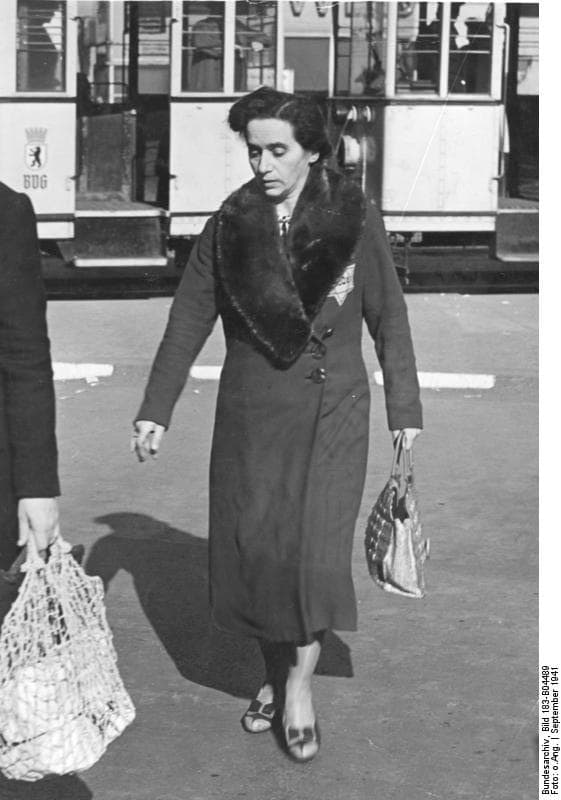
A Jewish woman wearing the yellow star in a Berlin street, September 1941, with a tram behind her
A Jewish woman wearing the yellow star in Berlin, September 1941, the month it became compulsory. Photo: Bundesarchiv, Bild 183-B04489 / CC-BY-SA 3.0

A workshop of forced labourers

Weidt’s workers did not choose him. From 1940 Berlin’s Jews were assigned their jobs by a ‘Deployment Section for Jews’ at the city’s labour office, and blind and deaf Jews were sent to workshops like his as forced labourers. In 1941 he employed about 35 people, and more than 45 are known by name for the years 1940–45. From September 1941 every one of them had to wear the yellow star in public.

Early in 1941 Weidt was also allowed to take on sighted Jewish workers. Three of them, Inge Deutschkron, Alice Licht and Werner Basch, worked in his office, which was strictly forbidden. An alarm system warned them of Gestapo inspections, and they hid in a niche under the stairs. Deutschkron’s memoir Ich trug den gelben Stern (‘I Wore the Yellow Star’, 1978) later made the workshop known far beyond Berlin.

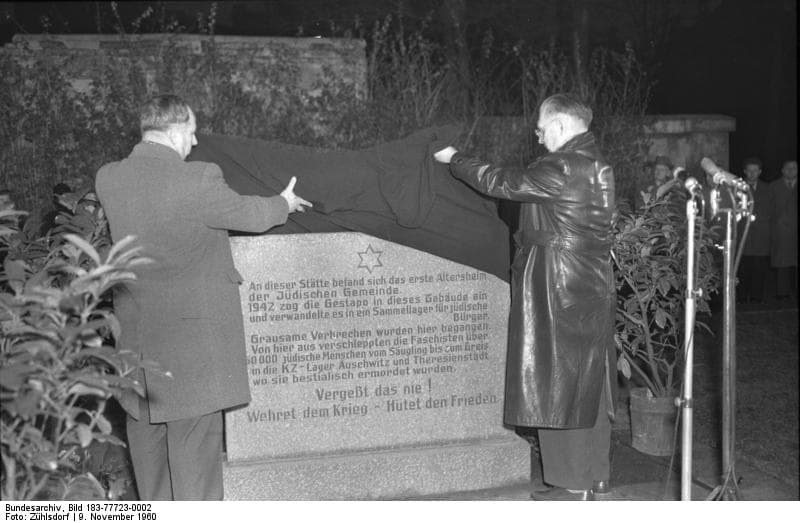
Unveiling of the memorial stone at the former Gestapo assembly camp on Große Hamburger Straße, Berlin, 9 November 1960
The memorial stone at the former assembly camp on Große Hamburger Straße is unveiled, 9 November 1960. Photo: Bundesarchiv, Bild 183-77723-0002 / Zühlsdorf / CC-BY-SA 3.0

Weidt’s circle of helpers

Weidt could not have done it alone. He built several circles of helpers, not all of whom knew about each other. His business partner Gustav Kremmert planned the Horn family’s hiding place. His friend Hedwig Porschütz bought food on the black market and hid four Jewish women in her flat. Theodor Görner, who ran a printing works at Rosenthaler Straße 26, organised forged papers, and Hans Rosenthal of the Jewish Community warned Weidt of the ‘Factory Action’ before it began.

The danger was a few minutes’ walk away. In 1942 the Gestapo turned the Jewish Community’s old people’s home at Große Hamburger Straße 26 into an assembly camp, from which Berlin’s Jews were deported to Theresienstadt and Auschwitz. When some of his workers ended up in Theresienstadt, Weidt and his helpers sent them more than 100 food parcels in 1943 and 1944, many under invented sender names.

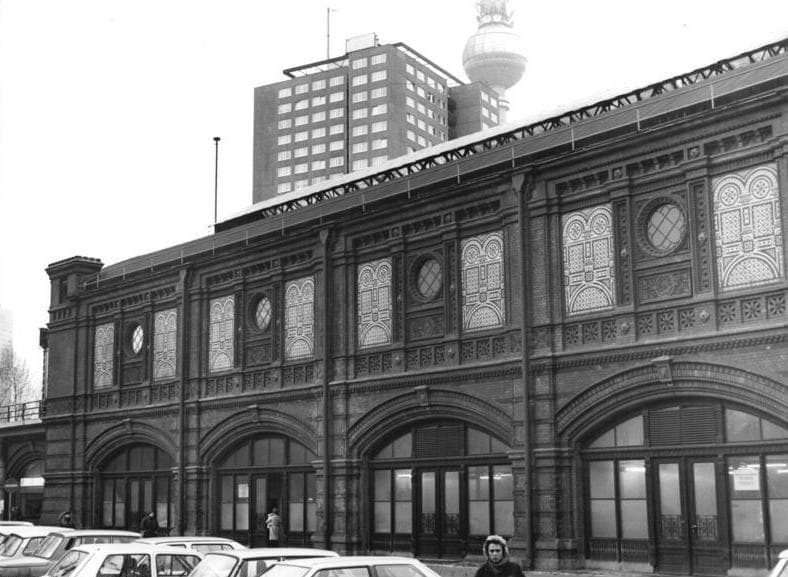
Hackescher Markt S-Bahn station in East Berlin in January 1991, then still named Marx-Engels-Platz, with the TV Tower behind
Hackescher Markt station in January 1991, when it was still called Marx-Engels-Platz. Photo: Bundesarchiv, Bild 183-1991-0129-306 / Grimm, Peer / CC-BY-SA 3.0

Forgotten and found again

Weidt kept the workshop going after the war and helped set up a Jewish children’s and old people’s home in Niederschönhausen before he died in December 1947, aged 64. His widow Else ran the business until the East Berlin authorities closed it in 1952. Alice Licht and Inge Deutschkron asked Yad Vashem to honour him, and in 1971 it recognised him as Righteous Among the Nations. In 1993 Deutschkron had a memorial plaque put up at Rosenthaler Straße 39.

The rooms themselves stayed almost unchanged. In 1999 a group of museum studies students came across them by chance and opened an exhibition, Blind Trust. The site joined the Jewish Museum Berlin in 2001, the German Resistance Memorial Center took it over in 2005, and the present exhibition opened in December 2006. Deutschkron, who did much to found it, was made an honorary citizen of Berlin in 2018 and died in 2022.

Plan your visit

Visiting the Otto Weidt museum

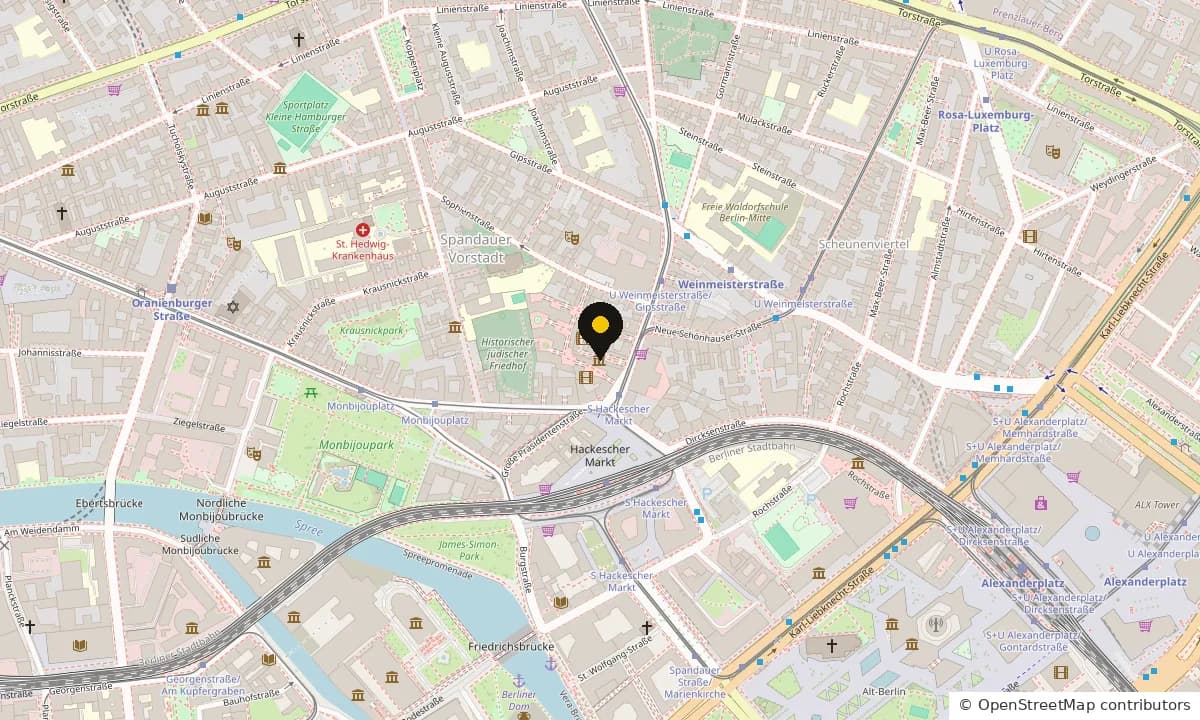
Map of the streets around the Otto Weidt museum, with a pin on the siteOpen in Google Maps

Rosenthaler Straße 39, 10178 Berlin · Monday–Friday 09:00–18:00; Saturday, Sunday and public holidays 10:00–18:00. Closed 24–26 December, 31 December and 1 January.

Getting there

  • S3S5S7S9Hackescher Markt300 m · 4 min

    Cross the square to Rosenthaler Straße and walk north; the passage into Haus Schwarzenberg is beside Café Cinema.

  • Tram M1Tram M4Tram M5Tram M6S Hackescher Markt130 m · 2 min

    The trams stop a few doors down Rosenthaler Straße from the passage.

  • U8Weinmeisterstraße400 m · 5 min

    Walk south down Rosenthaler Straße.

What you’ll see

  • The original rooms of the workshop on the first floor of the side wing, with the worn floorboards, workbenches and brush-binding machines of the 1940s.
  • The windowless back room, once hidden behind a wardrobe, where Chaim, Machla, Max and Ruth Horn hid in 1943 until they were betrayed that October.
  • Life stories of Weidt’s workers and helpers told through letters, photographs and poems, including a section on Inge Deutschkron, with texts in German and English.

Tips from a guide

  • Walk through the passage from Rosenthaler Straße into the Haus Schwarzenberg courtyard, the one covered in street art, not into the Hackesche Höfe next door.
  • The Anne Frank Zentrum is in the same courtyard, and the old Jewish cemetery and the site of the Große Hamburger Straße assembly camp are a few minutes’ walk away.
  • Groups with their own guide must phone the museum at least 30 minutes ahead, and groups of more than 15 can only visit on a free pre-booked tour.

Accessibility

The museum is on the first floor. The stairs are steep, so the museum asks visitors with impaired sight or mobility to use the lift from the courtyard. There is a wheelchair-accessible WC and tactile floor markings for blind and visually impaired visitors, and no parking. The courtyard itself is uneven in places. Check the BVG website for lift status at the stations.

Timeline

From brush workshop to museum

  1. 2 May 1883Otto Weidt is born in Rostock; his family moves to Berlin in 1888.
  2. 1905Weidt edits the newspaper Der Anarchist in Berlin.
  3. 1939Weidt and Gustav Kremmert found the workshop at Großbeerenstraße 92, Kreuzberg.
  4. 1940The workshop moves to the side wing of Rosenthaler Straße 39.
  5. Jan 1943Probably now, Weidt bribes the Gestapo to free his workers from Große Hamburger Straße.
  6. 27 Feb 1943The ‘Factory Action’: some of his workers are deported to Auschwitz.
  7. Oct 1943The Horn family is found in the hidden room; Alice Licht is arrested.
  8. 22 Dec 1947Otto Weidt dies in Berlin, aged 64.
  9. 1952The East Berlin authorities close the workshop.
  10. 1971Yad Vashem recognises Weidt as Righteous Among the Nations.
  11. Mar 1999Students open the exhibition ‘Blind Trust’ in the old rooms.
  12. Dec 2006The present permanent exhibition opens.

See it with a historian

Tours that stop at the Otto Weidt museum

The museum tells Weidt’s story inside his rooms; a guide can take you out into the streets around it, to the assembly camp, the cemetery and the homes his workers were taken from.

One hour in the old Jewish Quarter, a few minutes from Weidt’s workshop.

The Jewish Berlin Tour
One Hour1 Hour

The Jewish Berlin Tour

Private 1-hour walking tour of Berlin's old Jewish Quarter for up to 10 people. Starts at the Postfuhramt on Oranienburger Straße.

€200up to 10
View Tour

A half-day walk through historic Mitte that can take in the Otto Weidt workshop.

The Berlin Explorer Tour
Half Day4 Hours

The Berlin Explorer Tour

Private half-day walking tour of historic Mitte for up to 10 people. Starts at your hotel or anywhere in the centre.

€500up to 10
View Tour

A full day across the city, with time for Jewish Berlin and the workshop.

The Berlin History Tour
Full Day6 Hours

The Berlin History Tour

Private 6-hour van tour of Berlin's whole history in one day for up to 6 people. Starts at your hotel or anywhere in the city.

€1,000up to 6
View Tour

Questions visitors ask

Frequently asked questions

Is the Otto Weidt museum free?

Yes. Entry to the Museum Blindenwerkstatt Otto Weidt is free, and so are its guided tours for pre-booked groups of eight or more.

Where is the Otto Weidt museum?

At Rosenthaler Straße 39 in Berlin-Mitte, in the first courtyard of Haus Schwarzenberg, through the left-hand entrance and up to the first floor. It is next to the Hackesche Höfe, about four minutes’ walk from S Hackescher Markt.

Is the Otto Weidt museum in the Hackesche Höfe?

No, though it is often described that way. It is in the neighbouring courtyard of Haus Schwarzenberg at number 39; the Hackesche Höfe are at number 40.

What are the opening hours?

Monday to Friday 09:00–18:00, and Saturday, Sunday and public holidays 10:00–18:00. It is closed on 24–26 December, 31 December and 1 January.

How long do you need for the Otto Weidt museum?

Most people spend 45 minutes to an hour. It is a handful of rooms, but the life stories, documents and the hiding place deserve time.

Who was Otto Weidt?

A Berlin brush maker and former anarchist, nearly blind himself, who ran a workshop for blind and deaf Jewish workers from 1939. He bribed the Gestapo, forged papers and found hiding places to protect them, and in 1971 Yad Vashem recognised him as Righteous Among the Nations.

Can you see the hiding place?

Yes. The windowless room at the back of the workshop, once hidden behind a wardrobe, is part of the museum. The Horn family hid there in 1943 until they were betrayed in October; they were murdered in Auschwitz.

Is the museum wheelchair accessible?

Yes. A lift runs from the courtyard to the exhibition, which the museum recommends over its steep stairs, and there is a wheelchair-accessible WC and tactile floor markings.

Sources

Facts checked 4 November 2026. Spotted something out of date? Tell us.

Keep exploring

More Featured Experiences.

Every site we write about — 56 landmarks, museums, memorials and lesser-known corners of Berlin. See the full index →

01Walk Through The Brandenburg Gate02Explore The State Museums On Museum Island03Visit The Berlin TV Tower – The Fernsehturm04Cross The Cold War Border At Checkpoint Charlie05Visit The Site Of Adolf Hitler’s Führerbunker06Explore The Reconstructed Berlin Palace07Visit The Reichstag Cupola At Night08Explore The Forum Fridericianum09Shop At The Humboldt University Book Sale10Journey Into The Memorial To The Murdered Jews Of Europe11Step Inside The Neue Wache12Explore The Former Jewish Quarter – Spandauer Vorstadt13Visit The Remains Of The Berlin Wall14Walk Across The Bridge Of Spies15Explore The Topography Of Terror16Climb The Prussian Victory Column – The Siegessäule17Enter The Palace Of Tears – The Tränenpalast18Step Inside The Berlin Olympic Stadium19Explore Erich Mielke’s Office At The Stasi Museum20Walk Along Karl Marx Allee21Visit The Oldest Church In Berlin – The Nikolaikirche22Explore The Berliner Dom23Visit The Grave Of Frederick The Great24Walk Through The Ruins Of Anhalter Bahnhof25Stand On The Platz Des Volksaufstandes26Visit The German Resistance Museum27Visit The Soviet War Memorial In The Tiergarten28See The Georg Elser Memorial On Wilhelmstrasse29Step Inside The Kaiser Wilhelm Gedächtnis Kirche30Visit The Gleis 17 Memorial31Visit The Schloss Charlottenburg Mausoleum32Climb The Französischer Dom at Gendarmenmarkt33Explore The Interbau – IBA 5735Visit Cecilienhof – Site Of The Potsdam Conference36Visit The Stasi Prison In Hohenschönhausen37Spend The Day At Tempelhof Airport38Ride The Fastest Elevator In Europe39Visit The Soviet War Memorial In Treptower Park40Visit The Sachsenhausen Concentration Camp Memorial41Visit The Ravensbrück Concentration Camp Memorial42Visit Karlshorst – The Site Of The German Surrender43Visit The Socialists Cemetery – Zentralfriedhof Friedrichsfelde44Visit The Soviet War Memorial In Pankow45Visit the Seelow Heights Memorial46Visit The Commonwealth War Cemetery47Cross The Bösebrücke At Night48Explore The Allied Museum In Dahlem49Explore The Spandau Citadel50Visit The Brandenburg T4 Euthanasia Memorial51Visit The Wannsee Conference House52Visit The Jewish Museum53Visit The Jewish Cemetery In Weissensee54Walk Along The East Side Gallery55Explore The Volkspark Friedrichshain Flak Tower56Head Up The Teufelsberg