Skip to content
Inside the Memorial to the Murdered Jews of Europe in Berlin: a narrow path between tall grey concrete stelae

Berlin Experiences/Featured Experiences

Holocaust Memorial Berlin: Visit the Memorial to the Murdered Jews of Europe

Berlin’s austere memorial for the Jewish victims of National Socialism.

The short answer

The Memorial to the Murdered Jews of Europe, usually called the Holocaust Memorial, is Germany’s central memorial to the up to six million Jews murdered in the Holocaust. It stands at Cora-Berliner-Straße 1 in Berlin-Mitte, one block south of the Brandenburg Gate: a field of 2,711 concrete stelae by the architect Peter Eisenman, opened in May 2005, with an underground Information Centre at its eastern edge. The field is free and open at all hours, from every side. The Information Centre is also free and opens Tuesday to Sunday, 10:00–18:00. Allow 20–30 minutes for the field and about an hour for the exhibition.

Where
Cora-Berliner-Straße 1, 10117 Berlin-Mitte
Open
Field: always. Information Centre: Tue–Sun 10:00–18:00
Admission
Free (audio guide €3)
Time needed
20–30 minutes; 1 hour more for the Information Centre
Nearest station
S+U Brandenburger Tor, 5 minutes on foot
Step-free
Yes: 13 marked step-free paths; lift to the Information Centre with staff help

The story · by Matt Robinson

Berlin’s Memorial to the Murdered Jews of Europe is unlike anything else in the city. Unique in its intention and in its composition. Both strangely familiar in its design, yet completely alien.

An austere commemorative installation in the centre of the German capital for the millions of Jews who fell victim to one of the most murderous regimes of the 20th century. An event solidified in collective memory and summarised in one term – the Holocaust – or Shoah, as it is known in Hebrew. A genocide most remarkable for reaching a callous industrial meridian – planned, and eventually executed, with a bureaucratic efficiency never before witnessed in human history.

This strange and provocative interruption to the city landscape, a field of 2,711 concrete stelae, was introduced in 2005 – and designed by architect, Peter Eisenman (whose team was also shortlisted in 2002 to replan the World Trade Center site in New York City). Like the genocide whose victims it stands to pay tribute to, this place of remembrance bears all the hallmarks of an industrial process – grey, uniform, and regulated in its order.

Between past and present

Situated only a short walk from the Brandenburg Gate and Germany’s federal parliament, the memorial is also walking distance from the former Nazi government quarter and the site of Adolf Hitler’s Führerbunker. The location of the Nazi SS-GeStaPo headquarters, where the Holocaust would be planned from, is also located similarly nearby. Leaving this place of remembrance sandwiched in-between the darkest chapter in Germany’s past, to the south, and its introspective and repentant present, to the north.

View of the Reichstag dome and the Brandenburg Gate from the Memorial to the Murdered Jews of Europe in Berlin
The Reichstag dome and the Brandenburg Gate, seen from the stelae.

To approach this memorial from the streets that surround it is to be confronted with an unadorned mass of monumental grey – a panoramic presentation of the abstract. As what is most evident, on closer inspection of the memorial, is what is clearly missing. Nowhere is there a justification of its design, it is completely lacking in any immediate indication that it serves as a memorial – or even a memorial specifically for the Jewish victims of National Socialism. There are no names on the concrete blocks.

All that is present to explain the existence of this plot of land is a small plaque – visible on all corners of the memorial – listing its title and indicating what is also prohibited. No smoking, no eating amongst the blocks, and no climbing on top of them – or jumping from stele to stele.

Into the field

As there is no clear entrance point or fencing to cordon off the memorial, it remains accessible from all directions. And also open at night. The blocks vary in height, and also in angle, across the landscape. When examined from different viewpoints the memorial offers a subtly different perspective. Perhaps also allowing the visitor to then reach different conclusions from different viewpoints as to the meaning of the memorial.

Rows of low concrete stelae at Berlin’s Holocaust Memorial, with apartment blocks beyond the field
At the edges the stelae are barely knee-high.

Most significant though is the way that the pathways between the blocks allow visitors to descend into the memorial – only to be enveloped by the grey sentries of the blocks that suddenly surround and overwhelm the bodies weaving through them. The contrast between the blocks and the humans who descend into this bleak forest could not be more obvious – the warmth of bodies in contrast to the cold concrete most evident in the winter months when the memorial is often also covered in snow or swept through with an icy wind.

The journey into the centre of the memorial – its deepest point – is a story, a narrative, waiting to be discovered.

The journey into the centre of the memorial – its deepest point – is a story, a narrative, waiting to be discovered. With the singular interactions between the individuals exploring this memorial and undulating terrain as significant as to its meaning and purpose as the collective entirety of the project. Whichever approach is taken, the memorial must be experienced and interacted with, then contemplated when the visitor returns to the periphery. Perhaps even returning to the exact same location they left to enter the memorial but experiencing it in a different way at the end of a journey that took them into the dark heart of the memorial.

A living memorial

Although at first glance the memorial appears to be dead – simply a collection of clearly defined inanimate objects – it is in fact a living breathing phenomenon. That interacts with nature and humanity – and has to deal with the interaction of nature and humanity.

Perhaps its greatest strength is – despite initial impressions – its actual lack of uniformity. An understated critique of the National Socialist Weltanschauung that would lead to the Holocaust. While from a distance the blocks may appear identical, move closer and it is obvious that some have been weathered in different ways to others. That some have cracked or have visible holes due to the wind, rain, and snow.

A crack in a concrete stele at the Memorial to the Murdered Jews of Europe, with a US flag flying beyond
A weathered, cracked stele; the flag flies over the US Embassy next door.

That even trying to make something as simple as concrete homogeneous is an impossible task. And even more impossible to force humanity into a similar box. Any premeditated attempt to do so will inevitably lead to that box multiplied and materialising not as an unremarkable box but as a field of coffins.
The Holocaust Memorial in detail

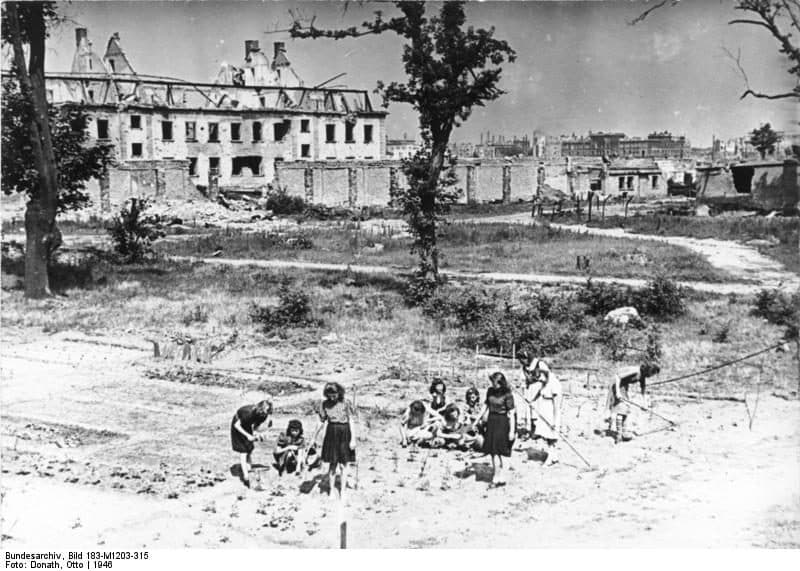
Young women planting vegetables on the former Ministergärten in Berlin in 1946, with ruined government buildings behind
The former Ministergärten between Voßstraße and the Brandenburg Gate, planted by a gardening school in 1946. Photo: Bundesarchiv, Bild 183-M1203-315 / Donath, Otto / CC-BY-SA 3.0

Why here? The site before the memorial

The memorial stands on part of the old Ministergärten, the gardens behind the government palaces on Wilhelmstraße. In the Nazi years Joseph Goebbels had his official villa here, and the Reich Chancellery and Hitler’s bunker lay just to the south. After 1945 the gardens were a wasteland among ruins; in 1946 a school for women gardeners was given part of the ground to grow food on.

From 1961 the land lay in the border strip of the Berlin Wall, between the Brandenburg Gate and Potsdamer Platz. When the Wall fell it was empty again. The citizens’ initiative led by the journalist Lea Rosh and the historian Eberhard Jäckel, which in 1988–89 had called for a memorial on the former Gestapo grounds in Kreuzberg, proposed this site instead in 1990, and in 1992 Helmut Kohl’s government agreed to provide part of it.

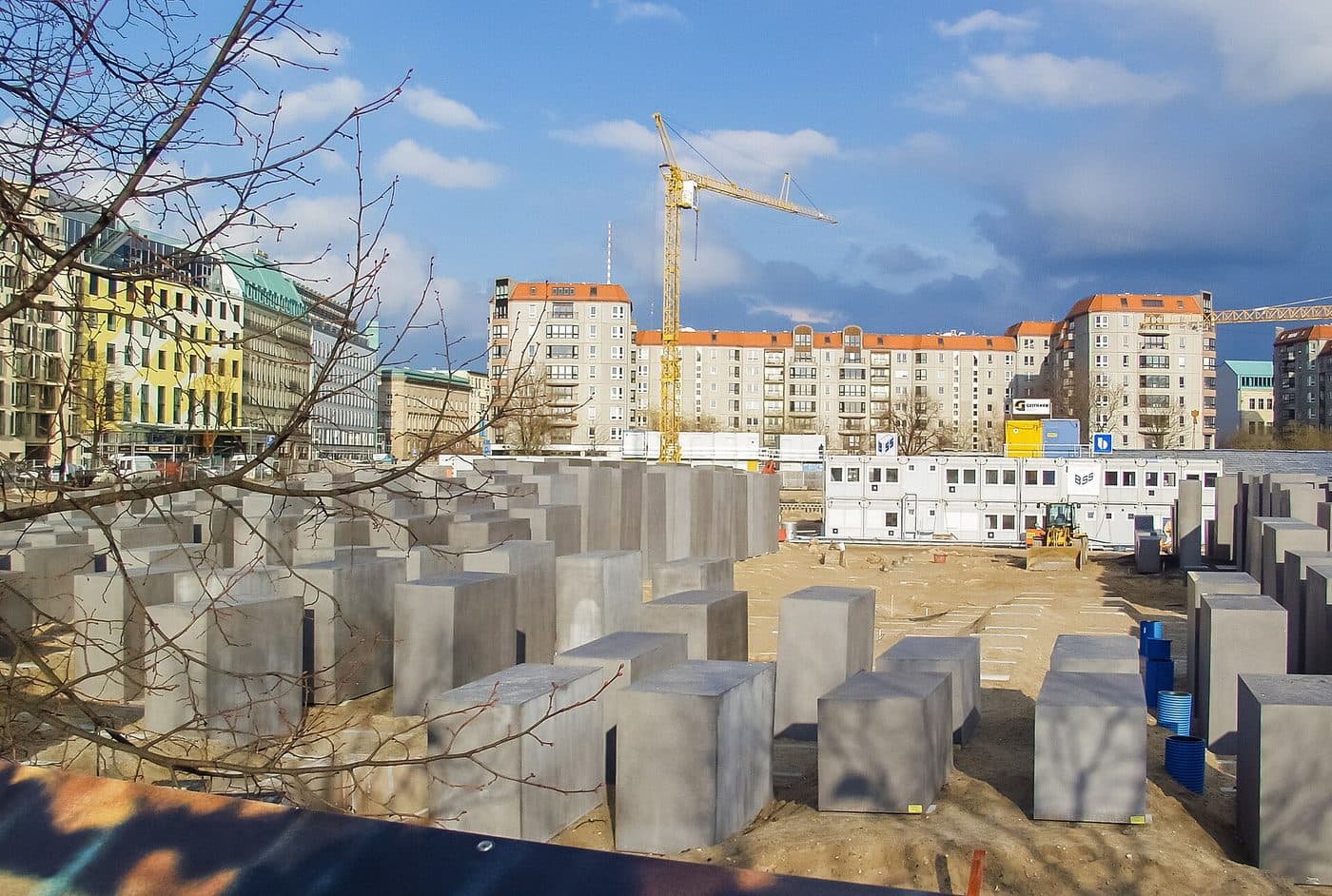
The Memorial to the Murdered Jews of Europe under construction in March 2004, with stelae, site huts and a crane
The field under construction, March 2004. Photo: Raimond Spekking / CC BY-SA 4.0, via Wikimedia Commons

Seventeen years of argument

A first competition in 1995 drew 528 entries, but Chancellor Kohl rejected the jury’s choice, a vast tilted slab engraved with victims’ names. A second, invited competition in 1997 produced the design by Peter Eisenman and the sculptor Richard Serra: thousands of concrete pillars on an undulating field. Serra withdrew in 1998, Eisenman reworked it, and on 25 June 1999 the Bundestag voted by 314 to 209 to build his Field of Stelae, adding an underground Information Centre so that the victims would also be named and their stories told.

Building began in April 2003 and was halted that October, when it emerged that the anti-graffiti coating on the stelae came from Degussa, whose former subsidiary Degesch had supplied Zyklon B for the gas chambers. After weeks of argument the board decided in November to carry on with Degussa’s product, partly because many stelae were already coated. The last stele was set on 15 December 2004, and the memorial was inaugurated on 10 May 2005.

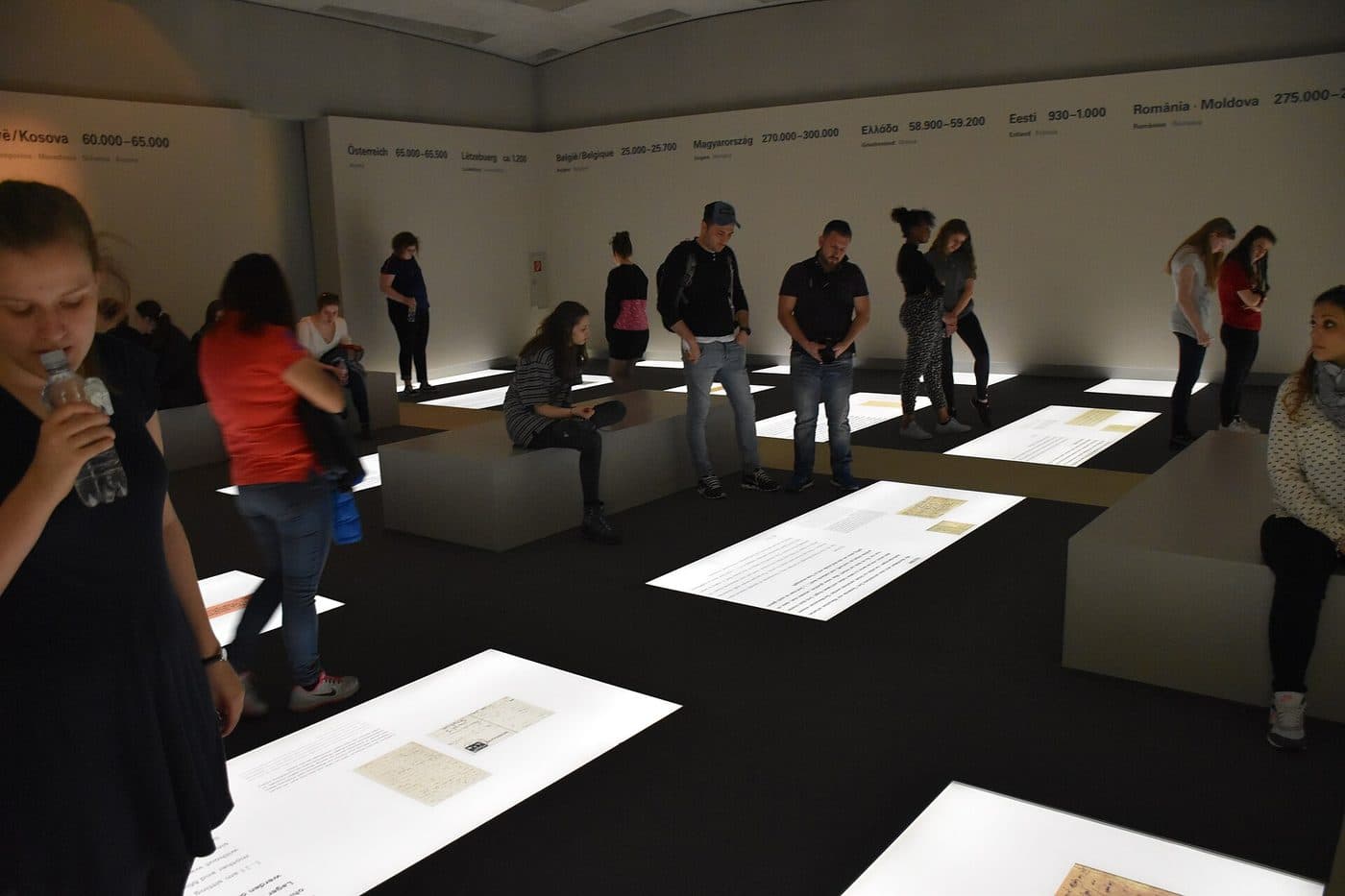
Visitors reading letters lit from the floor in the Room of Dimensions, Information Centre of the Holocaust Memorial, Berlin
The Room of Dimensions, with victims’ letters lit from beneath the floor. Photo: Vasyatka1 / CC BY-SA 4.0, via Wikimedia Commons

Under the stelae: the Information Centre

The Information Centre (Ort der Information) lies under the eastern edge of the field, its coffered concrete ceilings repeating the grid of stelae above. After a timeline of the persecution from 1933, four rooms turn the numbers into people. The Room of Dimensions shows letters and diary entries written by Jews in the ghettos and camps, lit from beneath the floor, with the number of victims from each country around the walls. The Room of Families follows 15 Jewish families. In the Room of Names, the names and short life stories of murdered Jews, drawn from Yad Vashem’s records, are read aloud, one after another. The Room of Sites maps places of persecution and murder across Europe.

Entry is free, through a security check. Allow about an hour, or 90 minutes with the €3 audio guide. On the first Sunday of every month there is a free public tour in English at 14:00.

Plan your visit

Visiting the Holocaust Memorial

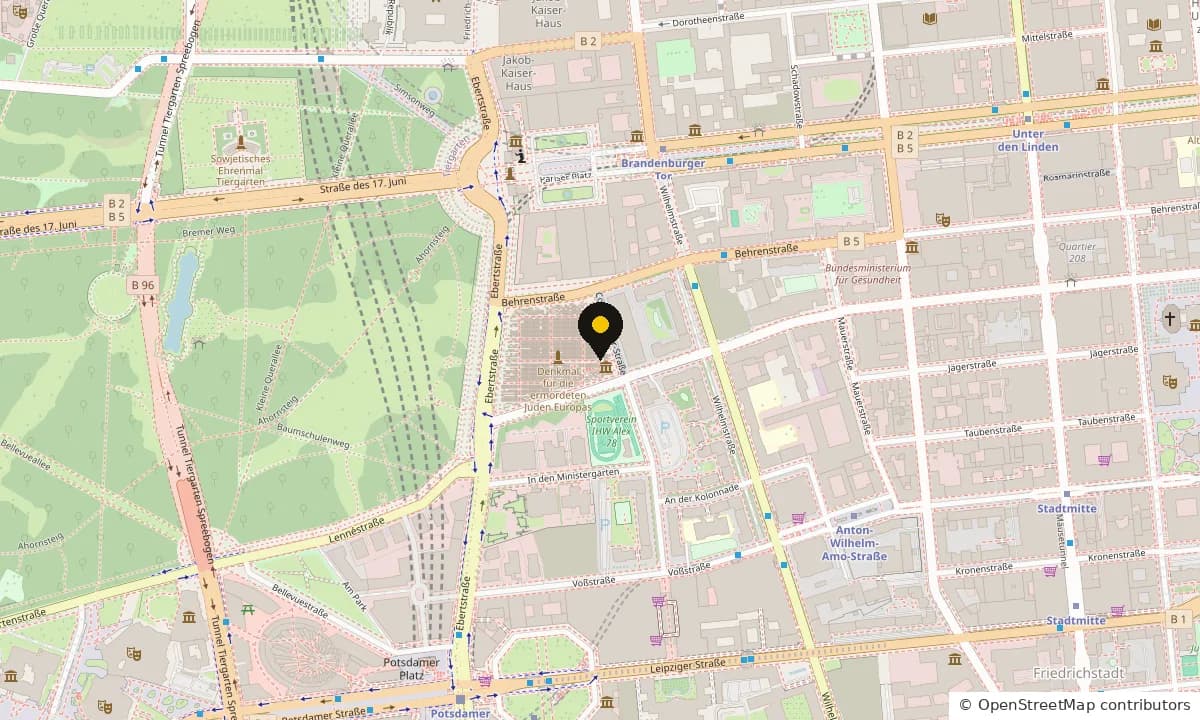
Map of the streets around the Holocaust Memorial, with a pin on the siteOpen in Google Maps

Cora-Berliner-Straße 1, 10117 Berlin · Field of Stelae: open 24 hours, every day. Information Centre: Tuesday–Sunday 10:00–18:00, last entry 17:15; closed on Mondays (except some public holidays), 24–26 December and from 16:00 on 31 December; opens at 12:00 on 1 January.

Getting there

  • S1S2S25S26U5Brandenburger Tor400 m · 5 min

    Walk south down Ebertstraße; the stelae begin at the corner of Behrenstraße.

  • U2Anton-Wilhelm-Amo-Straße500 m · 7 min

    Called Mohrenstraße until 2025, so older guides and maps still use that name.

  • S1S2S25S26U2Potsdamer Platz700 m · 10 min

    Walk north up Ebertstraße along the edge of the Tiergarten.

What you’ll see

  • The Field of Stelae: 2,711 grey concrete blocks in a grid on about 1.9 hectares, each 2.38 metres long and 0.95 metres wide, rising from ankle height at the edges to well over head height where the ground sinks towards the middle.
  • The underground Information Centre at the field’s eastern edge: a timeline of the persecution and murder of Europe’s Jews, then the Rooms of Dimensions, Families, Names and Sites.
  • The neighbours: the US Embassy along the northern edge, the Tiergarten and the Memorial to Homosexuals Persecuted under Nazism across Ebertstraße, and the site of Hitler’s bunker a block to the south.

Tips from a guide

  • The field never closes. It is at its quietest early in the morning and after dark, when the paths between the tall stelae feel very different from a busy summer afternoon.
  • For the Information Centre, travel light: there is a security check, a free cloakroom, and nothing larger than hand luggage (about 55 × 40 × 20 cm) is allowed. Booked groups go first, so expect a queue at busy times.
  • Please don’t climb on the stelae, jump between them, eat or smoke in the field; the house rules forbid it. The paths are narrow and cross blindly, so keep children from running.

Accessibility

The field can be crossed by wheelchair: 13 marked entry paths have a slope of no more than 8%, the paths are at least 93 cm wide and there are no steps, though the paving is uneven and some inner slopes are steeper. The Information Centre is reached by 37 steps or by a lift that staff operate, so ask at the stair entrance; inside, everything is on one level and wheelchairs can be borrowed at reception. There is no on-site parking. Check the BVG website for lift status at the stations.

Timeline

From a citizens’ appeal to a field of stelae

  1. Aug 1988Journalist Lea Rosh proposes the memorial at a panel discussion.
  2. Jan 1989Rosh and historian Eberhard Jäckel publish the first public appeal.
  3. Apr 1992Kohl’s government agrees to give part of the former Ministergärten.
  4. 1995First competition: 528 entries; Kohl rejects the jury’s choice.
  5. Nov 1997A second competition shortlists Peter Eisenman and Richard Serra’s field of pillars.
  6. 25 Jun 1999The Bundestag votes for Eisenman’s Field of Stelae and an Information Centre.
  7. Apr 2003Construction begins on the site.
  8. Oct–Nov 2003Work stops over the Degussa anti-graffiti coating, then resumes.
  9. 15 Dec 2004The last of the 2,711 stelae is set in place.
  10. 10 May 2005The memorial is inaugurated; it opens to the public two days later.
  11. 2007Hairline cracks are found in some 400 stelae; repairs follow.
  12. Jan–Apr 2026The Information Centre is closed for renovation from 12 January to 30 April.

See it with a historian

Tours that stop at the Holocaust Memorial

The field explains nothing on purpose; a guide can tell you how it came to be here, what stood on the ground before, and how it fits with the perpetrators’ sites a few minutes away.

One hour in the Nazi government district, from the Holocaust Memorial to the Topography of Terror.

The Third Reich Tour
One Hour1 Hour

The Third Reich Tour

Private 1-hour walking tour of the Nazi government district for up to 10 people. Starts at Pariser Platz by the Brandenburg Gate.

€200up to 10
View Tour

The rise and fall of the Third Reich, and how Berlin remembers its victims.

The Capital Of Tyranny Tour - Berlin Experiences
Full Day6 Hours

The Capital Of Tyranny

Private 6-hour van tour of Hitler's Berlin and the Third Reich for up to 6 people. Starts at your hotel or anywhere in the city.

€1,000up to 6
View Tour

The memorial after dark, when the field is at its most unsettling.

The Berlin At Night Tour
Half Day3 Hours

The Berlin At Night Tour

Private 3-hour evening walking tour of Berlin's lit-up historic centre for up to 10 people. Starts at Pariser Platz, Brandenburg Gate.

€450up to 10
View Tour

Questions visitors ask

Frequently asked questions

Is the Holocaust Memorial in Berlin free?

Yes. Both the Field of Stelae and the Information Centre underneath it are free, and there is nothing to book for individual visitors. Donations are welcome, and the audio guide for the exhibition costs €3.

What are the Holocaust Memorial’s opening hours?

The Field of Stelae is open 24 hours a day, every day of the year. The Information Centre is open Tuesday to Sunday, 10:00–18:00, with last entry 45 minutes before closing; it is closed on Mondays except some public holidays.

What does the Holocaust Memorial mean?

Peter Eisenman deliberately gave it no single meaning and said the number and form of the stelae are not symbolic. The field is meant to be walked through: the ground sinks, the blocks rise and the city disappears. Many visitors read it as a cemetery or a field of coffins, which is how Matt’s article above ends.

Why are there 2,711 stelae?

The number has no symbolic meaning. Early versions of the design had about 4,000 pillars; 2,711 is simply how many fitted the final site and grid.

Are there names on the memorial?

Not on the stelae, which carry no inscription. Names and life stories of murdered Jews, from the records of Yad Vashem in Jerusalem, are read aloud in the Room of Names in the Information Centre.

Where is the entrance?

The field has no single entrance: you can walk in from any side, at any time. The stairs and lift down to the Information Centre are on the eastern side of the field, near Cora-Berliner-Straße.

Can you climb or sit on the stelae?

Climbing on the stelae and jumping from block to block are forbidden, as are eating and smoking in the field. Treat it as what it is: a memorial to murdered people.

How long do you need at the Holocaust Memorial?

20–30 minutes to walk through the field. The foundation recommends about an hour for the Information Centre, or 90 minutes with the audio guide, plus any wait at the security check.

Keep exploring

More Featured Experiences.

Every site we write about — 56 landmarks, museums, memorials and lesser-known corners of Berlin. See the full index →

01Walk Through The Brandenburg Gate02Explore The State Museums On Museum Island03Visit The Berlin TV Tower – The Fernsehturm04Cross The Cold War Border At Checkpoint Charlie05Visit The Site Of Adolf Hitler’s Führerbunker06Explore The Reconstructed Berlin Palace07Visit The Reichstag Cupola At Night08Explore The Forum Fridericianum09Shop At The Humboldt University Book Sale11Step Inside The Neue Wache12Explore The Former Jewish Quarter – Spandauer Vorstadt13Visit The Remains Of The Berlin Wall14Walk Across The Bridge Of Spies15Explore The Topography Of Terror16Climb The Prussian Victory Column – The Siegessäule17Enter The Palace Of Tears – The Tränenpalast18Step Inside The Berlin Olympic Stadium19Explore Erich Mielke’s Office At The Stasi Museum20Walk Along Karl Marx Allee21Visit The Oldest Church In Berlin – The Nikolaikirche22Explore The Berliner Dom23Visit The Grave Of Frederick The Great24Walk Through The Ruins Of Anhalter Bahnhof25Stand On The Platz Des Volksaufstandes26Visit The German Resistance Museum27Visit The Soviet War Memorial In The Tiergarten28See The Georg Elser Memorial On Wilhelmstrasse29Step Inside The Kaiser Wilhelm Gedächtnis Kirche30Visit The Gleis 17 Memorial31Visit The Schloss Charlottenburg Mausoleum32Climb The Französischer Dom at Gendarmenmarkt33Explore The Interbau – IBA 5734Explore The Otto Weidt Workshop35Visit Cecilienhof – Site Of The Potsdam Conference36Visit The Stasi Prison In Hohenschönhausen37Spend The Day At Tempelhof Airport38Ride The Fastest Elevator In Europe39Visit The Soviet War Memorial In Treptower Park40Visit The Sachsenhausen Concentration Camp Memorial41Visit The Ravensbrück Concentration Camp Memorial42Visit Karlshorst – The Site Of The German Surrender43Visit The Socialists Cemetery – Zentralfriedhof Friedrichsfelde44Visit The Soviet War Memorial In Pankow45Visit the Seelow Heights Memorial46Visit The Commonwealth War Cemetery47Cross The Bösebrücke At Night48Explore The Allied Museum In Dahlem49Explore The Spandau Citadel50Visit The Brandenburg T4 Euthanasia Memorial51Visit The Wannsee Conference House52Visit The Jewish Museum53Visit The Jewish Cemetery In Weissensee54Walk Along The East Side Gallery55Explore The Volkspark Friedrichshain Flak Tower56Head Up The Teufelsberg