Skip to content
The Tränenpalast (Palace of Tears) in Berlin: the blue glass-fronted former border hall at Friedrichstraße station, with its ‘Ort der deutschen Teilung’ sign

Berlin Experiences/Featured Experiences

Palace of Tears Berlin: Visit the Tränenpalast at Friedrichstraße

The former East German border crossing at Friedrichstrasse station.

The short answer

The Tränenpalast, or Palace of Tears, is the former departure hall of the East German border crossing at Friedrichstraße station, where East Germans said goodbye to visitors returning to the West. It stands at Reichstagufer 17 in Berlin-Mitte, right beside S+U Friedrichstraße. Since 2011 it has been a museum of German division, run by the Haus der Geschichte foundation, with the original passport booths still in place. Admission is free, it is open Tuesday to Sunday (closed Mondays), and 45 minutes to an hour is enough.

Where
Reichstagufer 17, 10117 Berlin-Mitte, beside Friedrichstraße station
Open
Tue–Fri 09:00–18:00, Sat–Sun 10:00–18:00; closed Mondays
Admission
Free
Time needed
45–60 minutes
Nearest station
S+U Friedrichstraße, 2–3 minutes on foot
Step-free
Yes: one level, step-free entrance at the back

The story · by Matt Robinson

As one of Berlin’s most important train stations, situated on the city’s historic central line, the Stadtbahn, Bahnhof Friedrichstraße played a unique role during Berlin’s Cold War division – a crossing point utilised by travellers arriving from the West and departing from the East; anyone eager, and able, to hop the border following the construction of the Berlin Wall.

Although this particular crossing point possessed one novel characteristic – that it was located entirely deep in the Eastern sector of the city – unlike, say, Checkpoint Charlie, the US military crossing at the border between the Western district of Kreuzberg and Eastern district of Mitte. Instead of immediately arriving into the East of the city, when crossing from the West, it was possible to disembark directly into the heart of the German Democratic Republic at Friedrichstrasse.

Returning back to the West would prove harder than arriving in the East – courtesy of the paranoid approach of the GDR regime, eager to put an end to the flood of refugees who had, up until 1961, made their way to the British-French-American sectors of the city to permanently resettle.

To embark on that westward journey it would be necessary to pass through a passport control checkpoint – and face the scrupulous customs officers – before being allowed to continue.

The glass and steel Tränenpalast beside the brick and glass train shed of Friedrichstraße station in Berlin
The hall stands right against Friedrichstraße station.

The departure hall

This former departure terminal – for people leaving the East to head to West Berlin – now serves as a museum and historically protected monument, with preserved artefacts and personal histories on display, reflecting its time as the final impression many would have when saying goodbye to the East.

Its contemporary colloquial name, reflective of the painful separation of the country for more than 40 years and the painful parting of relatives and loved ones here at the border – the Palace of Tears (Tränenpalast).

Entering this glass and steel building, adjacent to Bahnhof Friedrichstraße, now, it is possible to retrace the steps of anyone who would have exited the German Democratic Republic through this structure from its construction in 1962 to the ‘Fall of the Wall’ in 1989.

Accessing the S-Bahn line at Friedrichstrasse heading towards Bahnhof Zoo, but additionally the U-Bahn line that would shuttle travellers to West Berlin via the northern district of Wedding and southern district of Kreuzberg, meant it was necessary to pass through this building and comply with the customary inspection and luggage checks from the guards.

In its present form, the museum here still contains the original passport control boxes – meaning that it is possible to recreate the border crossing experience, through these narrow corridors; albeit without the prying eyes of the representatives of the East German surveillance state.

Original passport control booth in the Tränenpalast, Berlin, with signs for citizens of West Berlin, West Germany and other states
An original passport booth, with the signs for each kind of traveller.

Separate checkpoints here were previously established for West Berliners, West Germans, foreigners, diplomats, transit travellers and East Germans – but, now only one of the passport control boxes remains symbolically open.

The Stasi at the border

For visitors from West Berlin, returning to the West through this building also provided the opportunity to come into contact with members of the much feared East German secret police (the Stasi) – although few would have known how close they were.

Members of the Pass and Control Units (Paß- und Kontrolleinheiten) who processed travellers passing through the GDR’s Grenzübergangsstellen (border crossing points) would appear in Border Troops (Grenztruppen) uniforms – although they were, in fact, members of the 6th Main Department (Hauptabteilung VI) of the Stasi.

East German border guard’s peaked cap on display at the Tränenpalast museum in Berlin
A border guard’s cap: the Stasi’s passport officers wore this uniform.

Following the construction of the Berlin Wall in 1961, the East German secret police (officially known as the Ministry for State Security) was rapidly expanded – to deal with the threats, perceived and real, to the East German system. Rather than swearing allegiance to defend the people of the country and their immediate interests, the Stasi was tasked as the ‘Shield and Sword’ of the ruling Socialist Unity Party – ensuring the realisation of its Marxist-Leninist platform.

This meant closely guarding the country’s borders, to deter smugglers from undermining the economy, prevention of ‘improper’ use of transit routes, but also the “securing” of the border crossings, and thwarting escape attempts.

Identifying individuals by their facial features and detecting any disguises that escapees may try to employ during their attempts would also fall under the remit of these border police.

After the Wall

Like many buildings in Berlin in the 1990s, this former border crossing control point was transformed into a nightclub and performance venue. It had actually been listed as a historical protected building by the East German government on October 2nd 1990 – one day before German reunification – although it took another 18 years to become a Federally listed memorial site.

In 2011, the Tränenpalast was transformed into a museum, overseen by the Haus der Geschichte – the Museum of Contemporary History – in Bonn.

Entrance to the museum is entirely free and it is still possible to leave to the West from here, although it is now necessary to walk out the entrance and around to the train station – which is no longer connected – avoiding the need to show your documents.

Visitors to East Berlin can now freely cross a border that once looked impenetrable and maintained with the constant threat of the use of deadly force.
The Tränenpalast in detail

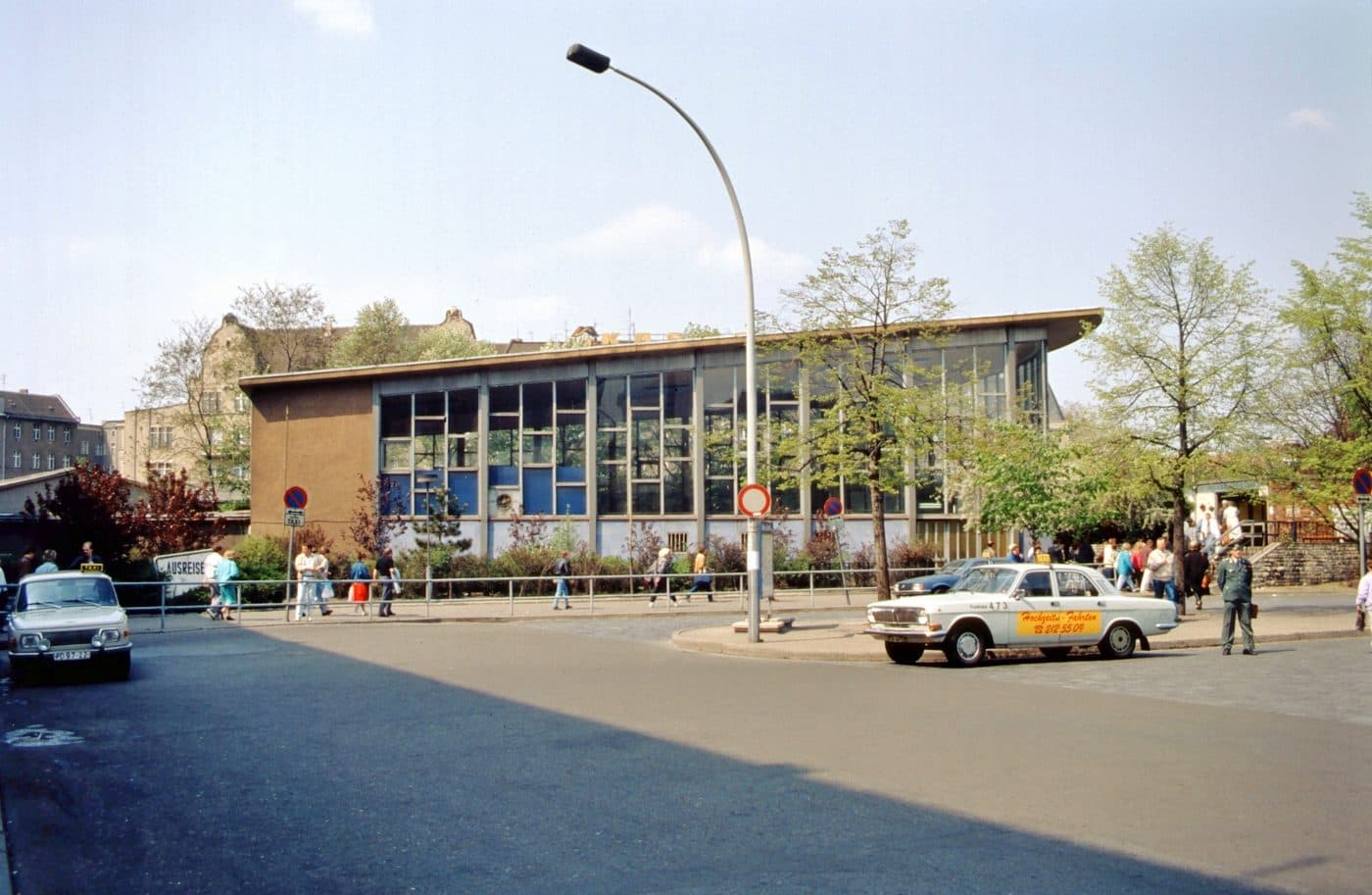
The Tränenpalast border departure hall at Friedrichstraße station in April 1990, with an ‘Ausreise’ (exit) sign and an East German taxi outside
The departure hall in April 1990, still in use: the sign on the left reads ‘Ausreise’ (exit). Photo: Lothar Weber / CC BY-SA 4.0, via Wikimedia Commons

How the departure hall worked

The Tränenpalast opened in 1962, about a year after the Wall went up, because the cramped lower levels of Friedrichstraße station could not cope with the traffic heading west. The Deutsche Reichsbahn built it to a design by the architect Horst Lüderitz, with Günter Matzko as engineer. Its self-supporting steel-and-glass frame was meant to match modern international architecture, and to make a border installation look like an ordinary station hall.

It handled departures only: travellers arriving from the West were checked inside the station itself. Leaving, you queued outside and showed your passport and visa to two Volkspolizei officers at the door. Then came customs, where bags were searched and any East German money had to be paid into a special account. At the back of the hall stood about ten passport booths, lit up for citizens of West Berlin, West Germany, the GDR and other states. Once your papers were cleared, a door buzzed open onto the part of the station reserved for trains to the West.

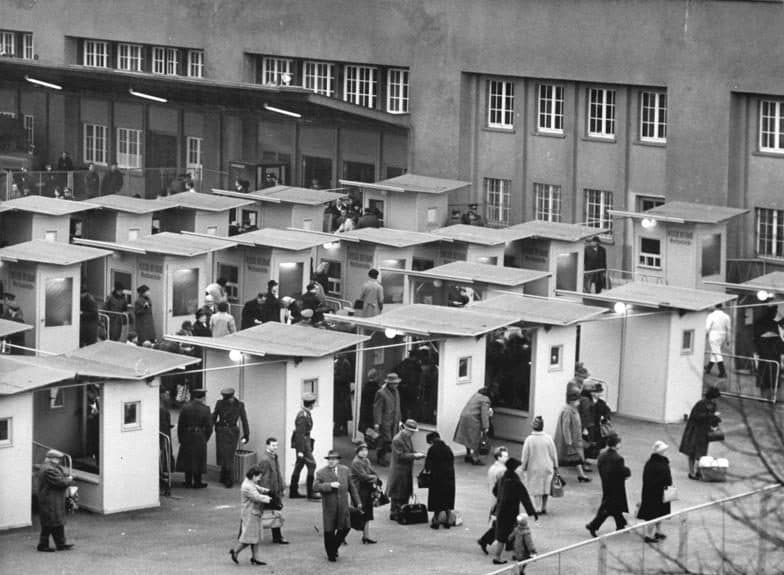
Temporary border control booths for West Berlin visitors at Friedrichstraße station in East Berlin, October 1964
Control booths for West Berliners visiting under the pass agreement, Friedrichstraße, October 1964. Photo: Bundesarchiv, Bild 183-C1031-0044-009 / Spremberg, Hans-Joachim / CC-BY-SA 3.0

Who could cross, and when

For most East Germans the hall was a place to say goodbye, not a way out. At first they could follow their visitors inside, but that was soon stopped and the farewells moved outside. From December 1963 pass agreements let West Berliners visit relatives in the East over the holidays, and from November 1964 East German pensioners were allowed to visit the West. After the treaties of 1972 visits became routine and the nickname almost faded, until later waves of East Germans were released from citizenship and left, most of them barred from coming back.

The darkest day came on 29 March 1974. Czesław Kukuczka, a Polish man who had tried to force his way to the West by threatening to blow up the Polish embassy, was handed what looked like exit papers and taken to the crossing, then shot in the back by a Stasi officer just short of the last checkpoint. He died soon afterwards. In October 2024 a Berlin court sentenced the former officer, then 80, to ten years for murder.

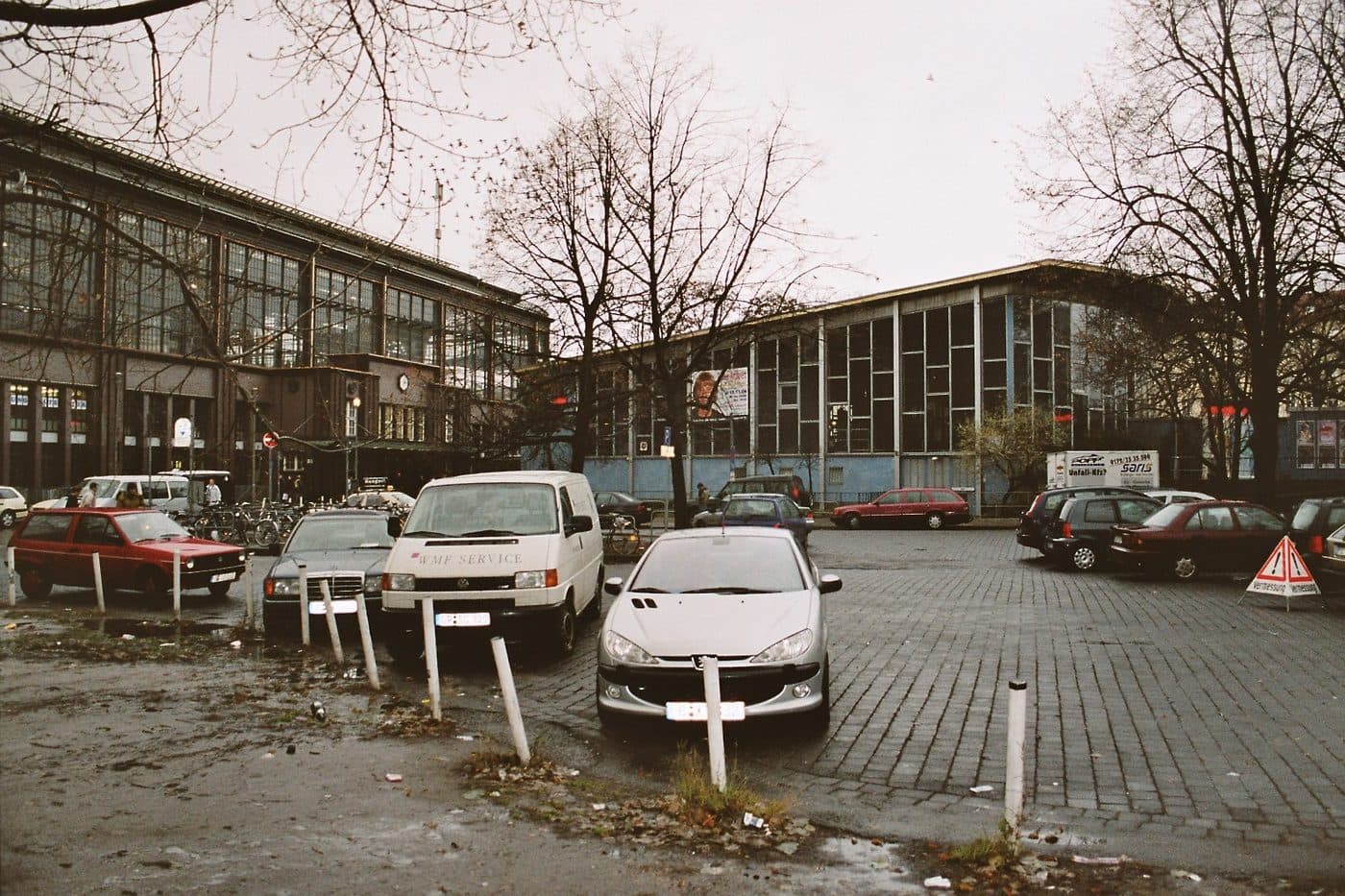
The Tränenpalast in December 2004, when the former border hall at Friedrichstraße was a club and concert venue, seen across a car park beside the station
The Tränenpalast in 2004, in its club years. Photo: Sir James / CC BY 3.0, via Wikimedia Commons

From nightclub to museum

The Wall opened on 9 November 1989, but the hall kept working as a border post: controls only ended on 1 July 1990, when the West German mark became East Germany’s currency. The passage that linked it to the station was removed after the border opened, and on 2 October 1990, the last day of the GDR, the building was listed as a monument. From 1991 it was a club and venue for concerts, cabaret and parties, until the Berlin Senate sold the site and the club closed in July 2006.

In November 2008 the federal government named the hall a place of remembrance. Restored to its 1962 appearance, it was opened by Chancellor Angela Merkel on 14 September 2011, and the Haus der Geschichte foundation’s exhibition welcomed the public the next day. On 550 square metres it combines original and reconstructed passport booths, witnesses’ interviews and a model of the whole crossing. Admission has been free from the start.

Plan your visit

Visiting the Tränenpalast

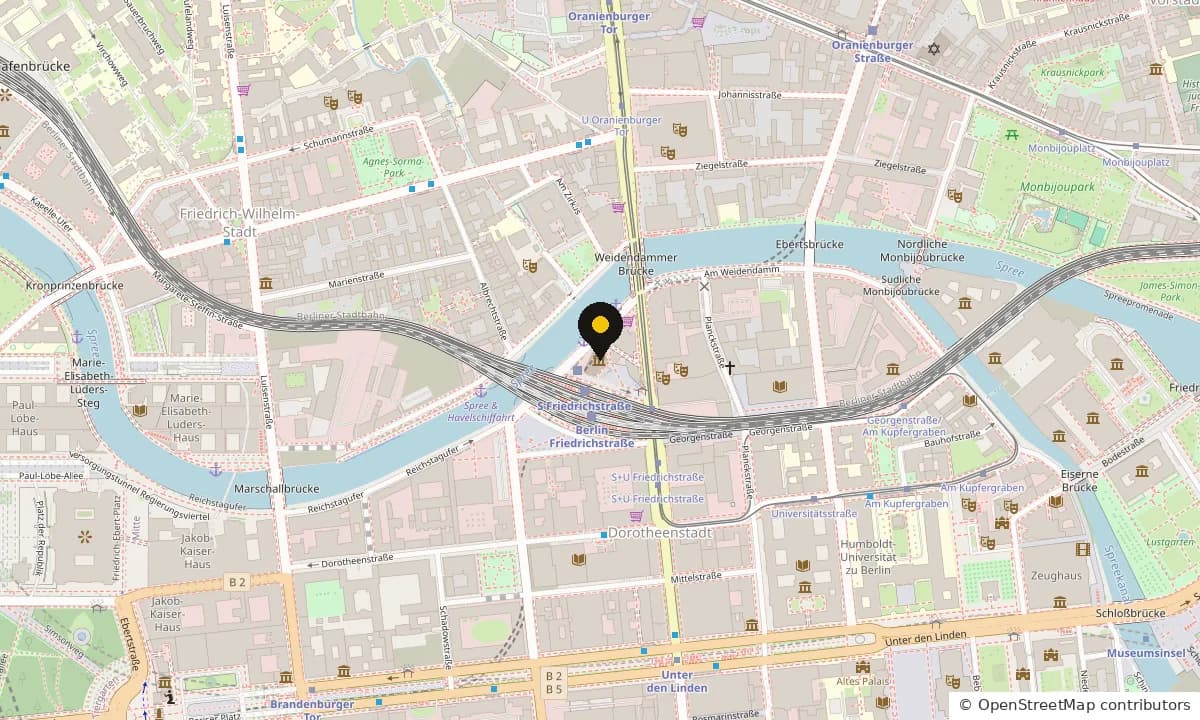
Map of the streets around the Tränenpalast, with a pin on the siteOpen in Google Maps

Reichstagufer 17, 10117 Berlin · Tuesday–Friday 09:00–18:00, Saturday and Sunday 10:00–18:00. Closed Mondays. In 2026 closed on 24 and 31 December; open 10:00–18:00 on 25 and 26 December and 1 January.

Getting there

  • S1S2S25S26S3S5S7S9Friedrichstraße180 m · 3 min

    Leave the station on the river side (north, towards the Spree): the hall is right in front of you.

  • U6Friedrichstraße170 m · 2 min

    In the divided city this was the only stop on the U6 in the East where West Berlin trains halted. The station has lifts.

  • Tram M1Tram 12S+U Friedrichstraße250 m · 4 min

    Step-free trams; walk north under the railway bridge.

What you’ll see

  • The original passport-control booths, panelled in brown laminate and marked for each kind of traveller; one of them you can still walk through.
  • Personal stories of division: letters and parcels sent across the border, smuggled documents and photographs, objects from people who escaped or left, and filmed interviews with witnesses.
  • A 1:87 model of the whole crossing at Friedrichstraße, showing how arrivals and departures were kept apart, inside a hall restored to its 1962 look.

Tips from a guide

  • Borrow the free audio guide at the desk (17 stops, in English and other languages) or play it on your phone over the museum’s free Wi-Fi.
  • Coats, rucksacks and umbrellas go in the free lockers. Photos for private use are fine, but no flash, tripods or selfie sticks.
  • Walk along the Spree to the Reichstag afterwards (14 minutes): the river was part of the border just west of here.

Accessibility

The exhibition is on one level (550 m²) and every section is wheelchair accessible; the step-free entrance is at the back of the building, facing the station, and is signposted. A barrier-free toilet with baby-changing is in the rear section of the exhibition. Walking sticks, a light wheelchair and folding stools can be borrowed free at the information desk. There is a tactile overview map and a few tactile objects (no floor guidance system), an audio guide with German audio description and one in German Sign Language. Guide and assistance dogs are welcome. Friedrichstraße station has lifts: check the BVG website for their status.

Timeline

From border hall to museum

  1. 13 Aug 1961The border closes; Friedrichstraße station becomes a crossing inside East Berlin.
  2. 1962The departure hall opens beside the station, designed by Horst Lüderitz.
  3. Dec 1963The first pass agreement lets West Berliners visit relatives in the East.
  4. Nov 1964East German pensioners are allowed to visit the West.
  5. 1972New treaties make visits from West Berlin routine.
  6. 29 Mar 1974Czesław Kukuczka is shot dead by a Stasi officer at the crossing.
  7. 9 Nov 1989The Wall opens; passport checks at Friedrichstraße carry on for months.
  8. 1 Jul 1990Border controls end with currency union.
  9. 2 Oct 1990The GDR lists the hall as a monument, a day before reunification.
  10. 1991–2006The hall is a club and venue for concerts, cabaret and parties.
  11. Nov 2008The federal memorial concept makes it a place of remembrance.
  12. 15 Sep 2011The Haus der Geschichte opens its free museum of German division.

See it with a historian

Tours that stop at the Tränenpalast

The museum shows how the crossing worked; a guide can walk you through the station, the river border and the ghost stations around it, and tell you what it meant to stand on either side.

A full day on life behind the Iron Curtain, from the Palace of Tears to Bernauer Straße.

The Berlin Wall Tour - Berlin Experiences
Full Day6 Hours

The Republic Of Fear

Private 6-hour van tour of East Berlin, the Stasi and life behind the Wall for up to 6 people. Starts at your hotel.

€1,000up to 6
View Tour

Our all-in-one full day, with the Cold War border as one chapter of the city’s story.

The Berlin History Tour
Full Day6 Hours

The Berlin History Tour

Private 6-hour van tour of Berlin's whole history in one day for up to 6 people. Starts at your hotel or anywhere in the city.

€1,000up to 6
View Tour

Half a day of Berlin’s highlights by private van, if your time is short.

The Bitesize Berlin Tour
Half Day3 Hours

The Bitesize Berlin Tour

Private 3-hour van tour of Berlin's major sights for up to 6 people. Starts at your hotel or anywhere in the city.

€700up to 6
View Tour

Questions visitors ask

Frequently asked questions

Why is it called the Palace of Tears?

Because East Germans said goodbye here to relatives and friends returning to the West, never knowing when they would see them again. Berliners first called it the ‘Tränenhalle’ (hall of tears); ‘Tränenpalast’ caught on later, after grand GDR names such as the Palast der Republik.

Is the Palace of Tears free?

Yes. Admission to the museum, the audio guide, the lockers and the group tours is free.

What are the Tränenpalast opening hours?

Tuesday to Friday 09:00–18:00, Saturday and Sunday 10:00–18:00, closed on Mondays. It also closes on 24 and 31 December; check hdg.de for other holidays before you go.

How long do you need at the Palace of Tears?

45 minutes to an hour is enough for most visitors; the free group tours last about an hour. Allow longer if you want to listen to all 17 stops of the audio guide.

Where is the Palace of Tears?

At Reichstagufer 17 in Berlin-Mitte, on the north side of Friedrichstraße station between the tracks and the Spree. From the S-Bahn or U6 it is two or three minutes’ walk.

Did people enter East Berlin through the Palace of Tears?

No. The hall was used only for leaving East Berlin. Visitors arriving from the West were checked inside Friedrichstraße station itself.

Is the Tränenpalast the same as Checkpoint Charlie?

No. Both crossings were on Friedrichstraße, but Checkpoint Charlie was a road crossing 1.6 km south for Allied personnel and foreigners, while the Tränenpalast was the departure hall for rail passengers at Friedrichstraße station.

Are there guided tours of the Tränenpalast?

The museum offers free one-hour tours for groups of ten or more, booked in advance, and a free audio guide for everyone else. Our Republic of Fear, Berlin History and Bitesize Berlin tours also stop here.

Keep exploring

More Featured Experiences.

Every site we write about — 56 landmarks, museums, memorials and lesser-known corners of Berlin. See the full index →

01Walk Through The Brandenburg Gate02Explore The State Museums On Museum Island03Visit The Berlin TV Tower – The Fernsehturm04Cross The Cold War Border At Checkpoint Charlie05Visit The Site Of Adolf Hitler’s Führerbunker06Explore The Reconstructed Berlin Palace07Visit The Reichstag Cupola At Night08Explore The Forum Fridericianum09Shop At The Humboldt University Book Sale10Journey Into The Memorial To The Murdered Jews Of Europe11Step Inside The Neue Wache12Explore The Former Jewish Quarter – Spandauer Vorstadt13Visit The Remains Of The Berlin Wall14Walk Across The Bridge Of Spies15Explore The Topography Of Terror16Climb The Prussian Victory Column – The Siegessäule18Step Inside The Berlin Olympic Stadium19Explore Erich Mielke’s Office At The Stasi Museum20Walk Along Karl Marx Allee21Visit The Oldest Church In Berlin – The Nikolaikirche22Explore The Berliner Dom23Visit The Grave Of Frederick The Great24Walk Through The Ruins Of Anhalter Bahnhof25Stand On The Platz Des Volksaufstandes26Visit The German Resistance Museum27Visit The Soviet War Memorial In The Tiergarten28See The Georg Elser Memorial On Wilhelmstrasse29Step Inside The Kaiser Wilhelm Gedächtnis Kirche30Visit The Gleis 17 Memorial31Visit The Schloss Charlottenburg Mausoleum32Climb The Französischer Dom at Gendarmenmarkt33Explore The Interbau – IBA 5734Explore The Otto Weidt Workshop35Visit Cecilienhof – Site Of The Potsdam Conference36Visit The Stasi Prison In Hohenschönhausen37Spend The Day At Tempelhof Airport38Ride The Fastest Elevator In Europe39Visit The Soviet War Memorial In Treptower Park40Visit The Sachsenhausen Concentration Camp Memorial41Visit The Ravensbrück Concentration Camp Memorial42Visit Karlshorst – The Site Of The German Surrender43Visit The Socialists Cemetery – Zentralfriedhof Friedrichsfelde44Visit The Soviet War Memorial In Pankow45Visit the Seelow Heights Memorial46Visit The Commonwealth War Cemetery47Cross The Bösebrücke At Night48Explore The Allied Museum In Dahlem49Explore The Spandau Citadel50Visit The Brandenburg T4 Euthanasia Memorial51Visit The Wannsee Conference House52Visit The Jewish Museum53Visit The Jewish Cemetery In Weissensee54Walk Along The East Side Gallery55Explore The Volkspark Friedrichshain Flak Tower56Head Up The Teufelsberg