Skip to content
Checkpoint Charlie in Berlin today: the replica ‘You are entering the American sector’ sign on Friedrichstraße, with tourists, bikes and the US flag behind

Berlin Experiences/Featured Experiences

Checkpoint Charlie: Visit Berlin’s Cold War Border Crossing

The former frontier between West and East Berlin.

The short answer

Checkpoint Charlie was the Allied crossing point between the American and Soviet sectors of Berlin from 1961 to 1990, on Friedrichstraße where it meets Zimmerstraße, on the line between Kreuzberg and Mitte. You can visit it at any time and for free: it is a public street corner. The guardhouse and sandbags in the middle of the road are a replica put up in 2000; the last real guardhouse is in the AlliiertenMuseum in Dahlem. The corner itself takes 20–30 minutes with the free outdoor exhibition; add about two hours if you visit the private Mauermuseum (€18.50) on the corner.

Where
Friedrichstraße at Zimmerstraße, on the Kreuzberg–Mitte line
Open
Always: a public street corner
Admission
Free (Mauermuseum €18.50)
Time needed
20–30 minutes; 2–3 hours with the Mauermuseum
Nearest station
U6 Kochstraße/Checkpoint Charlie, 2 minutes on foot
Step-free
Yes: street level, and a lift at U Kochstraße

The story · by Matt Robinson

No other junction in Berlin provokes such disdain from locals as where Friedrichstrasse and Zimmerstrasse intersect – the border between the vibrant city district of Kreuzberg to the south, and the historic central district of Mitte to the north. Colloquially – if not accurately – known as Checkpoint Charlie.

To the untrained eye, it may now simply appear as a congregation of recognisable trademarks – family friendly fast food names such as McDonald’s and KFC. Souvenir shops and wandering tourists – to locals what has understandably come to be known as the ‘Disneyland of Berlin’.

Chip away at this unsophisticated facade and you’ll find you’ve arrived at the spot that once served as the symbolic final line in the sand between East and West. The Cold War frontier. With the US sector of divided Berlin to the south and the Soviet zone of control across the road, to the north and east.

For more than 40 years, the last outpost of American control, in the island of West Berlin, stood here. As by a matter of geographical peculiarity, Berlin – while divided during the Cold War period into four different zones of control (the British, American, French, and Soviet) –  would end up situated inside the German Democratic Republic and within the Soviet sphere of influence.

A city divided

Agreements made by the victorious Allied forces, responsible for the defeat of Nazi Germany in 1945, meant that Hitler’s capital was destined to be divided and occupied – shared almost equally between these four powers.

By 1949, it had become obvious that tensions between East and West would not lead to compromise or capitulation – but rather an intense and prolonged European stalemate between the collective western forces of Great Britain, France, and United States – and the Soviet Union, on the other side. Berlin thus became a strategically important Cold War bargaining chip – the European ground zero of the conflict between East and West.

Checkpoint Charlie at night: Friedrichstraße in Berlin lit up, with the light-box portrait of an American soldier over the old crossing
Friedrichstraße at night, looking south from the former crossing.

The western sectors of the city maintained as the ‘shop front window of the western world’ – with residents paid extra for living in the shadow of the Red Danger and, remarkably, exempt from the military service expected of all adult aged men in West Germany.

In the Eastern sector of the city, the East German government would bring law and order, and fear, to the population – seeking to establish a workers’ and peasants’ state while serving as a Soviet satellite – representing the aims and interests of Moscow.

Freedom of movement

The relationship between East and West in Berlin, at this time, was a strange one. While not officially at war with each other, the Western Allies and the Soviet Union were also certainly not friends – and would provoke and undermine each other in various different ways. While maintaining an unusual measure of professional civility in others.

Including one important agreement – finalised in 1945 at the Potsdam Conference attended by Truman, Stalin, and Churchill – the freedom of movement of military personnel in the divided city of Berlin.

Light-box portrait of a Soviet soldier at Checkpoint Charlie, Berlin, facing south down Friedrichstraße into the former American sector
The Soviet soldier on Frank Thiel’s light box faces the former American sector.

Although the two countries of East and West Germany would assert their independence as fully functioning states, representing their citizens, and carrying out the general business expected of fully functioning countries – the capital of East Germany, East Berlin, would not be recognised as such by the Western Allies for the entire Cold War era. To the West, while contesting the legitimacy of East Germany, it was important to highlight the Soviet control that had been agreed upon at the end of the Second World War. As, West Berlin – although not the capital of West Germany (that title belonged to the Rheinlandish city of Bonn) – also maintained a special status until 1990; with British, French, and American soldiers stationed in this part of the city and free to roam.

The agreement finalised in Potsdam in 1945, meant these troops could cross into each other’s zones – and, importantly, that Western forces could not be denied entry to the Eastern sector of the city.

Checkpoint Alpha, Bravo, Charlie

Checkpoint Charlie, named after the NATO radio alphabet, was established in 1961 to deal with this peculiarity.

With a control box in the centre of the street, staffed by military police, this would serve as the final crossing point, part of a series of three, for US forces looking to visit East Berlin. The previous two were placed at both ends of a highway that passed through East Germany from Checkpoint Alpha in Helmstedt/Marienborn (the crossing from West Germany into East Germany) to Checkpoint Bravo at Drewitz/Dreilinden (the crossing from East Germany into West Berlin).

The corner today

The original box, that sat at this junction at the end of the Cold War, is now in the Allied Museum in Dahlem, a western district of Berlin. Instead, there is now a replica in its place – maintained by the owners of the Checkpoint Charlie Museum, located on the former US side of Friedrichstrasse.

Established on this street in 1963 by human rights activist, Rainer Hildebrandt, this museum documents some of the daring escapes to have taken place following the construction of the Berlin Wall in 1961 – with hot air balloons, converted vehicles, scuba diving equipment and assorted other inspiring methods. The museum also features a number of unusual artefacts, either donated or acquired over the past half a century – Soviet leader Nikita Khrushchev’s hat, US President Ronald Reagan’s chainsaw, and Mahatma Gandhi’s sandals.

Replica of the ‘You are entering the American sector’ sign at Checkpoint Charlie, in English, Russian, French and German
The replica sign, in the four languages of occupied Berlin.

Exploring the former site of Checkpoint Charlie, through the fog of consumerism that has since taken over, it is still possible to also make out a replica version of the border sign that once stood at this intersection. The surrounding buildings, once the offices of the CIA and KGB, have been converted into commercial businesses.

Looking down onto the ground you can also see where the Berlin Wall once traced through the city – the cobblestone line zigzagging across the street in front of the former border crossing at Checkpoint Charlie.
Checkpoint Charlie in detail

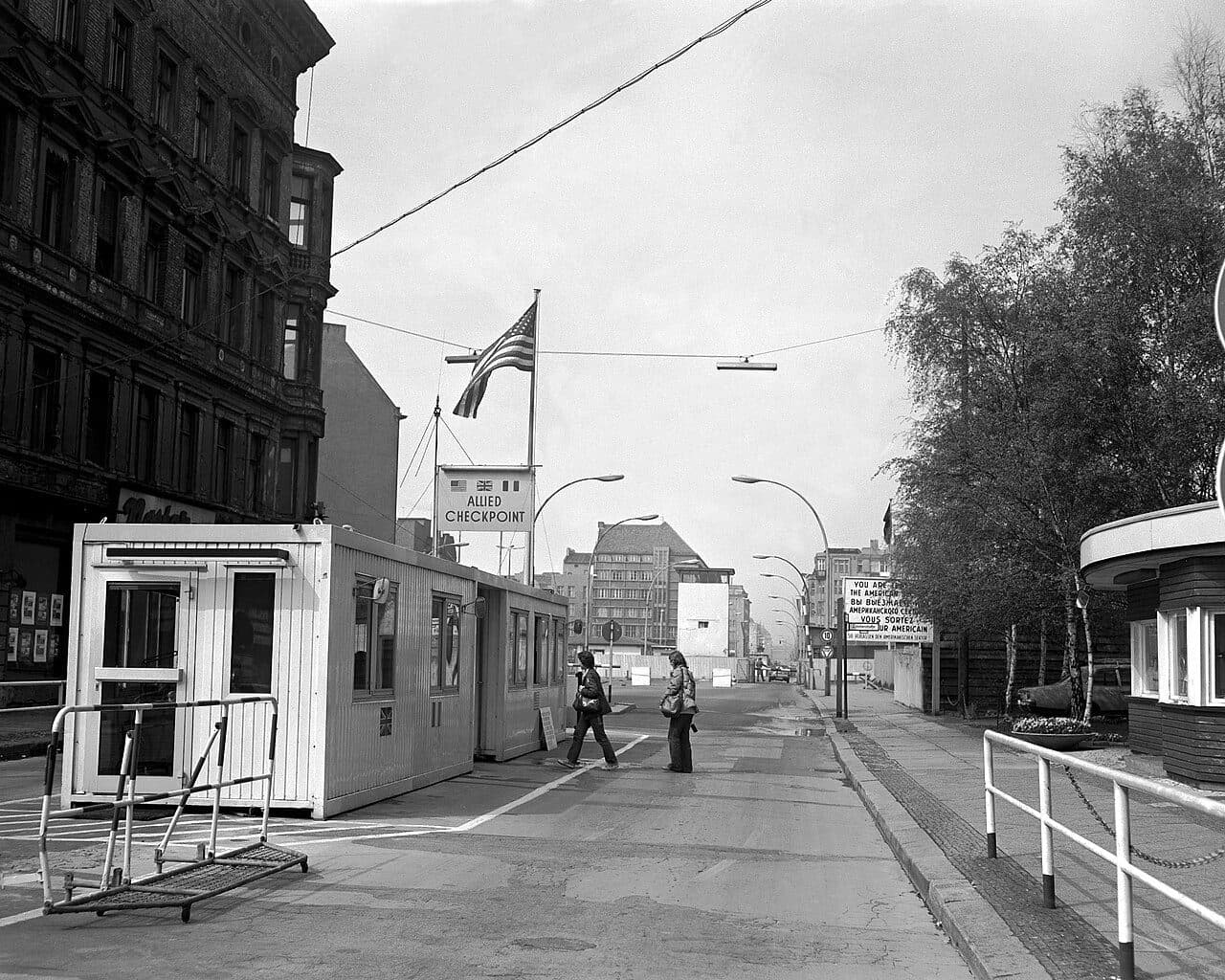
Checkpoint Charlie in 1977: the American guard cabin and ‘Allied Checkpoint’ sign on Friedrichstraße, Berlin, with a US flag and soldiers in the road
The American post on Friedrichstraße in 1977. Photo: Helga T. H. Mellmann, US Armed Forces / Public domain, via Wikimedia Commons

How the crossing worked

After East Germany sealed the border on 13 August 1961, Friedrichstraße became the one crossing in Berlin for Allied personnel, diplomats and foreigners. West Germans and West Berliners had to use other crossings. The Americans set up their post in August and September 1961, in the middle of the road on the West Berlin side. It was deliberately modest: the Western Allies did not accept the sector boundary as a state border, so their military police checked no passports. They logged Allied soldiers and officials going east and briefed them on how to behave.

The real controls were on the other side. East Germany’s Grenzübergangsstelle Friedrich-/Zimmerstraße grew into a fortified complex of barriers, zigzag lanes, inspection sheds and a watchtower, where foreign visitors had their papers and cars searched and changed money. The first American post was a wooden hut behind sandbags; it was later replaced by a larger metal cabin, the one lifted away in 1990.

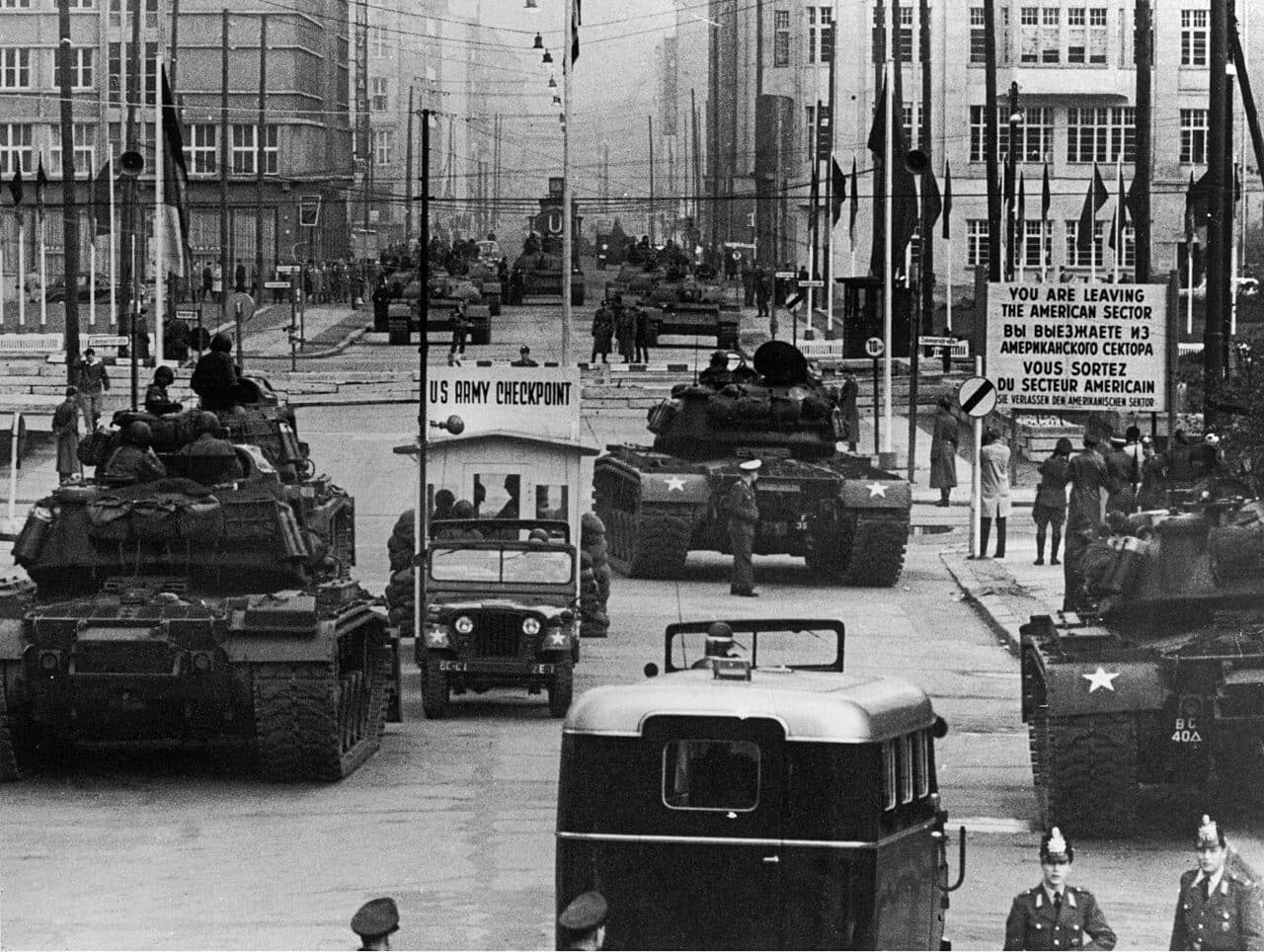
US Army M48 tanks and jeeps at Checkpoint Charlie on Friedrichstraße, Berlin, during the stand-off with Soviet tanks in October 1961
American tanks at Checkpoint Charlie during the stand-off, October 1961. Photo: U.S. Army / Public domain, via Wikimedia Commons

The tank stand-off, October 1961

On 22 October 1961, East German guards stopped Allan Lightner, the deputy head of the US Mission in Berlin, on his way to the theatre in East Berlin, and demanded his papers. Under four-power rules only the Soviets could check Allied officials, so he refused and was escorted through by military police. General Lucius D. Clay, President Kennedy’s envoy in Berlin, answered with force: on 25 October ten American M48 tanks rolled up to the checkpoint.

Shortly after 18:00 on 27 October, ten Soviet tanks drove down Friedrichstraße and stopped facing them, about 100 metres apart: the most direct face-off between American and Soviet forces in Berlin during the whole Cold War. After some 16 hours, and a back channel between Robert Kennedy and the Soviet agent Georgi Bolshakov, the Soviet tanks pulled back on the morning of 28 October and the Americans followed.

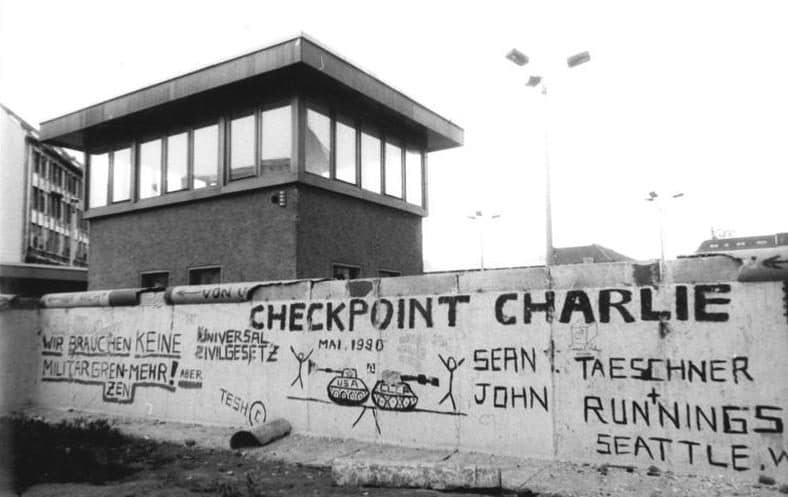
Checkpoint Charlie on its last morning, 22 June 1990: the American observation post behind a graffiti-covered wall on Friedrichstraße, Berlin
The checkpoint’s last morning, 22 June 1990, before the Allied buildings were dismantled. Photo: Bundesarchiv, Bild 183-1990-0622-025 / Uhlemann, Thomas / CC-BY-SA 3.0

From the fall of the Wall to today

On the night of 9–10 November 1989 East Berliners poured through the crossing as the Wall opened. On 22 June 1990, at a ceremony attended by the foreign ministers of the four powers and the two German states, the American guard cabin was lifted away by crane; it now stands in the AlliiertenMuseum in Dahlem. The East German installations were cleared by early 1991, and the wasteland plots on either side waited decades for a plan. A replica of the 1961 hut went up on 13 August 2000.

The small BlackBox Cold War exhibition closed on 10 January 2026. In March 2026 the Berlin Wall Foundation opened a free outdoor exhibition, and in September 2026 a jury chose the design for the Forum Checkpoint Charlie, a memorial and learning site with an information pavilion and public squares. Construction is due to start in 2030.

Plan your visit

Visiting Checkpoint Charlie

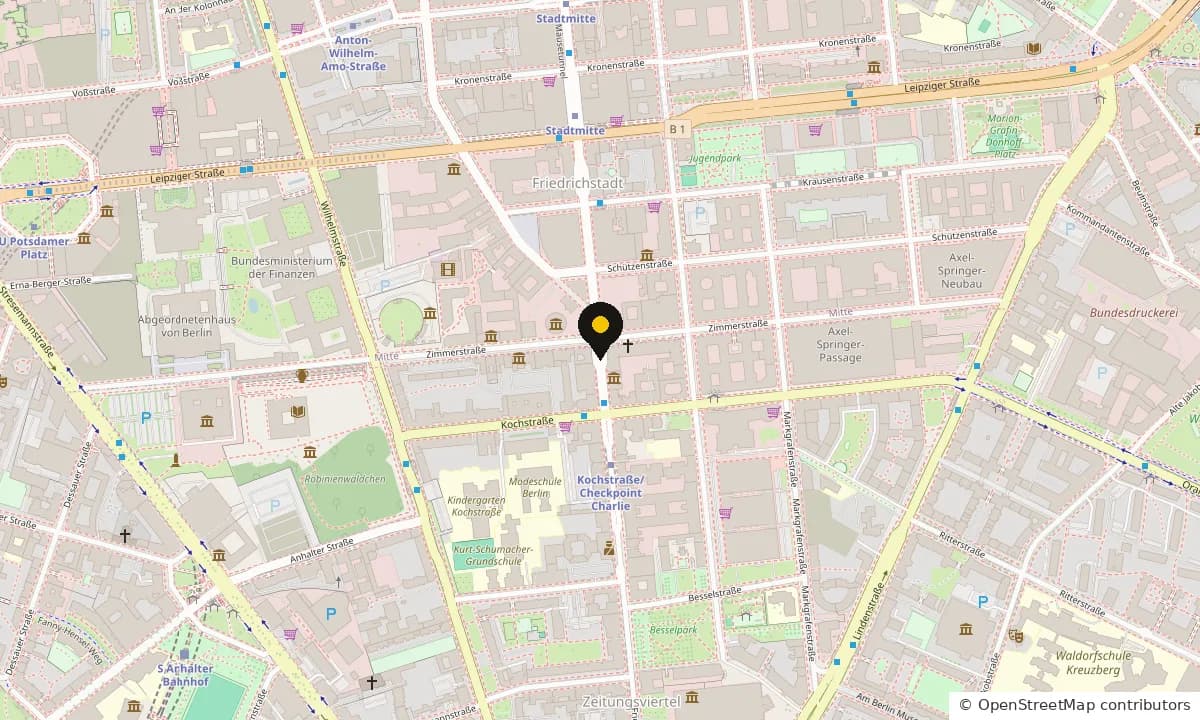
Map of the streets around Checkpoint Charlie, with a pin on the siteOpen in Google Maps

Friedrichstraße / Zimmerstraße, 10969 Berlin · Open 24 hours, every day (the street site and outdoor exhibition). The Mauermuseum is open daily 10:00–20:00.

Getting there

  • U6Kochstraße/Checkpoint Charlie150 m · 2 min

    Take the exit to Friedrichstraße and walk one block north; the replica hut is in the middle of the road. The station has a lift.

  • U2U6Stadtmitte450 m · 6 min

    Walk south down Friedrichstraße, crossing Leipziger Straße. Handy if you come from Alexanderplatz or Potsdamer Platz on the U2.

  • Bus M29U Kochstr./Checkpoint Charlie150 m · 2 min

    The stop is on Kochstraße beside the U-Bahn entrance, one block south of the crossing.

What you’ll see

  • The replica guardhouse, sandbags and the ‘You are leaving the American sector’ sign in the middle of Friedrichstraße, and above them Frank Thiel’s 1998 light box with portraits of an American and a Soviet soldier.
  • The double row of cobblestones marking the line of the Wall across Zimmerstraße, and ‘Crossing the Iron Curtain’, the Berlin Wall Foundation’s free outdoor exhibition on the square in front of the Asisi Panorama, open since March 2026.
  • The private Mauermuseum (Haus am Checkpoint Charlie) on the western corner, and a short walk east along Zimmerstraße, the memorial to Peter Fechter, shot at the Wall in 1962.

Tips from a guide

  • Come early in the morning or after dark: by midday the pavements are crowded and the road is a busy junction, so watch for traffic when you photograph the hut.
  • The real history is in the outdoor exhibition boards and the cobblestone Wall line, not the hut. Walk a few minutes east along Zimmerstraße to the Peter Fechter memorial for a quieter, more sobering stop.
  • The costumed ‘soldiers’ who charged for photos and passport stamps were banned by the district in November 2019. Nobody has the right to charge you for standing at the hut.

Accessibility

The site is at street level with level pavements, though the cobbles and crowds can be awkward for wheelchairs. U6 Kochstraße has a lift from platform to street; check the BVG website for lift status. The outdoor exhibition is accessible at any time. The Mauermuseum is in an older building on several floors: ask the museum about access before you go.

Timeline

From sector line to tourist corner

  1. Jul 1945US troops take over their sector; Friedrichstraße here marks its border with the Soviets.
  2. 13 Aug 1961East Germany seals the border; Friedrichstraße stays open for Allies and foreigners.
  3. Aug–Sep 1961The US Army sets up its checkpoint, a wooden hut behind sandbags.
  4. 22 Oct 1961East German guards stop US diplomat Allan Lightner and demand his papers.
  5. 27–28 Oct 1961Ten US and ten Soviet tanks face each other for about 16 hours.
  6. 17 Aug 1962Peter Fechter, 18, is shot at the Wall nearby and bleeds to death.
  7. 14 Jun 1963Rainer Hildebrandt’s Mauermuseum opens on Friedrichstraße.
  8. 26 Jun 1963President Kennedy visits Checkpoint Charlie during his Berlin trip.
  9. 9–10 Nov 1989The Wall opens; East Berliners pour through the crossing.
  10. 22 Jun 1990The American guard cabin is lifted away; it goes to the AlliiertenMuseum.
  11. 13 Aug 2000A replica of the first hut is unveiled in the middle of the road.
  12. 9 Sep 2026A jury picks the design for the Forum Checkpoint Charlie; building from 2030.

See it with a historian

Tours that stop at Checkpoint Charlie

The corner itself is mostly souvenirs; a guide can show you where the East German control complex stood, where the tanks faced off and where Peter Fechter died.

One hour in the divided city, with Checkpoint Charlie and the line of the Wall at its heart.

The Cold War Tour
One Hour1 Hour

The Cold War Berlin Tour

Private 1-hour walking tour of Cold War Berlin's border sites for up to 10 people. Starts by the Berlin Wall segments on Potsdamer Platz.

€200up to 10
View Tour

A full day on life behind the Iron Curtain, from the border crossings to the Stasi.

The Berlin Wall Tour - Berlin Experiences
Full Day6 Hours

The Republic Of Fear

Private 6-hour van tour of East Berlin, the Stasi and life behind the Wall for up to 6 people. Starts at your hotel.

€1,000up to 6
View Tour

The whole story of Berlin in one day, with the Cold War border as one of its chapters.

The Berlin History Tour
Full Day6 Hours

The Berlin History Tour

Private 6-hour van tour of Berlin's whole history in one day for up to 6 people. Starts at your hotel or anywhere in the city.

€1,000up to 6
View Tour

Questions visitors ask

Frequently asked questions

Is Checkpoint Charlie worth visiting?

Yes, for 20–30 minutes, if you know what you are looking at. The hut is a replica and the corner is commercial, but the free outdoor exhibition, the Wall line in the cobbles and the Peter Fechter memorial nearby tell the real story of the most famous crossing of the Cold War.

Is the Checkpoint Charlie guardhouse real?

No. The hut and sandbags are a replica of the first 1961 post, put up in 2000. The last real American guard cabin was lifted away on 22 June 1990 and is on show at the AlliiertenMuseum in Dahlem, which is free.

Is Checkpoint Charlie free?

Yes. The street site and the Berlin Wall Foundation’s outdoor exhibition are free and open at all hours. Only the private Mauermuseum on the corner charges admission: €18.50 for adults.

Why is it called Checkpoint Charlie?

It was the third Allied checkpoint on the route from West Germany to West Berlin, after Alpha at Helmstedt and Bravo at Dreilinden, so it took the third letter of the phonetic alphabet, C for Charlie.

Who could cross at Checkpoint Charlie?

Allied soldiers and officials, diplomats and foreigners. It was not open to West Germans or West Berliners, and East Germans could not cross at all without permission; the few who tried to break through risked their lives.

What happened at Checkpoint Charlie in 1961?

On 27–28 October 1961, ten American and ten Soviet tanks faced each other here for about 16 hours, after East German guards tried to check the papers of a US diplomat. Both sides pulled back without a shot being fired.

Is there a Cold War museum at Checkpoint Charlie?

Not at the moment. The small BlackBox Cold War exhibition closed in January 2026 and an investor’s museum plan was dropped. The city’s Forum Checkpoint Charlie, a memorial and learning site, is due to start construction in 2030; until then there is a free outdoor exhibition.

What is the nearest station to Checkpoint Charlie?

U6 Kochstraße/Checkpoint Charlie, a two-minute walk south of the hut. U Stadtmitte (U2 and U6) is about six minutes’ walk to the north.

Sources

Facts checked 3 November 2026. Spotted something out of date? Tell us.

Keep exploring

More Featured Experiences.

Every site we write about — 56 landmarks, museums, memorials and lesser-known corners of Berlin. See the full index →

01Walk Through The Brandenburg Gate02Explore The State Museums On Museum Island03Visit The Berlin TV Tower – The Fernsehturm05Visit The Site Of Adolf Hitler’s Führerbunker06Explore The Reconstructed Berlin Palace07Visit The Reichstag Cupola At Night08Explore The Forum Fridericianum09Shop At The Humboldt University Book Sale10Journey Into The Memorial To The Murdered Jews Of Europe11Step Inside The Neue Wache12Explore The Former Jewish Quarter – Spandauer Vorstadt13Visit The Remains Of The Berlin Wall14Walk Across The Bridge Of Spies15Explore The Topography Of Terror16Climb The Prussian Victory Column – The Siegessäule17Enter The Palace Of Tears – The Tränenpalast18Step Inside The Berlin Olympic Stadium19Explore Erich Mielke’s Office At The Stasi Museum20Walk Along Karl Marx Allee21Visit The Oldest Church In Berlin – The Nikolaikirche22Explore The Berliner Dom23Visit The Grave Of Frederick The Great24Walk Through The Ruins Of Anhalter Bahnhof25Stand On The Platz Des Volksaufstandes26Visit The German Resistance Museum27Visit The Soviet War Memorial In The Tiergarten28See The Georg Elser Memorial On Wilhelmstrasse29Step Inside The Kaiser Wilhelm Gedächtnis Kirche30Visit The Gleis 17 Memorial31Visit The Schloss Charlottenburg Mausoleum32Climb The Französischer Dom at Gendarmenmarkt33Explore The Interbau – IBA 5734Explore The Otto Weidt Workshop35Visit Cecilienhof – Site Of The Potsdam Conference36Visit The Stasi Prison In Hohenschönhausen37Spend The Day At Tempelhof Airport38Ride The Fastest Elevator In Europe39Visit The Soviet War Memorial In Treptower Park40Visit The Sachsenhausen Concentration Camp Memorial41Visit The Ravensbrück Concentration Camp Memorial42Visit Karlshorst – The Site Of The German Surrender43Visit The Socialists Cemetery – Zentralfriedhof Friedrichsfelde44Visit The Soviet War Memorial In Pankow45Visit the Seelow Heights Memorial46Visit The Commonwealth War Cemetery47Cross The Bösebrücke At Night48Explore The Allied Museum In Dahlem49Explore The Spandau Citadel50Visit The Brandenburg T4 Euthanasia Memorial51Visit The Wannsee Conference House52Visit The Jewish Museum53Visit The Jewish Cemetery In Weissensee54Walk Along The East Side Gallery55Explore The Volkspark Friedrichshain Flak Tower56Head Up The Teufelsberg