Skip to content
The Topography of Terror in Berlin: visitors at the open-air trench exhibition below the surviving Berlin Wall on Niederkirchnerstraße, with Göring’s former Aviation Ministry behind

Berlin Experiences/Featured Experiences

Topography of Terror: Visit the Former Gestapo and SS Headquarters

Site of the former Nazi SS-Gestapo headquarters.

The short answer

The Topography of Terror is a free documentation centre in Berlin-Kreuzberg, on the site where the Gestapo, the SS leadership and the Reich Security Main Office had their headquarters from 1933 to 1945. It stands at Niederkirchnerstraße 8, between Potsdamer Platz and Checkpoint Charlie, beside a surviving 200-metre stretch of the Berlin Wall. The indoor exhibition, the open-air exhibition in the excavated cellars and the site tour are open every day from 10:00 to 20:00, except 24 and 31 December and 1 January. Admission is free; allow about two hours.

Where
Niederkirchnerstraße 8, 10963 Berlin-Kreuzberg
Open
Daily 10:00–20:00; closed 24 and 31 Dec and 1 Jan
Admission
Free, audio guide included
Time needed
1½–2 hours
Nearest station
S Anhalter Bahnhof, 6 minutes on foot
Step-free
Yes: ramp, lift and accessible toilets

The story · by Matt Robinson

One of Berlin’s most famous museums, the Topography of Terror was built on land once occupied by the terror organs of the Nazi regime – the international base of operations for the SS (Schutzstaffel) paramilitary organisation and GeStaPo secret police – the Reich Security Main Office (RSHA).

The story of the museum’s concept, and conception, is one of confrontation – the important questions and uncomfortable answers. An earnest attempt to unmask the inner workings of Nazi Germany’s ideological warriors – their motivations, their justifications, and take stock of a system that normalised cruelty and rewarded ruthlessness.

The kind of belated confrontation that would not take place in the public post-war trials of Nazi criminals arranged by the victorious Allies – but take decades for the conditions in German society for this kind of impartial internal evaluation to be reached. Not until the 1980s would this happen – in fact more than 40 years after the end of the Second World War. Strangely coinciding with two US presidential visits.

Reagan, Bitburg and a symbolic dig

When US President, Ronald Reagan, arrived in West Berlin in June 1987, it was to a mixed reception. Restrictions were placed on transportation, and a huge police presence in the city was established to counter expected demonstrations. Although this visit is popularly remembered for the words he spoke on the western side of the Brandenburg Gate, imploring Soviet leader Mikhail Gorbachev to: “Open this gate…Tear down this Wall.”, it would not be his only visit to Berlin, or Germany, during his time in office – nor his most controversial.

Close-up of the original Berlin Wall at the Topography of Terror on Niederkirchnerstraße, chipped by souvenir hunters to the reinforcing bars
The Wall on Niederkirchnerstraße, chipped away in 1989–90.

Two years earlier in May 1985, Reagan had visited the Bitburg Cemetery in West Germany, and caused international uproar with his actions – intensely criticized for not cancelling his commemorations of the end of the Second World War there when it was discovered that 49 members of the Waffen-SS, the military arm of Nazi Germany’s SS (Schutzstaffel), were also buried in the cemetery.

The same month, a symbolic excavation ceremony was held on the grounds of the former SS headquarters, the Reich Security Main Office (RSHA), on what was previously known as Prinz-Albrecht-Strasse. In 1985, this disputed plot of land stood in the shadow of the Berlin Wall, in the West Berlin district of Kreuzberg, only 1.5km south of the city’s most iconic monument and where Reagan would speak in 1987 – the Brandenburg Gate.

The site destined to become what is now known as Topography of Terror.

The headquarters of terror, 1933–1945

Here at this location, from 1933 until 1945 – the 12 years of National Socialist rule – were the offices of some of the most feared organisations in Europe, if not the world. The headquarters of the Sicherheitspolizei, SD, Einsatzgruppen and GeStaPo. Controlled by Reichsführer-SS, Heinrich Himmler, and tasked with ensuring the realisation of the Nazi Party’s ideological goals while spreading terror across the continent.

Autumn ivy on a wall in the grounds of the Topography of Terror in Berlin, with the Gropius Bau and the Berlin state parliament behind
The Gropius Bau and the Abgeordnetenhaus from the grounds.

Not only would these organisations form the spiritual backbone of the regime – the intelligence services and secret police – but the criminal police would also eventually fall under the control of the Reich Main Security Office (RSHA). In this capacity, as the centralised institution involved in implementing Nazi doctrine, the RSHA held the power of life and death over every person who fell under the dominating boot of Nazi control or occupation.

Housed in a series of buildings, chiefly a former school of industrial arts and the palatial residence of Prince Albrecht of Prussia, both taken over by the Nazi security services, the Reich Main Security Office would serve as ground zero for the so-called Schreibtischtäter (Desktop Murderers), the bureaucratic workers responsible for orchestrating the genocidal policies of Nazi Germany from the safety of their offices. As these organisations and staff, directly answerable to Heinrich Himmler and Adolf Hitler above him, would also coordinate the systematic imprisonment of political opponents and the ‘protective custody’ process of the concentration camp industry.

…the so-called Schreibtischtäter (Desktop Murderers), the bureaucratic workers responsible for orchestrating the genocidal policies of Nazi Germany from the safety of their offices.

From rubble to memorial

One month after Ronald Reagan’s third visit to Germany in 1987 – the site of the SS-GeStaPo Headquarters would be transformed into a memorial and permanent exhibition showing the crimes of Nazism. Coinciding with the 750th anniversary celebrations of Berlin’s founding the same year – excavated traces of the buildings that once stood here were presented to the public, along with historical documentation.

The Nazi seizure of power in 1933 had involved the takeover of many traditional Prussian-German government offices and their corresponding buildings on the Wilhelmstrasse – with the eventual addition of a few other notable buildings such as Hitler’s New Reich Chancellery, Hermann Göring’s Aviation Ministry, and the offices of the Reich Propaganda Ministry, led by Joseph Goebbels. While the former Aviation Ministry and Propaganda Ministry buildings are still maintained as government buildings, having largely survived the Second World War, the SS-Gestapo Headquarters complex on Prinz-Albrecht-Strasse was reduced to rubble and gradually demolished after 1945 – after sustaining substantial damage from Anglo-American air raids.

During the Cold War period, this site was utilised for various different, and underwhelming, purposes – used by a construction site recycling company, turned into an ‘Autodrom’ for learner drivers to practise, and at one point there were proposals to transform the area into a helicopter landing zone in the heart of West Berlin.

The documentation centre today

What was opened in 1987 as the Topography of Terror, was augmented and reopened in 2010 – with additional government funding – to be remodelled as a combination of three sites.

The grey documentation centre of the Topography of Terror in Berlin-Kreuzberg, opened in 2010, behind its gravel-covered grounds
The documentation centre, opened in 2010.

Firstly, a grey documentation centre containing a chronological overview of the structure, bureaucratic methodology, and murderous actions of the various different organisations that fell under the purview of the RSHA. The second aspect being an excavated former cellar space of the Gestapo headquarters, where uniforms and documents were previously stored, used all year round for an open-air exhibition. And finally, a collection of information panels commenting on the terrain, and topography, of the site – intended to be experienced as part of a walking tour. Fifteen stations along a preconfigured route – that can be experienced with an audio guide – present the traces of the site in situ. Prompts for further examining the consequences of what was planned and implemented from this location.

What stands out most though about this particular endeavour, is how Topography of Terror extends its focus beyond that of other museums around the world that aim to preserve the memory of the victims of Nazi persecution and tell their stories, where National Socialist doctrine would otherwise want for these things to be forgotten. Here the spotlight is on the perpetrators, their identities, their actions, and the justifications they would give for their crimes – that sadly, would remain unpunished for decades after. Many simply allowed to escape justice entirely.

Here the spotlight is on the perpetrators, their identities, their actions, and the justifications they would give for their crimes…

And the unique opportunity to confront the cruel actions of these men and women in situ – transforming a location that once enabled these crimes into a place to engage and prepare anyone serious about ensuring such calamity is not repeated.
The Topography of Terror in detail

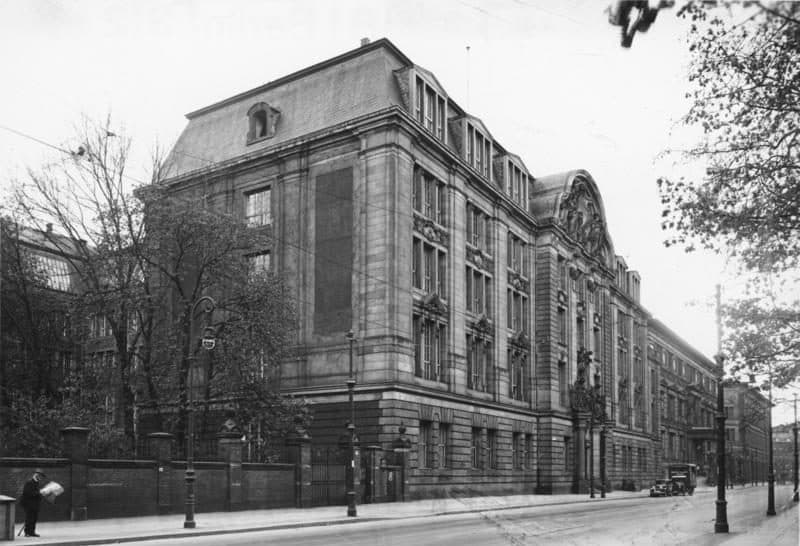
The Gestapo headquarters at Prinz-Albrecht-Straße 8 in Berlin in 1933, a former school of industrial arts
Prinz-Albrecht-Straße 8, the Gestapo headquarters, in 1933. Photo: Bundesarchiv, Bild 183-R97512 / CC-BY-SA 3.0

Prinz-Albrecht-Straße 8: the Gestapo headquarters

In 1933 the new Prussian secret state police office, the Geheimes Staatspolizeiamt or Gestapa, moved into a former school of industrial arts at Prinz-Albrecht-Straße 8, today’s Niederkirchnerstraße. Heinrich Himmler took it over as inspector in April 1934, and from 1936 he ran the Gestapo and the criminal police together as the Security Police. Its targets widened from communists and Social Democrats to every group the regime declared an enemy of the people, above all Jews.

In August 1933 a house prison was set up in the cellar. Even after it was enlarged in 1936 it had only 38 single cells and one shared cell, so most prisoners were held elsewhere and brought here for interrogation, often under torture. Among the several thousand people held here were members of the Red Orchestra network and the plotters of 20 July 1944. The foundations of the cells lie under a bed of gravel in the grounds.

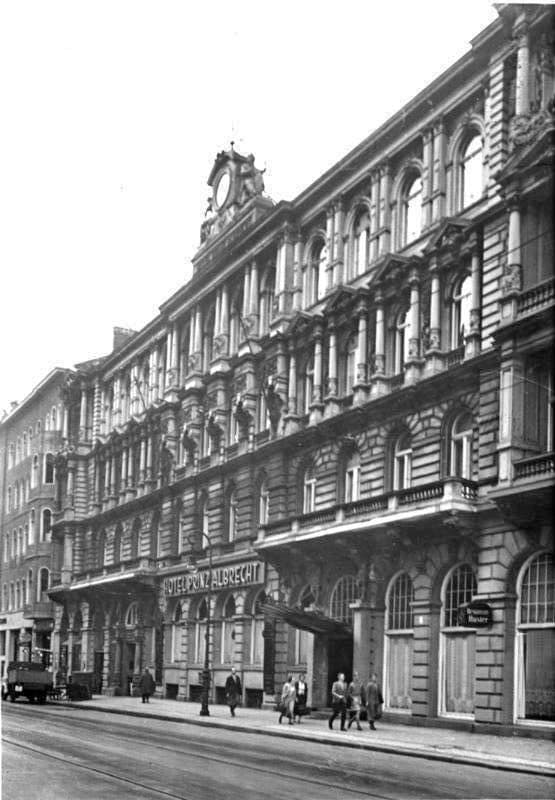
The Hotel Prinz Albrecht on Prinz-Albrecht-Straße in Berlin in 1934, the year the SS leadership moved in
The Hotel Prinz Albrecht, taken over by the SS leadership in 1934. Photo: Bundesarchiv, Bild 183-G01209-500-1 / CC-BY-SA 3.0

The SS, the SD and the Reich Security Main Office

In 1934 the SS leadership under Himmler moved into the Hotel Prinz Albrecht next door, and the SS security service, the SD, under Reinhard Heydrich, took over the Prinz-Albrecht-Palais around the corner on Wilhelmstraße. In September 1939, weeks after the invasion of Poland, Himmler merged the Security Police and the SD into the Reich Security Main Office (RSHA), led by Heydrich until his assassination in 1942 and then by Ernst Kaltenbrunner.

The RSHA joined a state police force to a Nazi Party organisation and put both outside the law. Its men led the Einsatzgruppen that shot Jews, Sinti and Roma, prisoners of war and communist officials in Poland and the Soviet Union, and its offices organised the deportations of the Holocaust. The SD’s leading men were mostly young university graduates who saw themselves as the ideological elite of National Socialism.

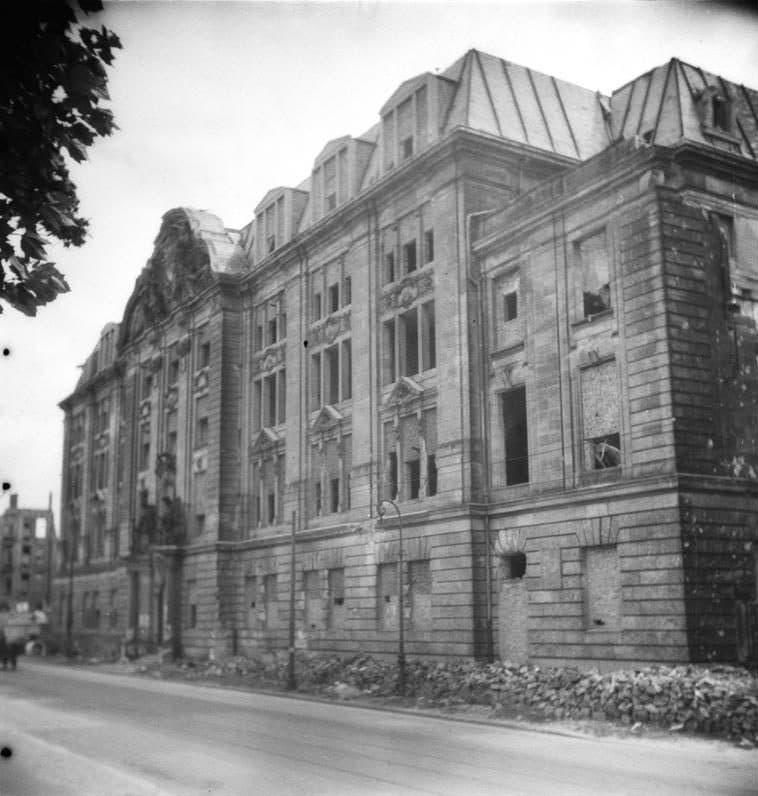
The bomb-damaged ruin of the Gestapo headquarters on Prinz-Albrecht-Straße in Berlin, June 1949
The ruin of the Gestapo headquarters, June 1949. Photo: Bundesarchiv, Bild 183-S85918 / Funck, Heinz / CC-BY-SA 3.0

After 1945: from wasteland to documentation centre

The bombed-out buildings were blown up and cleared by the mid-1950s, and the site was forgotten at the edge of West Berlin, closed off by the Wall to the north from 1961. A rubble recycling firm worked part of it, and from the late 1960s an ‘Autodrom’ let people drive without a licence. Only at the end of the 1970s did historians and victims’ groups draw attention back to it. A design competition in 1983 came to nothing, and in May 1985 the Aktives Museum association held a symbolic dig on the site.

The first exhibition opened in a temporary pavilion on 4 July 1987, meant only for Berlin’s 750th anniversary year; it was so popular that it stayed. Peter Zumthor’s design for a permanent building was begun in 1997, stalled in 1999 and abandoned in 2004. A new competition was won by Ursula Wilms and Heinz W. Hallmann, and their documentation centre opened on 6 May 2010.

Plan your visit

Visiting the Topography of Terror

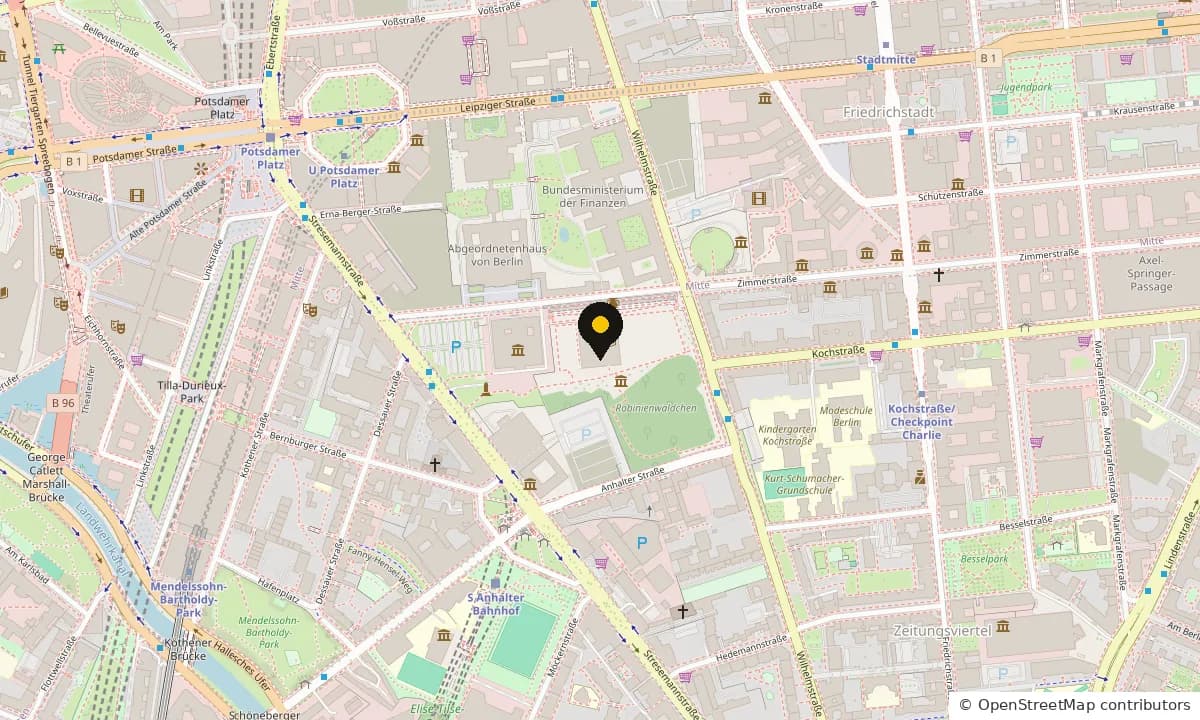
Map of the streets around the Topography of Terror, with a pin on the siteOpen in Google Maps

Niederkirchnerstraße 8, 10963 Berlin · Daily 10:00–20:00 (outdoor areas until dusk, 20:00 at the latest). Closed 24 and 31 December and 1 January.

Getting there

  • S1S2S25S26Anhalter Bahnhof400 m · 6 min

    Come out by the ruined portico of the old station; the documentation centre is just to the north, behind the Gropius Bau.

  • U6Kochstraße/Checkpoint Charlie550 m · 8 min

    Walk west along Zimmerstraße, on the line of the Wall, and cross Wilhelmstraße into Niederkirchnerstraße.

  • S1S2S25S26U2Potsdamer Platz750 m · 10 min

    Walk south-east down Stresemannstraße and turn left into Niederkirchnerstraße, past the Abgeordnetenhaus.

What you’ll see

  • The permanent exhibition in the documentation centre, ‘Topography of Terror. Gestapo, SS and Reich Security Main Office on Wilhelm- and Prinz-Albrecht-Straße’: five chapters of photographs and documents on the SS and police and the crimes they committed across Europe.
  • The open-air exhibition ‘Berlin 1933–1945. Between Propaganda and Terror’, in a trench along the excavated cellar walls on Niederkirchnerstraße, directly below the 200-metre stretch of the Berlin Wall.
  • The 15-station site tour across the grounds: the gravel bed over the foundations of the Gestapo’s house prison, the cellars of an SS supply barracks, and the robinia grove where the old Autodrom’s tracks still run.

Tips from a guide

  • Borrow the free audio guide (22 languages) at the service desk, or stream it to your phone over the free Wi-Fi with your own headphones.
  • Free public tours run at weekends, no booking: in English at 15:30 and in German at 14:00 on Saturdays and Sundays, 60 minutes. Be at the meeting point 15 minutes early.
  • Come after 17:00 for a quieter visit. The centre recommends it for visitors aged 14 and over; there are lockers in the foyer and a cafeteria in the building.

Accessibility

The exhibition level has no steps, and a ramp beside the entrance stairs leads into the building. A lift goes down to the toilets in the basement, which include accessible WCs in both the women’s and men’s toilets, and a wheelchair can be borrowed free at the service desk. Step-free routes lead into the exhibition trench and all outdoor areas are on paved paths, though the paths in the robinia grove are partly uneven. There is seating outside the entrance and inside. There is no parking on site; paid spaces for wheelchair users are in the Gropius Bau car park next door. The loan audio guides include versions in easy German, German Sign Language and with audio description.

Timeline

From Gestapo headquarters to documentation centre

  1. 1933The Prussian secret police (Gestapa) moves into Prinz-Albrecht-Straße 8.
  2. 1934The SS leadership takes over the Hotel Prinz Albrecht; the SD the Prinz-Albrecht-Palais.
  3. Sep 1939The Security Police and the SD merge into the Reich Security Main Office.
  4. 1945Bombing has left the buildings in ruins or badly damaged.
  5. 1950sThe ruins are blown up and cleared; the site falls into oblivion.
  6. 13 Aug 1961The Berlin Wall goes up along the northern edge of the site.
  7. Late 1960sAn ‘Autodrom’ and a rubble recycling firm move onto the empty site.
  8. 5 May 1985The Aktives Museum holds a symbolic dig, the day Reagan visits Bitburg.
  9. 4 Jul 1987The first ‘Topography of Terror’ exhibition opens for Berlin’s 750th anniversary.
  10. 1990The 200-metre stretch of Wall on Niederkirchnerstraße is listed as a monument.
  11. 2004Peter Zumthor’s half-built design is abandoned and its towers demolished.
  12. 6 May 2010The new documentation centre by Ursula Wilms opens.

See it with a historian

Tours that stop at the Topography of Terror

The exhibitions explain the system; a guide can show you where each building stood, and how this street connected to the ministries, the Chancellery and the camps.

One hour in the Nazi government district, ending at the Gestapo and SS headquarters.

The Third Reich Tour
One Hour1 Hour

The Third Reich Tour

Private 1-hour walking tour of the Nazi government district for up to 10 people. Starts at Pariser Platz by the Brandenburg Gate.

€200up to 10
View Tour

The rise and fall of the Third Reich, with the Topography of Terror among its stops.

The Capital Of Tyranny Tour - Berlin Experiences
Full Day6 Hours

The Capital Of Tyranny

Private 6-hour van tour of Hitler's Berlin and the Third Reich for up to 6 people. Starts at your hotel or anywhere in the city.

€1,000up to 6
View Tour

A full day through Berlin’s history, from the Nazi terror apparatus to the Wall beside it.

The Berlin History Tour
Full Day6 Hours

The Berlin History Tour

Private 6-hour van tour of Berlin's whole history in one day for up to 6 people. Starts at your hotel or anywhere in the city.

€1,000up to 6
View Tour

Questions visitors ask

Frequently asked questions

What is the Topography of Terror?

A documentation centre and open-air museum on the site of the Gestapo, SS and Reich Security Main Office headquarters in Berlin-Kreuzberg. Unlike most memorials, it focuses on the perpetrators: who they were, how their organisations worked and the crimes they planned here.

Is the Topography of Terror free?

Yes. Admission to all the exhibitions is free, and so are the audio guide and the weekend public tours. You do not need a ticket or a booking.

What are the Topography of Terror’s opening hours?

Daily 10:00–20:00; the outdoor areas close at dusk, at 20:00 at the latest. It is closed on 24 and 31 December and 1 January.

Where was the Gestapo headquarters in Berlin?

At Prinz-Albrecht-Straße 8, today’s Niederkirchnerstraße 8 in Kreuzberg, where the Topography of Terror stands. The building was wrecked by bombing and demolished after the war; only cellar walls and the foundations of its house prison survive in the grounds.

Where was the SS headquarters in Berlin?

The SS leadership under Himmler moved into the Hotel Prinz Albrecht, next to the Gestapo, in 1934, and the SD security service into the Prinz-Albrecht-Palais on Wilhelmstraße. All of it was on what is now the Topography of Terror site.

How long do you need at the Topography of Terror?

Allow 1½–2 hours for the indoor exhibition and the trench along the Wall; the audio guide for the indoor exhibition alone lasts about 60 minutes. Add half an hour if you want to walk the 15-station site tour.

Is the Berlin Wall at the Topography of Terror original?

Yes. The roughly 200-metre stretch along Niederkirchnerstraße is original, kept with the damage souvenir hunters did in 1989–90, and has been a listed monument since 1990. It marked the border between East Berlin’s Mitte and West Berlin’s Kreuzberg.

Is the Topography of Terror suitable for children?

The centre recommends it from age 14, and younger children only with a parent: many of the photographs show violence and murder.

Keep exploring

More Featured Experiences.

Every site we write about — 56 landmarks, museums, memorials and lesser-known corners of Berlin. See the full index →

01Walk Through The Brandenburg Gate02Explore The State Museums On Museum Island03Visit The Berlin TV Tower – The Fernsehturm04Cross The Cold War Border At Checkpoint Charlie05Visit The Site Of Adolf Hitler’s Führerbunker06Explore The Reconstructed Berlin Palace07Visit The Reichstag Cupola At Night08Explore The Forum Fridericianum09Shop At The Humboldt University Book Sale10Journey Into The Memorial To The Murdered Jews Of Europe11Step Inside The Neue Wache12Explore The Former Jewish Quarter – Spandauer Vorstadt13Visit The Remains Of The Berlin Wall14Walk Across The Bridge Of Spies16Climb The Prussian Victory Column – The Siegessäule17Enter The Palace Of Tears – The Tränenpalast18Step Inside The Berlin Olympic Stadium19Explore Erich Mielke’s Office At The Stasi Museum20Walk Along Karl Marx Allee21Visit The Oldest Church In Berlin – The Nikolaikirche22Explore The Berliner Dom23Visit The Grave Of Frederick The Great24Walk Through The Ruins Of Anhalter Bahnhof25Stand On The Platz Des Volksaufstandes26Visit The German Resistance Museum27Visit The Soviet War Memorial In The Tiergarten28See The Georg Elser Memorial On Wilhelmstrasse29Step Inside The Kaiser Wilhelm Gedächtnis Kirche30Visit The Gleis 17 Memorial31Visit The Schloss Charlottenburg Mausoleum32Climb The Französischer Dom at Gendarmenmarkt33Explore The Interbau – IBA 5734Explore The Otto Weidt Workshop35Visit Cecilienhof – Site Of The Potsdam Conference36Visit The Stasi Prison In Hohenschönhausen37Spend The Day At Tempelhof Airport38Ride The Fastest Elevator In Europe39Visit The Soviet War Memorial In Treptower Park40Visit The Sachsenhausen Concentration Camp Memorial41Visit The Ravensbrück Concentration Camp Memorial42Visit Karlshorst – The Site Of The German Surrender43Visit The Socialists Cemetery – Zentralfriedhof Friedrichsfelde44Visit The Soviet War Memorial In Pankow45Visit the Seelow Heights Memorial46Visit The Commonwealth War Cemetery47Cross The Bösebrücke At Night48Explore The Allied Museum In Dahlem49Explore The Spandau Citadel50Visit The Brandenburg T4 Euthanasia Memorial51Visit The Wannsee Conference House52Visit The Jewish Museum53Visit The Jewish Cemetery In Weissensee54Walk Along The East Side Gallery55Explore The Volkspark Friedrichshain Flak Tower56Head Up The Teufelsberg