Skip to content
Tower A, the gatehouse of the Sachsenhausen concentration camp in Oranienburg near Berlin, seen across the gravel outline of a demolished barrack

Berlin Experiences/Featured Experiences

Sachsenhausen: Visit the Concentration Camp Memorial Near Berlin

The grim nucleus of the Nazi concentration camp industry.

The short answer

Sachsenhausen is the former Nazi concentration camp at Oranienburg, about 35 km north of Berlin, and the nearest concentration camp memorial to the city. More than 200,000 people were held here between 1936 and 1945, and tens of thousands died; from 1945 to 1950 the Soviets used it as a special camp. You can visit every day and admission is free; the S1 or the RE5 takes you to Oranienburg, then it is a 20-minute walk or a short bus ride. Allow about three hours at the site, or half a day from central Berlin.

Where
Straße der Nationen 22, 16515 Oranienburg, 35 km north of Berlin
Open
Daily 08:30–18:00 in summer, 08:30–16:30 from late October to March; check before you go
Admission
Free; audio guide €3.50
Time needed
About 3 hours on site; half a day from Berlin
Nearest station
Oranienburg (S1, RE5), 20 minutes on foot
Step-free
Limited: long outdoor paths; wheelchairs on loan
With a guide
Private guided tour from your hotel in Berlin, with transport there and back. See the Sachsenhausen Camp Tour →

The story · by Matt Robinson

While the names of the extermination camps further east – such as Auschwitz and Treblinka – are etched in the dark annals of human history as centres of the Holocaust, it was in the so-called ‘protective custody camps’ and killing facilities on German soil, such as the Sachsenhausen Concentration Camp, that the Nazi plans for divide and rule, annihilation through work, and industrial mass murder, were first implemented.

Predating the invasion of Poland and the implementation of Aktion Reinhardt, a series of detention facilities were built in Germany to house political prisoners, subversives, and perceived enemies of the Nazi regime. In the south of Germany – the infamous Dachau camp, near Munich – in the centre, near Weimar, the Buchenwald facility – and north, near Hitler’s capital, the camp that would grow to become the most significant of the three major German political penitentiaries – Sachsenhausen.

The camp is situated on the outskirts of the sleepy village of Oranienburg, that was for a long time unremarkable except for its name – an illustration of the connection between the Imperial German and Prussian Hohenzollern royal family and the Dutch House of Orange.

Barracks 38 and 39, the reconstructed ‘Jewish barracks’ at the Sachsenhausen Concentration Camp Memorial in Oranienburg
Barracks 38 and 39, the ‘Jewish barracks’, now a museum.

Passing through its streets and amongst its commonplace tenements now, it may seem an unlikely location for a Nazi camp. Except for its close proximity, a mere 35km north, to the city of Berlin – the one time Nazi Reichshauptstadt – and significantly on the important Baltic railway line leading to Rostock.

Behind the gate

Following its inception in 1936, around 200,000 enemies of the National Socialist Weltanschauung and so-called ‘people’s community’ (Volksgemeinschaft) would pass through the gates of this Nazi concentration camp. The iconic ‘Arbeit Macht Frei’ lettering, a mocking gesture designed to send the message that with good behaviour and dedication to reform the prisoners would be granted their freedom – where the only freedom guaranteed was in death.

Tens of thousands of the individuals who would pass through these gates and enter this camp would perish over the nine miserable years of its operation.

While the early prisoners would be detained for political crimes and forced to endure brutal forced labour and wretched conditions, the net cast across German society by National Socialist policy would eventually widen to include homosexuals, Jehovah’s Witnesses, the work-shy, so-called race traitors (Rassenschänder) – and from 1938, Jewish citizens.

A concrete watchtower on the camp wall at the Sachsenhausen concentration camp, Oranienburg
One of the watchtowers on the camp wall.

From the gated entrance to the camp at Tower A, to the isolation barracks, the special prison, the infirmary, kitchen, and industrial yard – used for executions – this camp would be designed with one purpose in mind, to ensure the forced subjugation of the prisoners.

And to create a geometry of terror – ensuring that the minimal amount of pressure applied could result in the maximum amount of pain and control.

…a geometry of terror – ensuring that the minimal amount of pressure applied could result in the maximum amount of pain and control.

A school for perpetrators

Beyond its unassuming facade as a detention facility – where unlike a normal prison, the prisoners were denied due process and the right to a fair trial but rather apprehended and incarcerated into protective custody (Schutzhaft) – Sachsenhausen would also serve as a proving ground for the hundreds of perpetrators who would find gainful employment with the Nazi regime.

A system that would seek out and reward men like Karl Otto Koch, the camp’s second Commandant, and Rudolf Höss, who would serve as Administrator of prisoners’ property. Both men would advance their careers through the SS concentration camp hierarchy, with Koch progressing to serve as Commandant of Buchenwald, while Höss would become the longest standing Commandant at Auschwitz – overseeing the implementation of the industrial mass killing process using Zyklon B gas at the camp.

Unlike the early detention facilities opened in Nazi Germany following Hitler’s seizure of power in 1933, the later camps, such as Sachsenhausen would fall under the administration of Adolf Hitler’s personal bodyguard and the ideological force of the Schutzstaffel (SS) – headed by Heinrich Himmler.

Annihilation through work

SS jurisdiction over the camps, such as Sachsenhausen, would mean that prisoners would be systematically worked to death – or “Annihilated through work” as stated by Himmler. As beyond the triangle-shaped layout of the central part of Sachsenhausen, this facility also included several subcamps and factories where prisoners would be exploited of their most valuable resource – their labour. Several prominent German companies would profit from this slave labour industry: including aircraft manufacturer, Heinkel, AEG, and Siemens.

After 1945

Although conceived by the Nazis, the camp would be liberated and inherited by the Soviets in 1945 – only to be reopened as an NKVD detention camp for political prisoners and inmates sentenced by Soviet Military Tribunals. Some 60,000 people would be interned here over five years, with Sachsenhausen growing to become the largest of three special camps in the Soviet Occupation Zone.

Eventually, following the establishment of the East German state, Sachsenhausen would be opened in 1961 as a memorial – focused mainly on the suffering of political prisoners, such as the Communist and Social Democrat inmates. Its present day form as a museum can be seen as a direct consequence of German reunification in 1990.

The East German memorial sculpture of two prisoners and a soldier at the foot of the obelisk at Sachsenhausen
The East German memorial of 1961, at the foot of the obelisk.

Sachsenhausen is noteworthy now for its factual assessment of the darkest chapter in German history and lasting role as a place of remembrance for the people the National Socialist regime would much rather have been forgotten.
Sachsenhausen in detail

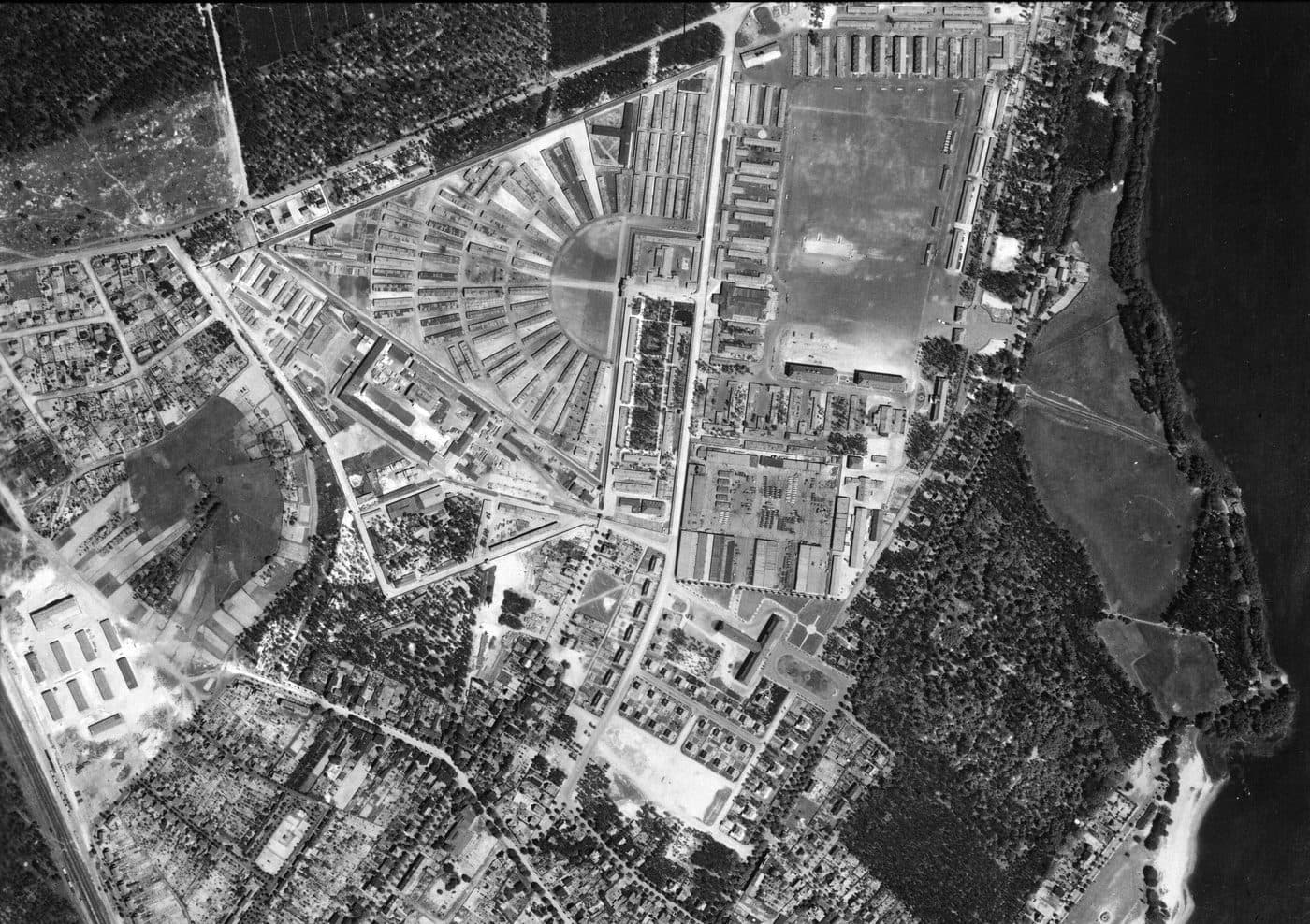
RAF aerial photograph of the Sachsenhausen concentration camp at Oranienburg, 20 May 1943, showing the triangular prisoners’ compound
The camp from the air, photographed by the RAF on 20 May 1943. The triangle of the prisoners’ compound is at the centre. Photo: Royal Air Force / Public domain, via Wikimedia Commons

A camp built as a model

Sachsenhausen was built in the summer of 1936 by prisoners brought from the Esterwegen and Berlin-Columbia camps. It was the first camp planned from scratch after Heinrich Himmler took control of the system, and the SS presented it as a model: the prisoners’ compound was laid out as a triangle with sides about 600 metres long, with Tower A at the centre of its base. From the gatehouse, the guards’ machine guns covered the roll-call ground and every row of barracks fanning out behind it.

The location mattered as much as the design. In 1938 the Inspectorate of the Concentration Camps, the office that ran every camp in the Reich, moved from Berlin to the ‘T-Building’ beside the camp. SS men trained at Sachsenhausen went on to run camps across occupied Europe, and from 1942 more than 100 subcamps and outside work details supplied prisoners to industry around Berlin.

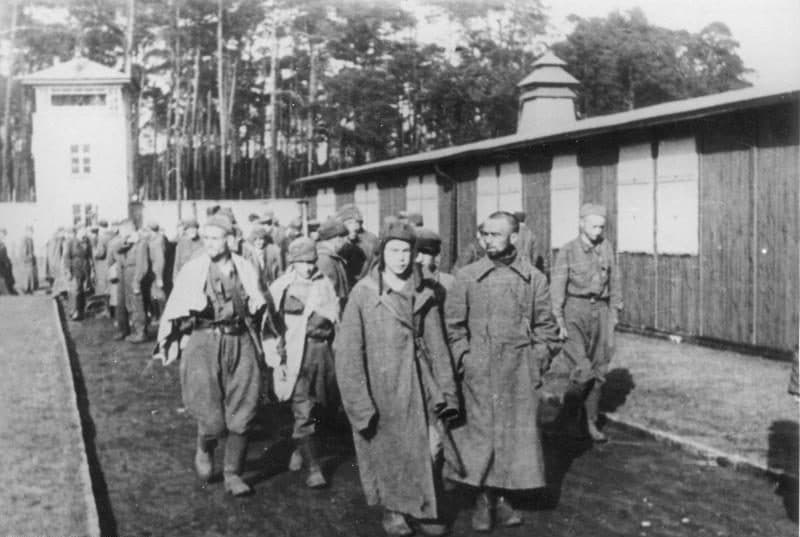
Soviet prisoners of war arriving at the Sachsenhausen concentration camp in 1941, walking past a wooden barrack and a watchtower
Soviet prisoners of war arriving at Sachsenhausen in 1941. Photo: Bundesarchiv, Bild 183-K0901-014 / CC-BY-SA 3.0

Murder at Sachsenhausen

Sachsenhausen was not built as an extermination camp, but killing became part of its routine. In the autumn of 1941 the SS murdered at least 10,000 Soviet prisoners of war here, many of them Jews, most of them shot in the neck in a barrack disguised as a medical room: told they were having their height measured, they were shot through a hatch behind their head. Methods tested here were then used elsewhere.

In May 1942 the SS completed Station Z in the industrial yard just outside the camp wall, with a neck-shooting room and crematorium ovens; a gas chamber was added in 1943. The SS named it Z, the last letter of the alphabet, as the counterpart to Tower A, where prisoners entered. On 21 April 1945, with the Red Army close, the SS drove more than 30,000 prisoners north on death marches. Thousands died on the roads.

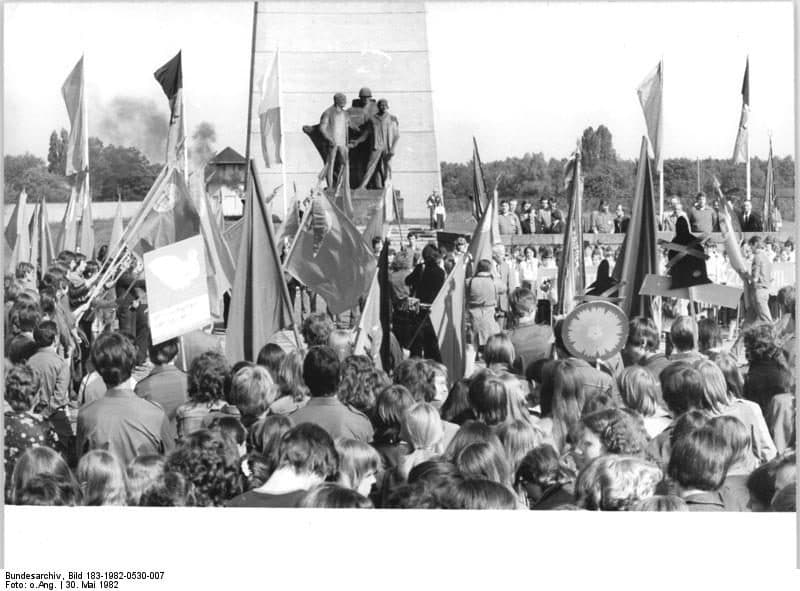
East German youth with flags at a ceremony in front of the obelisk and memorial sculpture at the Sachsenhausen National Memorial, May 1982
A Whitsun youth rally at the East German memorial, May 1982. Photo: Bundesarchiv, Bild 183-1982-0530-007 / CC-BY-SA 3.0

The Soviet camp and the East German memorial

On 22 April 1945 Soviet and Polish units found about 3,000 sick prisoners left behind in the camp. By August the Soviet secret police had reopened it as Special Camp No. 7, renamed No. 1 in 1948. Nazi functionaries were held here, but so were political prisoners, people arrested on denunciations and prisoners sentenced by Soviet military tribunals. At least 12,000 of them died of hunger and disease before the camp closed in 1950; their mass graves were found in 1990.

East Germany opened the National Memorial on 23 April 1961, after demolishing most of the original barracks. Its obelisk, marked with the red triangle of the political prisoners, honoured above all the Communists, while the Soviet camp went unmentioned. Since reunification the memorial has told both stories, with a separate museum for the special camp.

Plan your visit

Visiting Sachsenhausen

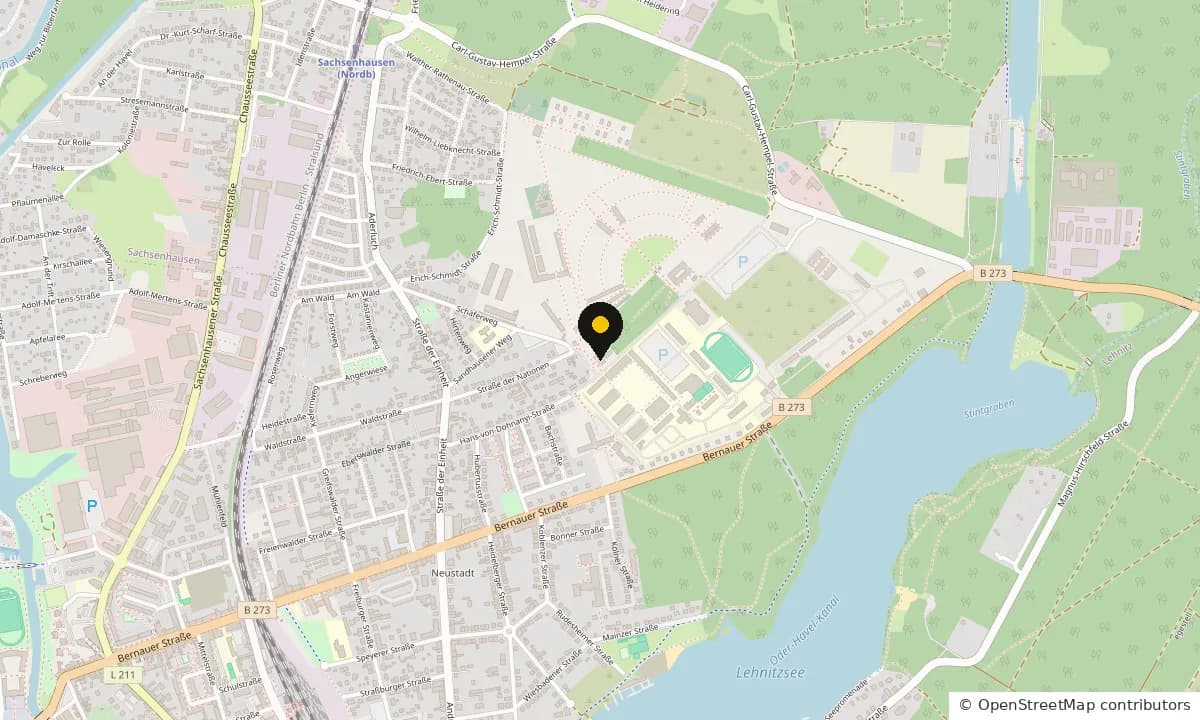
Map of the streets around Sachsenhausen, with a pin on the siteOpen in Google Maps

Straße der Nationen 22, 16515 Oranienburg · Daily. Grounds and exhibitions 08:30–18:00 from the end of March to late October, 08:30–16:30 in winter; visitor information centre 08:30–17:00. Closed or shorter hours around Christmas and New Year, and occasionally in bad winter weather: check sachsenhausen-sbg.de before you go.

Getting there

  • S1Oranienburg1.9 km · 20–25 min

    The end of the S1, every 20 minutes and 45 minutes from Friedrichstraße. You need an ABC ticket (or a Deutschlandticket). From the station follow the signs to the Gedenkstätte; the last stretch is Straße der Nationen.

  • RE5OranienburgAbout 30 min from Hauptbahnhof, then 20 min on foot

    Hourly and faster than the S-Bahn. Get off at Oranienburg, not at the smaller Sachsenhausen (Nordb) station, which is further from the memorial.

  • Bus 804Bus 821Gedenkstätte100 m · 2 min

    From outside Oranienburg station. Bus 804 (towards Malz) runs hourly, the last at about 17:20; bus 821 (towards Tiergarten) only a few times a day. Check times before you rely on them.

What you’ll see

  • Tower A, the SS gatehouse with ‘Arbeit macht frei’ on its gate, and beyond it the semicircular roll-call ground and the fan of gravel outlines where the prisoners’ barracks stood.
  • Barracks 38 and 39, the ‘Jewish barracks’, the cell block of the camp prison, the prisoners’ kitchen, the infirmary and the pathology building, most with their own exhibitions.
  • Station Z, the SS killing site, with the execution trench beside it; the 1961 East German obelisk; and the museum and graves of the Soviet special camp of 1945–1950.

Tips from a guide

  • The site is large and the exhibitions are spread across it: hire the audio guide (€3.50) at the visitor centre or come with a guide, and give it at least three hours.
  • In winter the grounds close at 16:30 and it gets dark early, so take a morning train and leave yourself time for the walk back to the station.
  • Most of the visit is outdoors on gravel and open ground, with few places to shelter: wear sensible shoes and dress for the weather.

Accessibility

Access is limited, as this is a historic site: the memorial says wheelchair users and visitors with visual impairments should come accompanied. Wheelchairs can be borrowed at the visitor information centre. Accessible toilets are in the visitor centre, the café in the New Museum, the former prisoners’ kitchen, the library and the former infirmary. Distances are long and many paths are gravel.

Timeline

From concentration camp to memorial

  1. 21 Mar 1933The SA opens an early concentration camp in a disused brewery in Oranienburg.
  2. Jul 1934The SS takes over the Oranienburg camp, which is soon closed.
  3. Jul 1936Prisoners start building the new camp at Sachsenhausen.
  4. 1938The Inspectorate of the Concentration Camps moves to Oranienburg.
  5. Autumn 1941The SS murders at least 10,000 Soviet prisoners of war at the camp.
  6. May 1942Station Z, the killing site with crematorium ovens, is completed.
  7. 21 Apr 1945The SS starts driving more than 30,000 prisoners north on death marches.
  8. 22 Apr 1945Soviet and Polish troops liberate about 3,000 sick prisoners left behind.
  9. Aug 1945The Soviets reopen the site as NKVD Special Camp No. 7.
  10. 1950The special camp closes; at least 12,000 prisoners have died there.
  11. 23 Apr 1961East Germany opens the National Memorial Sachsenhausen.

See it with a historian

Tours that stop at Sachsenhausen

The signs explain each building; a guide connects them, from the camp’s design to its perpetrators, and to what the site meant under the Soviets and in East Germany.

The Invention Of Hell Tour - Berlin Experiences
Full Day5 Hours

The Sachsenhausen Camp Tour

Private 5-hour van tour from Berlin to the Sachsenhausen Memorial for up to 6 people. Starts at your hotel in Berlin.

€975up to 6
View Tour

Why this tour

A full day with a historian: starting from your hotel and covering the whole camp, from Tower A to Station Z.

See the Sachsenhausen Camp Tour

Questions visitors ask

Frequently asked questions

Where is the nearest concentration camp to Berlin?

Sachsenhausen, in the town of Oranienburg, about 35 km north of central Berlin. Take the S1 to the end of the line, then walk 20 minutes.

How do I get to Sachsenhausen from Berlin?

Take the S1 to Oranienburg (45 minutes from Friedrichstraße) or the faster RE5 from Hauptbahnhof (about 30 minutes, hourly), then walk 20 minutes or take bus 804 or 821 to the Gedenkstätte stop. You need an ABC ticket or a Deutschlandticket.

Is it free to visit Sachsenhausen?

Yes. Admission to the memorial and its museums is free. The audio guide costs €3.50, and guided tours cost extra.

How long do you need at Sachsenhausen?

Allow about three hours at the site to see the main buildings and exhibitions, and half a day in total from central Berlin, including the journey.

Can you visit Sachsenhausen without a tour?

Yes. You can walk around on your own with the free signs and the audio guide from the visitor centre. A guide helps if you want the history connected, as the site is large and the exhibitions are spread out.

Was Sachsenhausen a death camp?

No. It was a concentration camp, built for political prisoners and later for forced labour, not an extermination camp like Treblinka or Auschwitz-Birkenau. But tens of thousands died there, and the SS carried out mass murder on the site, including at least 10,000 Soviet prisoners of war in 1941.

Is Sachsenhausen open on Mondays?

The grounds and exhibitions are listed as open daily, 08:30–18:00 in summer and 08:30–16:30 in winter. Hours change around Christmas and New Year and in bad winter weather, so check sachsenhausen-sbg.de before you go.

Who were the prisoners at Sachsenhausen?

At first mainly German political opponents of the Nazis, then Jehovah’s Witnesses, gay men, people labelled ‘asocial’ or ‘criminal’, and Jews, especially after November 1938. During the war most prisoners came from occupied countries, above all Poland and the Soviet Union.

Keep exploring

More Featured Experiences.

Every site we write about — 56 landmarks, museums, memorials and lesser-known corners of Berlin. See the full index →

01Walk Through The Brandenburg Gate02Explore The State Museums On Museum Island03Visit The Berlin TV Tower – The Fernsehturm04Cross The Cold War Border At Checkpoint Charlie05Visit The Site Of Adolf Hitler’s Führerbunker06Explore The Reconstructed Berlin Palace07Visit The Reichstag Cupola At Night08Explore The Forum Fridericianum09Shop At The Humboldt University Book Sale10Journey Into The Memorial To The Murdered Jews Of Europe11Step Inside The Neue Wache12Explore The Former Jewish Quarter – Spandauer Vorstadt13Visit The Remains Of The Berlin Wall14Walk Across The Bridge Of Spies15Explore The Topography Of Terror16Climb The Prussian Victory Column – The Siegessäule17Enter The Palace Of Tears – The Tränenpalast18Step Inside The Berlin Olympic Stadium19Explore Erich Mielke’s Office At The Stasi Museum20Walk Along Karl Marx Allee21Visit The Oldest Church In Berlin – The Nikolaikirche22Explore The Berliner Dom23Visit The Grave Of Frederick The Great24Walk Through The Ruins Of Anhalter Bahnhof25Stand On The Platz Des Volksaufstandes26Visit The German Resistance Museum27Visit The Soviet War Memorial In The Tiergarten28See The Georg Elser Memorial On Wilhelmstrasse29Step Inside The Kaiser Wilhelm Gedächtnis Kirche30Visit The Gleis 17 Memorial31Visit The Schloss Charlottenburg Mausoleum32Climb The Französischer Dom at Gendarmenmarkt33Explore The Interbau – IBA 5734Explore The Otto Weidt Workshop35Visit Cecilienhof – Site Of The Potsdam Conference36Visit The Stasi Prison In Hohenschönhausen37Spend The Day At Tempelhof Airport38Ride The Fastest Elevator In Europe39Visit The Soviet War Memorial In Treptower Park41Visit The Ravensbrück Concentration Camp Memorial42Visit Karlshorst – The Site Of The German Surrender43Visit The Socialists Cemetery – Zentralfriedhof Friedrichsfelde44Visit The Soviet War Memorial In Pankow45Visit the Seelow Heights Memorial46Visit The Commonwealth War Cemetery47Cross The Bösebrücke At Night48Explore The Allied Museum In Dahlem49Explore The Spandau Citadel50Visit The Brandenburg T4 Euthanasia Memorial51Visit The Wannsee Conference House52Visit The Jewish Museum53Visit The Jewish Cemetery In Weissensee54Walk Along The East Side Gallery55Explore The Volkspark Friedrichshain Flak Tower56Head Up The Teufelsberg