Skip to content
Soviet War Memorial in Schönholzer Heide, Pankow: the grove of honour leading to the Mother Homeland statue and the 33.5-metre obelisk

Berlin Experiences/Featured Experiences

Soviet War Memorial Pankow: Visit the Memorial in Schönholzer Heide

The largest Soviet cemetery in Berlin.

The short answer

The Soviet War Memorial in Schönholzer Heide (Sowjetisches Ehrenmal) is a Red Army war cemetery in the Pankow district of north Berlin, where about 13,200 soldiers killed in the Battle of Berlin are buried: more than at any other Soviet memorial in the city. Completed in November 1949, it runs from a gateway on Germanenstraße past 16 burial chambers to a statue of Mother Homeland and a 33.5-metre obelisk. It is free, but it has gates and set hours: 07:00–19:00 from April to September and 08:00–16:00 from October to March. It is 15 minutes’ walk from S-Bahn Schönholz, or bus 155 stops at the gate; allow 30–45 minutes.

Where
Germanenstraße, 13156 Berlin-Pankow (Niederschönhausen)
Open
Daily: Apr–Sep 07:00–19:00, Oct–Mar 08:00–16:00
Admission
Free
Time needed
30–45 minutes
Nearest station
S Schönholz, 15 minutes on foot; bus 155 to the gate
Step-free
Yes: ramps down to the lower level since 2013

The story · by Matt Robinson

The final Soviet operation to inflict a decisive blow to Hitler’s regime by occupying the Nazi capital of Berlin would last for 17 days – starting on April 16th 1945. From the Oderbruch, and the present border between Germany and Poland, to the top of the Reichstag, this battle would claim the lives of around 80,000 Soviet soldiers.

The troops gathered outside Berlin in preparation for this final engagement undoubtedly must have been a strange sight, with so many different dialects and languages that officers could often not communicate with their troops. Varied as much in physical appearance as in battle dress, these soldiers – wearing shades of different uniforms – came from every republic of the Soviet Union. Russians and Belorussians, Ukrainians, Karelians, Tartars, Georgians, Kazakhs, Azerbaijanis, Bashkirs, Mordvinians, Uzbeks, Mongols, and Cossacks. They came on horseback, and on foot, on captured vehicles – and lend-lease American ones too.

The howl of Stalin’s organ, the much feared Katyusha rocket launcher, signalling their arrival. They would bring with them the tools of their trade – PPSh-41 submachine guns and satchel charges, to aid in the gruelling urban combat – even pick-axes and dynamite to blow holes in buildings through which the infantry would advance. Supported by T-34 and IS-II tanks, self-propelled guns such as the SU-76, SU-100, and ISU-152. Teams of horses would drag supplies and wounded.

When the smoke of battle finally settled, around 23,000 of these fallen Red Army troops would find their final resting place within the city limits of Berlin – divided between three huge cemeteries.

Russian inscription between two bronze wall torches at the Soviet War Memorial in Schönholzer Heide, Berlin-Pankow
‘Bare your heads! Here Soviet soldiers, heroes of the Great Patriotic War 1941–1945, rest in eternal sleep. They gave their lives for your happiness.’

The largest in the German capital, in fact one of the largest Soviet cemeteries on European soil outside of Russia, is the Soviet War Memorial in Schönholzer Heide – sometimes referred to as the Soviet Cemetery in Pankow.

Two fronts race for Berlin

Two Soviet Fronts (Army Groups) would participate in the Battle of Berlin – the 1st Belorussian Front, commanded by Soviet Marshal Georgy Zhukov, and the 1st Ukrainian Front, under the command of Marshal Ivan Konev.

The initial Soviet plan of attack on the city saw Zhukov’s troops storming across the Seelow Heights, to the west of the river Oder, and straight into the heart of Berlin. A phase in the operation that Zhukov had promised Soviet leader, Joseph Stalin, would only take one day – in fact it would take almost four days before troops of the 1st Belorussian Front would be securely speeding through open country to envelop Berlin, after having finally smashed through the last German defensive line on the Eastern Front.

While the men of Zhukov’s 1st Belorussian Front struggled to push through the centre, Ivan Konev’s forces had already managed to break through the left flank of the German defensive line and were speeding towards Berlin – with the Third Guards Tank Army arriving at the German Army Headquarters at Zossen on April 20th. Having crossed the river Spree earlier in their drive virtually intact, these troops would then thrust northwards – heading along the road leading from Zossen to Berlin – ‘Der Weg zur Ewigkeit’ as it had been dubbed by German Field Marshal Gerd von Rundstedt (“The road to eternity”).

Zhukov was increasingly concerned that the prize of conquering the Nazi capital was going to fall into Konev’s hands, and demanded that his troops push through into Berlin at all costs.

On April 21st – elements of the 5th Shock Army finally reached the eastern Berlin suburb of Marzahn – signalling the arrival of the Red Army in the city. A single storey building on Landsberger Allee (no. 563) – occupied by a vegetable gardener named Gustav Frick in 1945 – stands today as a memorial to the arrival of Soviet troops. Although debate continues as to whether it was actually Marzahn or the borough of Malchow – in Berlin Lichtenberg – where Red Army troops first set foot in Berlin.

What is certain is that on April 21st 1945, they finally reached the city limits.

Through Pankow to the city centre

Having spent the last two days crossing open countryside, Soviet armour was still advancing rapidly, with infantry arriving behind to clear any remaining pockets of German resistance. Ensuring a swift arc across the north of the city and into Berlin’s outskirts. But the denser the urban terrain, the more difficult tactical operations would become for the Soviet troops.

By the end of April 21st 1945 – the original date outlined in Stalin’s plans for the fall of Berlin – the 1st Belorussian Front had moved into the outskirts of the city, pushing through the districts of Weissensee, Pankow, and Lichtenberg in the east.

Fighting past what would become the Soviet Memorial in Schönholzer Heide – until the war a recreation ground that had grown in popularity from the 19th century.

The 33.5-metre syenite obelisk of the Soviet War Memorial in Schönholzer Heide, Pankow, with its Russian inscription, seen from below
The obelisk: 33.5 metres of light grey syenite.

Whilst enveloping the Nazi capital in a pincer move that would connect near the city of Potsdam to the west, the two Soviet Fronts were also busy grinding into Berlin’s central district – with a clear dividing line right through the heart of the city. Stalin Order 11074 stated that from April 23rd, the diplomatic station of Anhalter Bahnhof near the Wilhelmstrasse government quarter would serve as the final dividing object – giving both Zhukov, and importantly Konev, the opportunity to press on into the city centre and take the Reichstag before the other. An important landmark that both commanders were striving to storm – that would forever indicate their status as conqueror of Berlin. This only served to further increase the momentum of the Soviet troops, and the number of casualties.

When the Berlin Strategic Offensive Operation finally ended, the Soviet tally for losses was measured at 304,887 killed, wounded, and missing, between April 16th and May 2nd.

The Schönholzer Heide cemetery would become the final resting place for 13,200 of these dead.

The memorial

Of the three Soviet War Memorials in Berlin, this is not only the largest, but it was also the last to be completed – as opposed to the memorial in the Tiergarten, which was unveiled in 1945, and the Treptower Park memorial, which was finished in time for the anniversary of the end of the Second World War in 1949. Some of the individual soldiers buried here are easier to identify than in the other memorials, as there are 100 bronze tablets where the names, ranks and years of birth of these troops are listed, on the walls of the cemetery.

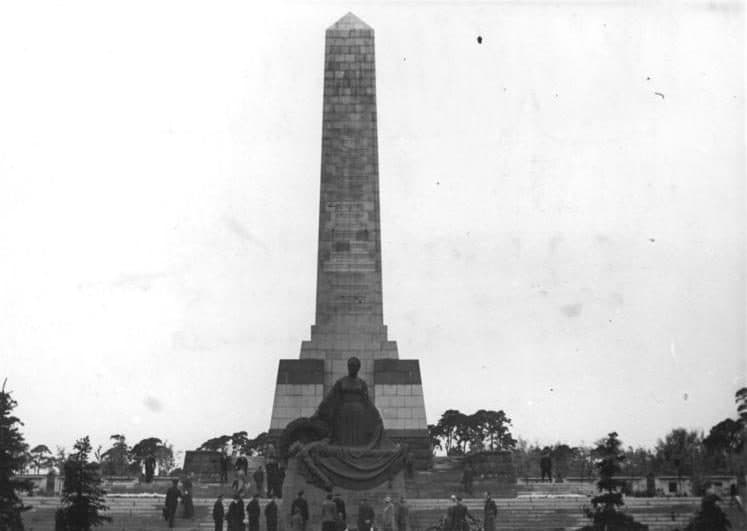
The main focus of the memorial is a statue personifying the Motherland, which is situated in front of a 33.5 meter tall obelisk made of syenite. The obelisk’s base, which is made out of black porphyry, contains 42 bronze tablets – on which the names of fallen officers are inscribed.

Mother Homeland mourning her fallen son: the bronze statue in front of the obelisk at the Soviet War Memorial in Schönholzer Heide, Berlin
Mother Homeland mourns her son, covered by the banner of victory.

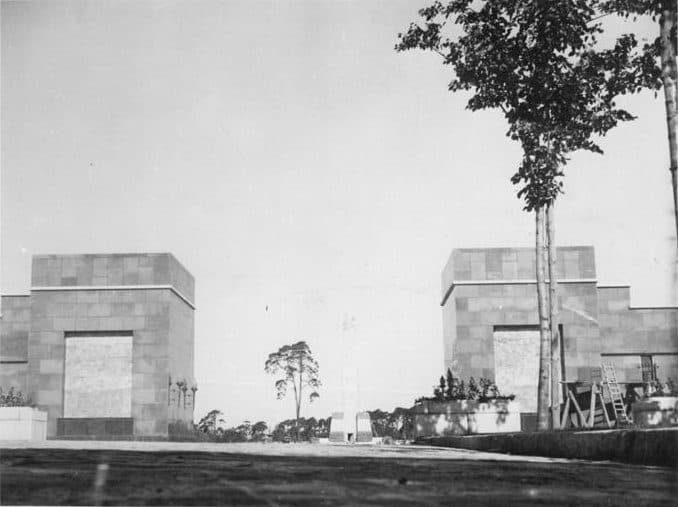
The entrance to this memorial is a sculptured avenue of lime trees, leading to two granite pillars with symbolic wreaths and bronze bowls with an eternal flame. Flanking the entrance there are two gate buildings with bronze reliefs depicting parts of the Great Patriotic War. Nearby it is possible to find eight coats of arms, symbolising the different branches of the Soviet armed forces. Similar to the Soviet War Memorial in Treptower Park, there are also quotes from Joseph Stalin on display, in German and Russian, inside the two entrance towers.

While much of this memorial appears similar to the other Soviet war memorials in the city, there is the notable exception here that many of the soldiers and officers – including two colonels – buried here have their names listed in tribute. Although the names adorning the walls constitute only one-fifth of the fallen. Most of the Soviet dead would be buried unidentified – their sacrifice relayed to their families as the ultimate price paid in the service of liberating Europe from fascism.
The memorial in detail

The gate buildings of the Soviet War Memorial in Pankow-Schönholz under construction in August 1949, with a ladder against one wall
The gate buildings shortly before completion, August 1949. Photo: Bundesarchiv, Bild 183-S87033 / Barbarino / CC-BY-SA 3.0

Building the memorial, 1947–49

The Schönholzer Heide had been a favourite outing for Berlin families since the 19th century, but during the Second World War the park was turned into a large forced-labour camp. After the war the Soviet authorities chose its north-western corner for their third great cemetery in Berlin, partly because many field graves lay nearby, waiting to be moved. Work began in May 1947 to designs by the architects Konstantin Solovyov, M. Belaventsev and V. Korolyov, with the sculptor Ivan Pershudchev.

The cemetery covers about three hectares and is laid out as one long axis: a lime avenue from Germanenstraße, the gateway, the grove of honour, and the obelisk at the far end. It was dedicated on 7 November 1949, the anniversary of the October Revolution, six months after Treptower Park. The East Berlin city government then took over its care.

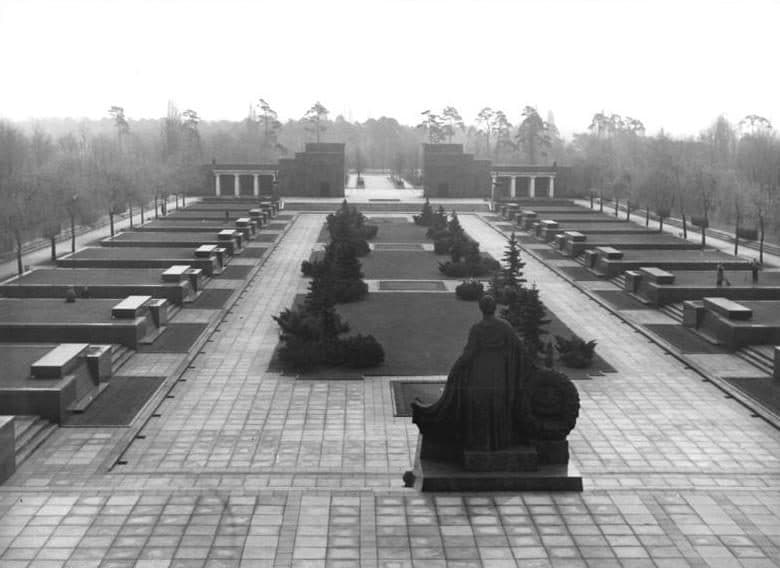
View from the obelisk over the grove of honour at the Soviet War Memorial in Berlin-Schönholz in 1956, with burial chambers either side and the gate buildings beyond
The view from the obelisk over the grove of honour, May 1956. Photo: Bundesarchiv, Bild 183-37912-0004 / Quaschinsky, Hans-Günter / CC-BY-SA 3.0

Who is buried here?

More than 13,000 Red Army officers and soldiers who died in the last battles for Berlin in April and May 1945 lie here, 120 women among them. That makes it the largest Soviet war cemetery in Berlin by number of burials, ahead of Treptower Park (more than 7,000) and the Tiergarten (about 2,500). 1,182 are buried in the 16 chambers either side of the central lawn; the rest lie in mass graves beneath the grove.

Only a minority could be identified. The 100 bronze tablets on the wall give the names, ranks and years of birth of 2,647 soldiers, and 42 more tablets on the obelisk’s base name fallen officers. Two colonels lie in the crypt beneath the obelisk’s hall of honour. A memorial stone behind the obelisk remembers Soviet soldiers who died as prisoners of war in German captivity, a rare gesture at a time when Stalin treated surrendered soldiers as suspected traitors.

Crowds at the obelisk and Mother Homeland statue of the Soviet War Memorial in Berlin-Schönholz on 8 May 1950, the first Day of Liberation
The rally on the first ‘Day of Liberation’, 8 May 1950. Photo: Bundesarchiv, Bild 183-S96434 / Köhler, Gustav / CC-BY-SA 3.0

From East German ritual to restoration

In East Germany the Soviet memorials were places of state ceremony. When the GDR made 8 May a public holiday, the ‘Day of Liberation’, in 1950, delegations from Berlin factories, the government and the parties marched to Schönholz for a rally. The memorial was repaired between 1968 and 1974, and in 1977 it appeared on an East German postage stamp.

After reunification Germany took on the Soviet war graves by treaty: the German–Soviet treaty of 9 November 1990 placed the memorials under the protection of German law, and a 1992 agreement with Russia committed the federal government to maintaining them. By 2010 the buildings showed serious damage, and a restoration costing about €10.35 million repaired every structure and the gardens, adding ramps for step-free access. The memorial reopened on 13 August 2013. Grün Berlin has looked after it for the Senate since 2008.

Plan your visit

Visiting the Soviet War Memorial in Pankow

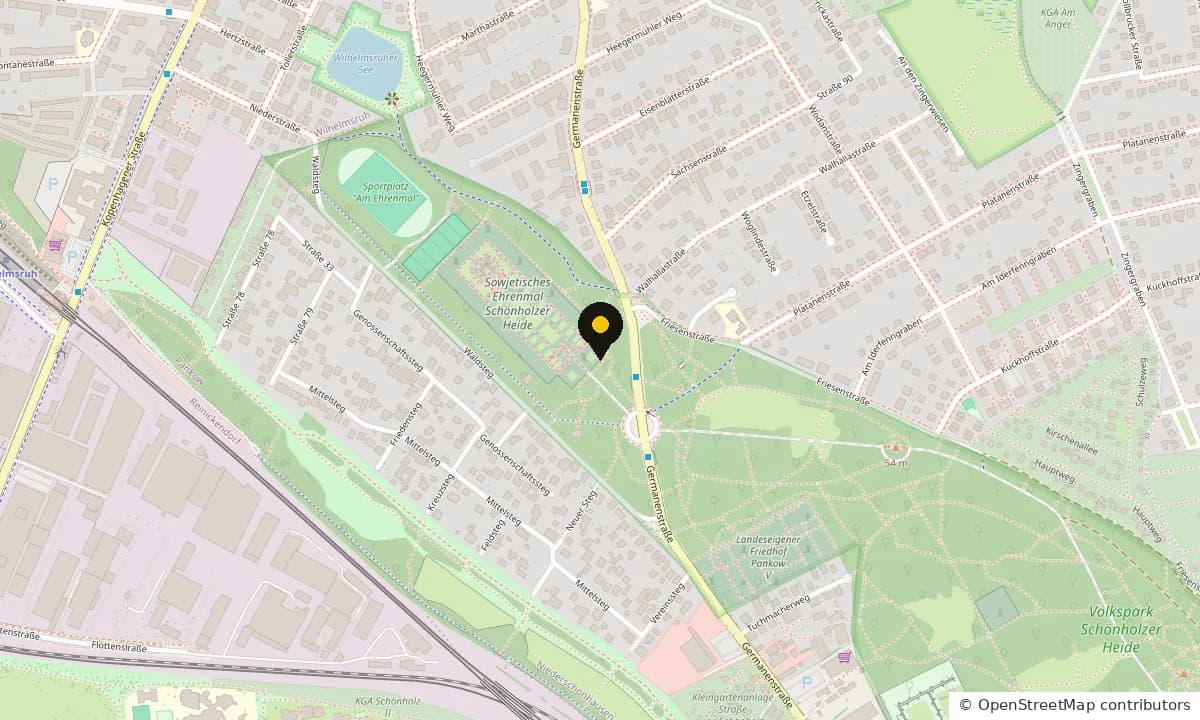
Map of the streets around the Soviet War Memorial in Pankow, with a pin on the siteOpen in Google Maps

Germanenstraße, 13156 Berlin · Daily, April–September 07:00–19:00, October–March 08:00–16:00. The gates are locked outside these hours.

Getting there

  • S1S25S85Schönholz1.1 km · 15 min

    The S1 and S25 run direct from Friedrichstraße (about 15 minutes) and Potsdamer Platz. From the station walk north along the edge of the Volkspark Schönholzer Heide and up Germanenstraße to the gateway on your left.

  • Bus 155Ehrenmal Schönholz150 m · 2 min

    The stop is beside the forecourt. Bus 155 runs between S+U Pankow (U2, S2, S8, S85) and Wilhelmsruh.

What you’ll see

  • The gateway: two granite pillars with bronze flame bowls, and two gate buildings of red granite with large bronze reliefs of the Soviet people fighting and mourning, and quotations from Stalin in German and Russian inside.
  • The grove of honour: 16 burial chambers holding 1,182 soldiers along the central lawn, inside a 560-metre wall carrying 100 bronze tablets with the names of 2,647 of the dead.
  • Mother Homeland mourning her son, under the banner of victory, in front of the 33.5-metre syenite obelisk; the obelisk’s black porphyry base bears 42 tablets with officers’ names, and two colonels lie in the crypt beneath it.

Tips from a guide

  • Mind the time: unlike Treptow, which lies in an open park, this memorial has gates that are locked at night, and from October to March they close at 16:00.
  • Bus 155 drops you at the gate; if you come by S-Bahn, the walk from Schönholz runs past the edge of the Volkspark Schönholzer Heide, the 19th-century park the cemetery was cut out of.
  • On 8 and 9 May people come to lay flowers and the police may set rules on flags and symbols at the Soviet memorials. For a quiet visit, choose another day.

Accessibility

The paths through the memorial are paved and level, and two ramps built during the 2010–13 restoration give step-free access to the lower level of the cemetery. The bus stop is beside the entrance; the walk from S Schönholz is 1.1 km. Check the BVG website for lift status at the station.

Timeline

From park to war cemetery

  1. 19th c.The Schönholzer Heide becomes a popular day out for Berlin families.
  2. 1939–45The park is turned into a large forced-labour camp.
  3. 21 Apr 1945The Red Army reaches Berlin; fighting moves into Pankow and Weißensee.
  4. 2 May 1945Berlin’s garrison surrenders. Some 80,000 Soviet soldiers have died in the battle.
  5. May 1947Work on the cemetery begins in the north-west of the park.
  6. 7 Nov 1949The memorial is dedicated, the last of Berlin’s three great Soviet memorials.
  7. 8 May 1950A rally here marks the GDR’s first ‘Day of Liberation’ holiday.
  8. 1968–74East Berlin repairs the memorial.
  9. 9 Nov 1990A German–Soviet treaty puts the Soviet memorials under German legal protection.
  10. 2010–13A €10.35 million restoration repairs all the buildings and adds ramps.
  11. 13 Aug 2013The memorial reopens to the public.

See it with a historian

Tours that stop at the Soviet War Memorial in Pankow

The memorial says little about who these soldiers were or how they died; a guide can follow their route into Berlin and explain what the memorials meant in East Germany.

The Red Army’s advance in April 1945, from the city’s edge to the Reichstag.

The Battle Of Berlin Tour - Berlin Experiences
Full Day6 Hours

The Battle Of Berlin Tour

Private 6-hour van tour of the 1945 battlefield, from the outskirts to the Reichstag, for up to 6 people. Starts at your hotel.

€1,000up to 6
View Tour

The rise and fall of the Third Reich, ending with the battle that filled these graves.

The Capital Of Tyranny Tour - Berlin Experiences
Full Day6 Hours

The Capital Of Tyranny

Private 6-hour van tour of Hitler's Berlin and the Third Reich for up to 6 people. Starts at your hotel or anywhere in the city.

€1,000up to 6
View Tour

Life behind the Iron Curtain, in the East Berlin where the Soviet memorials were state shrines.

The Berlin Wall Tour - Berlin Experiences
Full Day6 Hours

The Republic Of Fear

Private 6-hour van tour of East Berlin, the Stasi and life behind the Wall for up to 6 people. Starts at your hotel.

€1,000up to 6
View Tour

Questions visitors ask

Frequently asked questions

Where is the Soviet War Memorial in Pankow?

In the north-western corner of the Volkspark Schönholzer Heide, with its entrance on Germanenstraße in Niederschönhausen, Berlin-Pankow (13156). It is about 15 minutes’ walk from S-Bahn Schönholz, and bus 155 stops at the gate.

How many soldiers are buried at the Schönholzer Heide memorial?

About 13,200 Red Army soldiers, including 120 women, who died in the battle for Berlin in April and May 1945. Only 2,647 are named on the bronze tablets on the wall; most were buried unidentified.

Is the Soviet War Memorial in Pankow free, and when is it open?

It is free. Unlike the other two Soviet memorials it has gates: it opens daily 07:00–19:00 from April to September and 08:00–16:00 from October to March.

Which is the largest Soviet war memorial in Berlin?

By number of burials, Schönholzer Heide, with about 13,200 dead. Treptower Park is larger in area (about 9 hectares against 3) and much better known, with more than 7,000 burials; the Tiergarten memorial has about 2,500.

Who is the statue at the Schönholzer Heide memorial?

Mother Homeland, the personification of the Soviet motherland, mourning her fallen son, who lies covered by the banner of victory. The pose recalls a Christian pietà; the sculptor was Ivan Pershudchev.

Was The Lives of Others filmed here?

Yes. In the 2006 film, the writer Georg Dreyman meets his dissident friends at the memorial to plan the anonymous article that drives the second half of the story.

How long do you need at the memorial?

30–45 minutes to walk from the gateway to the obelisk and back and read the tablets. Add 15 minutes each way if you walk from S-Bahn Schönholz.

Are there tours that visit the Soviet War Memorial in Pankow?

Yes. Our Battle of Berlin, Capital of Tyranny and Republic of Fear tours can include it, and a private guide can explain the battle that filled these graves and what the memorial meant in East Germany.

Keep exploring

More Featured Experiences.

Every site we write about — 56 landmarks, museums, memorials and lesser-known corners of Berlin. See the full index →

01Walk Through The Brandenburg Gate02Explore The State Museums On Museum Island03Visit The Berlin TV Tower – The Fernsehturm04Cross The Cold War Border At Checkpoint Charlie05Visit The Site Of Adolf Hitler’s Führerbunker06Explore The Reconstructed Berlin Palace07Visit The Reichstag Cupola At Night08Explore The Forum Fridericianum09Shop At The Humboldt University Book Sale10Journey Into The Memorial To The Murdered Jews Of Europe11Step Inside The Neue Wache12Explore The Former Jewish Quarter – Spandauer Vorstadt13Visit The Remains Of The Berlin Wall14Walk Across The Bridge Of Spies15Explore The Topography Of Terror16Climb The Prussian Victory Column – The Siegessäule17Enter The Palace Of Tears – The Tränenpalast18Step Inside The Berlin Olympic Stadium19Explore Erich Mielke’s Office At The Stasi Museum20Walk Along Karl Marx Allee21Visit The Oldest Church In Berlin – The Nikolaikirche22Explore The Berliner Dom23Visit The Grave Of Frederick The Great24Walk Through The Ruins Of Anhalter Bahnhof25Stand On The Platz Des Volksaufstandes26Visit The German Resistance Museum27Visit The Soviet War Memorial In The Tiergarten28See The Georg Elser Memorial On Wilhelmstrasse29Step Inside The Kaiser Wilhelm Gedächtnis Kirche30Visit The Gleis 17 Memorial31Visit The Schloss Charlottenburg Mausoleum32Climb The Französischer Dom at Gendarmenmarkt33Explore The Interbau – IBA 5734Explore The Otto Weidt Workshop35Visit Cecilienhof – Site Of The Potsdam Conference36Visit The Stasi Prison In Hohenschönhausen37Spend The Day At Tempelhof Airport38Ride The Fastest Elevator In Europe39Visit The Soviet War Memorial In Treptower Park40Visit The Sachsenhausen Concentration Camp Memorial41Visit The Ravensbrück Concentration Camp Memorial42Visit Karlshorst – The Site Of The German Surrender43Visit The Socialists Cemetery – Zentralfriedhof Friedrichsfelde45Visit the Seelow Heights Memorial46Visit The Commonwealth War Cemetery47Cross The Bösebrücke At Night48Explore The Allied Museum In Dahlem49Explore The Spandau Citadel50Visit The Brandenburg T4 Euthanasia Memorial51Visit The Wannsee Conference House52Visit The Jewish Museum53Visit The Jewish Cemetery In Weissensee54Walk Along The East Side Gallery55Explore The Volkspark Friedrichshain Flak Tower56Head Up The Teufelsberg