Skip to content
A path along the wall of the Jewish Cemetery Weißensee in Berlin, lined with family mausoleums on one side and trees on the other

Berlin Experiences/Featured Experiences

Weißensee Jewish Cemetery: Visit Europe’s Largest Jewish Cemetery

The largest active Jewish cemetery in Europe.

The short answer

The Jewish Cemetery Weißensee (Jüdischer Friedhof Weißensee) at Herbert-Baum-Straße 45, in Berlin’s north-eastern Weißensee district, is the largest Jewish cemetery in Europe by area: about 42 hectares, with nearly 116,000 graves since it opened in 1880. Anyone can visit, Sunday to Friday; it is closed on Saturdays and Jewish holidays, and men must cover their heads (kippot can be borrowed at the entrance). There is no published admission charge. Allow one to two hours; tram M4 from Alexanderplatz takes about 14 minutes to Albertinenstraße, 8 minutes’ walk from the gate.

Where
Herbert-Baum-Straße 45, 13088 Berlin-Weißensee
Open
Sun–Fri; closed Saturdays and Jewish holidays
Admission
No fee published; men must cover their heads
Time needed
1–2 hours
Nearest station
Tram M4/M13/12 Albertinenstraße, 8 minutes on foot
Step-free
Mostly: flat, but cobbled forecourt and uneven side paths

The story · by Matt Robinson

In the heart of Berlin’s northern Weissensee district lies a silent, sprawling testament to the history and resilience of the city’s Jewish community.

The Jewish Cemetery in Weissensee, a 42-hectare expanse of graves and memorials, stands as a unique and poignant symbol of the rise, fall, and resurrection of Berlin’s Jewish population over three centuries. With over 100,000 souls laid here to rest, it remains the largest active Jewish cemetery in Europe, nearly 150 years after its founding.

Though there are other European burial grounds with larger numbers of Jewish graves—such as Kozma Street Jewish Cemetery in Budapest (approx 300,000) and Okopowa Street Jewish Cemetery in Warsaw (approx 250,000) —none can match the ongoing legacy and historical record of the Weissensee Cemetery. The meticulously preserved death registry of which offers an unparalleled glimpse into the lives of those who rest here and the triumphant and troubled lineage of Berlin’s Jewish Community.

Unveiled in 1880 and designed by architect Hugo Licht, the cemetery complex was established to accommodate the city’s growing and increasingly affluent Jewish minority, which included around 65,000 members at the time. The previous Jewish cemetery on Schönhauser Allee had reached capacity, necessitating the creation of this vast new resting place.

But the significance of Weissensee Cemetery goes beyond its grand scale. It captures the spirit and aspirations of a minority community at the height of its ascendancy, with the graves, crypts, and mausoleums here marking the path from emancipation and integration to mass persecution, expulsion, extermination – and back. Bilingual inscriptions in German and Hebrew adorn the predominantly shiny black granite gravestones, echoing the voices of a vibrant and storied past.

Berlin’s Jewish elite

Among the notable figures buried here are politicians, spiritual leaders, inventors, economists, and entrepreneurs. Names such as Berthold Kempinski, founder of Kempinski Hotels, Hermann Tietz and Adolf Jandorf of the famed department stores, and prominent publishers Samuel Fischer and Rudolf Mosse are etched in stone.

Black granite obelisks for David and Natalie Levin among older graves at the Jewish Cemetery Weißensee in Berlin, inscribed in German
Black granite obelisks with German inscriptions, typical of the older fields.

These individuals have come to represent a generation that straddled the cusp of general emancipation, striving for recognition, respect, and the greater possibility of prosperity and social acceptability. They would embody a new class of Jewish elite at the turn of the 20th century, characterised by diligence, industriousness, self-discipline, and ambition.

Part of a community that sought to shake off the shackles of intolerance and forge a new path of German identity – while still remaining Jewish.

The field of honour

South of the main mourning hall is a field of honour, laid out in 1914, whose memorial was dedicated in 1927 by the National Association of Jewish Combat Soldiers (Reichsbund jüdischer Frontsoldaten) for 395 of the 12,000 Jewish soldiers who made the ultimate sacrifice for their integration during the First World War.

At its centre stands a three-metre high monumental altar made of shell limestone, designed by architect, Alexander Beer, who would serve as Gemeindebaumeister (Community Architect in Chief) to the Jewish Community in Berlin until his eventual deportation and death in Theresienstadt concentration camp in 1944.

Hiding among the graves

Like the broken trees that have toppled throughout the cemetery, the lineage of the Jewish community remains evidently divided: between those who were persecuted and perished, at the hands of National Socialist terror, and those that fled.

Essential to this darkest chapter in the cemetery’s history are also those who remained and hid amongst the tombs here.

During the height of the Holocaust, the Weissensee cemetery became a sanctuary for many, including Martin Riesenburger, who would later become the rabbi of East Berlin’s Jewish community. Along with his wife, Riesenburger sought refuge within the cemetery’s walls from 1943 to 1944. Amidst the horror of the Holocaust, he continued to bury the Jewish dead and courageously conducted religious services on the hallowed grounds.

Memorial stone at the Jewish Cemetery Weißensee to the men and women buried there who fought National Socialism, placed by the Jewish Community of Berlin in 2009
The Jewish Community’s 2009 stone for those buried here who fought National Socialism.

Riesenburger’s resourcefulness extended to the safeguarding of numerous religious artifacts, including Torah scrolls and silver ornaments. By concealing these sacred items within the cemetery, he ensured their survival against all odds. As the war drew to a close, he held his first post-war prayer service on May 11, 1945, a poignant reminder of the resilience of the Jewish faith.

The burial vault of the opera singer Joseph Schwarz offered refuge to those in hiding. But not all stories ended in salvation. The discovery of some hiding spots by the Gestapo led to unspeakable cruelty, as recounted by Christoph Hein in a harrowing report.

The dead without graves

At the entrance of the cemetery, a memorial honours the countless Holocaust victims who perished in the camps and have no graves.

The first memorial plaque, installed in September 1945, commemorates those whose ashes were scattered.

A long avenue of trees between rows of gravestones at the Jewish Cemetery Weißensee, Berlin
One of the tree-lined avenues between the grave fields.

In a solemn ceremony on January 27, 1992, marking the 47th anniversary of the liberation of Auschwitz, an urn containing the ashes of Auschwitz victims was placed in the cemetery.

While it is the Holocaust that remains the focal point on entering the cemetery, and a recurring theme throughout, the markers of ordinary life – and death – feature here dispersed like the plants and flowers that mark the natural passage of time.

Life goes on – and we must face up to its painful realities and liberating joys until its inevitable end.
The cemetery in detail

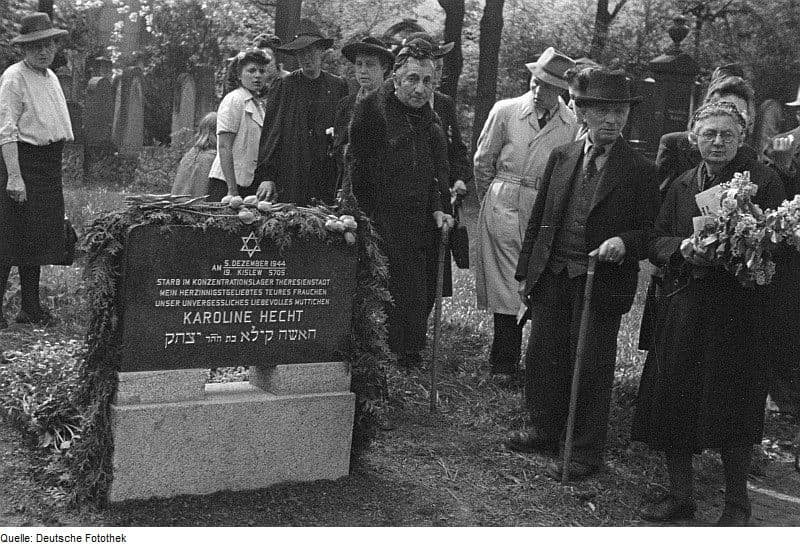
Mourners at the Jewish Cemetery Weißensee in May 1946 beside a new gravestone for Karoline Hecht, who died in Theresienstadt in December 1944
May 1946: a new stone for Karoline Hecht, who died in Theresienstadt in December 1944. Photo: Abraham Pisarek / Deutsche Fotothek / CC BY-SA 3.0 DE, via Wikimedia Commons

The cemetery under the Nazis

As persecution turned to deportation, the number of burials at Weißensee peaked in 1942. Many were suicides: 1,907 Jews who took their own lives between 1933 and 1945 are buried here. Until the early 1940s the cemetery nursery trained young Jews as gardeners, a skill meant to help them build a new life after emigrating, above all to Palestine.

In spring 1943 the community hid 583 Torah scrolls in the second mourning hall, built in 1910 in the south-east of the grounds. An incendiary bomb hit it that summer; about 90 scrolls were too badly burned to save and were buried near the entrance, where a stone reads ‘Here lie desecrated Torah scrolls’. Bombs damaged some 4,000 graves, but the Nazis never systematically desecrated the cemetery. Why remains unclear; the historian Hermann Simon has suggested its sheer size.

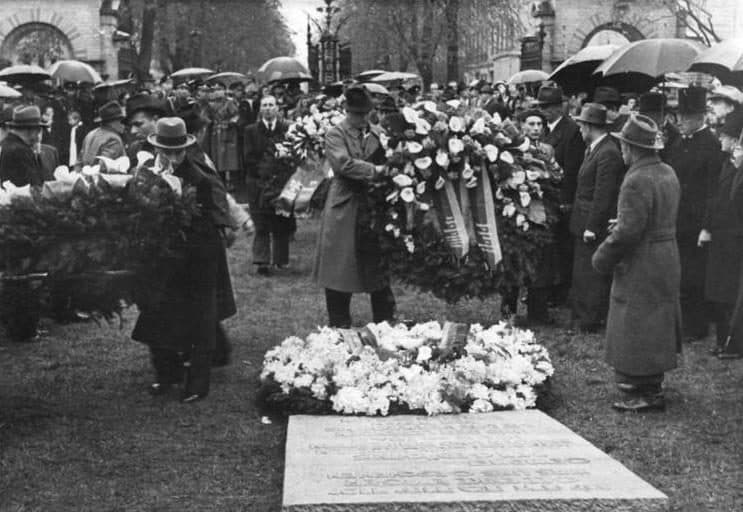
Wreaths laid at a new memorial to the Jews murdered by the Nazis, unveiled at the Jewish Cemetery Weißensee in Berlin on 23 April 1950
Wreaths at a new memorial to the murdered Jews, unveiled on 23 April 1950. Photo: Bundesarchiv, Bild 183-S95929 / Köhler, Gustav / CC-BY-SA 3.0

A divided community

Berlin’s Jewish community split into East and West from 1953, and in 1955 the West Berlin community bought woodland on Heerstraße for a cemetery of its own. From then on only the small, shrinking East Berlin community used Weißensee. In the 1920s about 200 people had tended the grounds; by the 1980s there were 16, and the trees and ivy took over. The ivy is now deliberately left in place.

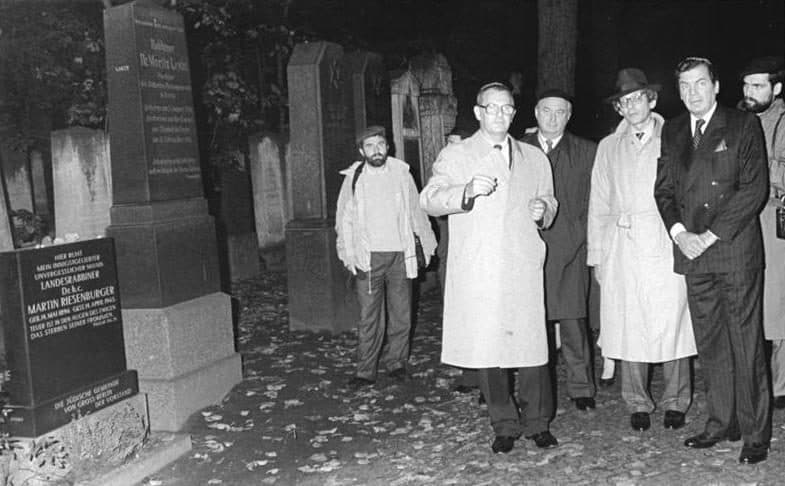
East Berlin did little for the site until 1977, when the city recognised it as a cultural monument and began paying for its upkeep; students and volunteers from Action Reconciliation helped clear the worst damage. The community’s rabbi, Martin Riesenburger, who had survived the war on these grounds, served East Berlin’s Jews until his death in 1965 and is buried here.

Edgar Bronfman, president of the World Jewish Congress, touring the Jewish Cemetery Weißensee in October 1988, beside the grave of Rabbi Martin Riesenburger
October 1988: Edgar Bronfman (right) of the World Jewish Congress, by Martin Riesenburger’s grave (left). Photo: Bundesarchiv, Bild 183-1988-1016-012 / Oberst, Klaus / CC-BY-SA 3.0

The road that was never built

In the 1920s the city bought a strip across the cemetery for a planned arterial road, and no graves were dug there. East Berlin revived the plan in the 1970s: the road would have cut the cemetery in two, linked only by footbridges. The East Berlin community agreed in writing in 1982 and work began in 1986. Protests came from abroad and from the East German opposition group Women for Peace, and the writer Stefan Heym objected that his family lay there. In October 1986 Erich Honecker ordered the work stopped.

Since 1990 the strip has been used for burials. In October 1999 vandals smashed more than 100 gravestones; the culprits were never found. From 2010 Berlin restored the 2.7 km wall, and in May 2025 the Holocaust survivor Margot Friedländer was buried here, beside her grandparents.

Plan your visit

Visiting the Jewish Cemetery Weißensee

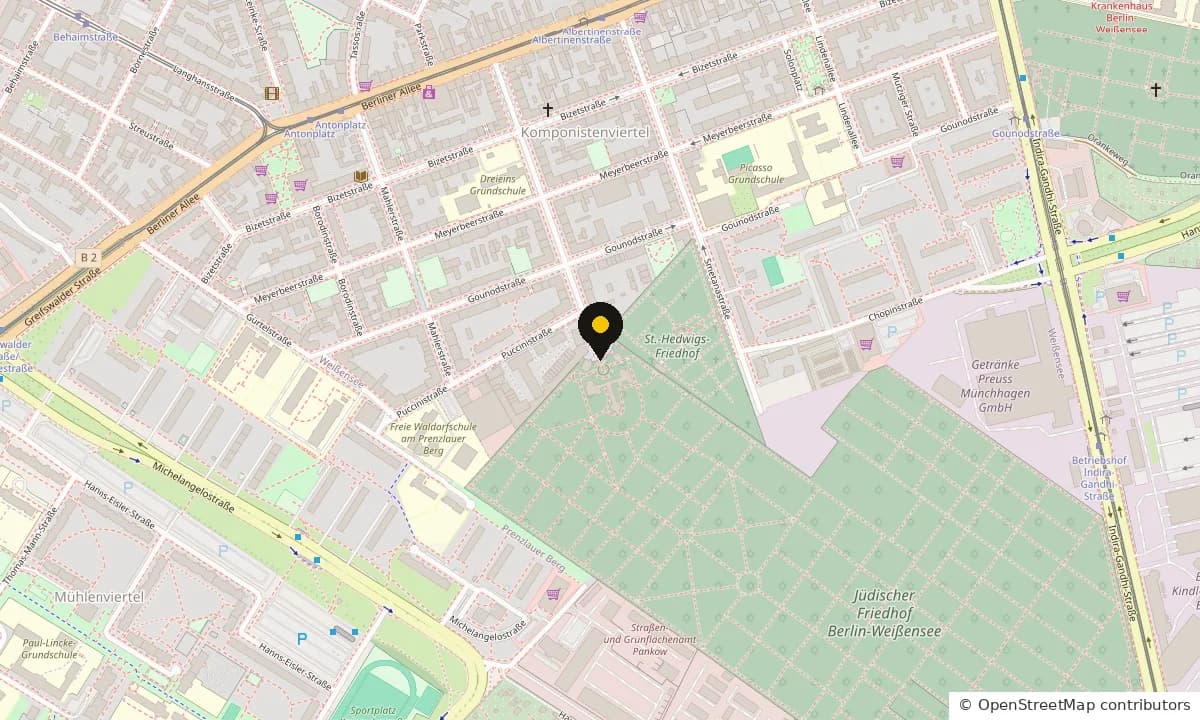
Map of the streets around the Jewish Cemetery Weißensee, with a pin on the siteOpen in Google Maps

Herbert-Baum-Straße 45, 13088 Berlin · Winter (1 October–31 March): Monday–Thursday 07:30–16:00, Friday 07:30–14:30, Sunday 08:00–16:00. Summer (1 April–30 September): Monday–Thursday 07:30–17:00, Friday 07:30–14:30, Sunday 08:00–17:00. Closed on Saturdays (the Sabbath) and Jewish holidays; check before you go.

Getting there

  • Tram M4Tram M13Tram 12Albertinenstraße600 m · 8 min

    The M4 runs along Greifswalder Straße from Hackescher Markt (20 min) and Alexanderplatz (14 min). Walk south down Herbert-Baum-Straße: the gate is at the end of the street.

  • S41S42Tram M4Greifswalder Straße5 min by tram, then 8 min on foot

    From the Ringbahn, change at Greifswalder Straße to the M4 heading north-east and ride to Albertinenstraße.

  • U2Tram 12Eberswalder Straße15 min by tram, then 8 min on foot

    From Prenzlauer Berg, take the 12 towards Weißensee, Pasedagplatz and get off at Albertinenstraße.

What you’ll see

  • Hugo Licht’s yellow-brick entrance buildings of 1880 in the Italian Renaissance style, linked by arcades to the domed mourning hall, and in front of them the memorial to the victims of the Shoah, ringed by stones bearing the names of the camps.
  • The row of honour to the right of the entrance, with the grave of the resistance fighter Herbert Baum and, on the back of his stone, the names of 27 members of his group killed in 1942–43.
  • 120 geometric grave fields under trees and ivy, grand family vaults and mausoleums along the walls, and the field of honour with Alexander Beer’s 1927 memorial to the Jewish soldiers of the First World War.

Tips from a guide

  • Plan around the Sabbath: the gates are shut all day Saturday and on Jewish holidays, and on Fridays they close at 14:30.
  • Men must cover their heads (kippot can be borrowed at the entrance). Keep to the paths: do not step on graves or sit on gravestones.
  • Looking for a family grave? The complete burial register survives: contact the cemetery administration before you go (030 925 3330, juedfriedweissensee@jg-berlin.org).

Accessibility

The cemetery is flat. The forecourt on Markus-Reich-Platz is cobbled, the main avenues are paved or gravelled, and the paths between the grave fields are narrow, uneven and often overgrown with ivy. There are visitor toilets, though they are not cleaned at weekends. Check the BVG website for step-free access at the tram stops.

Timeline

From 1880 to today

  1. 1827The Jewish community opens its cemetery on Schönhauser Allee.
  2. 9 Sep 1880The Weißensee cemetery, designed by Hugo Licht, is consecrated.
  3. 1914A field of honour for Jewish soldiers of the First World War is laid out.
  4. 1927Alexander Beer’s memorial to the 12,000 fallen Jewish soldiers is dedicated.
  5. 1943583 Torah scrolls are hidden in the second mourning hall; a bomb damages them.
  6. 11 May 1945Martin Riesenburger holds the first service after the liberation.
  7. Sep 1945A first memorial plaque for the murdered who have no graves is put up.
  8. 1949Herbert Baum’s remains are found and reburied in the row of honour.
  9. Oct 1986Honecker halts a road being built across the cemetery.
  10. 27 Jan 1992An urn of ashes from Auschwitz is placed at the entrance memorial.
  11. Oct 1999Vandals smash more than 100 gravestones.
  12. 15 May 2025Holocaust survivor Margot Friedländer is buried at Weißensee.

See it with a historian

Tours that stop at the Jewish Cemetery Weißensee

The cemetery is 42 hectares and a long way from the centre; on a private tour a guide can take you straight to the graves that matter and tell the stories behind the names.

The Berlin History Tour
Full Day6 Hours

The Berlin History Tour

Private 6-hour van tour of Berlin's whole history in one day for up to 6 people. Starts at your hotel or anywhere in the city.

€1,000up to 6
View Tour

Why this tour

Our all-in-one day by private van, built around the places you most want to see.

See the Berlin History Tour

Questions visitors ask

Frequently asked questions

Is Weißensee the largest Jewish cemetery in Europe?

By area, it is usually described as the largest: about 42 hectares, with nearly 116,000 graves. Some cemeteries, such as Kozma Street in Budapest, hold more burials.

When is the Jewish Cemetery Weißensee open?

Sunday to Friday. From October to March it is open Monday–Thursday 07:30–16:00, Friday 07:30–14:30 and Sunday 08:00–16:00; from April to September it closes at 17:00 instead of 16:00 (Friday stays 14:30). It is closed on Saturdays and Jewish holidays.

Why is the cemetery closed on Saturdays?

Saturday is the Sabbath, the Jewish day of rest, when Jewish cemeteries stay closed. It also closes on Jewish holidays, which move each year, so check the Jewish Community’s list before you go.

Do I need to cover my head?

Men must cover their heads. If you have no hat, kippot can be borrowed at the entrance.

How do I get to the Jewish Cemetery Weißensee?

Take tram M4, M13 or 12 to Albertinenstraße and walk 8 minutes south down Herbert-Baum-Straße to the gate. The M4 takes about 14 minutes from Alexanderplatz and 20 from Hackescher Markt.

Who is buried at Weißensee?

Among many others: the philosopher Hermann Cohen, the composer Louis Lewandowski, the painter Lesser Ury, the publishers Samuel Fischer and Rudolf Mosse, the department-store founders Hermann Tietz and Adolf Jandorf, the writer Stefan Heym, the resistance fighter Herbert Baum and the Holocaust survivor Margot Friedländer.

Can I find a relative’s grave?

Very likely: the cemetery’s burial register survives complete. Contact the administration before you go (030 925 3330, juedfriedweissensee@jg-berlin.org).

Are there guided tours of the cemetery?

The Friends of the Jewish Cemetery Weißensee run tours in German, for a donation, booked by email. Our Berlin History Tour can include the cemetery on a private day by van.

Keep exploring

More Featured Experiences.

Every site we write about — 56 landmarks, museums, memorials and lesser-known corners of Berlin. See the full index →

01Walk Through The Brandenburg Gate02Explore The State Museums On Museum Island03Visit The Berlin TV Tower – The Fernsehturm04Cross The Cold War Border At Checkpoint Charlie05Visit The Site Of Adolf Hitler’s Führerbunker06Explore The Reconstructed Berlin Palace07Visit The Reichstag Cupola At Night08Explore The Forum Fridericianum09Shop At The Humboldt University Book Sale10Journey Into The Memorial To The Murdered Jews Of Europe11Step Inside The Neue Wache12Explore The Former Jewish Quarter – Spandauer Vorstadt13Visit The Remains Of The Berlin Wall14Walk Across The Bridge Of Spies15Explore The Topography Of Terror16Climb The Prussian Victory Column – The Siegessäule17Enter The Palace Of Tears – The Tränenpalast18Step Inside The Berlin Olympic Stadium19Explore Erich Mielke’s Office At The Stasi Museum20Walk Along Karl Marx Allee21Visit The Oldest Church In Berlin – The Nikolaikirche22Explore The Berliner Dom23Visit The Grave Of Frederick The Great24Walk Through The Ruins Of Anhalter Bahnhof25Stand On The Platz Des Volksaufstandes26Visit The German Resistance Museum27Visit The Soviet War Memorial In The Tiergarten28See The Georg Elser Memorial On Wilhelmstrasse29Step Inside The Kaiser Wilhelm Gedächtnis Kirche30Visit The Gleis 17 Memorial31Visit The Schloss Charlottenburg Mausoleum32Climb The Französischer Dom at Gendarmenmarkt33Explore The Interbau – IBA 5734Explore The Otto Weidt Workshop35Visit Cecilienhof – Site Of The Potsdam Conference36Visit The Stasi Prison In Hohenschönhausen37Spend The Day At Tempelhof Airport38Ride The Fastest Elevator In Europe39Visit The Soviet War Memorial In Treptower Park40Visit The Sachsenhausen Concentration Camp Memorial41Visit The Ravensbrück Concentration Camp Memorial42Visit Karlshorst – The Site Of The German Surrender43Visit The Socialists Cemetery – Zentralfriedhof Friedrichsfelde44Visit The Soviet War Memorial In Pankow45Visit the Seelow Heights Memorial46Visit The Commonwealth War Cemetery47Cross The Bösebrücke At Night48Explore The Allied Museum In Dahlem49Explore The Spandau Citadel50Visit The Brandenburg T4 Euthanasia Memorial51Visit The Wannsee Conference House52Visit The Jewish Museum54Walk Along The East Side Gallery55Explore The Volkspark Friedrichshain Flak Tower56Head Up The Teufelsberg