Skip to content
The Berliner Dom (Berlin Cathedral) seen from the Lustgarten on Museum Island, with the TV Tower behind on the left

Berlin Experiences/Featured Experiences

Berliner Dom: Visit Berlin Cathedral, Its Dome and Royal Crypt

The former royal church of the Hohenzollern dynasty.

The short answer

The Berliner Dom, or Berlin Cathedral, is the largest Protestant church in Germany, built for the Hohenzollern dynasty and consecrated in 1905. It stands on the Lustgarten on Museum Island in Berlin-Mitte, four minutes’ walk from the U5 station Museumsinsel. It is open daily from 09:00 (Sundays from 12:00) to 18:00, with last entry at 17:00. A €15 ticket covers the church, the Hohenzollern crypt, the museum, the walk around the dome and an audio guide. Allow about 1½ hours.

Where
Am Lustgarten, 10178 Berlin-Mitte (Museum Island)
Open
Mon–Sat 09:00–18:00, Sun 12:00–18:00; last entry 17:00
Admission
€15, concessions €12; audio guide included
Time needed
About 1½ hours
Nearest station
U5 Museumsinsel, 4 minutes on foot
Step-free
Mostly: lifts to the church and crypt, not the dome

The story · by Matt Robinson

If churches and cathedrals are the eternal chaperones of great European cities, there is no more important religious site in Berlin than the imposing Berliner Dom.

Situated on the eastern edge of Berlin’s Museumsinsel, this striking landmark once provided the spiritual element of the triumvirate of Prussian presence here. The royal trinity offered by the Stadtschloss (representing the might and righteousness of the Hohenzollern royal family), the Altes Museum (worldly affluence and culture), and the Berliner Dom (a projection of heavenly authority underpinning the imperial power). Add to this the distant Zeughaus, once the Royal armoury, to the west across the river on Unter den Linden – and one can learn a lot about the values at the core of the Prussian heart and empire by digesting this representative panorama.

Consecrated on February 27th 1905, the Berlin Cathedral was designed by Catholic architects, Julius and Otto Raschdorff (father and son) although built by the order of Kaiser Wilhelm II – in a historicist mixture of Neo-Baroque and high Neo-Renaissance style. It is the largest protestant church in Germany, at 98m tall, and perhaps the most gaudy, overly decorated protestant church in the world. The dome alone is seventy metres high.

Inside the Berliner Dom: the altar, marble columns and stained-glass windows of the Sermon Church in Berlin Cathedral
The altar of the Sermon Church.

When the Berliner Dom was consecrated, it was intended not only as direct competition to St Paul’s in London (which stands 5 metres smaller than the Berlin equivalent) but also a dedication towards its greater (and taller by 20 metres) sister church in Rome, St Peter’s.

The Hohenzollern crypt

Like St Peter’s, it serves not only as a holy consecrated site of worship but resting place for members of the Hohenzollern dynasty, including the first Prussian king, Frederick I, and his second and most revered wife, Sophie Charlotte.

One of Berlin’s most enigmatic and intriguing crypts, as part of the Dom’s substructure this site has been used as a royal burial ground all the way back to the 1500s when Hohenzollern Elector Joachim II moved the royal chapter to the former Dominican church south of the palace.

Akin to the Capuchin Crypt in Vienna, where members of the House of Habsburg (including 12 emperors and 18 empresses) are entombed, and the Basilica of Saint-Denis (which contains the remains of the Kings of France – including nearly every king from the 10th century to Louis XVIII in the 19th century), the Berliner Dom contains one of the most important dynastic burial sites in Europe. With the church itself serving as an elaborate tombstone atop.

With the church itself serving as an elaborate tombstone atop.

The royal crypt’s marble-lined walls are bordered with numerous tombs and sarcophagi. The tomb of King Frederick III is located in one corner and is adorned with a metal sculpture of the monarch. Several other Prussian Royal Family members are also buried in the vault, including Queen Elisabeth and her sister Augusta.

In addition, there are many fascinating relics and works of art in the crypt. The most impressive of these is a sizable stained glass display that the Prussian Royal Family ordered in 1901 and that features biblical scenes. A number of statues and busts of members of the royal family, as well as different artworks and sculptures, are also located in the crypt.

An absent emperor, the Nazis and the war

Numerous notable people have visited the crypt over the years, including German President Paul von Hindenburg and Kaiser Wilhelm II and his wife. Although the man who conceived and financed the construction of the present day church – German Emperor, Wilhelm II – did not find his final resting place in the cellar of the Berlin Dom – unlike the 91 members of the House of Hohenzollern from the late 16th to the early 20th century that can be found permanently located here. Undeniably due to the circumstances surrounding his abdication in 1918 and subsequent flight to the Netherlands, where he would remain in exile until his death in 1941. He is instead buried in a mausoleum upon the grounds of Huis Doorn – his home for the twilight years of his life.

During the Nazi period, swastika flags flew from the cathedral on certain days and the regime often used the cathedral as a stage for its propaganda events. In 1935, the wedding of Hermann Göring to Emmy Göring (née Emma Johanna Henny Sonnemann) took place here, with Adolf Hitler acting as best man.

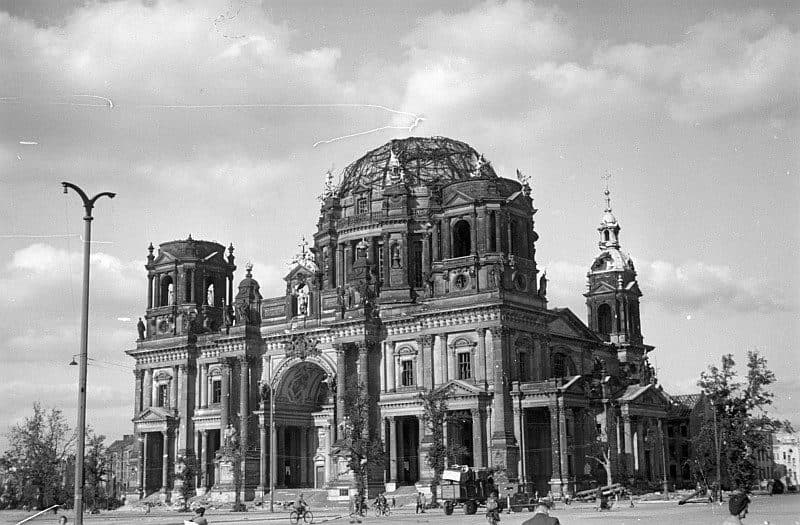
The structure was – like most things in central Berlin – severely damaged during the Second World War, from a combination of Anglo-American air raids and the Soviet invasion and occupation of the city in 1945. On the 24th May, 1944, a liquid incendiary bomb dropped by a US bomber hit the dome lantern and set it and the entire outer dome on fire. The lantern structure collapsed under its weight, smashing the inner stone dome and falling into the sermon church, where it broke through the church floor and damaged the coffins in the Hohenzollern crypt. The memorial church and its four towers were also damaged by the attack.

The inner dome of the Berliner Dom from below, with its ring of windows and mosaics, rebuilt after the 1944 fire
The inner dome, restored after the war.

The organ, the dome and the view

Due to the state policy of ‘Ruinen schaffen ohne Waffen’ inflicted on the eastern areas of Berlin by the East German authorities – destruction through neglect – it was not until 1985 that the Berliner Dom was restored to some part of its former glory and 1993 when it was eventually reopened to the public.

While the exterior of the building is impressive enough, undeniably one of the church’s star attractions is its huge pipe organ, complete with 7,269 pipes – all of which were melted down for scrap during WWI but have since been replaced – making it the largest late-Romantic organ that has survived in its original condition.

When you enter the Berlin Cathedral, your gaze will inevitably go up. The interior is tall enough to fit the entire Siegessäule (Victory Column) inside with room to spare. In fact, one of the most impressive parts of the church is the balcony surrounding the domed roof – reachable following 270 cathedral steps. From a height of 50m, visitors have a perfect 360 degree panoramic view of Berlin – with the museums on Museumsinsel, the Berlin City Palace, the Red Town Hall, and the Lustgarten all so close they feel within arm’s reach.

View from the dome of the Berliner Dom over the Lustgarten and Museum Island in Berlin, with a corner tower of the cathedral on the right
The view from the dome walk, 50 metres up.

Unlike other parishes, the Berliner Dom parish has to generate 97% of its annual budget itself, with only 3% coming from church taxes and grants from the state of Berlin. That equates to around 17,000€ per day for the maintenance of the listed building, musicians, church services, heating, electricity, security, staff and more. Thus expect to pay a reasonable 15€ per person for the opportunity to explore this magnificent structure.
The Berliner Dom in detail

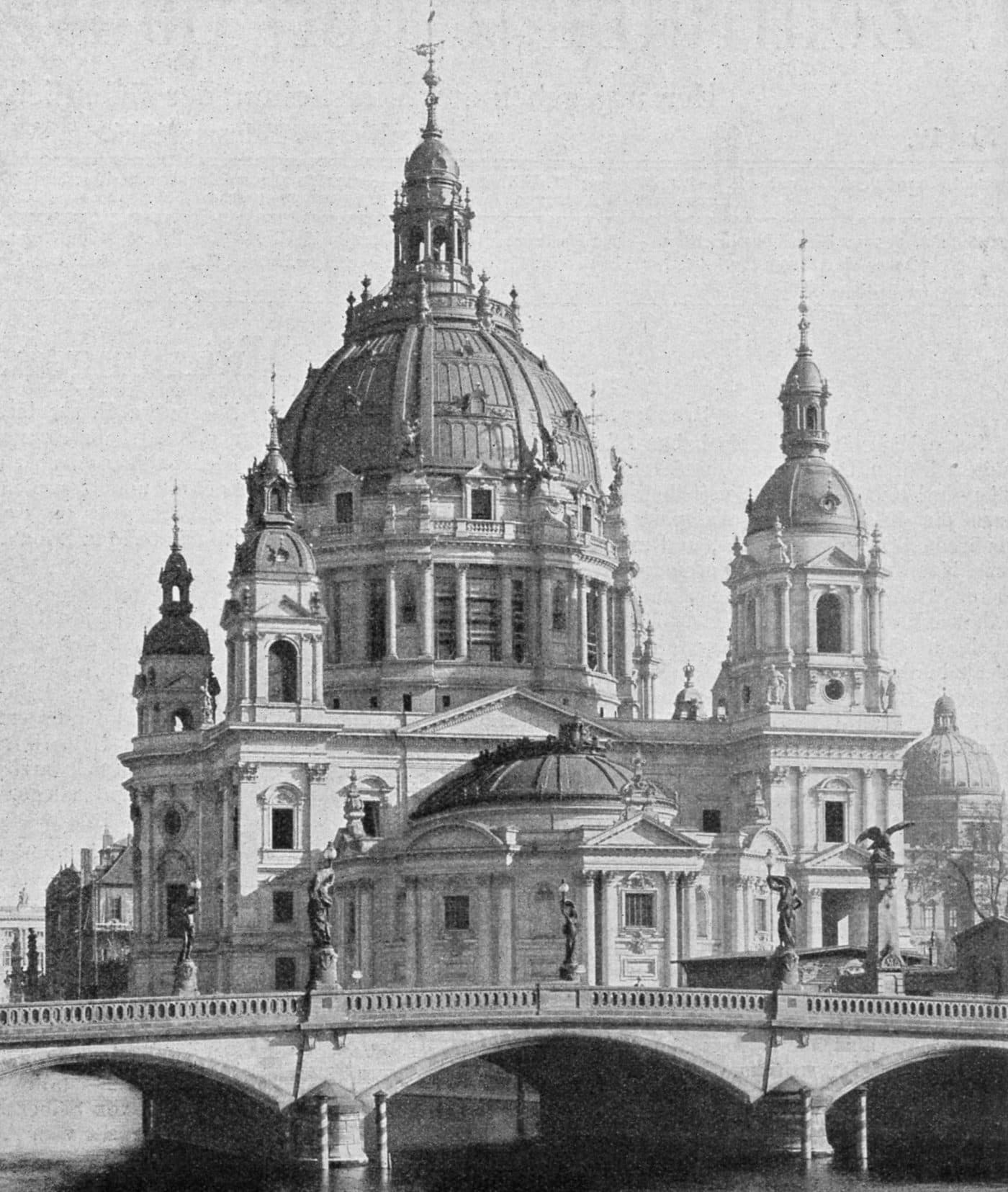
The new Berliner Dom in 1905, with its original tall dome and the memorial church on the north side, seen across the Spree
The cathedral in 1905, with its original dome and the memorial church in front. Photo: Unknown photographer / Public domain, via Wikimedia Commons

Three cathedrals on the Spree

The Berliner Dom is the third building to carry the name. In 1536 Elector Joachim II turned the Dominican church south of his palace into a richly furnished court church with princely tombs, and three years later it became Lutheran. Frederick the Great replaced it with a sober baroque church on the Lustgarten, consecrated in 1750, and had the electors’ coffins moved there. Karl Friedrich Schinkel remodelled that building in a plain classical style in 1816–21.

For the new German Empire it looked far too modest. Friedrich Wilhelm IV’s plans for a grand basilica got no further than the foundations, and it took Wilhelm II, as king and supreme governor of the Prussian church, to have Schinkel’s cathedral pulled down in 1893. Julius Raschdorff’s building went up from 1894, paid for by the state. When it was consecrated in 1905 it was 114 metres long, with a separate memorial church on its north side for the royal tombs.

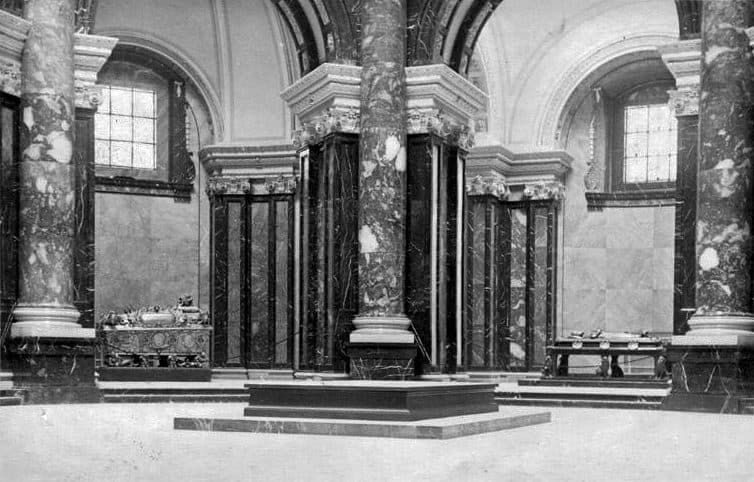
The memorial church (Denkmalskirche) of the Berliner Dom around 1900, with Hohenzollern sarcophagi between marble columns
The memorial church and its royal sarcophagi, around 1900. It was demolished in 1975. Photo: Unknown photographer / Public domain, via Wikimedia Commons

Inside the Hohenzollern crypt

The crypt takes up almost the whole basement of the cathedral. The cathedral counts 91 burials, from the end of the 16th century to the beginning of the 20th, among them the Great Elector, King Frederick I, Queen Sophie Charlotte and Elisabeth Christine, the wife of Frederick the Great. The oldest coffin is that of Elisabeth Magdalene, a daughter of Joachim II, who died in 1595. Most striking are the wooden coffins still covered in velvet and brocade, which rarely survive anywhere.

When the dome fell in 1944, the fire and falling masonry wrecked part of the crypt and destroyed some coffins almost completely. The grandest sarcophagi, including Andreas Schlüter’s gilded tombs for Frederick I and Sophie Charlotte, stood in the memorial church until East Germany demolished it in 1975, and have stood in the Sermon Church since. After six years of building work the crypt reopened on 1 March 2026, with a new introductory room and an interactive model showing where each coffin lies.

The war-damaged Berliner Dom in October 1945, its dome stripped to the bare frame, seen from the Lustgarten
The cathedral in October 1945, its dome burnt down to the frame. Photo: Abraham Pisarek / Deutsche Fotothek / CC BY-SA 3.0 DE, via Wikimedia Commons

From ruin to reopening

After the fire of 24 May 1944 the inner dome survived, but a huge hole gaped in the middle of the church, and rain and dust did the rest. The congregation moved into part of the crypt, which served as its church until 1971, and the damaged building was patched up enough to house the theology faculty of the Humboldt University. Closing the dome took until 1953.

Restoration only began in 1975, largely paid for in Deutschmarks by the West German Protestant Church and the Federal Government. The price was a simpler cathedral: the memorial church was demolished, and the dome and corner towers were rebuilt without their lanterns, 16 metres lower. The baptismal and wedding church reopened in 1980 and the Sermon Church on 6 June 1993, with Chancellor Helmut Kohl in the congregation. The last of the dome mosaics was unveiled in 2002.

Plan your visit

Visiting the Berliner Dom

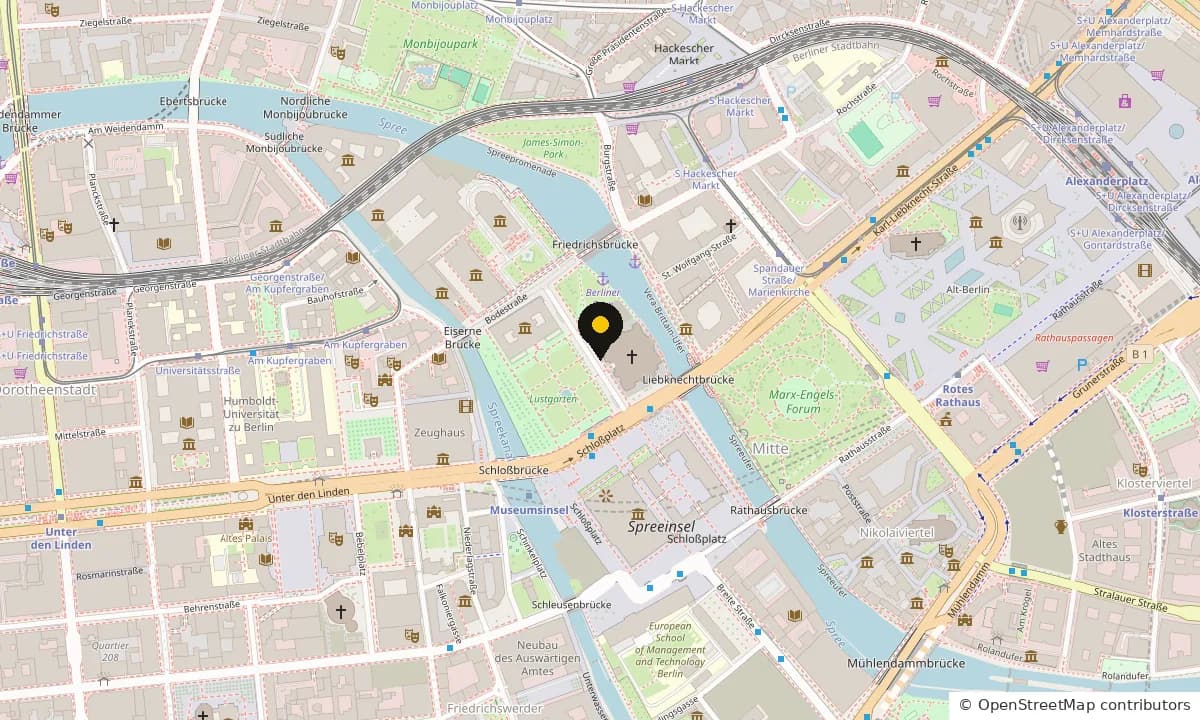
Map of the streets around the Berliner Dom, with a pin on the siteOpen in Google Maps

Am Lustgarten, 10178 Berlin · Monday–Saturday 09:00–18:00, Sunday 12:00–18:00 (after the morning service). Last entry 17:00. Hours change at short notice for services, concerts and events: check the cathedral’s daily calendar before you go.

Getting there

  • U5Museumsinsel300 m · 4 min

    Opened in 2021. Walk north past the Humboldt Forum and across the Lustgarten to the cathedral’s west front.

  • S3S5S7S9Hackescher Markt600 m · 8 min

    Walk south down Burgstraße along the Spree and cross the Friedrichsbrücke.

  • Bus 100Bus 200Bus 300Lustgarten100 m · 2 min

    Bus 100 is the classic sightseeing route between Zoologischer Garten and Alexanderplatz.

What you’ll see

  • The Sermon Church (Predigtkirche) beneath the great dome, with Anton von Werner’s mosaics, the oak pulpit, the Hohenzollern showpiece sarcophagi and the 7,269-pipe Sauer organ of 1905.
  • The Hohenzollern crypt, reopened in March 2026 after six years of building work: 91 burials from the late 16th to the early 20th century, introduced by a new room with an interactive model of the crypt.
  • The walk around the dome, 50 metres up and 270 steps from the ground: an open-air view over Museum Island, the Humboldt Forum, the Lustgarten, the Red Town Hall and the TV Tower.

Tips from a guide

  • Tickets are valid for a year from purchase, so buy online and pick a clear day: the dome walk is open to the weather and the view is half the point.
  • Free 30-minute guided tours, included in the ticket, generally start at 13:00, 14:00 and 15:00 in the Sermon Church. They are sometimes cancelled for rehearsals or events.
  • Rucksacks, suitcases and bags larger than A3 are not allowed inside, and the lockers in the basement are limited, so travel light. It is a working church: there is a short midday prayer at 12:00, Monday to Saturday.

Accessibility

Since March 2026 the cathedral can be visited step-free. A self-service lift on the north side rises from the street to the arcades and the main portals, and a lift beside the visitors’ staircase in the south tower links the crypt, the church and the Cathedral Museum. Accessible toilets are in the basement. The dome can only be reached by stairs. Visitors with a severe disability (50% or more) pay the concession price and one companion enters free. Check the BVG website for lift status at the stations; for anything else, call the porter’s lodge on +49 30 20269 179.

Timeline

From court church to cathedral

  1. 1536Joachim II makes the Dominican church beside his palace the court church.
  2. 1750A new baroque cathedral on the Lustgarten is consecrated under Frederick the Great.
  3. 1816–21Karl Friedrich Schinkel remodels it in a plain classical style.
  4. 1893Schinkel’s cathedral is demolished to make way for a grander one.
  5. 17 Jun 1894The foundation stone is laid for Julius Raschdorff’s new cathedral.
  6. 27 Feb 1905The new Berliner Dom is consecrated.
  7. 10 Apr 1935Hermann Göring marries Emmy Sonnemann here, with Hitler as best man.
  8. 24 May 1944An incendiary bomb sets the dome alight; the lantern crashes into the church.
  9. 1975East Germany demolishes the memorial church and restoration begins.
  10. 6 Jun 1993The restored Sermon Church reopens.
  11. 1 Mar 2026The renovated Hohenzollern crypt reopens and the cathedral becomes step-free.

See it with a historian

Tours that stop at the Berliner Dom

The audio guide explains the building; a guide puts it back among the palace, the museums and the dynasty it was built to glorify, and tells you who lies in the crypt and why.

One hour through the Hohenzollerns’ Berlin, from the Nikolaiviertel to Museum Island and the cathedral.

The Prussian Berlin Tour
One Hour1 Hour

The Prussian Berlin Tour

Private 1-hour walking tour of Berlin's Prussian royal centre for up to 10 people. Starts at the Rotes Rathaus near Alexanderplatz.

€200up to 10
View Tour

Half a day on foot through historic Mitte, at your own pace.

The Berlin Explorer Tour
Half Day4 Hours

The Berlin Explorer Tour

Private half-day walking tour of historic Mitte for up to 10 people. Starts at your hotel or anywhere in the centre.

€500up to 10
View Tour

A full day through Berlin’s whole story, with the Lustgarten, the cathedral and Museum Island on the way.

The Berlin History Tour
Full Day6 Hours

The Berlin History Tour

Private 6-hour van tour of Berlin's whole history in one day for up to 6 people. Starts at your hotel or anywhere in the city.

€1,000up to 6
View Tour

Questions visitors ask

Frequently asked questions

How much does it cost to visit the Berliner Dom?

A standard ticket is €15 and a concession ticket €12; one adult with up to four children under 18 also pays €15. The ticket includes the church, the Hohenzollern crypt, the Cathedral Museum, the dome walk, the audio guide and the short guided tours, and it is valid for a year.

What are the Berliner Dom’s opening hours?

Monday to Saturday 09:00–18:00 and Sunday 12:00–18:00, with last entry at 17:00. Services, concerts and events can change this at short notice, so check the calendar on berlinerdom.de on the day.

Can you climb the dome of the Berliner Dom?

Yes, and it is included in the ticket. 270 steps take you to an open-air walkway around the dome, 50 metres up. There is no lift to the dome, and it can close in bad weather.

Who is buried in the Berliner Dom?

The Hohenzollern crypt holds 91 burials from the late 16th to the early 20th century, including the Great Elector, King Frederick I and Queen Sophie Charlotte. Frederick the Great is buried at Sanssouci in Potsdam, and the last Kaiser, Wilhelm II, at Doorn in the Netherlands.

How long do you need at the Berliner Dom?

The cathedral suggests about 1½ hours to see the church, the crypt, the museum and the dome with the audio guide. A quick look at the church alone takes 30 minutes.

Is the Berliner Dom really a cathedral?

Not in the strict sense: it is a Protestant parish and collegiate church, not the seat of a bishop. Berlin’s Catholic cathedral is St. Hedwig’s on Bebelplatz, a few minutes’ walk away.

Is the Berliner Dom wheelchair accessible?

Since March 2026, yes, apart from the dome. A lift on the north side leads up to the portals, and a lift inside links the crypt, the church and the museum. Accessible toilets are in the basement.

Is the Berliner Dom the same as the French or German Cathedral?

No. The Französischer Dom and Deutscher Dom are the two domed towers on Gendarmenmarkt, about 15 minutes’ walk south-west; there ‘Dom’ comes from the French dôme, a dome. The Berliner Dom is the large church on the Lustgarten.

Keep exploring

More Featured Experiences.

Every site we write about — 56 landmarks, museums, memorials and lesser-known corners of Berlin. See the full index →

01Walk Through The Brandenburg Gate02Explore The State Museums On Museum Island03Visit The Berlin TV Tower – The Fernsehturm04Cross The Cold War Border At Checkpoint Charlie05Visit The Site Of Adolf Hitler’s Führerbunker06Explore The Reconstructed Berlin Palace07Visit The Reichstag Cupola At Night08Explore The Forum Fridericianum09Shop At The Humboldt University Book Sale10Journey Into The Memorial To The Murdered Jews Of Europe11Step Inside The Neue Wache12Explore The Former Jewish Quarter – Spandauer Vorstadt13Visit The Remains Of The Berlin Wall14Walk Across The Bridge Of Spies15Explore The Topography Of Terror16Climb The Prussian Victory Column – The Siegessäule17Enter The Palace Of Tears – The Tränenpalast18Step Inside The Berlin Olympic Stadium19Explore Erich Mielke’s Office At The Stasi Museum20Walk Along Karl Marx Allee21Visit The Oldest Church In Berlin – The Nikolaikirche23Visit The Grave Of Frederick The Great24Walk Through The Ruins Of Anhalter Bahnhof25Stand On The Platz Des Volksaufstandes26Visit The German Resistance Museum27Visit The Soviet War Memorial In The Tiergarten28See The Georg Elser Memorial On Wilhelmstrasse29Step Inside The Kaiser Wilhelm Gedächtnis Kirche30Visit The Gleis 17 Memorial31Visit The Schloss Charlottenburg Mausoleum32Climb The Französischer Dom at Gendarmenmarkt33Explore The Interbau – IBA 5734Explore The Otto Weidt Workshop35Visit Cecilienhof – Site Of The Potsdam Conference36Visit The Stasi Prison In Hohenschönhausen37Spend The Day At Tempelhof Airport38Ride The Fastest Elevator In Europe39Visit The Soviet War Memorial In Treptower Park40Visit The Sachsenhausen Concentration Camp Memorial41Visit The Ravensbrück Concentration Camp Memorial42Visit Karlshorst – The Site Of The German Surrender43Visit The Socialists Cemetery – Zentralfriedhof Friedrichsfelde44Visit The Soviet War Memorial In Pankow45Visit the Seelow Heights Memorial46Visit The Commonwealth War Cemetery47Cross The Bösebrücke At Night48Explore The Allied Museum In Dahlem49Explore The Spandau Citadel50Visit The Brandenburg T4 Euthanasia Memorial51Visit The Wannsee Conference House52Visit The Jewish Museum53Visit The Jewish Cemetery In Weissensee54Walk Along The East Side Gallery55Explore The Volkspark Friedrichshain Flak Tower56Head Up The Teufelsberg