Skip to content
Street sign reading Platz des Volksaufstandes von 1953 in front of the Detlev-Rohwedder-Haus, Berlin’s Federal Finance Ministry

Berlin Experiences/Featured Experiences

Platz des Volksaufstandes von 1953: Visit the 17 June Memorial

Where East Berlin’s workers confronted their government in June 1953.

The short answer

The Platz des Volksaufstandes von 1953 is the forecourt of the Detlev-Rohwedder-Haus, today the Federal Ministry of Finance, at the corner of Wilhelmstraße and Leipziger Straße in Berlin-Mitte. Built as Hermann Göring’s Air Ministry, the building was East Germany’s House of Ministries, and on 16 and 17 June 1953 thousands of protesters gathered here during the uprising. Set into the ground is Wolfgang Rüppel’s photo memorial of 2000, facing Max Lingner’s GDR mural Aufbau der Republik under the colonnade. The square is outdoors, free and open at all hours; 15–20 minutes is enough.

Where
Corner of Wilhelmstraße and Leipziger Straße, 10117 Berlin-Mitte
Open
Always: a public square
Admission
Free
Time needed
15–20 minutes
Nearest station
U2 Anton-Wilhelm-Amo-Straße, 4 minutes on foot
Step-free
Yes: the memorial and mural are at street level

The story · by Matt Robinson

Following the death of Soviet leader Joseph Stalin in March 1953, the East German government was confronted with a crisis that would define the course of life in the ‘Workers’ and Peasants’ state for the next four decades.

Since its founding four years earlier, East Germany had undergone a process of rapid Sovietisation – as collectivisation of agriculture, prioritised investment in heavy industry, and a crackdown on religious activity saw the young German Democratic Republic embarking on a path to “accelerate the construction of socialism”.

Cold War tensions between East and West had dramatically increased – and with the construction of the physical barrier of the Iron Curtain (the Inner German Barrier) in 1952, stretching from the Baltic coast to Czechoslovakia and beyond, the division of Germany into two distinct entities was beginning to look more and more permanent. Yet conditions were not improving for the population of East Germany at a pace anywhere near comparable to that in the West – in fact, quite the contrary.

As a result of this disparity, around 40% of the wealthiest farmers in East Germany fled West in 1952, leaving much of the farmland in the country to deteriorate in state hands – and causing a drop in living standards and increase in food costs. In response to this, the East German government chose to increase work quotas throughout the country – announcing measures that would amount to a 33% wage cut for all workers.

Max Lingner’s GDR mural Aufbau der Republik on the Detlev-Rohwedder-Haus in Berlin: marchers with flags and a ‘Sozialismus’ banner
Lingner’s mural: the march towards socialism.

Many would be unhappy with this enforced tightening of their belts – and choose to flee the country to the West via West Berlin – others would rise up against the state and make their voices heard by protesting across the country and in the de-facto capital of East Germany – East Berlin.

The ‘New Course’

At the time, Soviet leadership in Moscow, still struggling to come to terms with the power vacuum left by Stalin’s death, would be openly critical of the East German government’s policies of collectivisation, investment in heavy industry, and anti-religious action. Hoping to halt further remonstrations from the East German people, the Soviet leaders even challenged the fundamentals of East Germany’s Five Year Plan – while stopping short of insisting that the idea of new work quotas be renounced.

On June 11th 1953, the official East German party newspaper – Neues Deutschland – printed an official statement from the government announcing that the previous approach to societal reforms had been abandoned, in favour of a focus on consumer goods rather than heavy industry, but that this ‘New Course’ would indeed see the introduction of increased work quotas.

Public demonstration against this new state policy would begin less than a week later, when on June 16th 1953, construction workers at a hospital in the East Berlin district of Friedrichshain downed their tools, along with fellow workers from the flagship Stalinallee construction project, and marched on the Free Trade Union Federation offices on Wallstrasse in the city centre. While some protestors made their way to the Socialist Unity Party headquarters, many descended on the House of Ministries on Leipziger Strasse – the former Nazi Ministry of Aviation.

…construction workers at a hospital in the East Berlin district of Friedrichshain downed their tools…

The House of Ministries

This gigantic grey structure made of reinforced concrete with a marble and limestone exterior had survived the Second World War relatively unscathed. It was constructed in 1936 to serve as the headquarters of the German Luftwaffe (Air Force), which had grown to such importance that it was no longer deemed acceptable that it should remain under the command of the Army.

Detail of the Aufbau der Republik mural at the Federal Finance Ministry in Berlin: a builder shakes hands with an older man beside a tractor
Workers, farmers and intellectuals, as the state wanted them seen.

After the war, the building fell into the hands of the Soviet administration, however on October 7th 1949, this would be where the German Democratic Republic would be officially founded – with Wilhelm Pieck as President and Otto Grotewohl as Prime Minister. The building later served as home to the council of ministers of the GDR, and thus acquired the name the Haus der Ministerien (House of the Ministries).

On June 16th 1953, as the protestors gathered outside this building on the square at Leipziger Strasse, they would call for talks with East German leader, Walter Ulbricht, and Prime Minister, Grotewohl. Instead they found only Heavy Industry Minister Fritz Selbmann and Professor Robert Havemann, president of the GDR Peace Council, present. A further demonstration – and general strike – would be organised for the following day, June 17th 1953, starting at 7am from Strausberger Platz on Stalinallee and destined again for the city centre.

As the protestors dispersed that day, the East German government ruling Politburo met and decided that following public pressure they would revoke the work quotas and instead make them voluntary. Despite this, the demonstrations would continue regardless, with up to 1.5 million people participating in cities, towns, and villages across the country.

17 June 1953

Expecting chaos in the country, the Soviet command met with the East German leadership and decided to mobilise sixteen Red Army divisions to respond to any provocation and unrest.

By 1pm on June 17th 1953, martial law had been declared in East Berlin – and Soviet tanks were on the streets battling with protestors. The main mass of demonstrators had gathered again on Leipziger Strasse, outside the House of Ministries. By 9am around 25,000 people were calling for changes to East Germany’s policies – some demanding free and fair elections, others the release of protestors who had been arrested the day before.

The response from the government was direct and violent – as a result of the suppression of this popular uprising by Soviet troops and members of the East German security services, some 10,000 people were arrested, with at least 55 people killed and seven executed.

The lesson learned by the state would be that such sweeping transformations of society and immediate implementation would be problematic; and require more planning (such as with the construction of the Berlin Wall, in 1961). For the East German people, seeing the reaction of the state, many more would flee West, others choosing to remain yet faced with the knowledge that openly acting against the government would leave them exposed to repercussions from the Soviet forces stationed in the country.

The square today

Walking around this square today, it is possible to see a series of tablets explaining the significance of the square and its role in the uprising in 1953 – the panoramic image on the ground is one of the protestors gathered here before the Soviet troops arrived to disperse the crowd using tanks and soldiers.

Steelworkers and engineers in Max Lingner’s Meissen-tile mural under the colonnade of the Detlev-Rohwedder-Haus, Platz des Volksaufstandes, Berlin
Industry and planning, in Meissen porcelain tiles.

While the reaction in the West of the city would be to rename the street on the West side of the Brandenburg Gate as the Street of the 17th June (Strasse des 17. Juni) and hold a national unification day every year on that day, it would take until the fall of the Berlin Wall and German reunification for the significance of this square to be celebrated in East Berlin. As any record of the uprising was suppressed from East German history books.

For decades, East Germans remained fearful of the Soviet presence in the country, lest they rise up again and be confronted by soldiers and tanks. Fortunately, when the opportunity came to storm the border crossings in 1989 and smash down the Berlin Wall, these Soviet troops would be nowhere in sight.
The Platz des Volksaufstandes in detail

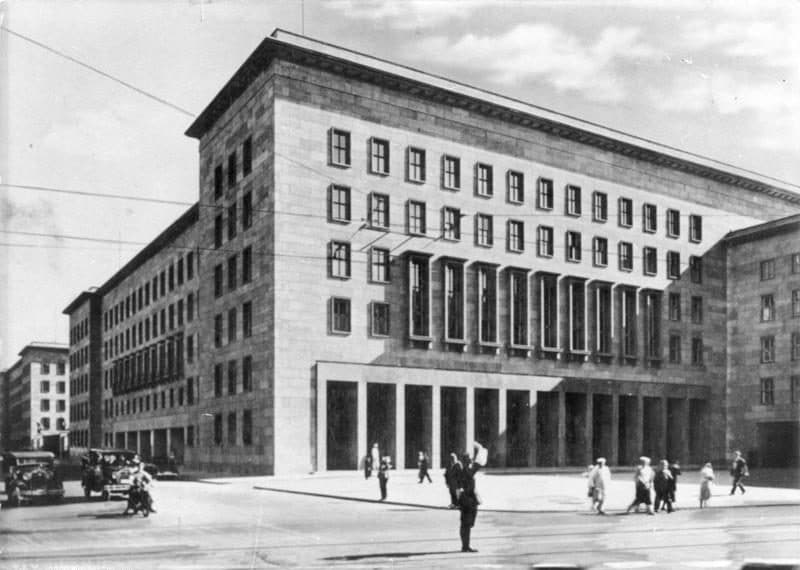
The Reich Air Ministry on Leipziger Straße in Berlin, 1938, with the colonnade where the GDR mural is today
The Air Ministry’s Leipziger Straße front in 1938. Lingner’s mural now fills the colonnade. Photo: Bundesarchiv, Bild 183-H27413 / CC-BY-SA 3.0

Göring’s Air Ministry

The building behind the square was put up in 1935–36 for Hermann Göring’s Reich Air Ministry, to designs by Ernst Sagebiel, on the site of the old Prussian War Ministry. It was meant to intimidate: 112,000 square metres, about 2,100 rooms and nearly 6.8 kilometres of corridors, the largest office building in Berlin at the time. Anti-aircraft guns stood on the roof, and a public air-raid shelter was built under the forecourt where the square is now.

On 12 November 1938, three days after the November Pogrom, Göring chaired a meeting here of more than 100 officials and business leaders that set out how Jews were to be stripped of their property and pushed out of economic life. The ministry also employed Harro Schulze-Boysen, who passed secrets to Moscow until the Gestapo broke his ‘Red Orchestra’ group in 1942. The building came through the war largely intact, which is why both German states’ histories pass through it.

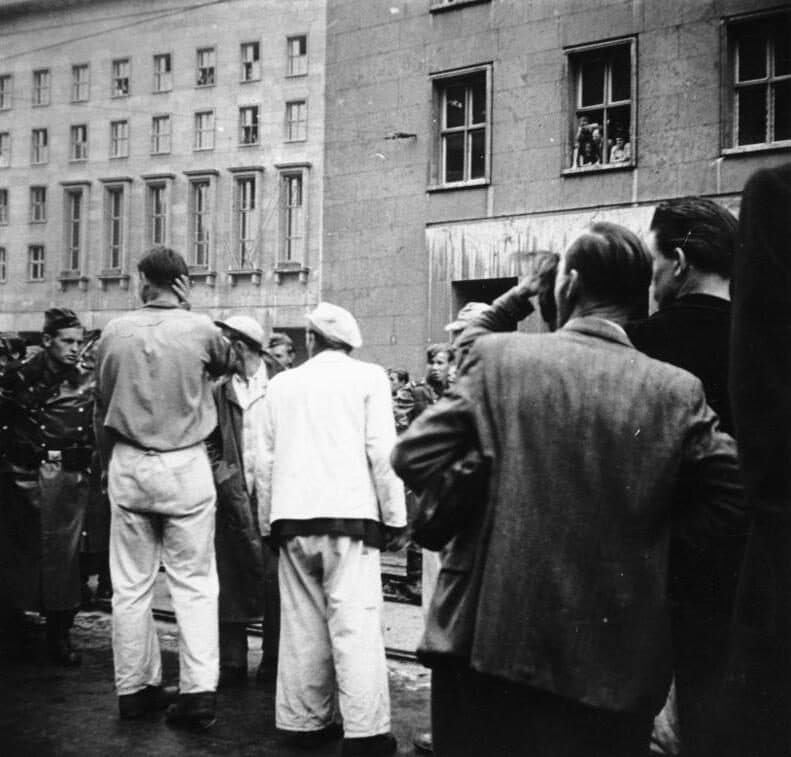
Building workers in white overalls in a crowd outside the House of Ministries on Leipziger Straße, East Berlin, 17 June 1953
Building workers outside the House of Ministries, 17 June 1953. Photo: Bundesarchiv, Bild 146-2003-0031 / CC-BY-SA 3.0

16 and 17 June 1953

On 28 May 1953 the ruling party raised work norms by 10 per cent, which meant more work for the same pay. On 15 and 16 June builders on East Berlin’s big sites stopped work, and on the 16th they marched to the House of Ministries. The government withdrew the increase that afternoon, but too late: a general strike had already been called for the next morning.

On 17 June protests and strikes spread to more than 700 towns and villages, with around a million people taking part. In the afternoon the Soviet occupying forces declared a state of emergency and sent tanks into the streets around this building. At least 55 people died, about 10,000 were arrested within three weeks, and Soviet tribunals and East German courts carried out seven death sentences. Wolfgang Rüppel’s memorial uses a photograph from that day.

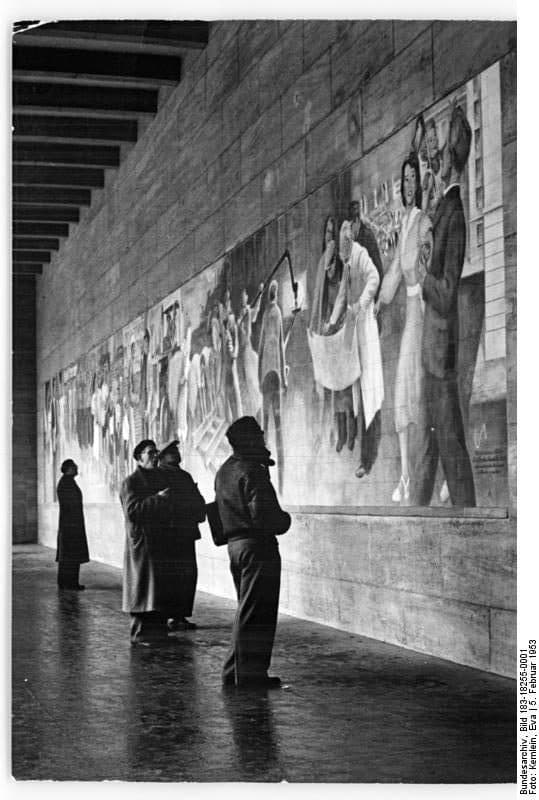
People looking at Max Lingner’s new mural under the colonnade of the House of Ministries in East Berlin, February 1953
Lingner’s mural, newly finished, in February 1953. Photo: Bundesarchiv, Bild 183-18255-0001 / Kemlein, Eva / CC-BY-SA 3.0

Lingner’s mural and Rüppel’s reply

Max Lingner, a communist painter who had spent the Nazi years in France, was commissioned to replace a Nazi-era relief by Arnold Waldschmidt in the colonnade. His design, about 24 by 3 metres and painted on Meissen porcelain tiles, was sent back for changes again and again by Walter Ulbricht and Otto Grotewohl until 1952, and Lingner himself was unhappy with the result. It was in place by February 1953, four months before the workers it celebrates marched up to it in protest.

When the forecourt was redesigned in 2000, the federal government and the Berlin Senate held a two-stage competition for a memorial. None of the first 87 invited entries went through, and Wolfgang Rüppel was among ten artists asked to try again. His answer was to lay a real photograph of 17 June, coarsened and set between sheets of glass, directly in front of Lingner’s painted promise. The square itself was only named in 2013, for the uprising’s 60th anniversary.

Plan your visit

Visiting the Platz des Volksaufstandes

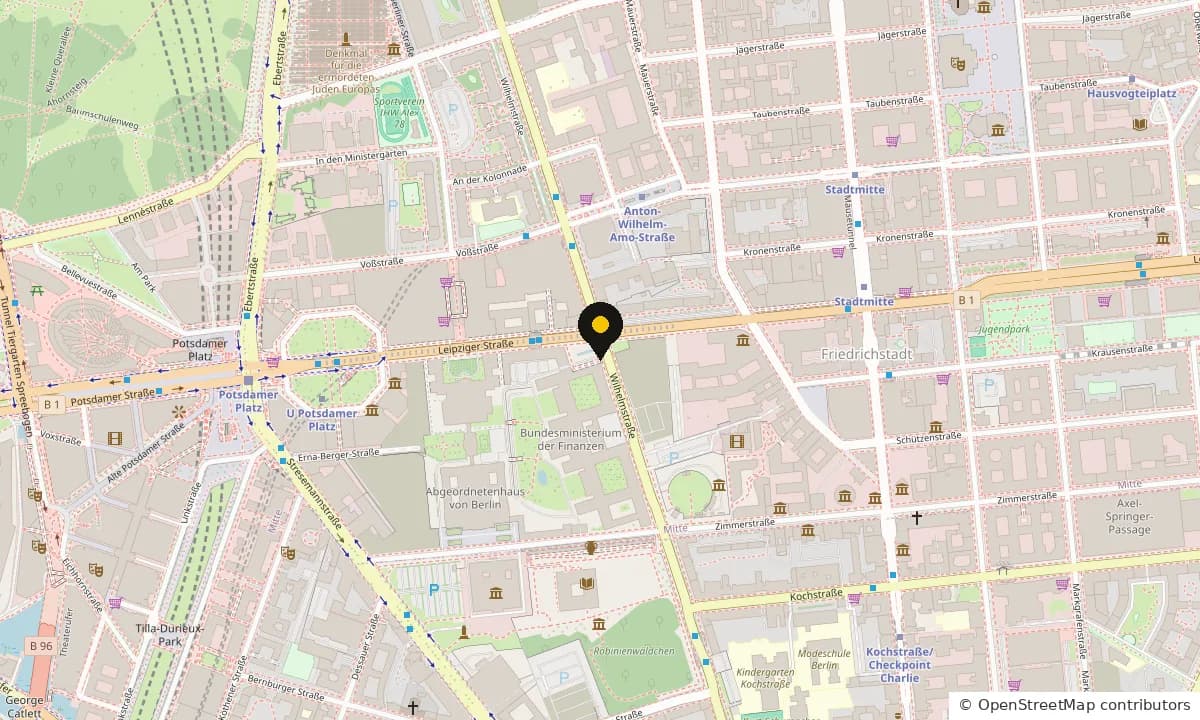
Map of the streets around the Platz des Volksaufstandes, with a pin on the siteOpen in Google Maps

Wilhelmstraße 97 / Leipziger Straße, 10117 Berlin · Open 24 hours, every day

Getting there

  • U2Anton-Wilhelm-Amo-Straße300 m · 4 min

    Called Mohrenstraße until 2025. Walk south down Wilhelmstraße to the corner of Leipziger Straße.

  • S1S2S25S26U2Potsdamer Platz600 m · 8 min

    Walk east along Leipziger Straße; the ministry fills the right-hand side of the street.

  • Bus M48Bus 200Bus 300Leipziger Straße/Wilhelmstraße100 m · 1 min

    The stop is on Leipziger Straße, beside the square.

What you’ll see

  • Wolfgang Rüppel’s memorial of 2000: an anonymous photograph of workers marching arm in arm on 17 June 1953, enlarged to about 25 metres and set under glass in the ground.
  • Max Lingner’s mural Aufbau der Republik (1950–53), about 24 metres of painted Meissen porcelain tiles under the colonnade on the Leipziger Straße side, showing the happy socialist future the state promised.
  • The Detlev-Rohwedder-Haus itself, Ernst Sagebiel’s 1935–36 Air Ministry, with a plaque of 1993 to the victims of 17 June and information panels on the uprising at the corner.

Tips from a guide

  • Look at the ground memorial from a few steps back: Rüppel coarsened the photograph, so the faces only come together at a distance.
  • Stand between the two works: the memorial was designed as a direct reply to the mural behind it, the promise and the reality facing each other.
  • The building is a working ministry, so you cannot walk in. The ministry’s visitors’ service runs occasional public tours in German (register in advance) and 90-minute group visits for 10–50 people by request.

Accessibility

The square, the ground memorial and the colonnade with the mural are at street level on level paving. Check the BVG website for lift status at the stations. There are no toilets or seating on the square; the nearest are around Potsdamer Platz.

Timeline

From Air Ministry to the people’s square

  1. 1935–36Ernst Sagebiel builds the Reich Air Ministry for Hermann Göring.
  2. 12 Nov 1938Göring chairs the meeting that plans the economic exclusion of Germany’s Jews.
  3. 7 Oct 1949The GDR is founded in the building’s great hall; it becomes the House of Ministries.
  4. 1950–53Max Lingner’s Meissen-tile mural Aufbau der Republik goes up in the colonnade.
  5. 16 Jun 1953Building workers march to the House of Ministries and call a general strike.
  6. 17 Jun 1953The uprising spreads across East Germany; Soviet tanks crush it.
  7. 15 Jun 1961Ulbricht, in the great hall: ‘No one has any intention of building a wall.’
  8. 28 Jul 1965The Holzapfel family escape to West Berlin by cable from the roof.
  9. 1991–94The Treuhandanstalt, privatising East German industry, has its headquarters here.
  10. 1999The Federal Ministry of Finance moves in from Bonn.
  11. 2000Wolfgang Rüppel’s photo memorial to 17 June 1953 is set into the forecourt.
  12. 2013The forecourt is named Platz des Volksaufstandes von 1953.

See it with a historian

Tours that stop at the Platz des Volksaufstandes

The square has a photo and a mural; a guide can tell you what happened in the streets around them in June 1953, and why the building matters to both German dictatorships.

One hour in the divided city, with the 1953 uprising as one of its turning points.

The Cold War Tour
One Hour1 Hour

The Cold War Berlin Tour

Private 1-hour walking tour of Cold War Berlin's border sites for up to 10 people. Starts by the Berlin Wall segments on Potsdamer Platz.

€200up to 10
View Tour

A full day on life behind the Iron Curtain, from 17 June 1953 to the Stasi.

The Berlin Wall Tour - Berlin Experiences
Full Day6 Hours

The Republic Of Fear

Private 6-hour van tour of East Berlin, the Stasi and life behind the Wall for up to 6 people. Starts at your hotel.

€1,000up to 6
View Tour

The rise and fall of the Third Reich, with Göring’s Air Ministry on the route.

The Capital Of Tyranny Tour - Berlin Experiences
Full Day6 Hours

The Capital Of Tyranny

Private 6-hour van tour of Hitler's Berlin and the Third Reich for up to 6 people. Starts at your hotel or anywhere in the city.

€1,000up to 6
View Tour

Questions visitors ask

Frequently asked questions

What is the Platz des Volksaufstandes von 1953?

The forecourt of the Federal Ministry of Finance at Wilhelmstraße and Leipziger Straße in Berlin-Mitte, named in 2013 after the East German uprising of June 1953. Protesters gathered here on 16 and 17 June 1953, when the building was the GDR’s House of Ministries.

What happened on 17 June 1953?

Strikes and protests against higher work norms grew into an uprising across East Germany, with around a million people in more than 700 places. Soviet troops and tanks crushed it; at least 55 people died and about 10,000 were arrested.

Where is the 17 June 1953 memorial in Berlin?

Set into the ground of this square, in front of the Finance Ministry at the corner of Leipziger Straße and Wilhelmstraße. It is Wolfgang Rüppel’s enlarged photograph of marching workers under glass, unveiled in 2000.

What is the mural on the Finance Ministry?

Max Lingner’s Aufbau der Republik (Building the Republic), about 24 metres of painted Meissen porcelain tiles finished in 1952–53, under the colonnade on the Leipziger Straße side. It shows the GDR’s idealised socialist future and is a listed monument.

Was the Finance Ministry really Göring’s Air Ministry?

Yes. The Detlev-Rohwedder-Haus was built in 1935–36 as Hermann Göring’s Reich Air Ministry, then served as the GDR’s House of Ministries and the Treuhandanstalt’s headquarters before the Finance Ministry moved in in 1999.

Can you go inside the Detlev-Rohwedder-Haus?

Only on a guided visit. The ministry’s visitors’ service offers occasional public tours in German that you register for in advance, and group visits for 10–50 people on request; the square, memorial and mural are outside and open at all times.

Is the Straße des 17. Juni the same place?

No. The Straße des 17. Juni is the avenue west of the Brandenburg Gate, renamed by West Berlin in June 1953 in honour of the uprising. The protests themselves happened in East Berlin, here on Leipziger Straße and around Stalinallee.

Are there tours that stop here?

Yes. Our Cold War tour, Republic of Fear tour and Capital of Tyranny tour all pass the square, and a guide can explain both the Nazi and the East German history of the building.

Keep exploring

More Featured Experiences.

Every site we write about — 56 landmarks, museums, memorials and lesser-known corners of Berlin. See the full index →

01Walk Through The Brandenburg Gate02Explore The State Museums On Museum Island03Visit The Berlin TV Tower – The Fernsehturm04Cross The Cold War Border At Checkpoint Charlie05Visit The Site Of Adolf Hitler’s Führerbunker06Explore The Reconstructed Berlin Palace07Visit The Reichstag Cupola At Night08Explore The Forum Fridericianum09Shop At The Humboldt University Book Sale10Journey Into The Memorial To The Murdered Jews Of Europe11Step Inside The Neue Wache12Explore The Former Jewish Quarter – Spandauer Vorstadt13Visit The Remains Of The Berlin Wall14Walk Across The Bridge Of Spies15Explore The Topography Of Terror16Climb The Prussian Victory Column – The Siegessäule17Enter The Palace Of Tears – The Tränenpalast18Step Inside The Berlin Olympic Stadium19Explore Erich Mielke’s Office At The Stasi Museum20Walk Along Karl Marx Allee21Visit The Oldest Church In Berlin – The Nikolaikirche22Explore The Berliner Dom23Visit The Grave Of Frederick The Great24Walk Through The Ruins Of Anhalter Bahnhof26Visit The German Resistance Museum27Visit The Soviet War Memorial In The Tiergarten28See The Georg Elser Memorial On Wilhelmstrasse29Step Inside The Kaiser Wilhelm Gedächtnis Kirche30Visit The Gleis 17 Memorial31Visit The Schloss Charlottenburg Mausoleum32Climb The Französischer Dom at Gendarmenmarkt33Explore The Interbau – IBA 5734Explore The Otto Weidt Workshop35Visit Cecilienhof – Site Of The Potsdam Conference36Visit The Stasi Prison In Hohenschönhausen37Spend The Day At Tempelhof Airport38Ride The Fastest Elevator In Europe39Visit The Soviet War Memorial In Treptower Park40Visit The Sachsenhausen Concentration Camp Memorial41Visit The Ravensbrück Concentration Camp Memorial42Visit Karlshorst – The Site Of The German Surrender43Visit The Socialists Cemetery – Zentralfriedhof Friedrichsfelde44Visit The Soviet War Memorial In Pankow45Visit the Seelow Heights Memorial46Visit The Commonwealth War Cemetery47Cross The Bösebrücke At Night48Explore The Allied Museum In Dahlem49Explore The Spandau Citadel50Visit The Brandenburg T4 Euthanasia Memorial51Visit The Wannsee Conference House52Visit The Jewish Museum53Visit The Jewish Cemetery In Weissensee54Walk Along The East Side Gallery55Explore The Volkspark Friedrichshain Flak Tower56Head Up The Teufelsberg