Skip to content
The two red granite flags at the Soviet War Memorial in Treptower Park, Berlin, seen across the stone-paved forecourt

Berlin Experiences/Featured Experiences

Soviet War Memorial Berlin: Visit the Memorial in Treptower Park

The largest Soviet war memorial in Berlin.

The short answer

The Soviet War Memorial in Treptower Park is a military cemetery and monument in south-east Berlin, where more than 7,000 Red Army soldiers killed in the Battle of Berlin are buried. Dedicated on 8 May 1949, it is the largest of the city’s three Soviet memorials, ending at Yevgeny Vuchetich’s 12-metre bronze soldier carrying a child. It lies inside the public Treptower Park, about 10 minutes’ walk from S-Bahn Treptower Park. Admission is free, there are no tickets and it is open every day; allow 45–60 minutes to walk its length.

Where
Treptower Park, Puschkinallee / Am Treptower Park, 12435 Berlin-Treptow
Open
Every day, in a public park; no set hours, best in daylight
Admission
Free
Time needed
45–60 minutes
Nearest station
S Treptower Park, 10 minutes on foot
Step-free
Mostly: level paths, but steps up the mound to the soldier

The story · by Matt Robinson

The Battle of Berlin in 1945 – that led to the total defeat of Nazi forces in the city, and a two month Soviet occupation, followed by the division of Berlin between the four victorious allied powers – was brutal and unforgiving.

It led to the direct loss of thousands of lives – both military and civilian – and came at the end of years of damage inflicted on the city by Anglo-American air raids, designed to harass the population and disrupt life in Hitler’s capital city.

The Soviet reckoning with the heart of the Nazi state, officially designated the Berlin Strategic Offensive Operation would take place over 17 bloody days. From the banks of the river Oder, bordering present-day Poland, with the battle of Seelow Heights, to the raising of the Red Banner on top of the Reichstag. Over that space of time an overwhelming number of Soviet troops would descend on Berlin, some 2.5 million amassed outside the city – eventually encircling it on April 25th.

Of those, around 80,000 would be killed in the assault – many to be repatriated back to their families and loved ones, some buried (at least temporarily) where they fell, many others gathered into mass graves across the former Nazi capital – to be laid to rest eternally on German soil – in a series of three huge cemeteries.

The largest of them, to be found in the south east of the city, is in the idyllic setting of Treptower Park.

The largest Soviet cemetery in Berlin

This monumental military cemetery was completed in 1949 and opened on May 8th – four years to the day after the end of the Second World War in Europe.

It serves as the final resting place for around 7,000 officers and soldiers of the Red Army and is considered the main commemorative memorial in the city for fallen Soviet soldiers. Thus the focus of annual commemorations that take place every year on May 8th to celebrate the capitulation of Nazi Germany. Covering around 9 hectares of land, previously occupied by a hippodrome shaped playground and sports field, this is the largest Soviet cemetery in Berlin.

Limestone sarcophagus with a relief of marching Red Army soldiers and a carved inscription at the Soviet War Memorial in Treptower Park
One of the sixteen limestone sarcophagi.

Despite this, it is actually much smaller – in terms of the number of bodies buried here – than the Soviet cemetery located in the district of Pankow, to the north. The final resting place for 13,000 Soviet soldiers and officers. Not only is that the largest Soviet cemetery in Berlin by number of bodies buried there, but is also the largest Russian cemetery in Europe outside of Russia.

A further, more centrally located cemetery, sits in the Tiergarten park near the Reichstag, for the around 2,500 Soviet soldiers who died in the fighting in that area in 1945.

From the Urals to the Spree

While impressive enough in its size and design, the memorial in Treptower Park is actually the final part of a series – a triptych that stretches from the city of Magnitogorsk, located on the eastern side of the extreme southern extent of the Ural Mountains – through the city of Volgograd (previously known as Stalingrad) and on to Berlin.

These three cities each have Soviet memorials, two designed by the same artist, with statues representing the progress of the Soviet fight during the Second World War.

The first in Magnitogorsk, titled the Rear-Front Memorial, depicts a worker and a warrior raising a sword above their heads (to symbolise the sword being forged in this industrial region). The second, in Volgograd, The Motherland Calls, was the tallest statue in the world when it was constructed in 1967, and is of a woman stepping forward with a raised sword (symbolising the mobilisation of Soviet forces).

Finally in Berlin – at Treptower Park – the sword is being driven into the ground by a 12 metre tall Soviet soldier standing over a broken swastika. This statue is the centrepiece of the memorial – situated in the most south eastern point of the grounds.

The 12-metre bronze Soviet soldier holding a child and a lowered sword, on top of the mausoleum mound in Treptower Park, Berlin
Vuchetich’s soldier, sword lowered over the broken swastika.

However, beyond its direct allegorical value representing the final Soviet campaign in Berlin, it is also rumoured to depict the specific deeds of a Red Army Sergeant of Guards named Nikolai Masalov. Masalov is said to have braved heavy machine gun fire in the Battle of Berlin to save a young German girl whose mother had disappeared.

Whether there is any truth in the story, his rumoured actions are now immortalised in this giant bronze sculpture through local lore.

Walking through the memorial

The Soviet war memorial in Treptower Park is accessible through the arches of two entrances that lead to an open clearing and the first in a number of different parts to the memorial – a 3-metre high granite statue of “Mother Homeland”. Her head bowed and facing a wide avenue lined with weeping birches.

The steady incline of this boulevard leads to two huge stylized flags sculpted of red granite and the actual cemetery of five rectangular communal graves beyond in a massive open field – flanked with sixteen sarcophagi.

Bronze statue of a kneeling Soviet soldier with helmet and gun, laid with red carnations, at the foot of a red granite flag in Treptower Park
A kneeling soldier at the foot of one of the granite flags.

From here the memorial opens up with a view of the Soviet soldier statue to the south east.

The limestone sarcophagi – one for each of the 16 Soviet Republics – chronicle the story of the Great Patriotic War of Liberation, in the words of Soviet leader Joseph Stalin. Accompanied by relief carvings corresponding to the different stages of the war, the text is displayed in both German and Russian.

Beyond the memorial’s historical significance and impressive design, it can also boast this one rather peculiar characteristic – as one of the last places in Europe where the words of Joseph Stalin remain on public display.
The memorial in detail

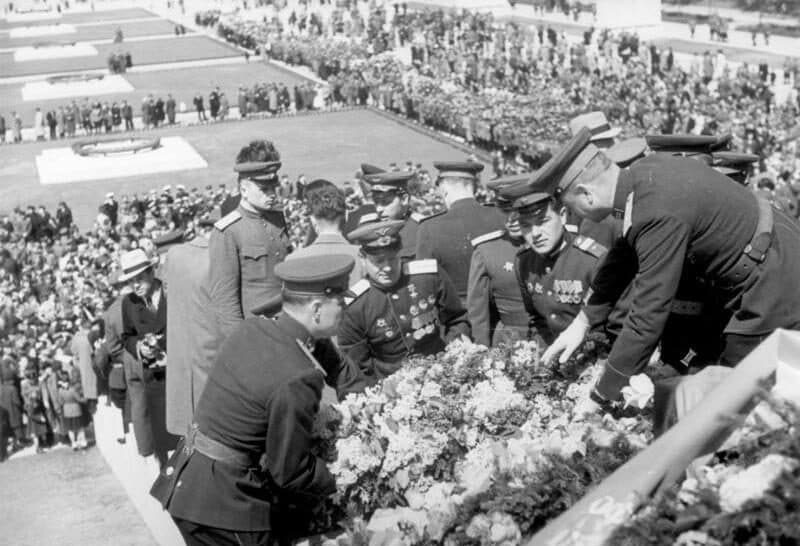
Soviet officers laying wreaths in front of crowds at the dedication of the Soviet War Memorial in Treptower Park, 8 May 1949
Soviet officers lay wreaths at the dedication, 8 May 1949. Photo: Bundesarchiv, Bild 183-V08566 / Malischew / CC-BY-SA 3.0

Building the memorial, 1946–49

The Soviet Military Administration ordered the memorial in 1946. The winning design came from a Soviet collective led by the architect Yakov Belopolsky and the sculptor Yevgeny Vuchetich, with the painter Alexander Gorpenko and the engineer Sarra Valerius, and the brief asked that it speak of liberation from National Socialism rather than of victory. Work began in June 1946 on the old sports ground of Gustav Meyer’s 19th-century park. Soviet engineer officers ran the site, but most of the work was done by German firms and some 1,200 workers; Berlin foundries such as Noack cast many of the bronzes, while the soldier himself was cast in Leningrad.

It was dedicated at 11:00 on 8 May 1949, the fourth anniversary of the German surrender and two weeks before the Federal Republic was founded in the West. Of Berlin’s three Soviet memorials it came second: the Tiergarten memorial had been unveiled in November 1945, and Schönholzer Heide in Pankow was finished later in 1949.

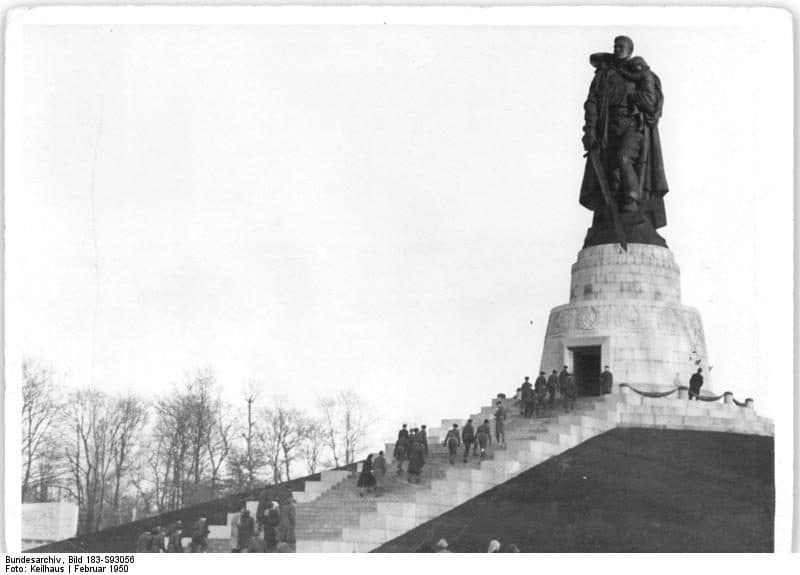
Visitors climbing the steps of the mausoleum mound to the bronze soldier statue at the Soviet War Memorial in Treptower Park, February 1950
Visitors on the steps up to the soldier, February 1950. Photo: Bundesarchiv, Bild 183-S93056 / Keilhaus / CC-BY-SA 3.0

The soldier and the child

Vuchetich’s bronze soldier is about 12 metres tall and weighs some 70 tonnes. He holds a small German girl on his left arm and lowers a sword over a smashed swastika: the image was meant to show a liberator, not a conqueror. For decades he was linked to Sergeant Nikolai Masalov, who is said to have carried a child out of the line of fire near the Landwehr Canal on 30 April 1945, and a plaque on the Potsdamer Brücke honours him. The soldier who actually posed for Vuchetich is usually named as Ivan Odarchenko, then a young Soviet soldier serving in Berlin.

By the end of the century the statue was badly corroded. In October 2003 it was lifted off the mound and shipped to a workshop on the island of Rügen, and on 4 May 2004 it was back in place, in time for the anniversary. The federal government paid more than €11 million for the renovation of the whole memorial, including re-gilding the Stalin quotations.

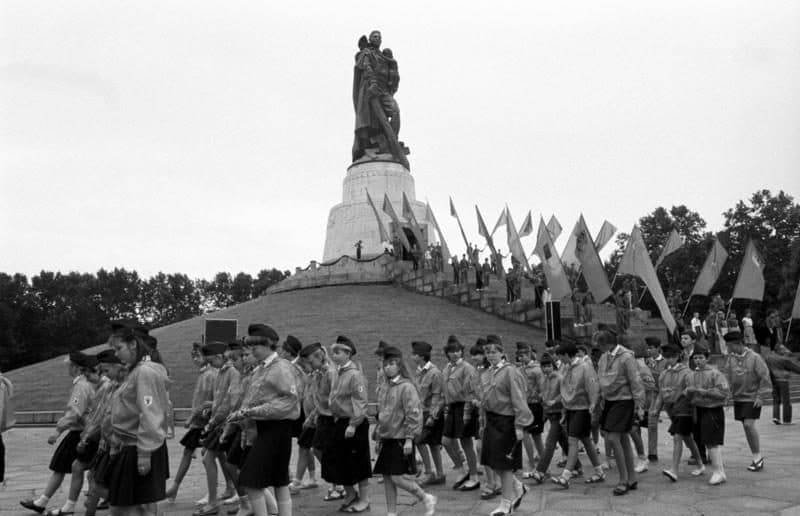
Young Pioneers in uniform marching past the soldier statue at the Soviet War Memorial in Treptower Park, July 1987
East German and Soviet pioneers lay wreaths at the memorial, July 1987. Photo: Bundesarchiv, Bild 183-1987-0727-24 / Uhlemann, Thomas / CC-BY-SA 3.0

Who looks after it now?

In East Germany the memorial was a stage for state ritual: wreaths on 8 May, Young Pioneers and Free German Youth on parade, foreign delegations brought to pay their respects. When graffiti appeared on it at the end of December 1989, the ruling party, renamed the SED-PDS, called a rally here on 3 January 1990 that drew some 250,000 people. On 31 August 1994 Helmut Kohl and Boris Yeltsin laid wreaths here as the last Russian troops left Germany.

Under the German–Russian war graves agreement of 1992, Germany must preserve the Soviet memorials permanently, and any change needs Russia’s consent, which is one reason the Stalin quotations are still there. The site belongs to the state of Berlin and is looked after for the Senate by Grün Berlin. Since Russia’s full-scale invasion of Ukraine in 2022, the 8 and 9 May commemorations have been tense, and the police set rules on flags and symbols for those days.

Plan your visit

Visiting the Soviet War Memorial

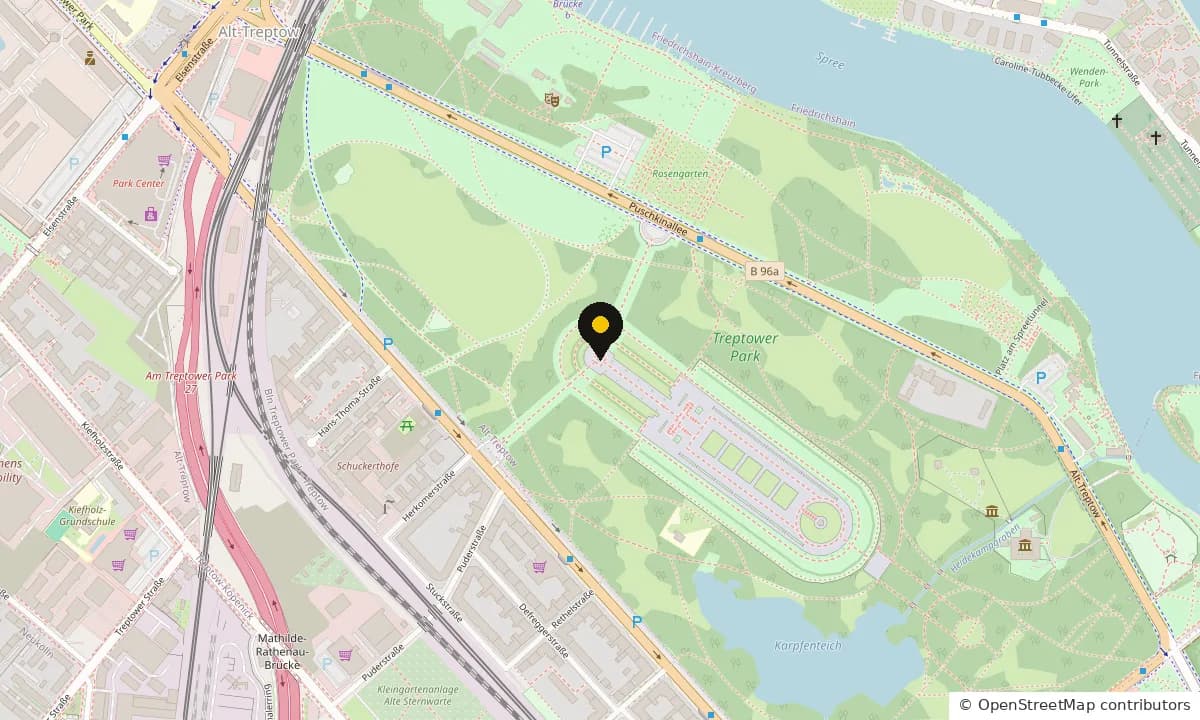
Map of the streets around the Soviet War Memorial, with a pin on the siteOpen in Google Maps

Puschkinallee, 12435 Berlin · Every day. The memorial is in a public park and no fixed hours are published; visit in daylight to see it properly.

Getting there

  • S8S9S41S42S85Treptower Park700 m · 10 min

    Leave the station towards Puschkinallee and walk south-east along it, past the bus stop, to the arched gateway on your right.

  • Bus 165Bus 166Bus 265Sowjetisches Ehrenmal350 m · 4 min

    The stop on Puschkinallee is beside the northern gateway. Buses 165 and 265 run from U Märkisches Museum in Mitte.

What you’ll see

  • Mother Homeland, a 3-metre granite figure of a grieving mother, at the forecourt where the two entrance avenues meet.
  • Two huge red granite flags with kneeling soldiers at their feet, the five lawns of the central field, and sixteen limestone sarcophagi carved with reliefs and quotations from Stalin in Russian and German.
  • The 12-metre bronze soldier on his mound at the far end, with the small domed crypt and its mosaic beneath him.

Tips from a guide

  • Walk the whole axis from Mother Homeland to the soldier: the memorial was designed to be read in that order, and the view back from the top of the mound is the best on the site.
  • On 8 and 9 May thousands come to lay flowers, and the police set rules on flags and symbols. For a quiet visit, choose another day.
  • Combine it with the rest of Treptower Park: the Spree riverbank and boat landing are 5 minutes north, and the Archenhold Observatory is on the far side of the Karpfenteich pond.

Accessibility

The paths through the memorial are wide and level, and berlin.de describes the access as wheelchair-friendly with guidance for blind visitors, but some areas, including the steps up the mound to the soldier and crypt, are not step-free. Check the BVG website for lift status at S Treptower Park. There are no toilets at the memorial.

Timeline

From sports ground to war cemetery

  1. 16 Apr 1945The Red Army opens its offensive on Berlin from the Oder.
  2. 25 Apr 1945Soviet forces complete the encirclement of the city.
  3. 2 May 1945Berlin’s garrison surrenders.
  4. 8 May 1945The German surrender is signed in Karlshorst.
  5. 11 Nov 1945The Soviet memorial in the Tiergarten is unveiled.
  6. Jun 1946Work begins on the memorial in Treptower Park.
  7. 8 May 1949The memorial is dedicated, four years after the surrender.
  8. 3 Jan 1990About 250,000 people rally here after graffiti appears on the memorial.
  9. 1992Germany agrees with Russia to preserve the Soviet memorials permanently.
  10. 31 Aug 1994Kohl and Yeltsin lay wreaths as the last Russian troops leave.
  11. 2003–04The soldier is restored on Rügen and returns to his plinth on 4 May 2004.

See it with a historian

Tours that stop at the Soviet War Memorial

The memorial was built to tell a story in stone; a guide can tell you what it leaves out, from the battle itself to the politics of who gets remembered.

The battle of April 1945, with both Treptower Park and the Tiergarten memorial.

The Battle Of Berlin Tour - Berlin Experiences
Full Day6 Hours

The Battle Of Berlin Tour

Private 6-hour van tour of the 1945 battlefield, from the outskirts to the Reichstag, for up to 6 people. Starts at your hotel.

€1,000up to 6
View Tour

Life behind the Iron Curtain, from Karl-Marx-Allee and the Stasi to Treptower Park.

The Berlin Wall Tour - Berlin Experiences
Full Day6 Hours

The Republic Of Fear

Private 6-hour van tour of East Berlin, the Stasi and life behind the Wall for up to 6 people. Starts at your hotel.

€1,000up to 6
View Tour

The whole story of the city in a day, from Prussia to the fall of the Wall.

The Berlin History Tour
Full Day6 Hours

The Berlin History Tour

Private 6-hour van tour of Berlin's whole history in one day for up to 6 people. Starts at your hotel or anywhere in the city.

€1,000up to 6
View Tour

Questions visitors ask

Frequently asked questions

Is the Soviet War Memorial in Treptower Park free?

Yes. There is no ticket and no charge; the memorial is part of the public Treptower Park.

When is the Soviet War Memorial open?

Every day. No fixed hours are published because it lies in a public park, but go in daylight to see the reliefs and the view from the mound.

How many soldiers are buried at Treptower Park?

More than 7,000 Red Army soldiers killed in the Battle of Berlin in spring 1945. It is the largest Soviet memorial in Berlin by area, though the cemetery at Schönholzer Heide in Pankow holds more graves.

How do I get to the Soviet War Memorial in Berlin?

Take the S-Bahn (S8, S9, S41, S42 or S85) to Treptower Park and walk about 10 minutes along Puschkinallee, or take bus 165, 166 or 265 to the stop Sowjetisches Ehrenmal, right by the northern gateway.

What does the soldier statue mean?

The bronze soldier holds a rescued German child and lowers his sword over a broken swastika: the memorial presents the Red Army as liberator of Germany from Nazism. The pose is often linked to Sergeant Nikolai Masalov, who is said to have saved a girl under fire on 30 April 1945.

Who designed the memorial?

A Soviet team led by the architect Yakov Belopolsky and the sculptor Yevgeny Vuchetich, who also made The Motherland Calls in Volgograd, with the painter Alexander Gorpenko and the engineer Sarra Valerius. It was built in 1946–49, largely by German firms and workers.

Why are Stalin’s words still on the memorial?

The quotations on the sarcophagi are part of a protected war grave. Under a 1992 agreement with Russia, Germany must preserve the Soviet memorials and may not change them without Russian consent.

Is the Treptower Park memorial the same as the one near the Brandenburg Gate?

No. The memorial near the Brandenburg Gate is in the Tiergarten, about 45 minutes away by public transport. It is older (1945) and smaller, with about 2,500 graves and two T-34 tanks.

Keep exploring

More Featured Experiences.

Every site we write about — 56 landmarks, museums, memorials and lesser-known corners of Berlin. See the full index →

01Walk Through The Brandenburg Gate02Explore The State Museums On Museum Island03Visit The Berlin TV Tower – The Fernsehturm04Cross The Cold War Border At Checkpoint Charlie05Visit The Site Of Adolf Hitler’s Führerbunker06Explore The Reconstructed Berlin Palace07Visit The Reichstag Cupola At Night08Explore The Forum Fridericianum09Shop At The Humboldt University Book Sale10Journey Into The Memorial To The Murdered Jews Of Europe11Step Inside The Neue Wache12Explore The Former Jewish Quarter – Spandauer Vorstadt13Visit The Remains Of The Berlin Wall14Walk Across The Bridge Of Spies15Explore The Topography Of Terror16Climb The Prussian Victory Column – The Siegessäule17Enter The Palace Of Tears – The Tränenpalast18Step Inside The Berlin Olympic Stadium19Explore Erich Mielke’s Office At The Stasi Museum20Walk Along Karl Marx Allee21Visit The Oldest Church In Berlin – The Nikolaikirche22Explore The Berliner Dom23Visit The Grave Of Frederick The Great24Walk Through The Ruins Of Anhalter Bahnhof25Stand On The Platz Des Volksaufstandes26Visit The German Resistance Museum27Visit The Soviet War Memorial In The Tiergarten28See The Georg Elser Memorial On Wilhelmstrasse29Step Inside The Kaiser Wilhelm Gedächtnis Kirche30Visit The Gleis 17 Memorial31Visit The Schloss Charlottenburg Mausoleum32Climb The Französischer Dom at Gendarmenmarkt33Explore The Interbau – IBA 5734Explore The Otto Weidt Workshop35Visit Cecilienhof – Site Of The Potsdam Conference36Visit The Stasi Prison In Hohenschönhausen37Spend The Day At Tempelhof Airport38Ride The Fastest Elevator In Europe40Visit The Sachsenhausen Concentration Camp Memorial41Visit The Ravensbrück Concentration Camp Memorial42Visit Karlshorst – The Site Of The German Surrender43Visit The Socialists Cemetery – Zentralfriedhof Friedrichsfelde44Visit The Soviet War Memorial In Pankow45Visit the Seelow Heights Memorial46Visit The Commonwealth War Cemetery47Cross The Bösebrücke At Night48Explore The Allied Museum In Dahlem49Explore The Spandau Citadel50Visit The Brandenburg T4 Euthanasia Memorial51Visit The Wannsee Conference House52Visit The Jewish Museum53Visit The Jewish Cemetery In Weissensee54Walk Along The East Side Gallery55Explore The Volkspark Friedrichshain Flak Tower56Head Up The Teufelsberg