Skip to content
The Brandenburg Gate at night

Berlin Experiences/Mythbusting Berlin

Why Is Berlin The Capital Of Germany?

Not by destiny. Prussia's ambition made Berlin the capital in 1871, and in 1991 the Bundestag voted 337 to 320 to move the government back from Bonn.

By Matt Robinson · Updated · 19 min read

“Berlin is no beauty, to be sure, but for those captivated by her she does have a strange, rough magic, an endearing resilient spirit that is hard to define.”
Alexandra Ritche – Faust’s Metropolis

Today, Berlin is Germany’s largest city by both population and area, home to the country’s federal government and its official capital. A sprawling metropolis that bears the deep scars and vibrant triumphs of history on every street corner.

Yet, it is far from the nation’s most industrious hub. It is not its richest city; in fact, recent studies have shown it is one of the few world capitals to have a net negative effect on its country’s GDP. Frankfurt remains the financial heart, Munich and Stuttgart the industrial powerhouses.

Berlin is not located within the country’s largest state, nor is it its oldest city. It is a loss leader, known more for its seismic cultural and historical relevance than for generating wealth.

So, what made this city so special?

Why, after a century of turmoil that saw it become the capital of a militaristic empire, a doomed republic, a criminal dictatorship, and a divided nation, was it once again chosen to lead a reunified Germany?

The answer is a dramatic saga of ambition, ideology, violence, and an unbreakable will to endure.

–

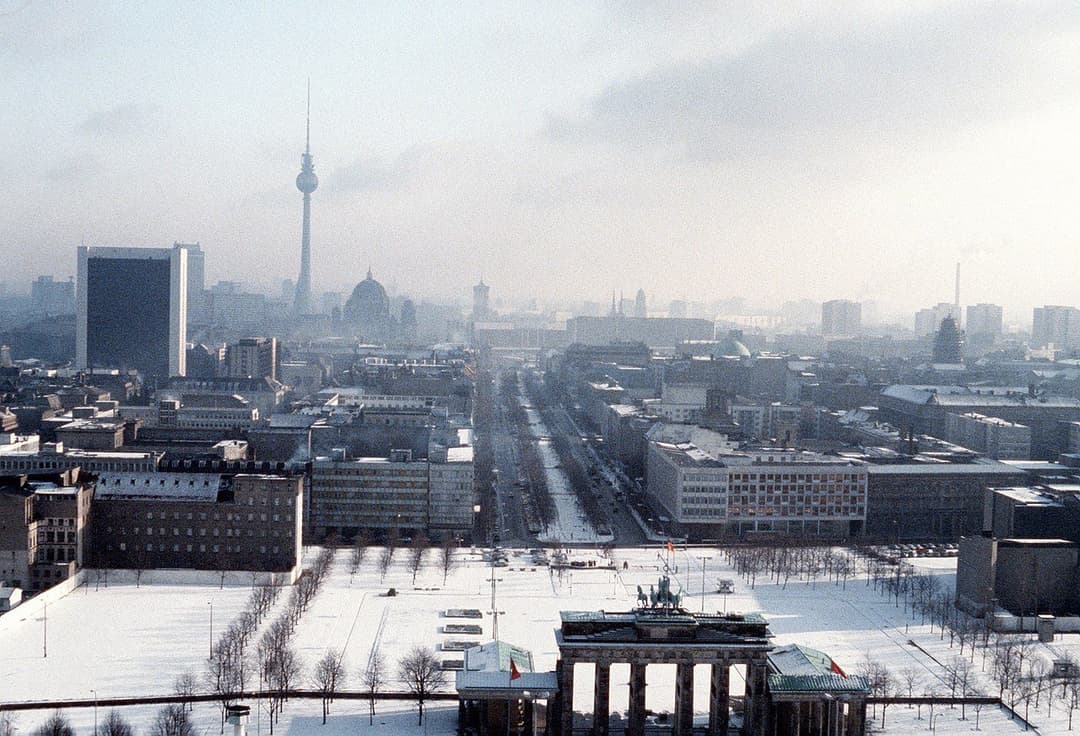
A view of the Brandenburg Gate, with East Berlin in the background in 1983 - Public Domain
Brandenburg Gate, with East Berlin in the background in 1983 - Public Domain

1991 - Berlin Rises Again

“Berlin is all about volatility. Its identity is based not on stability but on change.”
Rory MacLean

For much of the 20th century, there were two Germanies, split asunder by the Cold War, each with its own capital. 

The German Democratic Republic (GDR) in the East defiantly made East Berlin its capital, ignoring post-war agreements and cementing the city’s status as the frontline of an ideological global conflict. 

For the communists, Berlin was always a prize. When Karl Marx, an alumnus of Berlin’s university, prophesied a great revolution in an industrialised nation, he was looking at the teeming, politically charged streets of Berlin rather than anywhere further east. 

Vladimir Lenin initially shared the same outlook and saw Berlin as the key to a world revolution, just as Adolf Hitler would later see it as the key to a German one.

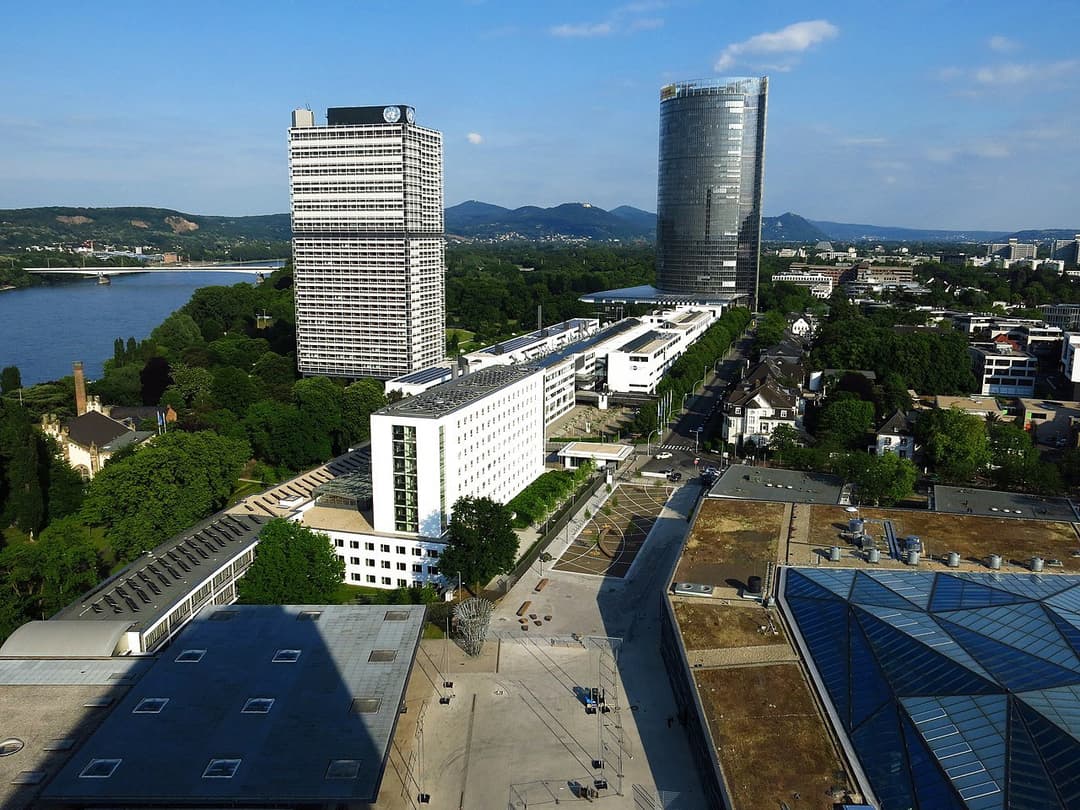
In the western part of Cold War divided Germany, the Federal Republic (FRG) sought out a new, untainted seat of government. In 1949, the sleepy university town of Bonn was chosen. The selection was deliberate. Frankfurt, a more obvious and powerful candidate, was rejected. Bonn was small, provincial, and, crucially, located far to the west. It symbolised a humble, new beginning, away from the Prussian militarism and Nazi megalomania so deeply associated with Berlin. Bonn was modest, stable, and reassuringly dull—the perfect antidote to Germany’s catastrophic recent past.

The writer Elias Canetti, reflecting on the horrors of the war, wrote in 1943 that he could no longer look at a map as ‘the names of cities reek of burnt flesh’. Bonn was a name that carried no such stench.

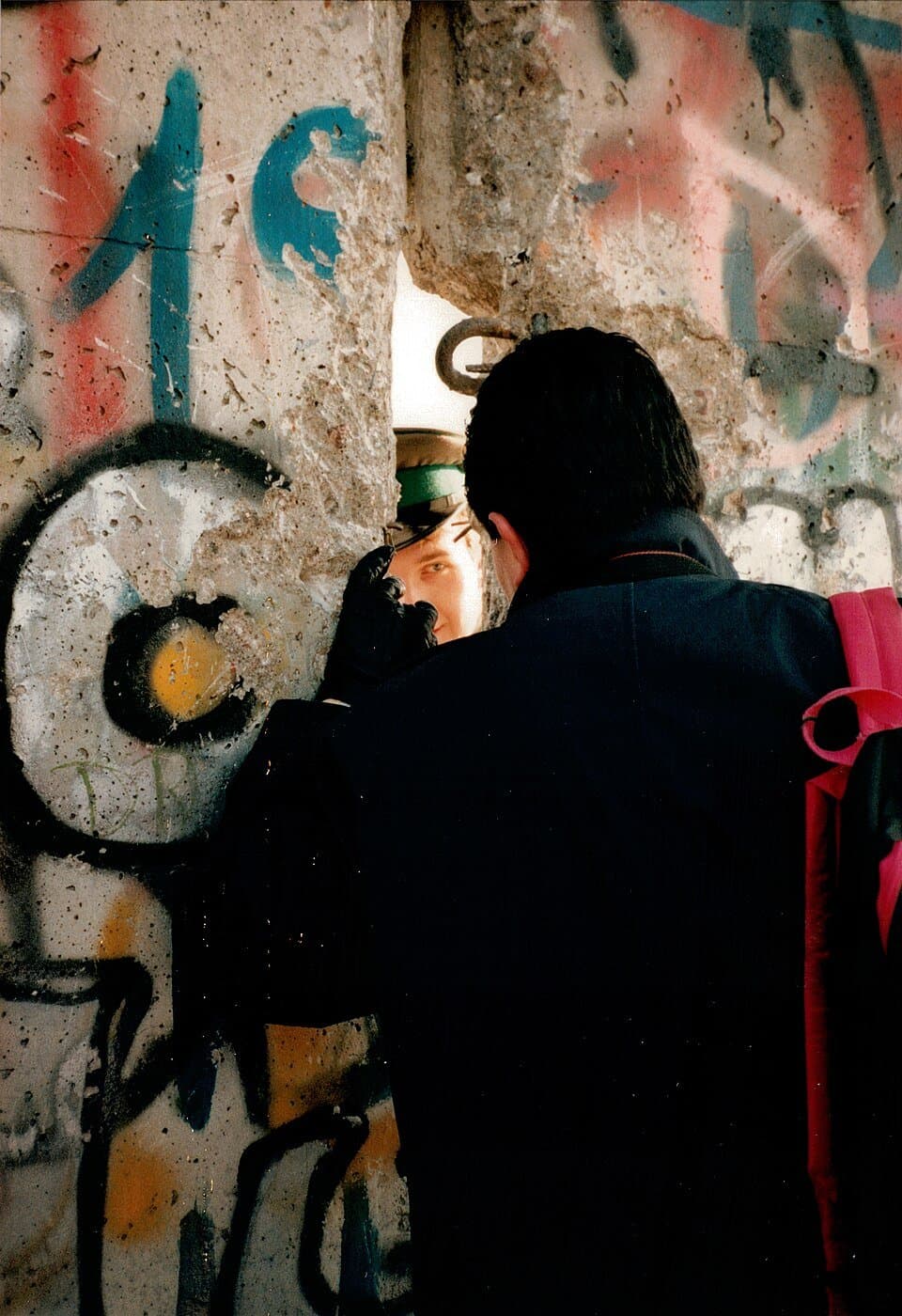
An East German guard speaks to a Westerner through a broken seam in the Berlin Wall, November 1989 - Creative Commons Attribution-Share Alike 3.0 Unported license

This arrangement was shattered on November 9th 1989, when the Berlin Wall fell. Less than a year later, on August 31st 1990, the Unification Treaty was signed, officially naming Berlin the ‘Capital of United Germany’. 

But this was largely symbolic. The real battle was yet to come: where would the government actually sit?

What followed was one of the most passionate and divisive debates in modern German history. 

On June 20th 1991, the German Bundestag convened for a marathon 12-hour session to decide the nation’s future. The arguments were fierce. Supporters of Bonn, the “federal village,” championed its legacy as the cradle of West Germany’s peaceful, prosperous, and democratic history. They warned against returning to a city whose name was synonymous with imperialism and totalitarianism. They pointed to the astronomical costs of moving—estimates ranged from $34 billion to $41 billion—at a time when the economic burden of absorbing East Germany was already immense. A popular sticker supporting Bonn read: “Stop the game of billions. Stop the relocation madness.”

Proponents of Berlin argued that the move was essential to truly “complete the unification of Germany.” They saw it as a powerful gesture of reconciliation towards the 17 million East Germans, a sign that they were not merely being annexed by the West but were central to the new nation’s identity. 

Former Chancellor and West Berlin Mayor, Willy Brandt, famously dismissed Bonn as a “cocktail party capital” and argued that Berlin “deserved” more than an empty title. Chancellor Helmut Kohl, a powerful advocate for Berlin, spoke emotionally of the city’s role in overcoming division.

When the final vote was tallied, the result was stunningly close. By a margin of just 337 to 320, the Bundestag voted to move the seat of government to Berlin.

The former government quarter in Bonn (2015) - Andreas Axel Kirch / Wikimedia Commons / CC BY-SA 3.0 DE

The decision split the country largely along regional and generational lines. 

Legislators from the south and west tended to favour Bonn, while those from the north and, crucially, the newly integrated east, voted for Berlin. The votes of the eastern German representatives tipped the balance, a poignant symbol of their new role in the unified state.

The decision was enshrined in law with the Berlin-Bonn Act of 1994, which outlined a phased transfer to be completed by 1999. 

Bonn was not abandoned; it was granted the unique title of “Federal City” and remains the headquarters for six federal ministries, a second home for the government. 

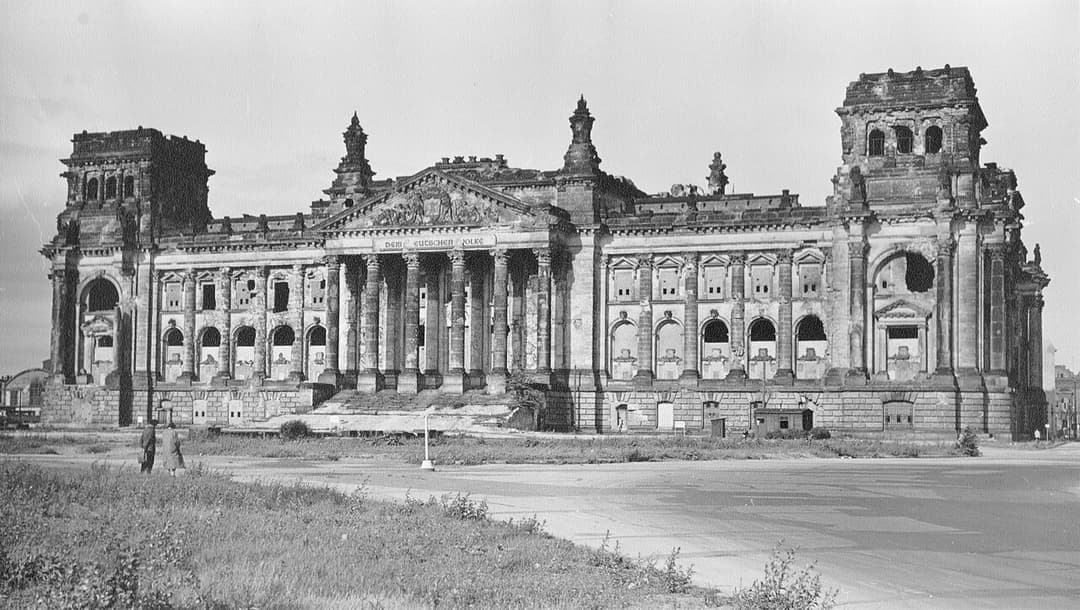
But the primary seat of power was returning to the city on the Spree. This necessitated a colossal building project, centred on the revitalisation of the Reichstag building, which had stood largely derelict since the infamous 1933 fire that propelled the Nazis to absolute power.

The ruin of the Reichstag in 1952 - Creative-Commons-Lizenz CC0 1.0

The euphoria of the decision soon gave way to the harsh realities of its implementation. The sheer cost and complexity of the move became a sore point across Germany. Wessis (Westerners) grumbled about the ‘Solidarity Tax’ siphoning money to the east, while Ossis (Easterners) faced soaring unemployment and social issues as their state-run economy collapsed. The birthrate in the east, for instance, fell by 60 percent between 1989 and 1992. 

Other major cities felt sidelined, fearing that too much investment was being funnelled into the new capital.

The architect Axel Schultes, tasked with designing the new government quarter, lamented the frantic pace, quoting the 19th-century novelist Theodor Fontane’s critique of a previous Berlin building boom: ‘the city is growing, but the botching continues’. 

Yet, Wolfgang Schäuble, a key figure in the reunification process, implored Germans to look beyond the immediate difficulties. The move, he insisted, was ‘not about the work place, moving or travel costs… in reality it is about the future of Germany.’

Berlin was chosen not because of its dark history, but in spite of it. 

It was a conscious decision to confront the past, to build a new, transparent democracy in the very rooms where tyranny had been plotted. In truth, the 1991 vote was not about making Berlin the capital—the Unification Treaty had already done that. It was about reaffirming a status Berlin had held ever since a unified Germany was first forged from “Iron & Blood” in 1871.

To some in 1991, it seemed only right that Berlin’s central status be fully  restored – as both the capital and home to the seat of government – a matter of destiny fulfilled.

This a reprojection of the mood that had swept the city in 1871 when Berlin first became the capital of Germany.

–

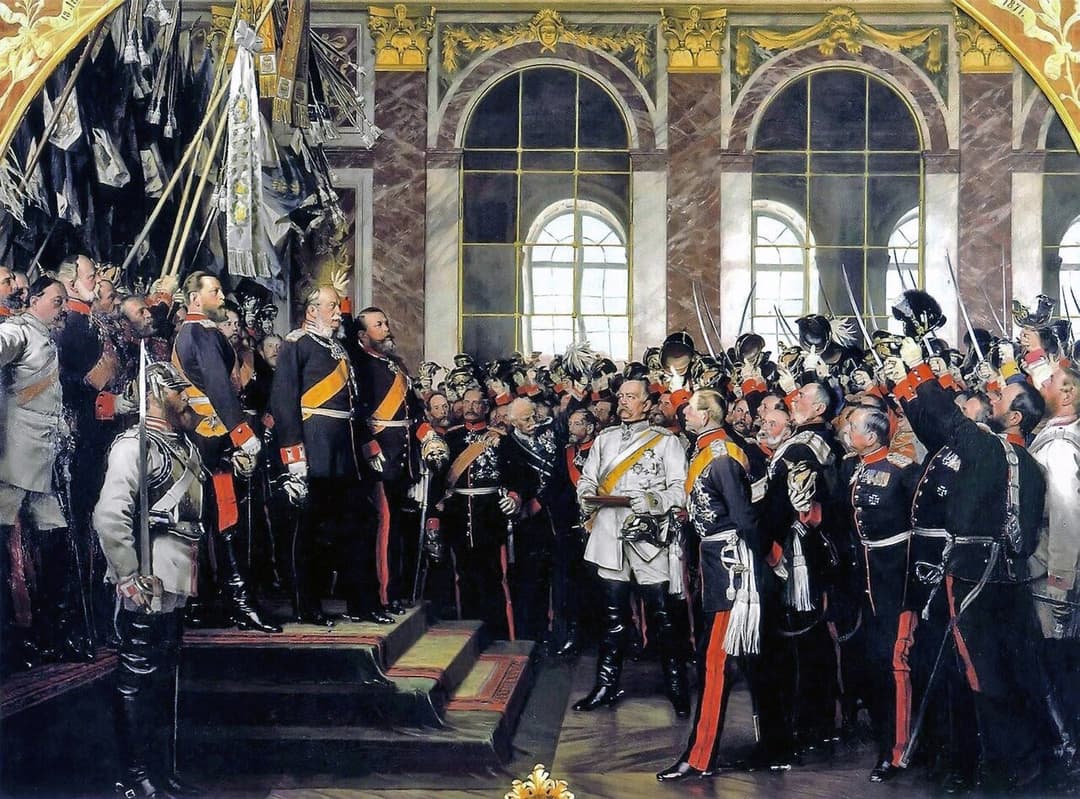
The proclamation of the German Empire in 1871 by Anton Werner (1885) - Public Domain

1871 - German Unification & The Heart Of Prussia

“The great questions of the day will not be settled by means of speeches and majority decisions but by iron and blood.”
Otto von Bismarck – September 30th 1862

When Berlin was declared the capital of a newly unified German Empire in 1871, the optimism was boundless. 

Newspapers dedicated endless pages to ‘the phenomenon that is Berlin’. A 1900 guidebook hailed it as ‘the most glorious city in the world’, the seat of emperors and kings, boasting a population of over three million and a garrison of 23,000 men. It was, the guide claimed, ‘the richest city in Europe’.

This meteoric rise was not preordained. For centuries, Vienna, the seat of the Habsburgs – the royal family who had dominated the Holy Roman Empire, was the undisputed centre of the German-speaking world. 

Berlin’s ascent was entirely the result of the ruthless ambition and military prowess of one German state: the Kingdom of Prussia. The city’s destiny was forged not by geography or ancient prestige, but by the will of the Hohenzollern dynasty and its formidable army.

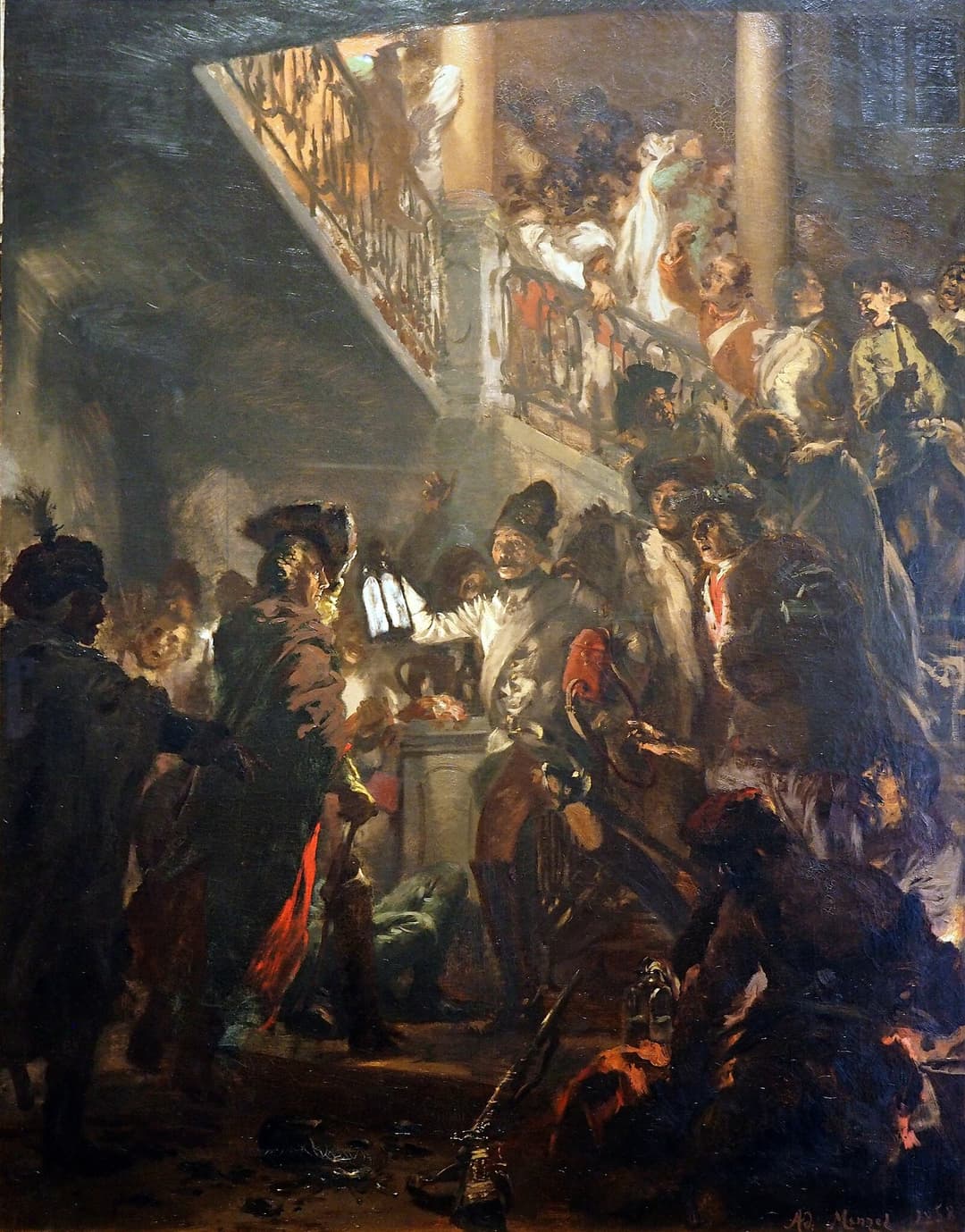
The story of Prussia is one of transforming a peripheral state into a European superpower. Frederick I crowned himself the first “King in Prussia” in 1701. His son, Frederick William I, the “Soldier King,” poured the kingdom’s resources into creating the most disciplined and efficient army in Europe. It was his son, however, Frederick II—Frederick the Great—who wielded this army like a surgical instrument to carve out a place for Prussia among the great powers. His stunning victories against the combined might of Austria, Russia, and France in the Seven Years’ War cemented Prussia’s reputation.

Frederick the Great at Lissa: Bonsoir, Messieurs by Adolf Menzel (1858) - Public Domain

But Frederick was more than a brilliant general. A friend of Voltaire and a true monarch of the Enlightenment, he transformed Prussia into a beacon of progress. He introduced one of Europe’s first codified legal systems, abolished torture, and promoted freedom of speech and religion. Berlin became a haven for the persecuted, welcoming French Huguenots, Dutch traders, and Silesian Catholics, for whom he even built a grand cathedral, St. Hedwig’s, in the heart of his Protestant capital.

This dual identity—a centre of both military might and intellectual life—defined 19th-century Berlin. It was the city of generals like von Moltke but also of the philosopher Hegel and the pathologist Virchow. And it was the city of a new breed of industrial titans—Siemens, Borsig, Rathenau—who transformed it from a modest manufacturing town into the most powerful industrial city in Europe.

In 1836, an industrialist named August Borsig opened an iron foundry in the poor district of Moabit; within a few years, he was the largest locomotive maker on the continent.

The novelist Wilhelm Raabe wrote, ‘The German Empire was founded when the first railway was built,’ as the new technology stitched the fragmented German states together. 

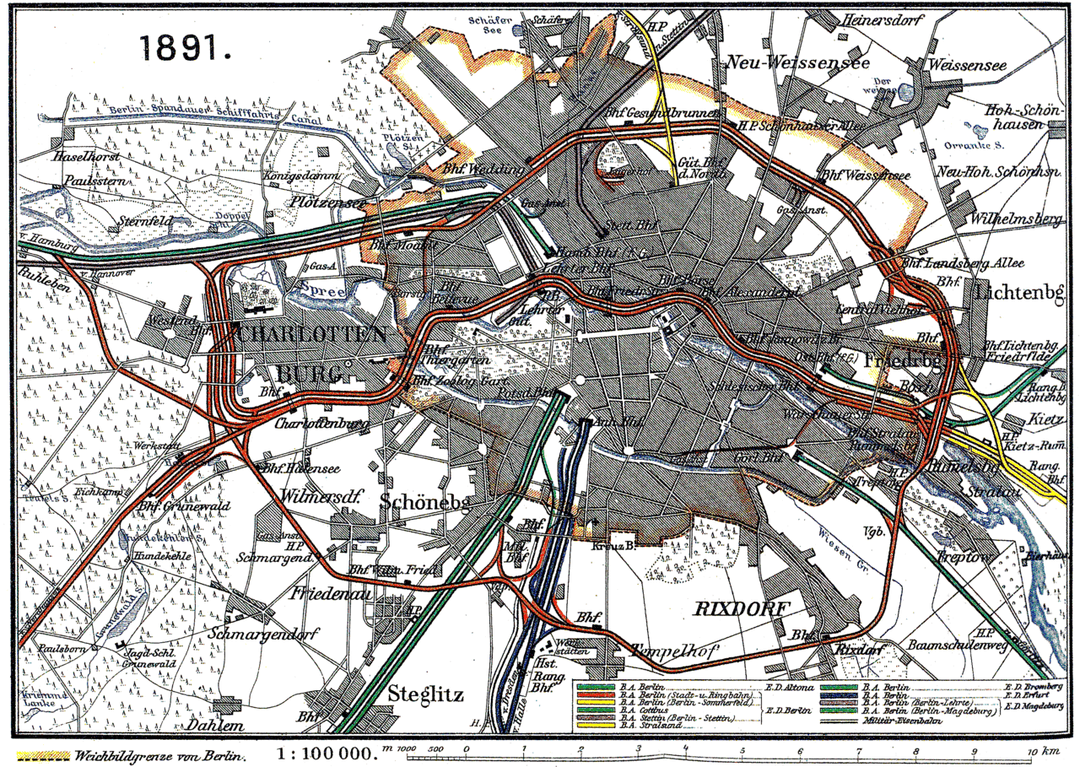
Evolution of rail transport in Berlin and its successive nationalisation. Situation in 1896 - Public Domain

In 1882, Werner Siemens installed Germany’s first electric streetlights on Potsdamer Platz. Two years later, the legendary Café Bauer on Unter den Linden dazzled patrons with the world’s first electrical interior lighting—though the system malfunctioned and burned the building to the ground days later. 

This was the new Berlin: brash, innovative, and moving at breakneck speed. The writer Sybille Bedford aptly called it ‘the parvenu capital of Europe’. The old bucolic world Theodor Fontane had described as a ‘desert panorama, crisscrossed with asparagus beds’ was gone forever.

The political unification of this burgeoning economic power was engineered by one man: Otto von Bismarck, the ‘Iron Chancellor’. Appointed Minister President of Prussia in 1862 by King Wilhelm I, Bismarck was a master of Realpolitik. 

In a now-legendary speech, he declared that the great questions of the day would not be decided by “speeches and majority resolutions – that was the great mistake of 1848 and 1849 – but by iron and blood”. 

Between 1864 and 1871, Bismarck orchestrated three short, decisive wars. First against Denmark, then a stunning victory over Austria in 1866 that ended Vienna’s influence over German affairs, and finally against France in the Franco-Prussian War of 1870-71.

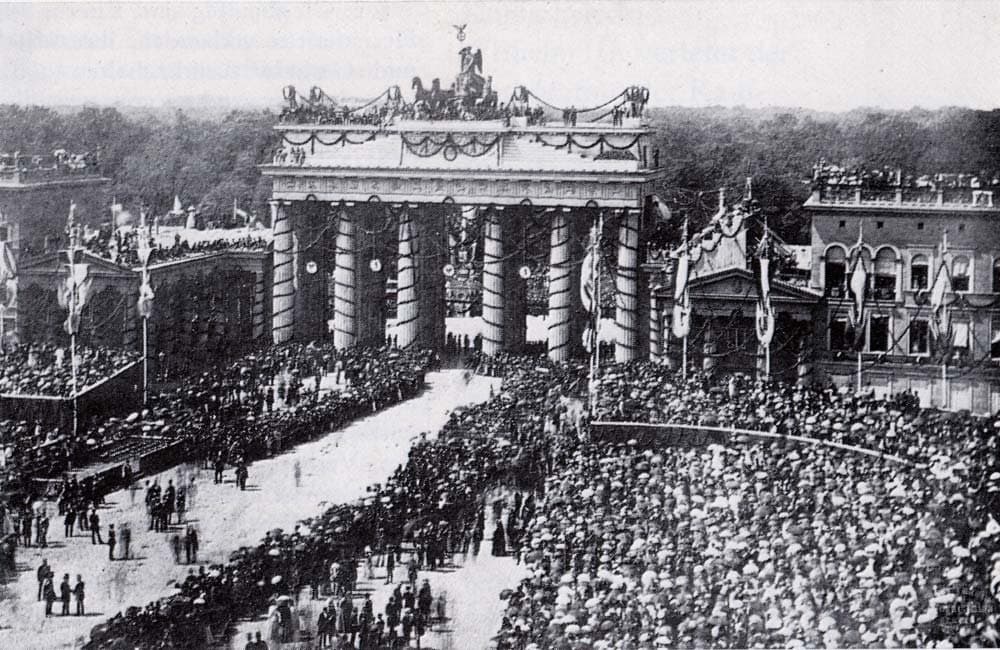
The Brandenburg Gate with decorations and conscripted Prussian troops after the Franco-Prussian War 1871 - Public Domain

Victory in this final conflict was the capstone of his plan. 

On January 18th 1871, in a moment of supreme triumph for Prussia and profound humiliation for France, the German Empire was proclaimed in the Hall of Mirrors at the Palace of Versailles. The Prussian King, Wilhelm I, who had been reluctant about the whole affair, was crowned the first German Emperor.

Berlin was the obvious choice for the new imperial capital. Yet, the decision was not without debate. Many Germans, particularly in the south, viewed the city as a symbol of arrogant, militaristic Prussia. 

But Berlin’s economic and industrial supremacy was undeniable. It was the heart of the railway network, the financial hub, and the driving force of the new empire. It had become, through sheer force of will, the centre of Germany.

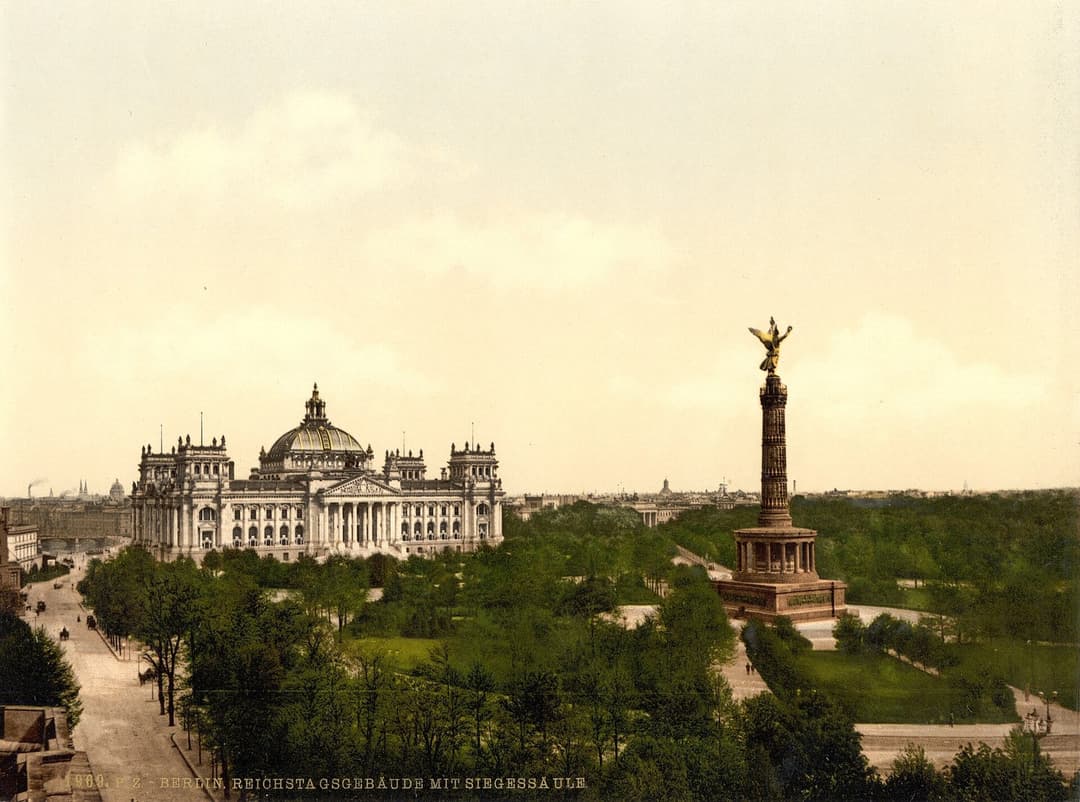
The Reichstag with the Siegessaulle in its original location (1900) - Public Domain

The new status was immortalized in stone and bronze. The Victory Column, or Siegessäule, initially begun to commemorate the victory over Denmark, was redesigned to celebrate all three unification wars. Topped with a gilded statue of Victoria, the Roman goddess of victory, it is known to Berliners today with a grudging affection as ‘Gold Else’.

The German Empire, born in triumph, would come to a catastrophic end in the trenches of World War I. The emperor, Wilhelm II, abdicated and fled to the Netherlands. In the chaos that followed, politicians met in the quiet city of Weimar to establish a new democratic republic. But Berlin, despite the street fighting and political instability, remained the capital throughout the tumultuous 1920s and into the dark days of the 1930s. The great ministries built by the Prussian state would continue to serve the German government, waiting for the next, most terrible chapter in the city’s history.

–

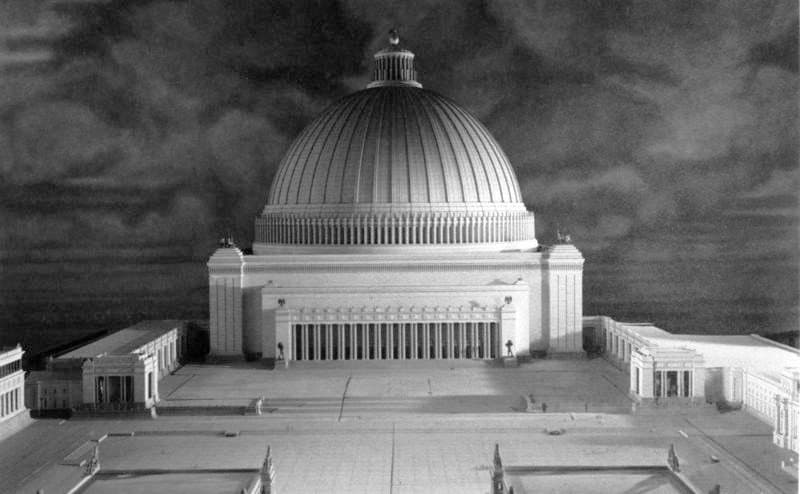
Albert Speer's model of the Great Hall - Bundesarchiv, Bild 146-1986-029-02 / CC-BY-SA 3.0

Germania - The Nazi World City

“The Earth is littered with the ruins of empires that believed they were eternal.”
Camille Paglia

For the Nazi Party, a movement born in the beer halls of Munich, conquering Berlin was both a strategic and symbolic necessity. The German capital was a bastion of the political left, a vibrant, multi-ethnic metropolis that represented everything they despised. They called it “Red Berlin.” To truly become a pan-German movement, they had to take and hold the capital.

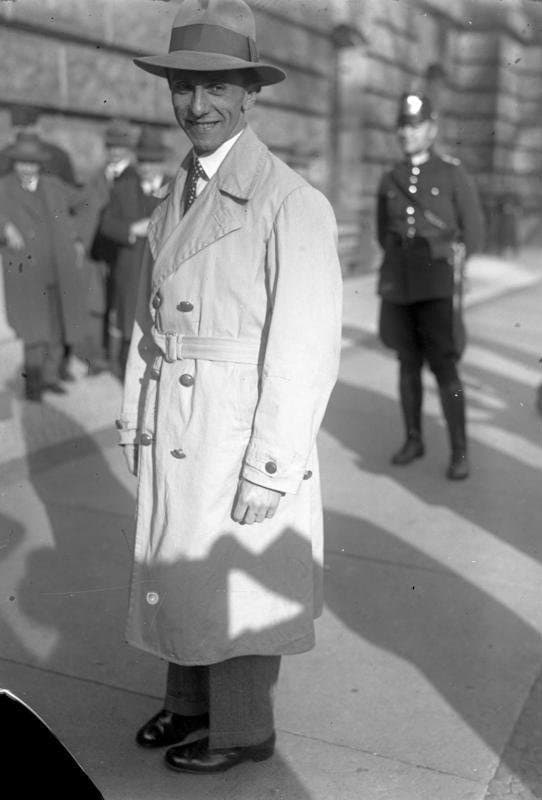
The man Hitler tasked with this mission was Joseph Goebbels. Appointed Gauleiter (District Leader) of Berlin in 1926, Goebbels unleashed a relentless campaign of propaganda and political agitation. He was a master of manipulating the city’s anxieties, using his newspaper, Der Angriff (The Assault), to rail against communists and Jews. His tactics of provocation and street violence were designed to shatter the democratic order and win the capital for the Nazis. His success in this brutal campaign cemented his position in Hitler’s inner circle and led to his eventual role as the Reich’s Minister of Propaganda.

Joseph Goebbels, the Nazi Gauleiter in Berlin (1932) - Bundesarchiv, Bild 102-13168 / CC-BY-SA 3.0

Once in power, the Nazis sought to hijack Berlin’s legacy for their own. They drew on the history of Prussia and the German Empire, twisting it into a narrative that culminated in their own “Thousand-Year Reich.” Berlin was not just to be the capital; it was to be reborn as the capital of the world.

Adolf Hitler harboured grandiose architectural visions for the city, plans he developed with his chief architect, Albert Speer. After their planned victory in World War II, Berlin was to be razed and rebuilt as Welthauptstadt Germania (World Capital Germania). This project was megalomania rendered in concrete and steel.

The plans centred on a monumental north-south axis, a grand boulevard called the Avenue of Splendors, which would dwarf the Champs-Élysées in Paris. At one end would stand a Triumphal Arch so enormous that its Parisian counterpart could have fit comfortably inside its opening.

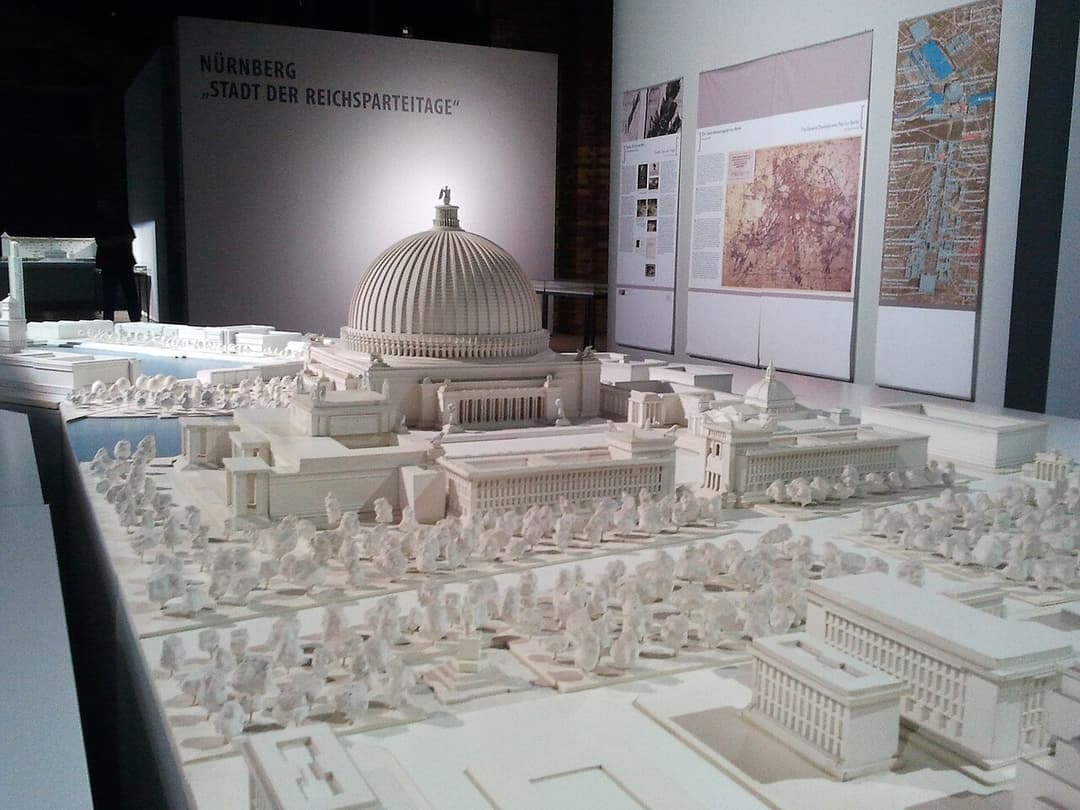
Model of the Große Halle from Hitler's Germania project - Creative Commons Attribution 3.0 Unported

At the other end, the crowning jewel of Germania: the Volkshalle, or People’s Hall. This colossal domed assembly hall, inspired by the Pantheon in Rome, was designed to hold 180,000 people. Its dome would have been sixteen times larger than that of St. Peter’s Basilica, so vast that planners worried the breath of the assembled crowds could create its own indoor weather system. Existing landmarks like the Brandenburg Gate and the Reichstag would have been dwarfed, rendered insignificant by the sheer scale of the Nazi vision.

Only a few elements of this monstrous plan were ever realized. The East-West axis was broadened (today’s Straße des 17. Juni), and the Victory Column was moved to its current location in the Tiergarten park. But the war intervened. To test the marshy Berlin soil for the massive Triumphal Arch, Speer’s engineers built a gigantic concrete cylinder, the Schwerbelastungskörper (heavy load-bearing body).
It still stands today in the district of Tempelhof, a bizarre and chilling monument to a nightmare that was never fully built.

The Germania project was not just an architectural fantasy; it had a sinister, practical purpose. The planned demolitions were used as a pretext to evict thousands of Jewish families from their homes, driving them into ever more crowded ghettos and, eventually, to the concentration camps.

The dream of Germania was inextricably linked to the Holocaust, a plan to build a new world on the rubble of the old and the ashes of its victims.

–

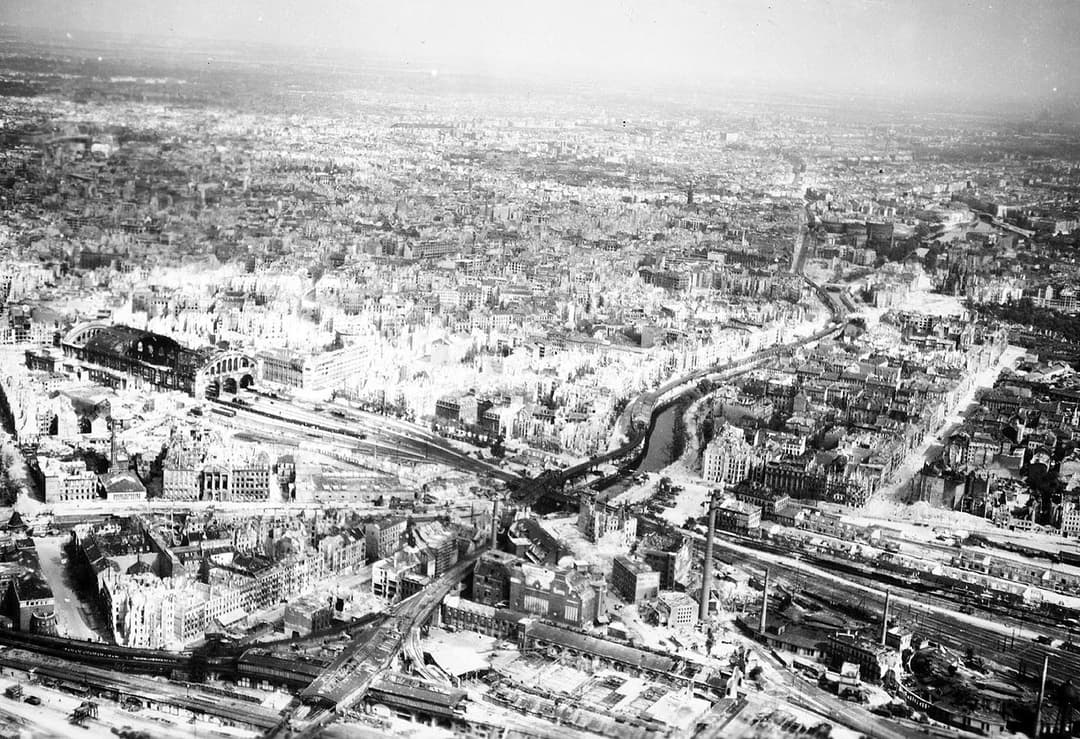
An aerial photo of Berlin in ruin in 1945 - Public Domain

Berlin - Then & Now

“The way our big cities change sucks. The beauty of cities was that they were edgy, sometimes even a little dangerous. Artists, poets, and activists could come and unify and create different kinds of scenes. Not just fashion scenes, scenes that were politically active. Big cities are getting so high-end oriented, business corporate fashion, fashion not in an artistic sense but in a corporate sense. For me that edgy beauty of cities is lost, wherever you go.”
Patti Smith

There was talk at the end of the Second World War of simply moving on from Berlin – so ruined as it was by the successive Allied air raids and Soviet conquest of the city – that it was openly suggested it would be better to build a new city nearby and abandon the rubble.

However, after its near-total destruction in 1945, Berlin ultimately spent the next four decades as a broken city, the epicentre of the Cold War. But even as an “encircled island,” West Berlin cultivated a unique identity. In a 1963 conversation in The Atlantic magazine, the novelist Günter Grass articulated this special status. West Germany, he said, ‘sickened me’ with its relentless focus on business. ‘Berliners are not so easily fobbed off with platitudes,’ he argued. ‘Berlin is probably the only city in Germany that can boast of an atmosphere which is genuinely metropolitan. The other cities are much more provincial.’

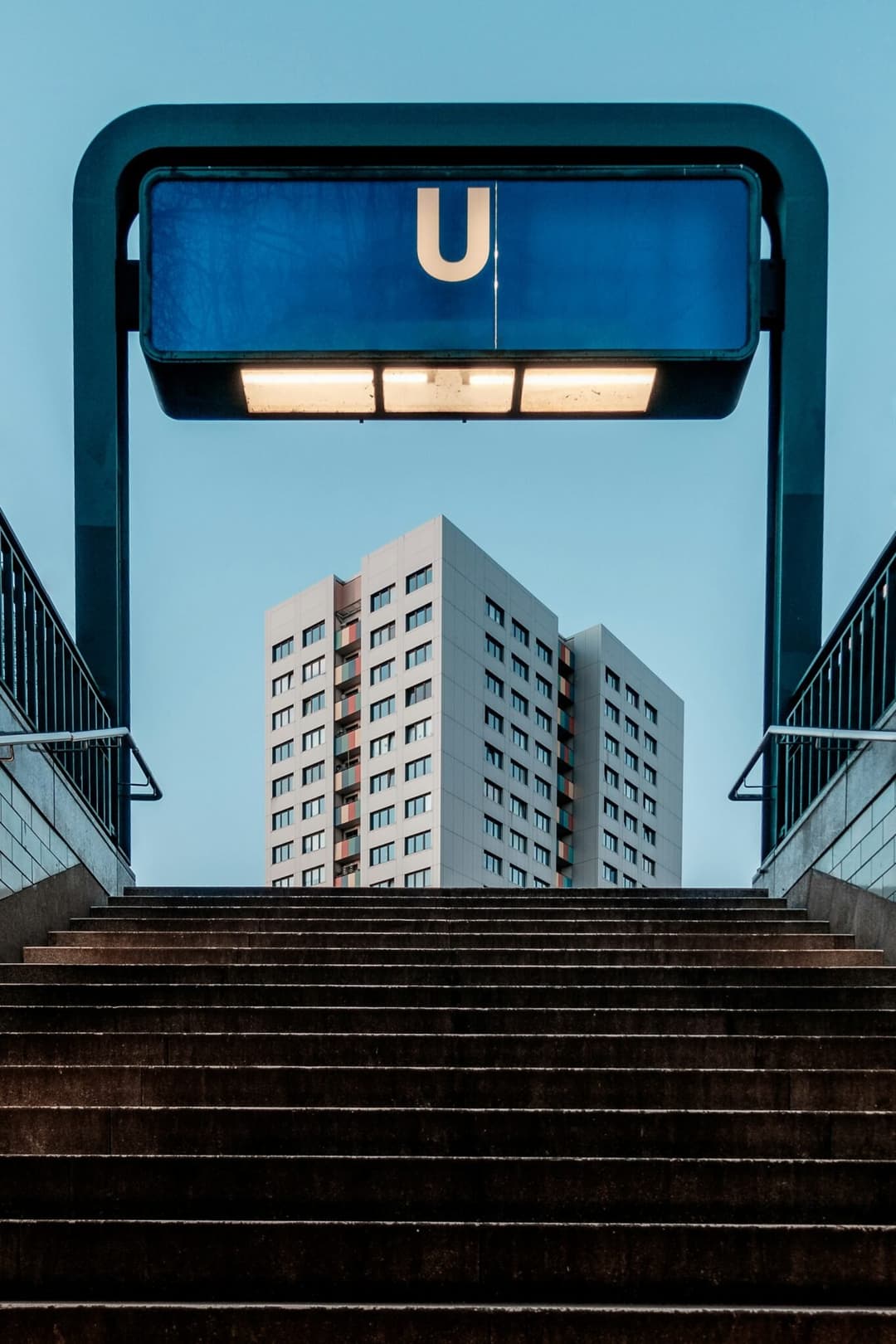
A Berlin underground station - Heye Jensen-Unsplash Lizenz

This metropolitan character, forged in isolation and defiance, is what carried Berlin through the division and into the modern era. 

When the Wall fell, the city was suddenly whole again, a living museum of the tumultuous 20th century. A walk through its streets is a walk through layers of history. There is the site of Leibniz’s first Academy of Sciences, the balcony from which the Kaiser promised his troops they would be ‘home by Christmas’ in 1914, and the very spot where Karl Liebknecht declared a socialist republic four years later. There are the chilling remnants of the Nazi regime: the location of Hitler’s bunker, the imposing former Air Ministry, and the train stations from which the city’s Jews were deported to their deaths. There is the building in Karlshorst where the German military surrendered to the Soviets, and everywhere, the faint, ghostly trace of where the Wall once snaked its oppressive path.

The reunification, celebrated with such joy, brought profound challenges. The decision to exchange the East German Mark for the powerful Deutschmark on a one-to-one basis was a political necessity but an economic disaster for the East. Its industries, unable to compete, collapsed overnight. For many East Germans, the promise of freedom was accompanied by the harsh reality of unemployment and a sense that their entire lives had been invalidated.

Today, Berlin thrives not as an industrial or financial titan, but as a global capital of culture, creativity, and technology. It is a city of artists, start-ups, and innovators, drawn by its relatively low cost of living and its atmosphere of tolerance and possibility.

While Germany’s powerful industrial giants like BMW, Mercedes Benz, BASF, and Siemens are headquartered elsewhere, Berlin has reinvented itself as a hub for the new economy.

The city that was once the headquarters of Europe’s most rigid military state is now celebrated for its chaotic, free-spirited energy. It remains a city in constant flux, perpetually unfinished, forever grappling with its own identity.

–

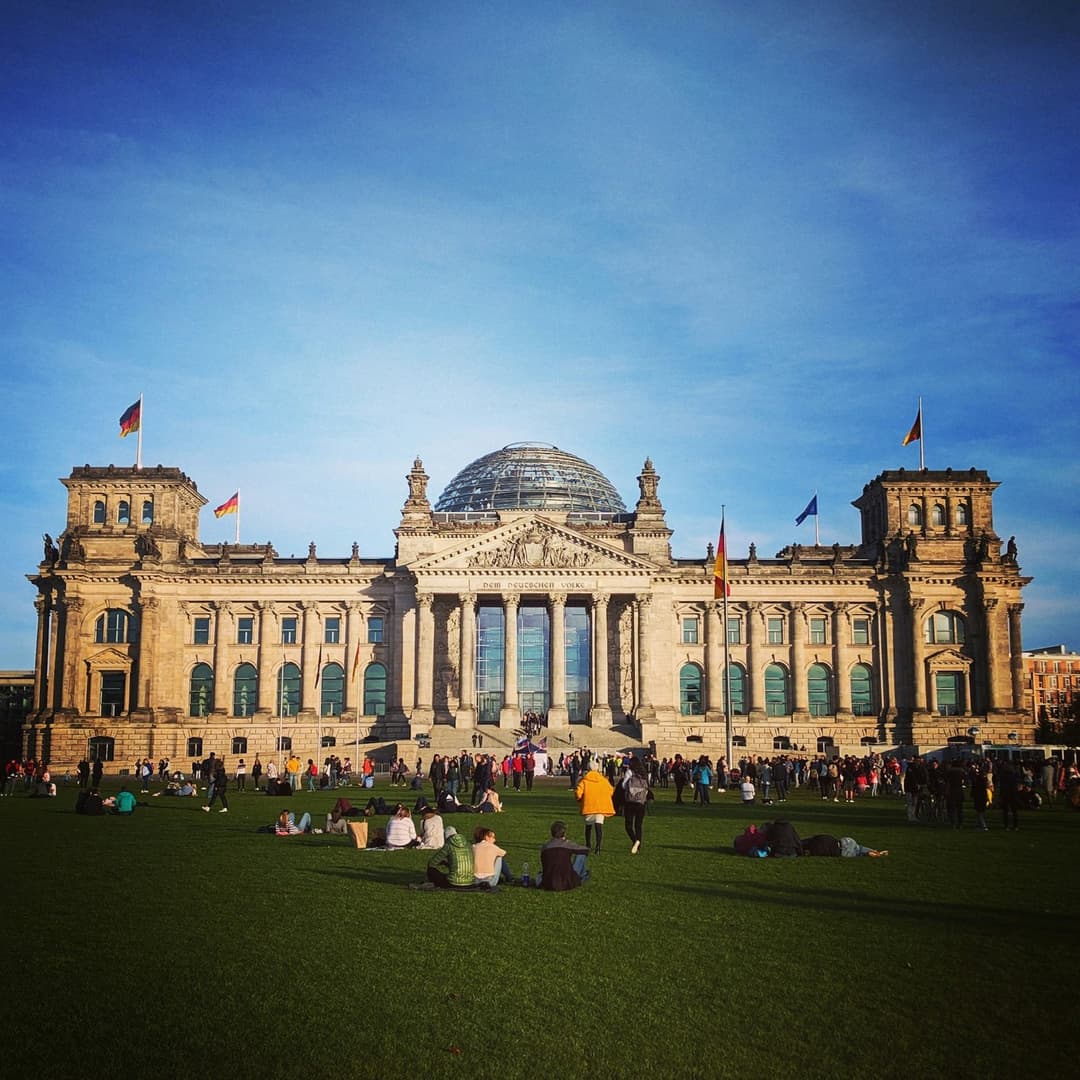
The Reichstag present day - Alana Harris-Unsplash Lizenz

Conclusion

“I find Berlin highly disagreeable. Nothing but dust and dire crowds of people running around as if a minute cost them 10 Mark […] I share your aversion towards the city wholeheartedly, it is a hideous place. But I fear I will be forced to live here for much longer.”
Ernst Reuter, West Berlin Mayor 1948-1953

It is all too easy to be seduced by the singularity of history, to believe that what is now was always meant to be. But Berlin’s status as Germany’s capital was never inevitable. It was the product of a series of historical accidents, iron-willed ambitions, and conscious, often painful, choices. It could have been Frankfurt, the historic site of imperial coronations, or Munich, the heart of Bavaria. For forty years, it was the quiet, unassuming town of Bonn.

That Berlin would not only emerge from the ashes of 1945 but also reclaim its role as the capital of a peaceful, democratic, and unified Germany is a testament to the city’s unique place in the world.

Its journey was not a straight line to greatness but a violent, chaotic path. The city’s power stemmed first from the military ambition of Prussia, which used Berlin as the headquarters for its project of German unification through “iron and blood.” It was then turbocharged by an industrial revolution that made it the economic engine of a new empire. It was later captured and remade by the Nazis as the heart of a criminal regime, and finally torn in two by a global ideological struggle.

The 1991 decision to return the seat of government to Berlin was a profound act of faith. It was a choice to embrace the city’s entire history, the brilliant and the barbaric, and to build the future on that complex, contested ground. Berlin stands as proof that a city built on a swamp, in the sandbox of an old empire, can endure the worst of human history and rise again, not just as a capital, but as a symbol of hope and transformation for the entire world.

Sources

Berlin Underworlds Association (Ed.) (2008), Mythos Germania: Shadows and Traces of the Reich Capital, Edition Berliner Unterwelten, ISBN 978-3-937863-09-0.

Blanning, Tim (2015), Frederick the Great: King of Prussia, Allen Lane, ISBN 978-1-84614-177-6.

Chrastil, Rachel (2023), Bismarck’s War: The Franco-Prussian War and the Making of Modern Europe, Penguin Books, ISBN 978-0-14-199843-5.

Clark, Christopher (2006), Iron Kingdom: The Rise and Downfall of Prussia 1600–1947, Penguin Books, ISBN 978-0-14-029334-0.

Clark, Christopher (2023), Prisoners of Time: Prussians, Germans and Other Humans, Penguin Books, ISBN 978-0-14-199728-5.

Hawes, James (2017), The Shortest History of Germany, Old Street Publishing, ISBN 978-1-908904-43-3.

Hoyer, Katja (2021), Blood and Iron: The Rise and Fall of the German Empire 1871–1918, The History Press, ISBN 978-0-7509-9910-3.

Information Centre Berlin (1983), East Berlin, Verlag Information Centre Berlin, ISBN unavailable.

Kampfner, John (2023), In Search of Berlin: The Story of Europe’s Most Important City, Atlantic Books, ISBN 978-1-83895-992-0.

MacLean, Rory (2014), Berlin: Imagine a City, Weidenfeld & Nicolson, ISBN 978-0-297-87042-0.

McKay, Sinclair (2022), Berlin: Life and Loss in the City That Shaped the Century, Penguin Books, ISBN 978-0-241-98715-5.

Mitford, Nancy (1970), Frederick the Great, Hamish Hamilton, ISBN 978-0-241-02207-8.

Richie, Alexandra (1998), Faust’s Metropolis: A History of Berlin, Carroll & Graf, ISBN 978-0-7867-0529-2.

Speer, Albert (1970), Inside the Third Reich, Sphere Books, ISBN 978-0-7221-5309-2.

White-Spunner, Barney (2019), Berlin: The Story of a City, Simon & Schuster, ISBN 978-1-4711-7635-0.

Wilson, Peter H. (2016), The Holy Roman Empire: A Thousand Years of Europe’s History, Allen Lane, ISBN 978-1-84614-318-3.

Liked this piece? Have a look at the Berlin Experiences tours that cover this history.

See the Berlin History TourMore articles →

Share this piece

Know someone who still believes it?

Explore in person

Tours that address this myth.

The Berlin History Tour
Full Day6 Hours

The Berlin History Tour

Private 6-hour van tour of Berlin's whole history in one day for up to 6 people. Starts at your hotel or anywhere in the city.

€1,000up to 6
View Tour
The Prussian Berlin Tour
One Hour1 Hour

The Prussian Berlin Tour

Private 1-hour walking tour of Berlin's Prussian royal centre for up to 10 people. Starts at the Rotes Rathaus near Alexanderplatz.

€200up to 10
View Tour

More reading

The other myths, busted.

49 more — drag, scroll or use the arrow keys.

Soviet troops pose next to the Reichsadler as it once appeared on top of Tempelhof Airport (1934) - Public Domain
Are There Any Nazi Statues Left In Berlin?
US Army soldiers crossing the Rhine (1945) - Public Domain
Could The Western Allies Have Captured Berlin?
Women at Ravensbrück - where Elizabeth Rothschild was imprisoned and died
Did Any Of The Rothschild Dynasty Die In The Holocaust?
Frederick the Great - Der Konig Uberall
Did Frederick The Great Introduce The Potato To Germany?
Adolf Hitler Eastern Front
Did Hitler Escape To Argentina In 1945?
March of SA men in uniform giving the Hitler salute - on their way to Kaffelstein (1933) - State Archives of Baden-Württemberg, Wertheim State Archives SN 70 G 4135
Did Hugo Boss Design The Nazi Uniforms?
Rudolf Hess (1933 & 1945) - Public Domain
Did Rudolf Hess Really Commit Suicide?
Dismantling the German experimental nuclear pile at Haigerloch (April 1945) - Public Domain
Did The Nazis Develop Nuclear Weapons?
Did The Nazis Invent Decaf Coffee? – Mythbusting Berlin
Did The Nazis Invent Decaf Coffee?
German infantry on bicycles during the invasion of the Soviet Union
Did The Nazis Invent The Bicycle Reflector?
The site of the Nazi's Operation Bernhard counterfeiting operation: KZ Sachsenhausen
Did The Nazis Run The Largest Counterfeiting Operation In History?
Surrender of Berlin - 1945
Did The Second World War End In Berlin?
Spanish Flu & the rise of Nazi Germany
Did The Spanish Flu Pandemic Help The Nazis Take Power?
One of the final photos of Adolf Hitler, taken on March 20th 1945 -Public Domain
Have Adolf Hitler’s Remains Been DNA Tested?
Prisoners at Sachsenhausen Concentration Camp attend roll call (1937) - Public Domain
How Did The Nazi Concentration Camps Differ From The Soviet GULAG?
The construction of the first actual Berlin Wall in August 1961 - Public Domain
How Long Did It Take To Build The Berlin Wall?
The remains of the Bürgerbrauhalle after an assassination attempt against Adolf Hitler in 1939 - Bundesarchiv, Bild 183-E12329 / Wagner / CC-BY-SA 3.0
How Many Assassination Attempts On Adolf Hitler Were There?
Evidence of Jewish prisoners at Auschwitz-Birkenau being undressed and led to their deaths - Public Domain
How Many Jews Died In The Holocaust?
A sign at the Berlin Wall in East Berlin (November 1961) declares, “Whoever attacks us will be destroyed," - Public Domain
How Many People Died Trying To Escape East Germany?
Berlin's Nikolaiviertel
How Old Is Berlin?
Adolf Hitler practices his speech techniques
Was Adolf Hitler A Drug Addict?
Adolf Hitler practicing his oratory skills - Public Domain
Was Adolf Hitler A Freemason?
Adolf Hitler practicing his oratory skills - Public Domain
Was Adolf Hitler Gay?
Adolf Hitler practicing his oratory skills - Public Domain
Was Adolf Hitler Jewish?
Hertha Heuwer - the inventor of Currywurst - Public Domain
Was Currywurst Invented In Berlin?
Fanta advertising from the 1940s - Public Domain
Was Fanta Invented By The Nazis?
Frederick the Great at the Battle of Zorndorf by Carl Roechling (1911)
Was Frederick The Great Gay?
Henry Ford
Was Henry Ford A Nazi?
Franz Rudolf Frisching portrait in 1785 in Prussian Blue.
Was The Colour Blue Invented In Berlin?
Döner Kebab
Was The Döner Kebab Invented In Berlin?
Menschen am Potsdamer Platz auf der Westseite der Berliner Mauer am 11. November 1989
Was The Fall Of The Berlin Wall An Accident?
The Nazi Party in parliament (1935)
Was The Nazi Party Democratically Elected?
The Allied bombing of Wesel during the Second World War - Public Domain
Were The Allied Bombings Of Germany War Crimes?
Photograph of the Hadamar killing centre with a smoking chimney, (1941) - Hadamar Memorial Museum
Were The Nazi Medical Experiments Useful?
The Oath of the Horatii by Jacques-Louis David - Public Domain
What Are The Origins Of The Nazi Salute?
Members of the Hitler Youth parade in the formation of a swastika to honor the Unknown Soldier. Germany, August 27th 1933 - Public Domain
What Are The Origins Of The Nazi Swastika?
Pink pipes in Berlin - Public Domain
What Are The Pink Pipes In Berlin?
A street battle between revolutionaries and the royal military in the Breite Strasse Street, Berlin during the March 1848 revolution - Public Domain
What Do The Colours Of The German Flag Symbolise?
Adolf Hitler's Alligator - Saturn
What Happened To Adolf Hitler’s Alligator?
German Kaiser Wilhelm II in Bruges, Belgium during the First World War - Public Domain
What Happened To The German Royal Family?
Adolf Hitler (right) and Benito Mussolini (left) in Munich, Germany, 1937 - Public Domain
What Is The Difference Between Fascism & Nazism?
Checkpoint Charlie in 1989
What Was Checkpoint Charlie?
The crowning of Wilhelm I as German Emperor and the birth of Germany in 1871
What Was Prussia?
United States Air Force building a runway for Operation Vittles planes (1948) - Public Domain
What Was The Berlin Airlift?
A close-up of the Socialist Kiss painted on the East Side Gallery - LeO Tiresias
What Was The Socialist Kiss?
Construction of the Berlin Wall at the Brandenburg Gate
Who Built The Berlin Wall?
Soviet flag on the Reichstag - 1945
Who Really Raised The Soviet Flag On The Reichstag?
Inside the Reichstag Plenary Chamber/Image: United States Holocaust Memorial Museum
Who Was Really Responsible For The Reichstag Fire?
The defendants at the Nuremberg Trial (1946) - Public Domain
Who Were The Last Nazis On Trial?